


John 12:15
- μὴmēNotG3361PRT-NNegative Particle Negative
- φοβοῦphoboudo fearG5399V-PNM-2SVerb Present Middle Or Passive Deponent Imperative 2nd Singular
- θυγάτηρthugatērdaughterG2364N-VSFNoun Vocative Singular Feminine
- Σιών·Siōnof ZionG4622N-GSF-LNoun Genitive Singular Feminine Location
- ἰδοὺidouBeholdG2400INJInterjection
- ὁhotheG3588T-NSMDefinite article Nominative Singular Masculine
- βασιλεύςbasileusKingG935N-NSM-TNoun Nominative Singular Masculine Title
- σουsouof youG4771P-2GSPersonal pronoun Genitive 2nd Singular
- ἔρχεταιerchetaicomesG2064V-PNI-3SVerb Present Middle Or Passive Deponent Indicative 3rd Singular
- καθήμενοςkathēmenossittingG2521V-PNP-NSMVerb Present Middle Or Passive Deponent Participle Nominative Singular Masculine
- ἐπὶepionG1909PREPPreposition
- πῶλονpōlona coltG4454N-ASMNoun Accusative Singular Masculine
- ὄνουonouof a donkeyG3688N-GSFNoun Genitive Singular Feminine
English is a literal word-by-word gloss of the Greek, not the KJV's wording. Why?
This is the original text the KJV's translators worked from — each Greek word with its own literal English meaning in this verse, prepared by scholars at Tyndale House, Cambridge. The KJV translates whole sentences, not word by word, so its wording differs: one Greek word can become several English words, and the KJV may choose “charity” where the gloss reads “love”. Both are faithful — they answer different questions. For the KJV's own rendering, switch to the KJV text.
Details
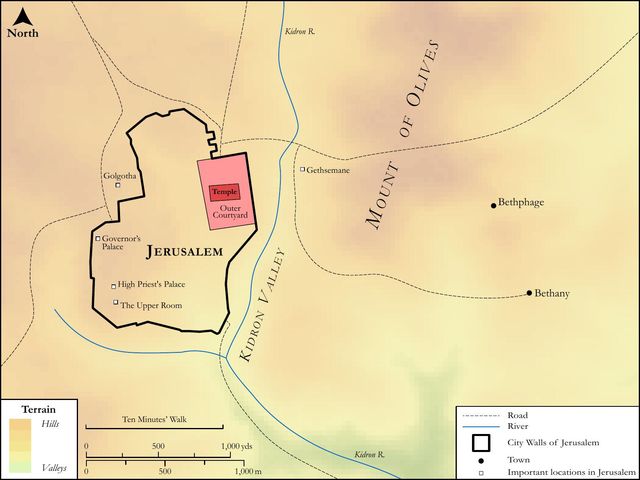
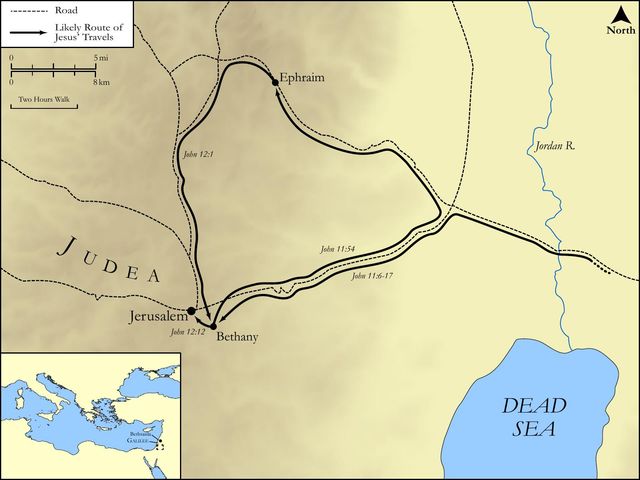
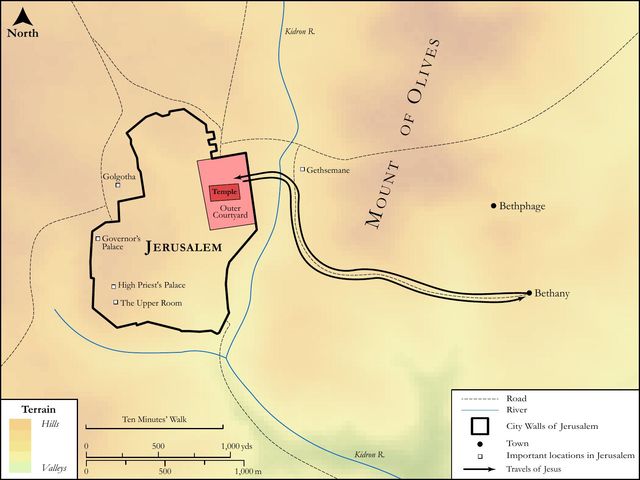
See on the biblical-era maps
Study this verse
Public-domain commentary
Matthew Henry
From his Commentary on the Whole Bible. Henry comments on passages, not single verses — this entry covers John 12:12–19. His four-level outline is real structure in the source text, so it is rendered as structure.
This story of Christ's riding in triumph to Jerusalem is recorded by all the evangelists, as worthy of special remark; and in it we may observe,
I.The respect that was paid to our Lord Jesus by the common people, Joh 12:12, Joh 12:13, where we are told,
1.Who they were that paid him this respect: much people, ochlos polus - a great crowd of those that came up to the feast; not the inhabitants of Jerusalem, but the country people that came from remote parts to worship at the feast; the nearer the temple of the Lord, the further from the Lord of the temple. They were such as came up to the feast.
(1.)Perhaps they had been Christ's hearers in the country, and great admirers of him there, and therefore were forward to testify their respect to him at Jerusalem, where they knew he had many enemies. Note, Those that have a true value and veneration for Christ will neither be ashamed nor afraid to own him before men in any instance whereby they may do him honour.
(2.)Perhaps they were those more devout Jews that came up to the feast some time before, to purify themselves, that were more inclined to religion than their neighbours, and these were they that were so forward to honour Christ. Note, The more regard men have to God and religion in general, the better disposed they will be to entertain Christ and his religion, which is not destructive but perfective of all previous discoveries and institutions. They were not the rulers, nor the great men, that went out to meet Christ, but the commonalty; some would have called them a mob, a rabble: but Christ has chosen the weak and foolish things (Co1 1:27), and is honoured more by the multitude than by the magnificence of his followers; for he values men by their souls, not their names and titles of honour.
2.On what occasion they did it: They heard that Jesus was coming to Jerusalem. They had enquired for him (Joh 11:55, Joh 11:56): Will he not come up to the feast? And now they hear he is coming; for none that seek Christ seek in vain. Now when they heard he was coming, they bestirred themselves, to give him an agreeable reception. Note, Tidings of the approach of Christ and his kingdom should awaken us to consider what is the work of the day, that it may be done in the day. Israel must prepare to meet their God (Amo 4:12), and the virgins to meet the bridegroom.
3.In what way they expressed their respect; they had not the keys of the city to present to him, nor the sword nor mace to carry before him, none of the city music to compliment him with, but such as they had they gave him; and even this despicable crowd was a faint resemblance of that glorious company which John saw before the throne, and before the Lamb, Rev 7:9, Rev 7:10. Though these were not before the throne, they were before the Lamb, the paschal Lamb, who now, according to the usual ceremony, four days before the feast, was set apart to be sacrificed for us. There it is said of that celestial choir,
(1.)That they had palms in their hands, and so had these branches of palm-trees. The palm-tree has ever been an emblem of victory and triumph; Cicero calls one that had won many prizes plurimarum palmarum homo - a man of many palms. Christ was now by his death to conquer principalities and powers, and therefore it was fit that he should have the victor's palm borne before him; though he was but girding on the harness, yet he could boast as though he had put it off. But this was not all; the carrying of palm-branches was part of the ceremony of the feast of tabernacles (Lev 23:40; Neh 8:15), and their using this expression of joy in the welcome given to our Lord Jesus intimates that all the feasts pointed at his gospel, had their accomplishment in it, and particularly that of the feast of tabernacles, Zac 14:16.
(2.)That they cried with a loud voice, saying, Salvation to our God (Rev 7:10); so did these here, they shouted before him, as is usual in popular welcomes, Hosanna, blessed is the king of Israel, that comes in the name of the Lord; and hosanna signifies salvation. It is quoted from Psa 118:25, Psa 118:26. See how well acquainted these common people were with the scripture, and how pertinently they apply it to the Messiah. High thoughts of Christ will be best expressed in scripture-words. Now in their acclamations,
[1.]They acknowledge our Lord Jesus to be the king of Israel, that comes in the name of the Lord. Though he went now in poverty and disgrace, yet, contrary to the notions their scribes had given them of the Messiah, they own him to be a king, which bespeaks both his dignity and honour, which we must adore; and his dominion and power, to which we must submit. They own him to be, First, A rightful king, coming in the name of the Lord (Psa 2:6), sent of God, not only as a prophet, but as a king. Secondly, The promised and long-expected king, Messiah the prince, for he is king of Israel. According to the light they had, they proclaimed him king of Israel in the streets of Jerusalem; and, they themselves being Israelites, hereby they avouched him for their king.
[2.]They heartily wish well to his kingdom, which is the meaning of hosanna; let the king of Israel prosper, as when Solomon was crowned they cried, God save king Solomon, Kg1 1:39. In crying hosanna they prayed for three things: - First, That his kingdom might come, in the light and knowledge of it, and in the power and efficacy of it. God speed the gospel plough. Secondly, That it might conquer, and be victorious over all opposition, Rev 6:2. Thirdly, That it might continue. Hosanna is, Let the king live for ever; though his kingdom may be disturbed, let it never be destroyed, Psa 72:17.
[3.]They bid him welcome into Jerusalem: "Welcome is he that cometh; we are heartily glad to see him; come in thou blessed of the Lord; and well may we attend with our blessings him who meets us with his." This welcome is like that (Psa 24:7-9), Lift up your heads, O ye gates. Thus we must every one of us bid Christ welcome into our hearts, that is, we must praise him, and be well pleased in him. As we should be highly pleased with the being and attributes of God, and his relation to us, so we should be with the person and offices of the Lord Jesus, and his meditation between us and God. Faith saith, Blessed is he that cometh.
II.The posture Christ puts himself into for receiving the respect that was paid him (Joh 12:14):
When he had found, or procured, a young ass, he sat thereon. It was but a poor sort of figure he made, he alone upon an ass, and a crowd of people about him shouting Hosanna.
1.This was much more of state than he used to take; he used to travel on foot, but now was mounted. Though his followers should be willing to take up with mean things, and not affect any thing that looks like grandeur, yet they are allowed to use the service of the inferior creatures, according as God in his providence gives particular possession of those things over which, by his covenant with Noah and his sons, he has given to man a general dominion.
2.Yet it was much less of state than the great ones of the world usually take. If he would have made a public entry, according to the state of a man of high degree, he should have rode in a chariot like that of Solomon's (Sol 3:9, Sol 3:10), with pillars of silver, the bottom of gold, and the covering of purple; but, if we judge according to the fashion of this world, to be introduced thus was rather a disparagement than any honour to the king of Israel, for it seemed as if he would look great, and knew not how. His kingdom was not of this world, and therefore came not with outward pomp. He was now humbling himself, but in his exalted state John sees him in a vision on a white horse, with a bow and a crown.
III.The fulfilling of the scripture in this:
As it is written, Fear not, daughter of Sion, Joh 12:15. This is quoted from Zac 9:9. To him bore all the prophets witness, and particularly to this concerning him.
1.It was foretold that Zion's king should come, should come thus, sitting on an ass's colt; even this minute circumstance was foretold, and Christ took care it should be punctually fulfilled. Note,
(1.)Christ is Zion's king; the holy hill of Zion was of old destined to be the metropolis or royal city of the Messiah.
(2.)Zion's king does and will look after her, and come to her; though for a short time he retires, in due time he returns.
(3.)Though he comes but slowly (an ass is slow-paced), yet he comes surely, and with such expressions of humility and condescension as greatly encourage the addresses and expectations of his loyal subjects. Humble supplicants may reach to speak with him. If this be a discouragement to Zion, that her king appears in no greater state or strength, let her know that though he comes to her riding on an ass's colt, yet he goes forth against her enemies riding on the heavens for her help, Deu 33:26.
2.The daughter of Zion is therefore called upon to behold her king, to take notice of him and his approaches; behold and wonder, for he comes with observation, though not with outward show, Sol 3:11. Fear not. In the prophecy, Zion is told to rejoice greatly, and to shout, but here it is rendered, Fear not. Unbelieving fears are enemies to spiritual joys; if they be cured, if they be conquered, joy will come of course; Christ comes to his people to silence their fears. If the case be so that we cannot reach to the exultations of joy, yet we should labour to get from under the oppressions of fear. Rejoice greatly; at least, fear not.
IV.The remark made by the evangelist respecting the disciples (Joh 12:16):
They understood not at first why Christ did this, and how the scripture was fulfilled; but when Jesus was glorified, and thereupon the Spirit poured out, then they remembered that these things were written of him in the Old Testament, and that they and others had, in pursuance thereof, done these things to him.
1.See here the imperfection of the disciples in their infant state; even they understood not these things at first. They did not consider, when they fetched the ass and set him thereon, that they were performing the ceremony of the inauguration of Zion's king. Now observe,
(1.)The scripture is often fulfilled by the agency of those who have not themselves an eye to the scripture in what they do, Isa 45:4.
(2.)There are many excellent things, both in the word and providence of God, which the disciples themselves do not at first understand: not at their first acquaintance with the things of God, while they see men as trees walking; not at the first proposal of the things to their view and consideration. That which afterwards is clear was at first dark and doubtful.
(3.)It well becomes the disciples of Christ, when they are grown up to maturity in knowledge, frequently to reflect upon the follies and weaknesses of their first beginning, that free grace may have the glory of their proficiency, and they may have compassion on the ignorant. When I was a child, I spoke as a child.
2.See here the improvement of the disciples in their adult state. Though they had been children, they were not always so, but went on to perfection. Observe,
(1.)When they understood it: When Jesus was glorified; for,
[1.]Till then they did not rightly apprehend the nature of his kingdom, but expected it to appear in external pomp and power, and therefore knew not how to apply the scriptures which spoke of it to so mean an appearance. Note, The right understanding of the spiritual nature of Christ's kingdom, of its powers, glories, and victories, would prevent our misinterpreting and misapplying the scriptures that speak of it.
[2.]Till then the Spirit was not poured out, who was to lead them into all truth. Note, The disciples of Christ are enabled to understand the scriptures by the same Spirit that indited the scriptures. The spirit of revelation is to all the saints a spirit of wisdom, Eph 1:17, Eph 1:18.
(2.)How they understood it; they compared the prophecy with the event, and put them together, that they might mutually receive light from each other, and so they came to understand both: Then remembered they that these things were written of him by the prophets, consonant to which they were done to him. Note, Such an admirable harmony there is between the word and works of God that the remembrance of what is written will enable us to understand what is done, and the observation of what is done will help us to understand what is written. As we have heard, so have we seen. The scripture is every day fulfilling.
V.The reason which induced the people to pay this respect to our Lord Jesus upon his coming into Jerusalem, though the government was so much set against him. It was because of the illustrious miracle he had lately wrought in raising Lazarus.
1.See here what account and what assurance they had of this miracle; no doubt, the city rang of it, the report of it was in all people's mouths. But those who considered it as a proof of Christ's mission, and a ground of their faith in him, that they might be well satisfied of the matter of fact, traced the report to those who were eye-witnesses of it, that they might know the certainty of it by the utmost evidence the thing was capable of: The people therefore that stood by when he called Lazarus out of his grave, being found out and examined, bore record, Joh 12:17. They unanimously averred the thing to be true, beyond dispute or contradiction, and were ready, if called to it, to depose it upon oath, for so much is implied in the word Emarturei. Note, The truth of Christ's miracles was evidenced by incontestable proofs. It is probable that those who had seen this miracle did not only assert it to those who asked them, but published it unasked, that this might add to the triumphs of this solemn day; and Christ's coming in now from Bethany, where it was done, would put them in mind of it. Note, Those who wish well to Christ's kingdom should be forward to proclaim what they know that may redound to his honour.
2.What improvement they made of it, and what influence it had upon them (Joh 12:18): For this cause, as much as any other, the people met him.
(1.)Some, out of curiosity, were desirous to see one that had done such a wonderful work. Many a good sermon he had preached in Jerusalem, which drew not such crowds after him as this one miracle did. But,
(2.)Others, out of conscience, studied to do him honour, as one sent of God. This miracle was reserved for one of the last, that it might confirm those which went before, and might gain him this honour just before his sufferings; Christ's works were all not only well done (Mar 7:7) but well timed.
VI.The indignation of the Pharisees at all this; some of them, probably, saw, and they all soon heard of, Christ's public entry.
The committee appointed to find out expedients to crush him thought they had gained their point when he had retired unto privacy, and that he would soon be forgotten in Jerusalem, but they now rage and fret when they see they imagined but a vain thing.
1.They own that they had got no ground against him; it was plainly to be perceived that they prevailed nothing. They could not, with all their insinuations, alienate the people's affections from him, nor with their menaces restrain them from showing their affection to him. Note, Those who oppose Christ, and fight against his kingdom, will be made to perceive that they prevail nothing. God will accomplish his own purposes in spite of them, and the little efforts of their impotent malice. You prevail nothing, ouk ōpheleite - you profit nothing. Note, There is nothing got by opposing Christ.
2.They own that he had got ground: The world is gone after him; there is a vast crowd attending him, a world of people: an hyperbole common in most languages. Yet here, like Caiaphas, ere they were aware, they prophesied that the world would go after him; some of all sorts, some from all parts; nations shall be discipled. But to what intent was this said?
(1.)Thus they express their own vexation at the growth of his interest; their envy makes them fret. If the horn of the righteous be exalted with honour, the wicked see it, and are grieved (Psa 112:9, Psa 112:10); considering how great these Pharisees were, and what abundance of respect was paid them, one would think they needed not grudge Christ so inconsiderable a piece of honour as was now done him; but proud men would monopolize honour, and have none share with them, like Haman.
(2.)Thus they excite themselves and one another, to a more vigorous carrying on of the war against Christ. As if they should say, "Dallying and delaying thus will never do. We must take some other and more effectual course, to put a stop to this infection; it is time to try our utmost skill and force, before the grievance grows past redress." Thus the enemies of religion are made more resolute and active by being baffled; and shall its friends be disheartened with every disappointment, who know its cause is righteous and will at last be victorious?
Historical interpretation
Historical reception
8 surviving comments on this verse. Each one is dated, so this reads as a timeline rather than a list.
Select a marker to jump to its quote. Markers stagger vertically where authors wrote within a few decades of each other.
Zechariah gave this prophecy after the return from Babylon toward the conclusion of prophecy. But there is no record of a Jewish king since that time, such as the prophecy predicts, except our Lord and Savior Jesus Christ, in whom this prediction was fulfilled.… But what was his riding on a donkey meant to show but the lowly and humble manner that marked his first coming?
Seest thou that this most choked them, the persuasion which all men had that He was not an enemy of God? And this most divided the people, His saying that He came from the Father.
(Hom. lxiv) The Law enjoined, that on the tenth day of the first month a lamb or a kid should be shut up in the house, and be kept to the fourteenth day of the same month, on the evening of which day it was sacrificed. In accordance with this law, the Elect Lamb, the Lamb without spot, when He went up to Jerusalem to be immolated for the sanctification of the people, went up five days before, i. e. on the tenth day.
(Hom. lxvi. 1) They showed now at last that they thought Him greater than a prophet: And went forth to meet Him, and cried, Hosanna! Blessed is the King of Israel, that cometh in the name of the Lord.
(Hom. lxvi. 1) This is what more than any thing made men believe in Christ, viz. the assurance, that He was not opposed to God, that He came from the Father. The words show us the divinity of Christ. Hosanna is, Save us; and salvation in Scripture is attributed to God alone. And cometh, it is said, not is brought: the former befits a lord, the latter a servant. In the name of the Lord, goes to prove the same thing. He does not come in the name of a servant, but in the name of the Lord.
(Hom. lxvi. 1) He did this prophetically, to figure the unclean Gentiles being brought into subjection to the Gospel; and also as a fulfilment of prophecy.
(Hom. lxvi. 1) Or thus: Whereas they had had wicked kings, who had subjected them to wars, He saith to them, Trust Me, I am not such as they, but gentle and mild: which He showed by the manner of His entrance. For He did not enter at the head of an army, but simply riding on an ass. And observe the philosophy of the Evangelist, who is not ashamed of confessing his ignorance at the time of what these things meant: These things understood not the disciple at the first, but when Jesus was glorified.
(Hom. lvi. 1) Our Lord had not then revealed these things to them. Indeed it would have been a scandal to them had they known Him to be King at the time of His sufferings. Nor would they have understood the nature of His kingdom, but have mistaken it for a temporal one.
"Rejoice greatly, daughter of Zion"? Because all their kings had for the most part been an unjust and covetous kind of men, and had given them over to their enemies, and had perverted the people, and made them subject to their foes; "Be of good courage," It saith, "this is not such an one, but meek and gentle"; as is shown by the ass, for He entered not with an army in His train, but having an ass alone.
But how, after not walking openly in Jewry, and retiring into the wilderness, doth He again enter openly? Having quenched their anger by retiring, He cometh to them when they were stilled. Moreover, the multitude which went before and which followed after was sufficient to cast them into an agony; for no sign so much attracted the people as that of Lazarus. And another Evangelist saith, that they strewed their garments under His feet, and that "the whole city was moved"; with so great honor did He enter. And this He did, figuring one prophecy and fulfilling another; and the same act was the beginning of the one and the end of the other. For the, "Rejoice, for thy King cometh unto thee meek," belonged to Him as fulfilling a prophecy, but the sitting upon an ass was the act of one prefiguring a future event, that He was about to have the impure race of the Gentiles subject to Him.
But how say the others, that He sent disciples, and said, "Loose the ass and the colt," while John saith nothing of the kind, but that "having found a young ass, He sat upon it"? Because it is likely that both circumstances took place, and that He after the ass was loosed, while the disciples were bringing it, found the colt, and sat upon it. And they took the small branches of palm trees and olives, and strewed their garments in the way, showing that they now had a higher opinion concerning Him than of a Prophet.
"But this," saith the Evangelist, "the disciples knew not, that it was written of Him." Seest thou that they were ignorant on most points, because He did not reveal to them? For when He said, "Destroy this Temple, and in three days I will raise it up," neither then did the disciples understand. And another Evangelist saith, that "the saying was hid from them," and they knew not that He should rise from the dead. Now this was with reason concealed from them, (wherefore another Evangelist saith, that as they heard it from time to time, they grieved and were dejected, and this because they understood not the saying concerning the Resurrection,) it was with reason concealed, as being too high for them: but why was not the matter of the ass revealed to them? Because this was a great thing also. But observe the wisdom of the Evangelist, how he is not ashamed to parade their former ignorance. That it was written they knew, that it was written of Him they knew not. For it would have offended them if He being a King were about to suffer such things, and be so betrayed. Besides, they could not at once have taken in the knowledge of the Kingdom of which He spake; for another Evangelist saith, that they thought the words were spoken of a kingdom of this world.
Jesus, then, "found a young ass, and sat thereon; as it is written, Fear not, daughter of Zion: behold, thy King cometh, sitting on an ass's colt." Among that people, then, was the daughter of Zion to be found; for Zion is the same as Jerusalem. Among that very people, I say, reprobate and blind as they were, was the daughter of Zion, to whom it was said, "Fear not, daughter of Zion: behold, thy King cometh, sitting on an ass's colt." This daughter of Zion, who was thus divinely addressed, was amongst those sheep that were hearing the Shepherd's voice, and in that multitude which was celebrating the Lord's coming with such religious zeal, and accompanying Him in such warlike array. To her was it said, "Fear not:" acknowledge Him whom thou art now extolling, and give not way to fear when He comes to suffering; for by the shedding of His blood is thy guilt to be blotted out, and thy life restored. But by the ass's colt, on which no man had ever sat (for so it is found recorded in the other evangelists), we are to understand the Gentile nations which had not received the law of the Lord; by the ass, on the other hand (for both animals were brought to the Lord), that people of His which came of the nation of Israel, and was already so far subdued as to recognize its Master's crib.
(Tr. li. 5) John relates the matter briefly, the other Evangelists are more full. The ass, we read in them, was the foal of an ass on which no man had sat: i. e. the Gentile world, who had not received our Lord. The other ass, which was brought, (not the foal, for there were two,) is the believing Jew.
(Tr. li) This act of our Lord's is pointed to in the Prophets, though the malignant rulers of the Jews did not see in it any fulfilment of prophecy: As it is written, Fear not, daughter of Sion, behold thy King cometh sitting on an ass's colt. Yea, in that nation though reprobate, though blind, there remained still the daughter of Sion; even Jerusalem. To her it is said, Fear not, acknowledge Him whom thou praisest, and tremble not when He suffers. That blood it is which shall wipe away thy sins, and redeem thy life.
Continue studying John 12:15 across the web’s major study libraries — every link below opens this exact verse, chapter, or book on the destination site.
Read & Compare
 BibleGatewayThis verse in more than 200 translations and 70 languages.
 Bible.comThe YouVersion reader — hundreds of translations, reading plans, and highlights.
 ESV.orgCrossway's official English Standard Version reader.
 NET BibleThe NET translation with 60,000+ translators' notes on every rendering decision.
 STEP BibleTyndale House's free study tool — original text, vocabulary, and scholarly resources.
 BibliaLogos Bible Software's free web reader.
 USCCBThe New American Bible (Revised Edition) with the U.S. bishops' study notes.
Commentaries
 BibleHub CommentariesDozens of classic commentaries on this verse, gathered on one page.
 StudyLightMore than 100 commentary sets — the largest collection on the web.
 BibleRefPlain-English commentary on what this verse means, verse by verse.
 Enduring WordDavid Guzik's free commentary on this chapter, widely used by Bible teachers.
 Bible Study ToolsVerse commentary alongside Greek and Hebrew study aids.
Original Language & Research
- BibleHub InterlinearThe verse word by word — original language, transliteration, and English.
- BibleHub LexiconEvery word's original-language definition and Strong's entry.
 Blue Letter BibleDeep-study tools — Strong's numbers, concordance, and word studies.
 CNTR CollationThe earliest Greek manuscripts of this verse, collated letter by letter.
Sermons, Hymns & Audio


TrulyRandomVerse is not affiliated with these sites and doesn’t control their content. They’re linked because they’re genuinely useful.
Summary
John 12:15 captures a pivotal moment in Jesus' ministry: His triumphal entry into Jerusalem, just days before His crucifixion. This verse, a direct quotation from Old Testament prophecy, highlights Jesus' identity as the long-awaited King of Israel, yet emphasizes His humble and peaceful nature as He enters the holy city not on a warhorse, but on a young donkey, offering assurance and hope to the "daughter of Sion" rather than instilling fear.
Context
ShowHideLiterary Context
John 12:15 is situated within the broader narrative of Jesus' final week leading up to His passion. The preceding chapter, John 11, details the miraculous resurrection of Lazarus, an event that profoundly impacted public opinion, drawing many to believe in Jesus and simultaneously intensifying the resolve of the Jewish religious leaders to put Him to death. Chapter 12 opens with Jesus being anointed at Bethany, followed by the arrival of large crowds in Jerusalem who had heard of Lazarus' resurrection and were eager to see both Jesus and Lazarus. The triumphal entry (John 12:12-19) is a public culmination of Jesus' earthly ministry, a deliberate act that fulfills prophecy and forces a confrontation with the established religious order. The people's acclamation and the Pharisees' despair underscore the Messianic claims being made and recognized, setting the stage for the discourses on His impending death and glorification that follow in John 12:20-50.
Historical & Cultural Context
Jesus' entry into Jerusalem on a donkey was a deliberate, symbolic act steeped in Old Testament prophecy and contrasting sharply with typical imperial displays. In the ancient Near East, kings often rode horses into battle or for grand processions, signifying military strength and conquest. However, riding a donkey, particularly a young, unbroken one, was a symbol of peace, humility, and royal authority in a non-militaristic sense, as seen in the enthronement of Israelite kings like Solomon (1 Kings 1:33). The crowds' enthusiastic reception, waving palm branches and shouting "Hosanna!" (John 12:13), mirrored the traditional Jewish welcome for a king or deliverer, reminiscent of the Maccabean period. The phrase "daughter of Sion" (or Zion) is a poetic, personified term for Jerusalem and its inhabitants, often used in prophetic literature (e.g., Isaiah 62:11) to express an intimate relationship between God and His people, conveying a sense of divine protection and expectation.
Key Themes
ShowHideThis verse powerfully encapsulates several key themes central to John's Gospel and broader biblical theology. The most prominent is the Fulfillment of Prophecy, as John explicitly states that Jesus' actions were "as it is written" (John 12:14), directly quoting or alluding to Zechariah 9:9). This demonstrates God's sovereign plan unfolding precisely through Christ. Another crucial theme is the Humility of the King. Unlike the worldly expectations of a conquering Messiah, Jesus' choice of a donkey underscores His kingdom's spiritual nature, emphasizing peace, service, and self-sacrifice over earthly power and military might. This humility is a hallmark of His entire ministry, culminating in His crucifixion. Finally, the command "Fear not, daughter of Sion" highlights the theme of Assurance and Comfort. Despite the impending tumultuous events of the passion week, Jesus' arrival as King is presented as a source of hope and security for His people, signaling that His reign brings liberation from fear rather than cause for alarm.
Exposition and Analysis
ShowHideKey Word Analysis
ShowHideThis verb, often translated as "to fear" or "to be afraid," carries a range of meanings from terror to reverence. Here, combined with the negative particle "not" (mḗ), it forms a direct command to dispel apprehension. It implies that the King's arrival should not be met with dread, as one might fear a conquering potentate, but with a trusting and welcoming spirit. This contrasts with the fear that often accompanies human power and points to the different nature of Christ's kingship.
This term denotes a sovereign ruler, one who holds ultimate authority and dominion. In the context of Israel, "King" was a loaded term, referring to the long-awaited Messiah who would restore God's kingdom. John's use of this word here is a profound theological statement, identifying Jesus as the rightful, prophesied monarch, yet one whose reign is characterized by humility and peace rather than earthly might.
While pōlos can refer to any young animal, in this context, coupled with ónos (ass/donkey), it specifically means a young donkey, often one that has not yet been ridden. This detail is crucial for understanding the prophetic fulfillment and the symbolic nature of Jesus' entry. It emphasizes the animal's untrained nature, making Jesus' control over it a subtle display of His divine authority, and further underscores the humility and simplicity of His chosen mode of transport, contrasting sharply with the grandeur of a warhorse.
Verse Breakdown
ShowHide"Fear not, daughter of Sion:"
This opening phrase is a direct command and an address. "Fear not" (μὴ φοβοῦ, mē phobou) is a common biblical injunction, often accompanying a divine revelation or a moment of significant assurance. "Daughter of Sion" (θυγάτηρ Σιών, thygatēr Siōn) is a poetic, personified address to Jerusalem and its inhabitants, signifying the people of Israel. The command reassures them that the arrival of their King is not a cause for alarm or judgment, but for joyful recognition and hope, despite the turbulent times ahead.
"behold, thy King cometh,"
The interjection "behold" (ἰδοὺ, idoú) draws immediate attention to a momentous event about to unfold. It serves as a dramatic announcement. "Thy King cometh" (ὁ βασιλεύς σου ἔρχεται, ho basileus sou erchetai) declares Jesus' identity and imminent arrival. This is a direct fulfillment of Messianic prophecy, proclaiming that the long-awaited sovereign of Israel is indeed present and making His public appearance. The emphasis is on His rightful claim to kingship, recognized by the crowds, even if misunderstood by many.
"sitting on an ass's colt."
This concluding phrase describes the specific manner of the King's arrival, directly fulfilling the prophecy of Zechariah 9:9. The detail of "sitting on an ass's colt" (ἐπὶ πῶλον ὄνου, epi pōlon onou) is profoundly symbolic. It signifies that this King is not a conquering warrior riding a warhorse, but a King of peace and humility. His choice of transport underscores the spiritual nature of His kingdom, which is established through meekness and service, not through worldly power or military might.
Literary Devices
ShowHideJohn 12:15 is rich with literary devices that enhance its theological message. Foremost is Allusion and Direct Quotation, as the verse explicitly quotes or paraphrases Zechariah 9:9, serving to underscore the divine orchestration of events and the fulfillment of Old Testament prophecy in Jesus. This literary technique validates Jesus' Messianic claims by connecting His actions directly to the sacred texts. Personification is evident in the address "daughter of Sion," which imbues the city of Jerusalem and its inhabitants with human qualities, creating a sense of intimacy and direct appeal. This device also evokes a rich tradition from prophetic literature where Israel is often depicted as a daughter or bride. Finally, Symbolism is powerfully employed through the image of Jesus "sitting on an ass's colt." The donkey itself is a symbol of peace and humility, contrasting sharply with the warhorse, which symbolizes military conquest. This choice of mount symbolically communicates the nature of Jesus' kingdom as one of peace and spiritual authority, rather than earthly dominion or violent overthrow.
Theological and Thematic Connections
ShowHideJohn 12:15 stands as a profound theological statement on the nature of Christ's kingship and the fulfillment of God's redemptive plan. It reveals that God's chosen King would not arrive with worldly pomp and power, but with humility and peace, subverting human expectations of a conquering hero. This humble entry foreshadows the ultimate path of Christ's kingdom: one established not through force, but through self-sacrifice and spiritual transformation. It underscores the divine paradox where true power is found in meekness, and ultimate victory is achieved through apparent weakness on the cross. The "fear not" command emphasizes that God's sovereign plan, though it may involve suffering, ultimately brings assurance and salvation to His people. This event is a visible manifestation of the spiritual kingdom Jesus inaugurated, a kingdom "not of this world" (John 18:36), yet one that demands allegiance and transforms hearts.
Reflection and Application
ShowHideJohn 12:15 offers a powerful invitation for personal reflection and practical application in the life of a believer. It challenges our often-worldly expectations of power, leadership, and success, urging us to embrace the counter-cultural humility exemplified by our King. Just as Jesus entered Jerusalem not with a show of force but with quiet dignity, we are called to welcome Him into the "Jerusalem" of our own lives and hearts with a spirit of humility and peace, rather than fear or a desire for worldly gain. This verse reminds us that true authority in God's kingdom is expressed through service, sacrifice, and a gentle spirit, rather than dominance or self-assertion. It encourages us to trust in God's perfect timing and His sovereign plan, even when it unfolds in ways that defy our human logic or comfort. To truly receive Christ as King means to align our values with His, prioritizing spiritual peace and humble service over earthly ambition.
Questions for Reflection
ShowHideFAQ
ShowHideWhy did Jesus ride a donkey instead of a horse, as a king might?
ShowHideJesus' choice to ride a donkey, specifically a young colt, was a deliberate and profoundly symbolic act, directly fulfilling the prophecy found in Zechariah 9:9. In ancient Near Eastern cultures, kings rode horses when going to war or displaying military might. However, riding a donkey signified peace, humility, and a non-militaristic kingship. By choosing a donkey, Jesus publicly declared Himself to be the promised Messiah, but one whose kingdom was not of this world (John 18:36), established through spiritual authority and self-sacrifice rather than military conquest or political power. It underscored His identity as the Prince of Peace.
What is the significance of the phrase "daughter of Sion"?
ShowHide"Daughter of Sion" (or Zion) is a poetic and endearing term used frequently in the Old Testament prophetic books (e.g., Isaiah 62:11, Micah 4:8) to refer to the city of Jerusalem and, by extension, its inhabitants or the people of Israel as a whole. It personifies the nation, often conveying a sense of intimate relationship with God, divine protection, and a call to rejoice or lament. In John 12:15, it serves as a tender address, reassuring the people of Jerusalem that the arrival of their King is a cause for hope and not fear.
How does this event relate to "Palm Sunday"?
ShowHideThe event described in John 12:15, along with its parallels in the other Gospels (Matthew 21:1-11, Mark 11:1-11, Luke 19:28-44), is traditionally commemorated as "Palm Sunday." This day marks the beginning of Holy Week, the week leading up to Easter, which remembers Jesus' passion, death, and resurrection. The name "Palm Sunday" comes from the crowds waving palm branches and shouting praises as Jesus entered Jerusalem (John 12:13), recognizing Him as their King and Messiah.
Christ-Centered Fulfillment
ShowHideJohn 12:15 is a profound Christ-centered fulfillment, revealing the paradoxical nature of Jesus' kingship and His redemptive mission. His humble entry into Jerusalem on a donkey, directly fulfilling the prophecy of Zechariah 9:9, was not merely a symbolic act, but a tangible demonstration of the kind of King He truly is: one who comes in peace, not conquest, and whose power is perfected in weakness. This entry foreshadows His ultimate act of humility and self-sacrifice on the cross, where He, the King of Glory, willingly laid down His life to redeem humanity, as prophesied in Isaiah 53. The "fear not" command to the "daughter of Sion" finds its ultimate fulfillment in Christ's victory over sin and death, which liberates believers from the fear of judgment and offers eternal peace. His reign, though inaugurated in humility, culminates in His glorious exaltation, as described in Philippians 2:5-11. He is the King who, having completed His work on earth, ascended to His heavenly throne (Hebrews 12:2), and who will one day return, not on a donkey, but as the triumphant King of Kings and Lord of Lords, riding a white horse (Revelation 19:11-16), to establish His eternal kingdom in its fullness.