


Judges 14:5
Bible text: King James Version (1769 Blayney text) · Public domain
Bible text: King James Version with Strong's numbers · Public domain
Bible text: Berean Standard Bible · Public domain
Bible text: American Standard Version (1901) · Public domain
Bible text: World English Bible, Messianic edition · Public domain
Bible text: Geneva Bible (1599) · Public domain
Bible text: Young's Literal Translation · Public domain
- וַיֵּרֶדvai·Ye·redand he went downH3381Conj-w ¦ V-Qal-ConsecImperf-3msVerb Qal Consecutive Imperfect 3rd Singular Masculineוַandיֵּרֶדhe went down
- שִׁמְשׁוֹןshim·ShonSamsonH8123N-proper-mNoun Proper Masculine
- וְאָבִיוve·'a·Vivand his fatherH1Conj-w ¦ N-msc ¦ 3msNoun Singular Masculine Constructוְandאָבִיfatherוhis
- וְאִמּוֹve·'i·Moand his motherH517Conj-w ¦ N-fsc ¦ 3msNoun Singular Feminine Constructוְandאִמּmotherוֹhis
- תִּמְנָתָהtim·Na·tahTimnah towardsH8553N-proper ¦ SfxNoun Proper LocationתִּמְנָתָTimnahהtowards
- וַיָּבֹאוּvai·ya·Vo·'uand they cameH935Conj-w ¦ V-Qal-ConsecImperf-3mpVerb Qal Consecutive Imperfect 3rd Plural Masculineוַandיָּבֹאוּthey came
- עַד'adtoH5704PrepPreposition
- כַּרְמֵיkar·Mei[the] vineyards ofH3754N-mpcNoun Plural Masculine Construct
- תִמְנָתָהtim·Na·tahTimnah <towards>H8553N-proper ¦ SfxNoun Proper LocationתִמְנָתָTimnahה<towards>
- וְהִנֵּהve·hi·Nehand there!H2009Conj-w ¦ PrtParticle Interjectionוְandהִנֵּהthere!
- כְּפִירke·Fira young lion ofH3715N-mscNoun Singular Masculine Construct
- אֲרָיוֹת'a·ra·YotlionsH738N-fpNoun Plural Feminine Absolute
- שֹׁאֵגsho·'Eg[was] roaringH7580V-Qal-Prtcpl-msVerb Qal Participle Singular Masculine Absolute
- לִקְרָאתוֹlik·ra·Toto meet himH7122Prep-l ¦ V-Qal-Inf ¦ 3msVerb Qal Infinitive Constructלִtoקְרָאתmeetוֹhim
English is a literal word-by-word gloss of the Hebrew, not the KJV's wording. Why?
This is the original text the KJV's translators worked from — each Hebrew word with its own literal English meaning in this verse, prepared by scholars at Tyndale House, Cambridge. The KJV translates whole sentences, not word by word, so its wording differs: one Hebrew word can become several English words, and the KJV may choose “the LORD” where the gloss reads “Yahweh”. Both are faithful — they answer different questions. For the KJV's own rendering, switch to the KJV text.
Details
See on the biblical-era maps
Study this verse
Public-domain commentary
Matthew Henry
From his Commentary on the Whole Bible. Henry comments on passages, not single verses — this entry covers Judges 14:1–9. His three-level outline is real structure in the source text, so it is rendered as structure.
Here, I. Samson, under the extraordinary guidance of Providence, seeks an occasion of quarrelling with the Philistines, by joining in affinity with them - a strange method, but the truth is Samson was himself a riddle, a paradox of a man, did that which was really great and good, by that which was seemingly weak and evil, because he was designed not to be a pattern to us (who must walk by rule, not by example), but a type of him who, though he knew no sin, was made sin for us, and appeared in the likeness of sinful flesh, that he might condemn and destroy sin in the flesh, Rom 8:3.
1.As the negotiation of Samson's marriage was a common case, we may observe,
(1.)That is was weakly and foolishly done of him to set his affections upon a daughter of the Philistines; the thing appeared very improper. Shall one that is not only an Israelite, but a Nazarite, devoted to the Lord, covet to become one with a worshipper of Dagon? Shall one marked for a patriot of his country match among those that are its sworn enemies? He saw this woman (Jdg 14:1), and she pleased him well, Jdg 14:3. It does not appear that he had any reason to think her wise or virtuous, or in any way likely to be a help-meet for him; but he saw something in her face that was very agreeable to his fancy, and therefore nothing will serve but she must be his wife. He that in the choice of a wife is guided only by his eye, and governed by his fancy, must afterwards thank himself if he find a Philistine in his arms.
(2.)Yet it was wisely and well done not to proceed so much as to make his addresses to her till he had first made his parents acquainted with the matter. He told them, and desired them to get her for him to wife, Jdg 14:2. Herein he is an example to all children. Conformably to the law of the fifth commandment, children ought not to marry, nor to move towards marrying, without the advice and consent of their parents; those that do (as bishop Hall here expresses it) wilfully unchild themselves, and exchange natural affections for violent. parents have a property in their children as parts of themselves. In marriage this property is transferred; for such is the law of the relation that a man shall leave his father and his mother and cleave to his wife. It is therefore not only unkind and ungrateful, but very unjust, to alienate this property without their concurrence; whoso thus robbeth his father or mother, stealing himself from them, who is nearer and dearer to them than their goods, and yet saith, It is no transgression, the same is the companion of a destroyer, Pro 28:24.
(3.)His parents did well to dissuade him from yoking himself thus unequally with unbelievers. Let those who profess religion, but are courting an affinity with the profane and irreligious, matching into families where they have reason to think the fear of God is not, nor the worship of God, let them hear their reasoning, and apply it to themselves: "Is there never a woman among the daughters of thy brethren, or, if none of our tribe, never a one among all thy people, never an Israelite, that pleases thee, or that thou canst think worthy of thy affection, that thou shouldest marry a Philistine?" In the old world the sons of God corrupted and ruined themselves, their families, and that truly primitive church, by marrying with the daughters of men, Gen 6:2. God had forbidden the people of Israel to marry with the devoted nations, one of which the Philistines were, Deu 7:3.
(4.)If there had not been a special reason for it, it certainly would have been improper in him to insist upon his choice, and in them to agree to it at last. Yet their tender compliance with his affections may be observed as an example to parents not to be unreasonable in crossing their children's choices, nor to deny their consent, especially to those that have seasonably and dutifully asked it, without some very good cause. As children must obey their parents in the Lord, so parents must not provoke their children to wrath, lest they be discouraged. This Nazarite, in his subjection to his parents, asking their consent, and not proceeding till he had it, was not only an example to all children, but a type of the holy child Jesus, who went down with his parents to Nazareth (thence called a Nazarene) and was subject to them, Luk 2:51.
2.But this treaty of marriage is expressly said to be of the Lord, Jdg 14:4. Not only that God afterwards overruled it to serve his designs against the Philistines, but that he put it into Samson's heart to make this choice, that he might have occasion against the Philistine. It was not a thing evil in itself for him to marry a Philistine. It was forbidden because of the danger of receiving hurt by idolaters; where there was not only no danger of that kind, but an opportunity hoped for of doing that hurt to them which would be good service to Israel, the law might well be dispense with. It was said (Jdg 13:25) that the Spirit of the Lord began to move him at times, and we have reason to think he himself perceived that Spirit to move him at this time, when he made this choice, and that otherwise he would have yielded to his parents' dissuasives, nor would they have consented at last if he had not satisfied them it was of the Lord. This would bring him into acquaintance and converse with the Philistines, by which he might have such opportunities of galling them as otherwise he could not have. It should seem, the way in which the Philistines oppressed Israel was, not by great armies, but by the clandestine incursions of their giants and small parties of their plunderers. In the same way therefore Samson must deal with them; let him but by this marriage get among them, and he would be a thorn in their sides. Jesus Christ, having to deliver us from this present evil world, and to cast out the prince of it, did himself visit it, though full of pollution and enmity, and, by assuming a body, did in some sense join in affinity with it, that he might destroy our spiritual enemies, and his own arm might work the salvation.
II.Samson, by a special providence, is animated and encouraged to attack the Philistines.
That being the service for which he was designed, God, when he called him to it, prepared him for it by two occurrences: -
1.By enabling him, in one journey to Timnath, to kill a lion, Jdg 14:5, Jdg 14:6. Many decline doing the service they might do because they know not their own strength. God let Samson know what he could do in the strength of the Spirit of the Lord, that he might never be afraid to look the greatest difficulties in the face. David, who was to complete the destruction of the Philistines, must try his hand first upon a lion and a bear, that thence he might infer, as we may suppose Samson did, that the uncircumcised Philistine should be as one of them, Sa1 17:36.
(1.)Samson's encounter with the lion was hazardous. It was a young lion, one of the fiercest sort, that set upon him, roaring for his prey, and setting his eye particularly upon him; he roared in meeting him, so the word is. He was all alone in the vineyards, whither he had rambled from his father and mother (who kept the high road), probably to eat grapes. Children consider not how they expose themselves to the roaring lion that seeks to devour when, out of a foolish fondness for liberty, they wander from under the eye and wing of their prudent pious parents. Nor do young people consider what lions lurk in the vineyards, the vineyards of red wines, as dangerous as snakes under the green grass. Had Samson met with this lion in the way, he might have had more reason to expect help both from God and man than here in the solitary vineyards, out of his road. But there was a special providence in it, and the more hazardous the encounter was,
(2.)The victory was so much the more illustrious. It was obtained without any difficulty: he strangled the lion, and tore his throat as easily as he would have strangled a kid, yet without any instrument, not only no sword nor bow, but not so much as a staff or knife; he had nothing in his hand. Christ engaged the roaring lion, and conquered him in the beginning of his public work (Mat 4:1, etc.), and afterwards spoiled principalities and powers, triumphing over them in himself, as some read it, not by any instrument. He was exalted in his own strength. That which added much to the glory of Samson's triumph over the lion was that when he had done this great exploit he did not boast of it, did not so much as tell his father nor mother that which many a one would soon have published through the whole country. Modesty and humility make up the brightest crown of great performances.
2.By providing him, the next journey, with honey in the carcase of this lion, Jdg 14:8, Jdg 14:9. When he came down the next time to solemnize his nuptials, and his parents with him, he had the curiosity to turn aside into the vineyard where he had killed the lion, perhaps that with the sight of the place he might affect himself with the mercy of that great deliverance, and might there solemnly give thanks to God for it. It is good thus to remind ourselves of God's former favours to us. There he found the carcase of the lion; the birds or beasts of prey, it is likely, had eaten the flesh, and in the skeleton a swarm of bees had knit, and made a hive of it, and had not been idle, but had there laid up a good stock of honey, which was one of the staple commodities of Canaan; such plenty there was of it that the land is said to flow with milk and honey. Samson, having a better title than any man to the hive, seizes the honey with his hands. This supposes an encounter with the bees; but he that dreaded not lion's paws had no reason to fear their stings. As by his victory over the lion he was emboldened to encounter the Philistine-giants, if there should be occasion, notwithstanding their strength and fierceness, so by dislodging the bees he was taught not to fear the multitude of the Philistines; though they compassed him about like bees, yet in the name of the Lord he should destroy them, Psa 118:12. Of the honey he here found,
(1.)He ate himself, asking no questions for conscience' sake; for the dead bones of an unclean beast had not that ceremonial pollution in them that the bones of a man had. John Baptist, that Nazarite of the New Testament, lived upon wild honey.
(2.)He gave to his parents, and they did eat; he did not eat all himself. Hast thou found honey? eat so much as is sufficient for thee, and no more, Pro 25:16. He let his parents share with him. Children should be grateful to their parents with the fruits of their own industry, and so show piety at home, Ti1 5:4. Let those that by the grace of God have found sweetness in religion themselves communicate their experience to their friends and relations, and invite them to come and share with them. He told not his parents whence he had it, lest they should scruple eating it. Bishop Hall observes here that those are less wise and more scrupulous than Samson that decline the use of God's gifts because they find them in ill vessels. Honey is hone still, though in a dead lion. Our Lord Jesus having conquered Satan, that roaring lion, believers find honey in the carcase, abundant strength and satisfaction, enough for themselves and for all their friends, from that victory.
Historical interpretation
Historical reception
2 surviving comments on this verse. Each one is dated, so this reads as a timeline rather than a list.
Select a marker to jump to its quote. Markers stagger vertically where authors wrote within a few decades of each other.
This request was granted; and Samson on his return to visit his promised bride, turned a little way out of the road, and straightway there met him a lion from the wood, fierce in its savage freedom. Samson had no companion, nor any weapon in his hand; but he felt ashamed to fly, and conscious power gave him courage. He caught the lion as it rushed upon him in his arms, and strangled it by the tightness of his embrace, leaving it near the wayside lying upon the underwood, for the spot was clothed with luxuriant herbage, and planted with vineyards. The skin of the beast he thought would be little esteemed by his beloved bride, for seasons such as these derive their grace not from savage trophies, but rather from gentle joys and festal garlands. On his returning by the same road he found an honeycomb in the belly of the lion, and carried it off as a gift to the maiden and her parents; for such gifts befit a bride. And having first tasted the honey, he gave them the comb to eat, but was silent as to whence it came.
Many of the fathers have spoken a great deal about this lion, beloved brothers, and all of them have said what is fitting and in accord with the facts. Some have said that the lion prefigured Christ our Lord. Truly, this is very appropriate, for to us Christ is a lion in whose mouth we found the food of honey after his death. What is sweeter than the Word of God? Or what is stronger than his right hand? In whose mouth after death is there food and bees, except his in whose word is the good of our salvation and the congregation of the Gentiles? The lion can further be understood as the Gentiles who believed. First, it was a body of vanity, but is now the body of Christ in which the apostles like bees stored the honey of wisdom gathered from the dew of heaven and the flowers of divine grace. Thus, food came out of the mouth of the one who died; because nations which were as fierce as lions at first, accepted with a devout heart the word of God which they received and produced the fruit of salvation.
Continue studying Judges 14:5 across the web’s major study libraries — every link below opens this exact verse, chapter, or book on the destination site.
Read & Compare
 BibleGatewayThis verse in more than 200 translations and 70 languages.
 Bible.comThe YouVersion reader — hundreds of translations, reading plans, and highlights.
 ESV.orgCrossway's official English Standard Version reader.
 NET BibleThe NET translation with 60,000+ translators' notes on every rendering decision.
 STEP BibleTyndale House's free study tool — original text, vocabulary, and scholarly resources.
 BibliaLogos Bible Software's free web reader.
 USCCBThe New American Bible (Revised Edition) with the U.S. bishops' study notes.
Commentaries
 BibleHub CommentariesDozens of classic commentaries on this verse, gathered on one page.
 StudyLightMore than 100 commentary sets — the largest collection on the web.
 BibleRefPlain-English commentary on what this verse means, verse by verse.
 Enduring WordDavid Guzik's free commentary on this chapter, widely used by Bible teachers.
 Bible Study ToolsVerse commentary alongside Greek and Hebrew study aids.
Original Language & Research
- BibleHub InterlinearThe verse word by word — original language, transliteration, and English.
- BibleHub LexiconEvery word's original-language definition and Strong's entry.
 Blue Letter BibleDeep-study tools — Strong's numbers, concordance, and word studies.
 SefariaThe Hebrew text with Rashi and centuries of Jewish commentary.
Sermons, Hymns & Audio


TrulyRandomVerse is not affiliated with these sites and doesn’t control their content. They’re linked because they’re genuinely useful.
Summary
Judges 14:5 vividly portrays the initial segment of Samson's journey to Timnath with his parents, a trip necessitated by his controversial desire for a Philistine wife. As they approach the Philistine city, traversing its surrounding vineyards, their path is abruptly and dramatically interrupted by the sudden appearance and roar of a young lion. This pivotal and perilous encounter serves as the foundational moment for the first public manifestation of Samson's extraordinary, divinely empowered strength, setting the stage for the unfolding narrative of his judgeship.
Context
ShowHideLiterary Context
This verse is strategically placed within the opening scenes of Samson's narrative, immediately following his unconventional declaration of intent to marry a Philistine woman from Timnath, a decision met with parental disapproval as recorded in Judges 14:1-3. The journey itself, undertaken by Samson with his father and mother, underscores the societal customs surrounding marriage negotiations in ancient Israel, even when the choice of spouse was contentious. The sudden and violent encounter with the lion serves as a dramatic prelude to the subsequent revelation of the Spirit of the Lord empowering Samson in Judges 14:6, establishing a pattern of solitary, divinely-enabled exploits that will characterize his entire career as a judge. It sets the stage for the recurring motif of Samson's unique strength, often displayed in unexpected and highly dramatic circumstances, frequently outside conventional Israelite military engagement.
Historical & Cultural Context
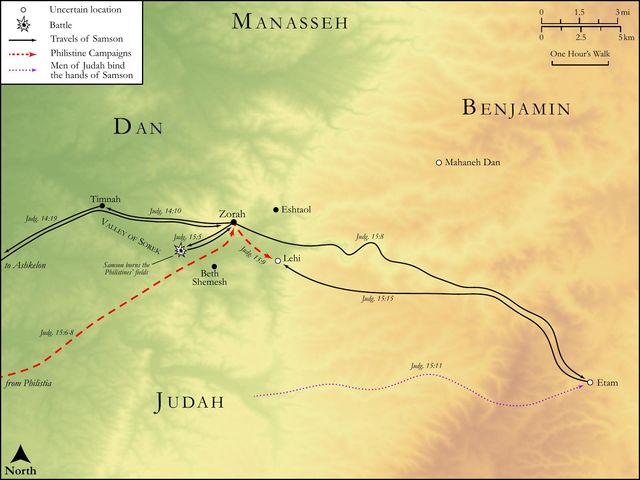
The geographical setting of Timnath, a Philistine city, is crucial, highlighting the persistent tension and cultural intermingling between Israel and the Philistines during the tumultuous period of the Judges. Samson's pursuit of a Philistine wife directly contravened the Mosaic Law, which explicitly prohibited intermarriage with foreign peoples to preserve Israel's distinct covenant identity, as detailed in Deuteronomy 7:3-4. This prohibition was particularly stringent for Samson, who was consecrated as a Nazarite from birth, with specific vows outlined in Numbers 6:1-21 and reiterated in Judges 13:5. Vineyards in ancient Israel were typically situated on the periphery of cultivated land, often bordering wilder, unpopulated areas. This made them natural habitats for wild predators such as lions, which were indeed present in the Levant during this era and posed a genuine threat to travelers and livestock. Thus, Samson's encounter, while extraordinary in its outcome, reflects a realistic danger of the time.
Key Themes
ShowHideThis verse introduces and reinforces several profound themes central to Samson's narrative and the broader book of Judges. Foremost among these is Divine Empowerment, as the lion encounter immediately foreshadows the supernatural strength Samson wields, which the text explicitly attributes to the Spirit of the Lord in the very next verse, Judges 14:6. The unexpected nature of the attack also underscores Providence Amidst Imperfection, demonstrating how God's sovereign plan can unfold and advance even through human choices that appear ill-advised or contrary to His revealed will. Furthermore, the solitary confrontation with a formidable and dangerous foe subtly Foreshadows Conflict—Samson's life is defined by individual battles against overwhelming odds, particularly against the Philistines, where he consistently operates outside established military structures, relying solely on his unique, God-given gifts for deliverance.
Exposition and Analysis
ShowHideKey Word Analysis
ShowHideThis primitive word (אָב) denotes a literal and immediate father, but also carries broader figurative meanings such as a chief or forefather. In this context, the presence of Samson's "father" emphasizes the familial and societal structure surrounding his marriage intentions, highlighting the patriarchal authority and the communal nature of such significant life events, even as Samson's personal choices challenge traditional norms.
A primitive word (אֵם) signifying a mother, understood as the foundational bond of the family. Like "father," it can be used in a wider, figurative sense. Her presence alongside Samson and his father underscores the joint parental responsibility and concern for their son, despite their expressed reservations about his chosen Philistine bride. This detail grounds the dramatic event in the reality of a family journey.
This term (כְּפִיר), derived from a root suggesting "covered in by walls" (perhaps referring to a village, or a lion covered with a mane), refers to a strong, vigorous, and often aggressive adult lion, not merely a cub. The use of kᵉphîyr emphasizes the formidable and dangerous nature of the beast Samson encountered, highlighting the gravity of the immediate threat and magnifying the subsequent, astonishing display of his strength. It signifies a full-grown, powerful predator, making the ensuing act of tearing it apart all the more astounding.
This primitive root (שָׁאג) vividly conveys the terrifying, guttural sound of a lion's roar, often associated with a rumble or moan. This onomatopoeic word emphasizes the suddenness, intensity, and predatory intent of the attack, creating a sense of immediate, overwhelming danger. A lion's roar was not merely a sound but a declaration of presence, dominance, and often a precursor to an attack, intended to intimidate and paralyze its prey.
Verse Breakdown
ShowHide"Then went Samson down, and his father and his mother, to Timnath"
This clause establishes the setting, the key characters, and the initial action. The phrase "went down" (יָרַד, yarad') often implies a geographical descent, suggesting Timnath was situated at a lower elevation than Samson's home. Metaphorically, it can also hint at a "descent" into Philistine territory and culture, a move laden with theological implications for Samson's Nazarite identity and Israel's covenant purity. The inclusion of his parents underscores the public and familial nature of the marriage arrangements, even amidst their likely reservations about his choice of a Philistine wife.
"and came to the vineyards of Timnath"
This specifies the precise location where the dramatic encounter unfolds. Vineyards, while cultivated, typically bordered wilder, uncultivated areas on the outskirts of towns, making them natural habitats for wild animals like lions. For Samson, a Nazarite, the very presence in a vineyard—a place associated with grapes and wine, both forbidden to him by his vow—adds a layer of ironic tension to the setting, though the text does not imply he partakes of anything here.
"and, behold, a young lion roared against him"
The interjection "behold" (וְהִנֵּה, wəhinnēh') serves as a dramatic marker, signaling a sudden, unexpected, and highly significant event. The "young lion" is depicted as a powerful, dangerous predator, and its "roaring against him" signifies a direct, aggressive, and life-threatening challenge. This is not a casual sighting but an immediate, confrontational encounter, setting the stage for Samson's first major and supernatural display of strength, which will define his role as a judge.
Literary Devices
ShowHideJudges 14:5 is rich with several potent literary devices that enhance its dramatic and theological impact. Foreshadowing is prominent, as the sudden, solitary, and divinely-empowered victory over the roaring lion serves as a powerful prelude to Samson's future conflicts with the Philistines, who are often depicted as overwhelming, beast-like adversaries. This initial display of strength hints at the unique, supernatural anointing that will be the hallmark of his judgeship. There is also a strong element of Irony in the scene: Samson, a Nazarite consecrated to God, is on a journey to secure a marriage with a Philistine woman—a choice explicitly contrary to Israelite law—yet it is precisely on this journey that God's power is first overtly manifested through him. The Juxtaposition of the mundane family journey with the sudden, wild, and life-threatening confrontation creates immediate dramatic tension and underscores the unpredictable nature of divine intervention. Furthermore, the lion itself can be seen as Symbolism, representing not only the formidable physical obstacles and enemies Samson will face but, by extension, the spiritual adversaries that confront God's people throughout salvation history.
Theological and Thematic Connections
ShowHideThis verse powerfully illustrates the profound theological theme of divine sovereignty intersecting with human agency, even when that agency is deeply flawed. Despite Samson's questionable choice of a Philistine wife, a decision seemingly contrary to God's covenantal commands for Israel, God's overarching redemptive plan for Israel's deliverance from the Philistines is paradoxically advanced through this very journey. The unexpected lion attack becomes a providential opportunity for God to reveal and confirm the unique anointing and supernatural strength upon Samson, demonstrating that His purposes can be fulfilled through unexpected means and in surprising, even compromising, contexts. It highlights that God can work through individuals and circumstances, even those that appear to deviate from His immediate ideal will, to accomplish His larger redemptive purposes, often preparing and equipping His chosen instruments through trials and dangers.
Reflection and Application
ShowHideSamson's encounter with the roaring lion in the vineyards of Timnath serves as a profound and enduring reminder that life's most significant challenges and opportunities for divine intervention often emerge unexpectedly, even when we are pursuing paths that may not perfectly align with God's optimal wisdom. This verse compels us to consider how God's sovereign hand might be at work in our own "vineyards"—those places where our choices lead us, where danger might lurk, or where we feel most vulnerable and unprepared. It powerfully underscores that divine empowerment is not exclusively reserved for moments of perfect obedience but can manifest powerfully in moments of crisis, revealing gifts, strengths, and callings we never knew we possessed. Just as the lion's roar was a terrifying sound, we too face "roaring lions" in our lives—whether they are spiritual attacks, personal crises, overwhelming circumstances, or the daunting challenges of our calling. The profound lesson is to trust that God's strength is made perfect in our weakness, enabling us to face and overcome what seems insurmountable, often in ways that reveal His glory and faithfulness rather than our own merit or capability.
Questions for Reflection
ShowHideFAQ
ShowHideWhy were Samson's parents with him if he was acting against their wishes?
ShowHideWhile Samson's parents clearly expressed disapproval of his desire to marry a Philistine woman (Judges 14:3), it was a deeply ingrained cultural custom for parents to accompany their son to formally negotiate a marriage, even if they disagreed with the choice of bride. Their presence highlights the pervasive societal norms of the time, where marriage was a communal and familial affair, not merely an individual decision. It also suggests their continued parental responsibility and perhaps a lingering hope that the situation might resolve differently or that they could still influence the outcome. Their involvement underscores that Samson's actions, though personal, had significant public and familial implications.
Was this lion attack a test from God?
ShowHideThe biblical text does not explicitly state that the lion attack was a "test" from God in the sense of a trial of obedience or faithfulness. However, it unequivocally served as a providential opportunity for God to demonstrate and confirm the unique anointing and supernatural strength that had been promised to Samson from birth, as foretold in Judges 13:5. The immediate aftermath, where "the Spirit of the LORD came mightily upon him" (Judges 14:6) enabling him to tear the lion apart, reveals it as a divinely orchestrated moment. It was a crucial validation of Samson's destined role as a deliverer for Israel, showcasing God's power working through him despite his personal choices.
What is the significance of the "vineyards" in this verse?
ShowHideThe "vineyards of Timnath" hold multifaceted significance. Geographically, vineyards were typically located on the outskirts of towns, bordering wilder, uncultivated areas, making them natural places for encounters with wild animals like lions. Thematically, for Samson, a Nazarite, contact with grape products (wine, grapes, etc.) was strictly forbidden by his vow, as outlined in Numbers 6:3-4. While the text does not indicate he consumed anything, his very presence in a vineyard adds a subtle layer of ironic tension or potential temptation, highlighting his proximity to elements forbidden by his vow. Yet, it is precisely in this setting, bordering on the wild and potentially compromising, that God's extraordinary power is about to be displayed through him, underscoring God's ability to work in unexpected places.
Christ-Centered Fulfillment
ShowHideSamson's solitary and divinely empowered victory over the roaring lion in Judges 14:5 serves as a profound Old Testament type, powerfully foreshadowing the ultimate triumph of Jesus Christ. Just as Samson faced a formidable physical beast, humanity faces a spiritual adversary, vividly described in 1 Peter 5:8 as "your adversary the devil, as a roaring lion, walketh about, seeking whom he may devour." Samson's strength, derived from the Spirit of the Lord, enabled him to overcome a physical threat; similarly, Christ, the true "Lion of the Tribe of Judah" (Revelation 5:5), entered our world not merely to overcome physical foes but to conquer sin, death, and the devil himself. His decisive victory was not achieved through brute physical force but through His sacrificial death on the cross and His glorious resurrection, thereby "disarming the powers and authorities" of darkness and making a public spectacle of them (Colossians 2:15). Samson's isolated act of strength points to Christ's unique and unparalleled power to deliver His people from their greatest enemies, a power now made available to believers through the indwelling of the Holy Spirit, enabling us to stand firm against spiritual adversaries as we put on the full armor of God (Ephesians 6:10-12).