


Judges 16:18
Bible text: King James Version (1769 Blayney text) · Public domain
Bible text: King James Version with Strong's numbers · Public domain
Bible text: Berean Standard Bible · Public domain
Bible text: American Standard Version (1901) · Public domain
Bible text: World English Bible, Messianic edition · Public domain
Bible text: Geneva Bible (1599) · Public domain
Bible text: Young's Literal Translation · Public domain
- וַתֵּרֶאva·Te·re'and she sawH7200Conj-w ¦ V-Qal-ConsecImperf-3fsVerb Qal Consecutive Imperfect 3rd Singular Feminineוַandתֵּרֶאshe saw
- דְלִילָהde·li·LahDelilahH1807N-proper-fNoun Proper Feminine
- כִּיkithatH3588PrtParticle Conditional
- הִגִּידhi·Gidhe had toldH5046V-Hiphil-Perf-3msVerb Hiphil Perfect 3rd Singular Masculine
- לָהּlahto <the> herPrep-l ¦ 3fsSuffix Personal 3rd Singular Feminineלָto <the>הּher
- אֶת'et<obj.>H853DirObjMParticle Object Indicator
- כָּלkolallH3605N-mscNoun Singular Masculine Construct
- לִבּוֹli·Bohis heartH3820N-msc ¦ 3msNoun Singular Masculine Constructלִבּheartוֹhis
- וַתִּשְׁלַחva·tish·Lachand she sentH7971Conj-w ¦ V-Qal-ConsecImperf-3fsVerb Qal Consecutive Imperfect 3rd Singular Feminineוַandתִּשְׁלַחshe sent
- וַתִּקְרָאva·tik·Ra'and she summonedH7121Conj-w ¦ V-Qal-ConsecImperf-3fsVerb Qal Consecutive Imperfect 3rd Singular Feminineוַandתִּקְרָאshe summoned
- לְסַרְנֵיle·sar·Nei<to> [the] rulers ofH5633Prep-l ¦ N-mpcNoun Plural Masculine Constructלְ<to>סַרְנֵי[the] rulers of
- פְלִשְׁתִּיםfe·lish·Tim[the] PhilistinesH6430N-mpNoun Gentilic Plural Masculine Absolute
- לֵאמֹרle·Mor<to> sayingH559Prep-l ¦ V-Qal-InfVerb Qal Infinitive Constructלֵ<to>אמֹרsaying
- עֲלוּ'a·Lucome upH5927V-Qal-Imp-2mpVerb Qal Imperative 2nd Plural Masculine
- הַפַּעַםha·Pa·'amthis timeH6471Art ¦ N-fsNoun Singular Feminine Absoluteהַthisפַּעַםtime
- כִּיkiforH3588PrtParticle Conditional
- הִגִּידhi·Gidhe has toldH5046V-Hiphil-Perf-3msVerb Hiphil Perfect 3rd Singular Masculine
- לִיlaito <the> mePrep-l ¦ 1csSuffix Personal 1st Singular common genderלִto <the>יme
- אֶת'et<obj.>H853DirObjMParticle Object Indicator
- כָּלkolallH3605N-mscNoun Singular Masculine Construct
- לִבּוֹli·Bohis heartH3820N-msc ¦ 3msNoun Singular Masculine Constructלִבּheartוֹhis
- וְעָלוּve·'a·Luand they came upH5927Conj-w ¦ V-Qal-ConsecPerf-3cpVerb Qal Consecutive Perfect 3rd Plural common genderוְandעָלוּthey came up
- אֵלֶיהָ'e·Lei·hato herH413Prep ¦ 3fsPreposition Definiteאֵלֶיtoהָher
- סַרְנֵיsar·Nei[the] rulers ofH5633N-mpcNoun Plural Masculine Construct
- פְלִשְׁתִּיםfe·lish·Tim[the] PhilistinesH6430N-mpNoun Gentilic Plural Masculine Absolute
- וַיַּעֲלוּvai·ya·'a·Luand they brought upH5927Conj-w ¦ V-Hiphil-ConsecImperf-3mpVerb Hiphil Consecutive Imperfect 3rd Plural Masculineוַandיַּעֲלוּthey brought up
- הַכֶּסֶףha·Ke·sefthe silverH3701Art ¦ N-msNoun Singular Masculine Absoluteהַtheכֶּסֶףsilver
- בְּיָדָםbe·ya·Damin their handH3027Prep-b ¦ N-csc ¦ 3mpNoun Singular common gender Constructבְּinיָדָhandםtheir
English is a literal word-by-word gloss of the Hebrew, not the KJV's wording. Why?
This is the original text the KJV's translators worked from — each Hebrew word with its own literal English meaning in this verse, prepared by scholars at Tyndale House, Cambridge. The KJV translates whole sentences, not word by word, so its wording differs: one Hebrew word can become several English words, and the KJV may choose “the LORD” where the gloss reads “Yahweh”. Both are faithful — they answer different questions. For the KJV's own rendering, switch to the KJV text.
Details
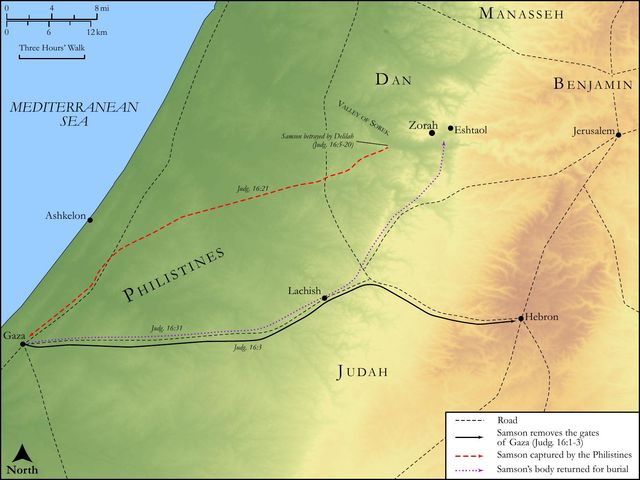
See on the biblical-era maps

Study this verse
Public-domain commentary
Matthew Henry
From his Commentary on the Whole Bible. Henry comments on passages, not single verses — this entry covers Judges 16:18–21.
We have here the fatal consequences of Samson's folly in betraying his own strength; he soon paid dearly for it. A whore is a deep ditch; he that is abhorred of the Lord shall fall therein. In that pit Samson sinks. Observe, 1. What care Delilah took to make sure of the money for herself. She now perceived, by the manner of his speaking, that he had told her all his heart, and the lords of the Philistines that hired her to do this base thing are sent for; but they must be sure to bring the money in their hands, Jdg 16:18. The wages of unrighteousness are accordingly produced, unknown to Samson. It would have grieved one's heart to have seen one of the bravest men then in the world sold and bought, as a sheep for the slaughter; how does this instance sully all the glory of man, and forbid the strong man ever to boast of his strength! 2. What course she took to deliver him up to them according to the bargain. Many in the world would, for the hundredth part of what was here given Delilah, sell those that they pretend the greatest respect for. Trust not in a friend then, put no confidence in a guide. See what a treacherous method she took (Jdg 16:19): She made him sleep upon her knees. Josephus says, She gave him some intoxicating liquor, which laid him to sleep. What opiates she might steal into his cup we know not, but we cannot suppose that he knowingly drank wine or strong drink, for that would have been a forfeiture of his Nazariteship as much as the cutting off of his hair. She pretended the greatest kindness even when she designed the greatest mischief, which yet she could not have compassed if she had not made him sleep. See the fatal consequences of security. Satan ruins men by rocking them asleep, flattering them into a good opinion of their own safety, and so bringing them to mind nothing and fear nothing, and then he robs them of their strength and honour and leads them captive at his will. When we sleep our spiritual enemies do not. When he was asleep she had a person ready to cut off his hair, which he did so silently and so quickly that it did not awake him, but plainly afflicted him; even in his sleep, his spirit manifestly sunk upon it. I think we may suppose that if this ill turn had been done to him in his sleep by some spiteful body, without his being himself accessory to it, as he was here, it would not have had this strange effect upon him; but it was his own wickedness that corrected him. It was his iniquity, else it would not have been so much his infelicity. 3. What little concern he himself was in at it, Jdg 16:20. He could not but miss his hair as soon as he awoke, and yet said, "I will shake myself as at other times after sleep," or, "as at other times when the Philistines were upon me, to make my part good against them." Perhaps he thought to shake himself the more easily, and that his head would feel the lighter, now that his hair was cut, little thinking how much heavier the burden of guilt was than that of hair. He soon found in himself some change, we have reason to think so, and yet wist not that the Lord had departed from him: he did not consider that this was the reason of the change. Note, Many have lost the favourable presence of God and are not aware of it; they have provoked God to withdraw from them, but are not sensible of their loss, nor ever complain of it. Their souls languish and grow weak, their gifts wither, every thing goes cross with them; and yet they impute not this to the right cause: they are not aware that God has departed from them, nor are they in any care to reconcile themselves to him or to recover his favour. When God has departed we cannot do as at other times. 4. What improvement the Philistines soon made of their advantages against him, Jdg 16:21. The Philistines took him when God had departed from him. Those that have thrown themselves out of God's protection become an easy prey to their enemies. If we sleep in the lap of our lusts, we shall certainly wake in the hands of the Philistines. It is probable they had promised Delilah not to kill him, but they took an effectual course to disable him. The first thing they did, when they had him in their hands and found they could manage him, was to put out his eyes, by applying fire to them, says the Arabic version. They considered that his eyes would never come again, as perhaps his hair might, and that the strongest arms could do little without eyes to guide the, and therefore, if now they blind him, they for ever blind him. His eyes were the inlets of his sin: he saw the harlot at Gaza, and went in unto her (Jdg 16:1), and now his punishment began there. Now that the Philistines had blinded him he had time to remember how his own lust had blinded him. The best preservative of the eyes is to turn them away from beholding vanity. They brought him down to Gaza, that there he might appear in weakness where he had lately given such proofs of his strength (Jdg 16:3), and be a jest to those to whom he had been a terror. They bound him with fetters of brass who had before been held in the cords of his own iniquity, and he did grind in the prison, work in their bridewell, either for their profit or his punishment, or for both. The devil does thus by sinners, blinds the minds of those who believe not, and so enslaves them, and secures them in his interests. Poor Samson, how hast thou fallen! How is thy honour laid in the dust! How has the glory and defence of Israel become the drudge and triumph of the Philistines! The crown has fallen from his head; woe unto him, for he hath sinned. Let all take warning by his fall carefully to preserve their purity, and to watch against all fleshly lusts; for all our glory has gone, and our defence departed form us, when the covenant of our separation to God, as spiritual Nazarites, is profaned.
Continue studying Judges 16:18 across the web’s major study libraries — every link below opens this exact verse, chapter, or book on the destination site.
Read & Compare
 BibleGatewayThis verse in more than 200 translations and 70 languages.
 Bible.comThe YouVersion reader — hundreds of translations, reading plans, and highlights.
 ESV.orgCrossway's official English Standard Version reader.
 NET BibleThe NET translation with 60,000+ translators' notes on every rendering decision.
 STEP BibleTyndale House's free study tool — original text, vocabulary, and scholarly resources.
 BibliaLogos Bible Software's free web reader.
 USCCBThe New American Bible (Revised Edition) with the U.S. bishops' study notes.
Commentaries
 BibleHub CommentariesDozens of classic commentaries on this verse, gathered on one page.
 StudyLightMore than 100 commentary sets — the largest collection on the web.
 BibleRefPlain-English commentary on what this verse means, verse by verse.
 Enduring WordDavid Guzik's free commentary on this chapter, widely used by Bible teachers.
 Bible Study ToolsVerse commentary alongside Greek and Hebrew study aids.
Original Language & Research
- BibleHub InterlinearThe verse word by word — original language, transliteration, and English.
- BibleHub LexiconEvery word's original-language definition and Strong's entry.
 Blue Letter BibleDeep-study tools — Strong's numbers, concordance, and word studies.
 SefariaThe Hebrew text with Rashi and centuries of Jewish commentary.
Sermons, Hymns & Audio


TrulyRandomVerse is not affiliated with these sites and doesn’t control their content. They’re linked because they’re genuinely useful.
Summary
Judges 16:18 marks the devastating climax of Samson's repeated spiritual compromises, detailing the precise moment Delilah finally extracts the secret of his supernatural strength. Having relentlessly worn down his resistance through persistent emotional manipulation, she immediately discerns the truth in his full confession, prompting her to dispatch a summons for the Philistine lords. They eagerly arrive with the promised payment already in hand, setting the stage for Samson's imminent capture, humiliation, and the tragic fulfillment of his compromised calling. This pivotal verse powerfully underscores the catastrophic consequences of misplaced trust and the insidious, erosive nature of unresisted temptation.
Context
ShowHideLiterary Context
This verse serves as the narrative's turning point within the tragic saga of Samson and Delilah, directly following Samson's complete disclosure of his Nazarite vow and the divine source of his strength in Judges 16:17. Delilah's relentless badgering, meticulously detailed in Judges 16:6-16, where Samson had offered three deceitful answers, finally achieves its malevolent objective. Her immediate and decisive action—sending for the Philistine lords—demonstrates her absolute certainty that this time, Samson has genuinely "told her all his heart," a phrase deliberately repeated for emphatic effect. This critical moment directly precedes Samson's capture, blinding, and enslavement, marking the irreversible culmination of his compromised life as Israel's judge. The narrative masterfully builds tension through Delilah's escalating attempts, culminating in this irreversible act of betrayal.
Historical & Cultural Context
Samson's ministry unfolded during the tumultuous period of the Judges, an era in Israelite history characterized by a recurring cycle of apostasy, divine judgment through foreign oppression (in this instance, by the Philistines), and God's merciful raising of deliverers. The Philistines were a formidable, technologically superior people who controlled the fertile coastal plain of Canaan, frequently subjugating and harassing the Israelites. Their "lords" (Hebrew: seranim) were the powerful rulers of their five principal cities (Gaza, Ashkelon, Ashdod, Ekron, and Gath), signifying a coordinated and significant effort to neutralize Samson, who had been a perpetual and devastating threat to their dominion (e.g., his victory with a jawbone in Judges 15:15). The immense sum of money promised to Delilah (1,100 shekels of silver from each of the five lords, as stipulated in Judges 16:5) vividly underscores the Philistines' desperation and Delilah's profound mercenary motivation, a stark and tragic contrast to the divine purpose for which Samson had been consecrated from birth (as prophesied in Judges 13:5).
Key Themes
ShowHideThis pivotal moment in Samson's narrative powerfully illuminates several profound and enduring themes. First, it underscores the destructive theme of betrayal and deception, with Delilah acting as a calculating, avarice-driven agent who ruthlessly exploits Samson's profound weakness for personal gain. Her actions serve as a chilling reminder of the devastating power of treachery, particularly when it targets a sacred trust. Second, the verse starkly highlights the consequences of compromise and spiritual erosion. Samson, despite being uniquely endowed with divine strength and consecrated for God's service, consistently indulged in relationships and behaviors that directly contradicted his sacred calling. His gradual, persistent yielding to temptation, culminating in this ultimate revelation, vividly demonstrates how a pattern of moral and spiritual compromises inevitably leads to catastrophic downfall, even for those uniquely gifted by God. Finally, it powerfully portrays human vulnerability in the face of relentless temptation. Samson's extraordinary physical strength is starkly juxtaposed with his profound moral and spiritual fragility. His inability to resist Delilah's emotional manipulation and persistent nagging underscores the perilous danger of succumbing to unceasing temptation, even when the tempter's malevolent intentions are patently clear, serving as a timeless cautionary tale for all who might unwisely play with sin.
Exposition and Analysis
ShowHideKey Word Analysis
ShowHideThe Hebrew verb râʼâh (H7200, וַתֵּרֶא, "and she saw") implies far more than mere physical sight; it connotes deep understanding, keen perception, and discerning recognition. Delilah "saw" not simply that Samson spoke, but that his words carried the undeniable weight of truth, that he had genuinely and completely revealed his innermost secret. This profound perception immediately confirmed her suspicions and validated her relentless efforts, prompting her swift and decisive action to capitalize on his newfound vulnerability.
The Hebrew word lêb (H3820, לְבָבוֹ, "his heart") refers not merely to the emotional center but to the comprehensive totality of the inner person—encompassing the mind, will, affections, and even the intellect. When Samson "told her all his heart," it signifies a complete and utter disclosure of his innermost being, his most guarded secret, and the very essence of his unique relationship with God through the Nazarite vow. This was not just information; it was a profound act of self-revelation, a surrender of his most sacred spiritual truth, tragically misplaced into the hands of his sworn enemy.
The Hebrew root nâgad (H5046, הִגִּיד/הִגִּיד, "had told/hath shewed") means "to front, i.e., stand boldly out opposite; by implication (causatively), to manifest; figuratively, to announce (always by word of mouth to one present)." Its repetition emphasizes the act of full disclosure. Samson's "telling" and "showing" his heart to Delilah was a complete, verbal manifestation of his deepest secret, leaving no room for doubt in Delilah's mind that he had finally laid bare the source of his strength.
Verse Breakdown
ShowHide"And when Delilah saw that he had told her all his heart,"
This opening clause establishes Delilah's perceptive understanding and certainty. After three previous deceptions and Samson's persistent evasion, she now discerns the genuine truth in his confession. The repetition of "all his heart" from the preceding verse (Judges 16:17) emphasizes the completeness of Samson's surrender and the pivotal, irreversible nature of this moment. Her "seeing" is an act of profound recognition, confirming that his resistance had finally and irrevocably broken.
"she sent and called for the lords of the Philistines, saying, Come up this once, for he hath shewed me all his heart."
Delilah's immediate and decisive action underscores her absolute certainty and her mercenary intent. The phrase "Come up this once" conveys a sense of urgent finality, indicating that the opportune moment to capture Samson was now definitively at hand, not to be missed. Her reiteration, "for he hath shewed me all his heart," serves as her confident assurance to the Philistine lords that this time, the secret was truly revealed, and their substantial investment would finally yield its desired outcome.
"Then the lords of the Philistines came up unto her, and brought money in their hand."
This concluding clause confirms the Philistine lords' readiness, eagerness, and swiftness to fulfill their part of the treacherous bargain. Their immediate arrival, with the substantial payment already "in their hand," highlights the pre-arranged nature of the deal and their eager anticipation of Samson's capture. It also powerfully emphasizes the overwhelming financial motivation driving Delilah's betrayal, reducing Samson's sacred Nazarite vow and divine calling to a mere commodity.
Literary Devices
ShowHideThe passage employs several potent literary devices to heighten its dramatic impact and underscore its theological implications. Irony is profoundly prominent, as the physically strongest man in Israel proves to be tragically morally and spiritually weak, utterly unable to resist the persistent, manipulative nagging of a woman whose hostile intentions are overtly clear. This stark contrast highlights the profound paradox of Samson's character. The Repetition of the phrase "all his heart" (or "shewed me all his heart") serves to emphasize the profound nature of Samson's complete disclosure and Delilah's absolute certainty that she had finally extracted the truth. This repetition also effectively builds dramatic tension, reinforcing the grave consequences of Samson's betrayal of his sacred Nazarite vow. The narrative also skillfully employs Foreshadowing, as Samson's previous flirtations with danger, his repeated deceptions of Delilah, and his consistent compromises hinted at his ultimate downfall, making this moment the inevitable and tragic culmination of his spiritual erosion. Finally, the act of the Philistine lords bringing "money in their hand" functions as powerful Symbolism, representing the corrupting power of greed and the transactional, dehumanizing nature of Delilah's betrayal, reducing a divine calling to a mere financial transaction.
Theological and Thematic Connections
ShowHideJudges 16:18 serves as a stark and enduring theological warning against the insidious dangers of spiritual compromise and the relentless nature of persistent temptation. Samson's story is a tragic testament to the truth that even those uniquely gifted and called by God are not immune to the devastating consequences of moral and spiritual failings. His revelation of "all his heart" to Delilah symbolizes a profound betrayal of his covenant with God, demonstrating how the gradual erosion of spiritual discipline and the unchecked indulgence of fleshly desires can lead to catastrophic spiritual and physical bondage. This verse highlights the critical importance of guarding one's heart and discerning true intentions, as misplaced trust and unchecked vulnerability can lead to devastating outcomes. Ultimately, it reminds us that while God's sovereign plan may still unfold amidst human failure, personal disobedience carries severe and painful consequences, often leading to self-inflicted suffering and loss.
Reflection and Application
ShowHideThe tragic narrative of Judges 16:18 offers profound and timeless lessons for contemporary believers. Samson's downfall, initiated by his repeated compromises and culminating in this act of misplaced trust, serves as a powerful cautionary tale for every generation. It reminds us that true spiritual strength is not merely about outward gifting, impressive physical prowess, or even past victories, but fundamentally about the integrity of the heart and an unwavering commitment to God's commands and calling. We are called to be vigilant against the subtle, persistent whispers of temptation, recognizing that sin often works incrementally, gradually wearing down our resistance until we surrender our most sacred trusts and vulnerabilities. This verse challenges us to engage in honest self-examination: Are there areas in our own lives where we are compromising our convictions, playing with sin, or placing our trust in those who would exploit our weaknesses or undermine our faith? Discerning the true intentions of others and diligently guarding our hearts are crucial for spiritual preservation and flourishing. Ultimately, Samson's story underscores the vital importance of maintaining a vibrant, obedient, and intimate relationship with God, for it is in Him alone that our true strength, security, and spiritual integrity are found.
Questions for Reflection
ShowHideFAQ
ShowHideWhy did Samson finally tell Delilah his secret after so many deceptions?
ShowHideSamson's final revelation was the tragic culmination of his profound spiritual and moral decline, driven by Delilah's relentless and emotionally manipulative persistence. Judges 16:16 explicitly states that "she pressed him daily with her words, and urged him, so that his soul was vexed unto death." This suggests a profound emotional and psychological wearing down, a relentless assault on his willpower. Despite his extraordinary physical strength, Samson demonstrated a remarkable moral weakness and an inability to break free from this destructive relationship. His repeated deceptions were a dangerous form of playing with sin, and eventually, his resistance was completely eroded, leading him to betray his sacred Nazarite vow and the very source of his divine strength. It powerfully highlights the extreme danger of persistent temptation and the human tendency to succumb when clear boundaries are repeatedly crossed and spiritual vigilance is abandoned.
What is the significance of the Philistine lords bringing "money in their hand"?
ShowHideThe Philistine lords bringing "money in their hand" immediately upon Delilah's summons emphasizes several crucial points. First, it unequivocally confirms the pre-arranged, mercenary nature of the agreement between Delilah and the Philistines, as detailed in Judges 16:5. They were fully prepared to pay the immense bribe as soon as Samson's secret was definitively confirmed. Second, it highlights their eagerness and absolute certainty that this time, Delilah had truly succeeded in her mission. They did not come to negotiate further; they came ready to pay and to execute Samson's capture. Third, it underscores the Philistines' profound desperation to neutralize Samson, who had been a significant and devastating threat to their dominion over Israel. The money thus symbolizes the extraordinarily high value they placed on his capture and the corrupting power of greed that served as Delilah's primary motivation.
Christ-Centered Fulfillment
ShowHideThe tragic narrative of Samson, particularly his catastrophic downfall in Judges 16:18, finds profound Christ-centered fulfillment not in parallel but in powerful, illuminating contrast. Samson, chosen by God and endowed with supernatural strength, was intended to be a deliverer for Israel, yet his life was tragically marked by compromise, moral weakness, and ultimately, a profound betrayal that led to his own bondage. He revealed his "heart"—his deepest secret and the source of his unique power—to an enemy, leading to his humiliation and death, a death that brought a measure of salvation to Israel but was born of his own grave failures. In stark contrast, Jesus Christ, the true and perfect Deliverer, also revealed His "heart"—not to an enemy for personal gain, but to His disciples in perfect trust and self-giving love, as seen in His intimate fellowship and teaching (e.g., John 15:15). While Samson's strength resided in a physical sign of a vow he ultimately broke, Christ's strength is inherent in His divine nature and His perfect, unwavering obedience to the Father, even unto the most agonizing death (as celebrated in Philippians 2:8). Jesus willingly surrendered Himself, not through weakness or coercion, but through ultimate strength, perfect love, and divine purpose, to be betrayed and crucified. His sacrifice was not for His own sin, but to deliver humanity from the bondage of sin and death (e.g., Romans 5:8 and Hebrews 2:14-15). Samson's story, therefore, ultimately points to the profound need for a perfect deliverer, one who would not succumb to temptation or compromise, but who would perfectly fulfill God's will and secure true, eternal salvation, a role flawlessly and eternally embodied by Jesus Christ.