


Judges 16:19
- וַתְּיַשְּׁנֵהוּva·te·ya·she·Ne·huand she made sleep himH3462Conj-w ¦ V-Piel-ConsecImperf-3fs ¦ 3msVerb Piel Consecutive Imperfect 3rd Singular Feminineוַandתְּיַשְּׁנֵshe made sleepהוּhim
- עַל'alonH5921PrepPreposition
- בִּרְכֶּיהָbir·Kei·haher kneesH1290N-fdc ¦ 3fsNoun Dual Feminine Constructבִּרְכֶּיkneesהָher
- וַתִּקְרָאva·tik·Ra'and she summonedH7121Conj-w ¦ V-Qal-ConsecImperf-3fsVerb Qal Consecutive Imperfect 3rd Singular Feminineוַandתִּקְרָאshe summoned
- לָאִישׁla·'Ish<to> the manH376Prep-l ¦ N-msNoun Singular Masculine Absoluteלָ<to> theאִישׁman
- וַתְּגַלַּחva·te·ga·Lachand she shaved offH1548Conj-w ¦ V-Piel-ConsecImperf-3fsVerb Piel Consecutive Imperfect 3rd Singular Feminineוַandתְּגַלַּחshe shaved off
- אֶת'et<obj.>H853DirObjMParticle Object Indicator
- שֶׁבַעShe·va'sevenH7651N-csNoun Singular common gender Absolute
- מַחְלְפוֹתmach·le·Fot[the] plaits ofH4253N-fpcNoun Plural Feminine Construct
- רֹאשׁוֹro·Shohis headH7218N-msc ¦ 3msNoun Singular Masculine Constructרֹאשׁheadוֹhis
- וַתָּחֶלva·Ta·cheland she beganH2490Conj-w ¦ V-Hiphil-ConsecImperf-3fsVerb Hiphil Consecutive Imperfect 3rd Singular Feminineוַandתָּחֶלshe began
- לְעַנּוֹתוֹle·'a·no·Toto humble himH6031Prep-l ¦ V-Piel-Inf ¦ 3msVerb Piel Infinitive Constructלְtoעַנּוֹתhumbleוֹhim
- וַיָּסַרvai·Ya·sarand it departedH5493Conj-w ¦ V-Qal-ConsecImperf-3msVerb Qal Consecutive Imperfect 3rd Singular Masculineוַandיָּסַרit departed
- כֹּחוֹko·Chohis strengthH3581N-msc ¦ 3msNoun Singular Masculine Constructכֹּחstrengthוֹhis
- מֵעָלָיוme·'a·Lavfrom on <the> himH5921Prep-m ¦ Prep ¦ 3msPreposition Definiteמֵfromעָלָיon <the>וhim
English is a literal word-by-word gloss of the Hebrew, not the KJV's wording. Why?
This is the original text the KJV's translators worked from — each Hebrew word with its own literal English meaning in this verse, prepared by scholars at Tyndale House, Cambridge. The KJV translates whole sentences, not word by word, so its wording differs: one Hebrew word can become several English words, and the KJV may choose “the LORD” where the gloss reads “Yahweh”. Both are faithful — they answer different questions. For the KJV's own rendering, switch to the KJV text.
Details
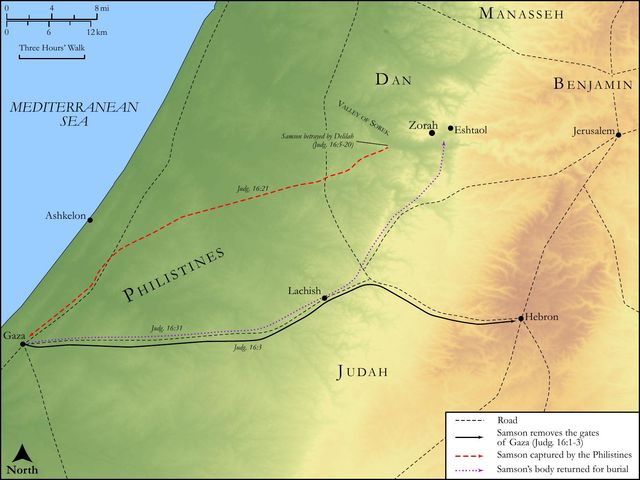
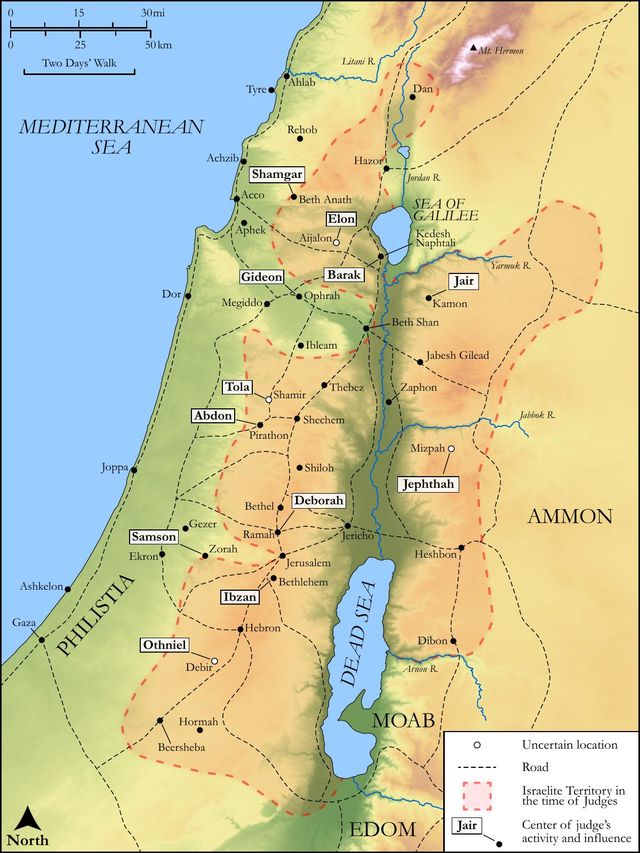
See on the biblical-era map
Study this verse
Public-domain commentary
Matthew Henry
From his Commentary on the Whole Bible. Henry comments on passages, not single verses — this entry covers Judges 16:18–21.
We have here the fatal consequences of Samson's folly in betraying his own strength; he soon paid dearly for it. A whore is a deep ditch; he that is abhorred of the Lord shall fall therein. In that pit Samson sinks. Observe, 1. What care Delilah took to make sure of the money for herself. She now perceived, by the manner of his speaking, that he had told her all his heart, and the lords of the Philistines that hired her to do this base thing are sent for; but they must be sure to bring the money in their hands, Jdg 16:18. The wages of unrighteousness are accordingly produced, unknown to Samson. It would have grieved one's heart to have seen one of the bravest men then in the world sold and bought, as a sheep for the slaughter; how does this instance sully all the glory of man, and forbid the strong man ever to boast of his strength! 2. What course she took to deliver him up to them according to the bargain. Many in the world would, for the hundredth part of what was here given Delilah, sell those that they pretend the greatest respect for. Trust not in a friend then, put no confidence in a guide. See what a treacherous method she took (Jdg 16:19): She made him sleep upon her knees. Josephus says, She gave him some intoxicating liquor, which laid him to sleep. What opiates she might steal into his cup we know not, but we cannot suppose that he knowingly drank wine or strong drink, for that would have been a forfeiture of his Nazariteship as much as the cutting off of his hair. She pretended the greatest kindness even when she designed the greatest mischief, which yet she could not have compassed if she had not made him sleep. See the fatal consequences of security. Satan ruins men by rocking them asleep, flattering them into a good opinion of their own safety, and so bringing them to mind nothing and fear nothing, and then he robs them of their strength and honour and leads them captive at his will. When we sleep our spiritual enemies do not. When he was asleep she had a person ready to cut off his hair, which he did so silently and so quickly that it did not awake him, but plainly afflicted him; even in his sleep, his spirit manifestly sunk upon it. I think we may suppose that if this ill turn had been done to him in his sleep by some spiteful body, without his being himself accessory to it, as he was here, it would not have had this strange effect upon him; but it was his own wickedness that corrected him. It was his iniquity, else it would not have been so much his infelicity. 3. What little concern he himself was in at it, Jdg 16:20. He could not but miss his hair as soon as he awoke, and yet said, "I will shake myself as at other times after sleep," or, "as at other times when the Philistines were upon me, to make my part good against them." Perhaps he thought to shake himself the more easily, and that his head would feel the lighter, now that his hair was cut, little thinking how much heavier the burden of guilt was than that of hair. He soon found in himself some change, we have reason to think so, and yet wist not that the Lord had departed from him: he did not consider that this was the reason of the change. Note, Many have lost the favourable presence of God and are not aware of it; they have provoked God to withdraw from them, but are not sensible of their loss, nor ever complain of it. Their souls languish and grow weak, their gifts wither, every thing goes cross with them; and yet they impute not this to the right cause: they are not aware that God has departed from them, nor are they in any care to reconcile themselves to him or to recover his favour. When God has departed we cannot do as at other times. 4. What improvement the Philistines soon made of their advantages against him, Jdg 16:21. The Philistines took him when God had departed from him. Those that have thrown themselves out of God's protection become an easy prey to their enemies. If we sleep in the lap of our lusts, we shall certainly wake in the hands of the Philistines. It is probable they had promised Delilah not to kill him, but they took an effectual course to disable him. The first thing they did, when they had him in their hands and found they could manage him, was to put out his eyes, by applying fire to them, says the Arabic version. They considered that his eyes would never come again, as perhaps his hair might, and that the strongest arms could do little without eyes to guide the, and therefore, if now they blind him, they for ever blind him. His eyes were the inlets of his sin: he saw the harlot at Gaza, and went in unto her (Jdg 16:1), and now his punishment began there. Now that the Philistines had blinded him he had time to remember how his own lust had blinded him. The best preservative of the eyes is to turn them away from beholding vanity. They brought him down to Gaza, that there he might appear in weakness where he had lately given such proofs of his strength (Jdg 16:3), and be a jest to those to whom he had been a terror. They bound him with fetters of brass who had before been held in the cords of his own iniquity, and he did grind in the prison, work in their bridewell, either for their profit or his punishment, or for both. The devil does thus by sinners, blinds the minds of those who believe not, and so enslaves them, and secures them in his interests. Poor Samson, how hast thou fallen! How is thy honour laid in the dust! How has the glory and defence of Israel become the drudge and triumph of the Philistines! The crown has fallen from his head; woe unto him, for he hath sinned. Let all take warning by his fall carefully to preserve their purity, and to watch against all fleshly lusts; for all our glory has gone, and our defence departed form us, when the covenant of our separation to God, as spiritual Nazarites, is profaned.
Historical interpretation
Historical reception
2 surviving comments on this verse. Each one is dated, so this reads as a timeline rather than a list.
Select a marker to jump to its quote. Markers stagger vertically where authors wrote within a few decades of each other.
But the one who has taken root as “a fruitful olive tree in the house of God” composes those words against the tyrant which we have heard in the psalm, saying, “Why do you glory in evil, you who are mighty in iniquity,” whose “tongue” is “like a sharp razor.” It was by means of these two things that [Samson] was led off, after [Delilah] had removed the beauty of his hair and cut off the “seven locks of curls” in which our strength lies. Now you will by all means understand the meaning of the spiritual curls from the number seven, just as Isaiah has enumerated the grace which comes from the Spirit in seven parts. If these are cut off, as happened in the case of Samson, the destruction of the “eyes” follows, and one becomes a laughing stock to foreigners when they are drunk.
Now what does it mean that Samson possessed strength in his hair? Notice this carefully, too, brothers. He did not have strength in his hand, his foot, his chest, not even in his head, but in his hair. What is hair? If we perceive it, the apostle answers us after being questioned, “Hair is a covering”; and Christ had strength in a covering, when the shadows of the old law protected him. For this reason the hair of Samson was a covering, since it was seen and understood in Christ at different times. What does it mean that Samson’s secret was betrayed and his head was shaved? The law was despised and Christ suffered. They would not have killed Christ if they had not contemned the law, for they knew that it was not right for them to kill him. They told the judge, “It is not lawful for us to put anyone to death.” Samson’s head was shaved, the secrets were exposed, the covering was removed; Christ who lay hidden was revealed. Moreover, the hair was restored and again covered the head, because the Jews were unwilling to recognize Christ when he was risen. He was in a mill, blinded and in a prison house. The prison or mill is the labor of this world. The blindness of Samson indicates people who are blinded by their infidelity and do not recognize Christ exercising his power or ascending into heaven.
Continue studying Judges 16:19 across the web’s major study libraries — every link below opens this exact verse, chapter, or book on the destination site.
Read & Compare
 BibleGatewayThis verse in more than 200 translations and 70 languages.
 Bible.comThe YouVersion reader — hundreds of translations, reading plans, and highlights.
 ESV.orgCrossway's official English Standard Version reader.
 NET BibleThe NET translation with 60,000+ translators' notes on every rendering decision.
 STEP BibleTyndale House's free study tool — original text, vocabulary, and scholarly resources.
 BibliaLogos Bible Software's free web reader.
 USCCBThe New American Bible (Revised Edition) with the U.S. bishops' study notes.
Commentaries
 BibleHub CommentariesDozens of classic commentaries on this verse, gathered on one page.
 StudyLightMore than 100 commentary sets — the largest collection on the web.
 BibleRefPlain-English commentary on what this verse means, verse by verse.
 Enduring WordDavid Guzik's free commentary on this chapter, widely used by Bible teachers.
 Bible Study ToolsVerse commentary alongside Greek and Hebrew study aids.
Original Language & Research
- BibleHub InterlinearThe verse word by word — original language, transliteration, and English.
- BibleHub LexiconEvery word's original-language definition and Strong's entry.
 Blue Letter BibleDeep-study tools — Strong's numbers, concordance, and word studies.
 SefariaThe Hebrew text with Rashi and centuries of Jewish commentary.
Sermons, Hymns & Audio


TrulyRandomVerse is not affiliated with these sites and doesn’t control their content. They’re linked because they’re genuinely useful.
Summary
Judges 16:19 vividly portrays the culmination of Delilah's relentless deception against Samson, marking the precise moment his extraordinary, divinely-granted strength departed from him. This pivotal verse details the final, treacherous act that led to the downfall of Israel's most powerful judge, highlighting the immediate and tragic consequences of his spiritual compromise and the violation of his sacred Nazarite vow.
Context
ShowHideLiterary Context
Judges 16:19 stands as the devastating climax of the Samson narrative, embedded within the broader Book of Judges. This book chronicles Israel's recurring cycle of apostasy, divine judgment through oppression, subsequent repentance, and eventual deliverance through divinely appointed judges. Samson, introduced with a miraculous birth prophecy and a lifelong Nazarite vow, was uniquely set apart to begin Israel's deliverance from Philistine domination. This verse follows Delilah's three prior, unsuccessful attempts to extract the secret of Samson's strength, each met with a deceptive answer. His fatal confession, born of relentless badgering, is recorded just prior in Judges 16:17, setting the stage for this moment of betrayal. The immediate and dire consequences of this act are then detailed in Judges 16:20-21, where Samson is captured, blinded, and enslaved.
Historical & Cultural Context
The period of the Judges, roughly spanning from 1400 to 1050 BC, was characterized by political decentralization and spiritual decline within Israel. This era saw recurrent conflicts with surrounding peoples, most notably the Philistines, a formidable "Sea Peoples" group possessing superior iron technology and well-organized city-states. Samson's Nazarite vow, detailed in Numbers 6, was a special, voluntary consecration to God, requiring abstinence from wine, avoidance of contact with dead bodies, and, crucially for Samson, never cutting his hair. For him, his uncut hair was not the intrinsic source of his strength but the visible, outward sign and condition of his consecrated relationship with God, through which divine power flowed. Delilah, likely a Philistine or an agent loyal to their interests, skillfully exploited the cultural vulnerabilities of the time, employing seduction and deceit as a potent weapon against Israel's champion.
Key Themes
ShowHideJudges 16:19 powerfully contributes to several overarching themes prevalent in the Book of Judges and the broader biblical narrative. It starkly illustrates the consequences of spiritual compromise, as Samson's repeated yielding to temptation and his eventual disregard for his sacred vow lead directly to his catastrophic downfall, demonstrating how persistent sin can erode divine protection and favor. The verse also underscores the divine source of true strength, revealing that Samson's extraordinary power was not inherent but a miraculous gift contingent upon his faithfulness to God's covenant. This emphasizes that human ability is nothing without divine empowerment and that God's gifts, while freely given, are often maintained through obedience. Furthermore, this passage exemplifies the destructive nature of betrayal and deception, as Delilah's calculated actions, motivated by greed and loyalty to Israel's enemies, bring about the tragic end of a divinely appointed leader, serving as a potent warning against misplaced trust and the allure of worldly gain.
Exposition and Analysis
ShowHideKey Word Analysis
ShowHideMeaning "to be slack or languid, i.e. (by implication) sleep (figuratively, to die); also to grow old, stale or inveterate." Here, it signifies a deep, heavy sleep, emphasizing Samson's complete vulnerability and unconsciousness. This profound slumber renders him utterly defenseless against Delilah's treachery, suggesting not only physical rest but perhaps a spiritual complacency or blindness to the imminent danger that foreshadowed his eventual physical blindness.
Meaning "to be bald, i.e. (causatively) to shave; figuratively to lay waste." This verb describes the direct action taken against Samson. It's not Delilah herself who shaves him, but she causes "a man" to do it, highlighting her orchestrating role in the violation. The act of shaving off his hair was a direct, irreversible breach of his Nazarite vow, symbolizing the stripping away of his consecrated status and, consequently, the divine power that flowed through his obedience.
Meaning "vigor, literally (force, in a good or a bad sense) or figuratively (capacity, means, produce)." This word refers to Samson's extraordinary, divinely bestowed physical power. Its departure signifies the immediate and profound consequence of his disobedience. The loss of kôach was not merely a physical weakening but a spiritual withdrawal, demonstrating that his might was not inherent but a gift from God, contingent upon his faithfulness to the covenant symbolized by his hair.
Verse Breakdown
ShowHide"And she made him sleep upon her knees;"
This phrase paints a vivid picture of Samson's complete vulnerability and Delilah's deceptive control. His head, the very locus of the visible sign of his Nazarite vow, rests intimately and trustingly on the lap of his betrayer. This imagery underscores his profound spiritual and physical compromise, portraying a deceptive peace that precedes his catastrophic downfall.
"and she called for a man, and she caused him to shave off the seven locks of his head;"
Delilah's active and calculated role in orchestrating the betrayal is emphasized. She does not perform the act herself, but deliberately directs "a man" (likely a Philistine agent or servant) to carry out the deed, maintaining a chilling detachment while ensuring the violation. The "seven locks" are highly significant, symbolizing completeness or perfection, reinforcing the totality of the violation of his vow and the sacred nature of what was irrevocably lost.
"and she began to afflict him, and his strength went from him."
This is the pivotal moment of consequence. The phrase "she began to afflict him" suggests an immediate, palpable onset of weakness, perhaps even a physical struggle or discomfort as the divine power receded. The final clause, "and his strength went from him," is a stark, direct statement of the devastating outcome. It unequivocally highlights that his strength was not inherent but a divine gift that could be withdrawn, directly linked to his faithfulness to the Nazarite vow and, by extension, to his covenant relationship with God. The departure of strength was the direct and instantaneous result of the broken covenant.
Literary Devices
ShowHideJudges 16:19 is rich in Irony. Samson, the strongest man in Israel, divinely empowered to deliver his people, is rendered utterly helpless not by an army or a mighty warrior, but by a woman's cunning and seduction. His strength, meant to overcome the Philistines, is undone by a woman aligned with them. The Symbolism of Samson's hair is paramount; it is not the source of his strength itself, but the outward sign of his consecrated relationship with God and his Nazarite vow. Its removal symbolizes the breaking of this sacred vow and the severing of his spiritual connection, leading to the departure of divine power. The narrative also employs Pathos, evoking a profound sense of pity and sorrow for Samson's tragic fall, a hero brought low by his own moral failings and a woman's calculated betrayal.
Theological and Thematic Connections
ShowHideJudges 16:19 serves as a profound theological statement on the nature of divine empowerment, the sanctity of vows, and the devastating consequences of spiritual compromise. Samson's strength was a manifestation of God's Spirit working through him, not an inherent physical attribute. His violation of the Nazarite vow, symbolized by the cutting of his hair, was an act of profound disobedience and a disregard for his consecrated status. This act severed the conduit of divine power, demonstrating that God's gifts are often conditional upon faithfulness and obedience. The verse warns against the dangers of persistent temptation, the seductive power of sin, and the critical importance of guarding one's heart and commitments to God, as even great spiritual gifts can be lost through unfaithfulness.
Reflection and Application
ShowHideJudges 16:19 offers timeless lessons for believers today, serving as a stark reminder of the cost of compromise and the paramount importance of spiritual vigilance. Samson's repeated yielding to Delilah's manipulative pressure, despite clear warnings and previous deceptions, illustrates how persistent temptation can subtly erode our spiritual defenses and lead to significant falls. Just as Samson's strength was tied to his vow, our spiritual vitality and effectiveness in God's service are profoundly linked to our faithfulness to His Word, our personal commitments to Him, and our unwavering willingness to obey. This verse challenges us to discern carefully the relationships we cultivate, ensuring they build us up in faith rather than drawing us away from God's path. It underscores that our true strength, wisdom, and protection come solely from the Lord, and when we stray from Him, we risk losing access to that divine empowerment, much like Samson, who was tragically unaware that the Lord had departed from him (Judges 16:20). Therefore, we are called to guard our hearts diligently, uphold our vows with integrity, and remain in constant, humble reliance on God's sustaining grace.
Questions for Reflection
ShowHideFAQ
ShowHideWhy was Samson's strength tied to his hair, and what does it symbolize?
ShowHideSamson's strength was not inherently in his hair itself, but rather the hair was the visible sign and condition of his Nazarite vow, a special covenant of dedication to God outlined in Numbers 6. One of the prohibitions of this vow was that a razor should never touch the Nazarite's head (Numbers 6:5). Therefore, the uncut hair symbolized his consecrated status and his complete dependence on God for his extraordinary power. When his hair was cut, it represented the breaking of his vow and a profound act of disobedience, which severed the conduit through which God's Spirit empowered him. It symbolizes that God's power flows through obedience and faithfulness, and when that covenant relationship is broken, the divine empowerment can be withdrawn.
Christ-Centered Fulfillment
ShowHideSamson's tragic story, culminating in Judges 16:19, finds profound Christ-centered fulfillment not in his outward strength, but paradoxically, in his weakness, betrayal, and ultimate death that brought deliverance. Samson, though divinely empowered, was a deeply flawed deliverer, brought low by his own sin and the calculated betrayal of one he loved. His strength was external and conditional, a gift that could be lost. In stark contrast, Jesus Christ is the ultimate and perfect deliverer, whose strength is inherent divinity, not contingent on any external sign or vow. He too was betrayed, not by a lover for money, but by a close disciple for a paltry sum (Matthew 26:14-16). While Samson's strength departed, Christ willingly "emptied himself, by taking the form of a servant" (Philippians 2:7), allowing Himself to be "afflicted" and weakened unto death on the cross (Isaiah 53:5). Yet, it was precisely through this ultimate act of self-sacrificial weakness and perfect obedience that He achieved the greatest victory, conquering sin and death, and providing eternal deliverance for all who believe (Hebrews 2:14-15). Samson's physical strength was lost, but Christ's spiritual power was supremely revealed in His resurrection, demonstrating that true, redemptive power is found not in outward might, but in obedient love and self-giving sacrifice (1 Corinthians 1:25).