


Numbers 11:30
Bible text: King James Version (1769 Blayney text) · Public domain
Bible text: Berean Standard Bible · Public domain
Bible text: American Standard Version (1901) · Public domain
Bible text: World English Bible, Messianic edition · Public domain
Bible text: Geneva Bible (1599) · Public domain
Bible text: Young's Literal Translation · Public domain
- וַיֵּאָסֵףvai·ye·'a·Sefand he gathered himselfH622Conj-w ¦ V-Niphal-ConsecImperf-3msVerb Niphal Consecutive Imperfect 3rd Singular Masculineוַandיֵּאָסֵףhe gathered himself
- מֹשֶׁהmo·ShehMosesH4872N-proper-mNoun Proper Masculine
- אֶל'eltoH413PrepPreposition
- הַמַּחֲנֶהha·ma·cha·Nehthe campH4264Art ¦ N-fsNoun Singular Feminine Absoluteהַtheמַּחֲנֶהcamp
- הוּאhu'heH1931Pro-3msPronoun Personal 3rd Singular Masculine
- וְזִקְנֵיve·zik·Neiand [the] elders ofH2205Conj-w ¦ Adj-mpcAdjective Plural Masculine Constructוְandזִקְנֵי[the] elders of
- יִשְׂרָאֵלYis·ra·'ElIsraelH3478N-properNoun Proper Location
English is a literal word-by-word gloss of the Hebrew, not the KJV's wording. Why?
This is the original text the KJV's translators worked from — each Hebrew word with its own literal English meaning in this verse, prepared by scholars at Tyndale House, Cambridge. The KJV translates whole sentences, not word by word, so its wording differs: one Hebrew word can become several English words, and the KJV may choose “the LORD” where the gloss reads “Yahweh”. Both are faithful — they answer different questions. For the KJV's own rendering, switch to the KJV text.
Details
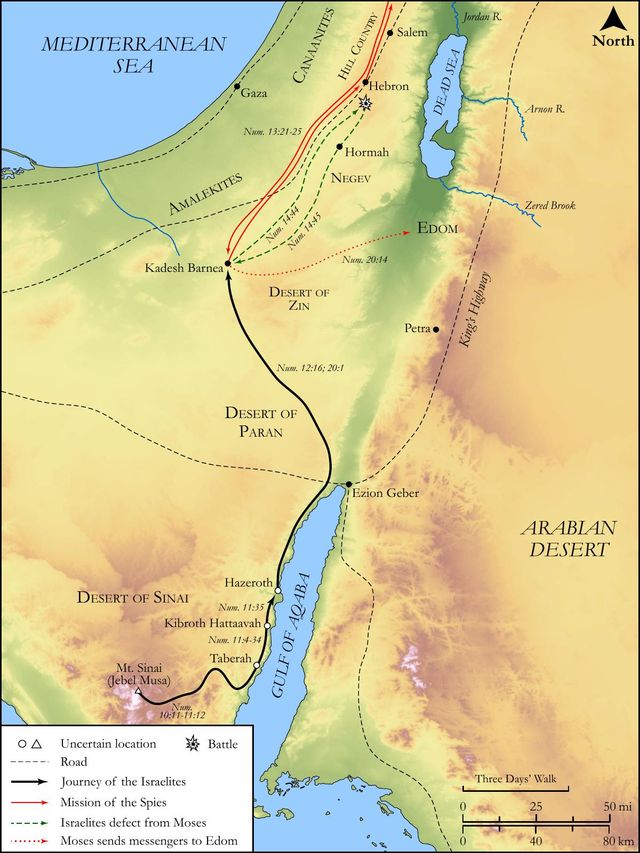
See on the biblical-era map
Study this verse
Public-domain commentary
Matthew Henry
From his Commentary on the Whole Bible. Henry comments on passages, not single verses — this entry covers Numbers 11:24–30. His three-level outline is real structure in the source text, so it is rendered as structure.
We have here the performance of God's word to Moses, that he should have help in the government of Israel.
I.Here is the case of the seventy privy-counsellors in general.
Moses, though a little disturbed by the tumult of the people, yet was thoroughly composed by the communion he had with God, and soon came to himself again. And according as the matter was concerted,
1.He did his part; he presented the seventy elders before the Lord, round the tabernacle (Num 11:24), that they might there stand ready to receive the grace of God, in the place where he manifested himself, and that the people also might be witnesses of their solemn call. Note, Those that expect favour from God must humbly offer themselves and their service to him.
2.God was not wanting to do his part. He gave of his Spirit to the seventy elders (Num 11:25), which enabled those whose capacities and education set them but on a level with their neighbours of a sudden to say and do that which was extraordinary, and which proved them to be actuated by divine inspiration: they prophesied, and did not cease all that day, and (some think) only that day. They discoursed to the people of the things of God, and perhaps commented upon the law they had lately received with admirable clearness, and fulness, and readiness, and aptness of expression, so that all who heard them might see and say that God was with them of a truth; see Co1 14:24, Co1 14:25. Thus, long afterwards, Saul was marked for the government by the gift of prophecy, which came upon him for a day and a night, Sa1 10:6, Sa1 10:11. When Moses was to fetch Israel out of Egypt, Aaron was appointed to be his prophet, Exo 7:1. But, now that God had called Aaron to other work, in his room Moses has seventy prophets to attend him. Note, Those are fittest to rule in God's Israel that are well acquainted with divine things and are apt to teach to edification.
II.Here is the particular case of two of them, Eldad and Medad, probably two brothers.
1.They were nominated by Moses to be assistants in the government, but they went not out unto the tabernacle as the rest did, Num 11:26. Calvin conjectures that the summons was sent them, but that it did not find them, they being somewhere out of the way; so that, though they were written, yet they were not called. Most think that they declined coming to the tabernacle out of an excess of modesty and humility; being sensible of their own weakness and unworthiness, they desired to be excused from coming into the government. Their principle was their praise, but their practice in not obeying orders was their fault.
2.The Spirit of God found them out in the camp, where they were hidden among the stuff, and there they prophesied, that is, they exercised their gift of praying, preaching, and praising God, in some private tent. Note, The Spirit of God is not tied to the tabernacle, but, like the wind, blows where he listeth, Joh 3:8. Whither can we go from that Spirit? There was a special providence in it that these two should be absent, for thus it appeared that it was indeed a divine Spirit which the elders were actuated by, and that Moses gave them not that Spirit, but God himself. They modestly declined preferment, but God forced it upon them; nay, they have the honour of being named, which the rest have not: for those that humble themselves shall be exalted, and those are most fit for government who are least ambitious of it.
3.Information of this was given to Moses (Num 11:27): "Eldad and Medad do prophesy in the camp; there is a conventicle in such a tent, and Eldad and Medad are holding forth there, from under the inspection and presidency of Moses, and out of the communion of the rest of the elders." Whoever the person was that brought the tidings, he seems to have looked upon it as an irregularity.
4.Joshua moved to have them silenced: My lord Moses, forbid them, Num 11:28. It is probable that Joshua himself was one of the seventy, which made him the more jealous for the honour of their order. He takes it for granted that they were not under any necessitating impulse, for the spirit of the prophets is subject to the prophets, and therefore he would have them either not to prophesy at all or to come to the tabernacle and prophesy in concert with the rest. He does not desire that they should be punished for what they had done, but only restrained for the future. This motion he made from a good principle, not out of any personal dislike to Eldad and Medad, but out of an honest zeal for that which he apprehended to be the unity of the church, and concern for the honour of God and Moses.
5.Moses rejected the motion, and reproved him that made it (v. 29): "Enviest thou for my sake? Thou knowest not what manner of spirit thou art of." Though Joshua was Moses's particular friend and confidant, though he said this out of a respect to Moses, whose honour he was very loth to see lessened by the call of those elders, yet Moses reproves him, and in him all that show such a spirit.
(1.)We must not secretly grieve at the gifts, graces, and usefulness of others. It was the fault of John's disciples that they envied Christ's honour because it shaded their master's, Joh 3:26, etc.
(2.)We must not be transported into heats against the weaknesses and infirmities of others. Granting that Eldad and Medad were guilty of an irregularity, yet Joshua was too quick and too warm upon them. Our zeal must always be tempered with the meekness of wisdom: the righteousness of God needs not the wrath of man, Jam 1:20.
(3.)We must not make even the best and most useful men heads of a party. Paul would not have his name made use of to patronise a faction, Co1 1:12, Co1 1:13.
(4.)We must not be forward to condemn and silence those that differ from us, as if they did not follow Christ because they do not follow him with us, Mar 9:38. Shall we reject those whom Christ has owned, or restrain any from doing good because they are not in every thing of our mind? Moses was of another spirit; so far from silencing these two, and quenching the Spirit in them, he wished all the Lord's people were prophets, that is, that he would put his Spirit upon them. Not that he would have any set up for prophets that were not duly qualified, or that he expected that the Spirit of prophecy should be made thus common; but thus he expresses the love and esteem he had for all the Lord's people, the complacency he took in the gifts of others, and how far he was from being displeased at Eldad and Medad's prophesying from under his eye. Such an excellent spirit as this blessed Paul was of, rejoicing that Christ was preached, though it was by those who therein intended to add affliction to his bonds, Phi 1:16. We ought to be pleased that God is served and glorified, and good done, though to the lessening of our credit and the credit of our way.
6.The elders, now newly ordained, immediately entered upon their administration (Num 11:30); when their call was sufficiently attested by their prophesying, they went with Moses to the camp, and applied themselves to business. Having received the gift, they ministered the same as good stewards. And now Moses was pleased that he had so many to share with him in his work and honour. And,
(1.)Let the testimony of Moses be credited by those who desire to be in power, that government is a burden. It is a burden of care and trouble to those who make conscience of the duty of it; and to those who do not it will prove a heavier burden in the day of account, when they fall under the doom of the unprofitable servant that buried his talent.
(2.)Let the example of Moses be imitated by those that are in power; let them not despise the advice and assistance of others, but desire it, and be thankful for it, not coveting to monopolize wisdom and power. In the multitude of counsellors there is safety.
Continue studying Numbers 11:30 across the web’s major study libraries — every link below opens this exact verse, chapter, or book on the destination site.
Read & Compare
 BibleGatewayThis verse in more than 200 translations and 70 languages.
 Bible.comThe YouVersion reader — hundreds of translations, reading plans, and highlights.
 ESV.orgCrossway's official English Standard Version reader.
 NET BibleThe NET translation with 60,000+ translators' notes on every rendering decision.
 STEP BibleTyndale House's free study tool — original text, vocabulary, and scholarly resources.
 BibliaLogos Bible Software's free web reader.
 USCCBThe New American Bible (Revised Edition) with the U.S. bishops' study notes.
Commentaries
 BibleHub CommentariesDozens of classic commentaries on this verse, gathered on one page.
 StudyLightMore than 100 commentary sets — the largest collection on the web.
 BibleRefPlain-English commentary on what this verse means, verse by verse.
 Enduring WordDavid Guzik's free commentary on this chapter, widely used by Bible teachers.
 Bible Study ToolsVerse commentary alongside Greek and Hebrew study aids.
Original Language & Research
- BibleHub InterlinearThe verse word by word — original language, transliteration, and English.
- BibleHub LexiconEvery word's original-language definition and Strong's entry.
 Blue Letter BibleDeep-study tools — Strong's numbers, concordance, and word studies.
 SefariaThe Hebrew text with Rashi and centuries of Jewish commentary.
Sermons, Hymns & Audio


TrulyRandomVerse is not affiliated with these sites and doesn’t control their content. They’re linked because they’re genuinely useful.
Summary
Numbers 11:30 serves as the pivotal conclusion to a significant divine initiative, marking the formal integration of shared leadership within the Israelite community. This verse succinctly describes the physical return of Moses and the newly Spirit-empowered seventy elders to the main encampment, signifying the successful establishment of a divinely appointed, distributed leadership structure ready to collectively guide the nation through the wilderness.
Context
ShowHideLiterary Context
This verse provides the narrative resolution to a critical episode in Numbers 11, which began with the Israelites' intense craving for meat and their weariness of manna, leading to widespread lamentation and a deep crisis for Moses' leadership. Overwhelmed by the immense responsibility, Moses poured out his distress to the Lord, even expressing a desire for death, as detailed in Numbers 11:11-15. In response, God instructed Moses to gather seventy elders, promising to take some of the Spirit that was upon Moses and put it upon them, so they might share the burden (Numbers 11:16-17). When these elders assembled at the Tent of Meeting, the Spirit of the Lord rested upon them, and they began to prophesy (Numbers 11:24-25). The narrative also includes the remarkable incident of Eldad and Medad, who, though remaining in the camp, also received the Spirit and prophesied, prompting Joshua's concern but Moses' magnanimous response, "Would God that all the Lord's people were prophets, and that the Lord would put his spirit upon them!" (Numbers 11:26-29). Numbers 11:30 then provides the simple, yet profound, statement of Moses and these Spirit-empowered elders returning to the camp, marking the completion of this divine initiative and the establishment of a new, shared leadership paradigm.
Historical & Cultural Context
The setting for Numbers 11:30 is the Israelite wilderness journey, a period of immense challenge and formation for the nascent nation. The "camp of Israel" was a highly organized, vast encampment, structured around the Tabernacle, reflecting a divinely ordered society. The concept of "elders" (zâqên) was deeply rooted in Israel, signifying respected, experienced, and wise men who served as local leaders, judges, and administrators within their clans and tribes. In Israel, these elders held significant authority and were often the primary point of contact between Moses and the people. The anointing of the Spirit upon these elders, enabling them to "prophesy," was a dramatic and public demonstration of divine endorsement, elevating their traditional roles with supernatural empowerment. This event also takes place against the backdrop of a nomadic existence, where order, clear leadership, and divine provision were not merely desirable but essential for survival and cohesion. The return to the "camp" was not just a physical movement but a re-entry into the communal life, bringing the newly established leadership structure into immediate effect for the entire congregation.
Key Themes
ShowHideNumbers 11:30 contributes significantly to several overarching themes within the book of Numbers and the Pentateuch. Firstly, it powerfully illustrates the theme of Divine Provision and Compassion, as God responds directly to Moses' plea for relief, not by removing the burden but by distributing it through supernatural empowerment. Secondly, it underscores the critical theme of Shared Leadership and Delegation, demonstrating God's model for effective governance and ministry that moves beyond a single, overburdened leader to a distributed, Spirit-empowered team. This principle is vital for the sustainability and health of any large community. Thirdly, the event highlights Divine Empowerment by the Spirit, emphasizing that true leadership in God's economy is not merely human effort or wisdom but is enabled and sustained by the direct anointing of the Holy Spirit, as seen in the elders' ability to prophesy (Numbers 11:25). Finally, the verse subtly reinforces the theme of Order and Integration within the community, as the return to the camp signifies the formal and public integration of this new leadership structure, ensuring stability and a clear chain of command for the journey ahead.
Exposition and Analysis
ShowHideKey Word Analysis
ShowHideThe KJV's "gat him" is an archaic English rendering of the Hebrew verb ʼâçaph (אָסַף), which primarily means "to gather for any purpose," "to assemble," or "to take away." In this context, it signifies Moses gathering himself or returning, indicating a deliberate movement back to the camp. The use of this verb emphasizes the completion of the divine appointment at the Tent of Meeting and the immediate, purposeful re-entry into the communal space, ready to resume leadership responsibilities.
The Hebrew word machăneh (מַחֲנֶה) refers to an encampment, a military camp, or a general gathering of people. For the Israelites in the wilderness, "the camp" was their entire temporary dwelling place, a vast and highly organized community centered around the Tabernacle. It represented not just a physical location but the collective identity and living space of the entire nation. Moses and the elders' return to the "camp" signifies their re-engagement with the daily life and challenges of the people they were now commissioned to lead, bringing the newly established leadership structure directly into the heart of the community.
The Hebrew word zâqên (זָקֵן) refers to an "old" or "aged" person, often carrying the connotation of wisdom, experience, and authority. In ancient Israel, elders were respected leaders within their tribes and clans, serving as administrators and judges. In this context, these are the seventy men specifically chosen by God and upon whom His Spirit rested, elevating their traditional roles with divine empowerment to share Moses' burden. Their inclusion underscores the legitimacy and divine sanction of this newly distributed leadership.
Verse Breakdown
ShowHide"And Moses gat him into the camp,"
This clause describes Moses' physical movement. Having been at the Tent of Meeting where the Spirit was poured out upon the elders, Moses now returns to the main body of the Israelite community. This return is not merely a logistical detail but signifies the completion of the divine mandate to establish a shared leadership. It marks the transition from the special, sacred space of encounter with God to the practical, communal space of daily life and leadership.
"he and the elders of Israel."
This second clause identifies those who returned with Moses. The inclusion of "the elders of Israel" is crucial. These are the seventy men upon whom the Spirit of the Lord had just rested, enabling them to prophesy and share in Moses' burden. Their return alongside Moses underscores their newly confirmed status and authority. It publicly affirms their role as divinely appointed co-leaders, ready to collectively bear the responsibilities of guiding the nation, thereby alleviating Moses' singular burden and establishing a more robust, distributed leadership structure for the journey ahead.
Literary Devices
ShowHideThe simplicity and directness of Numbers 11:30 employ Narrative Economy, a literary device where a minimal number of words are used to convey a significant action or outcome. The verse does not elaborate on the journey back or the reception of Moses and the elders, but rather states the fact of their return with succinct precision. This brevity highlights the decisive and complete nature of the preceding divine appointment and the immediate integration of the new leadership. Furthermore, the act of "gat him into the camp" functions as Symbolism. The "camp" represents the collective Israelite community and their journey, while the return of Moses and the Spirit-filled elders symbolizes the formal establishment and integration of a divinely ordained, shared leadership structure within the heart of the nation. It marks a new phase in Israel's wilderness experience, characterized by distributed authority and Spirit-empowered guidance.
Theological and Thematic Connections
ShowHideNumbers 11:30, though brief, is profoundly significant for understanding God's model of leadership and His ongoing work through His Spirit. It illustrates that God is attentive to the burdens of His servants and provides supernatural empowerment and communal support to sustain them in their calling. The anointing of the seventy elders demonstrates God's desire for a distributed, Spirit-filled leadership, not merely a single charismatic figure. This event foreshadows the New Testament emphasis on the Holy Spirit's indwelling and empowering of all believers for service, and the importance of shared ministry within the body of Christ, where diverse gifts are given for the common good. It teaches us that God's solutions to human limitations often involve the multiplication of His Spirit's anointing and the establishment of a supportive, collaborative community.
Reflection and Application
ShowHideNumbers 11:30, in its quiet culmination of a tumultuous narrative, offers profound lessons for contemporary leadership and community life. It reminds us that even the most capable leaders, like Moses, have limits and require divine provision and human support. For those in positions of leadership, this verse encourages a humble recognition of personal limitations and a willingness to delegate authority, empowering others to share the burden and contribute their gifts. It underscores that effective leadership is not about lone heroism but about fostering a collaborative environment where burdens are shared and responsibilities are distributed. For every believer, it highlights the truth that God equips those He calls, often through the outpouring of His Spirit, enabling them to serve beyond their natural abilities. This passage invites us to embrace a vision of community where spiritual gifts are recognized and celebrated, where mutual support is paramount, and where the Spirit's presence empowers all to participate in God's work, ensuring that no one is left to carry the load alone.
Questions for Reflection
ShowHideFAQ
ShowHideWhat is the significance of Moses and the elders returning to "the camp" in this verse?
ShowHideThe return to "the camp" is highly significant. It signifies the formal and public integration of the newly established, Spirit-empowered leadership structure into the daily life of the Israelite community. Up until this point in Numbers 11, the elders had been gathered at the Tent of Meeting, a sacred space set apart for divine encounter. Their return to the general encampment with Moses means that the divine anointing and the new shared responsibility are not confined to a special religious ceremony but are brought directly into the practical, administrative, and pastoral life of the nation. It marks the transition from a divine appointment to its practical implementation, ensuring that the burden of leadership is now truly distributed among the seventy elders, under Moses' ultimate authority.
Why is this seemingly simple verse considered important in the broader narrative of Numbers?
ShowHideThis seemingly simple verse is crucial because it marks the successful conclusion of a major crisis and the implementation of God's solution for it. The preceding verses detail Moses' profound despair and the people's intense complaining. Numbers 11:30 acts as a resolution, showing that God has not only heard Moses' cry but has also acted decisively by providing a sustainable, Spirit-empowered leadership model. It's the moment where the divine promise of shared Spirit and burden becomes a lived reality within the community. This verse therefore underscores themes of divine provision, shared leadership, and the empowering work of the Holy Spirit, setting the stage for the continued journey through the wilderness with a more robust administrative and spiritual framework.
Christ-Centered Fulfillment
ShowHideNumbers 11:30, while describing an Old Testament administrative and spiritual transition, finds its ultimate fulfillment and deeper meaning in the person and work of Jesus Christ and the outpouring of the Holy Spirit in the New Covenant. The Spirit that rested on the seventy elders, enabling them to prophesy and share Moses' burden, foreshadows the universal outpouring of the Holy Spirit promised by Christ and inaugurated at Pentecost. Jesus, as the ultimate Prophet, Priest, and King, is the supreme bearer of the Spirit without measure (John 3:34). He is the one who perfectly embodies and fulfills the leadership that Moses and the elders imperfectly represented. Furthermore, Christ's ascension and the subsequent giving of the Holy Spirit to all believers (Acts 2:1-4) means that the Spirit is no longer limited to a select few elders, but indwells every believer, empowering them for ministry and service within the body of Christ (Ephesians 4:11-12). The shared leadership established in Numbers 11:30 points to the church as Christ's body, where diverse spiritual gifts are distributed by the same Spirit for the common good, under the headship of Christ, ensuring that His mission is carried out not by one overburdened leader, but by a Spirit-empowered community (1 Corinthians 12:4-7). Thus, the return of Moses and the elders to the camp prefigures the church's ongoing mission, empowered by the Spirit, to live out Christ's presence in the world.