


Numbers 11:31
Bible text: King James Version (1769 Blayney text) · Public domain
Bible text: King James Version with Strong's numbers · Public domain
Bible text: Berean Standard Bible · Public domain
Bible text: American Standard Version (1901) · Public domain
Bible text: World English Bible, Messianic edition · Public domain
Bible text: Geneva Bible (1599) · Public domain
Bible text: Young's Literal Translation · Public domain
- וְרוּחַve·Ru·achand a windH7307Conj-w ¦ N-fsNoun Singular Feminine Absoluteוְandרוּחַa wind
- נָסַעna·Sa'it set outH5265V-Qal-Perf-3msVerb Qal Perfect 3rd Singular Masculine
- מֵאֵתme·'Etfrom withH854Prep-m ¦ PrepPrepositionמֵfromאֵתwith
- יְהוָהYah·wehYahwehH3068N-properNoun Proper Title
- וַיָּגָזvai·Ya·gozand it broughtH1468Conj-w ¦ V-Qal-ConsecImperf-3msVerb Qal Consecutive Imperfect 3rd Singular Masculineוַandיָּגָזit brought
- שַׂלְוִיםsal·VimquailsH7958N-mpNoun Plural Masculine Absolute
- מִןminfromH4480PrepPreposition
- הַיָּםhai·Yamthe seaH3220Art ¦ N-msNoun Singular Masculine Absoluteהַtheיָּםsea
- וַיִּטֹּשׁvai·yi·Toshand it left [them]H5203Conj-w ¦ V-Qal-ConsecImperf-3msVerb Qal Consecutive Imperfect 3rd Singular Masculineוַandיִּטֹּשׁit left [them]
- עַל'alatH5921PrepPreposition
- הַמַּחֲנֶהha·ma·cha·Nehthe campH4264Art ¦ N-fsNoun Singular Feminine Absoluteהַtheמַּחֲנֶהcamp
- כְּדֶרֶךְke·De·rekhabout a journey ofH1870Prep-k ¦ N-cscNoun Singular common gender Constructכְּaboutדֶרֶךְa journey of
- יוֹםYoma dayH3117N-msNoun Singular Masculine Absolute
- כֹּהKohthusH3541AdvAdverb
- וּכְדֶרֶךְu·khe·De·rekhand about a journey ofH1870Conj-w ¦ Prep-k ¦ N-cscNoun Singular common gender Constructוּandכְaboutדֶרֶךְa journey of
- יוֹםyOma dayH3117N-msNoun Singular Masculine Absolute
- כֹּהKohthusH3541AdvAdverb
- סְבִיבוֹתse·vi·VotaroundH5439N-cpcNoun Plural common gender Construct
- הַמַּחֲנֶהha·ma·cha·Nehthe campH4264Art ¦ N-fsNoun Singular Feminine Absoluteהַtheמַּחֲנֶהcamp
- וּכְאַמָּתַיִםu·khe·'a·ma·Ta·yimand about two cubitsH520Conj-w ¦ Prep-k ¦ N-fdNoun Dual Feminine Absoluteוּandכְaboutאַמָּתַיִםtwo cubits
- עַל'alaboveH5921PrepPreposition
- פְּנֵיpe·Nei[the] surface ofH6440N-mpcNoun Plural Masculine Construct
- הָאָרֶץha·'A·retzthe groundH776Art ¦ N-fsNoun Singular Feminine Absoluteהָtheאָרֶץground
English is a literal word-by-word gloss of the Hebrew, not the KJV's wording. Why?
This is the original text the KJV's translators worked from — each Hebrew word with its own literal English meaning in this verse, prepared by scholars at Tyndale House, Cambridge. The KJV translates whole sentences, not word by word, so its wording differs: one Hebrew word can become several English words, and the KJV may choose “the LORD” where the gloss reads “Yahweh”. Both are faithful — they answer different questions. For the KJV's own rendering, switch to the KJV text.
Details
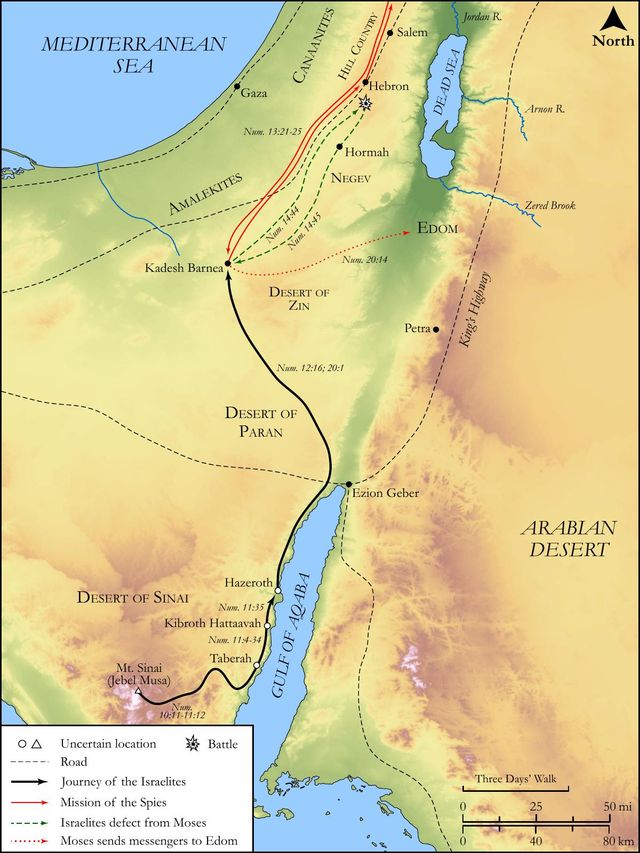
See on the biblical-era map
Study this verse
Public-domain commentary
Matthew Henry
From his Commentary on the Whole Bible. Henry comments on passages, not single verses — this entry covers Numbers 11:31–35.
God, having performed his promise to Moses by giving him assessors in the government, thereby proving the power he has over the spirits of men by his Spirit, he here performs his promise to the people by giving them flesh, proving thereby his power over the inferior creatures and his dominion in the kingdom of nature. Observe, 1. How the people were gratified with flesh in abundance: A wind (a south-east wind, as appears, Psa 78:26) brought quails, Num 11:31. It is uncertain what sort of animals they were; the psalmist calls them feathered fowl, or fowl of wing. The learned bishop Patrick inclines to agree with some modern writers, who think they were locusts, a delicious sort of food well known in those parts, the rather because they were brought with a wind, lay in heaps, and were dried in the sun for use. Whatever they were, they answered the intention, they served for a month's feast for Israel, such an indulgent Father was God to his froward family. Locusts, that had been a plague to fruitful Egypt, feeding upon the fruits, were a blessing to a barren wilderness, being themselves fed upon. 2. How greedy they were of this flesh that God sent them. They flew upon the spoil with an unsatiable appetite, not regarding what Moses had told them from God, that they would surfeit upon it, Num 11:32. Two days and a night they were at it, gathering flesh, till every master of a family had brought home ten homers (that is, ten ass-loads) at least. David longed for the water of the well of Bethlehem, but would not drink it when he had it, because it was obtained by venturing; much more reason these Israelites had to refuse this flesh, which was obtained by murmuring, and which, they might easily perceive, by what Moses said, was given them in anger; but those that are under the power of a carnal mind will have their lusts fulfilled, though it be to the certain damage and ruin of their precious souls. 3. How dearly they paid for their feasts, when it came into the reckoning: The Lord smote them with a very great plague (Num 11:33), some bodily disease, which probably was the effect of their surfeit, and was the death of many of them, and those, it is likely, the ringleaders in the mutiny. Note, God often grants the desires of his own people in love. He gave them their request, but sent leanness into their soul, Psa 106:15. By all that was said to them they were not estranged from their lusts, and therefore, while the meat was in their mouths, the wrath of God came upon them, Psa 78:30, Psa 78:31. What we inordinately desire, if we obtain it (we have reason to fear), will be some way or other a grief and cross to us. God satiated them first, and then plagued them, (1.) To save the reputation of his own power, that it might not be said, "He would not have cut them off had he been able to supply them." And, (2.) To show us the meaning of the prosperity of sinners; it is their preparation for ruin, they are fed as an ox for the slaughter. Lastly, The remembrance of this is preserved in the name given to the place, Num 11:34. Moses called it Kibroth-hattaavah, the graves of lusters or of lust. And well it had been if these graves of Israel's lusters had proved the graves of Israel's lust: the warning was designed to be so, but it had not its due effect, for it follows (Psa 78:32), For all this, they sinned still.
Continue studying Numbers 11:31 across the web’s major study libraries — every link below opens this exact verse, chapter, or book on the destination site.
Read & Compare
 BibleGatewayThis verse in more than 200 translations and 70 languages.
 Bible.comThe YouVersion reader — hundreds of translations, reading plans, and highlights.
 ESV.orgCrossway's official English Standard Version reader.
 NET BibleThe NET translation with 60,000+ translators' notes on every rendering decision.
 STEP BibleTyndale House's free study tool — original text, vocabulary, and scholarly resources.
 BibliaLogos Bible Software's free web reader.
 USCCBThe New American Bible (Revised Edition) with the U.S. bishops' study notes.
Commentaries
 BibleHub CommentariesDozens of classic commentaries on this verse, gathered on one page.
 StudyLightMore than 100 commentary sets — the largest collection on the web.
 BibleRefPlain-English commentary on what this verse means, verse by verse.
 Enduring WordDavid Guzik's free commentary on this chapter, widely used by Bible teachers.
 Bible Study ToolsVerse commentary alongside Greek and Hebrew study aids.
Original Language & Research
- BibleHub InterlinearThe verse word by word — original language, transliteration, and English.
- BibleHub LexiconEvery word's original-language definition and Strong's entry.
 Blue Letter BibleDeep-study tools — Strong's numbers, concordance, and word studies.
 SefariaThe Hebrew text with Rashi and centuries of Jewish commentary.
Sermons, Hymns & Audio


TrulyRandomVerse is not affiliated with these sites and doesn’t control their content. They’re linked because they’re genuinely useful.
Summary
Numbers 11:31 vividly portrays the Lord's extraordinary, albeit disciplinary, response to the Israelites' grumbling for meat in the wilderness. Following their discontent with manna and their intense craving for a varied diet, God sends an overwhelming deluge of quails, driven by a divine wind, covering an immense area around the camp to an astonishing depth, thereby fulfilling His promise to provide meat in such abundance that it would become a source of revulsion and judgment.
Context
ShowHideLiterary Context
Numbers 11:31 serves as the dramatic culmination of the Israelites' sustained complaints against the Lord and Moses, a narrative thread that begins at the chapter's opening. The people, tired of the consistent manna, expressed a deep longing for the diverse foods they had enjoyed in Egypt, leading them to weep bitterly at the tent doors, as detailed in Numbers 11:4-6. This widespread discontent grieved Moses deeply, causing him to express his overwhelming burden to the Lord, questioning his ability to lead such a rebellious people (Numbers 11:11-15). In response to Moses's plea, God promised not only to provide meat but to do so for an entire month, until it became utterly loathsome to them (Numbers 11:18-20). The preceding verses also describe the appointment of seventy elders to assist Moses, and the Spirit's anointing upon them, setting the stage for God's powerful, yet double-edged, fulfillment of His word.
Historical & Cultural Context
The setting for this event is the wilderness journey of the Israelites after their exodus from Egypt, a period characterized by divine provision (such as manna and water from the rock) juxtaposed with frequent Israelite rebellion and testing. Quails (Coturnix coturnix) were indeed migratory birds known to pass over the Sinai Peninsula, often flying low and exhausted during their migration, making them relatively easy to catch. However, the sheer scale and precise timing described in Numbers 11:31 transcend any natural phenomenon, clearly indicating a direct, miraculous intervention by God. The description of the quails covering "a day's journey" (approximately 15-20 miles or 24-32 km) and being "two cubits high" (approximately 3 feet or 0.9 meters) around the camp depicts an unfathomable quantity, far beyond what any human effort could achieve or even process. This event occurred at Kibroth-hattaavah, a name meaning "graves of craving," which would forever mark the site of Israel's gluttonous indulgence and God's subsequent judgment.
Key Themes
ShowHideThis verse powerfully illustrates several key themes prevalent in the book of Numbers and throughout the Pentateuch. It highlights the theme of divine provision, showcasing God's absolute ability to supply the needs (or even the sinful desires) of His people in miraculous ways, as seen earlier with the manna in Exodus 16. Simultaneously, it underscores the theme of human discontent and rebellion, revealing the Israelites' persistent ingratitude despite God's faithfulness, a recurring motif from Exodus 15 onwards. Most significantly, it demonstrates the theme of divine judgment, where God's provision, when given in response to sinful craving, becomes an instrument of discipline. This episode serves as a stark warning about the dangers of unchecked desires and the consequences of despising God's gracious provision, leading directly to the plague mentioned in Numbers 11:33.
Exposition and Analysis
ShowHideKey Word Analysis
ShowHideThe term "wind" (רוּחַ, H7307) in Hebrew is rich with meaning, often referring to a literal wind, but also to breath, spirit, or the Spirit of God. Here, "a wind from the LORD" (רוּחַ מֵאֵת יְהוָה) signifies not merely a natural meteorological event, but a direct, powerful, and intentional act of divine agency. It is God Himself who commands and directs this force, demonstrating His absolute sovereignty over creation to accomplish His purposes, whether in blessing or in judgment.
The Hebrew word for "quails" (שְׂלָו, H7958) refers to a specific migratory bird (Coturnix coturnix) known to traverse the Sinai region. While quails were a natural part of the ecosystem, their appearance in such unprecedented numbers, at a specific time, and in a precise location, points to a miraculous intervention rather than a mere natural occurrence. This was not a random flock but a divinely orchestrated delivery, precisely to meet (and overwhelm) the Israelites' demand for meat.
A cubit (אַמָּה, H520) was an ancient unit of length, typically the distance from the elbow to the tip of the middle finger, roughly 18 inches (45 cm). Thus, "two cubits high" (אַמָּתַיִם) translates to approximately three feet (0.9 meters). This detail emphasizes the immense, almost unbelievable, quantity of quails. They were not merely scattered but piled deep on the ground, creating a literal mountain of meat, far exceeding any reasonable need or capacity for consumption. This hyperbole underscores the overwhelming nature of God's provision and the excess of the people's craving.
Verse Breakdown
ShowHide"And there went forth a wind from the LORD"
This opening clause immediately establishes the divine origin and supernatural nature of the event. It was not a random gust but a directed, purposeful wind, directly commanded by Yahweh (H3068), emphasizing His active involvement and control over creation.
"and brought quails from the sea"
The wind's specific action was to transport the quails (H7958). "From the sea" (H3220) likely refers to the Gulf of Aqaba or the Mediterranean, indicating the birds were migrating and were supernaturally diverted and concentrated towards the Israelite camp, highlighting the precision of God's intervention.
"and let [them] fall by the camp"
The quails were not merely blown over but "fell" or "were dropped" (H5203) precisely at the location of the camp (H4264). This implies a controlled descent, making them accessible for the Israelites to gather, fulfilling God's promise to provide meat directly to them.
"as it were a day's journey on this side, and as it were a day's journey on the other side, round about the camp"
This describes the vast geographical extent of the quail deposit. A "day's journey" (H3117, H1870) was roughly 15-20 miles (24-32 km). This means the quails covered an area extending approximately 15-20 miles in every direction from the center of the camp (H4264), creating a circular area roughly 30-40 miles (48-64 km) in diameter. This emphasizes the staggering, unprecedented scale of the provision.
"and as it were two cubits [high] upon the face of the earth"
This final clause describes the astonishing depth of the quail deposit. At approximately three feet high (H520), the quails were piled up, not just scattered, "upon the face (H6440) of the earth (H776)." This detail underscores the overwhelming abundance and the sheer, almost repulsive, quantity of meat, fulfilling God's promise that they would have meat until it became nauseating to them.
Literary Devices
ShowHideNumbers 11:31 employs several potent literary devices to convey its message. Divine Intervention is paramount, as the explicit mention of "a wind from the LORD" points directly to God's miraculous involvement in orchestrating this event, transcending natural phenomena. The description of the quails covering "a day's journey" in every direction and lying "two cubits high" utilizes Hyperbole, exaggerating the scale to emphasize the overwhelming abundance and the dramatic nature of God's response. This vivid imagery creates a powerful mental picture of an almost unbelievable quantity of meat, underscoring both God's immense power and the magnitude of the people's gluttonous desire. There is also a profound element of Irony, as God grants the Israelites their sinful desire for meat, but the very abundance of this provision becomes a source of judgment and ultimately, death, as described in the subsequent verses. The detailed, almost clinical, description of the quails' fall and accumulation serves to ground the miraculous in concrete, albeit exaggerated, terms, making the divine act both awe-inspiring and terrifying.
Theological and Thematic Connections
ShowHideNumbers 11:31 stands as a profound theological statement on the nature of God's provision, human desire, and divine judgment. It reveals that God is not only capable of providing abundantly but can also use that very abundance as a means of discipline when desires are rooted in rebellion and ingratitude rather than genuine need. This episode highlights the danger of craving what God has not given or despising what He has provided, demonstrating that sometimes, the most severe judgment is to be given over to one's own sinful desires. It underscores God's absolute sovereignty over creation, able to command even the winds and the creatures of the air to fulfill His purposes, whether for blessing or for a terrifying display of justice. The narrative serves as a cautionary tale, reminding us that God's ways are higher than our ways, and our desires, when unchecked and rebellious, can lead to devastating consequences.
Reflection and Application
ShowHideNumbers 11:31 offers a stark and enduring lesson for believers today, challenging us to deeply examine the nature of our desires and our posture towards God's provision. In a world saturated with consumerism and the constant pursuit of "more," this passage warns against the spiritual peril of discontentment and the insatiable craving for things outside of God's perfect will. Are we truly thankful for the daily "manna" God provides – our basic needs, His constant presence, His faithful sustenance – or are we constantly grumbling, longing for something different, something seemingly more exciting or fulfilling, much like the Israelites longed for the "flesh pots" of Egypt? This text compels us to cultivate a spirit of contentment, trusting that God knows what is truly good for us, even if it doesn't align with our immediate cravings. It reminds us that sometimes, getting exactly what we want, especially when it stems from a rebellious heart, can lead to spiritual and even physical detriment. True satisfaction is found not in the abundance of possessions or the fulfillment of every desire, but in a grateful heart that rests in God's sovereign and wise provision.
Questions for Reflection
ShowHideFAQ
ShowHideWas the provision of quails a blessing or a judgment?
ShowHideThe provision of quails in Numbers 11:31 was a complex act that served as both a fulfillment of God's promise and a severe judgment. While God did provide the meat the Israelites craved, the manner and scale of the provision, coupled with the subsequent plague, clearly indicate it was a disciplinary act. God gave them what they wanted, not what was good for them, allowing their sinful desires to lead to their own undoing. This is evident in the immediate context where the people were struck with a severe plague "while the meat was still between their teeth" (Numbers 11:33). It demonstrates God's power to provide, but also His willingness to allow the consequences of rebellious desires to manifest.
How could the quails be "two cubits high"? Is this literal?
ShowHideThe description of the quails being "two cubits high" (approximately three feet deep) is likely a use of hyperbole, a literary device to emphasize the overwhelming, almost unbelievable, quantity of the birds. While quails did migrate in large numbers and could be caught, the text's aim is to convey the miraculous and excessive nature of God's provision in response to Israel's gluttonous demands. It highlights that the quails were not merely scattered but piled up in an astonishing abundance, far beyond what was needed or even manageable, thereby underscoring the severity of God's response to their craving. This vivid imagery communicates the sheer magnitude of the event and the extent to which God fulfilled His word, even to their detriment.
Christ-Centered Fulfillment
ShowHideThe narrative of the quails in Numbers 11:31, while a stark account of divine provision and judgment, ultimately points us to the person and work of Jesus Christ. The Israelites' craving for meat stemmed from their discontent with God's perfect provision (manna), highlighting humanity's inherent tendency to reject God's sustaining grace and seek fulfillment in earthly desires. This foreshadows the deeper spiritual hunger that only Christ can satisfy. While the quails brought temporary satiety followed by judgment, Jesus declares Himself to be the "bread of life" (John 6:35), the true spiritual sustenance that descends from heaven, offering eternal life to those who believe, unlike the manna that their fathers ate and died (John 6:49-50). The judgment that followed the quails, leading to death at Kibroth-hattaavah, stands in stark contrast to Christ's ultimate sacrifice, where He bore the judgment for our sinful cravings and rebellion, offering life instead of death. He is the ultimate provision, not merely for physical hunger, but for the soul's deepest longing, satisfying us completely and eternally, so that we "shall never hunger" (John 6:35) and "never thirst" (John 4:14). In Christ, God's provision is not a double-edged sword of blessing and judgment for our rebellion, but pure grace, freely given to redeem us from the consequences of our insatiable desires and lead us to true, abundant life.