


Numbers 11:33
Bible text: King James Version (1769 Blayney text) · Public domain
Bible text: King James Version with Strong's numbers · Public domain
Bible text: Berean Standard Bible · Public domain
Bible text: American Standard Version (1901) · Public domain
Bible text: World English Bible, Messianic edition · Public domain
Bible text: Geneva Bible (1599) · Public domain
Bible text: Young's Literal Translation · Public domain
- הַבָּשָׂרha·ba·Sarthe meatH1320Art ¦ N-msNoun Singular Masculine Absoluteהַtheבָּשָׂרmeat
- עוֹדֶנּוּo·De·nustill itH5750Adj-msc ¦ 3msAdjective Numerical Singular Masculine Constructעוֹדֶstillנּוּit
- בֵּיןbein[was] betweenH996Adj-mscAdjective Numerical Singular Masculine Construct
- שִׁנֵּיהֶםshi·nei·Hemtheir teethH8127N-fdc ¦ 3mpNoun Dual Feminine Constructשִׁנֵּיteethהֶםtheir
- טֶרֶםTe·remnot yetH2962Adj-csAdjective Numerical Singular common gender Absolute
- יִכָּרֵתyi·ka·Retit was chewedH3772V-Niphal-Imperf-3msVerb Niphal Imperfect 3rd Singular Masculine
- וְאַףve·'Afand [the] anger ofH639Conj-w ¦ N-mscNoun Singular Masculine Constructוְandאַף[the] anger of
- יְהוָהYah·wehYahwehH3068N-properNoun Proper Title
- חָרָהcha·Rahit burnedH2734V-Qal-Perf-3msVerb Qal Perfect 3rd Singular Masculine
- בָעָםva·'Amon the peopleH5971Prep-b ¦ N-msNoun Singular Masculine Absoluteבָon theעָםpeople
- וַיַּךְvai·Yakhand he struckH5221Conj-w ¦ V-Hiphil-ConsecImperf-3msVerb Hiphil Consecutive Imperfect 3rd Singular Masculineוַandיַּךְhe struck
- יְהוָהYah·wehYahwehH3068N-properNoun Proper Title
- בָּעָםba·'Am<on> the peopleH5971Prep-b ¦ N-msNoun Singular Masculine Absoluteבָּ<on> theעָםpeople
- מַכָּהma·Kaha plagueH4347N-fsNoun Singular Feminine Absolute
- רַבָּהra·BahgreatH7227Adj-fsAdjective Singular Feminine Absolute
- מְאֹדme·'OdveryH3966Adj-msAdjective Numerical Singular Masculine Absolute
English is a literal word-by-word gloss of the Hebrew, not the KJV's wording. Why?
This is the original text the KJV's translators worked from — each Hebrew word with its own literal English meaning in this verse, prepared by scholars at Tyndale House, Cambridge. The KJV translates whole sentences, not word by word, so its wording differs: one Hebrew word can become several English words, and the KJV may choose “the LORD” where the gloss reads “Yahweh”. Both are faithful — they answer different questions. For the KJV's own rendering, switch to the KJV text.
Details
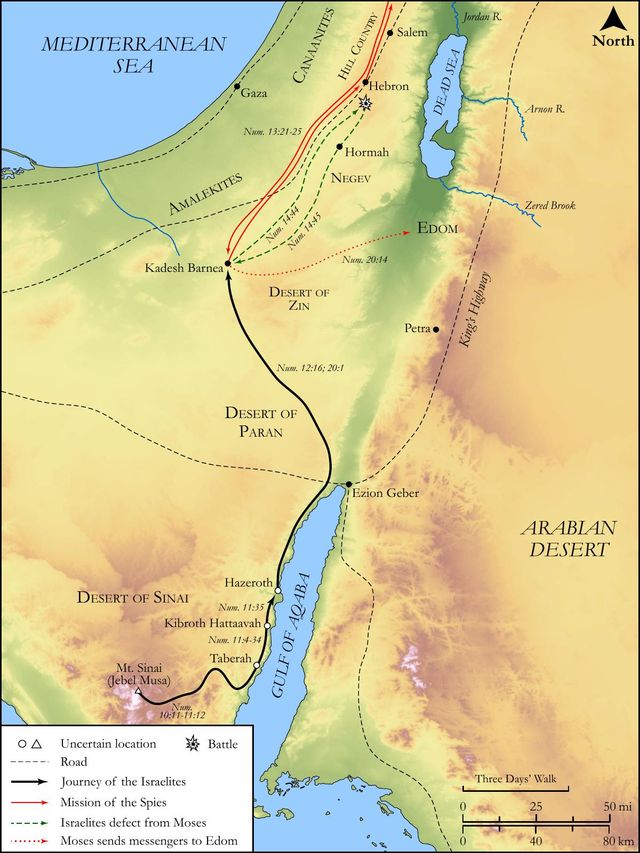
See on the biblical-era map
Study this verse
Public-domain commentary
Matthew Henry
From his Commentary on the Whole Bible. Henry comments on passages, not single verses — this entry covers Numbers 11:31–35.
God, having performed his promise to Moses by giving him assessors in the government, thereby proving the power he has over the spirits of men by his Spirit, he here performs his promise to the people by giving them flesh, proving thereby his power over the inferior creatures and his dominion in the kingdom of nature. Observe, 1. How the people were gratified with flesh in abundance: A wind (a south-east wind, as appears, Psa 78:26) brought quails, Num 11:31. It is uncertain what sort of animals they were; the psalmist calls them feathered fowl, or fowl of wing. The learned bishop Patrick inclines to agree with some modern writers, who think they were locusts, a delicious sort of food well known in those parts, the rather because they were brought with a wind, lay in heaps, and were dried in the sun for use. Whatever they were, they answered the intention, they served for a month's feast for Israel, such an indulgent Father was God to his froward family. Locusts, that had been a plague to fruitful Egypt, feeding upon the fruits, were a blessing to a barren wilderness, being themselves fed upon. 2. How greedy they were of this flesh that God sent them. They flew upon the spoil with an unsatiable appetite, not regarding what Moses had told them from God, that they would surfeit upon it, Num 11:32. Two days and a night they were at it, gathering flesh, till every master of a family had brought home ten homers (that is, ten ass-loads) at least. David longed for the water of the well of Bethlehem, but would not drink it when he had it, because it was obtained by venturing; much more reason these Israelites had to refuse this flesh, which was obtained by murmuring, and which, they might easily perceive, by what Moses said, was given them in anger; but those that are under the power of a carnal mind will have their lusts fulfilled, though it be to the certain damage and ruin of their precious souls. 3. How dearly they paid for their feasts, when it came into the reckoning: The Lord smote them with a very great plague (Num 11:33), some bodily disease, which probably was the effect of their surfeit, and was the death of many of them, and those, it is likely, the ringleaders in the mutiny. Note, God often grants the desires of his own people in love. He gave them their request, but sent leanness into their soul, Psa 106:15. By all that was said to them they were not estranged from their lusts, and therefore, while the meat was in their mouths, the wrath of God came upon them, Psa 78:30, Psa 78:31. What we inordinately desire, if we obtain it (we have reason to fear), will be some way or other a grief and cross to us. God satiated them first, and then plagued them, (1.) To save the reputation of his own power, that it might not be said, "He would not have cut them off had he been able to supply them." And, (2.) To show us the meaning of the prosperity of sinners; it is their preparation for ruin, they are fed as an ox for the slaughter. Lastly, The remembrance of this is preserved in the name given to the place, Num 11:34. Moses called it Kibroth-hattaavah, the graves of lusters or of lust. And well it had been if these graves of Israel's lusters had proved the graves of Israel's lust: the warning was designed to be so, but it had not its due effect, for it follows (Psa 78:32), For all this, they sinned still.
Historical interpretation
Historical reception
1 surviving comment on this verse from the historical church.
To some, indeed, who lack patience, the Lord God in his wrath grants them what they ask, just as in his mercy, on the other hand, he refused it to his apostle. We read what and how the Israelites asked and received, but when their lust had been satisfied, their lack of patience was severely punished.
Continue studying Numbers 11:33 across the web’s major study libraries — every link below opens this exact verse, chapter, or book on the destination site.
Read & Compare
 BibleGatewayThis verse in more than 200 translations and 70 languages.
 Bible.comThe YouVersion reader — hundreds of translations, reading plans, and highlights.
 ESV.orgCrossway's official English Standard Version reader.
 NET BibleThe NET translation with 60,000+ translators' notes on every rendering decision.
 STEP BibleTyndale House's free study tool — original text, vocabulary, and scholarly resources.
 BibliaLogos Bible Software's free web reader.
 USCCBThe New American Bible (Revised Edition) with the U.S. bishops' study notes.
Commentaries
 BibleHub CommentariesDozens of classic commentaries on this verse, gathered on one page.
 StudyLightMore than 100 commentary sets — the largest collection on the web.
 BibleRefPlain-English commentary on what this verse means, verse by verse.
 Enduring WordDavid Guzik's free commentary on this chapter, widely used by Bible teachers.
 Bible Study ToolsVerse commentary alongside Greek and Hebrew study aids.
Original Language & Research
- BibleHub InterlinearThe verse word by word — original language, transliteration, and English.
- BibleHub LexiconEvery word's original-language definition and Strong's entry.
 Blue Letter BibleDeep-study tools — Strong's numbers, concordance, and word studies.
 SefariaThe Hebrew text with Rashi and centuries of Jewish commentary.
Sermons, Hymns & Audio


TrulyRandomVerse is not affiliated with these sites and doesn’t control their content. They’re linked because they’re genuinely useful.
Summary
Numbers 11:33 delivers a stark and immediate depiction of divine judgment unleashed upon the Israelites in the wilderness. Despite the LORD's consistent and miraculous provision of manna, the people, influenced by a "mixed multitude" and succumbing to intense craving for meat, expressed profound discontent and rebellion. In response to their ungodly lust, God provided an overwhelming abundance of quail, yet even as they consumed the desired flesh, His righteous wrath was kindled, striking them with a devastating plague. This incident at Kibroth-hattaavah serves as an enduring warning about the perilous consequences of ingratitude, covetousness, and a murmuring spirit that rejects divine sufficiency and tests the patience of a holy God.
Context
ShowHideLiterary Context
Numbers 11:33 culminates a critical narrative sequence within the book of Numbers, immediately following the Israelites' departure from Mount Sinai. The chapter begins with the people's initial complaints about hardship, prompting a punitive fire from the LORD (see Numbers 11:1-3). This grumbling quickly escalates into a profound lament for the perceived culinary delights of Egypt—meat, fish, and vegetables—contrasted sharply with their disdain for the manna, God's supernatural daily provision (see Numbers 11:4-6). Moses himself becomes overwhelmed by the people's incessant complaining, leading to the appointment of seventy elders to share the burden of leadership (see Numbers 11:10-17). In response to their insatiable craving, God promises to give them meat, not for a day or two, but for an entire month, until it becomes utterly repulsive, signifying judgment rather than blessing (see Numbers 11:18-20). The miraculous provision of vast quantities of quail, brought by a wind from the LORD, sets the stage for the swift and terrifying judgment described in this verse (see Numbers 11:31-32), culminating in the devastating plague at Kibroth-hattaavah, meaning "the graves of craving."
Historical & Cultural Context
The events of Numbers 11 unfold during the Israelites' arduous forty-year wilderness wandering, a period divinely ordained to test and humble them, fostering a deep dependence on God. The "mixed multitude" mentioned in Numbers 11:4 refers to the non-Israelites who accompanied them out of Egypt, often serving as a catalyst for spiritual contagion and discontent among the Israelites. In Scripture, divine judgment through plagues, as upon Egypt, was a well-understood and terrifying manifestation of the LORD's power and holiness, often visited as punishment for rebellion, covenant violation, or sacrilege. The Israelites' craving for meat, seemingly a minor desire, was far from innocuous; it represented a profound rejection of God's supernatural provision and a nostalgic longing for the perceived comforts and security of Egyptian bondage. This was not merely a dietary preference but a profound act of ingratitude, a challenge to God's leadership, and an indictment of His goodness and sufficiency, demonstrating a deep-seated spiritual rebellion against the covenant relationship.
Key Themes
ShowHideThis verse powerfully contributes to several overarching themes pervasive throughout the book of Numbers and the Pentateuch. Firstly, it emphatically highlights Divine Wrath and Immediate Judgment, underscoring that God's patience, while immense, is not infinite, and His justice is swift and decisive when confronted with persistent rebellion and unholy desires. Secondly, it vividly illustrates the severe Consequences of Ungodly Lust and Complaining. The Israelites' insatiable craving for meat, born out of dissatisfaction with God's perfect provision, transcended a simple physical need; it revealed a profound spiritual offense rooted in a lack of faith and gratitude. This serves as a potent warning against covetousness and a murmuring spirit, echoing similar warnings found in passages like 1 Corinthians 10:6-11. Thirdly, the incident at Kibroth-hattaavah powerfully demonstrates God's Holiness and Justice. While merciful and long-suffering, God is also a consuming fire (as stated in Hebrews 12:29) who demands reverence, obedience, and faithfulness from His covenant people. Finally, it profoundly illustrates The Peril of Receiving What You Want, particularly when desires are rooted in rebellion and ingratitude. God sometimes grants desires not as a blessing but as a judgment, allowing people to experience the destructive consequences of their own sinful cravings, a principle also powerfully articulated in Psalm 78:29-31.
Exposition and Analysis
ShowHideKey Word Analysis
ShowHideWhile literally referring to the meat of the quail that God provided, in this context, "flesh" symbolizes the object of the Israelites' intense, inordinate, and ungodly craving. It represents the earthly, carnal desire that superseded their spiritual contentment and trust in God's miraculous provision. The fact that judgment struck while the flesh was "yet between their teeth" underscores the direct and immediate link between their physical act of consumption and their profound spiritual rebellion.
This noun, literally meaning "nose" or "nostril," is a common Hebrew idiom for "anger" or "wrath," as anger often manifests physically through flaring nostrils or heavy breathing. In this context, it signifies a fierce, burning indignation from God, a righteous and holy response to the people's flagrant disobedience, ingratitude, and rejection of His grace. It is not an impulsive human temper tantrum but a controlled, holy displeasure against sin that demands justice.
This term denotes a "blow," "stroke," or "slaughter," specifically referring to a divinely inflicted calamity, epidemic, or wound. Its use here emphasizes that the affliction was not a natural consequence or a mere coincidence but a direct, supernatural act of God's judgment. The description of it as a "very great plague" (combining makkâh with mᵉʼôd "very" and rab "great") indicates its widespread, severe, and devastating nature, resulting in significant loss of life among the rebellious Israelites.
Verse Breakdown
ShowHide"And while the flesh [was] yet between their teeth, ere it was chewed"
This clause dramatically emphasizes the astonishing immediacy and precision of God's judgment. It highlights the direct correlation between the act of consuming the lusted-after meat and the sudden onset of divine wrath. The judgment was not delayed, nor did it allow for repentance or a change of heart after the fact; it struck in the very moment of their rebellious indulgence, underscoring God's absolute sovereignty, His intolerance for sin, and the profound seriousness of their transgression.
"the wrath of the LORD was kindled against the people"
This phrase directly attributes the ensuing calamity to God's active and righteous anger. The verb "kindled" (from chârâh) suggests a sudden, intense burst of divine indignation, a holy fire ignited by their profound ingratitude, persistent rebellion, and testing of His patience. It clarifies that the subsequent plague was not an accident or a natural disaster but a deliberate, intentional expression of God's displeasure against their unholy craving and incessant murmuring.
"and the LORD smote the people with a very great plague"
This final clause describes the devastating consequence of God's kindled wrath. The verb "smote" (from nâkâh) implies a direct, forceful strike or blow, emphasizing the intentionality and power of God's action. The "very great plague" indicates a widespread and severe affliction, resulting in significant casualties among the Israelites. This was a clear, undeniable demonstration of God's power to judge and His unwavering commitment to holiness, even among His chosen covenant people.
Literary Devices
ShowHideNumbers 11:33 employs several powerful literary devices to convey its sobering message with maximum impact. Irony is profoundly evident, as the very thing the Israelites craved—meat—became the direct instrument of their judgment, transforming a desired blessing into a devastating curse. This highlights the inherent danger of desires not aligned with God's will. The phrase "while the flesh was yet between their teeth, ere it was chewed" utilizes vivid Imagery and striking Juxtaposition, contrasting the immediate gratification of their lust with the swift, terrifying onset of divine wrath. This creates a powerful sense of suddenness, inevitability, and inescapable consequence. The description of God's "wrath...kindled" is a potent Anthropomorphism, attributing human-like emotion (anger) and action (kindling a fire) to God, making His response relatable while simultaneously emphasizing the intensity and righteous nature of His displeasure. The "very great plague" functions as a form of Hyperbole or Emphasis, stressing the overwhelming magnitude and severity of the divine judgment, ensuring the reader fully grasps the gravity of the people's sin and the commensurate nature of God's holy response.
Theological and Thematic Connections
ShowHideNumbers 11:33 stands as a sobering testament to the unblemished holiness of God and the profound gravity of human rebellion, particularly when expressed through ungratefulness and insatiable desires. It reveals that God's patience, while vast and enduring, is not infinite, and His justice is an immutable, fundamental aspect of His divine character. The incident at Kibroth-hattaavah ("graves of craving") serves as a stark warning, underscoring the spiritual danger of covetousness and the profound offense of murmuring against divine provision. It teaches a crucial theological lesson: true contentment is found not in pursuing fleshly desires that often lead to spiritual death, but in trusting God's perfect sufficiency and sovereign care. This narrative serves as a perpetual admonition against testing God and reminds believers that even seemingly minor acts of discontent can stem from a deeper lack of faith and reverence, ultimately inviting severe and immediate consequences from a holy God.
Reflection and Application
ShowHideNumbers 11:33 serves as a timeless and potent warning for believers across all generations, urging us to cultivate a posture of profound gratitude, deep contentment, and unwavering trust in God's provision in all circumstances. It compels us to deeply examine the desires of our hearts: are they truly aligned with God's perfect will and abundant provision, or are they rooted in selfish craving, dissatisfaction, and a fundamental lack of trust in His goodness and wisdom? This passage powerfully reminds us that grumbling and murmuring are not trivial offenses but serious expressions of unbelief and rebellion that can provoke divine displeasure. We are called to live with a discerning spirit, recognizing that God's provision, even if it doesn't immediately match our personal desires or expectations, is always ultimately sufficient, perfect, and designed for our spiritual flourishing. The severity and immediacy of the judgment at Kibroth-hattaavah should instill a healthy, reverent fear of the LORD, fostering a humble obedience that seeks to honor Him in every thought, word, and deed, rather than testing His patience with our unholy cravings and discontented spirits.
Questions for Reflection
ShowHideFAQ
ShowHideWhy was God's judgment so swift and severe in Numbers 11:33?
ShowHideGod's judgment was swift and severe because the Israelites' craving for meat was not merely a physical hunger but a profound spiritual rebellion rooted in a deep-seated lack of faith, ingratitude, and a blatant rejection of God's miraculous provision of manna. Their murmuring was persistent, challenging God's authority, goodness, and sufficiency. The immediacy of the judgment—"while the flesh was yet between their teeth"—underscored the direct link between their sin and its consequence, serving as a powerful, undeniable lesson about the gravity of their rebellion and God's unwavering holiness. This was a clear demonstration that God is not to be trifled with, and His patience, while immense, has limits when His people continually provoke Him with unholy desires and ingratitude, a pattern of rebellion also seen in Numbers 14.
Does God still punish people in this way today?
ShowHideWhile God's character of holiness and justice remains eternally unchanged, the form of His judgment often differs in the New Covenant era. Direct, immediate, physical plagues as seen in Numbers are less common, but the spiritual principles remain profoundly relevant. God still allows people to experience the natural, destructive consequences of their sinful desires (as articulated in James 1:15), and He lovingly disciplines His children for their good (as taught in Hebrews 12:5-11). Ultimately, the greatest judgment for sin has been fully and perfectly borne by Christ on the cross. For those who reject Him, the ultimate judgment is eternal separation from God. However, the narrative in Numbers 11:33 serves as a timeless and solemn warning against presuming upon God's grace and persisting in unrepentant sin.
What does "lusted a lust" (Numbers 11:4) mean in this context, and how does it relate to Numbers 11:33?
ShowHideThe phrase "lusted a lust" from Numbers 11:4 is a powerful Hebraism, an emphatic construction meaning "they intensely lusted" or "they craved with a great, overwhelming craving." The Hebrew word for "lust" here is ta'avah (תַּאֲוָה), which signifies a strong, often inordinate, illicit, or sinful desire. In this context, it refers to the Israelites' intense, unholy, and deeply discontented craving for meat, which went far beyond legitimate hunger and escalated into outright rebellion against God's provision and authority. Numbers 11:33 is the direct, immediate, and devastating fulfillment of the consequence of this "lusted lust." God, in His sovereign judgment, gave them precisely what they craved, but because the desire was rooted in sin, defiance, and ingratitude, the "blessing" of abundance became a curse, leading to the devastating plague. It powerfully demonstrates that sometimes God gives people over to their sinful desires as a form of judgment, allowing them to reap the bitter fruit of their own rebellion.
Christ-Centered Fulfillment
ShowHideNumbers 11:33, with its stark portrayal of divine wrath against unholy craving and rebellion, finds profound Christ-centered fulfillment in several interconnected ways. The Israelites' rejection of manna, God's heavenly bread and miraculous daily provision, for the "flesh" they craved, powerfully foreshadows humanity's persistent tendency to reject God's true spiritual provision for fleeting, earthly desires. Jesus, however, declares Himself to be the "bread of life" who came down from heaven, offering eternal satisfaction and true sustenance to all who come to Him, standing in stark contrast to the temporary and ultimately fatal quail (see John 6:35 and John 6:51). The wrath of the LORD, so vividly displayed at Kibroth-hattaavah as a "very great plague," was fully and finally poured out upon Jesus on the cross. He became the ultimate sacrifice, bearing the entirety of God's righteous judgment for the sins of humanity, including our unholy cravings, discontented hearts, and rebellious spirits (see 2 Corinthians 5:21 and Galatians 3:13). Through faith in Him, believers are mercifully spared the wrath that our own lusts and rebellion justly deserve, finding true contentment, complete forgiveness, and eternal life, free from condemnation (see Romans 8:1).