


Numbers 11:32
Bible text: King James Version (1769 Blayney text) · Public domain
Bible text: King James Version with Strong's numbers · Public domain
Bible text: Berean Standard Bible · Public domain
Bible text: American Standard Version (1901) · Public domain
Bible text: World English Bible, Messianic edition · Public domain
Bible text: Geneva Bible (1599) · Public domain
Bible text: Young's Literal Translation · Public domain
- וַיָּקָםvai·Ya·komand it aroseH6965Conj-w ¦ V-Qal-ConsecImperf-3msVerb Qal Consecutive Imperfect 3rd Singular Masculineוַandיָּקָםit arose
- הָעָםha·'Amthe peopleH5971Art ¦ N-msNoun Singular Masculine Absoluteהָtheעָםpeople
- כָּלkolallH3605N-mscNoun Singular Masculine Construct
- הַיּוֹםhai·yOmthe dayH3117Art ¦ N-msNoun Singular Masculine Absoluteהַtheיּוֹםday
- הַהוּאha·Hu'<the> thatH1931Art ¦ Pro-3msPronoun Personal 3rd Singular Masculineהַ<the>הוּאthat
- וְכָלve·kholand allH3605Conj-w ¦ N-mscNoun Singular Masculine Constructוְandכָלall
- הַלַּיְלָהha·Lay·lahthe nightH3915Art ¦ N-msNoun Singular Masculine Absoluteהַtheלַּיְלָהnight
- וְכֹלve·Kholand allH3605Conj-w ¦ N-mscNoun Singular Masculine Constructוְandכֹלall
- יוֹםYom[the] day ofH3117N-mscNoun Singular Masculine Construct
- הַמָּחֳרָתha·mo·cho·Ratthe next dayH4283Art ¦ N-fsNoun Singular Feminine Absoluteהַtheמָּחֳרָתnext day
- וַיַּאַסְפוּvai·ya·'as·Fuand they gatheredH622Conj-w ¦ V-Qal-ConsecImperf-3mpVerb Qal Consecutive Imperfect 3rd Plural Masculineוַandיַּאַסְפוּthey gathered
- אֶת'et<obj.>H853DirObjMParticle Object Indicator
- הַשְּׂלָוha·se·Lavthe quailH7958Art ¦ N-fsNoun Singular Feminine Absoluteהַtheשְּׂלָוquail
- הַמַּמְעִיטha·mam·'Itthe [one who] did littleH4591Art ¦ V-Hiphil-Prtcpl-msVerb Hiphil Participle Singular Masculine Absoluteהַtheמַּמְעִיט[one who] did little
- אָסַף'a·Safhe gatheredH622V-Qal-Perf-3msVerb Qal Perfect 3rd Singular Masculine
- עֲשָׂרָה'a·sa·RahtenH6235N-fsNoun Singular Feminine Absolute
- חֳמָרִיםcho·ma·RimhomersH2563N-mpNoun Plural Masculine Absolute
- וַיִּשְׁטְחוּvai·yish·te·Chuand they spread [them] outH7849Conj-w ¦ V-Qal-ConsecImperf-3mpVerb Qal Consecutive Imperfect 3rd Plural Masculineוַandיִּשְׁטְחוּthey spread [them] out
- לָהֶםla·Hemfor <the> themselvesPrep-l ¦ 3mpSuffix Personal 3rd Plural Masculineלָfor <the>הֶםthemselves
- שָׁטוֹחַsha·To·achcompletely <to spread out>H7849V-Qal-InfAbsVerb Qal Infinitive Absolute
- סְבִיבוֹתse·vi·VotaroundH5439N-cpcNoun Plural common gender Construct
- הַמַּחֲנֶהHa·ma·cha·Nehthe campH4264Art ¦ N-fsNoun Singular Feminine Absoluteהַtheמַּחֲנֶהcamp
English is a literal word-by-word gloss of the Hebrew, not the KJV's wording. Why?
This is the original text the KJV's translators worked from — each Hebrew word with its own literal English meaning in this verse, prepared by scholars at Tyndale House, Cambridge. The KJV translates whole sentences, not word by word, so its wording differs: one Hebrew word can become several English words, and the KJV may choose “the LORD” where the gloss reads “Yahweh”. Both are faithful — they answer different questions. For the KJV's own rendering, switch to the KJV text.
Details
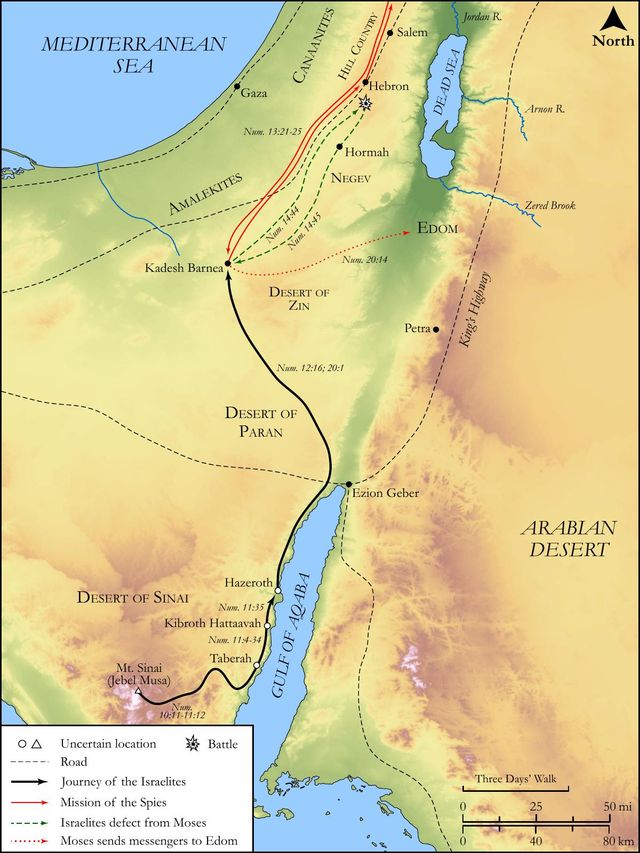
See on the biblical-era map
Study this verse
Public-domain commentary
Matthew Henry
From his Commentary on the Whole Bible. Henry comments on passages, not single verses — this entry covers Numbers 11:31–35.
God, having performed his promise to Moses by giving him assessors in the government, thereby proving the power he has over the spirits of men by his Spirit, he here performs his promise to the people by giving them flesh, proving thereby his power over the inferior creatures and his dominion in the kingdom of nature. Observe, 1. How the people were gratified with flesh in abundance: A wind (a south-east wind, as appears, Psa 78:26) brought quails, Num 11:31. It is uncertain what sort of animals they were; the psalmist calls them feathered fowl, or fowl of wing. The learned bishop Patrick inclines to agree with some modern writers, who think they were locusts, a delicious sort of food well known in those parts, the rather because they were brought with a wind, lay in heaps, and were dried in the sun for use. Whatever they were, they answered the intention, they served for a month's feast for Israel, such an indulgent Father was God to his froward family. Locusts, that had been a plague to fruitful Egypt, feeding upon the fruits, were a blessing to a barren wilderness, being themselves fed upon. 2. How greedy they were of this flesh that God sent them. They flew upon the spoil with an unsatiable appetite, not regarding what Moses had told them from God, that they would surfeit upon it, Num 11:32. Two days and a night they were at it, gathering flesh, till every master of a family had brought home ten homers (that is, ten ass-loads) at least. David longed for the water of the well of Bethlehem, but would not drink it when he had it, because it was obtained by venturing; much more reason these Israelites had to refuse this flesh, which was obtained by murmuring, and which, they might easily perceive, by what Moses said, was given them in anger; but those that are under the power of a carnal mind will have their lusts fulfilled, though it be to the certain damage and ruin of their precious souls. 3. How dearly they paid for their feasts, when it came into the reckoning: The Lord smote them with a very great plague (Num 11:33), some bodily disease, which probably was the effect of their surfeit, and was the death of many of them, and those, it is likely, the ringleaders in the mutiny. Note, God often grants the desires of his own people in love. He gave them their request, but sent leanness into their soul, Psa 106:15. By all that was said to them they were not estranged from their lusts, and therefore, while the meat was in their mouths, the wrath of God came upon them, Psa 78:30, Psa 78:31. What we inordinately desire, if we obtain it (we have reason to fear), will be some way or other a grief and cross to us. God satiated them first, and then plagued them, (1.) To save the reputation of his own power, that it might not be said, "He would not have cut them off had he been able to supply them." And, (2.) To show us the meaning of the prosperity of sinners; it is their preparation for ruin, they are fed as an ox for the slaughter. Lastly, The remembrance of this is preserved in the name given to the place, Num 11:34. Moses called it Kibroth-hattaavah, the graves of lusters or of lust. And well it had been if these graves of Israel's lusters had proved the graves of Israel's lust: the warning was designed to be so, but it had not its due effect, for it follows (Psa 78:32), For all this, they sinned still.
Continue studying Numbers 11:32 across the web’s major study libraries — every link below opens this exact verse, chapter, or book on the destination site.
Read & Compare
 BibleGatewayThis verse in more than 200 translations and 70 languages.
 Bible.comThe YouVersion reader — hundreds of translations, reading plans, and highlights.
 ESV.orgCrossway's official English Standard Version reader.
 NET BibleThe NET translation with 60,000+ translators' notes on every rendering decision.
 STEP BibleTyndale House's free study tool — original text, vocabulary, and scholarly resources.
 BibliaLogos Bible Software's free web reader.
 USCCBThe New American Bible (Revised Edition) with the U.S. bishops' study notes.
Commentaries
 BibleHub CommentariesDozens of classic commentaries on this verse, gathered on one page.
 StudyLightMore than 100 commentary sets — the largest collection on the web.
 BibleRefPlain-English commentary on what this verse means, verse by verse.
 Enduring WordDavid Guzik's free commentary on this chapter, widely used by Bible teachers.
 Bible Study ToolsVerse commentary alongside Greek and Hebrew study aids.
Original Language & Research
- BibleHub InterlinearThe verse word by word — original language, transliteration, and English.
- BibleHub LexiconEvery word's original-language definition and Strong's entry.
 Blue Letter BibleDeep-study tools — Strong's numbers, concordance, and word studies.
 SefariaThe Hebrew text with Rashi and centuries of Jewish commentary.
Sermons, Hymns & Audio


TrulyRandomVerse is not affiliated with these sites and doesn’t control their content. They’re linked because they’re genuinely useful.
Summary
Numbers 11:32 vividly recounts the Israelites' relentless and excessive gathering of quails, a miraculous yet punitive provision from God in the wilderness. This verse powerfully illustrates the sheer, overwhelming abundance of divine supply, even when given in judgment, while simultaneously exposing the people's insatiable craving, their insensitivity to God's gracious daily provision of manna, and their greedy, hoarding behavior that set the stage for swift divine consequence.
Context
ShowHideLiterary Context
Numbers 11:32 is strategically placed within a pivotal narrative in Numbers chapter 11, which details the Israelites' escalating discontent and God's multifaceted response. Following their miraculous deliverance from Egypt and the consistent, daily provision of manna, the mixed multitude among them, and subsequently the entire congregation, succumbed to a deep craving for meat, lamenting their former diet in Egypt and despising the manna (Numbers 11:4-6). Moses, burdened by their incessant complaints, expressed his profound despair to God (Numbers 11:11-15). In response to their ingratitude and lack of faith, God, in His righteous anger, promised to provide meat in such overwhelming abundance that it would become utterly loathsome to them (Numbers 11:18-20). This verse, Numbers 11:32, describes the immediate, intense fulfillment of that promise, directly preceding the severe plague that ensued at Kibroth-hattaavah ("graves of craving") (Numbers 11:33).
Historical & Cultural Context
The events of Numbers 11 unfold during Israel's protracted forty-year wilderness wandering, a period designed by God for their spiritual formation, discipline, and complete reliance on His divine provision. The setting is the desolate Sinai Peninsula, an arid environment where natural food sources were exceedingly scarce, rendering God's daily manna a continuous, supernatural miracle. Quails (Hebrew: selav), a migratory bird, are known to traverse the Sinai region, particularly during spring and autumn migrations. They often fly low and become exhausted, making them relatively easy to catch. The text specifies that a strong wind brought them, likely from the sea, and deposited them around the Israelite camp to a depth of "two cubits" (approximately three feet) above the ground for a day's journey in every direction (Numbers 11:31). This phenomenon, while having a basis in natural migration patterns, is clearly amplified and directed by divine intervention. The "camp" refers to the meticulously organized encampment of the Israelite tribes, centered around the Tabernacle, underscoring the communal nature of both their sin and God's response. The act of "spreading them abroad" was a common ancient method of food preservation, specifically drying or curing meat in the sun, indicating the people's intent to store the vast quantities they gathered.
Key Themes
ShowHideNumbers 11:32 powerfully encapsulates several profound themes central to the book of Numbers and the broader Pentateuch. It vividly illustrates the theme of Divine Provision and Judgment, showcasing God's absolute sovereignty and power to provide abundantly, even in the most desolate environments, yet also His righteous willingness to judge sin, particularly murmuring, ingratitude, and a lack of faith in His divine plan (Numbers 11:1). The excessive gathering highlights the pervasive theme of Human Greed and Discontent, revealing the Israelites' insatiable desires and their profound failure to trust in God's sufficient daily provision of manna (Numbers 11:6). Despite their miraculous deliverance and God's constant, faithful care, their hearts remained prone to craving and covetousness. This leads directly to the theme of Consequences of Rebellion, as the immediate aftermath of this excessive gathering is a severe plague, serving as a stark reminder that even when God grants desires born of sinful craving, the outcome can be devastatingly punitive and reveal the destructive nature of such desires (Numbers 11:33).
Exposition and Analysis
ShowHideKey Word Analysis
ShowHideThe verb "gathered" (אָסַף, H622) signifies collecting, bringing in, or assembling for a purpose. Its repeated use in the verse, especially in conjunction with the prolonged time frame ("all that day, and all that night, and all the next day"), underscores a continuous, relentless, and almost obsessive effort. This was not a casual collection but an intense, prolonged activity driven by an insatiable desire, highlighting the people's lack of moderation and their profound distrust in God's ongoing provision. The root also carries connotations of "taking away" or "removing," which ironically foreshadows the removal of life through the ensuing plague.
A "homer" (חֹמֶר, H2563) was a substantial unit of dry measure in ancient Israel, equivalent to ten ephahs or approximately 220 liters (about 6 bushels). The phrase "ten homers" (עֲשֶׂרֶת חֳמָרִים, 'aseret ḥomārîm') thus represents an astonishing quantity, far exceeding any immediate need for a single individual or family. The word chômer itself can mean "heap" or "pile," reinforcing the idea of an immense, piled-up quantity. This detail powerfully emphasizes the extraordinary scale of both God's provision and the people's extreme greed, indicating a hoarding mentality rather than a gathering for sustenance or sharing.
The term "day" (יוֹם, H3117) refers to a period of time, specifically the warm hours from sunrise to sunset, or a full 24-hour period. Its repetition, alongside "night" (לַיִל, H3915), in the phrase "all that day, and all that night, and all the next day" emphasizes the extraordinary duration and intensity of the gathering. This sustained, round-the-clock effort highlights the people's singular focus and overwhelming desire for the meat, demonstrating their covetousness and their complete disregard for rest or moderation in their pursuit of worldly gratification.
Verse Breakdown
ShowHide"And the people stood up all that day, and all [that] night, and all the next day,"
This opening clause vividly conveys the extraordinary duration and intensity of the Israelites' activity. It was not a brief, opportunistic collection but a sustained, round-the-clock effort, indicating their singular focus and overwhelming, almost obsessive, desire for the meat. This relentless pursuit underscores their covetousness and their profound lack of rest or moderation in their pursuit of fleshly gratification, contrasting sharply with the Sabbath rest and daily reliance on God's provision implied by the manna.
"and they gathered the quails:"
This concise statement identifies the object of their intense labor. The quails were the specific meat God had promised, delivered miraculously by a wind, covering the ground around the camp. This highlights the literal and immediate fulfillment of God's word, even if the context of the provision was judgment rather than pure blessing, showcasing God's power to provide exactly what was demanded, albeit with a severe consequence.
"he that gathered least gathered ten homers:"
This is a powerful, emphatic statement that underscores the truly immense quantities involved. It functions as hyperbole, emphasizing that even the person who exerted the least effort or had the smallest capacity still collected an amount that would be staggering for a single individual or family, far more than could be consumed quickly. This detail powerfully illustrates the widespread nature of the people's excessive greed and their communal engagement in hoarding, rather than simply satisfying a need.
"and they spread [them] all abroad for themselves round about the camp."
This final clause describes the practical method of preserving the vast quantities of quails. Spreading them out, likely in the sun, was a common ancient practice for drying and curing meat to prevent spoilage, indicating their intent to store them for future consumption. The phrase "for themselves" emphasizes the self-serving nature of their actions – they were accumulating vast stores for their own desires, rather than trusting God for daily provision or sharing equitably. "Round about the camp" indicates the sheer quantity covered the entire area, further illustrating the overwhelming abundance and the people's collective gluttony.
Literary Devices
ShowHideNumbers 11:32 is rich with literary devices that amplify its theological message. Hyperbole is powerfully employed in the statement "he that gathered least gathered ten homers," which exaggerates the minimum amount collected to underscore the truly astonishing quantity of quails and, by extension, the people's extreme greed and gluttony. The Repetition of temporal phrases ("all that day, and all that night, and all the next day") highlights the relentless, continuous, and obsessive nature of the people's gathering, emphasizing their insatiable desire and lack of moderation. There is a profound element of Irony in God's provision: He gives the people exactly what they crave, but the very abundance of this desired "blessing" becomes a vehicle for judgment, turning their coveted meat into a source of plague and death. Finally, the quails themselves function as Symbolism, representing both God's immense power to provide beyond measure and His severe displeasure with the people's grumbling, ingratitude, and profound lack of faith.
Theological and Thematic Connections
ShowHideNumbers 11:32 serves as a profound theological warning about the insidious dangers of discontent, ingratitude, and the pursuit of fleshly desires over spiritual sustenance. It reveals a God who is both infinitely powerful in provision and righteously just in judgment. While God provides what the people demand, the manner and excess of the provision expose their covetous hearts and lead directly to divine chastisement. This passage teaches that not all desires, even if granted by God, are beneficial or stem from a pure heart. It underscores the critical importance of cultivating contentment and trusting in God's wisdom regarding His provision, rather than succumbing to cravings that lead to excess, spiritual harm, and ultimately, judgment. The Israelites' insatiable hunger for meat, despite having miraculous manna, foreshadows humanity's persistent struggle with spiritual dissatisfaction and the pursuit of worldly gratification as a substitute for divine communion.
Reflection and Application
ShowHideNumbers 11:32 challenges us to deeply examine the desires of our own hearts and the objects of our pursuit. The Israelites, despite daily miraculous provision of manna, craved more, and their craving led to a destructive excess and divine judgment. This serves as a potent reminder that God can indeed grant our desires, but if those desires stem from discontent, greed, or a profound lack of trust in His sufficiency, the outcome may be detrimental to our spiritual, emotional, and even physical well-being. We are called to cultivate a spirit of profound gratitude for God's daily provisions and to find our ultimate contentment in Him alone, rather than constantly seeking external gratification or accumulating beyond need. This passage encourages us to discern carefully between legitimate needs and sinful cravings, recognizing that true and lasting satisfaction comes not from endless accumulation or the fulfillment of every desire, but from a humble reliance on God's perfect will and timing. It also highlights the seriousness of murmuring and ingratitude against God, reminding us that such attitudes can invite divine discipline and hinder our spiritual growth.
Questions for Reflection
ShowHideFAQ
ShowHideWhy did God provide so many quails if it was a punishment?
ShowHideGod's provision of an overwhelming abundance of quails, as described in Numbers 11:31-32, was a complex act that simultaneously demonstrated His immense power, fulfilled His specific promise, and served as a profound form of judgment. The Israelites had complained bitterly, demanding meat and despising the miraculous manna, thereby challenging God's provision and authority (Numbers 11:4-6). In His righteous anger, God promised to give them meat "until it come out at your nostrils, and it be loathsome unto you" (Numbers 11:20). The sheer, excessive quantity of quails, far more than they could possibly need or consume, was designed to expose their insatiable greed and turn their desired "blessing" into a burdensome and ultimately destructive experience. The "punishment" wasn't simply in the provision itself, but in the plague that immediately followed their gluttonous consumption, a direct consequence of their sinful craving, ingratitude, and lack of trust (Numbers 11:33). It illustrates a sobering truth: God sometimes gives people over to their sinful desires to reveal the destructive and unsatisfying nature of those desires, allowing the consequences to serve as a severe lesson.
Christ-Centered Fulfillment
ShowHideNumbers 11:32, with its stark depiction of Israel's insatiable craving for flesh and God's provision in judgment, finds profound Christ-centered fulfillment in the New Testament. The Israelites rejected the miraculous, daily manna—a divine provision that foreshadowed Christ—and longed for the fleeting satisfaction of earthly meat. This powerfully prefigures humanity's persistent tendency to seek satisfaction in worldly desires rather than in the spiritual nourishment offered by Jesus Christ. Jesus Himself is the ultimate "meat" that truly satisfies, the Bread of Life who came down from heaven, whose flesh and blood truly sustain eternal life (John 6:53-58). Unlike the quails, which brought a plague due to gluttonous craving, Christ's provision brings life, peace, and eternal satisfaction. The judgment that fell upon Israel for their discontent and covetousness points to the ultimate judgment for sin, which Christ bore on the cross, offering true freedom from the curse of insatiable desires and the bondage of sin (Galatians 3:13). He invites all who are spiritually hungry and thirsty to come to Him for lasting satisfaction, a spiritual feast that never leads to condemnation but to abundant and eternal life (Matthew 5:6; John 4:13-14). In Christ, we find true contentment and an end to the restless craving that plagued Israel.