


Exodus 16:36
Bible text: King James Version (1769 Blayney text) · Public domain
Bible text: Berean Standard Bible · Public domain
Bible text: American Standard Version (1901) · Public domain
Bible text: World English Bible, Messianic edition · Public domain
Bible text: Geneva Bible (1599) · Public domain
Bible text: Young's Literal Translation · Public domain
- וְהָעֹמֶרve·ha·'O·merand the omerH6016Conj-w ¦ Art ¦ N-msNoun Singular Masculine Absoluteוְandהָtheעֹמֶרomer
- עֲשִׂרִית'a·si·Rit[is] [the] tenth [part] ofH6224Adj-fscAdjective Numerical Position Singular Feminine Construct
- הָאֵיפָהha·'ei·Fahthe ephahH374Art ¦ N-fsNoun Singular Feminine Absoluteהָtheאֵיפָהephah
- הוּאHu'itH1931Pro-3msPronoun Personal 3rd Singular Masculine
English is a literal word-by-word gloss of the Hebrew, not the KJV's wording. Why?
This is the original text the KJV's translators worked from — each Hebrew word with its own literal English meaning in this verse, prepared by scholars at Tyndale House, Cambridge. The KJV translates whole sentences, not word by word, so its wording differs: one Hebrew word can become several English words, and the KJV may choose “the LORD” where the gloss reads “Yahweh”. Both are faithful — they answer different questions. For the KJV's own rendering, switch to the KJV text.
Details
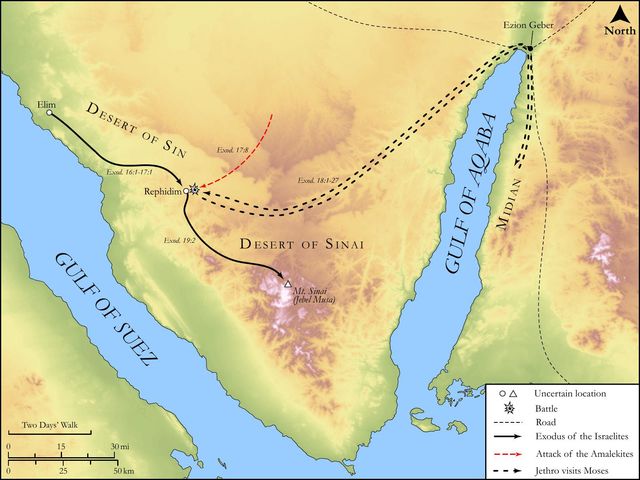
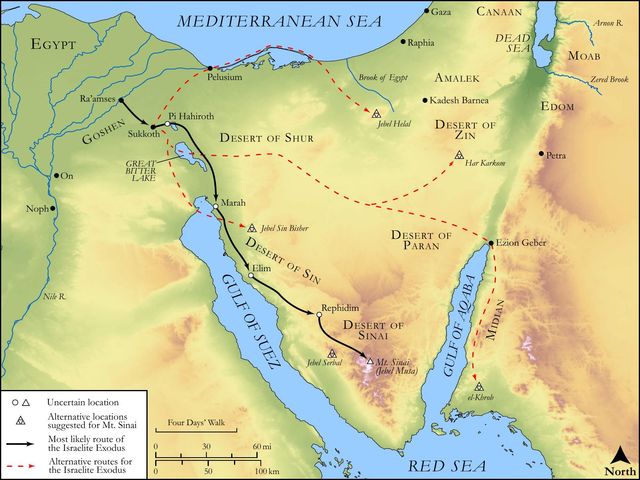
See on the biblical-era maps

Study this verse
Public-domain commentary
Matthew Henry
From his Commentary on the Whole Bible. Henry comments on passages, not single verses — this entry covers Exodus 16:32–36.
God having provided manna to be his people's food in the wilderness, and to be to them a continual feast, we are here told, 1. How the memory of it was preserved. An omer of this manna was laid up in a golden pot, as we are told (Heb 9:4), and kept before the testimony, or the ark, when it was afterwards made, Exo 16:32-34. The preservation of this manna from waste and corruption was a standing miracle, and therefore the more proper memorial of this miraculous food. "Posterity shall see the bread," says God, "wherewith I have fed you in the wilderness," see what sort of food it was, and how much each man's daily proportion of it was, that it may appear they were neither kept to hard fare nor to short allowance, and then judge between God and Israel, whether they had any cause given them to murmur and find fault with their provisions, and whether they and their seed after them had not a great deal of reason gratefully to won God's goodness to them. Note, Eaten bread must not be forgotten. God's miracles and mercies are to be had in everlasting remembrance, for our encouragement to trust in him at all times. 2. How the mercy of it was continued as long as they had occasion for it. The manna never ceased till they came to the borders of Canaan, where there was bread enough and to spare, Exo 16:35. See how constant the care of Providence is; seedtime and harvest fail not, while the earth remains. Israel was very provoking in the wilderness, yet the manna never failed them: thus still God causes his rain to fall on the just and unjust. The manna is called spiritual meat (Co1 10:3), because it was typical of spiritual blessings in heavenly things. Christ himself is the true manna, the bread of life, of which this was a figure, Joh 6:49-51. The word of God is the manna by which our souls are nourished, Mat 4:4. The comforts of the Spirit are hidden manna, Rev 2:17. These come from heaven, as the manna did, and are the support and comfort of the divine life in the soul, while we are in the wilderness of this world. It is food for Israelites, for those only that follow the pillar of cloud and fire. It is to be gathered; Christ in the word is to be applied to the soul, and the means of grace are to be used. We must every one of us gather for ourselves, and gather in the morning of our opportunities, which if we let slip, it may be too late to gather. The manna they gathered must not be hoarded up, but eaten; those that have received Christ must by faith live upon him, and not receive his grace in vain. There was manna enough for all, enough for each, and none had too much; so in Christ there is a complete sufficiency, and no superfluity. But those that did eat manna hungered again, died at last, and with many of them God was not well-pleased; whereas those that feed on Christ by faith shall never hunger, and shall die no more, and with them God will be for ever well pleased. The Lord evermore give us this bread!
Historical interpretation
Historical reception
1 surviving comment on this verse from the historical church.
Anyway, when the instruction is given to consecrate in a golden vessel the memorial of the food sent down by God from heaven, “the gomor,” it is written, “is a tenth part of three measures.” For our purposes, “three measures” means three sources of judgment: perception of sensible objects; reason, for evaluating sentences, nouns and verbs; and the intellect, for intelligible objects.
Continue studying Exodus 16:36 across the web’s major study libraries — every link below opens this exact verse, chapter, or book on the destination site.
Read & Compare
 BibleGatewayThis verse in more than 200 translations and 70 languages.
 Bible.comThe YouVersion reader — hundreds of translations, reading plans, and highlights.
 ESV.orgCrossway's official English Standard Version reader.
 NET BibleThe NET translation with 60,000+ translators' notes on every rendering decision.
 STEP BibleTyndale House's free study tool — original text, vocabulary, and scholarly resources.
 BibliaLogos Bible Software's free web reader.
 USCCBThe New American Bible (Revised Edition) with the U.S. bishops' study notes.
Commentaries
 BibleHub CommentariesDozens of classic commentaries on this verse, gathered on one page.
 StudyLightMore than 100 commentary sets — the largest collection on the web.
 BibleRefPlain-English commentary on what this verse means, verse by verse.
 Enduring WordDavid Guzik's free commentary on this chapter, widely used by Bible teachers.
 Bible Study ToolsVerse commentary alongside Greek and Hebrew study aids.
Original Language & Research
- BibleHub InterlinearThe verse word by word — original language, transliteration, and English.
- BibleHub LexiconEvery word's original-language definition and Strong's entry.
 Blue Letter BibleDeep-study tools — Strong's numbers, concordance, and word studies.
 SefariaThe Hebrew text with Rashi and centuries of Jewish commentary.
Sermons, Hymns & Audio


TrulyRandomVerse is not affiliated with these sites and doesn’t control their content. They’re linked because they’re genuinely useful.
Summary
Exodus 16:36 serves as a concise, parenthetical explanation within the unfolding narrative of God's miraculous provision of manna to the Israelites in the wilderness. This crucial verse precisely defines the relationship between two ancient Hebrew dry measures, the omer and the ephah, ensuring that future generations and readers fully grasp the exact quantities involved in the daily gathering of manna and, by extension, the meticulous, abundant, and faithful nature of God's provision for His beloved people.
Context
ShowHideLiterary Context
This verse is strategically placed at the culmination of the detailed instructions and narrative concerning the manna. The preceding verses in Exodus 16 meticulously describe the Israelites' murmuring for food after their deliverance from Egyptian bondage, God's gracious and immediate response by promising "bread from heaven" (Exodus 16:4), and the specific instructions for its daily collection—"an omer for every man, according to the number of your persons" (Exodus 16:16). The narrative also includes the critical Sabbath observance, where no manna fell, and the command to preserve an omer of manna as a perpetual memorial (Exodus 16:33). Exodus 16:36, therefore, functions as a vital clarification, ensuring the reader understands the precise scale of the daily miracle and the enduring significance of the preserved memorial. It provides a technical detail essential for comprehending the practicalities and immense scope of God's miraculous and sustained provision.
Historical & Cultural Context
The Israelites, a vast multitude estimated to be in the millions, had recently been freed from centuries of slavery and were traversing a barren, inhospitable wilderness, utterly dependent on God for their very sustenance. In the days of Moses, units of measure were absolutely crucial for trade, agriculture, and the orderly conduct of daily life, though their exact values could sometimes vary regionally. The inclusion of this precise definition of the omer in relation to the more common ephah highlights the meticulousness of the biblical record and its profound concern for historical accuracy and clarity. It bridges a potential knowledge gap for later generations, who might not have been familiar with the omer as a specific unit of measure, especially since it was primarily associated with the unique event of the manna. This exacting detail underscores the tangible reality of God's daily, consistent provision for a massive population over forty years, emphasizing that His divine care was not vague or arbitrary but exact, sufficient, and perfectly tailored for their every need.
Key Themes
ShowHideExodus 16:36, though seemingly a mere technical note, powerfully reinforces several overarching themes found throughout the book of Exodus and the Pentateuch. Primarily, it underscores the theme of Divine Precision and Order. God's provision is not haphazard but meticulously measured and delivered, reflecting His orderly character. This precision also speaks to God's Faithfulness and Sufficiency, demonstrating that He provides exactly what is needed—no more, no less—for His people's daily sustenance, fostering a profound sense of Dependence on God. The manna, measured by the omer, was a daily lesson in trusting God for "daily bread," preventing hoarding and cultivating reliance. Furthermore, the verse contributes to the theme of God's Covenantal Care, showing His intimate involvement in the practical details of His people's lives as He leads them through the wilderness toward the promised land, fulfilling His promises with exactitude and unwavering commitment. This meticulous detail also serves to establish the Veracity and Reliability of the Divine Word, assuring readers that the biblical account is grounded in tangible, measurable realities.
Exposition and Analysis
ShowHideKey Word Analysis
ShowHideFrom the root meaning "to heap," this noun properly refers to a heap or sheaf, but in this context, it denotes a specific dry measure. As defined here, it represents the precise daily allowance of manna per person, highlighting God's exact and sufficient provision for each individual. While its precise modern equivalent is debated, it is generally understood to be approximately 2.3 liters or about 2.5 quarts, a small, individual portion. Its significance here is its designation as the precise daily allowance of manna per person, highlighting God's exact and sufficient provision for each individual.
Of Egyptian derivation, this term refers to a standard unit of dry measure in ancient Israel, primarily used for grains and other commodities. It was a larger measure, roughly equivalent to 23 liters or 25 quarts. By defining the omer as a tenth of an ephah, the text grounds the specific manna measure within a more widely understood system of weights and measures, making its quantity comprehensible to a broader audience and underscoring the practicality of the divine instructions.
Derived from the word for "ten," this ordinal number explicitly states the precise mathematical relationship between the omer and the ephah. The exact ratio underscores the divine precision in the instructions for gathering manna, reinforcing the theme of God's orderliness, the careful fulfillment of His word, and the exactitude of His provision. It leaves no ambiguity regarding the scale of the daily miracle.
Verse Breakdown
ShowHide"Now an omer [is]"
This introductory phrase functions as a parenthetical clarification, signaling to the reader that the following information is a technical detail designed to aid understanding. It directly identifies the unit of measure that was central to the daily manna collection, drawing attention to its specific quantity.
"the tenth [part]"
This clause specifies the exact proportion of the omer in relation to a larger, more common unit. The use of a precise fraction, "the tenth part," emphasizes the meticulous nature of the divine instruction and provision, leaving no ambiguity about the quantity and reinforcing the theme of God's exactness.
"of an ephah."
This concluding phrase completes the definition by identifying the larger standard unit of measure to which the omer is being compared. By relating the omer to the ephah, the text provides essential context and scale, allowing readers to conceptualize the volume of manna involved in God's daily miracle and appreciate the sheer magnitude of His sustained provision.
Literary Devices
ShowHideExodus 16:36 primarily employs Parenthetical Explanation. This device is used to insert supplementary information that clarifies a point or provides crucial detail without interrupting the main flow of the narrative. In this case, the verse provides a technical definition essential for the reader's full comprehension of the manna account, particularly the precise quantities involved in the daily gathering and the preserved memorial. It functions as a Didactic Aside, educating the reader about ancient Hebrew measurements, thereby enhancing the historical and practical understanding of the text. The inclusion of such a precise detail also contributes significantly to the overall sense of Verisimilitude, lending credibility and authenticity to the biblical narrative by demonstrating a concern for factual accuracy and practical details, reinforcing the historical reality of the events described.
Theological and Thematic Connections
ShowHideThis seemingly technical verse, by defining the precise relationship between the omer and the ephah, subtly yet profoundly reinforces several key theological truths. It speaks to the meticulous nature of God, who is not only powerful enough to rain bread from heaven but also cares deeply about the exact quantity needed for each individual. This divine precision underscores God's inherent orderliness, His unwavering faithfulness in providing exactly what is required, and the absolute reliability of His instructions. It teaches a profound dependence on God for "daily bread," not in excess, but in perfect sufficiency, fostering trust and discouraging hoarding. The very act of defining the measure ensures clarity and underscores that God's provisions and commands are not arbitrary but are given with intentionality, exactness, and divine wisdom for the well-being of His people.
Reflection and Application
ShowHideExodus 16:36, though a technical detail, offers profound and enduring insights for contemporary believers. It serves as a powerful reminder that our God is a God of order, precision, and perfect sufficiency. He is intimately concerned with the minute details of our lives, providing exactly what we need, precisely when we need it, often in ways that teach us daily dependence rather than fostering self-sufficiency or promoting excess. This verse challenges us to cultivate a deep trust in God's meticulous care, even when His provision seems modest or just enough, and to recognize that His "daily bread" is precisely measured for our spiritual growth and our increasing reliance on Him. It also implicitly encourages us, as stewards of God's creation and resources, to be precise, clear, and just in our own dealings, reflecting the divine character of order, integrity, and careful stewardship in all aspects of our lives and communication.
Questions for Reflection
ShowHideFAQ
ShowHideWhy is this verse included in the Bible, given its technical nature?
ShowHideThis verse is included primarily as a parenthetical explanation to ensure the reader's full comprehension of the manna narrative. The omer was a specific unit of measure for the manna, and its exact quantity might not have been clear to later generations or those unfamiliar with ancient Hebrew measures. By defining it as "the tenth part of an ephah," the text provides a precise scale for understanding the daily provision for millions of Israelites. It underscores the historical accuracy and practical detail of the biblical account, reinforcing the miraculous nature of God's provision for His people in the wilderness, as described in Exodus 16. This detail lends credibility to the narrative by demonstrating the author's concern for factual precision.
What is the practical significance of knowing the exact measurements of the omer and ephah?
ShowHideKnowing the precise relationship between the omer and the ephah allows readers to grasp the immense scale and meticulousness of God's daily miracle. An omer was approximately 2.3 liters, meaning each person received about 2.3 liters of manna daily. For a population of potentially two million people, this translates to an astonishing amount of food—millions of liters every single day for forty years. This detail emphasizes the incredible, sustained faithfulness of God's provision, demonstrating that He supplied not just vaguely, but with exactness and abundance for every individual, as highlighted in Exodus 16:16. It showcases God's perfect planning and unfailing care for His people's most basic needs.
Christ-Centered Fulfillment
ShowHideWhile Exodus 16:36 is a technical detail, its context within the manna narrative points powerfully and prophetically to Christ. The manna itself was a miraculous, daily provision from heaven, sustaining Israel physically in the barren wilderness and serving as a type or shadow of a greater spiritual reality. Jesus, in His profound teaching, explicitly identifies Himself as the "true bread from heaven" (John 6:32), superior to the manna that sustained only physical life and ultimately led to death. He declares, "I am the bread of life; whoever comes to me shall not hunger, and whoever believes in me shall never thirst" (John 6:35). Just as the omer was the precise, sufficient daily measure for each Israelite, Christ is the perfectly sufficient and complete provision for our spiritual hunger, given by God's meticulous grace and divine plan. He is the fulfillment of the Old Testament shadows, the ultimate and enduring sustenance for our spiritual journey, teaching us that "man shall not live by bread alone, but by every word that comes from the mouth of God" (Matthew 4:4). The preserved omer of manna in the ark (Hebrews 9:4) served as a perpetual reminder of God's faithful provision, just as the Person of Christ is the enduring reality of God's perfect, precisely planned salvation, available to all who believe.