


Romans 9:25
Bible text: King James Version (1769 Blayney text) · Public domain
Bible text: Berean Standard Bible · Public domain
Bible text: American Standard Version (1901) · Public domain
Bible text: World English Bible, Messianic edition · Public domain
Bible text: Geneva Bible (1599) · Public domain
Bible text: Young's Literal Translation · Public domain
- ὡςhōsAsG5613PRTParticle or Disjunctive
- καὶkaialsoG2532CONJConjunction
- ἐνeninG1722PREPPreposition
- τῷtō<the>G3588T-DSMDefinite article Dative Singular Masculine
- ὩσηὲHōsēeHoseaG5617N-DSM-PNoun Dative Singular Masculine Individual
- λέγει·legeiHe saysG3004V-PAI-3SVerb Present Active Indicative 3rd Singular
- καλέσωkalesōI will callG2564V-FAI-1SVerb Future Active Indicative 1st Singular
- τὸνtonthat which [is]G3588T-ASMDefinite article Accusative Singular Masculine
- οὐounotG3756PRT-NNegative Particle Negative
- λαόνlaonpeopleG2992N-ASMNoun Accusative Singular Masculine
- μουmouof MineG3165P-1GSPersonal pronoun Genitive 1st Singular
- λαόνlaonpeopleG2992N-ASMNoun Accusative Singular Masculine
- μουmouof MineG3165P-1GSPersonal pronoun Genitive 1st Singular
- καὶkaiandG2532CONJConjunction
- τὴνtēnher whoG3588T-ASFDefinite article Accusative Singular Feminine
- οὐκouknotG3756PRT-NNegative Particle Negative
- ἠγαπημένηνēgapēmenēnlovedG25V-RPP-ASFVerb Perfect Passive Participle Accusative Singular Feminine
- ἠγαπημένηνēgapēmenēnlovedG25V-RPP-ASFVerb Perfect Passive Participle Accusative Singular Feminine
English is a literal word-by-word gloss of the Greek, not the KJV's wording. Why?
This is the original text the KJV's translators worked from — each Greek word with its own literal English meaning in this verse, prepared by scholars at Tyndale House, Cambridge. The KJV translates whole sentences, not word by word, so its wording differs: one Greek word can become several English words, and the KJV may choose “charity” where the gloss reads “love”. Both are faithful — they answer different questions. For the KJV's own rendering, switch to the KJV text.
Details
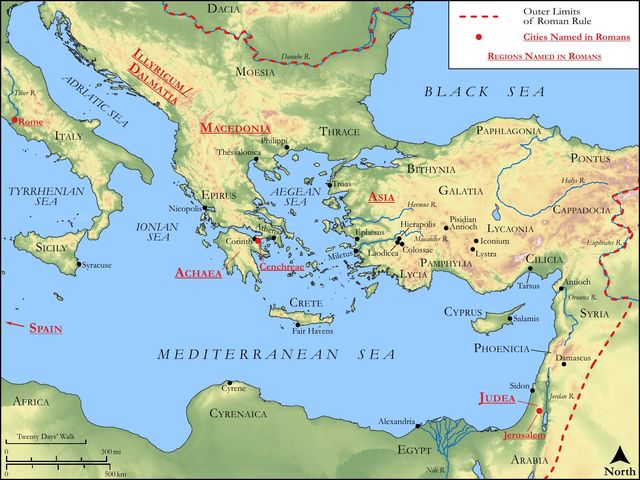
See on the biblical-era maps

Study this verse
Public-domain commentary
Matthew Henry
From his Commentary on the Whole Bible. Henry comments on passages, not single verses — this entry covers Romans 9:25–29. His three-level outline is real structure in the source text, so it is rendered as structure.
Having explained the promise, and proved the divine sovereignty, the apostle here shows how the rejection of the Jews, and the taking in of the Gentiles, were foretold in the Old Testament, and therefore must needs be very well consistent with the promise made to the fathers under the Old Testament. It tends very much to the clearing of a truth to observe how the scripture is fulfilled in it. The Jews would, no doubt, willingly refer it to the Old Testament, the scriptures of which were committed to them. Now he shows how this, which was so uneasy to them, was there spoken of.
I.By the prophet Hosea, who speaks of the taking in of a great many of the Gentiles, Hos 2:23 and Hos 1:10.
The Gentiles had not been the people of God, not owning him, nor being owned by him in that relation: "But," says he, "I will call them my people, make them such and own them as such, notwithstanding all their unworthiness." A blessed change! Former badness is no bar to God's present grace and mercy. - And her beloved which was not beloved. Those whom God calls his people he calls beloved: he loves those that are his own. And lest it might be supposed that they should become God's people only by being proselyted to the Jewish religion, and made members of that nation, he adds, from Hos 1:10, In the place where it was said, etc., there shall they be called. They need not be embodied with the Jews, nor go up to Jerusalem to worship; but, wherever they are scattered over the face of the earth, there will God own them. Observe the great dignity and honour of the saints, that they are called the children of the living God; and his calling them so makes them so. Behold, what manner of love! This honour have all his saints.
II.By the prophet Isaiah, who speaks of the casting off of many of the Jews, in two places.
1.One is Isa 10:22, Isa 10:23, which speaks of the saving of a remnant, that is, but a remnant, which, though in the prophecy it seems to refer to the preservation of a remnant from the destruction and desolation that were coming upon them by Sennacherib and his army, yet is to be understood as looking further, and sufficiently proves that it is no strange thing for God to abandon to ruin a great many of the seed of Abraham, and yet maintain his word of promise to Abraham in full force and virtue. This is intimated in the supposition that the number of children of Israel was as the sand of the sea, which was part of the promise made to Abraham, Gen 22:17. And yet only a remnant shall be saved; for many are called, but few are chosen. In this salvation of the remnant we are told (Rom 9:28) from the prophet,
(1.)That he will complete the work: He will finish the work. When God begins he will make an end, whether in ways of judgment or of mercy. The rejection of the unbelieving Jews god would finish in their utter ruin by the Romans, who soon after this quite took away their place and nation. The assuming of Christian churches into the divine favour, and the spreading of the gospel in other nations, was a work which God would likewise finish, and be known by his name JEHOVAH. As for God, his work is perfect. Margin, He will finish the account. God, in his eternal counsels, has taken an account of the children of men, allotted them to such or such a condition, to such a share of privileges; and, as they come into being, his dealings with them are pursuant to these counsels: and he will finish the account, complete the mystical body, call in as many as belong to the election of grace, and then the account will be finished.
(2.)That he will contract it; not only finish it, but finish it quickly. Under the Old Testament he seemed to tarry, and to make a longer and more tedious work of it. The wheels moved but slowly towards the extent of the church; but now he will cut it short, and make a short work upon the earth. Gentile converts were now flying as a cloud. But he will cut it short in righteousness, both in wisdom and in justice. Men, when they cut short, do amiss; they do indeed despatch causes; but, when God cuts short, it is always in righteousness. So the fathers generally apply it. Some understand it of the evangelical law and covenant, which Christ has introduced and established in the world: he has in that finished the work, put an end to the types and ceremonies of the Old Testament. Christ said, It is finished, and then the veil was rent, echoing as it were to the word that Christ said upon the cross. And he will cut it short. The work (it is logos - the word, the law) was under the Old Testament very long; a long train of institutions, ceremonies, conditions: but now it is cut short. Our duty is now, under the gospel, summed up in much less room than it was under the law; the covenant was abridged and contracted; religion is brought into a less compass. And it is in righteousness, in favour to us, in justice to his own design and counsel. With us contractions are apt to darken things: -
- Brevis esse laboro, Obscurus fio -
I strive to be concise, but prove obscure.
but it is not so in this case. Though it be cut short, it is clear and plain; and, because short, the more easy.
2.Another is quoted from Isa 1:9, where the prophet is showing how in a time of general calamity and destruction God would preserve a seed. This is to the same purport with the former; and the scope of it is to show that it was no strange thing for God to leave the greatest part of the people of the Jews to ruin, and to reserve to himself only a small remnant: so he had done formerly, as appears by their own prophets; and they must not wonder if he did so now. Observe,
(1.)What God is. He is the Lord of sabaoth, that is, the Lord of hosts - a Hebrew word retained in the Greek, as Jam 5:4. All the host of heaven and earth are at his beck and disposal. When God secures a seed to himself out of a degenerate apostate world, he acts as Lord of sabaoth. It is an act of almighty power and infinite sovereignty.
(2.)What his people are; they are a seed, a small number. The corn reserved for next year's seedings is but little, compared with that which is spent and eaten. But they are a useful number - the seed, the substance, of the next generation, Isa 6:13. It is so far from being an impeachment of the justice and righteousness of God that so many perish and are destroyed, that it is a wonder of divine power and mercy that all are not destroyed, that there are any saved; for even those that are left to be a seed, if God had dealt with them according to their sins, had perished with the rest. This is the great truth which this scripture teacheth us.
Historical interpretation
Three Centuries of Reception
5 surviving comments on this verse. Each one is dated, so this reads as a timeline rather than a list.
Select a marker to jump to its quote. Markers stagger vertically where authors wrote within a few decades of each other.
And proclaim in what sense .
and Him who, by His Son Christ Jesus, has called us to the knowledge of Himself, from the worship of stones, so that those who were not a people were made a people, and she beloved who was not beloved.
And it shall come to pass, that in the place where it was said, This is not a people, there shall they be called the children of the living God."
It is clear that this was said about the Gentiles, who once were not God’s people, but afterward, to the chagrin of the Jews, received mercy and are called God’s people. Once they were not loved, but when the Jews fell away they were adopted as children and are now loved, so that where once they were not called God’s people, now they are called children of the living God.
"I will call them My people, which were not My people; and her beloved, which was not beloved." Here to prevent their saying, that you are deceiving us here with specious reasoning, he calls Hosea to witness, who crieth and saith, "I will call them My people, who were not My people." Who then are the not-people? Plainly, the Gentiles. And who the not-beloved? The same again. However, he says, that they shall become at once people, and beloved, and sons of God.
The gist of the entire argument leads to this conclusion. Paul taught that we do good by the mercy of God and that the Jews who had received the gospel should not glory in their works, thinking that they had deserved this and not wanting it to be given to the Gentiles. In Paul’s mind, the Jews should cease from such pride and understand that if we are called to faith not through our own works but by the mercy of God and if it is given to those who believe to do good, then they should not begrudge the Gentiles this mercy as if it had been given to the Jews on the ground of prior merit, which is nothing.
This passage originally applied to Jews, not to Gentiles.… It meant that God’s people would lose their status and be called “Not my people” and “Not beloved.” But then God promised that the rejected Jews would be called back again. Thus from having been God’s people and then rejected they would return.… The Gentiles, on the other hand, would become God’s people for the first time, having never been his people before.
Continue studying Romans 9:25 across the web’s major study libraries — every link below opens this exact verse, chapter, or book on the destination site.
Read & Compare
 BibleGatewayThis verse in more than 200 translations and 70 languages.
 Bible.comThe YouVersion reader — hundreds of translations, reading plans, and highlights.
 ESV.orgCrossway's official English Standard Version reader.
 NET BibleThe NET translation with 60,000+ translators' notes on every rendering decision.
 STEP BibleTyndale House's free study tool — original text, vocabulary, and scholarly resources.
 BibliaLogos Bible Software's free web reader.
 USCCBThe New American Bible (Revised Edition) with the U.S. bishops' study notes.
Commentaries
 BibleHub CommentariesDozens of classic commentaries on this verse, gathered on one page.
 StudyLightMore than 100 commentary sets — the largest collection on the web.
 BibleRefPlain-English commentary on what this verse means, verse by verse.
 Enduring WordDavid Guzik's free commentary on this chapter, widely used by Bible teachers.
 Bible Study ToolsVerse commentary alongside Greek and Hebrew study aids.
Original Language & Research
- BibleHub InterlinearThe verse word by word — original language, transliteration, and English.
- BibleHub LexiconEvery word's original-language definition and Strong's entry.
 Blue Letter BibleDeep-study tools — Strong's numbers, concordance, and word studies.
 CNTR CollationThe earliest Greek manuscripts of this verse, collated letter by letter.
Sermons, Hymns & Audio


TrulyRandomVerse is not affiliated with these sites and doesn’t control their content. They’re linked because they’re genuinely useful.
Summary
Romans 9:25 serves as a crucial scriptural anchor in Paul's defense of God's sovereign election and the unexpected inclusion of Gentiles into the covenant people. Quoting from the prophet Hosea, Paul demonstrates that God's redemptive plan has always encompassed the calling of those who were not His chosen people, extending His mercy and transforming outsiders into His beloved family, thereby validating the present reality of Gentile believers as part of the true Israel.
CONTEXT
ShowHideLiterary Context: Romans 9 initiates a pivotal section (chapters 9-11) where Paul grapples with the profound theological dilemma of Israel's rejection of their Messiah and God's apparent faithfulness to His covenant promises. Having established the universal need for salvation and justification by faith in chapters 1-8, Paul now addresses the specific question of Israel's status. He argues that God's promises are not nullified, but rather that His election has always been based on His sovereign choice, not human descent or works. Romans 9:25, along with other Old Testament citations, functions as a prophetic proof-text, showing that the inclusion of those "not my people" (Gentiles) was always part of God's design, foreshadowed in Hosea's prophecy concerning the restoration of unfaithful Israel. This verse immediately follows Paul's assertion that God's election is not based on human will or effort but on His mercy, as seen in His choice of Jacob over Esau (Romans 9:10-13).
Historical & Cultural Context: In Paul's time, the concept of a covenant people was deeply ingrained in Jewish identity, rooted in their lineage from Abraham and the Mosaic Law. The idea that Gentiles, who were considered "outsiders" and "unclean," could become part of God's people on equal footing with Jews was revolutionary and often scandalous. This tension was a major source of conflict within the early Christian church, particularly between Jewish and Gentile believers. Paul's argument in Romans 9-11 directly addresses this cultural and theological divide, asserting that God's plan transcends ethnic boundaries. The original prophecy in Hosea (specifically Hosea 1:9 and Hosea 2:23) was given to Israel during a period of deep spiritual apostasy. God symbolically named Hosea's children "Lo-Ammi" ("not my people") and "Lo-Ruhamah" ("not pitied" or "not beloved") to signify His temporary rejection of unfaithful Israel. However, the prophecy also contained a promise of future restoration and renewed covenant relationship, where God would reverse these judgments. Paul, by quoting this, applies the principle of God calling the "uncalled" to the Gentiles, demonstrating God's consistent character of extending mercy beyond initial covenant boundaries.
Key Themes:
Exposition and Analysis
ShowHideKey Word Analysis
ShowHideThis verb signifies "to call" or "to summon," often with the implication of inviting or naming. In the context of divine action, it carries the weight of a sovereign invitation or appointment, indicating God's initiative in bringing individuals into a particular status or relationship. Here, it highlights that the transformation from "not my people" to "my people" is entirely God's doing, a result of His powerful and purposeful summons.
This term refers to a "people" in general, often used in the Septuagint (Greek Old Testament) to denote the chosen people of God, Israel. Paul's use of "my people" and "not my people" directly echoes Hosea's symbolic language for Israel's rejection and restoration. By applying it to Gentiles, Paul redefines the boundaries of "God's people" to include those who were formerly outside the covenant, emphasizing that this new "people" is formed by divine election and grace, not ethnic lineage.
Derived from the verb "to love," this word signifies a deep, unconditional, and self-sacrificial love. In Hosea, "not beloved" (Lo-Ruhamah) symbolized God's temporary withdrawal of compassion from unfaithful Israel. Paul's quotation, "her beloved, which was not beloved," emphasizes God's profound and transformative affection. It underscores that God's decision to call and embrace the Gentiles is rooted in His boundless love, extending His favor to those who had no prior claim to it.
Verse Breakdown
ShowHide"As he saith also in Osee,"
Paul introduces his Old Testament citation, attributing it to the prophet Hosea (Osee is the Greek form of Hosea). This immediately signals that the inclusion of Gentiles is not a novel idea but has prophetic roots, demonstrating the continuity of God's plan across testaments. It underscores the divine authority behind Paul's argument.
"I will call them my people, which were not my people;"
This is a direct quotation, primarily from Hosea 2:23, though also echoing Hosea 1:10. In its original context, it referred to God's promise to restore unfaithful Israel, reversing the symbolic judgment of "Lo-Ammi" ("not my people"). Paul applies this principle expansively to the Gentiles, who were truly "not my people" in the covenant sense. It highlights God's sovereign power to transform identity and status, bringing those who were alienated into a familial relationship with Himself.
"and her beloved, which was not beloved."
This phrase, also from Hosea 2:23, reinforces the previous clause. "Not beloved" (Lo-Ruhamah) originally symbolized God's temporary lack of pity or compassion for Israel due to their unfaithfulness. By reversing this, God promises to show mercy and love. Paul applies this to the Gentiles, who were inherently "not beloved" in the sense of not being the recipients of God's special covenantal love, yet are now made "beloved" through His gracious initiative. This emphasizes the unmerited nature of God's favor extended to them.
Literary Devices
ShowHidePaul's use of Quotation/Allusion is central to Romans 9:25. By directly quoting Hosea, he grounds his revolutionary theological claims about Gentile inclusion in the established authority of the Old Testament prophets. This serves to legitimize the Gentile mission to a Jewish audience and demonstrates the continuity of God's redemptive plan. Furthermore, Paul employs Typology, interpreting Hosea's prophecy concerning the restoration of unfaithful Israel as a type or pattern for God's calling of the Gentiles. The principle of God reversing a state of rejection and declaring "not my people" to be "my people" is applied to a new, broader context. The verse also features powerful Antithesis or Contrast: "not my people" versus "my people," and "not beloved" versus "beloved." This stark juxtaposition highlights the radical transformation wrought by God's sovereign grace, emphasizing the dramatic shift in status from alienation to intimate relationship, from exclusion to inclusion. This rhetorical device underscores the magnitude of God's mercy.
Theological and Thematic Connections
ShowHideRomans 9:25 profoundly illustrates the boundless nature of God's grace and His sovereign prerogative in salvation. It reveals that God's redemptive plan was never exclusively limited to an ethnic lineage but always contained the capacity for a wider, inclusive embrace. Theologically, it affirms that God's election is an act of unmerited favor, not based on human merit or prior status. Those who were once outside the covenant, without hope and alienated from God, are now, by His divine initiative, brought near and declared to be His own cherished people. This truth dismantles any notion of human boasting or self-righteousness, placing the entirety of salvation firmly in the hands of a merciful and sovereign God who calls the "uncalled" and loves the "unloved."
Reflection and Application
ShowHideRomans 9:25 offers profound comfort and a radical redefinition of identity for all believers, especially those who once felt distant from God or unworthy of His love. It reminds us that our standing before God is not earned through heritage, good works, or any human effort, but is a pure gift of His sovereign, unmerited mercy. If you have ever felt like an outsider, "not my people" or "not beloved," this verse declares that God's expansive grace reaches precisely to those places of alienation. Through faith in Christ, we are transformed from strangers and foreigners into fellow citizens with the saints and members of God's household. This truth should cultivate deep humility, profound gratitude, and unwavering confidence in God's unfailing love. It calls us to live lives that reflect this radical grace, extending the same mercy and welcome to others that God has so lavishly extended to us. Our identity as God's "people" and "beloved" is a divine declaration, not a human achievement, empowering us to live in the security of His embrace.
Questions for Reflection
ShowHideFAQ
ShowHideWhy does Paul quote from Hosea, a prophet who spoke to Israel, to justify the inclusion of Gentiles?
ShowHidePaul's genius lies in his theological interpretation and application of Old Testament prophecy. While Hosea's prophecy originally addressed God's temporary rejection and promised future restoration of unfaithful Israel (symbolized by the names "Lo-Ammi" and "Lo-Ruhamah" for Hosea's children), Paul sees in this a broader principle of God's sovereign mercy. The core idea is God's power and willingness to reverse a state of alienation and declare "not my people" to be "my people." Paul argues that this principle is not limited to Israel's restoration but extends to the Gentiles, who were truly "not God's people" in a covenantal sense. Thus, God's historical action with Israel serves as a type or pattern for His present action in calling the Gentiles into His family. This demonstrates that the inclusion of Gentiles was not an afterthought but was consistent with God's character and foreshadowed in His divine word, validating the current reality of the church, which comprises both Jews and Gentiles (Ephesians 2:11-19).
Does Romans 9:25 imply that God has rejected ethnic Israel permanently?
ShowHideNo, Romans 9:25, when understood within the broader context of Romans 9-11 as a whole, does not imply God's permanent rejection of ethnic Israel. Paul explicitly addresses this in Romans 11:1-2 by asking, "I say then, Hath God cast away his people? God forbid." He then goes on to explain that there is a remnant of Israel chosen by grace (Romans 11:5), and that Israel's hardening is only partial and temporary, serving a purpose in bringing salvation to the Gentiles (Romans 11:11-12). Ultimately, Paul affirms that "all Israel will be saved" (Romans 11:26), indicating a future restoration for the nation. Romans 9:25 highlights God's sovereign freedom to call the Gentiles, but this does not negate His ongoing covenant faithfulness to Israel.
Christ-Centered Fulfillment
ShowHideRomans 9:25 finds its ultimate and most profound fulfillment in the person and work of Jesus Christ. The "calling" of those who were "not my people" and "not beloved" is made possible exclusively through Christ's redemptive sacrifice. He is the Lamb of God who takes away the sin of the world (John 1:29), breaking down the dividing wall of hostility between Jew and Gentile and creating one new humanity in Himself (Ephesians 2:14-16). Through faith in Christ, individuals from every nation, tribe, and tongue, who were once alienated from God and without hope, are now reconciled to Him and adopted into His family, becoming children of God (John 1:12). Jesus's mission was to seek and save the lost (Luke 19:10), extending God's call and love to those among the outcasts. He embodies the very mercy and love of God that transforms the "not beloved" into the "beloved," making peace through the blood of His cross (Colossians 1:20). Thus, the prophetic words of Hosea, applied by Paul to the Gentiles, are fully realized in the inclusive, reconciling, and transforming power of the Gospel of Jesus Christ.