


John 16:27
- αὐτὸςautosHimselfG846P-NSMPersonal pronoun Nominative Singular Masculine
- γὰρgarforG1063CONJConjunction
- ὁhotheG3588T-NSMDefinite article Nominative Singular Masculine
- πατὴρpatērFatherG3962N-NSM-TNoun Nominative Singular Masculine Title
- φιλεῖphileilovesG5368V-PAI-3SVerb Present Active Indicative 3rd Singular
- ὑμᾶςhumasyouG4771P-2APPersonal pronoun Accusative 2nd Plural
- ὅτιhotibecauseG3754CONJConjunction
- ὑμεῖςhumeisyou yourselvesG4771P-2NPPersonal pronoun Nominative 2nd Plural
- ἐμὲemeMe myselfG1473P-1ASPersonal pronoun Accusative 1st Singular
- πεφιλήκατεpephilēkatehave lovedG5368V-RAI-2PVerb Perfect Active Indicative 2nd Plural
- καὶkaiandG2532CONJConjunction
- πεπιστεύκατεpepisteukatehave believedG4100V-RAI-2PVerb Perfect Active Indicative 2nd Plural
- ὅτιhotithatG3754CONJConjunction
- ἐγὼegōI myselfG1473P-1NSPersonal pronoun Nominative 1st Singular
- παρὰparafromG3844PREPPreposition
- τοῦtou<the>G3588T-GSMDefinite article Genitive Singular Masculine
- θεοῦtheouGodG2316N-GSM-TNoun Genitive Singular Masculine Title
- ἐξῆλθονexēlthoncame forthG1831V-2AAI-1SVerb 2nd Aorist Active Indicative 1st Singular
English is a literal word-by-word gloss of the Greek, not the KJV's wording. Why?
This is the original text the KJV's translators worked from — each Greek word with its own literal English meaning in this verse, prepared by scholars at Tyndale House, Cambridge. The KJV translates whole sentences, not word by word, so its wording differs: one Greek word can become several English words, and the KJV may choose “charity” where the gloss reads “love”. Both are faithful — they answer different questions. For the KJV's own rendering, switch to the KJV text.
Details
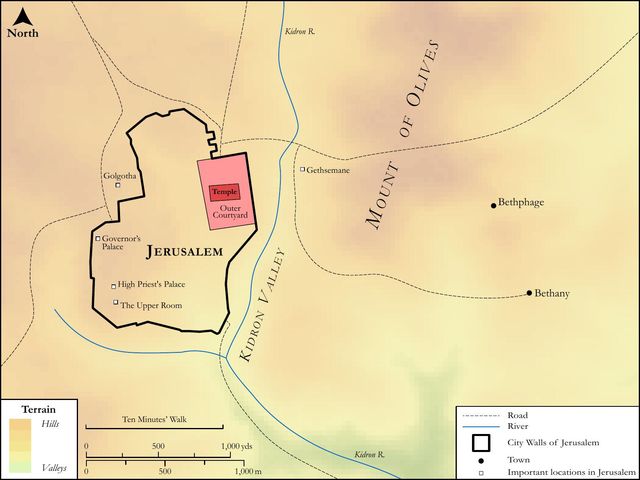
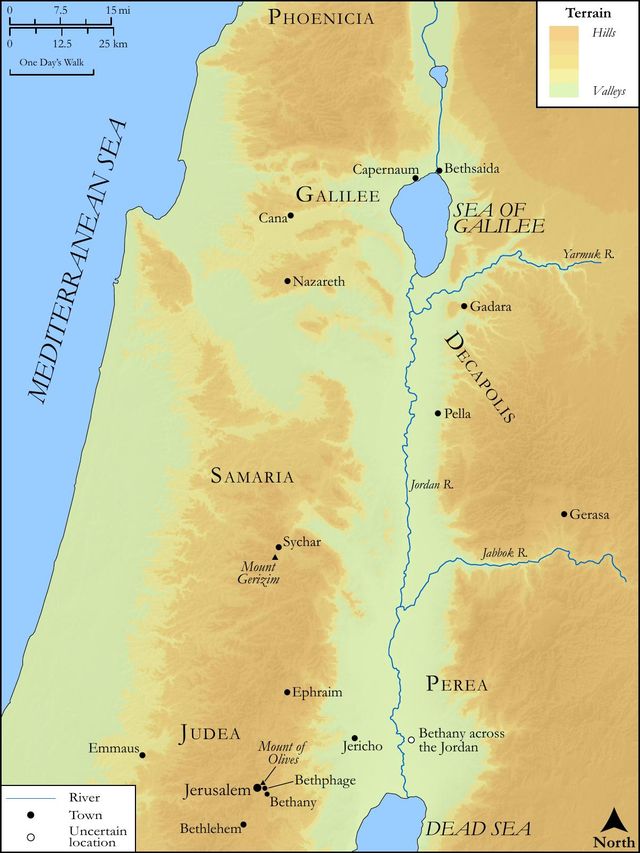
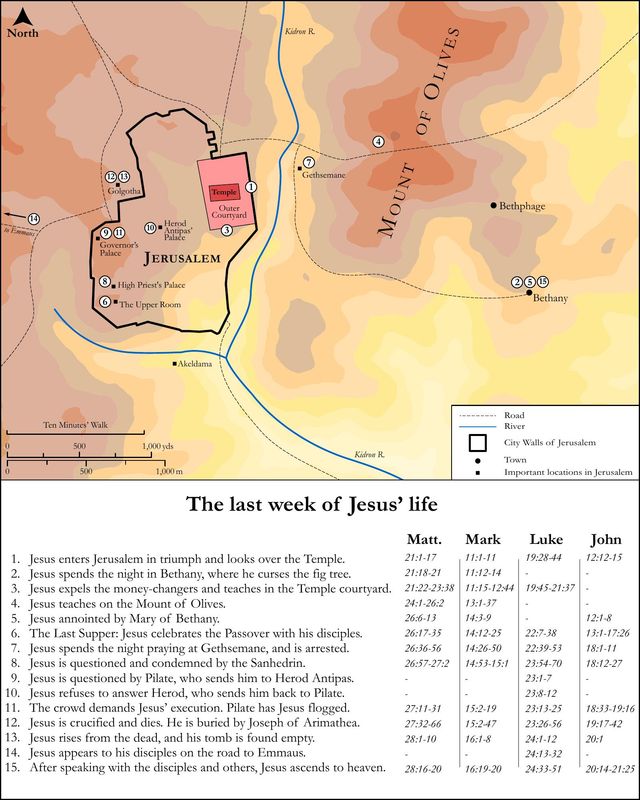
See on the biblical-era map
Study this verse
Public-domain commentary
Matthew Henry
From his Commentary on the Whole Bible. Henry comments on passages, not single verses — this entry covers John 16:23–27. His four-level outline is real structure in the source text, so it is rendered as structure.
An answer to their askings is here promised, for their further comfort. Now there are two ways of asking: asking by way of enquiry, which is the asking of the ignorant; and asking by way of request, which is the asking of the indigent. Christ here speaks of both.
I.By way of enquiry, they should not need to ask (Joh 16:23):
"In that day you shall ask me nothing;" ouk erōtēsete ouden - you shall ask no questions; "you shall have such a clear knowledge of gospel mysteries, by the opening of your understandings, that you shall not need to enquire" (as Heb 8:11, they shall not teach); "you shall have more knowledge on a sudden than hitherto you have had by diligent attendance." They had asked some ignorant questions (as Joh 9:2), some ambitious questions (as Mat 18:1), some distrustful ones (as Mat 19:27), some impertinent ones, (as Joh 21:21), some curious ones (as Act 1:6); but after the Spirit was poured out, nothing of all this. In the story of the apostles' Acts we seldom find them asking questions, as David, Shall I do this? Or, Shall I go thither? For they were constantly under a divine guidance. In that weighty case of preaching the gospel to the Gentiles, Peter went, nothing doubting, Act 10:20. Asking questions supposes us at a loss, or at least at a stand, and the best of us have need to ask questions; but we should aim at such a full assurance of understanding that we may not hesitate, but be constantly led in a plain path both of truth and duty.
Now for this he gives a reason (Joh 16:25), which plainly refers to this promise, that they should not need to ask questions: "These things have I spoken unto you in proverbs, in such a way as you have thought not so plain and intelligible as you could have wished, but the time cometh when I shall show you plainly, as plainly as you can desire, of the Father, so that you shall not need to ask questions."
1.The great thing Christ would lead them into was the knowledge of God: "I will show you the Father, and bring you acquainted with him." This is that which Christ designs to give and which all true Christians desire to have. When Christ would express the greatest favour intended for his disciples, he tells them that it would, show them plainly of the Father; for what is the happiness of heaven, but immediately and everlastingly to see God? To know God as the Father of our Lord Jesus Christ is the greatest mystery for the understanding to please itself with the contemplation of; and to know him as our Father is the greatest happiness for the will and affections to please themselves with the choice and enjoyment of.
2.Of this he had hitherto spoken to them in proverbs, which are wise and instructive sayings, but figurative, and resting in generals. Christ had spoken many things very plainly to them, and expounded his parables privately to the disciples, but,
(1.)Considering their dulness, and unaptness to receive what he said to them, he might be said to speak in proverbs; what he said to them was as a book sealed, Isa 29:11.
(2.)Comparing the discoveries he had made to them, in what he had spoken to their ears, with what he would make to them when he would put his Spirit into their heart, all hitherto had been proverbs. It would be a pleasing surprise to themselves, and they would think themselves in a new world, when they would reflect upon all their former notions as confused and enigmatical, compared with their present clear and distinct knowledge of divine things. The ministration of the letter was nothing to that of the Spirit, Co2 3:8-11.
(3.)Confining it to what he had said of the Father, and the counsels of the Father. what he had said was very dark, compared with what was shortly to be revealed, Col 2:2.
3.He would speak to them plainly, parrēsia - with freedom, of the Father. When the Spirit was poured out, the apostles attained to a much greater knowledge of divine things than they had before, as appears by the utterance the Spirit gave them, Act 2:4. They were led into the mystery of those things of which they had previously a very confused idea; and what the Spirit showed them Christ is here said to show them, for, as the Father speaks by the Son, so the Son by the Spirit. But this promise will have its full accomplishment in heaven, where we shall see the Father as he is, face to face, not as we do now, through a glass darkly (Co1 13:12), which is matter of comfort to us under the cloud of present darkness, by reason of which we cannot order our speech, but often disorder it. While we are here, we have many questions to ask concerning the invisible God and the invisible world; but in that day we shall see all things clearly, and ask no more questions.
II.He promises that by way of request they should ask nothing in vain.
it is taken for granted that all Christ's disciples give themselves to prayer. He has taught them by his precept and pattern to be much in prayer; this must be their support and comfort when he had left them; their instruction, direction, strength, and success, must be fetched in by prayer. Now,
1.Here is an express promise of a grant, Joh 16:23. The preface to this promise is such as makes it inviolably sure, and leaves no room to question it: "Verily, verily, I say unto you, I pledge my veracity upon it." The promise itself is incomparably rich and sweet; the golden sceptre is here held out to us, with the word, What is thy petition, and it shall be granted? For he says, Whatsoever you shall ask the Father in my name, he will give it to you. We had it before, Joh 14:13. What would we more? The promise is as express as we can desire.
(1.)We are here taught how to seek; we must ask the Father in Christ's name; we must have an eye to God as a Father, and come as children to him; and to Christ as Mediator, and come as clients. Asking of the Father includes a sense of spiritual blessings, with a conviction that they are to be had from God only. It included also humility of address to him, with a believing confidence in him, as a Father able and ready to help us. Asking in Christ's name includes an acknowledgment of our own unworthiness to receive any favour from God, a complacency in the method God has taken of keeping up a correspondence with us by his Son, and an entire dependence upon Christ as the Lord our Righteousness.
(2.)We are here told how we shall speed: He will give it to you. What more can we wish for than to have what we want, nay, to have what we will, in conformity to God's will, for the asking? He will give it to you from whom proceedeth every good and perfect gift. What Christ purchased by the merit of his death, he needed not for himself, but intended it for, and consigned it to, his faithful followers; and having given a valuable consideration for it, which was accepted in full, by this promise he draws a bill as it were upon the treasury in heaven, which we are to present by prayer, and in his name to ask for that which is purchased and promised, according to the true intent of the new covenant. Christ had promised them great illumination by the Spirit, but they must pray for it, and did so, Act 1:14. God will for this be enquired of. He had promised them perfection hereafter, but what shall they do in the mean time? They must continue praying. Perfect fruition is reserved for the land of our rest; asking and receiving are the comfort of the land of our pilgrimage.
2.Here is an invitation for them to petition. It is thought sufficient if great men permit addresses, but Christ calls upon us to petition, Joh 16:24.
(1.)He looks back upon their practice hitherto: Hitherto have you asked nothing in my name. This refers either [1.] To the matter of their prayers: "You have asked nothing comparatively, nothing to what you might have asked, and will ask when the Spirit is poured out." See what a generous benefactor our Lord Jesus is, above all benefactors; he gives liberally, and is so far from upbraiding us with the frequency and largeness of his gifts that he rather upbraids us with the seldomness and straitness of our requests: "You have asked nothing in comparison of what you want, and what I have to give, and have promised to give." We are told to open our mouth wide. Or, [2.] To the name in which they prayed. They prayed many a prayer, but never so expressly in the name of Christ as now he was directing them to do; for he had not as yet offered up that great sacrifice in the virtue of which our prayers were to be accepted, nor entered upon his intercession for us, the incense whereof was to perfume all our devotions, and so enable us to pray in his name. Hitherto they had cast out devils, and healed diseases, in the name of Christ, as a king and a prophet, but they could not as yet distinctly pray in his name as a priest.
(2.)He looks forward to their practice for the future: Ask and you shall receive, that your joy may be full. Here,
[1.]He directs them to ask for all that they needed and he had promised.
[2.]He assures them that they shall receive. What we ask from a principle of grace God will graciously give: You shall receive it. There is something more in this than the promise that he will give it. He will not only give it, but give you to receive it, give you the comfort and benefit of it, a heart to eat of it, Ecc 6:2.
[3.]That hereby their joy shall be full. This denotes, First. The blessed effect of the prayer of faith; it helps to fill up the joy of faith. Would we have our joy full, as full as it is capable of being in this world, we must be much in prayer. When we are told to rejoice evermore, it follows immediately, Pray without ceasing. See how high we are to aim in prayer - not only at peace, but joy, a fulness of joy. Or, Secondly, The blessed effects of the answer of peace: "Ask, and you shall receive that which will fill your joy." God's gifts, through Christ, fill the treasures of the soul, they fill its joy, Pro 8:21. "Ask for the gift of the Holy Ghost, and you shall receive it; and whereas other knowledge increaseth sorrow (Ecc 1:18), the knowledge he gives will increase, will fill, your joy."
3.Here are the grounds upon which they might hope to speed (Joh 16:26, Joh 16:27), which are summed up in short by the apostle (Jo1 2:1): "We have an advocate with the Father."
(1.)We have an advocate; as to this, Christ saw cause at present not to insist upon it, only to make the following encouragement shine the brighter: "I say not unto you that I will pray the Father for you. Suppose I should not tell you that I will intercede for you, should not undertake to solicit every particular cause you have depending there, yet it may be a general ground of comfort that I have settled a correspondence between you and God, have erected a throne of grace, and consecrated for you a new and living way into the holiest." He speaks as if they needed not any favours, when he had prevailed for the gift of the Holy Ghost to make intercession within them, as Spirit of adoption, crying Abba, Father; as if they had no further need of him to pray for them now, but we shall find that he does more for us than he says he will. Men's performances often come short of their promises, but Christ's go beyond them.
(2.)We have to do with a Father, which is so great an encouragement that it does in a manner supersede the other: "For the Father himself loveth you, philei humas, he is a friend to you, and you cannot be better befriended." Note, The disciples of Christ are the beloved of God himself. Christ not only turned away God's wrath from us, and brought us into a covenant of peace and reconciliation, but purchased his favour for us, and brought us into a covenant of friendship. Observe what an emphasis is laid upon this "The Father himself loveth you, who is perfectly happy in the enjoyment of himself, whose self-love is both his infinite rectitude and his infinite blessedness; yet he is pleased to love you." The Father himself, whose favour you have forfeited, and whose wrath you have incurred, and with whom you need an advocate, he himself now loves you. Observe,
[1.]Why the Father loved the disciples of Christ: Because you have loved me, and have believed that I am come from God, that is, because you are my disciples indeed: not as if the love began on their side, but when by his grace he has wrought in us a love to him he is well pleased with the work of his own hands. See here, First, What is the character of Christ's disciples; they love him, because they believe he came out from God, is the only-begotten of the Father, and his high-commissioner to the world. Note, Faith in Christ works by love to him, Gal 5:6. If we believe him to be the Son of God, we cannot but love him as infinitely lovely in himself; and if we believe him to be our Saviour, we cannot but love him as the most kind to us. Observe with what respect Christ is pleased to speak of his disciples' love to him, and how kindly he took it; he speaks of it as that which recommended them to his Father's favour: "You have loved me and believed in me when the world has hated and rejected me; and you shall be distinguished yourselves." Secondly, See what advantage Christ's faithful disciples have, the Father loves them, and that because they love Christ; so well pleased is he in him that he is well pleased with all his friends.
[2.]What encouragement this gave them in prayer. They need not fear speeding when they came to one that loved them, and wished them well. First, This cautions us against hard thoughts of God. When we are taught in prayer to plead Christ's merit and intercession, it is not as if all the kindness were in Christ only, and in God nothing but wrath and fury; no, the matter is not so, the Father's love and good-will appointed Christ to be the Mediator; so that we owe Christ's merit to God's mercy in giving him for us. Secondly, Let it cherish and confirm in us good thoughts of God. Believers, that love Christ, ought to know that God loves them, and therefore to come boldly to him as children to a loving Father.
Historical interpretation
Nine Centuries of Reception
7 surviving comments on this verse. Each one is dated, so this reads as a timeline rather than a list.
Select a marker to jump to its quote. Markers stagger vertically where authors wrote within a few decades of each other.
For how shall he not be loved for whose sake the only-begotten Son is sent from the Father's bosom, the Word of faith, the faith which is superabundant; the Lord Himself distinctly confessing and saying, "For the Father Himself loveth you, because ye have loved Me; "
When we ask God for something, there is no need for intermediaries. And he is no more disposed to help us because he is asked by others than if we ourselves ask. For he wants us to seek things from him often. This pleases him very much. For it is in this alone that he becomes our debtor: Every time we pray to him, he is pleased and freely gives us what we have not loaned him. And should he see someone who is in need fervently praying to him, he will himself pay down for us what he has not received from us. But if we pray in an indifferent manner, he will be indifferent to our request—not because he does not want to give but because our prayer is acceptable only when we pray to him with all our hearts.Nor does God put off the granting of our prayers because he detests them or because he is against us. But he does clearly wish, by delaying his giving, to keep us close to himself; just as fathers who love their children tenderly will withhold a gift from children who are lazy and indifferent in order to teach them to persevere. And have your prayers been heard? Then give thanks because your prayers have been heard. And have your prayers not been heard? Keep praying so that they may be heard.… For, though you may be helpless and without a protector, if you cry out to God himself you shall most certainly be heard.
(Tr. ci. 4) The word ask here means not only to seek for, but to ask a question: the Greek word from which it is translated has both meanings.
(Tr. cii) But does He love us because we love Him; or rather do not we love Him, because He loved us? This is what the Evangelist says, Let us love God, because God first loved us. (1 John 4:19) The Father then loves us, because we love the Son, (Diligamus Deum, Vulg.) it being from the Father and the Son, that we receive the love from the Father and the Son. He loves what He has made; but He would not make in us what He loved, except He loved us in the first place.
(Tr. cii) He came forth from the Father, because He is of the Father; He came into the world, because He showed Himself in the body to the world. He left the world by His departure in the body, and went to the Father by the ascension of His humanity, nor yet in respect of the government of His presence, left the world; just as when He went forth from the Father and came into the world, He did so in such wise as not to leave the Father. But our Lord Jesus Christ, we read, was asked questions, and petitioned after His resurrection: for when about to ascend to Heaven He was asked by His disciples when He would restore the kingdom to Israel; when in Heaven He was asked by Stephen, to receive his spirit. And who would dare to say that as mortal He might be asked, as immortal He might not? I think then that when He says, In that day ye shall ask Me nothing, He refers not to the time of His resurrection, but to that time when we shall see Him as He is: which vision is not of this present life, but of the life everlasting, when we shall ask for nothing, ask no questions, because there will remain nothing to be desired, nothing to be learnt.
(Tr. cii) The word whatsoever, must not be understood to mean any thing, but something which with reference to obtaining the life of blessedness is not nothing. That is not sought in the Saviour's name, which is sought to the hindering of our salvation; for by, in My name, must be understood not the mere sound of the letters or syllables, but that which is rightly and truly signified by that sound. He who holds any notion concerning Christ, which should not be held of the only Son of God, does not ask in His name. But he who thinks rightly of Him, asks in His name, and receives what he asks, if it be not against his eternal salvation: he receives when it is right he should receive; for some things are only denied at present in order to be granted at a more suitable time. Again, the words, He will give it you, only comprehend those benefits which properly appertain to the persons who ask. All saints are heard for themselves, but not for all; for it is not, will give, simply, but, will give you; what follows: Hitherto have ye asked nothing in My name, may be understood in two ways: either that they had not asked in His name, because they had not known it as it ought to be known; or, Ye have asked nothing, because with reference to obtaining the thing ye ought to ask for, what ye have asked for is to be counted nothing. That therefore they may ask in His name not for what is nothing, but for the fulness of joy, He adds, Ask and ye shall receive, that your joy may be full. This full joy is not carnal, but spiritual joy; and it will be full, when it is so great that nothing can be added to it.
(1. de Trin. c. 8) And this is that full joy, than which nothing can be greater, viz. to enjoy God, the Trinity, in the image of Whom we are made.
(Tr. cii) Whatsoever then is asked, which appertained to the getting this joy, this must be asked in the name of Christ. For His saints that persevere in asking for it, He will never in His divine mercy disappoint. But whatever is asked beside this is nothing, i. e. not absolutely nothing, but nothing in comparison (computatione) with so great a thing as this. It follows: These things have I spoken unto you in proverbs: but the time cometh, when I shall no more speak unto you in proverbs, but I shall show you plainly of the Father. The hour of which He speaks may be understood of the future life, when we shall see Him, as the Apostle saith, face to face, (1 Cor. 13:12) and, These things have I spoken to you in proverbs, of that which the Apostle saith, Now we see as in a glass darkly. But I will show you that the Father shall be seen through the Son; For no man knoweth the Father save the Son, and he to whom the Son shall reveal Him. (Mat. 11:17)
(Tr. cii. c. 3) But this sense seems to be interfered with by what follows: At that day ye shall ask in My name. What shall we have to ask for in a future life, when all our desires shall be satisfied? Asking implies the want of something. It remains then that we understand the words of Jesus going to make His disciples spiritual, from being carnal and natural beings. The natural man so understands whatever he hears of God in a bodily sense, as being unable to conceive any other. Wherefore whatever Wisdom saith of the incorporeal, immutable substance are proverbs to him, not that he accounts them proverbs, but understands them as if they were proverbs. But when, become spiritual, he hath begun to discern all things, though in this life he see but in a glass and in part, ye doth he perceive, not by bodily sense, not by idea of the imagination, but by most sure intelligence of the mind, perceive and hold that God is not body, but spirit: the Son showeth so plainly of the Father, that He who showeth is seen to be of the same nature with Him who is shewn. Then they who ask, ask in His name, because by the sound of that name they understand nothing but the thing itself which is expressed by that name. These are able to think that our Lord Jesus Christ, in so far as He is man, intercedes with the Father for us, in so far as He is God, hears us together with the Father: which I think is His meaning when He says, And I say not unto you that I will pray the Father for you. To understand this, viz. how that the Son does not ask the Father, but Father and Son together hear those who ask, is beyond the reach of any but the spiritual vision.
"For the Father Himself," He says, "loveth you, because ye have loved me." Is it the case, then, that He loveth, because we love; or rather, that we love, because He loveth? Let this same evangelist give us the answer out of his own epistle: "We love Him," he says, "because He first loved us." This, then, was the efficient cause of our loving, that we were loved. And certainly to love God is the gift of God. He it was that gave the grace to love Him, who loved while still unloved. Even when displeasing Him we were loved, that there might be that in us whereby we should become pleasing in His sight. For we could not love the Son unless we loved the Father also. The Father loveth us, because we love the Son; seeing it is of the Father and Son we have received the power to love both the Father and the Son: for love is shed abroad in our hearts by the Spirit of both, by which Spirit we love both the Father and the Son, and whom we love along with the Father and the Son. God, therefore, it was that wrought this religious love of ours whereby we worship God; and He saw that it is good, and on that account He Himself loved that which He had made. But He would not have wrought in us something He could love, were it not that He loved ourselves before He wrought it.
And in saying this, He shows us too, to our profit, that very acceptable to God the Father is the honour and love which we have towards His Offspring. Not understanding this, the miserable people of the Jews did not shrink from assailing Him with intolerable blasphemies, and sought to kill Him, according to the Scripture, because of the conversion of the mind of His believers from the obscure commandment of the Law to the clearness of the life according to the Gospel. For these wretched men said in their ignorance, or rather in their desire to sharpen their blasphemous tongues against Him, If this man were from God, He would not have broken the Sabbath day. He says then, that God the Father will very readily vouchsafe His favour to those who have undoubting faith, and are well assured that He came out from God the Father. For the Father will, as it were, He says, hail in advance, and anticipate, the request of the Mediator, and overwhelm with spiritual blessings the mind of those who have a right understanding concerning Me, and not according to the imaginations of those who are too much enamoured of the letter of the Law.
And by the words I came out from God, we must surmise that He means either I was begotten from, and manifested Myself out of, His Substance (the words being taken with reference to what goes before as to His existing in a sense independently of His Father but not altogether separately from Him; for the Father is in the Son, and the Son again by Nature in the Father); or we must take the words "I came out from," as meaning I became even as you are; that is, a Man, endued with your form and nature. For the peculiar nature of any being may be conceived of as the place from which it proceeds, when it is transformed into anything else and becomes what it was not before. We are indeed far from asserting that when He took the form of man even as ourselves, being at the same time truly the Only-begotten, He divested Himself of His Godhead. For He is the same yesterday, and today, yea and for ever. But when He took upon Himself a nature that was not His own, while at the same time He retained His peculiar attributes, He may be conceived of as having come forth from God, in a sense appropriate to this passage. You may take, if you choose, the words I came forth from the Father, in yet another sense, as follows: The Pharisees, only apt in error, as I have already said, thought that Christ came before the world like one of the false prophets, with no mission from God, but of His own motion; inasmuch as they were accustomed to point out to those that went to Him, that Christ's teaching conflicted with the Law. And for this reason they considered Him guilty of disobedience, declaring that the keeping of the Law is most acceptable to God the Father, but it was broken by His teaching. They therefore rejected Christ as an enemy of God, and as having chosen to oppose the dispensation given to them from Him through Moses, and argued that He was for this reason an alien from God. But not so the blessed disciples. For they loved Him, and had their minds exalted above the madness of the Jews, and they had a genuine faith that He came out from God, as we have just been told. For this cause then were they beloved of the Father, and were requited, as it were, by receiving equal favour from Him. And if they who believe that the Son came out from God are very dear and acceptable to God the Father, surely they who are diseased with the contrary opinion are accursed and abominable in God's sight. And if God is very ready to hearken to those who love the Son, clearly He will not accept the prayers of His enemies; and this is what is said by the mouth of Isaiah to them: And when ye spread forth your hands to Me, I will hide Mine eyes from you; yea, when ye make many prayers I will not hear: your hands are full of blood.
He still cheers them with the promise that help will be given them from above in their temptations: At that day ye shall ask in My Name. And ye will be so in favour with the Father, that ye will no longer need my intervention: And I say not unto you that I will pray the Father for you, for the Father Himself loveth you. But that they might not start back from our Lord, as though they were no longer in need of Him, He adds, Because ye have loved Me: as if to say, The Father loves you, because ye have loved Me; when therefore ye fall from My love, ye will straightway fall from the Fathers love.
Continue studying John 16:27 across the web’s major study libraries — every link below opens this exact verse, chapter, or book on the destination site.
Read & Compare
 BibleGatewayThis verse in more than 200 translations and 70 languages.
 Bible.comThe YouVersion reader — hundreds of translations, reading plans, and highlights.
 ESV.orgCrossway's official English Standard Version reader.
 NET BibleThe NET translation with 60,000+ translators' notes on every rendering decision.
 STEP BibleTyndale House's free study tool — original text, vocabulary, and scholarly resources.
 BibliaLogos Bible Software's free web reader.
 USCCBThe New American Bible (Revised Edition) with the U.S. bishops' study notes.
Commentaries
 BibleHub CommentariesDozens of classic commentaries on this verse, gathered on one page.
 StudyLightMore than 100 commentary sets — the largest collection on the web.
 BibleRefPlain-English commentary on what this verse means, verse by verse.
 Enduring WordDavid Guzik's free commentary on this chapter, widely used by Bible teachers.
 Bible Study ToolsVerse commentary alongside Greek and Hebrew study aids.
Original Language & Research
- BibleHub InterlinearThe verse word by word — original language, transliteration, and English.
- BibleHub LexiconEvery word's original-language definition and Strong's entry.
 Blue Letter BibleDeep-study tools — Strong's numbers, concordance, and word studies.
 CNTR CollationThe earliest Greek manuscripts of this verse, collated letter by letter.
Sermons, Hymns & Audio


TrulyRandomVerse is not affiliated with these sites and doesn’t control their content. They’re linked because they’re genuinely useful.
Summary
John 16:27 offers a profound declaration from Jesus, assuring His disciples that God the Father holds a direct, personal love for them. This intimate affection from the Father is explicitly linked to the disciples' own genuine love for Jesus and their steadfast belief in His divine origin and unique relationship with God. This verse serves as a powerful source of comfort and a cornerstone for understanding the intimate, reciprocal nature of the divine-human relationship established through Christ.
Context
ShowHideLiterary Context
This verse is situated within Jesus' Farewell Discourse, spanning John 13 through John 17. Delivered in the upper room on the night before His crucifixion, this discourse is Jesus' final, extended teaching to His disciples, preparing them for His physical departure, the coming of the Holy Spirit, and the challenges they would face. Specifically, John 16:27 follows Jesus' explanation in John 16:26 that in the coming era, they would pray directly to the Father in Jesus' name, and Jesus would not need to ask the Father on their behalf in the same way, because the Father Himself already loves them. This transition underscores a new level of direct access and intimacy with God the Father, mediated not by a constant intercession but by an established, inherent divine love.
Historical & Cultural Context
The disciples were in a state of deep confusion and distress, grappling with the impending reality of Jesus' departure. Their understanding of God's relationship with humanity was largely framed by the Old Covenant, where access to God was often mediated through priests, sacrifices, and the Temple system. The idea of the Creator of the universe having a direct, personal "love" (phileo, a tender affection) for individual believers, without the need for constant human intercession, would have been revolutionary and immensely comforting. Furthermore, Jesus' assertion "I came out from God" challenged conventional Jewish messianic expectations, emphasizing His unique divine nature and origin, which was a stumbling block for many but foundational for His true followers.
Key Themes
ShowHideJohn 16:27 powerfully encapsulates several core themes woven throughout Jesus' Farewell Discourse and the broader Gospel of John. Firstly, it highlights the intimate and personal nature of God the Father's love for His people, emphasizing that this love is not merely a general benevolence but a direct, affectionate regard. Secondly, it underscores the reciprocal relationship between divine love and human response, showing that the Father's love is extended to those who have genuinely loved Jesus and believed in His divine origin. This reciprocal dynamic is a hallmark of the New Covenant. Lastly, the verse strongly reaffirms Jesus' divine identity and unique relationship with the Father, solidifying the foundational truth that He is truly "from God," a concept central to the entire Gospel's Christology, as seen in passages like John 1:1-18.
Exposition and Analysis
ShowHideKey Word Analysis
ShowHideThis term (G5368) denotes a tender, affectionate love, akin to the love between friends or family members. Unlike agapáō (G25), which signifies a broader, unconditional, and often self-sacrificial love, philéō emphasizes personal attachment and sentiment. Its use here for both the Father's love for the disciples and the disciples' love for Jesus highlights a shared, intimate affection, suggesting a responsive and relational bond.
This verb (G1831), meaning "to issue forth" or "to go out from," strongly emphasizes Jesus' origin and source. It is not merely a physical departure but signifies a divine procession or mission, underscoring that Jesus' very being and purpose originate directly from God the Father. This phrase affirms His pre-existence and divine commission.
This noun (G2316) refers to the supreme Divinity, the ultimate Creator and Ruler of the universe. In this context, "from God" signifies the divine realm, emphasizing Jesus' unique and unparalleled relationship with the divine essence. It asserts His divine nature and authority, distinguishing Him from mere human prophets or teachers.
Verse Breakdown
ShowHide"For the Father himself loveth you,"
This opening clause emphasizes the directness and personal nature of God the Father's affection. The inclusion of "himself" (Greek: autós) intensifies the statement, assuring the disciples that God's love for them is not merely mediated through Jesus' intercession, but is an inherent, active disposition from the Father's own heart. It signifies a profound, unmerited, and intimate divine regard for those who are in Christ.
"because ye have loved me,"
This specifies the first reason or condition for the Father's direct love. The disciples' genuine, affectionate love (phileo) for Jesus is presented not as a meritorious act that earns God's love, but as a responsive relationship that aligns them with the Father's will and heart. Their personal attachment to Jesus is recognized and reciprocated by the Father.
"and have believed that I came out from God."
This provides the second, equally crucial reason. The disciples' intellectual and spiritual assent to Jesus' divine origin and unique identity is foundational. Their faith in Jesus as truly God incarnate, sent directly from the Father, is a prerequisite for experiencing this direct, intimate love from God. This belief signifies a true understanding and acceptance of who Jesus is, beyond merely a human teacher or prophet.
Literary Devices
ShowHideThe verse employs several significant literary devices. Causality is explicitly established through the use of "because," clearly linking the Father's love to the disciples' love and belief in Jesus. This creates a logical and theological framework for understanding the divine-human relationship. Emphasis is achieved through the phrase "the Father himself," which underscores the direct, unmediated nature of God's love, moving beyond the need for constant intercession for the disciples' sake. Furthermore, the verse demonstrates Reciprocity, highlighting a dynamic exchange: the disciples' love for Jesus and faith in His divine origin are met with the Father's personal love for them. This reciprocal pattern reflects the relational core of the Christian faith.
Theological and Thematic Connections
ShowHideJohn 16:27 stands as a powerful testament to the New Covenant reality of direct access to God and the profound intimacy available to believers. It redefines the relationship between God and humanity, moving beyond a distant, transactional dynamic to one of personal, affectionate love. This verse assures believers that their love for Jesus and their faith in His divine identity are not only pleasing to God but are the very grounds upon which the Father extends His direct, personal affection. It underscores the Trinitarian unity in salvation, where the Father's love is expressed through the Son, and our response to the Son brings us into the Father's embrace. This direct love empowers believers to approach God with confidence, knowing they are cherished children, not distant subjects.
Reflection and Application
ShowHideJohn 16:27 offers immense comfort and a profound sense of security for every believer. To know that the Creator of the universe, the Almighty Father, personally "loves" you with a tender, affectionate love – not merely a general benevolence – transforms one's understanding of their standing before God. This verse invites us to rest in the assurance that our relationship with God is not precarious or dependent on our perfect performance, but is rooted in our genuine love for Jesus and our belief in who He is. It emboldens us to approach God in prayer with confidence, knowing that He delights in us because we delight in His Son. This truth should ignite a deeper love for Jesus within us, knowing that our affection for Him is deeply valued by the Father, and it should strengthen our conviction in Jesus' divine identity, which is the very foundation of our faith and our relationship with God.
Questions for Reflection
ShowHideFAQ
ShowHideWhat is the significance of Jesus saying "the Father himself loveth you" rather than simply stating that the Father loves them through Him?
ShowHideThe phrase "the Father himself loveth you" (KJV) or "the Father himself loves you" (NIV/ESV) is profoundly significant because it emphasizes the direct, unmediated, and personal nature of God the Father's affection for believers. While Jesus is indeed the mediator who makes access to the Father possible, this statement assures the disciples that the Father's love for them is not merely a consequence of Jesus' intercession, but an inherent, active disposition. It suggests a new level of intimacy in the New Covenant, where believers are brought into a direct, loving relationship with God the Father, based on their relationship with His Son. This means believers can approach God's throne of grace with confidence, knowing they are personally cherished by the Father, not just tolerated or accepted through a proxy.
What is the distinction between the Greek words philéō and agapáō for "love" in this context, and why is philéō used here?
ShowHideThe Greek language has multiple words for "love," with philéō (φιλέω) and agapáō (ἀγαπάω) being two prominent ones. Agapáō (often transliterated as agape) typically denotes a broader, unconditional, self-sacrificial, and volitional love, often associated with God's divine, initiating love for humanity, as seen in John 3:16. Philéō (often transliterated as phileo), used in John 16:27, describes a tender, affectionate, and personal love, akin to friendship or familial fondness. Its use here for both the Father's love for the disciples and the disciples' love for Jesus highlights a shared, responsive affection. It suggests that the Father's love for those who love Jesus is a personal, intimate delight, a relational warmth that reciprocates their own affection for His Son. This choice of word emphasizes the personal bond and mutual sentiment within the divine-human relationship.
Christ-Centered Fulfillment
ShowHideJohn 16:27, while a direct declaration of the Father's love, is profoundly Christ-centered in its fulfillment. Jesus Himself is the very reason and means by which this direct, intimate love from the Father is extended to humanity. The clause "because ye have loved me, and have believed that I came out from God" explicitly links the Father's affection to the Son. It is through Jesus' incarnation—His coming "out from God" to dwell among us—that humanity gains access to the Father's heart. His life, death, and resurrection reconcile us to God, making us adopted children and heirs. Without Jesus, this direct, personal love would remain inaccessible due to sin. He is the "way, the truth, and the life," and no one comes to the Father except through Him (John 14:6). Thus, Jesus is not merely the messenger of the Father's love; He is the living embodiment and the very foundation of that love, making it possible for us to be deeply cherished by God, not because of our own merit, but because of our faith in Him and His finished work on the cross (Romans 5:8). Our access to the Father's direct love is a testament to the ultimate fulfillment of God's redemptive plan in Christ.