


John 13:33
- τεκνίαtekniaLittle childrenG5040N-VPNNoun Vocative Plural Neuter
- ἔτιetiyetG2089ADVAdverb
- μικρὸνmikrona little whileG3398A-ASNAdjective Accusative Singular Neuter
- μεθ᾽meth᾽withG3326PREPPreposition
- ὑμῶνhumōnyouG4771P-2GPPersonal pronoun Genitive 2nd Plural
- εἰμιeimiI amG1510V-PAI-1SVerb Present Active Indicative 1st Singular
- ζητήσετέzētēseteYou will seekG2212V-FAI-2PVerb Future Active Indicative 2nd Plural
- μεmeMeG3165P-1ASPersonal pronoun Accusative 1st Singular
- καὶkaiandG2532CONJConjunction
- καθὼςkathōseven asG2531CONJConjunction
- εἶπονeiponI saidG2036V-2AAI-1SVerb 2nd Aorist Active Indicative 1st Singular
- τοῖςtoisto theG3588T-DPMDefinite article Dative Plural Masculine
- ἸουδαίοιςIoudaioisJewsG2453N-DPM-PGNoun Dative Plural Masculine Individual Gentilic
- ὅτιhotithatG3754CONJConjunction
- ὅπουhopouWhereG3699CONJConjunction
- ἐγὼegōI myselfG1473P-1NSPersonal pronoun Nominative 1st Singular
- ὑπάγωhupagōgoG5217V-PAI-1SVerb Present Active Indicative 1st Singular
- ὑμεῖςhumeisyou yourselvesG4771P-2NPPersonal pronoun Nominative 2nd Plural
- οὐounotG3756PRT-NNegative Particle Negative
- δύνασθεdunastheare ableG1410V-PNI-2PVerb Present Middle Or Passive Deponent Indicative 2nd Plural
- ἐλθεῖνeltheinto comeG2064V-2AANVerb 2nd Aorist Active Infinitive
- καὶkaialsoG2532CONJConjunction
- ὑμῖνhuminto youG4771P-2DPPersonal pronoun Dative 2nd Plural
- λέγωlegōI sayG3004V-PAI-1SVerb Present Active Indicative 1st Singular
- ἄρτιartinowG737ADVAdverb
English is a literal word-by-word gloss of the Greek, not the KJV's wording. Why?
This is the original text the KJV's translators worked from — each Greek word with its own literal English meaning in this verse, prepared by scholars at Tyndale House, Cambridge. The KJV translates whole sentences, not word by word, so its wording differs: one Greek word can become several English words, and the KJV may choose “charity” where the gloss reads “love”. Both are faithful — they answer different questions. For the KJV's own rendering, switch to the KJV text.
Details
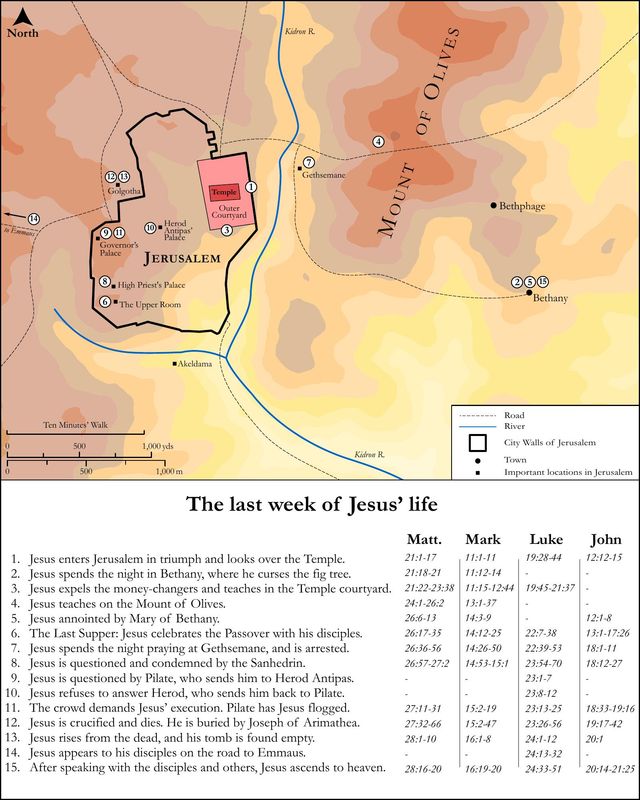
See on the biblical-era map


Study this verse
Public-domain commentary
Matthew Henry
From his Commentary on the Whole Bible. Henry comments on passages, not single verses — this entry covers John 13:31–35. His four-level outline is real structure in the source text, so it is rendered as structure.
This and what follows, to the end of ch. 14, was Christ's table-talk with his disciples. When supper was done, Judas went out; but what did the Master and his disciples do, whom he left sitting at table? They applied themselves to profitable discourse, to teach us as much as we can to make conversation with our friends at table serviceable to religion. Christ begins this discourse. The more forward we are humbly to promote that communication which is good, and to the use of edifying, the more like we are to Jesus Christ. Those especially that by their place, reputation, and gifts, command the company, to whom men give ear, ought to use the interest they have in other respects as an opportunity of doing them good. Now our Lord Jesus discourses with them (and probably discourses much more largely than is here recorded),
I.Concerning the great mystery of his own death and sufferings, about which they were as yet so much in the dark that they could not persuade themselves to expect the thing itself, much less did they understand the meaning of it; and therefore Christ gives them such instructions concerning it as made the offence of the cross to cease. Christ did not begin this discourse till Judas was gone out, for he was a false brother. The presence of wicked people is often a hindrance to good discourse. When Judas was gone out, Christ said, now is the Son of man glorified; now that Judas is discovered and discarded, who was a spot in their love-feast and a scandal to their family, now is the Son of man glorified. Note, Christ is glorified by the purifying of Christian societies: corruptions in his church are a reproach to him; the purging out of those corruptions rolls away the reproach. Or, rather, now Judas was gone to set the wheels a-going, in order to his being put to death, and the thing was likely to be effected shortly: Now is the Son of man glorified, meaning, Now he is crucified.
1.Here is something which Christ instructs them in, concerning his sufferings, that was very comforting.
(1.)That he should himself be glorified in them. Now the Son of man is to be exposed to the greatest ignominy and disgrace, to be despitefully used to the last degree, and dishonoured both by the cowardice of his friends and the insolence of his enemies; yet now he is glorified; For,
[1.]Now he is to obtain a glorious victory over Satan and all the powers of darkness, to spoil them, and triumph over them. He is now girding on the harness, to take the field against these adversaries of God and man, with as great an assurance as if he had put it off.
[2.]Now he is to work out a glorious deliverance for his people, by his death to reconcile them to God, and bring in an everlasting righteousness and happiness for them; to shed that blood which is to be an inexhaustible fountain of joys and blessings to all believers.
[3.]Now he is to give a glorious example of self-denial and patience under the cross, courage and contempt of the world, zeal for the glory of God, and love to the souls of men, such as will make him to be for ever admired and had in honour. Christ had been glorified in many miracles he had wrought, and yet he speaks of his being glorified now in his sufferings, as if that were more than all his other glories in his humble state.
(2.)That God the Father should be glorified in them. The sufferings of Christ were,
[1.]The satisfaction of God's justice, and so God was glorified in them. Reparation was thereby made with great advantage for the wrong done him in his honour by the sin of man. The ends of the law were abundantly answered, and the glory of his government effectually asserted and maintained.
[2.]They were the manifestation of his holiness and mercy. The attributes of God shine brightly in creation and providence, but much more in the work of redemption; see Co1 1:24; Co2 4:6. God is love, and herein he hath commended his love.
(3.)That he should himself be greatly glorified after them, in consideration of God's being greatly glorified by them, Joh 13:32. Observe how he enlarges upon it.
[1.]He is sure that God will glorify him; and those whom God glorifies are glorious indeed. Hell and earth set themselves to vilify Christ, but God resolved to glorify him, and he did it. He glorified him in his sufferings by the amazing signs and wonders, both in heaven and earth, which attended them, and extorted even from his crucifiers an acknowledgment that he was the Son of God. But especially after his sufferings he glorified him, when he set him at his own right hand, gave him a name above every name.
[2.]That he will glorify him in himself - en heautō. Either, First, In Christ himself. He will glorify him in his own person, and not only in his kingdom among men. This supposes his speedy resurrection. A common person may be honoured after his death, in his memory or posterity, but Christ was honoured in himself. Or, secondly, in God himself. God will glorify him with himself, as it is explained, Joh 17:5. He shall sit down with the Father upon his throne, Rev 3:21. This is true glory.
[3.]That he will glorify him straightway. He looked upon the joy and glory set before him, not only as great, but as near; and his sorrows and sufferings short and soon over. Good services done to earthly princes often remain long unrewarded; but Christ had his preferments presently. It was but forty hours (or not so much) from his death to his resurrection, and forty days thence to his ascension, so that it might well be said that he was straightway glorified, Psa 16:10.
[4.]All this in consideration of God's being glorified in and by his sufferings: Seeing God is glorified in him, and receives honour from his sufferings, God shall in like manner glorify him in himself, and give honour to him. Note, first, In the exaltation of Christ there was a regard had to his humiliation, and a reward given for it. Because he humbled himself, therefore God highly exalted him. If the Father be so great a gainer in his glory by the death of Christ, we may be sure that the Son shall be no loser in his. See the covenant between them, Isa 53:12. Secondly, Those who mind the business of glorifying God no doubt shall have the happiness of being glorified with him.
2.Here is something that Christ instructs them in, concerning his sufferings, which was awakening, for as yet they were slow of heart to understand it (Joh 13:33): Little children, yet a little while I am with you, etc. Two things Christ here suggests, to quicken his disciples to improve their present opportunities; two serious words: -
(1.)That his stay in this world, to be with them here, they would find to be very short. Little children. This compellation does not bespeak so much their weakness as his tenderness and compassion; he speaks to them with the affection of a father, now that he is about to leaven them, and to leave blessings with them. Know this, then, that yet a little while I am with you. Whether we understand this as referring to his death or his ascension it comes much to one; he had but a little time to spend with them, and therefore,
[1.]Let them improve the advantage they now had. If they had any good question to ask, if they would have any advice, instruction, or comfort, let them speak quickly; for yet a little while I am with you. We must make the best of the helps we have for our souls while we have them, because we shall not have them long; they will be taken from us, or we from them.
[2.]Let them not doat upon his bodily presence, as if their happiness and comfort were bound up in that; no, they must think of living without it; not be always little children, but go alone, without their nurses. Ways and means are appointed but for a little while, and are not to be rested in, but pressed through to our rest, to which they have a reference.
(2.)That their following him to the other world, to be with him there, they would find to be very difficult. What he had said to the Jews (Joh 7:34) he saith to his disciples; for they have need to be quickened by the same considerations that are propounded for the convincing and awakening of sinners. Christ tells them here,
[1.]That when he was gone they would feel the want of him; You shall seek me, that is "you shall wish you had me again with you." We are often taught the worth of mercies by the want of them. Though the presence of the Comforter yielded them real and effectual relief in straits and difficulties, yet it was not such a sensible satisfaction as his bodily presence would have been to those who had been used to it. But observe, Christ said to the Jews, You shall seek me and not find me; but to the disciples he only saith, You shall seek me, intimating that though they should not find his bodily presence any more than the Jews, yet they should find that which was tantamount, and should not seek in vain. When they sought his body in the sepulchre, though they did not find it, yet they sought to good purpose.
[2.]That whither he went they could not come, which suggests to them high thoughts of him, who was going to an invisible inaccessible world, to dwell in that light which none can approach unto; and also low thoughts of themselves, and serious thoughts of their future state. Christ tells them that they could not follow him (as Joshua told the people that they could not serve the Lord) only to quicken them to so much the more diligence and care. They could not follow him to his cross, for they had not courage and resolution; it appeared that they could not when they all forsook him and fled. Nor could they follow him to his crown, for they had not a sufficiency of their own, nor were their work and warfare yet finished.
II.He discourses with them concerning the great duty of brotherly love (Joh 13:34, Joh 13:35):
You shall love one another. Judas was now gone out, and had proved himself a false brother; but they must not therefore harbour such jealousies and suspicions one of another as would be the bane of love: though there was one Judas among them, yet they were not all Judases. Now that the enmity of the Jews against Christ and his followers was swelling to the height, and they must expect such treatment as their Master had, it concerned them by brotherly love to strengthen one another's hands. Three arguments for mutual love are here urged: -
1.The command of their Master (Joh 13:34): A new commandment I give unto you. He not only commends it as amiable and pleasant, not only counsels it as excellent and profitable, but commands it, and makes it one of the fundamental laws of his kingdom; it goes a-breast with the command of believing in Christ, Jo1 3:23; Pe1 1:22. It is the command of our ruler, who has a right to give law to us; it is the command of our Redeemer, who gives us this law in order to the curing of our spiritual diseases and the preparing of us for our eternal bliss. It is a new commandment; that is,
(1.)It is a renewed commandment; it was a commandment from the beginning (Jo1 2:7), as old as the law of nature, it was the second great commandment of the law of Moses; yet, because it is also one of the great commandments of the New Testament, of Christ the new Lawgiver, it is called a new commandment; it is like an old book in a new edition corrected and enlarged. This commandment has been so corrupted by the traditions of the Jewish church that when Christ revived it, and set it in a true light, it might well be called a new commandment. Laws of revenge and retaliation were so much in vogue, and self-love had so much the ascendant, that the law of brotherly love was forgotten as obsolete and out of date; so that as it came from Christ new, it was new to the people.
(2.)It is an excellent command, as a new song is an excellent song, that has an uncommon gratefulness in it.
(3.)It is an everlasting command; so strangely new as to be always so; as the new covenant, which shall never decay (Heb 8:13); it shall be new to eternity, when faith and hope are antiquated.
(4.)As Christ gives it, it is new. Before it was, Thou shalt love thy neighbour; now it is, You shall love one another; it is pressed in a more winning way when it is thus pressed as mutual duty owing to one another.
2.The example of their Saviour is another argument for brotherly love: As I have loved you. It is this that makes it a new commandment - that this rule and reason of love (as I have loved you) is perfectly new, and such as had been hidden from ages and generations. Understand this,
(1.)Of all the instances of Christ's love to his disciples, which they had already experienced during the time he went in and out among them. He spoke kindly to them, concerned himself heartily for them, and for their welfare, instructed, counselled, and comforted them, prayed with them and for them, vindicated them when they were accused, took their part when they were run down, and publicly owned them to be dearer to him that his mother, or sister, or brother. He reproved them for what was amiss, and yet compassionately bore with their failings, excused them, made the best of them, and passed by many an oversight. Thus he had loved them, and just now washed their feet; and thus they must love one another, and love to the end. Or,
(2.)It may be understood of the special instance of love to all his disciples which he was now about to give, in laying down his life for them. Greater love hath no man than this, Joh 15:13. Has he thus loved us all? Justly may he expect that we should be loving to one another. Not that we are capable of doing any thing of the same nature for each other (Psa 49:7), but we must love one another in some respects after the same manner; we must set this before us as our copy, and take directions from it. Our love to one another must be free and ready, laborious and expensive, constant and persevering; it must be love to the souls one of another. We must also love one another from this motive, and upon this consideration - because Christ has loved us. See Rom 15:1, Rom 15:3; Eph 5:2, Eph 5:25; Phi 2:1-5.
3.The reputation of their profession (Joh 13:35): By this shall all men know that you are my disciples, if you have love one to another. Observe, We must have love, not only show love, but have it in the root and habit of it, and have it when there is not any present occasion to show it; have it ready. "Hereby it will appear that you are indeed my followers by following me in this." Note, Brotherly love is the badge of Christ's disciples. By this he knows them, by this they may know themselves (Jo1 2:14), and by this others may know them. This is the livery of his family, the distinguishing character of his disciples; this he would have them noted for, as that wherein they excelled all others - their loving one another. This was what their Master was famous for; all that ever heard of him have heard of his love, his great love; and therefore, if you see any people more affectionate one to another than what is common, say, "Certainly these are the followers of Christ, they have been with Jesus." Now by this it appears,
(1.)That the heart of Christ was very much upon it, that his disciples should love one another. In this they must be singular; whereas the way of the world is to be every one for himself, they should be hearty for one another. He does not say, By this shall men know that you are my disciples - if you work miracles, for a worker of miracles is but a cypher without charity (Co1 13:1, Co1 13:2); but if you love one another from a principle of self-denial and gratitude to Christ. This Christ would have to be the proprium of his religion, the principal note of the true church.
(2.)That it is the true honour of Christ's disciples to excel in brotherly love. Nothing will be more effectual than this to recommend them to the esteem and respect of others. See what a powerful attractive it was, Act 2:46, Act 2:47. Tertullian speaks of it as the glory of the primitive church that the Christians were known by their affection to one another. Their adversaries took notice of it, and said, See how these Christians love one another, Apol. cap. 39.
(3.)That, if the followers of Christ do not love one another, they not only cast an unjust reproach upon their profession, but give just cause to suspect their own sincerity. O Jesus! are these thy Christians, these passionate, malicious, spiteful, ill-natured people? Is this thy son's coat? When our brethren stand in need of help from us, and we have an opportunity of being serviceable to them, when they differ in opinion and practice from us, or are any ways rivals with or provoking to us, and so we have an occasion to condescend and forgive, in such cases as this it will be known whether we have this badge of Christ's disciples.
Historical interpretation
Two Centuries of Reception
10 surviving comments on this verse. Each one is dated, so this reads as a timeline rather than a list.
Select a marker to jump to its quote. Markers stagger vertically where authors wrote within a few decades of each other.
In this way the Lord in the Gospels spurs on His disciples, urging them to attend to Him, hastening as He was to the Father; rendering His hearers more eager by the intimation that after a little He was to depart, and showing them that it was requisite that they should take more unsparing advantage of the truth than ever before, as the Word was to ascend to heaven. Again, therefore, He calls them children; for He says, "Children, a little while I am with you."
The statement “Yet a little while I am with you” is clear in the simple sense, so far as the literal sense is concerned, since he would soon no longer be with the disciples. First, he was arrested by the cohort and the tribune and the servants of the Jews who bound him and led him off to Annas first, and after this he was delivered to Pilate. Next, he was condemned to the cross, and then he spent three days and three nights in the heart of the earth.
For in that “little while” in which they would not see him, they would seek Jesus, and for this reason they would weep and lament, although their grief would change to joy when the saying was fulfilled, “And again a little while and you will see me.” But to seek Jesus is to seek the Word, and wisdom, and justice, and truth and the power of God, all of which Christ is.
(Hom. lxxii. 3) And therefore He said, little children; for He did not mean to speak to them, as He had to the Jews. Ye cannot follow Me now, He says, in order to rouse the love of His disciples. For the departure of loved friends kindles all our affection, and especially if they are going to a place where we cannot follow them. He purposely too speaks of His death, as a kind of translation, a happy removal to a place, where mortal bodies do not enter.
But, he says, as I said to the Jews that they could not come where I go, “so now I say to you.” Notice that he added “now.” By saying that they could not come where he goes, he means that they still cannot face death like him. In fact, they all run away. And even Simon denied him. But he added “now” to declare that afterward they would disregard sufferings and trials. Indeed, after the descent of the Holy Spirit they even enjoyed suffering for Christ since they were fully confirmed in faith in him and in the promise of future things. Therefore, he says, even though you are led by love to look for me—I know that you do this because of your love for me—nevertheless you cannot prove now your love with your works since your natural weakness inspires you with fear. Therefore things are going to happen [now] that cannot happen in a different way. If you want, you can do what I am teaching you to do even now while you are still a little apprehensive since it is useful now, and it will be [even more] useful later.
He references the time up until his passion when he says “only a little longer.” He says to the Jews, “You will look for me,” and adds, “and you will not find me,” because they would no longer see him anymore after his passion. But to his disciples he only says, “You will look for me.” Indeed, they looked for him and, since they were led by devotion in their search for him and saw themselves deprived of the care of their teacher, they found him. They saw him after his resurrection, and they lived and ate with him until he ascended into heaven.
After He had said, And shall straightway glorify Him, that they might not think that God was going to glorify Him in such a way, as that He would no longer have any converse with them on earth, He says, Little children, yet a little while I am with you: as if He said, I shall indeed straightway be glorified by My resurrection, but I shall not straightway ascend to heaven. For we read in the Acts of the Apostles, that He was with them forty days after His resurrection. These forty days are what He means by, A little while I am with you.
(Tr. lxiv. 1) It may be understood too thus: I am as yet in this frail flesh, even as ye are, until I die and rise again. He was with them after His resurrection, by bodily presence, not by participation of human frailty. These are the words which I spake unto you, while I was yet with you, (Luke 24:44) He says to His disciples after His resurrection; meaning, while I was in mortal flesh, as ye are. He was in the same flesh then with them, but not subject to the same mortality. But there is another Divine Presence unknown to mortal senses, of which He saith, Lo, I am with you alway, even unto the end of the world. (Mat. 28:20) This is not the presence meant by, A little while I am with you; for it is not a little while to the end of the world: or even if it is a little while, because that in the eye of God, a thousand years are as one day, yet what follows shows that it is not what our Lord is here alluding to; for He adds, Whither I go ye cannot follow Me now. At the end of the world they were to follow Him, whither He went; as He saith below; Father, I will that they be with Me, where I am. (c. 17:24)
(Tr. lxiv. 4) Or He means that they were not yet fit to follow Him to death for righteousness' sake. For how could they, when they were not ripe for martyrdom? Or how could they follow our Lord to immortality, they who were to die, and not to rise again till the end of the world? Or how could they follow Him to the bosom of the Father, when none could partake of that felicity, but they whose love was perfected? When He told the Jews this, He did not add now. But the disciples, though they could not follow Him then, would be able to do so afterwards, and therefore He addsc, So now I say to you.
It becomes us, dearly beloved, to keep in view the orderly connection of our Lord's words. For after having previously said, but subsequently to Judas' departure, and his separation from even the outward communion of the saints, "Now is the Son of man glorified, and God is glorified in Him;"-whether He said so as pointing to His future kingdom, when the wicked shall be separated from the good, or that His resurrection was then to take place, that is, was not to be delayed, like ours, till the end of the world;-and having then added, "If God is glorified in Him, God shall also glorify Him in Himself, and shall straightway glorify Him," whereby without any ambiguity He testified to the immediate fulfillment of His own resurrection; He proceeded to say, "Little children, yet a little while I am with you." To keep them, therefore, from thinking that God was to glorify Him in such a way that He would never again be joined with them in earthly intercourse, He said, "Yet a little while I am with you:" as if He had said, Straightway indeed I shall be glorified in my resurrection; and yet I am not straightway to ascend into heaven, but "yet a little while I am with you." For, as we find it written in the Acts of the Apostles, He spent forty days with them after His resurrection, going in and out, and eating and drinking: not indeed that He had any experience of hunger and thirst, but even by such evidences confirmed the reality of His flesh, which no longer needed, but still possessed the power, to eat and to drink. Was it, then, these forty days He had in view when He said, "Yet a little while I am with you," or something else? For it may also be understood in this way: "Yet a little while I am with you;" still, like you, I also am in this state of fleshly infirmity, that is, till He should die and rise again: for after He rose again He was with them, as has been said, for forty days in the full manifestation of His bodily presence; but He was no longer with them in the fellowship of human infirmity.
There is also another form of His divine presence unknown to mortal senses, of which He likewise says, "Lo, I am with you alway, even to the end of the world." This, at least, is not the same as "yet a little while I am with you;" for it is not a little while until the end of the world. Or if even this is so (for time flies, and a thousand years are in God's sight as one day, or as a watch in the night,) yet we cannot believe that He intended any such meaning on this occasion, especially as He went on to say, "Ye shall seek me, and as I said unto the Jews, Whither I go, ye cannot come." That is to say, after this little while that I am with you, "ye shall seek me, and whither I go, ye cannot come." Is it after the end of the world that, whither He goes, they will not be able to come? And where, then, is the place of which He is going to say a little after in this same discourse, "Father, I will that they also be with me where I am"? It was not then of that presence of His with His own which He is maintaining with them till the end of the world that He now spake, when He said, "Yet a little while I am with you;" but either of that state of mortal infirmity in which He dwelt with them till His passion, or of that bodily presence which He was to maintain with them up till His ascension.
That no one, however, may deem that sense inconsistent with the true one, in which we say that the Lord may have meant the communion of mortal flesh which He held with the disciples till His passion, when He said, "Yet a little while I am with you;" let those words also of His after His resurrection, as found in another evangelist, be taken into consideration, when He said, "These are the words which I spake unto you, while I was yet with you:" as if then He was no longer with them, even at the very time that they were standing by, seeing, touching, and talking with Him. What does He mean, then, by saying, "while I was yet with you," but, while I was yet in that state of mortal flesh wherein ye still remain? For then, indeed, He had been raised again in the same flesh; but He was no longer associated with them in the same mortality.
"Ye shall seek me: and as I said unto the Jews, Whither I go, ye cannot come; so say I to you now." That is, ye cannot come now. But when He said so to the Jews, He did not add the "now." The former, therefore, were not able at that time to come where He was going, but they were so afterwards; because He says so a little afterwards in the plainest terms to the Apostle Peter. For, on the latter inquiring, "Lord, whither goest Thou?" He replied to him, "Whither I go thou canst not follow me now; but thou shalt follow me afterwards." But what it means is not to be carelessly passed over. For whither was it that the disciples could not then follow the Lord, but were able afterwards? If we say, to death, what time can be discovered when any one of the sons of men will find it impossible to die; since such, in this perishable body, is the lot of man, that therein life is not a whit easier than death? They were not, therefore, at that time less able to follow the Lord to death, but they were less able to follow Him to the life which is deathless. For thither it was the Lord was going, that, rising from the dead, He should die no more, and death should no more have dominion over Him. For as the Lord was about to die for righteousness' sake, how could they have followed Him now, who were as yet unripe for the ordeal of martyrdom? Or, with the Lord about to enter the fleshly immortality, how could they have followed Him now, when, even though ready to die, they would have no resurrection till the end of the world? Or, on the point of going, as the Lord was, to the bosom of the Father, and that without any forsaking of them, just as He had never quitted that bosom in coming to them, how could they have followed Him now, since no one can enter on that state of felicity but he that is made perfect in love? And to show them, therefore, how it is that they may attain the fitness to proceed, where He was going before them, He says, "A new commandment I give unto you, that ye love one another."
Ye shall seek Me: and as I said unto the Jews, Whither I go, ye cannot come; so now I say unto you.
Not altogether without pain to His own disciples will the departure be, He says; it will be the departure of Himself. In the first place they will languish in grief on account of it, and will find the weight of bitterness produced by it to be intolerable. For beyond all question they will thirst once more to be with Him, and long to live with Him for ever; just as also the inspired Paul, preferring the being with Christ to life itself here, said it was better to depart and be with Christ. Perceiving this, and well knowing the hearts of those who love Him, Christ said that His Ascension would not be without grief to His disciples. But there was also, besides this feeling, another just cause that forced the holy disciples to seek to be with Christ. They were destined within a brief while to be compassed about with grievous dangers, and to be exposed on all sides to the ungovernable frenzies of the Jews, and even to fall victims to madness on the part of strangers, while on their mission through the whole world, preaching the word of the Saviour to those that were still wandering afar; so as to become acquainted with prisons, and to have their part in all kinds of insult and outrage, and to gain no less experience of other tortures: and all this in spite of their never having experienced any such suffering while they were with Christ. "Then most especially," He says, "ye shall seek My company, when the manifold waves of trial break over you." And hereby He sought not to bring the disciples to cowardly timidity, or to shatter their courage with fear; but rather to brace them up to fresh vigour, and in a manner to teach them to be ready prepared for the patient endurance of all which they expected would come upon them. For we shall find the Psalmist's song to be anything but meaningless, nay, rather to convey very profitable instruction in the words: I was prepared and was not confounded. For the wholly unexpected arrival of misfortune is wont to throw us into confusion, taking us as it were off our guard: but when a trial has been known beforehand and long expected, the greater part of the terror it occasions has passed away before it comes, and its power over its victims is not at all absolute, as the mind has already rehearsed it and often in imagination received its attack. In the same way, if some wild and savage animal, starting up from the midst of a luxuriant and dense jungle, rushes on one who does not see it coming, it tears him limb from limb before he is conscious of the attack, having seized him while he was unprepared for warfare: whereas if the beast is seen from afar and its coming expected, it meets an armed foe, and either does him less harm, or perchance has even to depart in helpless impotence. Just so in the case of temptations: that which is wholly unexpected will attack us more fiercely and more severely than one which has been anticipated for some time. With kind intent therefore does our Lord Jesus the Christ in saying "Ye shall seek Me" hint at the evils that will come on the disciples when His presence is removed, and the troubles that will arise from their enemies; preparing them by this warning for a renewal of their courage: with kind intent also He adds to these hints the statement that there will for the present be an obstacle in the way of their following Him. For as I said to the Jews, He says, even so I say now unto you: Whither I go ye cannot come. For not yet was the time come when the disciples should have accomplished their service on earth, and be admitted to the mansions above. For their entrance to those realms was reserved most strictly to its appointed season.
This point however we must notice again, that in speaking to the Jews, while giving to them this same warning, He said: Ye shall seek Me, and shall not find Me; but to His disciples He only says: Ye shall seek Me, fitly breaking off without the words "and shall not find Me." And why so? The Jews will rightly deserve to be told that they should never find Him, on account of their monstrous infidelity and the surpassing baseness of their impiety towards Him: but to those who have a true affection for Him, and have preserved their love in all sincerity, it could not be fitly said: "Ye shall not find Me." For He was ever with them, and will be with them to the end.
Little children, yet a little while I am with you.
He places the disciples in the position of little children and accounts them as new-born babes, although they had advanced to so high a stage in virtue, and were possessed of wisdom such as is fully vouchsafed to few; showing us hereby, and that very plainly, that even he who is accounted very perfect in the eyes of man is an infant in the sight of God, and feeble in mental faculties. For what is the understanding of man in comparison with the wisdom that fashioned the universe? Therefore it is that a Psalmist said to God: I was as a beast before Thee. And no one whatever will say, if he has any perception at all, that the Psalmist compares himself to a beast because of his having cleaved closely unto God; for such an idea would be a bitter disparagement of the Divine nature, and would be seen to involve a great impropriety. For he that cleaves to a wise man and "is" ever "before" him, (for I suppose I must adapt the words of the Psalm so far as is necessary,) would never become "as a beast;" but rather would become ready of mind, and quick of understanding, and skilful in judgment. If therefore any one acknowledged this to be very just and true, would not a person be thought foolish in the extreme who should suppose that one who cleaves fast to the wisdom that comes from God Himself will ever become as a beast in senseless folly? Why then does the Psalmist say that even he who is counted very wise among men will in comparison with the wisdom of God appear to be as a beast, and be reckoned among those who have no sense to guide them? It is because the understanding of man can no more be compared with the wisdom of God than the smallest star can vie with the rays of the sun, or even the heaviest of stones with the highest of all mountains; but rather is as nothing at all in comparison with it. And so it appears that even the perfect man is but as a little child.
Yet a little while, however, Christ said He would be with the disciples; not meaning that He was soon to depart so as to return no more, or to be separated from them altogether and entirely, for He is with us (according to His own words) alway, even unto the end of the world; but implying that He would not be with them in the flesh, as He had been yesterday and the day before, and that now there was even at the door, or rather within the door, the time of His departure thence unto the Father, and of His ascension into heaven. And I say that it is necessary for us all, at least those who are right minded and have their faith well established, to realise the fact that even though He is absent from us in the flesh, now that He has returned from earth to God the Father, yet He pervades all things in His Divine power, and is ever present with those who love Him. For surely this is why He also declared: Verily, verily, I say unto you, wherever two or three are gathered together in My Name, there am I in the midst of them. For just as, while still sojourning among men, yea, while verily on earth with flesh, He filled the heavens, and even then was still present with the holy angels, and never left the realms above; so now also, while verily in heaven with His own flesh, He fills the earth, and is ever present with those who know Him. And notice how, although expecting to be removed from earth as regards His flesh alone, since in the power of His Divinity He is ever with us, He nevertheless speaks of being with us yet a little while, including in this statement His whole and perfect Self without any division: lest any should endeavour to sever the One Christ into two Sons, but that all should think and believe that the Word begotten of God the Father is one with the Temple assumed from the holy virgin; not that they are of the same essence, but that after their ineffable union, none can speak of severing them without impiety: for the Christ is, of them both, One.
Continue studying John 13:33 across the web’s major study libraries — every link below opens this exact verse, chapter, or book on the destination site.
Read & Compare
 BibleGatewayThis verse in more than 200 translations and 70 languages.
 Bible.comThe YouVersion reader — hundreds of translations, reading plans, and highlights.
 ESV.orgCrossway's official English Standard Version reader.
 NET BibleThe NET translation with 60,000+ translators' notes on every rendering decision.
 STEP BibleTyndale House's free study tool — original text, vocabulary, and scholarly resources.
 BibliaLogos Bible Software's free web reader.
 USCCBThe New American Bible (Revised Edition) with the U.S. bishops' study notes.
Commentaries
 BibleHub CommentariesDozens of classic commentaries on this verse, gathered on one page.
 StudyLightMore than 100 commentary sets — the largest collection on the web.
 BibleRefPlain-English commentary on what this verse means, verse by verse.
 Enduring WordDavid Guzik's free commentary on this chapter, widely used by Bible teachers.
 Bible Study ToolsVerse commentary alongside Greek and Hebrew study aids.
Original Language & Research
- BibleHub InterlinearThe verse word by word — original language, transliteration, and English.
- BibleHub LexiconEvery word's original-language definition and Strong's entry.
 Blue Letter BibleDeep-study tools — Strong's numbers, concordance, and word studies.
 CNTR CollationThe earliest Greek manuscripts of this verse, collated letter by letter.
Sermons, Hymns & Audio


TrulyRandomVerse is not affiliated with these sites and doesn’t control their content. They’re linked because they’re genuinely useful.
Summary
John 13:33 captures Jesus' tender farewell to His disciples, delivered in the intimate setting of the Last Supper. He announces His imminent departure, a profound separation that will lead them to seek Him, echoing a similar statement made to the unbelieving Jews, but with a distinct nuance for His beloved followers, signaling a temporary physical absence before a future reunion.
Context
ShowHideLiterary Context
This verse is a crucial part of Jesus' Farewell Discourse, which spans John 13 through John 17. It immediately follows Judas's departure to betray Jesus (John 13:30). Having just washed their feet as an act of humble service (John 13:1-11) and identified His betrayer, Jesus now turns His full attention to the remaining eleven, preparing them for the profound and difficult transition of His physical absence. His words here are not a casual statement but a direct forewarning and comfort, setting the stage for the deep theological teachings and promises that follow concerning the Holy Spirit, His return, and the nature of their relationship with Him.
Historical & Cultural Context
The setting is the Upper Room in Jerusalem, during the Passover meal, a highly significant Jewish festival commemorating liberation from slavery in Egypt. This context amplifies the gravity of Jesus' words, as the Passover meal itself was a symbol of deliverance and covenant. For the disciples, who had left everything to follow Jesus, His physical presence was central to their understanding of the Kingdom. The idea of their Messiah leaving them would have been deeply unsettling, challenging their messianic expectations which often envisioned a conquering king establishing an earthly kingdom. Their cultural understanding of a teacher-disciple relationship involved constant physical proximity and instruction, making this separation a radical shift.
Key Themes
ShowHideJohn 13:33 contributes to several overarching themes in John's Gospel. The theme of Imminent Departure is central, signaling the approaching culmination of Jesus' earthly ministry and His return to the Father. This departure is paradoxically linked to the theme of Divine Glory, as Jesus' "going away" is ultimately His glorification through the cross and resurrection (John 13:31-32). The phrase "Ye shall seek me" introduces the theme of Sorrow and Longing, anticipating the disciples' grief and initial confusion, but also their eventual understanding and spiritual seeking. Finally, the tender address "Little children" highlights the theme of Paternal Love and Care, emphasizing Jesus' deep affection and pastoral concern for His followers, even as He delivers difficult news, contrasting sharply with His earlier, more confrontational statements to the unbelieving Jews in John 7:34 and John 8:21.
Exposition and Analysis
ShowHideKey Word Analysis
ShowHideThis diminutive form of "child" (from teknon) conveys deep affection, intimacy, and tenderness. It emphasizes Jesus' paternal care and the disciples' spiritual dependence on Him, akin to a loving father addressing his beloved offspring. It's a term of endearment, rarely used by Jesus in the Gospels, making its appearance here particularly significant.
This adverb signifies a very brief remaining time, emphasizing the immediacy and urgency of Jesus' impending physical departure. It highlights the brevity of His remaining earthly presence with them, underscoring the preciousness of these final moments.
This combination of the absolute negative particle (ou) and the verb "to be able" (dýnamai) indicates a definite impossibility. For the disciples, it means they are physically unable to follow Him to the Father's presence at that specific moment. This is distinct from the spiritual inability of the unbelieving Jews, implying a temporary physical separation rather than a permanent spiritual one.
Verse Breakdown
ShowHide"Little children, yet a little while I am with you."
Jesus begins with a term of deep affection, "Little children" (teknia), emphasizing His tender, paternal love for His disciples. The phrase "yet a little while" underscores the brevity of His remaining physical presence, creating a sense of urgency and impending separation. This opening sets a tone of intimate, yet somber, farewell.
"Ye shall seek me: and as I said unto the Jews, Whither I go, ye cannot come;"
This clause reveals the disciples' anticipated reaction to Jesus' departure – they will "seek" Him, implying a longing for His physical presence that will be met with His absence. Jesus then draws a parallel to His earlier statements to the unbelieving Jews, where He declared they could not come where He was going. This parallel highlights the shared physical inability to follow Him to His divine destination.
"so now I say to you."
This concluding phrase explicitly applies the previous statement to the disciples. While the words are the same as those spoken to the Jews, the context and meaning are profoundly different. For the Jews, it signified a permanent spiritual separation due to their rejection of Him. For the disciples, it implies a temporary physical inability to follow Him at that moment, but with the underlying promise of a future reunion and dwelling with Him, as elaborated in the subsequent chapters of the Farewell Discourse.
Literary Devices
ShowHideJohn 13:33 employs several powerful literary devices. The opening phrase, Diminutive/Term of Endearment ("Little children" / teknia), immediately establishes a tone of profound intimacy and paternal affection, softening the impact of the difficult news that follows. There is a clear Parallelism between Jesus' statement to the Jews and His statement to the disciples, creating a rhetorical link that invites comparison and contrast. While the words are identical, the Irony lies in the differing implications: for the Jews, it signifies spiritual judgment and permanent separation; for the disciples, it foreshadows a temporary physical absence that will ultimately lead to a deeper spiritual presence through the Holy Spirit and a future reunion. This nuanced repetition also functions as Foreshadowing, preparing the disciples for the traumatic events of His crucifixion and the subsequent period of His physical absence, while simultaneously hinting at the future comfort and presence of the Spirit.
Theological and Thematic Connections
ShowHideJohn 13:33 profoundly shapes the disciples' understanding of Jesus' departure, transitioning them from a purely physical expectation of the Messiah to a spiritual reality. Jesus' departure is not an abandonment but a necessary step in the divine plan for their glorification and the coming of the Holy Spirit. His going "where they cannot come" at that moment is essential for His ascension to the Father, from whom He will send the Comforter to empower them for their mission. This temporary physical separation underscores the shift from a discipleship based on physical proximity to one founded on spiritual indwelling and faith in His invisible presence. It also highlights the unique nature of Jesus' journey back to the Father, a path only He could tread in His atoning work.
Reflection and Application
ShowHideJohn 13:33 offers profound comfort and guidance for believers navigating periods of uncertainty, loss, or apparent divine absence. Jesus' tender address, "Little children," reminds us of His enduring, intimate love and paternal care, even when He delivers difficult truths or when circumstances seem dire. His imminent departure, though painful for the disciples, was a necessary step in God's redemptive plan, leading to the greater empowerment of the Holy Spirit and the establishment of the Church. This teaches us to trust in God's sovereign purposes, even when we cannot fully grasp them in the moment. Our "seeking" Him in times of perceived absence should not be in despair, but in hopeful anticipation of His spiritual presence and promised return. It calls us to embrace a faith that transcends physical sight, relying on His Word and the indwelling Spirit for guidance and comfort. Just as Jesus prepared His disciples for a new phase of their walk, this verse encourages us to be open to God's transformative work in our lives, even when it involves challenging transitions or periods of waiting.
Questions for Reflection
ShowHideFAQ
ShowHideWhy did Jesus use the same phrase ("Whither I go, ye cannot come") for both the Jews and His disciples?
ShowHideWhile the exact words are the same, the meaning and implication differ significantly based on the audience and context. When Jesus said this to the unbelieving Jews in John 7:34 and John 8:21, it was a statement of judgment and permanent spiritual separation. Their rejection of Him meant they could not follow Him to the Father's presence, implying eternal condemnation. For His disciples in John 13:33, the meaning is one of temporary physical inability. They could not accompany Him to the cross, resurrection, and ascension at that moment. However, this temporary separation was for their ultimate good, leading to the sending of the Holy Spirit (John 16:7) and the promise of a future reunion where they would be with Him forever (John 14:3). It highlights the distinct spiritual states and destinies of the two groups.
Christ-Centered Fulfillment
ShowHideJohn 13:33, though seemingly a declaration of absence, finds its profound Christ-centered fulfillment in the very purpose of Jesus' departure. His "going away" was not an abandonment but the necessary prelude to His glorification through the cross and resurrection, which secured salvation for humanity. The path He took, "whither I go," was the path of atonement, a journey only the sinless Lamb of God could tread to reconcile humanity to the Father. His ascension to the Father's right hand, where the disciples "cannot come" at that moment, inaugurated His heavenly intercessory ministry (Romans 8:34) and paved the way for the outpouring of the Holy Spirit (Acts 2:33). Thus, His physical absence led to a more profound spiritual presence, as the Spirit now indwells believers, guiding them into all truth (John 16:13). The "seeking" of Jesus by the disciples is ultimately fulfilled in their spiritual union with Him through faith, culminating in the glorious promise of His return to take them to be with Him forever (John 14:3), fulfilling the deepest longing for His presence.