


John 8:21
Bible text: King James Version (1769 Blayney text) · Public domain
Bible text: King James Version with Strong's numbers · Public domain
Bible text: Berean Standard Bible · Public domain
Bible text: American Standard Version (1901) · Public domain
Bible text: World English Bible, Messianic edition · Public domain
Bible text: Geneva Bible (1599) · Public domain
Bible text: Young's Literal Translation · Public domain
- ΕἶπενEipenHe saidG2036V-2AAI-3SVerb 2nd Aorist Active Indicative 3rd Singular
- οὖνounthenG3767CONJConjunction
- πάλινpalinagainG3825ADVAdverb
- αὐτοῖςautoisto themG846P-DPMPersonal pronoun Dative Plural Masculine
- ὁho<the>G3588T-NSMDefinite article Nominative Singular Masculine
- Ἰησοῦς·IēsousJesusG2424N-NSM-PNoun Nominative Singular Masculine Individual
- ἐγὼegōI myselfG1473P-1NSPersonal pronoun Nominative 1st Singular
- ὑπάγωhupagōam going awayG5217V-PAI-1SVerb Present Active Indicative 1st Singular
- καὶkaiandG2532CONJConjunction
- ζητήσετέzētēseteyou will seekG2212V-FAI-2PVerb Future Active Indicative 2nd Plural
- μεmeMeG3165P-1ASPersonal pronoun Accusative 1st Singular
- καὶkaiandG2532CONJConjunction
- ἐνeninG1722PREPPreposition
- τῇtēatheG3588T-DSFDefinite article Dative Singular Feminine
- ἁμαρτίᾳhamartiasinG266N-DSFNoun Dative Singular Feminine
- ὑμῶνhumōnof youG4771P-2GPPersonal pronoun Genitive 2nd Plural
- ἀποθανεῖσθε·apothaneistheyou will dieG599V-FDI-2PVerb Future Middle Deponent Indicative 2nd Plural
- ὅπουhopouwhereG3699CONJConjunction
- ἐγὼegōI myselfG1473P-1NSPersonal pronoun Nominative 1st Singular
- ὑπάγωhupagōgoG5217V-PAI-1SVerb Present Active Indicative 1st Singular
- ὑμεῖςhumeisyou yourselvesG4771P-2NPPersonal pronoun Nominative 2nd Plural
- οὐounotG3756PRT-NNegative Particle Negative
- δύνασθεdunastheare ableG1410V-PNI-2PVerb Present Middle Or Passive Deponent Indicative 2nd Plural
- ἐλθεῖνeltheinto comeG2064V-2AANVerb 2nd Aorist Active Infinitive
English is a literal word-by-word gloss of the Greek, not the KJV's wording. Why?
This is the original text the KJV's translators worked from — each Greek word with its own literal English meaning in this verse, prepared by scholars at Tyndale House, Cambridge. The KJV translates whole sentences, not word by word, so its wording differs: one Greek word can become several English words, and the KJV may choose “charity” where the gloss reads “love”. Both are faithful — they answer different questions. For the KJV's own rendering, switch to the KJV text.
Details
See on the biblical-era maps
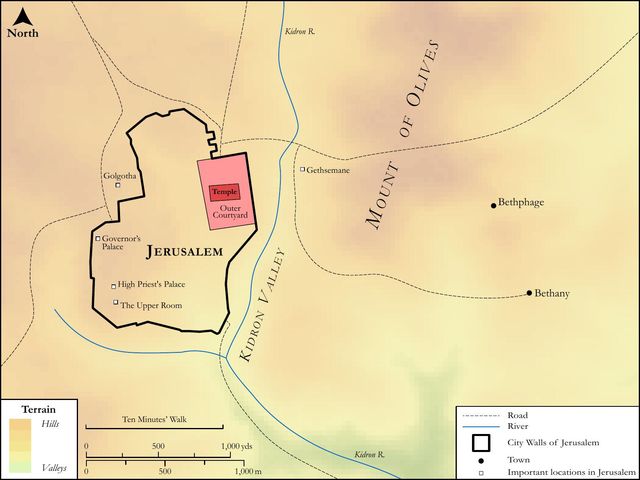
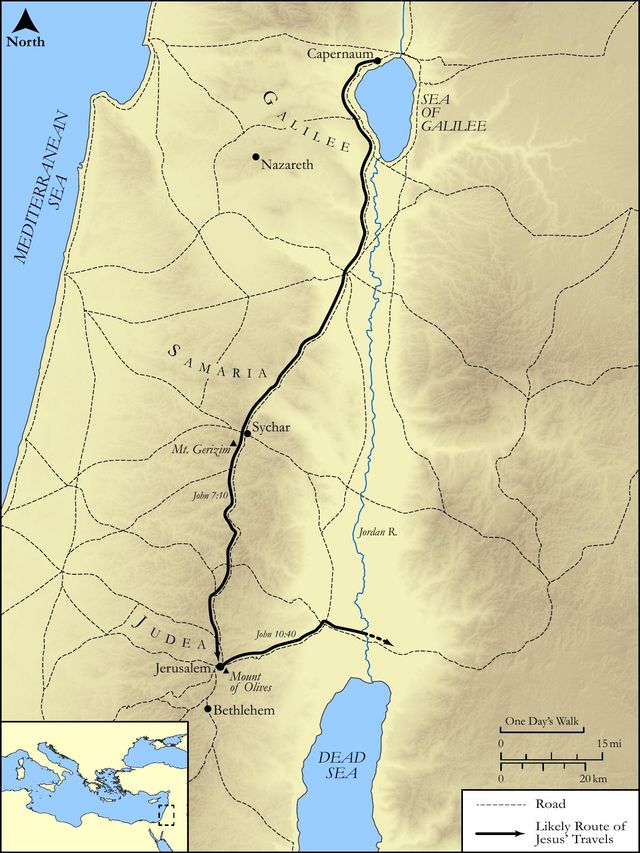
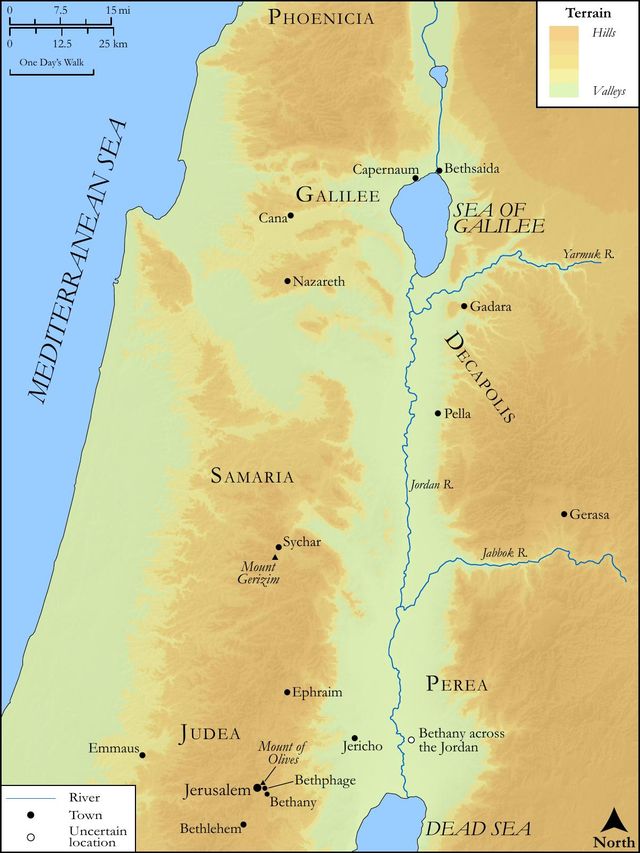
Study this verse
Public-domain commentary
Matthew Henry
From his Commentary on the Whole Bible. Henry comments on passages, not single verses — this entry covers John 8:21–30. His four-level outline is real structure in the source text, so it is rendered as structure.
Christ here gives fair warning to the careless unbelieving Jews to consider what would be the consequence of their infidelity, that they might prevent it before it was too late; for he spoke words of terror as well as words of grace. Observe here,
I.The wrath threatened (Joh 8:21):
Jesus said again unto them that which might be likely to do them good. He continued to teach, in kindness to those few who received his doctrine, though there were many that resisted it, which is an example to ministers to go on with their work, notwithstanding opposition, because a remnant shall be saved. Here Christ changes his voice; he had piped to them in the offers of his grace, and they had not danced; now he mourns to them in the denunciations of his wrath, to try if they would lament. He said, I go my way, and you shall seek me, and shall die in your sins. Whither I go you cannot come. Every word is terrible, and bespeaks spiritual judgments, which are the sorest of all judgments; worse than war, pestilence, and captivity, which the Old Testament prophets denounced. Four things are here threatened against the Jews.
1.Christ's departure from them: I go my way, that is, "It shall not be long before I go; you need not take so much pains to drive me from you, I shall go of myself." They said to him, Depart from us, we desire not the knowledge of thy ways; and he takes them at their word; but woe to those from whom Christ departs. Ichabod, the glory is gone, our defence is departed, when Christ goes. Christ frequently warned them of his departure before he left them: he bade often farewell, as one loth to depart, and willing to be invited, and that would have them stir up themselves to take hold on him.
2.Their enmity to the true Messiah, and their fruitless and infatuated enquiries after another Messiah when he was gone away, which were both their sin and their punishment: You shall seek me, which intimates either,
(1.)Their enmity to the true Christ: "You shall seek to ruin my interest, by persecuting my doctrine and followers, with a fruitless design to root them out." This was a continual vexation and torment to themselves, made them incurably ill-natured, and brought wrath upon them (God's and their own) to the uttermost. Or,
(2.)Their enquiries after false Christs: "You shall continue your expectations of the Messiah, and be the self-perplexing seekers of a Christ to come, when he is already come;" like the Sodomites, who, being struck with blindness, wearied themselves to find the door. See Rom 9:31, Rom 9:32.
3.Their final impenitency: You shall die in your sins. Here is an error in all our English Bibles, even the old bishops' translation, and that of Geneva (the Rhemists only excepted), for all the Greek copies have it in the singular number, en tē hamartia humōn - in your sin, so all the Latin versions; and Calvin has a note upon the difference between this and Joh 8:24, where it is plural, tais hamartiais, that here it is meant especially of the sin of unbelief, in hoc peccato vestro - in this sin of yours. Note, Those that live in unbelief are for ever undone if they die in unbelief. Or, it may be understood in general, You shall die in your iniquity, as Eze 3:19, and Eze 33:9. Many that have long lived in sin are, through grace, saved by a timely repentance from dying in sin; but for those who go out of this world of probation into that of retribution under the guilt of sin unpardoned, and the power of sin unbroken, there remaineth no relief: salvation itself cannot save them, Job 20:11; Eze 32:27.
4.Their eternal separation from Christ and all happiness in him: Whither I go you cannot come. When Christ left the world, he went to a state of perfect happiness; he went to paradise. Thither he took the penitent thief with him, that did not die in his sins; but the impenitent not only shall not come to him, but they cannot; it is morally impossible, for heaven would not be heaven to those that die unsanctified and unmeet for it. You cannot come, because you have no right to enter into that Jerusalem, Rev 22:14. Whither I go you cannot come, to fetch me thence, so Dr. Whitby; and the same is the comfort of all good Christians, that, when they get to heaven, they will be out of the reach of their enemies' malice.
II.The jest they made of this threatening.
Instead of trembling at this word, they bantered it, and turned it into ridicule (Joh 8:22): Will he kill himself? See here,
1.What slight thoughts they had of Christ's threatenings; they could make themselves and one another merry with them, as those that mocked the messengers of the Lord, and turned the burden of the word of the Lord into a by-word, and precept upon precept, line upon line, into a merry song, Isa 28:13. But be ye not mockers, lest your bands be made strong.
2.What ill thoughts they had of Christ's meaning, as if he had an inhuman design upon his own life, to avoid the indignities done him, like Saul. This is indeed (say they) to go whither we cannot follow him, for we will never kill ourselves. Thus they make him not only such a one as themselves, but worse; yet in the calamities brought by the Romans upon the Jews many of them in discontent and despair did kill themselves. They had put a much more favourable construction upon this word of his (Joh 7:34, Joh 7:35): Will he go to the dispersed among the Gentiles? But see how indulged malice grows more and more malicious.
III.The confirmation of what he had said.
1.He had said, Whither I go you cannot come, and here he gives the reason for this (Joh 8:23): You are from beneath, I am from above; you are of this world, I am not of this world. You are ek tōn katō - of those things which are beneath; noting, not so much their rise from beneath as their affection to these lower things: "You are in with these things, as those that belong to them; how can you come where I go, when your spirit and disposition are so directly contrary to mine?" See here,
(1.)What the spirit of the Lord Jesus was - not of this world, but from above. He was perfectly dead to the wealth of the world, the ease of the body, and the praise of men, and was wholly taken up with divine and heavenly things; and none shall be with him but those who are born from above and have their conversation in heaven.
(2.)How contrary to this their spirit was: "You are from beneath, and of this world." The Pharisees were of a carnal worldly spirit; and what communion could Christ have with them?
2.He had said, You shall die in your sins, and here he stand to it: "Therefore I said, You shall die in your sins, because you are from beneath;" and he gives this further reason for it, If you believe not that I am he, you shall die in your sins, Joh 8:24. See here,
(1.)What we are required to believe: that I am he, hoti egō eimi - that I am, which is one of God's names, Exo 3:14. It was the Son of God that there said, Ehejeh asher Ehejeh - I will be what I will be; for the deliverance of Israel was but a figure of good things to come, but now he saith, "I am he; he that should come, he that you expect the Messias to be, that you would have me to be to you. I am more than the bare name of the Messiah; I do not only call myself so, but I am he." True faith does not amuse the soul with an empty sound of words, but affects it with the doctrine of Christ's mediation, as a real thing that has real effects.
(2.)How necessary it is that we believe this. If we have not this faith, we shall die in our sins; for the matter is so settled that without this faith,
[1.]We cannot be saved from the power of sin while we live, and therefore shall certainly continue in it to the last. Nothing but the doctrine of Christ's grace will be an argument powerful enough, and none but the Spirit of Christ's grace will be an agent powerful enough, to turn us from sin to God; and that Spirit is given, and that doctrine given, to be effectual to those only who believe in Christ: so that, if Satan be not by faith dispossessed, he has a lease of the soul for its life; if Christ do not cure us, our case is desperate, and we shall die in our sins.
[2.]Without faith we cannot be saved from the punishment of sin when we die, for the wrath of God remains upon them that believe not, Mar 16:16. Unbelief is the damning sin; it is a sin against the remedy. Now this implies the great gospel promise: If we believe that Christ is he, and receive him accordingly, we shall not die in our sins. The law saith absolutely to all, as Christ said (Joh 8:21), You shall die in your sins, for we are all guilty before God; but the gospel is a defeasance of the obligation upon condition of believing. The curse of the law is vacated and annulled to all that submit to the grace of the gospel. Believers die in Christ, in his love, in his arms, and so are saved from dying in their sins.
IV.Here is a further discourse concerning himself, occasioned by his requiring faith in himself as the condition of salvation, Joh 8:25-29. Observe,
1.The question which the Jews put to him (Joh 8:25): Who art thou? This they asked tauntingly, and not with any desire to be instructed. he had said, You must believe that I am he. By his not saying expressly who he was, he plainly intimated that in his person he was such a one as could not be described by any, and in his office such a one as was expected by all that looked for redemption in Israel; yet this awful manner of speaking, which had so much significancy in it, they turned to his reproach, as if he knew not what to say of himself: "Who art thou, that we must with an implicit faith believe in thee, that thou art some mighty HE, we know not who or what, nor are worthy to know?"
2.His answer to this question, wherein he directs them three ways for information: -
(1.)He refers them to what he had said all along: "Do you ask who I am? Even the same that I said unto you from the beginning." The original here is a little intricate, tēn archēn ho ti kai lalō humin which some read thus: I am the beginning, which also I speak unto you. So Austin takes it. Christ is called Archē - the beginning (Col 1:18; Rev 1:8; Rev 21:6; Rev 3:14), and so it agrees with Joh 8:24, I am he. Compare Isa 41:4 : I am the first, I am he. Those who object that it is the accusative case, and therefore not properly answering to tis ei, must undertake to construe by grammar rules that parallel expression, Rev 1:8, ho ēn. But most interpreters agree with our version, Do you ask who I am?
[1.]I am the same that I said to you from the beginning of time in the scriptures of the Old Testament, the same that from the beginning was said to be the Seed of the woman, that should break the serpent's head, the same that in all the ages of the church was the Mediator of the covenant, and the faith of the patriarchs.
[2.]From the beginning of my public ministry. The account he had already given of himself he resolved to abide by; he had declared himself to be the Son of God (Joh 5:17), to be the Christ (Joh 4:26), and the bread of life, and had proposed himself as the object of that faith which is necessary to salvation, and to this he refers them for an answer to their question. Christ is one with himself; what he had said from the beginning, he saith still. His is an everlasting gospel.
(2.)He refers them to his Father's judgment, and the instructions he had from him (Joh 8:26): "I have many things, more than you think of, to say, and in them to judge of you. But why should I trouble myself any further with you? I know very well that he who sent me is true, and will stand by me, and bear me out, for I speak to the world (to which I am sent as an ambassador) those things, all those and those only, which I have heard of him." Here,
[1.]He suppresses his accusation of them. He had many things to charge them with, and many evidences to produce against them; but for the present he had said enough. Note, Whatever discoveries of sin are made to us, he that searches the heart has still more to judge of us, Jo1 3:20. How much soever God reckons with sinners in this world there is still a further reckoning yet behind, Deu 32:34. Let us learn hence not to be forward to say all we can say, even against the worst of men; we may have many things to say, by way of censure, which yet it is better to leave unsaid, for what is it to us?
[2.]He enters his appeal against them to his Father: He that sent me. Here two things comfort him: - First, That he had been true to his Father, and to the trust reposed in him: I speak to the world (for his gospel was to be preached to every creature) those things which I have heard of him. Being given for a witness to the people (Isa 55:4), he was Amen, a faithful witness, Rev 3:14. He did not conceal his doctrine, but spoke it to the world (being of common concern, it was to be of common notice); nor did he change or alter it, nor vary from the instructions he received from him that sent him. Secondly, That his Father would be true to him; true to the promise that he would make his mouth like a sharp sword; true to his purpose concerning him, which was a decree (Psa 2:7); true to the threatenings of his wrath against those that should reject him. Though he should not accuse them to his Father, yet the Father, who sent him, would undoubtedly reckon with them, and would be true to what he had said (Deu 18:19), that whosoever would not hearken to that prophet whom God would raise up he would require it of him. Christ would not accuse them; "for," saith he, "he that sent me is true, and will pass judgment on them, though I should not demand judgment against them." Thus, when he lets fall the present prosecution, he binds them over to the judgment-day, when it will be too late to dispute what they will not now be persuaded to believe. I, as a deaf man, heard not; for thou wilt hear, Psa 38:13, Psa 38:15. Upon this part of our Saviour's discourse the evangelist has a melancholy remark (Joh 8:27): They understood not that he spoke to them of the Father. See here, 1. The power of Satan to blind the minds of those who believe not. Though Christ spoke so plainly of God as his Father in heaven, yet they did not understand whom he meant, but thought he spoke of some father he had in Galilee. Thus the plainest things are riddles and parables to those who are resolved to hold fast their prejudices; day and night are alike to the blind. 2. The reason why the threatenings of the word make so little impression upon the minds of sinners; it is because they understand not whose the wrath is that is revealed in them. When Christ told them of the truth of him that sent him, as a warning to them to prepare for his judgment, which is according to truth, they slighted the warning, because they understood not to whose judgment it was that they made themselves obnoxious.
(3.)He refers them to their own convictions hereafter, Joh 8:28, Joh 8:29. He finds they will not understand him, and therefore adjourns the trial till further evidence should come in; they that will not see shall see, Isa 26:11. Now observe here,
[1.]What they should ere long be convinced of: "You shall know that I am he, that Jesus is the true Messiah. Whether you will own it or no before men, you shall be made to know it in your own consciences, the convictions of which, though you may stifle, yet you cannot baffle: that I am he, not that you represent me to be, but he that I preach myself to be, he that should come!" Two things they should be convinced of, in order to this: - First, That he did nothing of himself, not of himself as man, of himself alone, of himself without the Father, with whom he was one. He does not hereby derogate from his own inherent power, but only denies their charge against him as a false prophet; for of false prophets it is said that they prophesied out of their own hearts, and followed their own spirits. Secondly, That as his Father taught him so he spoke these things, that he was not autodidaktos - selftaught, but Theodidaktos - taught of God. The doctrine he preached was the counterpart of the counsels of God, with which he was intimately acquainted; kathōs edidaxe, tauta lalō - I speak those things, not only which he taught me, but as he taught me, with the same divine power and authority.
[2.]When they should be convinced of this: When you have lifted up the Son of man, lifted him up upon the cross, as the brazen serpent upon the pole (Joh 3:14), as the sacrifices under the law (for Christ is the great sacrifice), which, when they were offered, were said to be elevated, or lifted up; hence the burnt-offerings, the most ancient and honourable of all, were called elevations (Gnoloth from Gnolah, asendit - he ascended), and in many other offerings they used the significant ceremony of heaving the sacrifice up, and moving it before the Lord; thus was Christ lifted up. Or the expression denotes that his death was his exaltation. They that put him to death thought thereby for ever to have sunk him and his interest, but it proved to be the advancement of both, Joh 12:24. When the Son of man was crucified, the Son of man was glorified. Christ had called his dying his going away; here he calls it his being lifted up; thus the death of the saints, as it is their departure out of this world, so it is their advancement to a better. Observe, He speaks of those he is now talking with as the instruments of his death: when you have lifted up the Son of man; not that they were to be the priests to offer him up (no, that was his own act, he offered up himself), but they would be his betrayers and murderers; see Act 2:23. They lifted him up to the cross, but then he lifted up himself to his Father. Observe with what tenderness and mildness Christ here speaks to those who he certainly knew would put him to death, to teach us not to hate or seek the hurt of any, though we may have reason to think they hate us and seek our hurt. Now, Christ speaks of his death as that which would be a powerful conviction of the infidelity of the Jews. When you have lifted up the Son of man, then shall you know this. And why then? First, Because careless and unthinking people are often taught the worth of mercies by the want of them, Luk 17:22. Secondly, The guilt of their sin in putting Christ to death would so awaken their consciences that they would be put upon serious enquiries after a Saviour, and then would know that Jesus was he who alone could save them. And so it proved, when, being told that with wicked hands they had crucified and slain the Son of God, they cried out, What shall we do? and were made to know assuredly that this Jesus was Lord and Christ, Act 2:36. Thirdly, There would be such signs and wonders attending his death, and the lifting of him up from death in his resurrection, as would give a stronger proof of his being the Messiah than any that had been yet given: and multitudes were hereby brought to believe that Jesus is the Christ, who had before contradicted and opposed him. Fourthly, By the death of Christ the pouring out of the Spirit was purchased, who would convince the world that Jesus is he, Joh 16:7, Joh 16:8. Fifthly, The judgments which the Jews brought upon themselves, by putting Christ to death, which filled up the measure of their iniquity, were a sensible conviction to the most hardened among them that Jesus was he. Christ had often foretold that desolation as the just punishment of their invincible unbelief, and when it came to pass (lo, it did come) they could not but know that the great prophet had been among them, Eze 33:33.
[3.]What supported our Lord Jesus in the mean time (Joh 8:29): He that sent me is with me, in my whole undertaking; for the Father (the fountain and first spring of this affair, from whom as its great cause and author it is derived) hath not left me alone, to manage it myself, hath not deserted the business nor me in the prosecution of it, for do I always those things that please him. Here is,
First, The assurance which Christ had of his Father's presence with him, which includes both a divine power going along with him to enable him for his work, and a divine favour manifested to him to encourage him in it. He that sent me is with me, Isa 42:1; Psa 89:21. This greatly emboldens our faith in Christ and our reliance upon his word that he had, and knew he had, his Father with him, to confirm the word of his servant, Isa 44:26. The King of kings accompanied his own ambassador, to attest his mission and assist his management, and never left him alone, either solitary or weak; it also aggravated the wickedness of those that opposed him, and was an intimation to them of the premunire they ran themselves into by resisting him, for thereby they were found fighters against God. How easily soever they might think to crush him and run him down, let them know he had one to back him with whom it is the greatest madness that can be to contend.
Secondly, The ground of this assurance: For I do always those things that please him. That is, 1. That great affair in which our Lord Jesus was continually engaged was an affair which the Father that sent him was highly well pleased with. His whole undertaking is called the pleasure of the Lord (Isa 53:10), because of the counsels of the eternal mind about it, and the complacency of the eternal mind in it. 2. His management of that affair was in nothing displeasing to his Father; in executing his commission he punctually observed all his instructions, and did in nothing vary from them. No mere man since the fall could say such a word as this (for in many things we offend all) but our Lord Jesus never offended his Father in any thing, but, as became him, he fulfilled all righteousness. This was necessary to the validity and value of the sacrifice he was to offer up; for if he had in any thing displeased the Father himself, and so had had any sin of his own to answer for, the Father could not have been pleased with him as a propitiation for our sins; but such a priest and such a sacrifice became us as was perfectly pure and spotless. We may likewise learn hence that God's servants may then expect God's presence with them when they choose and do those things that please him, Isa 66:4, Isa 66:5.
V.Here is the good effect which this discourse of Christ's had upon some of his hearers (Joh 8:30): As he spoke these words many believed on him. Note,
1.Though multitudes perish in their unbelief, yet there is a remnant according to the election of grace, who believe to the saving of the soul. If Israel, the whole body of the people, be not gathered, yet there are those of them in whom Christ will be glorious, Isa 49:5. This the apostle insists upon, to reconcile the Jews' rejection with the promises made unto their fathers. There is a remnant, Rom 11:5.
2.The words of Christ, and particularly his threatening words, are made effectual by the grace of God to bring in poor souls to believe in him. When Christ told them that if they believed not they should die in their sins, and never get to heaven, they thought it was time to look about them, Rom 1:16, Rom 1:18.
3.Sometimes there is a wide door opened, and an effectual one, even where they are many adversaries. Christ will carry on his work, though the heathen rage. The gospel sometimes gains great victories where it meets with great opposition. Let this encourage God's ministers to preach the gospel, though it be with much contention, for they shall not labour in vain. Many may be secretly brought home to God by those endeavours which are openly contradicted and cavilled at by men of corrupt minds. Austin has an affectionate ejaculation in his lecture upon these words: Utinam et, me loquenti, multi credant; non in me, sed mecum in eo - I wish that when I speak, many may believe, not on me, but with me on him.
Historical interpretation
Nine Centuries of Reception
10 surviving comments on this verse. Each one is dated, so this reads as a timeline rather than a list.
Select a marker to jump to its quote. Markers stagger vertically where authors wrote within a few decades of each other.
If the Word is not received when present, he threatens to go.…As long as we preserve the seeds and principles of truth that have been sown in our souls, the Word has not yet departed from us. But if we utterly destroy them with a flood of wickedness, he will say to us, "I go." And then, even if we seek him, we will not find him but will die in our sin, overtaken in our sin and swept away by it.…
And we must not pass over without noticing the expression "you will die in your sins." If it is taken in the ordinary sense, it is clear that sinners will die in their sin and the righteous in their righteousness. But if "you will die" is taken in relation to death, the enemy of Christ, since the one who dies has committed a sin that leads to death, then it is clear that those to whom this is spoken have not yet died.…
Those to whom the Word had not yet come had not committed sin that leads to death. Still, they were spiritually sick, a sickness tending toward death. The Physician, seeing that they were deadly ill, after he had despaired of healing them, said, "I go, and you will seek me, and you will die in your sin." …
Perhaps the statement "where I go you cannot come," attached to "you will die in your sin," will be clearer. For whenever someone dies in his sin, he cannot go where Jesus goes, for no one who is dead can follow Jesus: "For the dead do not praise you, O Lord."
"Then said Jesus unto them, I go My way, and ye shall seek Me."
Why saith He this continually? To shame and terrify their souls; for observe what fear this saying caused in them. Although they desired to kill Him that they might be rid of Him, they yet ask, "whither He goeth," such great things did they imagine from the matter. He desired also to show them another thing, that the deed would not be effected through their force; but He showed it to them in a figure beforehand, and already foretold the Resurrection by these words.
"Then said the Jews, Will he kill himself?"
What then doth Christ? To remove their suspicion, and to show that such an act is sin, He saith,
"Ye are from beneath."
What He saith, is of this kind: "It is no wonder that ye imagine such things, ye who are carnal men, and have no spiritual thoughts, but I shall not do anything of the kind, for,
"I am from above; ye are of the world."
Here again He speaketh of their worldly and carnal imaginations, whence it is clear that the, "I am not of this world," doth not mean that He had not taken upon Him flesh, but that He was far removed from their wickedness. For He even saith, that His disciples were "not of the world", yet they had flesh. As then Paul, when he saith, "Ye are not in the flesh" doth not mean that they are incorporeal, so Christ when He saith, that His disciples are "not of the world," doth nothing else than testify to their heavenly wisdom.
"I said therefore unto you that...if ye believe not that I am He, ye shall die in your sins."
For if He came to take away the sin of the world, and if it is impossible for men to put that off in any other way except by the washing, it needs must be that he that believeth not must depart hence, having the old man; since he that will not by faith slay and bury that old man, shall die in him, and shall go away to that place to suffer the punishment of His former sins. Wherefore He said, "He that believeth not is judged already"; not merely through his not believing, but because he departeth hence having his former sins upon him.
(Hom. liii. 1) As if to say, No wonder that ye think as ye do, seeing ye are carnal, and understand nothing spiritually. I am from above.
(Hom. liii. 1) Or He says, I am not of this world, with reference to worldly and vain thoughts.
(Hom. liii. 1) For if He came in order to take away sin, and a man cannot put that off, except by washing, and cannot be baptized except he believe; it follows, that he who believes not must pass out of this life, with the old man, i. e. sin, within him: not only because he believes not, but because he departs hence, with his former sins upon him.
(Tract. xxxviii. 2) In accordance with what was just, He said that no man laid hands on Him, because His hour was not yet come; He now speaks to the Jews of His passion, as a free, and not a compulsory sacrifice on His part: Then said Jesus again unto them, I go My way. Death to our Lord was a return to the place whence He had come.
(Tract. xxxviii. 2) Ye shall seek Me, then, He says, not from compassionate regret, but from hatred: for after He had departed from the eyes of men, He was sought for both by those who hated, and those who loved Him: the one wanting to persecute, the other to have His presence. And that ye may not think that ye shall seek Me in a good sense, I tell you, Ye shall die in your sin. (ἁμαρτίᾳ plural in our Transl.) This is to seek Christ amiss, to die in one's sin: this is to hate Him, from Whom alone cometh salvation. He pronounces sentence on them prophetically, that they shall die in their sins.
(Tract. xxviii. s. 2) This He tells His disciples in another place; without saying to them, however, Ye shall die in your sin, He only says, Whither I go, ye cannot follow Me now; not preventing, but only delaying their coming.
But of His own passion itself, which lay not in any necessity He was under, but in His own power, all that He said in His discourse to the Jews was, "I go away." For to Christ the Lord's death was His proceeding to the place whence He had come, and from which He had never departed. "I go away," said He, "and ye shall seek me," not from any longing for me, but in hatred. For after His removal from human sight, He was sought for both by those who hated Him and those who loved Him; by the former in a spirit of persecution, by the latter with the desire of having Him. In the Psalms the Lord Himself says by the prophet, "A place of refuge hath failed me, and there is none that seeketh after my life;" and again He says in another place in the Psalms, "Let them be confounded and ashamed who seek after my life." He blamed the former for not seeking, He condemned the latter because they did. For it is wrong not to seek the life of Christ, that is, in the way the disciples sought it; and it is wrong to seek the life of Christ, that is, in the way the Jews sought it: for the former sought to possess it, these latter to destroy it.
Accordingly, because these men sought it thus in a wrong way, with a perverted heart, what next did He add? "Ye shall seek me, and"-not to let you suppose that ye will seek me for good-"ye shall die in your sin." This comes of seeking Christ wrongly, to die in one's sin; this of hating Him, through whom alone salvation could be found. For, while men whose hope is in God ought not to render evil even for evil, these men were rendering evil for good. The Lord therefore announced to them beforehand, and in His foreknowledge uttered the sentence, that they should die in their sin.
And then He adds, "Whither I go, ye cannot come." He said the same to the disciples also in another place; and yet He said not to them, "Ye shall die in your sin." But what did He say? The same as to these men: "Whither I go, ye cannot come." He did not take away hope, but foretold delay. For at the time when the Lord spake this to the disciples, they were not able to come whither He was going, yet were they to come afterwards; but these men never, to whom in His foreknowledge He said, "Ye shall die in your sin."
He said therefore unto them again, I go My way, and ye shall seek Me and shall die in your sins.
That we must needs take hold of the present time for whatever one may receive profit from to oneself, does Christ herein well declare unto us. For to be too late in what is good and to take after-counsel for what is profitable, clearly brings no gain but ministers wailing befitting the neglect. Our Lord therefore being good and gracious, as it is written, both bears with those who dishonour Him and aids those who insult Him and is found as God superior to all the littleness of man. Yet does He for their good threaten to depart from them, and says plainly I go My way, that He may implant in them a more resolved mind, and that they considering that they ought not to leave their Redeemer when present frustrate of His work, He may whet them to pass on to the faith and may make them now at length more ready unto obedience. And having cried out, I go My way, and threatened departure from the whole nation, He subjoined economically the damage therefrom ensuing unto them. For (He says) Ye shall die in your sins; and we shall see the nature of the thing bringing in the truth of what is said. For they who did not at all receive Him Who came to us from Heaven that He might justify all through faith, how shall they not beyond all contradiction die in their sins, and not receiving Him Who can cleanse them, how will they not have lasting defilement from their impiety? For to die unredeemed, yet laden with the weight of sin, to whom is it any doubt where this will conduct the soul of man? For deep Hades will, I deem, receive such an one, and he will continue in great darkness, yea he will inhabit fire and flames, with reason numbered among those of whom it has been said by Prophet's voice, Their worm shall not die neither shall their fire be quenched, and they shall be for a sight to all flesh. Whereof that they may escape the trial, Christ kept manifoldly calling them to a speedy turning away from their wonted unbelief, saying not only that He should leave them and go away, but also of necessity putting before them how great misfortune they will thence undergo. For ye shall die (He says) in your sins. But since He put in between, And ye shall seek Me, and hitherto we do not find the Jews seeking Him, we shall reasonably go to some other meaning: for He must needs be True. For even though they now in the body and yet in full enjoyment of the pleasures of the flesh, for their exceeding senselessness seek not their Redeemer, yet when they wretched fall into hell and have their abode in the place of punishments, when they are in the ill itself, then, then will they seek even against their will. For there (He says) is weeping and gnashing of teeth, each (it is likely) of those there wailing his carelessness in what was good, and well-nigh saying what is in the Book of Proverbs, I have not obeyed the voice of him that instructed me and taught me. Therefore as Paul saith, Let us therefore fear lest, a promise being left us of entering into His Rest, any of you should seem to come short of it. For we must run, that we may obtain, and not by our disbelief insult Him Who draws us out of bitter bondage, but submit ourselves and with upturned hands lay hold on the grace.
and whither I go, YE cannot come.
Not only does He say that they shall die in their sins, but declares clearly that, ascending not to the mansions above, they will remain outside of the good things of the kingdom: for they who received not Him Who came from above, how could they also follow Him ascending up? Double therefore is the punishment to them who believe not, and not in any single thing their loss. For just as they who have fallen into bodily loss of health must needs suffer and endure the trials of the suffering and besides be deprived of the pleasures of health; so and not otherwise do they who have departed into Hades, and there undergo punishment proportionate to the sins, both endure the state of punishment and lose the enjoyment of the hope of the saints. Most excellently then does our Lord Jesus Christ say not only that they shall die in their sins, but also that they shall not mount up to the mansions above: for binding them as by a twofold cord, does He haste to draw them away from their inherent ill-counsel. From all sides saving that which was lost and binding up the broken and raising up that which was broken down (for these are the ways of a Good Shepherd and One Who readily gives His Life for the salvation of the sheep) does He tell His own disciples, I will go and prepare a place for you, and will come again and receive you with Myself, showing that the very heaven will be accessible to the saints and teaching that the mansions above have been prepared for them that love Him, but to those who have chosen to disbelieve Him, rightly and needs does He say, Whither I go YE cannot come. For who at all will follow the All-holy Christ, if he love not the cleansing that is through faith? or how shall he that is yet defiled and that has not cleared off the filth from his passions be with our Lord Who loves us? What communion hath light with darkness, as Paul saith? For I deem that they ought to be holy who would say to the All-Pure God, My soul cleaveth after Thee.
I think that this meaning has now too not amiss been put on the words before us, but if one must go about and view it differently, and say yet something else besides, we will not shrink from doing this too. Whither I go, YE cannot come. Being Very God, I am absent from no one, I fill all things, and being with all, I dwell specially in Heaven, gladly having abode with holy spirits. But since I am the human-loving Framer of all things, I deemed intolerable the loss of My creation, I beheld man going away to utter destruction, I viewed him falling from sin unto death, I must needs reach forth an helping Hand to him as he lay, I must needs in every way aid him overcome and falling. How then was it meet to save that which was lost? it needed that the Physician should be with those in peril, it needed that Life should be there present with the dying, it needed that Light should have its abode with those in darkness. But it were not possible that ye being men by nature should take wing to Heaven and have your abode with the Saviour. Therefore have I Myself come to you, I heard the Saints oftentimes crying aloud, Bow Thy Heavens o Lord and come down; I bowed the Heavens therefore and have come down; for in no other way could ye look to come hither. Yet do I endure to remain with you, do ye more resolutely lay hold of life, purify yourselves through faith while He is with you Who knows to, and can, compassionate with authority. For I shall go, yea shall return again whither YE cannot come; even though ye should seek the Giver of salvation by an untimely after-counsel, ye shall not find Him: what follows ye may see. For ye shall surely die in your sins, and weighed down by your own transgressions, shall go mourning to the prison-house of death, there to pay the penalty of your lengthened unbelief. The Saviour then being good and exceeding loving to man, compels the Jews by fears of future punishment even against their will to be saved.
The connection of these words is such, that they might have been spoken at one place and one time, or at another place and another time: as either nothing at all, or some things, or many may have intervened.
Note: sin is in the singular number, your in the plural; to express one and the same wickedness in all.
He shows here that He will rise again in glory, and sit at the right hand of God.
Continue studying John 8:21 across the web’s major study libraries — every link below opens this exact verse, chapter, or book on the destination site.
Read & Compare
 BibleGatewayThis verse in more than 200 translations and 70 languages.
 Bible.comThe YouVersion reader — hundreds of translations, reading plans, and highlights.
 ESV.orgCrossway's official English Standard Version reader.
 NET BibleThe NET translation with 60,000+ translators' notes on every rendering decision.
 STEP BibleTyndale House's free study tool — original text, vocabulary, and scholarly resources.
 BibliaLogos Bible Software's free web reader.
 USCCBThe New American Bible (Revised Edition) with the U.S. bishops' study notes.
Commentaries
 BibleHub CommentariesDozens of classic commentaries on this verse, gathered on one page.
 StudyLightMore than 100 commentary sets — the largest collection on the web.
 BibleRefPlain-English commentary on what this verse means, verse by verse.
 Enduring WordDavid Guzik's free commentary on this chapter, widely used by Bible teachers.
 Bible Study ToolsVerse commentary alongside Greek and Hebrew study aids.
Original Language & Research
- BibleHub InterlinearThe verse word by word — original language, transliteration, and English.
- BibleHub LexiconEvery word's original-language definition and Strong's entry.
 Blue Letter BibleDeep-study tools — Strong's numbers, concordance, and word studies.
 CNTR CollationThe earliest Greek manuscripts of this verse, collated letter by letter.
Sermons, Hymns & Audio


TrulyRandomVerse is not affiliated with these sites and doesn’t control their content. They’re linked because they’re genuinely useful.
Summary
In John 8:21, Jesus issues a profound and somber warning to His Jewish adversaries, particularly the religious leaders, declaring His imminent departure and the dire consequences for those who reject Him: they will seek Him in vain, die in their sins, and be eternally barred from His divine destination. This verse encapsulates the exclusivity of Christ, the gravity of unbelief, and the eternal separation that results from persistent rejection of God's salvific offer.
Context
ShowHideLiterary Context
This declaration is part of a heated discourse between Jesus and the Pharisees during the Feast of Tabernacles. Immediately preceding this verse, Jesus has proclaimed Himself the "Light of the world" and asserted His divine origin and authority, challenging the spiritual blindness and self-righteousness of His audience. The Pharisees, however, remain entrenched in their unbelief, questioning His testimony and origin. Jesus' statement in John 8:21 serves as a stark escalation of His previous warnings (e.g., John 7:33-34), emphasizing the finality of their rejection and the irreversible nature of their spiritual state if they persist in unbelief. The subsequent verses continue this confrontation, with Jesus further exposing their spiritual parentage and their inability to understand His words because they are not "of God" (John 8:43-47).
Historical & Cultural Context
The Feast of Tabernacles (Sukkot) was one of the three major pilgrimage festivals, a joyous celebration commemorating God's provision during the wilderness wandering and looking forward to the messianic age. It involved rituals like water pouring and light displays, which Jesus prophetically reinterpreted as pointing to Himself (e.g., John 7:37-38 and John 8:12). Jerusalem would have been crowded with pilgrims, making it a prime setting for public discourse and confrontation. The Jewish religious leaders, particularly the Pharisees, held significant authority and were deeply invested in their interpretation of the Law and their traditions. Their rejection of Jesus stemmed from a combination of misunderstanding His messianic claims, jealousy over His popularity, and a rigid adherence to their own righteousness, which blinded them to the true nature of God's salvation. The concept of "dying in sins" would have resonated with their understanding of sin as a barrier to God's presence and a cause of divine judgment, though they likely misapplied it to Jesus rather than to themselves.
Key Themes
ShowHideJohn 8:21 powerfully contributes to several overarching themes in John's Gospel. The theme of Divine Origin and Destination is prominent, as Jesus speaks of "I go my way," signifying His return to the Father from whom He came. This underscores His unique identity as the Son of God, distinct from humanity. The Consequences of Unbelief is another central theme, highlighted by the pronouncement that they "shall die in your sins" and "cannot come" where He goes. This emphasizes the eternal separation from God that results from rejecting Jesus, contrasting sharply with the eternal life offered to those who believe (John 3:16). The Exclusivity of Christ is implicitly asserted; Jesus is the only path to God, and without Him, access to the divine realm is impossible. Finally, the theme of Divine Judgment is evident, as Jesus' words serve as a prophetic warning of the ultimate spiritual condemnation awaiting those who refuse to embrace the light He offers.
Exposition and Analysis
ShowHideKey Word Analysis
ShowHideMeaning "to die off (literally or figuratively)." In this context, it signifies not merely physical death, but a spiritual demise, a state of being eternally separated from God. It implies remaining under the power and guilt of sin, without the possibility of redemption.
Meaning "a sin (properly abstract)." This term denotes "missing the mark," failing to meet God's standard of righteousness. The plural "sins" emphasizes the accumulated acts and the pervasive state of rebellion against God. To "die in your sins" means to perish while remaining in this unpardoned, condemned state.
A combination of G3756 (ou, "the absolute negative") and G1410 (dýnamai, "to be able or possible"). Together, they form a strong negation: "not able," "impossible." This highlights the absolute barrier created by their unbelief, making it utterly impossible for them to enter the divine realm where Jesus is returning. It's not a matter of unwillingness on Jesus' part, but an inherent inability on theirs due to their spiritual condition.
Verse Breakdown
ShowHide"Then said Jesus again unto them"
This phrase indicates a continuation of Jesus' discourse with His Jewish interlocutors, specifically the Pharisees, and a reiteration of a warning previously given in John 7:33-34. The "again" underscores the persistence of their unbelief despite repeated divine revelation.
"I go my way"
Jesus refers to His impending departure from the earthly realm, which encompasses His crucifixion, resurrection, and ascension back to the Father. This phrase emphasizes His divine trajectory and ultimate destination, highlighting His heavenly origin and the fulfillment of His redemptive mission.
"and ye shall seek me"
This is a prophetic statement, implying a future time when these individuals, perhaps in distress or under judgment, will seek Jesus. However, this seeking will be futile, not born of genuine faith or repentance, but rather a desperate, belated search for relief or understanding.
"and shall die in your sins"
This is the grim consequence of their persistent unbelief. It signifies not just physical death, but spiritual death—remaining unforgiven, under the dominion and condemnation of their unpardoned transgressions, leading to eternal separation from God. Their spiritual state at the moment of death will determine their eternal destiny.
"whither I go, ye cannot come"
This declares an absolute and impassable gulf between Jesus and those who reject Him. The divine realm of God's glory and presence, to which Jesus is returning, is utterly inaccessible to those who cling to their sin and refuse His salvation. Their spiritual condition renders them incapable of entering His presence.
Literary Devices
ShowHideJohn 8:21 employs several potent literary devices. The most prominent is Foreshadowing, as Jesus speaks of His departure, subtly hinting at His crucifixion and ascension, events that are yet to occur. His words also function as a Prophetic Warning, a solemn declaration of future consequences for present unbelief, emphasizing the urgency of spiritual decision. There is a strong Contrast established between Jesus' divine trajectory ("I go my way") and the spiritual dead-end of His adversaries ("ye cannot come"). The phrase "die in your sins" uses Metonymy, where "sins" represents the state of unpardoned guilt and condemnation, making it the very condition in which they perish. The entire verse is an example of Apostrophe, as Jesus directly addresses His unbelieving audience with a stark, personal indictment, designed to provoke a response, though in this case, it only hardens their hearts.
Theological and Thematic Connections
ShowHideThis verse underscores the profound theological truth that salvation is exclusively found in Jesus Christ, and rejection of Him leads to eternal condemnation. The concept of "dying in your sins" is not merely a physical demise but a spiritual state of being unforgiven, alienated from God, and subject to His righteous judgment. It highlights the absolute necessity of repentance and faith in Christ for the forgiveness of sins and the attainment of eternal life. Jesus' departure signifies the completion of His redemptive work, and the inability of His adversaries to follow Him reveals the impassable chasm between the redeemed and the unredeemed, a chasm bridged only by Christ's atoning sacrifice.
Reflection and Application
ShowHideJohn 8:21 serves as a timeless and urgent call to introspection and decision. It confronts us with the sobering reality that our spiritual state at the moment of death determines our eternal destiny. For those who have not yet embraced Christ, it is a stark warning against procrastination and the profound danger of remaining in a state of unbelief and unpardoned sin. The "chasm" Jesus speaks of is real, and only He can bridge it. For believers, this verse deepens our appreciation for the immense grace and mercy extended to us through Christ's sacrifice, reminding us of the dire alternative we have been spared. It should also fuel our compassion and urgency in sharing the Gospel, knowing the eternal stakes for those who are still "in their sins." This passage compels us to examine our own hearts, ensuring that our hope is firmly placed in Christ, and to live lives that reflect the transforming power of His salvation.
Questions for Reflection
ShowHideFAQ
ShowHideWhat does Jesus mean by "I go my way"?
ShowHideWhen Jesus says, "I go my way," He is referring to His impending departure from the earthly realm, which encompasses His crucifixion, resurrection, and ultimately, His ascension back to the Father in heaven. This phrase highlights His divine origin and His preordained path to fulfill His redemptive mission and return to His glorious, heavenly abode. It signifies the completion of His earthly ministry and His return to the place from which He came, emphasizing His unique relationship with God the Father, as seen throughout John's Gospel.
What is the significance of "ye shall seek me, and shall die in your sins"?
ShowHideThis is a grave spiritual pronouncement. "Ye shall seek me" suggests a future time when these individuals might desperately search for Him, perhaps when facing judgment or distress, but it will be too late for salvation. Their seeking will not be born of genuine faith leading to repentance. To "die in your sins" means to physically die while remaining in a state of unpardoned sin, under its power and condemnation, leading to eternal separation from God. It's not merely having committed sins, but dying without having received forgiveness and deliverance from the dominion of sin through faith in Christ. This state results in spiritual death, which is eternal separation from God's presence and life, as underscored in passages like Romans 6:23.
Why could they not "come" where Jesus was going?
ShowHideThey could not "come" where Jesus was going because their persistent unbelief and unrepentant state created an absolute spiritual barrier. Jesus was returning to the realm of God's glory and presence, a holy place inaccessible to those who remain in their sins. Their rejection of Him, the only way to the Father (John 14:6), meant they were spiritually incapable of entering that divine realm. It was not a physical impossibility, but a spiritual one, rooted in their refusal to accept His identity and His offer of salvation.
Christ-Centered Fulfillment
ShowHideJohn 8:21 powerfully anticipates the Christ-centered fulfillment of salvation and judgment. Jesus' declaration "I go my way" directly foreshadows His atoning death on the cross, His glorious resurrection, and His ascension to the Father, which are the very means by which humanity can be reconciled to God. His departure was not an abandonment but the necessary step for the pouring out of the Holy Spirit (John 16:7) and the establishment of the New Covenant. The dire warning "ye shall die in your sins" highlights the profound contrast with those who believe in Him, for whom there is "no condemnation" (Romans 8:1). Christ's sacrifice on the cross became the ultimate payment for sin, freeing believers from its dominion and the sentence of spiritual death. Therefore, the inability of the unbelieving to "come" where Jesus goes underscores His unique role as the sole Mediator (1 Timothy 2:5), the only door to the Father's presence (John 10:9). Through His finished work, Jesus opened the way for all who believe to enter into eternal life and fellowship with God, fulfilling the promise of a new and living way into the holiest (Hebrews 10:19-20).