


John 9:2
Bible text: King James Version (1769 Blayney text) · Public domain
Bible text: Berean Standard Bible · Public domain
Bible text: American Standard Version (1901) · Public domain
Bible text: World English Bible, Messianic edition · Public domain
Bible text: Geneva Bible (1599) · Public domain
Bible text: Young's Literal Translation · Public domain
- καὶkaiAndG2532CONJConjunction
- ἠρώτησανērōtēsanaskedG2065V-AAI-3PVerb Aorist Active Indicative 3rd Plural
- αὐτὸνautonHimG846P-ASMPersonal pronoun Accusative Singular Masculine
- οἱhoitheG3588T-NPMDefinite article Nominative Plural Masculine
- μαθηταὶmathētaidisciplesG3101N-NPMNoun Nominative Plural Masculine
- αὐτοῦautouof HimG846P-GSMPersonal pronoun Genitive Singular Masculine
- λέγοντες·legontessayingG3004V-PAP-NPMVerb Present Active Participle Nominative Plural Masculine
- ῥαββίrhabbiRabbiG4461N-VSM-TNoun Vocative Singular Masculine Person Gentilic
- τίςtiswhoG5101I-NSMInterrogative pronoun Nominative Singular Masculine
- ἥμαρτενhēmartensinnedG264V-2AAI-3SVerb 2nd Aorist Active Indicative 3rd Singular
- οὗτοςhoutosthis [man]G3778D-NSMDemonstrative pronoun Nominative Singular Masculine
- ἢēorG2228CONJConjunction
- οἱhoitheG3588T-NPMDefinite article Nominative Plural Masculine
- γονεῖςgoneisparentsG1118N-NPMNoun Nominative Plural Masculine
- αὐτοῦautouof himG846P-GSMPersonal pronoun Genitive Singular Masculine
- ἵναinathatG2443CONJConjunction
- τυφλὸςtuphlosblindG5185A-NSMAdjective Nominative Singular Masculine
- γεννηθῇ;gennēthēahe may be born?G1080V-APS-3SVerb Aorist Passive Subjunctive 3rd Singular
English is a literal word-by-word gloss of the Greek, not the KJV's wording. Why?
This is the original text the KJV's translators worked from — each Greek word with its own literal English meaning in this verse, prepared by scholars at Tyndale House, Cambridge. The KJV translates whole sentences, not word by word, so its wording differs: one Greek word can become several English words, and the KJV may choose “charity” where the gloss reads “love”. Both are faithful — they answer different questions. For the KJV's own rendering, switch to the KJV text.
Details
See on the biblical-era maps
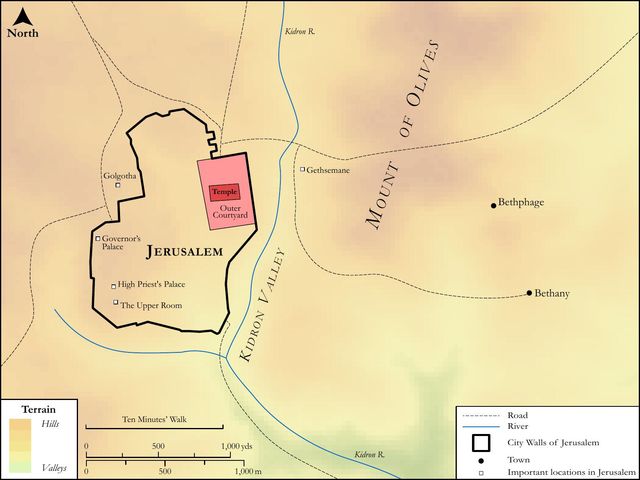
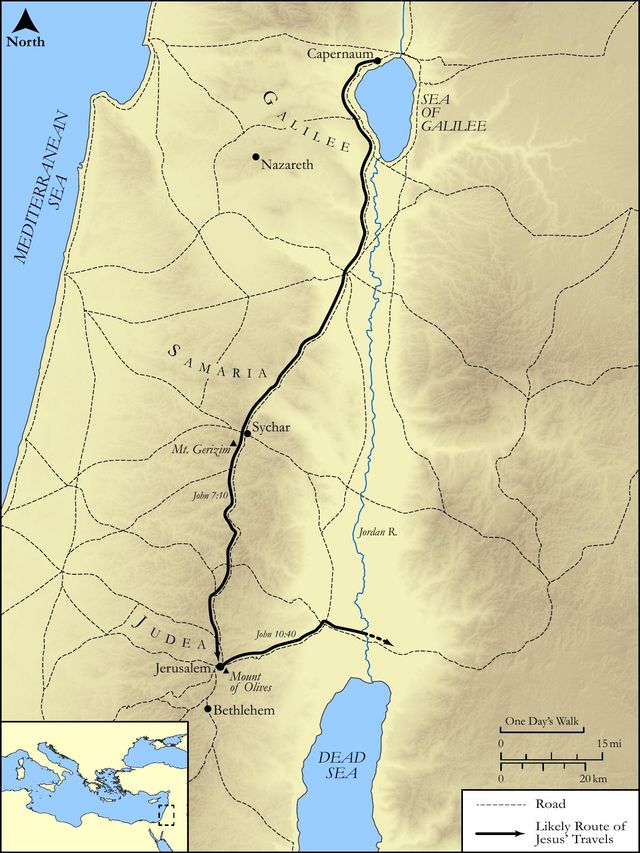
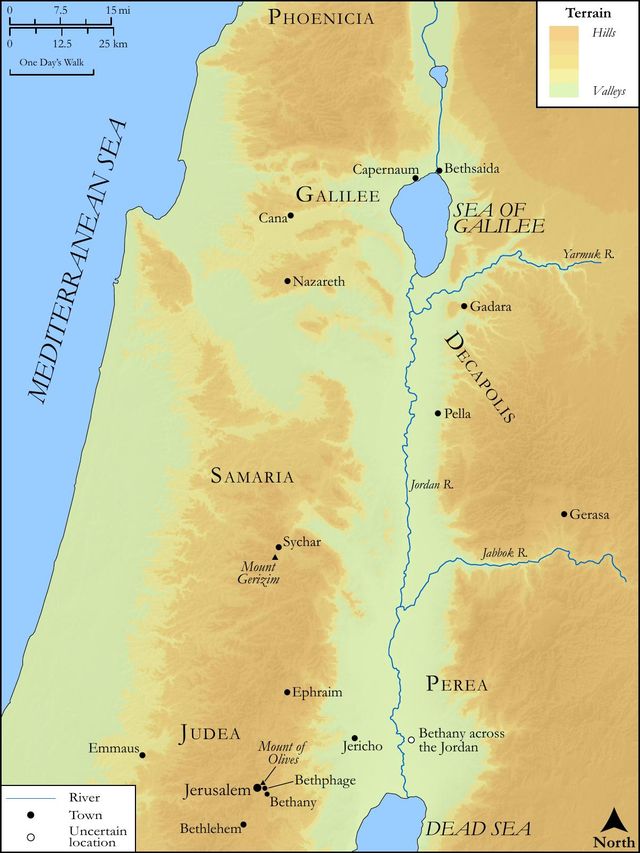
Study this verse
Public-domain commentary
Matthew Henry
From his Commentary on the Whole Bible. Henry comments on passages, not single verses — this entry covers John 9:1–7. His four-level outline is real structure in the source text, so it is rendered as structure.
We have here sight given to a poor beggar that had been blind from his birth. Observe,
I.The notice which our Lord Jesus took of the piteous case of this poor blind man (Joh 9:1):
As Jesus passed by he saw a man which was blind from his birth. The first words seem to refer to the last of the foregoing chapter, and countenance the opinion of those who in the harmony place this story immediately after that. There it was said, parēgen - he passed by, and here, without so much as repeating him name (though our translators supply it) kai paragō - and as he passed by. 1. Though the Jews had so basely abused him, both by word and deed gave him the highest provocation imaginable, yet he did not miss any opportunity of doing good among them, nor take up a resolution, as justly he might have done, never to have favoured them with any good offices. The cure of this blind man was a kindness to the public, enabling him to work for his living who before was a charge and burden to the neighbourhood. It is noble, and generous, and Christ-like, to be willing to serve the public, even when we are slighted and disobliged by them, or think ourselves so. Though he was in his flight from a threatening danger, and escaping for his life, yet he willingly halted and staid awhile to show mercy to this poor man. We make more haste than good speed when we out-run opportunities of doing good. 3. When the Pharisees drove Christ from them, he went to this poor blind beggar. Some of the ancients make this a figure of the bringing of the gospel to the Gentiles, who sat in darkness, when the Jews had rejected it, and driven it from them. 4. Christ took this poor blind man in his way, and cured him in transitu - as he passed by. Thus should we take occasions of doing good, even as we pass by, wherever we are.
Now, (1.) The condition of this poor man was very sad. He was blind, and had been so from his birth. If the light is sweet, how melancholy must it needs be for a man, all his days, to eat in darkness! He that is blind has no enjoyment of the light, but he that is born blind has no idea of it. Methinks such a one would give a great deal to have his curiosity satisfied with but one day's sight of light and colours, shapes and figures, though he were never to see them more. Why is the light of life given to one that is in this misery, that is deprived of the light of the sun, whose way is thus hid, and whom God hath thus hedged in? Job 3:20-23. Let us bless God that it was not our case. The eye is one of the most curious parts of the body, its structure exceedingly nice and fine. In the formation of animals, it is said to be the first part that appears distinctly discernible. What a mercy is it that there was no miscarriage in the making of ours! Christ cured many that were blind by disease or accident, but here he cured one that was born blind. [1.] That he might give an instance of his power to help in the most desperate cases, and to relieve when none else can. [2.] That he might give a specimen of the work of his grace upon the souls of sinners, which gives sight to those that were by nature blind.
(2.)The compassions of our Lord Jesus towards him were very tender. He saw him; that is, he took cognizance of his case, and looked upon him with concern. When God is about to work deliverance, he is said to see the affliction; so Christ saw this poor man. Others saw him, but not as he did. This poor man could not see Christ, but Christ saw him, and anticipated both his prayers and expectations with a surprising cure. Christ is often found of those that seek him not, nor see him, Isa 65:1. And, if we know or apprehend any thing of Christ, it is because we were first known of him (Gal 4:9) and apprehended by him, Phi 3:12.
II.The discourse between Christ and his disciples concerning this man.
When he departed out of the temple they went along with him: for these were they that continued with him in his temptations, and followed him whithersoever he went; and they lost nothing by their adherence to him, but gained experience abundantly. Observe,
1.The question which the disciples put to their Master upon this blind man's case, Joh 9:2. When Christ looked upon him, they had an eye to him too; Christ's compassion should kindle ours. It is probable that Christ told them this poor man was born blind, or they knew it by common fame; but they did not move Christ to heal him. Instead of this, they started a very odd question concerning him: Rabbi, who sinned, this man or his parents, that he was born blind? Now this question of theirs was,
(1.)Uncharitably censorious. They take it for granted that this extraordinary calamity was the punishment of some uncommon wickedness, and that this man was a sinner above all men that dwelt at Jerusalem, Luk 13:4. For the barbarous people to infer, Surely this man is a murderer, was not so strange; but it was inexcusable in them, who knew the scriptures, who had read that all things come alike to all, and knew that it was adjudged in Job's case that the greatest sufferers are not therefore to be looked upon as the greatest sinners. The grace of repentance calls our own afflictions punishments, but the grace of charity calls the afflictions of others trials, unless the contrary is very evident.
(2.)It was unnecessarily curious. Concluding this calamity to be inflicted for some very heinous crime, they ask, Who were the criminals, this man or his parents? And what was this to them? Or what good would it do them to know it? We are apt to be more inquisitive concerning other people's sins than concerning our own; whereas, it is more our concern to know wherefore God contends with us than wherefore he contends with others; for to judge ourselves is our sin. They enquire,
[1.]Whether this man was punished thus for some sin of his own, either committed or foreseen before his birth. Some think that the disciples were tainted with the Pythagorean notion of the pre-existence of souls, and their transmigration from one body to another. Was this man's soul condemned to the dungeon of this blind body to punish it for some great sin committed in another body which it had before animated? The Pharisees seem to have had the same opinion of his case when they said, Thou wast altogether born in sin (Joh 9:34), as if all those, and those only, were born in sin whom nature had stigmatized. Or,
[2.]Whether he was punished for the wickedness of his parents, which God sometimes visits upon the children. It is a good reason why parents should take heed of sin, lest their children smart for it when they are gone. Let not us thus be cruel to our own, as the ostrich in the wilderness. Perhaps the disciples asked this, not as believing that this was the punishment of some actual sin of his own or his parents, but Christ having intimated to another patient that his sin was the cause of this impotency (Joh 5:14), "Master," say they, "whose sin is the cause of this impotency?" Being at a loss what construction to put upon this providence, they desire to be informed. The equity of God's dispensations is always certain, for his righteousness is as the great mountains, but not always to be accounted for, for his judgments are a great deep.
2.Christ's answer to this question. He was always apt to teach, and to rectify his disciples' mistakes.
(1.)He gives the reason of this poor man's blindness: "Neither has this man sinned nor his parents, but he was born blind, and has continued so to this day, that now at last the works of God should be made manifest in him," Joh 9:3. Here Christ, who perfectly knew the secret springs of the divine counsels, told them two things concerning such uncommon calamities: - [1.] That they are not always inflicted as punishments of sin. The sinfulness of the whole race of mankind does indeed justify God in all the miseries of human life; so that those who have the least share of them must say that God is kind, and those who have the largest share must not say that he is unjust; but many are made much more miserable than others in this life who are not at all more sinful. Not but that this man was a sinner, and his parents sinners, but is was not any uncommon guilt that God had an eye to in inflicting this upon him. Note, We must take heed of judging any to be great sinners merely because they are great sufferers, lest we be found, not only persecuting those whom God has smitten (Psa 69:26), but accusing those whom he has justified, and condemning those for whom Christ died, which is daring and dangerous, Rom 8:33, Rom 8:34. [2.] That they are sometimes intended purely for the glory of God, and the manifesting of his works. God has a sovereignty over all his creatures and an exclusive right in them, and may make them serviceable to his glory in such a way as he thinks fit, in doing or suffering; and if God be glorified, either by us or in us, we were not made in vain. This man was born blind, and it was worth while for him to be so, and to continue thus long dark, that the works of God might be manifest in him. That is, First, That the attributes of God might be made manifest in him: his justice in making sinful man liable to such grievous calamities; his ordinary power and goodness in supporting a poor man under such a grievous and tedious affliction, especially that his extraordinary power and goodness might be manifested in curing him. Note, The difficulties of providence, otherwise unaccountable, may be resolved into this - God intends in them to show himself, to declare his glory, to make himself to be taken notice of. Those who regard him not in the ordinary course of things are sometimes alarmed by things extraordinary. How contentedly then may a good man be a loser in his comforts, while he is sure that thereby God will be one way or other a gainer in his glory! Secondly, That the counsels of God concerning the Redeemer might be manifested in him. He was born blind that our Lord Jesus might have the honour of curing him, and might therein prove himself sent of God to be the true light to the world. Thus the fall of man was permitted, and the blindness that followed it, that the works of God might be manifest in opening the eyes of the blind. It was now a great while since this man was born blind, and yet it never appeared till now why he was so. Note, The intentions of Providence commonly do not appear till a great while after the event, perhaps many years after. The sentences in the book of providence are sometimes long, and you must read a great way before you can apprehend the sense of them.
(2.)He gives the reason of his own forwardness and readiness to help and heal him, Joh 9:4, Joh 9:5. It was not for ostentation, but in pursuance of his undertaking: I must work the works of him that sent me (of which this is one), while it is day, and working time; the night cometh, the period of that day, when no man can work. This is not only a reason shy Christ was constant in doing good to the souls and bodies of men, but why particularly he did this, though it was the sabbath day, on which works of necessity might be done, and he proves this to be a work of necessity.
[1.]It was his Father's will: I must work the works of him that sent me. Note, First, The Father, when he sent his Son into the world, gave him work to do; he did not come into the world to take state, but to do business; whom God sends he employs, for he sends none to be idle. Secondly, The works Christ had to do were the works of him that sent him, not only appointed by him, but done for him; he was a worker together with God. Thirdly, He was pleased to lay himself under the strongest obligations to do the business he was sent about: I must work. He engaged his heart, in the covenant of redemption, to draw near, and approach to God as Mediator, Jer 30:21. Shall we be willing to be loose, when Christ was willing to be bound? Fourthly, Christ, having laid himself under obligations to do his work, laid out himself with the utmost vigour and industry in his work. He worked the works he had to do; did ergazesthai ta erga - made a business of that which was his business. It is not enough to look at our work, and talk over it, but we must work it.
[2.]Now was his opportunity: I must work while it is day, while the time lasts which is appointed to work in, and while the light lasts which is given to work by. Christ himself had his day. First, All the business of the mediatorial kingdom was to be done within the limits of time, and in this world; for at the end of the world, when time shall be no more, the kingdom shall be delivered up to God, even the Father, and the mystery of God finished. Secondly, all the work he had to do in his own person here on earth was to be done before his death; the time of his living in this world is the day here spoken of. Note, The time of our life is our day, in which it concerns us to do the work of the day. Day-time is the proper season for work (Psa 104:22, Psa 104:23); during the day of life we must be busy, not waste day-time, nor play by day-light; it will be time enough to rest when our day is done, for it is but a day.
[3.]The period of his opportunity was at hand, and therefore he would be busy; The night comes when no man can work. Note, The consideration of our death approaching should quicken us to improve all the opportunities of life, both for doing and getting good. The night comes, it will come certainly, may come suddenly, is coming nearer and nearer. We cannot compute how nigh our sun is, it may go down at noon; nor can we promise ourselves a twilight between the day of life and the night of death. When the night comes we cannot work, because the light afforded us to work by is extinguished; the grave is a land of darkness, and our work cannot be done in the dark. And, besides, our time allotted us for our work will then have expired; when our Master tied us to duty he tied us to time too; when night comes, call the labourers; we must then show our work, and receive according to the things done. In the world of retribution we are no longer probationers; it is too late to bid when the inch of candle is dropped. Christ uses this as an argument with himself to be diligent, though he had no opposition from within to struggle with; much more need have we to work upon our hearts these and the like considerations to quicken us.
[4.]His business in the world was to enlighten it (Joh 9:5): As long as I am in the world, and that will not be long, I am the light of the world. He had said this before, Joh 8:12. He is the Sun of righteousness, that has not only light in his wings for those that can see, but healing in his wings, or beams, for those that are blind and cannot see, therein far exceeding in virtue that great light which rules by day. Christ would cure this blind man, the representative of a blind world, because he came to be the light of the world, not only to give light, but to give sight. Now this gives us, First, A great encouragement to come to him, as a guiding, quickening, refreshing light. To whom should we look but to him? Which way should we turn our eyes, but to the light? We partake of the sun's light, and so we may of Christ's grace, without money and without price. Secondly, A good example of usefulness in the world. What Christ saith of himself, he saith of his disciples: You are lights in the world, and, if so, Let your light shine. What were candles made for but to burn?
III.The manner of the cure of the blind man, Joh 9:6, Joh 9:7.
The circumstances of the miracle are singular, and no doubt significant. When he had thus spoken for the instruction of his disciples, and the opening of their understandings, he addressed himself to the opening of the blind man's eyes. He did not defer it till he could do it either more privately, for his greater safety, or more publicly, for his greater honour, or till the sabbath was past, when it would give less offence. What good we have opportunity of doing we should do quickly; he that will never do a good work till there is nothing to be objected against it will leave many a good work for ever undone, Ecc 11:4. In the cure observe,
1.The preparation of the eye-salve. Christ spat on the ground, and made clay of the spittle. He could have cured him with a word, as he did others, but he chose to do it in this way to show that he is not tied to any method. He made clay of his own spittle, because there was no water near; and he would teach us not to be nice or curious, but, when we have at any time occasion, to be willing to take up with that which is next hand, if it will but serve the turn. Why should we go about for that which may as well be had and done a nearer way? Christ's making use of his own spittle intimates that there is healing virtue in every thing that belongs to Christ; clay made of Christ's spittle was much more precious than the balm of Gilead.
2.The application of it to the place: He anointed the eyes of the blind man with the clay. Or, as the margin reads it, He spread (epechrise), he daubed the clay upon the eyes of the blind man, like a tender physician; he did it himself with his own hand, though the patient was a beggar. Now Christ did this,
(1.)To magnify his power in making a blind man to see by that method which one would think more likely to make a seeing man blind. Daubing clay on the eyes would close them up, but never open them. Note, The power of God often works by contraries; and he makes men feel their own blindness before he gives them sight.
(2.)To give an intimation that it was his mighty hand, the very same that at first made man out of the clay; for by him God made the worlds, both the great world, and man the little world. Man was formed out of the clay, and moulded like the clay, and here Christ used the same materials to give sight to the body that at first he used to give being to it.
(3.)To represent and typify the healing and opening of the eyes of the mind by the grace of Jesus Christ. The design of the gospel is to open men's eyes, Act 26:18. Now the eye-salve that does the work is of Christ's preparing; it is made up, not as this, of his spittle, but of his blood, the blood and water that came out of his pierced side; we must come to Christ for the eye-salve, Rev 3:18. He only is able, and he only is appointed, to make it up, Luk 4:18. The means used in this work are very weak and unlikely, and are made effectual only by the power of Christ; when a dark world was to be enlightened, and nations of blind souls were to have their eyes opened, God chose the foolish things, and weak, and despised, for the doing of it. And the method Christ takes is first to make men feel themselves blind, as this poor man did whose eyes were daubed with clay, and then to give them sight. Paul in his conversion was struck blind for three days, and then the scales fell from his eyes. The way prescribed for getting spiritual wisdom is, Let a man become a fool, that he may be wise, Co1 3:18. We must be made uneasy with our blindness, as this man here, and then healed.
3.The directions given to the patient, Joh 9:7. His physician said to him, Go, wash in the pool of Siloam. Not that this washing was needful to effect the cure; but,
(1.)Christ would hereby try his obedience, and whether he would with an implicit faith obey the orders of one he was so much a stranger to.
(2.)He would likewise try how he stood affected to the tradition of the elders, which taught, and perhaps had taught him (for many that are blind are very knowing), that it was not lawful to wash the eyes, no not with spittle medicinally, on the sabbath day, much less to go to a pool of water to wash them.
(3.)He would hereby represent the method of spiritual healing, in which, though the effect is owing purely to his power and grace, there is duty to be done by us. Go, search the scriptures, attend upon the ministry, converse with the wise; this is like washing in the pool of Siloam. Promised graces must be expected in the way of instituted ordinances. The waters of baptism were to those who had been trained up in darkness like the pool of Siloam, in which they might not only wash and be clean, but wash, and have their eyes opened. Hence they that were baptized are said to be phōtisthentes - enlightened; and the ancients called baptism phōtismos - illumination. Concerning the pool of Siloam observe,
[1.]That it was supplied with water from mount Zion, so that these were the waters of the sanctuary (Psa 46:4), living waters, which were healing, Eze 47:9.
[2.]That the waters of Siloam had of old signified the throne and kingdom of the house of David, pointing at the Messiah (Isa 8:6), and the Jews who refused the waters of Shiloa, Christ's doctrine and law, and rejoiced in the tradition of the elders. Christ would try this man, whether he would cleave to the waters of Siloam or no.
[3.]The evangelist takes notice of the signification of the name, its being interpreted sent. Christ is often called the sent of God, the Messenger of the covenant (Mal 3:1); so that when Christ sent him to the pool of Siloam he did in effect send him to himself; for Christ is all in all to the healing of souls. Christ as a prophet directs us to himself as a priest. Go, wash in the fountain opened, a fountain of life, not a pool.
4.The patient's obedience to these directions: He went his way therefore, probably led by some friend or other; or perhaps he was so well acquainted with Jerusalem that he could find the way himself. Nature often supplies the want of sight with an uncommon sagacity; and he washed his eyes; probably the disciples, or some stander by, informed him that he who bade him do it was that Jesus whom he had heard so much of, else he would not have gone, at his bidding, on that which looked so much like a fool's errand; in confidence of Christ's power, as well as in obedience to his command, he went, and washed.
5.The cure effected: He came seeing. There is more glory in this concise narrative, He went and washed, and came seeing, than in Caesar's Veni, vidi, vici - I came, I saw, I conquered. When the clay was washed off from his eyes, all the other impediments were removed with it; so when the pangs and struggles of the new birth are over, and the pains and terrors of conviction past, the bands of sin fly off with them, and a glorious light and liberty succeed. See here an instance,
(1.)Of the power of Christ. What cannot he do who could not only do this, but do it thus? With a lump of clay laid on either eye, and washed off again, he couched those cataracts immediately which the most skilful oculist, with the finest instrument and the most curious hand, could not remove. No doubt this is he that should come, for by him the blind receive their sight.
(2.)It is an instance of the virtue of faith and obedience. This man let Christ do what he pleased, and did what he appointed him to do, and so was cured. Those that would be healed by Christ must be ruled by him. He came back from the pool to his neighbours and acquaintance, wondering and wondered at; he came seeing. This represents the benefit gracious souls find in attending on instituted ordinances, according to Christ's appointment; they have gone to the pool of Siloam weak, and have come away strengthened; have gone doubting, and come away satisfied; have gone mourning, and come away rejoicing; have gone trembling, and come away triumphing; have gone blind, and come away seeing, come away singing, Isa 52:8.
Historical interpretation
Seven Centuries of Reception
8 surviving comments on this verse. Each one is dated, so this reads as a timeline rather than a list.
Select a marker to jump to its quote. Markers stagger vertically where authors wrote within a few decades of each other.
There was a certain philosophy among the ancients that troubles came from sin because they were confident that God was not responsible for any evil. The notion that people suffer as an exercise so that they might perceive the power of God at last—this was not well known at all because they would rather have God give good rewards to the just then and there and not prolong suffering any longer for the sake of eternal life. Since he was a blind man from birth, it occurred to the disciples to ask. Since no one can sin before his birth, they ventured a guess that the parents were to blame. For they knew that children may suffer in order to bring grief to the parents. But the Lord said that the blindness did not occur because of any sin but for the sake of the glory of God that was about to take place as the power of God would be revealed through his unexpected recovery of sight.
Yet in the beginning of the world men lived long, and had no diseases. But when through carelessness they neglected the observation of the proper times, then the sons in succession cohabiting through ignorance at times when they ought not, place their children under innumerable afflictions. Whence our Teacher, when we inquired of Him in regard to the man who was blind from his birth, and recovered his sight, if this man sinned, or his parents, that he should be born blind, answered, 'Neither did he sin at all, nor his parents, but that the power of God might be made manifest through him in healing the sins of ignorance.'
(Hom. lvi. 1) The Jews having rejected Christ's words, because of their depth, He went out of the temple, and healed the blind man; that His absence might appease their fury, and the miracle soften their hard hearts, and convince their unbelief. And as Jesus passed by, He saw a man which was blind from his birth. It is to be remarked here that, on going out of the temple, He betook Himself intently to this manifestation of His power. He first saw the blind man, not the blind man Him: and so intently did He fix His eye upon him, that His disciples were struck, and asked, Rabbi, who did sin, this man or his parents, that he was born blind?
(Hom. liv. 1. c. 5) They were led to ask this question, by our Lord having said above, on healing the man sick of the palsy, Lo, thou art made whole; sin no more. Thinking from this that the man had been struck with the palsy for his sins, they ask our Lord of the blind man here, whether he did sin, or his parents; neither of which could have been the reason of his blindness; the former, because he had been blind from his birth; the latter, because the son does not suffer for the father.
Jesus answered, Neither hath this man sinned, nor his parents.
(Hom. lvi. 1, 2) He is not to be understood as meaning that others had become blind, in consequence of their parents' sins: for one man cannot be punished for the sin of another. But had the man therefore suffered unjustly? Rather I should say that that blindness was a benefit to him: for by it he was brought to see with the inward eye. At any rate He who brought him into being out of nothing, had the power to make him in the event no loser by it. Some too say, that the that here, is expressive not of the cause, but of the event, as in the passage in Romans, The law entered that sin might abound; (Rom. 5:20) the effect in this case being, that our Lord by opening the closed eye, and healing other natural infirmities, demonstrated His own power.
(Hom. liv. 2) That the glory of God should be made manifest, He saith of Himself, not of the Father; the Father's glory was manifest already. I must work the works of Him that sent Me: i. e. I must manifest Myself, and show that I do the same that My Father doeth.
(Hom. lvi. 2) While it is day, He adds; i. e. while men have the opportunity of believing in Me; while this life lasts; The night cometh, when none can work. Night here means that spoken of in Matthew, Cast him into outer darkness. (Mat. 22:13) Then will there be night, wherein none can work, but only receive for that which he has worked. While thou livest, do that which thou wilt do: for beyond it is neither faith, nor labour, nor repentance.
"Master, who did sin, this man, or his parents, that he was born blind?" A mistaken question, for how could he sin before he was born? and how, if his parents had sinned, would he have been punished? Whence then came they to put this question? Before, when He healed the paralytic, He said, "Behold, thou art made whole, sin no more." They therefore, having understood that he was palsied on account of sin, said, "Well, that other was palsied because of his sins; but concerning this man, what wouldest Thou say? hath he sinned? It is not possible to say so, for he is blind from his birth. Have his parents sinned? Neither can one say this, for the child suffers not punishment for the father." As therefore when we see a child evil entreated, we exclaim, "What can one say of this? what has the child done?" not as asking a question, but as being perplexed, so the disciples spake here, not so much asking for information, as being in perplexity.
(Tr. xliv. 1, 2) Rabbi is Master. They call Him Master, because they wished to learn: they put their question to our Lord, as to a Master.
That not from sins of the soul prior to birth do bodily sufferings befal any, nor yet does God bring the sins of their fathers upon any, punishing those who have nothing sinned, but brings righteous doom upon all.
Being desirous (and not without good reason) that the mystery should be explained, or rather being Divinely guided, the most wise disciples were urged to ask instruction on the subject. And they are inquisitive with profit, by this means furnishing an advantage not so much for themselves as for us. For we are benefited greatly both by hearing the true explanation of these things from the Omniscient, and in addition also by being warned off from the abomination of effete doctrines. These errors not only used to exist among the Jews, but are also |2 advocated now by some who are insufferably conceited in their knowledge of inspired Scripture and seem to pass for Christians. Such persons of a truth delight too much in their own sophistries, indulging their private fancies, and not fearing to mingle Greek error with the doctrines of the Church. For the Jews, when they were in misery, greatly murmured, as if merely suffering the penalty of their forefathers' impiety, or as if God were most unreasonably laying upon them the sins of their fathers, and scoffed at it as a most unjust punishment; they even said in a proverb: The fathers have eaten sour grapes and the children's teeth are set on edge. And these again, being afflicted with a like and kindred ignorance to those just mentioned by us, earnestly maintain 9 that the souls of men existed and had their being before the creation of their bodies, and that these souls having turned willingly to sin even before the existence of their bodies, then souls and bodies became united, when in the order of chastisement the souls received birth in the flesh. But in one brief statement the follies of both these parties are exposed by Christ, Who confidently affirms that neither had the blind man sinned nor his parents. He refutes the doctrine of the Jews by saying that the man had not been born blind on account of any sin either of himself or of his ancestors, no, not even of his father or mother; and he also overthrows the silly nonsense of the others, who say that souls sin before their existence in the body.
For some one will say to them and very reasonably: How, tell me, does Christ say that neither had the blind man sinned nor his parents? And yet we could not grant that they were altogether free from sin. For, inasmuch as they were human, it is I suppose in every way likely or rather it of necessity follows that they fell into errors. Pray then, what time does Christ mean to define as that concerning which His word shall appears to us true, that neither did the man himself sin, nor indeed his parents? |Surely He speaks of that which is previous to birth, when having no existence whatever, they did not sin.
Again, concerning such matters, how truly frivolous and beside the mark it is to think that souls sinned before the existence of their bodies, and on that account were embodied and sent into this world, we have argued at length at the beginning of the present gospel, in interpreting and commenting on the words: That was the True Light, which lighteth every man that cometh into the world; and it would be superfluous for us to discuss the subject again. But it is necessary to say whence it occurred to the Jews to fall into this opinion and supposition; also to show clearly that from inability to understand the Divine Word, they mistook its proper meaning. Israel once dwelt in tents in the wilderness, and God called His hierophant Moses on Mount Sinai; but when he extended his stay there with God to the number of forty days, he seemed to be a loiterer to those who had influence with the people, who both rose up against Aaron then being alone, and falling back in contempt upon the idolatries of Egypt, cried saying: Make us gods, which shall go before us; for as for this Moses, the man that brought us up out of the land of Egypt, we wot not what is become of him. Then what followed thereupon I think it necessary to speak of briefly. They made a calf, as it is written, and at this God was justly provoked to anger: then indeed He threatened to destroy the whole congregation at once. Moses fell down before Him and sought for pardon with much entreaty. The Creator of the universe granted forgiveness, and promised to punish the people no further than that He would not continue to go up with them to the land of promise, but would send with them instead His special Angel as it were in the position of leader. At this Moses was sorely grieved, and as God was not willing to go up with the people, he inferred with some likelihood indeed that the Divine anger was not yet thoroughly appeased. So he prayed again earnestly that God would accompany them, |4 knowing that the mere guidance of an Angel would not suffice some of the Israelites, and perhaps also fearing the weakness of the people and therefore deprecating the holy angels' hatred of evil; and he entreated the Good One, the Lover of men, the Supreme King and Lord over all, to be willing rather to be present with those so prone to transgress. For he knew that God would pardon them not once only but many times, and that He would grant mercy to those who should offend. And God also consented to this. Then Moses sought a sign from Him, even that he might see Him, as a full assurance and testimony that He had forgiven them completely: For, said he, if I have found grace in Thy sight, manifest Thyself to me; that I may evidently see Thee, that I may find grace in Thy sight, and that I may know that this great nation is Thy people. This also God granted, as far as it was possible, assuring in every way His own servant both that He had forgiven the people their sin and that He would go up with them to the land of promise. Then, giving as it were a sort of finishing touch to the promises, which seemed wanting, He commands Moses to hew out two other tables for Him, the former ones as we know having been broken in pieces, so that He might write down the Law yet again for the people; even in this affording no small evidence of His kindness towards them. And when Moses was ready also for this, the Lord descended in a child, as it is written, and stood with him there, and proclaimed the Name of the Lord. And the Lord passed by before his face and proclaimed: The Lord God is pitiful and merciful, long-suffering and abundant in mercy, and true, and keeping justice, and showing mercy unto thousands, taking away iniquities and unrighteousnesses and sins; and He will not clear the guilty; visiting the sins of fathers upon children and upon children's children unto the third and fourth generation.
But now attend carefully, for I am about to take up again the question proposed at first. God declares Himself to show His kindness and His incomparable love of |men in a manner suitable to Deity. For we maintain that these were the words of God, not of any other speaker; not (as some think) the words of the all-wise Moses, offering up laudatory prayers on behalf of the people. For that it is the Lord of all Himself speaking these things of Himself, no other than the blessed Moses himself will bear witness to us, teaching in the Book of Numbers, when the Israelites had again taken offence from unseasonable cowardice, because some, who by Moses at God's command had been sent to spy it out, spake evil of the Land of Promise. For when they returned from the land of the strangers and were come again to their own people, they spat out bitter words concerning it. Affirming the land to be so wild and rugged that it was capable of eating up its inhabitants, they excited so much hatred of it in the minds of their hearers, that bursting into tears they now desired again to be in Egypt with all its hardships. For, Let us make, said they, captains, and let us journey into Egypt. And when God threatened to destroy them, Moses again prayed, and all but reminding Him also of the promise He had given, went on to cry: And now let Thy strength be exalted, O Lord, according as Thou hast spoken, saying, The Lord is long-suffering and of great mercy and true, forgiving transgressions and iniquities and sins; and He will by no means clear the guilty, visiting the sins of fathers upon children unto the third and fourth generation. Forgive this people their sin according to Thy great mercy, as Thou hast been favourable to them from Egypt even until now. It appears therefore that He Who is God over all attributes to Himself love of men and the greatest forbearance towards evil. It will be fitting in the next place to set forth the cause on account of which the Jews, being deceived, could suppose our good God to be mindful of injury and exceeding wrathful.
For my part, I do not think them able to lay hold of the Divine Oracles in any way, or to cavil at them as if they have not expressed what is most excellent or have |6 strayed far from the law of fairness. On the other hand, I think that they only indulge their own ignorance in this matter, to suppose the sins of fathers to be really brought upon children, and the Divine anger to be stretched so far that it may even reach to the third and fourth generation, exacting unjustly from innocent persons the penalties of others' crimes. Would it not at all events be more becoming to them, if they were wise, to hold the opinion that the Source of righteousness and of our moral laws would do nothing so shameful? For even men inflict punishments according to the laws upon habitual transgressors, but by no means visit them on their children, unless perchance they are detected as partners and associates in the misdeeds: and as to Him Who prescribed to us the laws of all justice, how can He be detected in inflicting penalties such as among ourselves are greatly condemned? Then this also in addition is to be considered. By the mouth of Moses He published laws innumerable, and in many cases those living in bad habits were ordered to be punished, but nowhere is a command from Him to be found, that children should share the penalties incurred by their sinning fathers. For penalty is for those who are detected in crime, and it was ordained that it was fitting to punish those only who were obnoxious to the law. To think as the Jews do is therefore surely impious, but it is certainly the part of a wise man to investigate the Divine mind and by every means to observe what things are agreeable to Nature, the queen of all things. Rightly therefore let us hold that the God of the universe, setting as it were before Him His inherent clemency, willing to be admired for His pure love of men and to this end proclaiming: The Lord is longsuffering and of great mercy and true, forgiving transgressions and sins, would not wish to be known as so mindful of evil that He extends His anger even to the fourth generation inclusive. For how can He still be longsuffering and of great mercy, or how does He forgive transgressions and sins, Who cannot endure to limit the infliction of penalty to the person |7 of the sinner, but extends it beyond the third generation, and like a sort of thunderbolt assaults even the innocent? Surely then it is quite incredible and of almost utter folly, to suppose that God attributes to Himself, together with love of men and gentleness, anger so lasting and so unreasonable.
To these things another may be added by those who support the Jewish opinion, and do not allow that God knows a suitable time for every kind of action. For if He promises longsuffering and is found to yield very easily in laying aside His anger, why is He seen to have added: Visiting the sins of fathers upon children unto the third and fourth generation? Of course this was done for no other reason than a wish to frighten those who expect remission of sins from Him, as showing that the object of their hopes should never be realized, since He Who with reason is grieved with them is so mindful of evil and tenacious in anger.
But further, tell me what the hierophant Moses himself indicates to us. Would he not seem to do a thing most opposite to all reason, if, when Israel had given offence and was about to suffer punishment, he proceeded to pray for them, and, while asking for oblivion of the offence and an exhibition of God's love for men, he should unseasonably say to God: Thou art of such a nature that Thou requitest the sins of fathers upon children's children? For this would be rather the way of one instigating to anger than of one calling for mercy, and of one asking mindfulness of injury rather than longsuffering. But in my opinion by these words he seemed to importune God and to recall to His memory almost the very words which He Himself uttered, when He publicly proclaimed His inherent goodness. For in what way He is longsuffering and of great mercy, and how He is by nature One Who takes away sins and transgressions, will be most excellently discerned, in the very dealings wherein He seems to be somewhat bitter.
In the next place then I think it is fitting to set forth |8 in what way we may rightly understand the words which were spoken by God. The Lord, He says, is long suffering and of great mercy, taking away transgressions and sins. Then we will read that which immediately follows as if with a note of interrogation:. And will He not surely clear the guilty? So that thou mayest understand something of this sort: Will not, says He, the longsuffering and greatly merciful God, Who takes away transgressions and sins, will He not surely clear the guilty? Of course it is not to be doubted: certainly He will thoroughly purge him. For how is He longsuffering and of great mercy and how does He at all take away sins, unless He purges the guilty? At these words He goes off to a demonstration of His inherent longsuffering and forbearance, even that He will visit the sins of the fathers upon children unto the third and fourth generation: not chastising the son for the father; do not think this: nay, not even does He lay upon a descendant the faults of his ancestors like a burden: but meaning something of this sort. There was (we will suppose) a certain man, a transgressor of laws, having his mind full of all wickedness, and who, being taken in this manner of lining, deserved to be punished without any respite; but yet God in forbearance dealt with him patiently, not bringing upon him the wrath he had merited. Then to him was born a son, a rival of his father in impious deeds and outdoing his parent in villainy: God also showed longsuffering towards this man. But from him is born a third, and from the third a fourth, in no way inferior to their progenitors in wickedness, but practising equal impiety with them. Then God pours out wrath upon them, already even from the beginning deserved by the whole race, after He has tolerated as much as and even more than it behoved Him. A postponement of vengeance even unto the fourth generation, how is it not truly a commendation of Divine gentleness? For that He is wont to chastise neither son for father nor father for son, it is not hard to learn from those words which by the voice of the prophet Ezekiel He clearly spake to the Jews |9 themselves, when over this same thing they murmured and said: The fathers have eaten sour grapes and the children's teeth are set on edge. And, says he, the word of the Lord came unto me, saying, Son of man, what mean ye by this proverb in Israel, saying, The fathers have eaten sour grapes and the children's teeth are set on edge? As I live, saith the Lord, this proverb shall be said no more in Israel. For all souls are mine; as the soul of the father, so also the soul of the son; they are mine. The soul that sinneth, it shall die. The son shall not bear the iniquity of the father, neither shall the father bear the iniquity of his son: each in his own iniquity in which he hath sinned, in that shall he die. But I suppose no one is so foolish as to think that God did not at the beginning legislate in the most excellent way, but somehow changed His plans and altered His ideas for the better, and like one of ourselves was with difficulty and after subsequent deliberation able to improve His legislation to what was most fitting. In such a case, if we praise the earlier laws we shall clearly be blaming the later, and if we express an opinion that the later laws are superior we shall condemn the earlier by our lower estimation of them. God too will legislate in opposition to Himself, and will have fallen short, as we may have done, of a perfect standard, by ordaining one thing at one time and a different thing at another time. But I suppose every one will say that the Divine Nature cannot be in any way subject to such inconsistencies as this, and could not even have ever fallen short of absolute perfection.
It is then as a demonstration of His incomparable munificence that He alleges the words quoted above, viz:----Requiting the sins of fathers upon children unto the third and fourth generation. For that the merciful God is wont to punish sinners not immediately, but rather to do it reluctantly and to put off punishments for long seasons, thou wilt understand from His own words: And I was full of Mine anger and restrained it, and: did not make a full end of them. And again in another place: For the iniquity of the Amorites is not yet full. Thou seest that He was indeed full of anger, for some were perpetrating deeds deserving fulness of anger, but as God He forbore patiently and delayed to make a full end of those who offended Him. But in order that we may exhibit to thee as in a picture the proof of what we have said and from actual events demonstrate the praise of God's love for men to be contained in this text, I will bring forward something recorded in the Sacred Books, and will endeavour from the Divine Scripture itself to show the sins of fathers visited on children even to the third and fourth generation; not unjustly, but justly, and in a manner merited by the sufferers themselves. The story shall be summarized, because of the length of the narrative.
Well then, in the First Book of Kings we read that after other kings Ahab reigned over Israel, and burning with a most unrighteous desire for another man's vineyard, he slew the lord of it, even Naboth. For although he did not himself command that deed, yet he expressed no anger at the wickedness of his wife. At this God was of course wroth, and spake to Ahab by Elijah the prophet: Thus saith the Lord, Forasmuch as thou hast killed and also taken possession, therefore thus saith the Lord, In the place where the swine and the dogs licked the blood of Naboth, there shall the dogs lick thy blood; and the harlots shall wash themselves in thy blood. And again immediately: Thus saith the Lord, Behold I bring evil upon thee, and will kindle a fire behind thee, and will utterly destroy from Ahab every male and him that is shut up and left in Israel. And I will make thy house like the house of Jeroboam the son of Nebat, and like the house of Baasha the son of Ahab, for the provocations wherewith thou hast provoked Me to anger and made Israel to sin. And of Jezebel he spake, saying, The dogs shall eat her within the outer-wall of Jezreel. And him that dieth of Ahab in the city the dogs shall eat, and him that dieth in the field shall the birds of the air eat. When the Lord of all unmistakably threatened to do all these things and to inflict them, Ahab rent his garment and entered into his house; as it is written, He was pricked to the heart, and burst bitterly into tears, and girded his loins with sackcloth. In which state God pities him, and begins to allay His anger, and putting as it were a bridle to His sudden fury says to the Prophet: Hast thou seen how Ahab was pricked to the heart before Me? I will not bring these things in his days, but in his son's days I will bring the evil. Will it not therefore be right to inquire upon whom these things were fulfilled? Well, the son of Ahab was Ahaziah, Who, Scripture says, did evil in the sight of the Lord and walked in the way of his father Ahab, and in the way of Jezebel his mother. Then the son of Ahaziah was, Scripture says, Joram, of whom again it is written that he walked in the sins of the house of Jeroboam. Next to Joram reigned a third Ahaziah, of whom again the language of the narrative says that he did evil in the sight of the Lord, as did the house of Ahab. But when the time had now come for punishing the house of Ahab, which had not ceased from impiety towards God even to the fourth generation, there was anointed to be the next king over Israel Jehoshaphat son of Nimshi, who slew Ahaziah, and beside him Jezebel; he slew also seventy other sons of Ahab, carrying out as it were the Divine wrath to the uttermost, so that he obtained both honour and favour on account of it. For what saith God to him? Because thou hast done well in executing that which is right in Mine eyes, and hast done unto the house of Ahab according to all that was in Mine heart, thy children of the fourth generation shall sit upon thy throne. Thou seest therefore that He reluctantly punished in the fourth generation the wicked descendants of wicked men, whereas to him from whom He received honour He extends His mercy even to the fourth generation. Cease therefore, O Jew, to accuse the righteousness of God. As a form of encomium certainly we will accept that saying: Requiting the sins of fathers upon children unto the third and fourth generation.
(in Præf. Moral. c. 5) One stroke falls on the sinner, for punishment only, not conversion; another for correction; another not for correction of past sins, but prevention of future; another neither for correcting past, nor preventing future sins, but by the unexpected deliverance following the blow, to excite more ardent love of the Saviour's goodness.
(viii. Moral. c. xxx. [49.]) Or thus: By His spittle understand the savour of inward contemplation. It runs down from the head into the mouth, and gives us the taste of revelation from the Divine splendour even in this life. The mixture of His spittle with clay is the mixture of supernatural grace, even the contemplation of Himself with our carnal knowledge, to the soul's enlightenment, and restoration of the human understanding from its original blindness.
This question does not seem a proper one. For the Apostles had not been taught the fond notion of the Gentiles, that the soul has sinned in a previous state of existence. It is difficult to account for their putting it.
Continue studying John 9:2 across the web’s major study libraries — every link below opens this exact verse, chapter, or book on the destination site.
Read & Compare
 BibleGatewayThis verse in more than 200 translations and 70 languages.
 Bible.comThe YouVersion reader — hundreds of translations, reading plans, and highlights.
 ESV.orgCrossway's official English Standard Version reader.
 NET BibleThe NET translation with 60,000+ translators' notes on every rendering decision.
 STEP BibleTyndale House's free study tool — original text, vocabulary, and scholarly resources.
 BibliaLogos Bible Software's free web reader.
 USCCBThe New American Bible (Revised Edition) with the U.S. bishops' study notes.
Commentaries
 BibleHub CommentariesDozens of classic commentaries on this verse, gathered on one page.
 StudyLightMore than 100 commentary sets — the largest collection on the web.
 BibleRefPlain-English commentary on what this verse means, verse by verse.
 Enduring WordDavid Guzik's free commentary on this chapter, widely used by Bible teachers.
 Bible Study ToolsVerse commentary alongside Greek and Hebrew study aids.
Original Language & Research
- BibleHub InterlinearThe verse word by word — original language, transliteration, and English.
- BibleHub LexiconEvery word's original-language definition and Strong's entry.
 Blue Letter BibleDeep-study tools — Strong's numbers, concordance, and word studies.
 CNTR CollationThe earliest Greek manuscripts of this verse, collated letter by letter.
Sermons, Hymns & Audio


TrulyRandomVerse is not affiliated with these sites and doesn’t control their content. They’re linked because they’re genuinely useful.
Summary
John 9:2 captures the disciples' immediate response to encountering a man born blind, posing a question rooted in the prevailing theological framework of their day: "Master, who did sin, this man, or his parents, that he was born blind?" This inquiry reflects a common, yet often misguided, assumption that physical affliction, especially congenital disability, was a direct and punitive consequence of specific sin, either by the afflicted individual or their ancestors. This pivotal question sets the stage for Jesus to dismantle a deeply ingrained misconception and reveal a profound truth about the nature of suffering and the manifestation of God's glory.
Context
ShowHideLiterary Context
This verse immediately follows a highly confrontational exchange between Jesus and the Jewish religious leaders in John 8, culminating in Jesus' profound "I AM" declaration in John 8:58 and their subsequent attempt to stone Him. Jesus then "hid himself, and went out of the temple" (John 8:59). As Jesus walks away from the volatile temple precinct, He encounters a man who has been blind from birth. The disciples' question in John 9:2 is not a random query but arises directly from this encounter, setting the stage for Jesus' revolutionary teaching on suffering and divine purpose, which unfolds throughout John 9.
Historical & Cultural Context
The disciples' question reflects a deeply ingrained theological assumption prevalent in ancient Judaism: that physical affliction, especially severe or congenital conditions, was a direct consequence of sin. This belief stemmed partly from interpretations of the Mosaic Law, which often linked obedience to blessing and disobedience to curses (e.g., Deuteronomy 28). While the Old Testament does show instances where sin led to judgment, this principle was often misapplied to individual suffering. For a man born blind, the question of "whose sin?" became particularly perplexing, leading to speculative theories about sin committed in the womb, or even pre-existence, or, more commonly, the sins of the parents being visited upon the child (Exodus 20:5). This cultural lens shaped how people understood misfortune, often leading to judgment rather than compassion for the afflicted.
Key Themes
ShowHideThe central theme emerging from this verse is the pervasive human tendency to directly correlate Suffering and Sin. The disciples' question highlights a common misconception that all physical ailments, particularly congenital ones, are a punitive consequence of specific individual or ancestral transgression. This sets up Jesus' subsequent teaching, which challenges this narrow worldview and introduces the theme of Divine Purpose in Suffering, asserting that some suffering serves as an opportunity for God's glory to be revealed, as seen in John 9:3. Furthermore, the encounter underscores the Disciples' Limited Understanding, demonstrating their need for Jesus to reframe their theological perspectives. This narrative also implicitly connects to Jesus' identity as the Light of the World, declared earlier in John 8:12, as He is about to bring literal and spiritual sight to the blind man.
Exposition and Analysis
ShowHideKey Word Analysis
ShowHideThis verb (G2065) means "to interrogate" or "to request." Here, it signifies a direct inquiry, not merely a casual question, but one seeking a definitive answer to a perplexing theological dilemma. The disciples are not just curious; they are seeking understanding from their Master regarding a deeply held belief system.
The Greek term (G264) literally means "to miss the mark." In a moral and theological context, it refers to a deviation from God's perfect standard, a transgression against His law or will. The disciples' use of this word immediately frames the man's blindness within a framework of moral accountability and divine judgment.
This word (G1080) refers to the act of procreation or being brought forth. Its use in "born blind" emphasizes the congenital nature of the man's condition, making the disciples' question even more pointed and challenging to their understanding of sin, as it implies sin before birth or inherited sin.
Verse Breakdown
ShowHide"And his disciples asked him, saying, Master,"
This opening sets the scene, identifying the questioners as Jesus' closest followers, who address Him with respect as "Master" (Greek, rhabbí). Their posture is one of seeking authoritative teaching on a matter of profound spiritual and practical concern.
"who did sin, this man,"
The first part of the disjunctive question immediately posits the individual's own sin as a potential cause for his blindness. This reflects the common belief that personal transgression directly resulted in divine punishment, visible in physical affliction. The question implies a direct causal link between action and consequence.
"or his parents,"
The alternative posed by the disciples suggests another prevalent belief: that the sins of parents could be visited upon their children, even resulting in congenital defects. This idea, while having roots in Old Testament warnings about generational curses (e.g., Exodus 20:5), was often misapplied to attribute specific suffering to ancestral wrongdoing.
"that he was born blind?"
This concluding phrase clarifies the specific nature of the man's affliction – a congenital condition. The disciples' query is particularly sharp because it challenges the conventional understanding of sin and punishment. How could someone sin before birth to be born blind? This highlights the theological conundrum they faced and their expectation that Jesus, as their Master, would provide a definitive answer within their existing framework.
Literary Devices
ShowHideJohn's Gospel employs several literary devices in this verse to set the stage for Jesus' profound teaching. The primary device is Interrogative Rhetoric, where the disciples' question serves not merely as an inquiry but as a representation of a widely held, yet flawed, theological premise. This question acts as a Foreshadowing device, preparing the reader for Jesus' subsequent correction and revelation of a higher purpose for suffering, moving beyond a simplistic cause-and-effect model of sin and affliction. There is also an element of Irony in the disciples' question; while they seek to attribute blame based on a limited understanding of justice, Jesus is about to demonstrate a divine purpose that transcends human categories of sin and punishment, ultimately revealing God's glory through an act of healing that brings both physical and spiritual sight.
Theological and Thematic Connections
ShowHideJohn 9:2 confronts a persistent theological challenge: the human tendency to attribute suffering directly and solely to sin. This verse highlights a common, yet incomplete, understanding of divine justice and human affliction, where physical maladies are seen as direct punishments. Jesus' response in the subsequent verses (John 9:3-5) decisively refutes this simplistic correlation, shifting the focus from blame to divine purpose. He reveals that suffering, while often a consequence of a fallen world, is not always a direct result of individual transgression, but can be an occasion for God's power and glory to be made manifest. This profound reorientation challenges believers to move beyond a judgmental posture towards those who suffer, embracing instead a compassionate and missional perspective that seeks God's redemptive work in all circumstances.
Reflection and Application
ShowHideThe disciples' question in John 9:2 serves as a powerful mirror for our own assumptions about suffering and its causes. In a world grappling with illness, disability, and various forms of hardship, it is tempting to seek simple explanations, often defaulting to a judgmental stance that links misfortune directly to personal sin or the sins of others. However, Jesus' response in this narrative calls us to a higher, more compassionate, and God-centered perspective. Rather than asking "Who sinned?", we are invited to ask, "How can God's glory be revealed in this situation?" This shift compels us to move from judgment to empathy, from speculation to active participation in God's redemptive work. It challenges us to see suffering not merely as a problem to be solved or a punishment to be explained, but as a potential canvas upon which God desires to display His power, love, and grace, transforming our understanding of both human brokenness and divine sovereignty. Our application should be to cultivate a heart of compassion, seeking opportunities to minister to those who suffer, and to trust in God's sovereign purposes even when we do not fully understand them.
Questions for Reflection
ShowHideFAQ
ShowHideDid the Jews believe in reincarnation or pre-existence, which would explain "this man" sinning before birth?
ShowHideWhile some Jewish mystical traditions and later philosophical schools might have entertained ideas akin to pre-existence or transmigration of souls, the mainstream Jewish theology of Jesus' day did not widely embrace reincarnation as a common explanation for congenital defects. The more prevalent understanding for "this man" sinning before birth would have been the concept of sin committed in the womb (e.g., Jacob and Esau struggling in Rebekah's womb, though not framed as sin, but as a struggle, Genesis 25:22-23), or, more commonly, the idea of parental sin being visited upon the children, as implied in parts of the Old Testament (e.g., Exodus 20:5). The disciples' question primarily reflects these more common interpretations of sin and its generational consequences, rather than a belief in reincarnation.
Why did the disciples ask about sin rather than simply asking Jesus to heal the man?
ShowHideThe disciples' immediate impulse to question "who sinned" reveals the deep-seated theological framework through which they, and many in their culture, interpreted suffering. For them, a congenital condition like blindness was not merely a physical ailment but a sign of divine judgment, requiring an explanation rooted in moral transgression. They were operating within a system where cause and effect were tightly linked to sin and punishment. Their question was a natural extension of their worldview, seeking to understand the spiritual reason behind the man's condition before considering the possibility of a miraculous intervention. Jesus' subsequent answer in John 9:3 directly addresses and corrects this prevailing misconception, shifting the focus from blame to God's glory.
Christ-Centered Fulfillment
ShowHideThe question posed by the disciples in John 9:2, though rooted in a flawed understanding of suffering, ultimately serves to highlight the profound Christ-centered fulfillment of God's redemptive plan. In Jesus' response, He reframes the entire discussion, declaring that the man's blindness was "that the works of God should be made manifest in him" (John 9:3). This points to Christ as the ultimate revelation of God's works and glory. As the "Light of the World" (John 8:12), Jesus not only restores physical sight but also offers spiritual illumination, revealing the true nature of God's character – one of compassion and sovereign purpose, not merely punitive judgment. His healing of the man born blind foreshadows His greater work of delivering humanity from the blindness of sin and spiritual death, a salvation accomplished through His atoning sacrifice on the cross (2 Corinthians 5:21) and His resurrection. Through Christ, suffering is not always a sign of personal condemnation, but can become a powerful testimony to God's transformative power and the hope of new life found in Him (Romans 8:18-25). He is the one who bears our infirmities and carries our sorrows (Isaiah 53:4), ultimately bringing light into the deepest darkness.