


John 9:1
Bible text: King James Version (1769 Blayney text) · Public domain
Bible text: Berean Standard Bible · Public domain
Bible text: American Standard Version (1901) · Public domain
Bible text: World English Bible, Messianic edition · Public domain
Bible text: Geneva Bible (1599) · Public domain
Bible text: Young's Literal Translation · Public domain
- ΚαὶKaiAndG2532CONJConjunction
- παράγωνparagōnpassing byG3855V-PAP-NSMVerb Present Active Participle Nominative Singular Masculine
- εἶδενeidenHe sawG1492V-2AAI-3SVerb 2nd Aorist Active Indicative 3rd Singular
- ἄνθρωπονanthrōpona manG444N-ASMNoun Accusative Singular Masculine
- τυφλὸνtuphlonblindG5185A-ASMAdjective Accusative Singular Masculine
- ἐκekfromG1537PREPPreposition
- γενετῆςgenetēsbirthG1079N-GSFNoun Genitive Singular Feminine
English is a literal word-by-word gloss of the Greek, not the KJV's wording. Why?
This is the original text the KJV's translators worked from — each Greek word with its own literal English meaning in this verse, prepared by scholars at Tyndale House, Cambridge. The KJV translates whole sentences, not word by word, so its wording differs: one Greek word can become several English words, and the KJV may choose “charity” where the gloss reads “love”. Both are faithful — they answer different questions. For the KJV's own rendering, switch to the KJV text.
Details
See on the biblical-era maps
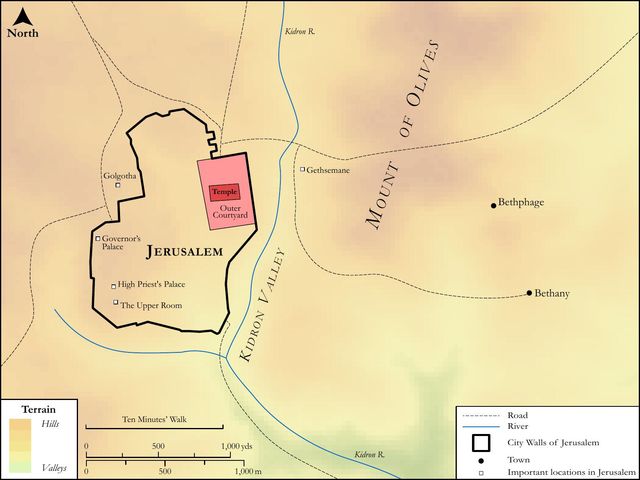
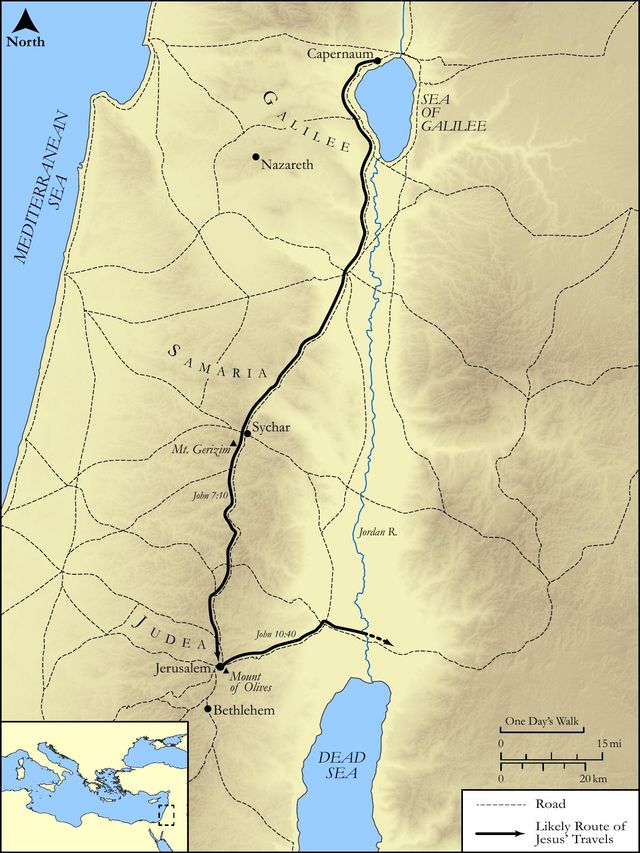
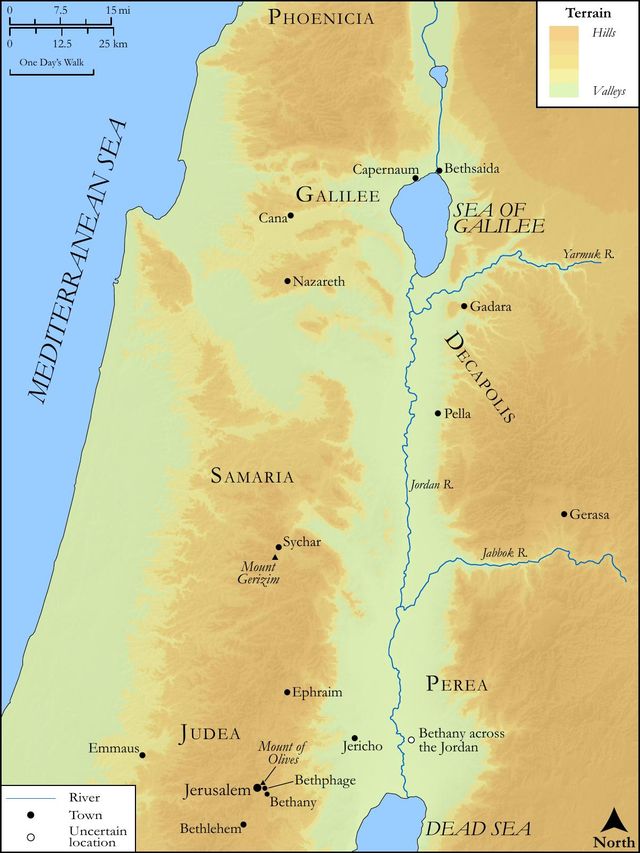
Study this verse
Public-domain commentary
Matthew Henry
From his Commentary on the Whole Bible. Henry comments on passages, not single verses — this entry covers John 9:1–7. His four-level outline is real structure in the source text, so it is rendered as structure.
We have here sight given to a poor beggar that had been blind from his birth. Observe,
I.The notice which our Lord Jesus took of the piteous case of this poor blind man (Joh 9:1):
As Jesus passed by he saw a man which was blind from his birth. The first words seem to refer to the last of the foregoing chapter, and countenance the opinion of those who in the harmony place this story immediately after that. There it was said, parēgen - he passed by, and here, without so much as repeating him name (though our translators supply it) kai paragō - and as he passed by. 1. Though the Jews had so basely abused him, both by word and deed gave him the highest provocation imaginable, yet he did not miss any opportunity of doing good among them, nor take up a resolution, as justly he might have done, never to have favoured them with any good offices. The cure of this blind man was a kindness to the public, enabling him to work for his living who before was a charge and burden to the neighbourhood. It is noble, and generous, and Christ-like, to be willing to serve the public, even when we are slighted and disobliged by them, or think ourselves so. Though he was in his flight from a threatening danger, and escaping for his life, yet he willingly halted and staid awhile to show mercy to this poor man. We make more haste than good speed when we out-run opportunities of doing good. 3. When the Pharisees drove Christ from them, he went to this poor blind beggar. Some of the ancients make this a figure of the bringing of the gospel to the Gentiles, who sat in darkness, when the Jews had rejected it, and driven it from them. 4. Christ took this poor blind man in his way, and cured him in transitu - as he passed by. Thus should we take occasions of doing good, even as we pass by, wherever we are.
Now, (1.) The condition of this poor man was very sad. He was blind, and had been so from his birth. If the light is sweet, how melancholy must it needs be for a man, all his days, to eat in darkness! He that is blind has no enjoyment of the light, but he that is born blind has no idea of it. Methinks such a one would give a great deal to have his curiosity satisfied with but one day's sight of light and colours, shapes and figures, though he were never to see them more. Why is the light of life given to one that is in this misery, that is deprived of the light of the sun, whose way is thus hid, and whom God hath thus hedged in? Job 3:20-23. Let us bless God that it was not our case. The eye is one of the most curious parts of the body, its structure exceedingly nice and fine. In the formation of animals, it is said to be the first part that appears distinctly discernible. What a mercy is it that there was no miscarriage in the making of ours! Christ cured many that were blind by disease or accident, but here he cured one that was born blind. [1.] That he might give an instance of his power to help in the most desperate cases, and to relieve when none else can. [2.] That he might give a specimen of the work of his grace upon the souls of sinners, which gives sight to those that were by nature blind.
(2.)The compassions of our Lord Jesus towards him were very tender. He saw him; that is, he took cognizance of his case, and looked upon him with concern. When God is about to work deliverance, he is said to see the affliction; so Christ saw this poor man. Others saw him, but not as he did. This poor man could not see Christ, but Christ saw him, and anticipated both his prayers and expectations with a surprising cure. Christ is often found of those that seek him not, nor see him, Isa 65:1. And, if we know or apprehend any thing of Christ, it is because we were first known of him (Gal 4:9) and apprehended by him, Phi 3:12.
II.The discourse between Christ and his disciples concerning this man.
When he departed out of the temple they went along with him: for these were they that continued with him in his temptations, and followed him whithersoever he went; and they lost nothing by their adherence to him, but gained experience abundantly. Observe,
1.The question which the disciples put to their Master upon this blind man's case, Joh 9:2. When Christ looked upon him, they had an eye to him too; Christ's compassion should kindle ours. It is probable that Christ told them this poor man was born blind, or they knew it by common fame; but they did not move Christ to heal him. Instead of this, they started a very odd question concerning him: Rabbi, who sinned, this man or his parents, that he was born blind? Now this question of theirs was,
(1.)Uncharitably censorious. They take it for granted that this extraordinary calamity was the punishment of some uncommon wickedness, and that this man was a sinner above all men that dwelt at Jerusalem, Luk 13:4. For the barbarous people to infer, Surely this man is a murderer, was not so strange; but it was inexcusable in them, who knew the scriptures, who had read that all things come alike to all, and knew that it was adjudged in Job's case that the greatest sufferers are not therefore to be looked upon as the greatest sinners. The grace of repentance calls our own afflictions punishments, but the grace of charity calls the afflictions of others trials, unless the contrary is very evident.
(2.)It was unnecessarily curious. Concluding this calamity to be inflicted for some very heinous crime, they ask, Who were the criminals, this man or his parents? And what was this to them? Or what good would it do them to know it? We are apt to be more inquisitive concerning other people's sins than concerning our own; whereas, it is more our concern to know wherefore God contends with us than wherefore he contends with others; for to judge ourselves is our sin. They enquire,
[1.]Whether this man was punished thus for some sin of his own, either committed or foreseen before his birth. Some think that the disciples were tainted with the Pythagorean notion of the pre-existence of souls, and their transmigration from one body to another. Was this man's soul condemned to the dungeon of this blind body to punish it for some great sin committed in another body which it had before animated? The Pharisees seem to have had the same opinion of his case when they said, Thou wast altogether born in sin (Joh 9:34), as if all those, and those only, were born in sin whom nature had stigmatized. Or,
[2.]Whether he was punished for the wickedness of his parents, which God sometimes visits upon the children. It is a good reason why parents should take heed of sin, lest their children smart for it when they are gone. Let not us thus be cruel to our own, as the ostrich in the wilderness. Perhaps the disciples asked this, not as believing that this was the punishment of some actual sin of his own or his parents, but Christ having intimated to another patient that his sin was the cause of this impotency (Joh 5:14), "Master," say they, "whose sin is the cause of this impotency?" Being at a loss what construction to put upon this providence, they desire to be informed. The equity of God's dispensations is always certain, for his righteousness is as the great mountains, but not always to be accounted for, for his judgments are a great deep.
2.Christ's answer to this question. He was always apt to teach, and to rectify his disciples' mistakes.
(1.)He gives the reason of this poor man's blindness: "Neither has this man sinned nor his parents, but he was born blind, and has continued so to this day, that now at last the works of God should be made manifest in him," Joh 9:3. Here Christ, who perfectly knew the secret springs of the divine counsels, told them two things concerning such uncommon calamities: - [1.] That they are not always inflicted as punishments of sin. The sinfulness of the whole race of mankind does indeed justify God in all the miseries of human life; so that those who have the least share of them must say that God is kind, and those who have the largest share must not say that he is unjust; but many are made much more miserable than others in this life who are not at all more sinful. Not but that this man was a sinner, and his parents sinners, but is was not any uncommon guilt that God had an eye to in inflicting this upon him. Note, We must take heed of judging any to be great sinners merely because they are great sufferers, lest we be found, not only persecuting those whom God has smitten (Psa 69:26), but accusing those whom he has justified, and condemning those for whom Christ died, which is daring and dangerous, Rom 8:33, Rom 8:34. [2.] That they are sometimes intended purely for the glory of God, and the manifesting of his works. God has a sovereignty over all his creatures and an exclusive right in them, and may make them serviceable to his glory in such a way as he thinks fit, in doing or suffering; and if God be glorified, either by us or in us, we were not made in vain. This man was born blind, and it was worth while for him to be so, and to continue thus long dark, that the works of God might be manifest in him. That is, First, That the attributes of God might be made manifest in him: his justice in making sinful man liable to such grievous calamities; his ordinary power and goodness in supporting a poor man under such a grievous and tedious affliction, especially that his extraordinary power and goodness might be manifested in curing him. Note, The difficulties of providence, otherwise unaccountable, may be resolved into this - God intends in them to show himself, to declare his glory, to make himself to be taken notice of. Those who regard him not in the ordinary course of things are sometimes alarmed by things extraordinary. How contentedly then may a good man be a loser in his comforts, while he is sure that thereby God will be one way or other a gainer in his glory! Secondly, That the counsels of God concerning the Redeemer might be manifested in him. He was born blind that our Lord Jesus might have the honour of curing him, and might therein prove himself sent of God to be the true light to the world. Thus the fall of man was permitted, and the blindness that followed it, that the works of God might be manifest in opening the eyes of the blind. It was now a great while since this man was born blind, and yet it never appeared till now why he was so. Note, The intentions of Providence commonly do not appear till a great while after the event, perhaps many years after. The sentences in the book of providence are sometimes long, and you must read a great way before you can apprehend the sense of them.
(2.)He gives the reason of his own forwardness and readiness to help and heal him, Joh 9:4, Joh 9:5. It was not for ostentation, but in pursuance of his undertaking: I must work the works of him that sent me (of which this is one), while it is day, and working time; the night cometh, the period of that day, when no man can work. This is not only a reason shy Christ was constant in doing good to the souls and bodies of men, but why particularly he did this, though it was the sabbath day, on which works of necessity might be done, and he proves this to be a work of necessity.
[1.]It was his Father's will: I must work the works of him that sent me. Note, First, The Father, when he sent his Son into the world, gave him work to do; he did not come into the world to take state, but to do business; whom God sends he employs, for he sends none to be idle. Secondly, The works Christ had to do were the works of him that sent him, not only appointed by him, but done for him; he was a worker together with God. Thirdly, He was pleased to lay himself under the strongest obligations to do the business he was sent about: I must work. He engaged his heart, in the covenant of redemption, to draw near, and approach to God as Mediator, Jer 30:21. Shall we be willing to be loose, when Christ was willing to be bound? Fourthly, Christ, having laid himself under obligations to do his work, laid out himself with the utmost vigour and industry in his work. He worked the works he had to do; did ergazesthai ta erga - made a business of that which was his business. It is not enough to look at our work, and talk over it, but we must work it.
[2.]Now was his opportunity: I must work while it is day, while the time lasts which is appointed to work in, and while the light lasts which is given to work by. Christ himself had his day. First, All the business of the mediatorial kingdom was to be done within the limits of time, and in this world; for at the end of the world, when time shall be no more, the kingdom shall be delivered up to God, even the Father, and the mystery of God finished. Secondly, all the work he had to do in his own person here on earth was to be done before his death; the time of his living in this world is the day here spoken of. Note, The time of our life is our day, in which it concerns us to do the work of the day. Day-time is the proper season for work (Psa 104:22, Psa 104:23); during the day of life we must be busy, not waste day-time, nor play by day-light; it will be time enough to rest when our day is done, for it is but a day.
[3.]The period of his opportunity was at hand, and therefore he would be busy; The night comes when no man can work. Note, The consideration of our death approaching should quicken us to improve all the opportunities of life, both for doing and getting good. The night comes, it will come certainly, may come suddenly, is coming nearer and nearer. We cannot compute how nigh our sun is, it may go down at noon; nor can we promise ourselves a twilight between the day of life and the night of death. When the night comes we cannot work, because the light afforded us to work by is extinguished; the grave is a land of darkness, and our work cannot be done in the dark. And, besides, our time allotted us for our work will then have expired; when our Master tied us to duty he tied us to time too; when night comes, call the labourers; we must then show our work, and receive according to the things done. In the world of retribution we are no longer probationers; it is too late to bid when the inch of candle is dropped. Christ uses this as an argument with himself to be diligent, though he had no opposition from within to struggle with; much more need have we to work upon our hearts these and the like considerations to quicken us.
[4.]His business in the world was to enlighten it (Joh 9:5): As long as I am in the world, and that will not be long, I am the light of the world. He had said this before, Joh 8:12. He is the Sun of righteousness, that has not only light in his wings for those that can see, but healing in his wings, or beams, for those that are blind and cannot see, therein far exceeding in virtue that great light which rules by day. Christ would cure this blind man, the representative of a blind world, because he came to be the light of the world, not only to give light, but to give sight. Now this gives us, First, A great encouragement to come to him, as a guiding, quickening, refreshing light. To whom should we look but to him? Which way should we turn our eyes, but to the light? We partake of the sun's light, and so we may of Christ's grace, without money and without price. Secondly, A good example of usefulness in the world. What Christ saith of himself, he saith of his disciples: You are lights in the world, and, if so, Let your light shine. What were candles made for but to burn?
III.The manner of the cure of the blind man, Joh 9:6, Joh 9:7.
The circumstances of the miracle are singular, and no doubt significant. When he had thus spoken for the instruction of his disciples, and the opening of their understandings, he addressed himself to the opening of the blind man's eyes. He did not defer it till he could do it either more privately, for his greater safety, or more publicly, for his greater honour, or till the sabbath was past, when it would give less offence. What good we have opportunity of doing we should do quickly; he that will never do a good work till there is nothing to be objected against it will leave many a good work for ever undone, Ecc 11:4. In the cure observe,
1.The preparation of the eye-salve. Christ spat on the ground, and made clay of the spittle. He could have cured him with a word, as he did others, but he chose to do it in this way to show that he is not tied to any method. He made clay of his own spittle, because there was no water near; and he would teach us not to be nice or curious, but, when we have at any time occasion, to be willing to take up with that which is next hand, if it will but serve the turn. Why should we go about for that which may as well be had and done a nearer way? Christ's making use of his own spittle intimates that there is healing virtue in every thing that belongs to Christ; clay made of Christ's spittle was much more precious than the balm of Gilead.
2.The application of it to the place: He anointed the eyes of the blind man with the clay. Or, as the margin reads it, He spread (epechrise), he daubed the clay upon the eyes of the blind man, like a tender physician; he did it himself with his own hand, though the patient was a beggar. Now Christ did this,
(1.)To magnify his power in making a blind man to see by that method which one would think more likely to make a seeing man blind. Daubing clay on the eyes would close them up, but never open them. Note, The power of God often works by contraries; and he makes men feel their own blindness before he gives them sight.
(2.)To give an intimation that it was his mighty hand, the very same that at first made man out of the clay; for by him God made the worlds, both the great world, and man the little world. Man was formed out of the clay, and moulded like the clay, and here Christ used the same materials to give sight to the body that at first he used to give being to it.
(3.)To represent and typify the healing and opening of the eyes of the mind by the grace of Jesus Christ. The design of the gospel is to open men's eyes, Act 26:18. Now the eye-salve that does the work is of Christ's preparing; it is made up, not as this, of his spittle, but of his blood, the blood and water that came out of his pierced side; we must come to Christ for the eye-salve, Rev 3:18. He only is able, and he only is appointed, to make it up, Luk 4:18. The means used in this work are very weak and unlikely, and are made effectual only by the power of Christ; when a dark world was to be enlightened, and nations of blind souls were to have their eyes opened, God chose the foolish things, and weak, and despised, for the doing of it. And the method Christ takes is first to make men feel themselves blind, as this poor man did whose eyes were daubed with clay, and then to give them sight. Paul in his conversion was struck blind for three days, and then the scales fell from his eyes. The way prescribed for getting spiritual wisdom is, Let a man become a fool, that he may be wise, Co1 3:18. We must be made uneasy with our blindness, as this man here, and then healed.
3.The directions given to the patient, Joh 9:7. His physician said to him, Go, wash in the pool of Siloam. Not that this washing was needful to effect the cure; but,
(1.)Christ would hereby try his obedience, and whether he would with an implicit faith obey the orders of one he was so much a stranger to.
(2.)He would likewise try how he stood affected to the tradition of the elders, which taught, and perhaps had taught him (for many that are blind are very knowing), that it was not lawful to wash the eyes, no not with spittle medicinally, on the sabbath day, much less to go to a pool of water to wash them.
(3.)He would hereby represent the method of spiritual healing, in which, though the effect is owing purely to his power and grace, there is duty to be done by us. Go, search the scriptures, attend upon the ministry, converse with the wise; this is like washing in the pool of Siloam. Promised graces must be expected in the way of instituted ordinances. The waters of baptism were to those who had been trained up in darkness like the pool of Siloam, in which they might not only wash and be clean, but wash, and have their eyes opened. Hence they that were baptized are said to be phōtisthentes - enlightened; and the ancients called baptism phōtismos - illumination. Concerning the pool of Siloam observe,
[1.]That it was supplied with water from mount Zion, so that these were the waters of the sanctuary (Psa 46:4), living waters, which were healing, Eze 47:9.
[2.]That the waters of Siloam had of old signified the throne and kingdom of the house of David, pointing at the Messiah (Isa 8:6), and the Jews who refused the waters of Shiloa, Christ's doctrine and law, and rejoiced in the tradition of the elders. Christ would try this man, whether he would cleave to the waters of Siloam or no.
[3.]The evangelist takes notice of the signification of the name, its being interpreted sent. Christ is often called the sent of God, the Messenger of the covenant (Mal 3:1); so that when Christ sent him to the pool of Siloam he did in effect send him to himself; for Christ is all in all to the healing of souls. Christ as a prophet directs us to himself as a priest. Go, wash in the fountain opened, a fountain of life, not a pool.
4.The patient's obedience to these directions: He went his way therefore, probably led by some friend or other; or perhaps he was so well acquainted with Jerusalem that he could find the way himself. Nature often supplies the want of sight with an uncommon sagacity; and he washed his eyes; probably the disciples, or some stander by, informed him that he who bade him do it was that Jesus whom he had heard so much of, else he would not have gone, at his bidding, on that which looked so much like a fool's errand; in confidence of Christ's power, as well as in obedience to his command, he went, and washed.
5.The cure effected: He came seeing. There is more glory in this concise narrative, He went and washed, and came seeing, than in Caesar's Veni, vidi, vici - I came, I saw, I conquered. When the clay was washed off from his eyes, all the other impediments were removed with it; so when the pangs and struggles of the new birth are over, and the pains and terrors of conviction past, the bands of sin fly off with them, and a glorious light and liberty succeed. See here an instance,
(1.)Of the power of Christ. What cannot he do who could not only do this, but do it thus? With a lump of clay laid on either eye, and washed off again, he couched those cataracts immediately which the most skilful oculist, with the finest instrument and the most curious hand, could not remove. No doubt this is he that should come, for by him the blind receive their sight.
(2.)It is an instance of the virtue of faith and obedience. This man let Christ do what he pleased, and did what he appointed him to do, and so was cured. Those that would be healed by Christ must be ruled by him. He came back from the pool to his neighbours and acquaintance, wondering and wondered at; he came seeing. This represents the benefit gracious souls find in attending on instituted ordinances, according to Christ's appointment; they have gone to the pool of Siloam weak, and have come away strengthened; have gone doubting, and come away satisfied; have gone mourning, and come away rejoicing; have gone trembling, and come away triumphing; have gone blind, and come away seeing, come away singing, Isa 52:8.
Historical interpretation
Nine Centuries of Reception
12 surviving comments on this verse. Each one is dated, so this reads as a timeline rather than a list.
Select a marker to jump to its quote. Markers stagger vertically where authors wrote within a few decades of each other.
They also maintain that the Saviour exhibited an emblem of this mystery in the case of that man who was blind from his birth,
He that supplied a defective part to him that was born blind from clay and spittle,
You have heard, my brother, the lesson of the Gospel, wherein it is narrated that as the Lord Jesus passed by He saw a man which was blind from his birth. Now if the Lord saw him He did not pass him by, neither ought we to pass him by whom the Lord overlooked not; especially since he was blind from his birth, which is not mentioned without reason.
Now there is a blindness in which by the operation of illness the sight of the eyes is obscured, and this by the help of time is mitigated; there is a blindness also which is caused by the entrance of humours, and this, when the defect is removed, is cured by the aid of medicine; and this I say that you may know that it was not by skill but by Divine Power that he who was blind from his birth was healed. For the Lord gave him health as a free gift, not by any medicinal skill, for they whom the Lord Jesus healed were they whom no one could cure.
(Hom. lvi. 1) The Jews having rejected Christ's words, because of their depth, He went out of the temple, and healed the blind man; that His absence might appease their fury, and the miracle soften their hard hearts, and convince their unbelief. And as Jesus passed by, He saw a man which was blind from his birth. It is to be remarked here that, on going out of the temple, He betook Himself intently to this manifestation of His power. He first saw the blind man, not the blind man Him: and so intently did He fix His eye upon him, that His disciples were struck, and asked, Rabbi, who did sin, this man or his parents, that he was born blind?
(Hom. liv. 1. c. 5) They were led to ask this question, by our Lord having said above, on healing the man sick of the palsy, Lo, thou art made whole; sin no more. Thinking from this that the man had been struck with the palsy for his sins, they ask our Lord of the blind man here, whether he did sin, or his parents; neither of which could have been the reason of his blindness; the former, because he had been blind from his birth; the latter, because the son does not suffer for the father.
Jesus answered, Neither hath this man sinned, nor his parents.
(Hom. lvi. 1, 2) He is not to be understood as meaning that others had become blind, in consequence of their parents' sins: for one man cannot be punished for the sin of another. But had the man therefore suffered unjustly? Rather I should say that that blindness was a benefit to him: for by it he was brought to see with the inward eye. At any rate He who brought him into being out of nothing, had the power to make him in the event no loser by it. Some too say, that the that here, is expressive not of the cause, but of the event, as in the passage in Romans, The law entered that sin might abound; (Rom. 5:20) the effect in this case being, that our Lord by opening the closed eye, and healing other natural infirmities, demonstrated His own power.
(Hom. liv. 2) That the glory of God should be made manifest, He saith of Himself, not of the Father; the Father's glory was manifest already. I must work the works of Him that sent Me: i. e. I must manifest Myself, and show that I do the same that My Father doeth.
(Hom. lvi. 2) While it is day, He adds; i. e. while men have the opportunity of believing in Me; while this life lasts; The night cometh, when none can work. Night here means that spoken of in Matthew, Cast him into outer darkness. (Mat. 22:13) Then will there be night, wherein none can work, but only receive for that which he has worked. While thou livest, do that which thou wilt do: for beyond it is neither faith, nor labour, nor repentance.
"And as Jesus passed by, He saw a man which was blind from his birth." Being full of love for man, and caring for our salvation, and desiring to stop the mouths of the foolish, He omitteth nothing of His own part, though there be none to give heed. Wherefore here, when they would not receive His sublime sayings, but said that He had a devil, and attempted to kill Him, He went forth from the Temple, and healed the blind, mitigating their rage by His absence, and by working the miracle softening their hardness and cruelty, and establishing His assertions. And He worketh a miracle which was no common one, but one which took place then for the first time. "Since the world began," saith he who was healed, "was it not heard that any man opened the eyes of one that was born blind." Some have, perhaps, opened the eyes of the blind, but of one born blind never. And that on going out of the Temple, He proceeded intentionally to the work, is clear from this; it was He who saw the blind man, not the blind man who came to Him; and so earnestly did He look upon him, that even His disciples perceived it.
(Tr. xliv. 1, 2) For the blind man here is the human race. Blindness came upon the first man by reason of sin: and from him we all derive it: i. e. man is blind from his birth.
All, certainly, that was done by our Lord Jesus Christ, both works and words, are worthy of our astonishment and admiration: His works, because they are facts; His words, because they are signs. If we reflect, then, on what is signified by the deed here done, that blind man is the human race; for this blindness had place in the first man through sin, from whom we all draw our origin, not only in respect of death, but also of unrighteousness. For if unbelief is blindness, and faith enlightenment, whom did Christ find a believer at His coming? seeing that the apostle, belonging himself to the family of the prophets, says: "And we also in times past were by nature the children of wrath, even as others." If "children of wrath," then children of vengeance, children of punishment, children of hell. For how is it "by nature," save that through the first man sinning moral evil rooted itself in us as a nature? If evil has so taken root within us, every man is born mentally blind. For if he sees, he has no need of a guide. If he does need one to guide and enlighten him, then is he blind from his birth.
While the Jews were raging against Him and now essaying to wound Him with stones, forthwith He goes forth of the temple that is among them, and takes Him away from the unholiness of His pursuers. And in passing by, straightway He seeth one blind from his birth, and setteth him as a token and that most clear that He will remove from the abominable behaviour of the Jews, and will leave the multitude of the God-opposers, and will rather visit the Gentiles, and to them transfer the abundance of His Clemency. And He likens them to the blind from his birth by reason of their having been made in error and that they are from their first age as it were bereft of the true knowledge of God, and that they Have not the light from God, i. e., the illumination through the Spirit.
It is meet to observe again what Christ's visiting the blind man as He was passing by, signifies. And it comes to me to think that Christ strictly speaking came not for the Gentiles but for Israel's sake alone (as Himself too somewhere says, I was not sent save unto the lost sheep of the house of Israel), yet was the recovery of sight given to the Gentiles, Christ transferring His Mercy to them as by the way, because of the disobedience of Israel. And this it was again which was afore-sung through Moses, I will provoke them to jealousy with not a nation, with a foolish nation will I anger them. For a foolish nation was it which serveth the creature more than Creator and like irrational beasts feeds on just all unlearning, and giveth heed only to things of the earth. But since Israel which was wise by reason of the law and prudent from having Prophets angered [God], it in its turn was angered by God, they who aforetime were not prudent being taken into the place belonging to these, for to them through faith was Christ made wisdom and sanctification and redemption, as it is written, i. e., both light and recovery of sight.
We have just heard that Jesus gave sight to the man who was blind from birth. Do you wonder? Jesus is the Savior. He did something in keeping with his name, for by his kindness he restored what he had given to a lesser degree in the womb. Now when he made his eyes less powerful, surely he did not make a mistake, but he deferred it for the miracle.… Behold, why Christ delayed when he made the eyes less powerful in the womb. Do not think that the parents of that blind man had no sin and that the blind man himself, when he was born, did not contract original sin; because of the fact of original sin even very little children are baptized. However, that blindness was not due to the sin of his parents or due to the sin of the blind man, but in order that the glory of God might be made manifest in him. For when we are born we all contract original sin, and still we are not born physically blind. That blind man was prepared as a salve for the human race. He was bodily restored to light, in order that by considering his miracle we might be enlightened in heart.
(in Præf. Moral. c. 5) One stroke falls on the sinner, for punishment only, not conversion; another for correction; another not for correction of past sins, but prevention of future; another neither for correcting past, nor preventing future sins, but by the unexpected deliverance following the blow, to excite more ardent love of the Saviour's goodness.
(viii. Moral. c. xxx. [49.]) Or thus: By His spittle understand the savour of inward contemplation. It runs down from the head into the mouth, and gives us the taste of revelation from the Divine splendour even in this life. The mixture of His spittle with clay is the mixture of supernatural grace, even the contemplation of Himself with our carnal knowledge, to the soul's enlightenment, and restoration of the human understanding from its original blindness.
Mystically, our Lord, after being banished from the minds of the Jews, passed over to the Gentiles. (non occ.). The passage or journey here is His descent from heaven to earth, where He saw the blind man, i. e. looked with compassion on the human race.
The Lord leaves the temple in order to dampen the anger of the Jews a little, and turns to the healing of the blind man. By this miracle He attempts to soften their stubborn disbelief, though they derived no benefit from it; at the same time, He shows them that He did not speak idly or boastfully when He said, Before Abraham was, I am (Jn. 8:58). Behold this miracle, the like of which has never been seen: others have restored the sight of blind men, but never of a man born blind. It is clear that Christ performed this miracle as God Who is before Abraham. To prove this to the Jews, He intentionally approached the blind man, and not vice-versa. When they see the Lord looking intently at the blind man, the disciples ask, Who did sin, this man, or his parents, that he was born blind? This question appears to be illogical. How could the man have sinned before he was born? The apostles, of course, did not accept the foolish notion that the soul commits sin in another world, before the body is formed, and is punished by being joined to the body. Being fishermen, they would never have heard of this teaching of the Greek philosophers. Their question, then, might appear foolish, but not to one who is attentive. The apostles heard Christ tell the paralytic, Behold, thou art made whole: sin no more, lest a worse thing come unto thee (Jn. 5:14). Now they see the blind man and wonder, “The paralytic was punished because of his sins; but what do You say about this man? How could he have been punished for his sins? He was blind from birth. Did his parents sin? That also cannot be, for a child is not punished for his father’s sins.”
Thus their question was an expression of perplexity, which the Lord dispels by explaining, “Neither hath this man sinned, (how could he before he was born?) nor his parents.” Christ does not say simply, “His parents did not sin,” implying that they were without fault; He adds, that he was born blind. His parents did sin, but that was not the cause of his blindness. It would be unjust to charge the sins of parents to the children, who have done nothing wrong. God makes this clear through the words of the prophet Ezekiel (18:2): “Let this parable no longer be spoken, The fathers have eaten unripe grapes, and the children’s teeth shall be set on edge.” The Lord also gave this commandment, through Moses: And the sons shall not be put to death for the fathers; everyone shall be put to death for his own sin (Dt. 24:18). But some might object, “Yet it is written, I am the Lord thy God, a jealous God, recompensing the sins of the fathers upon the children, to the third and fourth generation (Ex. 20:5).” It must be understood that this is not a universal decree applying to all men at all times, but only to those who came out of Egypt. Also, the meaning of the decree must be considered carefully. It does not say that the children are punished for the sins of their fathers, but rather that the sins of the fathers—meaning, the punishments for their sins—will be “recompensed” upon their children. This is because the children have committed the same sins as the fathers. The Lord did not want those who came out of Egypt to think that if they committed the same or worse sins than their fathers they would not be punished. Another way to put it is: “The sins of your fathers (that is, the penalty for their sins,) will come upon you also, because you did not become better than they, but have committed the same, and even worse.” Even when you see infants taken from this life, you must understand clearly that God cut their life short out of love for man. Had they lived, they would have become worse than their parents and filled their own souls, and the souls of many others, with wickedness. But all this is hidden in the abyss of God’s judgments. Let us now continue.
Continue studying John 9:1 across the web’s major study libraries — every link below opens this exact verse, chapter, or book on the destination site.
Read & Compare
 BibleGatewayThis verse in more than 200 translations and 70 languages.
 Bible.comThe YouVersion reader — hundreds of translations, reading plans, and highlights.
 ESV.orgCrossway's official English Standard Version reader.
 NET BibleThe NET translation with 60,000+ translators' notes on every rendering decision.
 STEP BibleTyndale House's free study tool — original text, vocabulary, and scholarly resources.
 BibliaLogos Bible Software's free web reader.
 USCCBThe New American Bible (Revised Edition) with the U.S. bishops' study notes.
Commentaries
 BibleHub CommentariesDozens of classic commentaries on this verse, gathered on one page.
 StudyLightMore than 100 commentary sets — the largest collection on the web.
 BibleRefPlain-English commentary on what this verse means, verse by verse.
 Enduring WordDavid Guzik's free commentary on this chapter, widely used by Bible teachers.
 Bible Study ToolsVerse commentary alongside Greek and Hebrew study aids.
Original Language & Research
- BibleHub InterlinearThe verse word by word — original language, transliteration, and English.
- BibleHub LexiconEvery word's original-language definition and Strong's entry.
 Blue Letter BibleDeep-study tools — Strong's numbers, concordance, and word studies.
 CNTR CollationThe earliest Greek manuscripts of this verse, collated letter by letter.
Sermons, Hymns & Audio


TrulyRandomVerse is not affiliated with these sites and doesn’t control their content. They’re linked because they’re genuinely useful.
Summary
John 9:1 introduces one of Jesus' most profound miracles, shifting the narrative from the intense theological debates and attempted stoning in the Temple to a powerful demonstration of divine compassion and authority. As Jesus "passed by," He intentionally observed a man who had been blind from birth, setting the stage for a miraculous healing that would not only restore physical sight but also ignite a deep theological discourse on spiritual blindness, the nature of suffering, and the identity of the Son of God. This opening verse immediately highlights Jesus' active engagement with human suffering and His sovereign purpose in all circumstances.
Context
ShowHideLiterary Context
This verse marks a dramatic transition from the preceding chapter, John 8, which culminates in Jesus' narrow escape from stoning by His adversaries (John 8:59). The shift from heated verbal conflict and accusations of blasphemy to a quiet, compassionate encounter with a suffering individual underscores a key Johannine theme: Jesus' works (miracles) serve as undeniable signs of His divine identity and authority, often in contrast to the spiritual blindness of those who oppose Him. The healing of the blind man is not merely a benevolent act but a pivotal "sign" that initiates a lengthy and complex theological discussion throughout the rest of John 9, exploring themes of light and darkness, spiritual insight versus physical sight, and the true source of authority.
Historical & Cultural Context
In ancient Jewish society, physical disabilities, especially congenital ones like blindness, were often perceived as a direct consequence of sin—either the individual's own sin (even prenatally, as suggested by some rabbinic traditions) or the sin of their parents. This belief is explicitly referenced in the disciples' question in John 9:2. People with such disabilities were frequently overlooked, relying on begging for survival, and were often considered ritually unclean or outside the full favor of God. The healing of a man born blind was therefore an unprecedented miracle, challenging deeply ingrained theological assumptions and demonstrating a level of divine power previously unheard of, akin to new creation. This context amplifies the impact of Jesus' act, as it directly confronts societal prejudices and theological misconceptions about suffering.
Key Themes
ShowHideJohn 9:1 immediately introduces several crucial themes that permeate the entire chapter and the Gospel of John. Firstly, it highlights Divine Encounter and Compassion, showcasing Jesus' active initiative in noticing and engaging with the lowly, even when not explicitly sought out. His "seeing" is not passive but an act of divine awareness and profound empathy, foreshadowing His role as the Good Shepherd who seeks out the lost. Secondly, the detail "blind from his birth" emphasizes the Nature of Suffering and sets up the theological debate about its cause, allowing Jesus to reveal that suffering can sometimes serve a higher purpose: "that the works of God might be displayed in him" (John 9:3). Lastly, this verse serves as a Preparation for Revelation, introducing a miracle that will not only restore physical sight but also lead to a profound discourse on spiritual blindness and the identity of Christ as the "Light of the World" (John 8:12).
Exposition and Analysis
ShowHideKey Word Analysis
ShowHideThis verb, while often meaning simply "to see," carries a deeper connotation in the perfect tense, implying "to know" or "to perceive." Here, it suggests Jesus' intentional, discerning gaze. He didn't merely glance at the man; He observed him with a purpose, recognizing his condition and the divine opportunity it presented. It speaks to Jesus' divine omniscience and compassionate awareness that extends beyond superficial observation.
This adjective describes the man's physical condition, indicating a complete lack of sight. However, in John's Gospel, "blindness" often serves as a powerful symbol for spiritual ignorance or an inability to perceive divine truth. The man's physical blindness in this verse immediately sets up the thematic contrast with the spiritual blindness of the Pharisees and others who fail to recognize Jesus' true identity, despite having physical sight.
Derived from the word for "generation" or "origin," this term emphasizes that the man's blindness was congenital—he was born with it. This detail is crucial because it elevates the subsequent healing from a mere recovery to an act of new creation. It means the man had never experienced sight, making the miracle undeniably profound and a clear demonstration of divine power, as opposed to healing an acquired illness or injury.
Verse Breakdown
ShowHide"And as Jesus passed by"
This phrase highlights Jesus' active movement and initiative. He was not sought out by the blind man; rather, He "passed by" and took notice. This underscores Jesus' sovereign control over events and His compassionate engagement with human suffering, even when uninvited. It also contrasts with His previous hurried departure from the Temple, indicating a deliberate shift in focus.
"he saw a man"
This simple observation is deeply significant. Unlike many in society who might have ignored or dismissed a beggar with a congenital disability, Jesus' gaze was intentional and discerning. It speaks to His divine awareness and His profound compassion for the lowly and suffering, identifying an individual whom He intended to minister to.
"which was blind from his birth"
This final clause provides the crucial detail about the man's condition. The congenital nature of his blindness sets the stage for the extraordinary miracle that follows. It signifies a lifelong affliction, making the subsequent healing an act of creation rather than mere restoration, and thereby magnifying the power and authority of Jesus. This detail also lays the groundwork for the theological discussion in the subsequent verses about the cause of suffering and the manifestation of God's glory.
Literary Devices
ShowHideJohn 9:1 employs several key literary devices. Foreshadowing is evident as the physical blindness of the man immediately hints at the spiritual blindness that will be a central theme throughout the chapter, particularly among the Pharisees who refuse to acknowledge Jesus' divine authority despite witnessing His miraculous works. There is a subtle Contrast between Jesus' compassionate engagement with the suffering man and the hostility and spiritual darkness of the religious leaders from the previous chapter. The man's condition also serves as Symbolism, where his physical blindness represents the spiritual darkness and ignorance that Jesus, as the Light of the World, has come to dispel. This initial scene sets up the profound Irony that those with physical sight (the Pharisees) are spiritually blind, while the physically blind man will ultimately gain both physical and spiritual sight through his encounter with Jesus.
Theological and Thematic Connections
ShowHideJohn 9:1 establishes a foundational theological truth: God's sovereignty extends over all circumstances, including human suffering. While suffering is often a consequence of a fallen world, this verse, particularly when read in light of John 9:3, challenges the simplistic notion that all affliction is a direct punishment for sin. Instead, it posits that some suffering can be an occasion for the manifestation of God's glory and power. Jesus' active "seeing" of the man highlights His divine compassion and His role as the one who brings light into darkness, both literally and spiritually. This encounter is a testament to God's initiative in reaching out to the lowly and demonstrating His redemptive purposes through miraculous intervention.
Reflection and Application
ShowHideJohn 9:1 serves as a profound call to reflection on how we perceive and respond to the suffering and overlooked in our own communities. Just as Jesus "passed by" and actively "saw" the man, we are challenged to move beyond passive observation and cultivate a compassionate, discerning gaze that recognizes the needs of others. This verse reminds us that every individual, regardless of their circumstances or perceived limitations, is worthy of divine attention and intervention. It encourages us to look for opportunities to be agents of God's compassion and to remember that God can use even the most challenging situations to reveal His glory and purpose. Furthermore, it invites us to consider our own spiritual sight—are we truly seeing the world, ourselves, and God as He intends, or are there areas where we, too, are spiritually blind, in need of Christ's illuminating touch?
Questions for Reflection
ShowHideFAQ
ShowHideWhy is the detail "blind from his birth" so important in this verse?
ShowHideThe detail "blind from his birth" (Greek: ek genetḗs) is critically important for several reasons. First, it emphasizes the extraordinary nature of the miracle Jesus is about to perform. This was not a case of healing a temporary illness or a recent injury, but a congenital condition where the man had never experienced sight. This makes the healing an act of new creation, demonstrating Jesus' divine power over creation itself, rather than just restoration. Second, it sets the stage for the disciples' question in John 9:2 regarding whether the man's blindness was due to his own sin or his parents' sin, a common theological belief at the time. This allows Jesus to correct a prevalent misconception about suffering, explaining that the man's condition was "that the works of God might be displayed in him" (John 9:3). Thus, the congenital blindness magnifies the glory of God revealed through Jesus' healing.
Christ-Centered Fulfillment
ShowHideJohn 9:1, though seemingly simple, profoundly foreshadows the Christ-centered fulfillment of God's redemptive plan. Jesus' act of "seeing" the man born blind is a tangible demonstration of His identity as the "Light of the World" (John 8:12), who came not only to illuminate the physical realm but, more importantly, to open the eyes of those spiritually blind. The man's congenital blindness symbolizes humanity's fallen state, born into spiritual darkness and unable to perceive God's truth without divine intervention. Christ, the Great Physician, actively seeks out and ministers to this profound spiritual need. His healing of the blind man is a powerful sign pointing to His ultimate work on the cross, where He would conquer sin and death, thereby enabling all who believe to receive spiritual sight and walk in the light of His truth (2 Corinthians 4:4-6). This miracle fulfills prophetic expectations of the Messiah opening blind eyes (Isaiah 42:7) and underscores that true sight is found only in knowing and believing in Jesus, who brings us from darkness into His marvelous light (Ephesians 5:14).