


Numbers 34:18
Bible text: King James Version (1769 Blayney text) · Public domain
Bible text: Berean Standard Bible · Public domain
Bible text: American Standard Version (1901) · Public domain
Bible text: World English Bible, Messianic edition · Public domain
Bible text: Geneva Bible (1599) · Public domain
Bible text: Young's Literal Translation · Public domain
- וְנָשִׂיאve·na·Si'and a leaderH5387Conj-w ¦ N-msNoun Singular Masculine Absoluteוְandנָשִׂיאa leader
- אֶחָד'e·ChadoneH259Adj-fsAdjective Numerical Singular Feminine Absolute
- נָשִׂיאna·Si'a leaderH5387N-msNoun Singular Masculine Absolute
- אֶחָד'e·ChadoneH259Adj-fsAdjective Numerical Singular Feminine Absolute
- מִמַּטֶּהmi·ma·Tehfrom a tribeH4294Prep-m ¦ N-msNoun Singular Masculine Absoluteמִfromמַּטֶּהa tribe
- תִּקְחוּtik·Chuyou will takeH3947V-Qal-Imperf-2mpVerb Qal Imperfect 2nd Plural Masculine
- לִנְחֹלlin·Cholto give as inheritanceH5157Prep-l ¦ V-Qal-InfVerb Qal Infinitive Constructלִtoנְחֹלgive as inheritance
- אֶת'et<obj.>H853DirObjMParticle Object Indicator
- הָאָרֶץha·'A·retzthe landH776Art ¦ N-fsNoun Singular Feminine Absoluteהָtheאָרֶץland
English is a literal word-by-word gloss of the Hebrew, not the KJV's wording. Why?
This is the original text the KJV's translators worked from — each Hebrew word with its own literal English meaning in this verse, prepared by scholars at Tyndale House, Cambridge. The KJV translates whole sentences, not word by word, so its wording differs: one Hebrew word can become several English words, and the KJV may choose “the LORD” where the gloss reads “Yahweh”. Both are faithful — they answer different questions. For the KJV's own rendering, switch to the KJV text.
Details
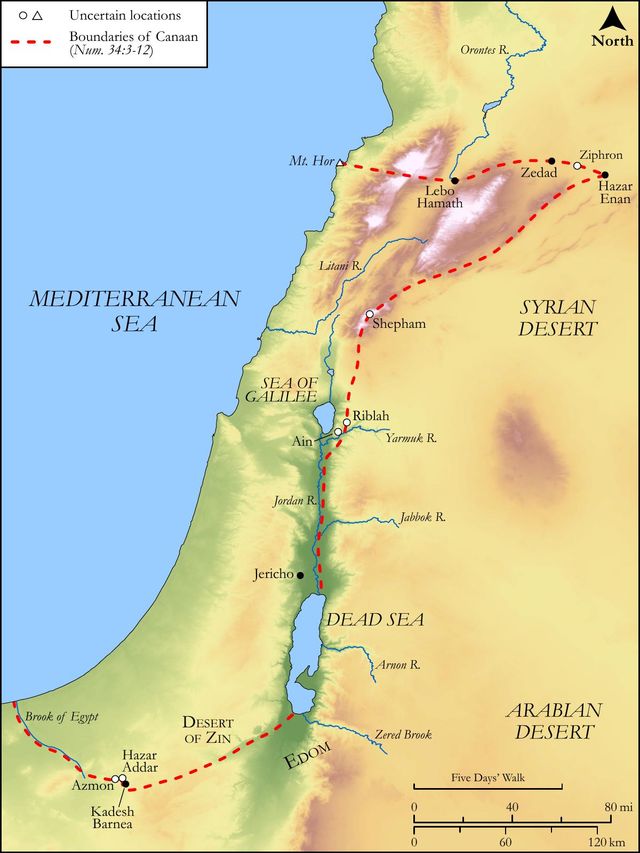
See on the biblical-era map
Study this verse
Continue studying Numbers 34:18 across the web’s major study libraries — every link below opens this exact verse, chapter, or book on the destination site.
Read & Compare
 BibleGatewayThis verse in more than 200 translations and 70 languages.
 Bible.comThe YouVersion reader — hundreds of translations, reading plans, and highlights.
 ESV.orgCrossway's official English Standard Version reader.
 NET BibleThe NET translation with 60,000+ translators' notes on every rendering decision.
 STEP BibleTyndale House's free study tool — original text, vocabulary, and scholarly resources.
 BibliaLogos Bible Software's free web reader.
 USCCBThe New American Bible (Revised Edition) with the U.S. bishops' study notes.
Commentaries
 BibleHub CommentariesDozens of classic commentaries on this verse, gathered on one page.
 StudyLightMore than 100 commentary sets — the largest collection on the web.
 BibleRefPlain-English commentary on what this verse means, verse by verse.
 Enduring WordDavid Guzik's free commentary on this chapter, widely used by Bible teachers.
 Bible Study ToolsVerse commentary alongside Greek and Hebrew study aids.
Original Language & Research
- BibleHub InterlinearThe verse word by word — original language, transliteration, and English.
- BibleHub LexiconEvery word's original-language definition and Strong's entry.
 Blue Letter BibleDeep-study tools — Strong's numbers, concordance, and word studies.
 SefariaThe Hebrew text with Rashi and centuries of Jewish commentary.
Sermons, Hymns & Audio


TrulyRandomVerse is not affiliated with these sites and doesn’t control their content. They’re linked because they’re genuinely useful.
Summary
Numbers 34:18 presents a pivotal divine directive for the meticulous and equitable division of the Promised Land among the Israelite tribes. God instructs Moses to appoint one prince from each tribe to oversee this crucial task, underscoring the principles of representative leadership, divine order, and the faithful fulfillment of covenant promises as Israel prepared to inherit its designated territory. This verse highlights God's active involvement in the practical details of His people's establishment, ensuring justice and unity in their new homeland.
Context
ShowHideLiterary Context
Numbers 34:18 is situated within a detailed legislative and narrative section (Numbers 33-36) that outlines the final preparations for Israel's entry into Canaan. Specifically, it follows the precise delineation of the geographical boundaries of the Promised Land in Numbers 34:1-12 and the general appointment of Moses, Eleazar the priest, and Joshua as overarching leaders for the land division in Numbers 34:17. This verse narrows the focus, specifying the crucial role of tribal representatives. It immediately precedes the listing of the names of these appointed princes in Numbers 34:19-29, setting the stage for the actual implementation of the land division, which is later recounted in the book of Joshua, particularly in passages like Joshua 14:1-2.
Historical & Cultural Context
At this point in Israel's history, they stood on the plains of Moab, poised to enter the land of Canaan after forty years of wilderness wandering. The division of land was not merely a logistical exercise but a foundational act for establishing their national identity, tribal cohesion, and economic stability. Land ownership was intrinsically linked to covenant identity and the fulfillment of God's promises to Abraham, Isaac, and Jacob. The "prince" (Hebrew: nasi') was a recognized tribal chief or leader, typically an elder or head of a prominent family, who commanded respect and authority within their respective tribe. Their involvement ensured that the land division was perceived as legitimate and fair by all tribal members, mitigating potential disputes and maintaining social order in a society where land was the primary source of livelihood and inheritance.
Key Themes
ShowHideNumbers 34:18 contributes significantly to several overarching themes within the book of Numbers and the Pentateuch. It powerfully illustrates Divine Order and Providence, showing God's meticulous planning and active involvement in the practical details of Israel's future, leaving nothing to chance. The appointment of specific leaders for a specific task highlights the theme of Responsible Leadership and Delegation, emphasizing that God works through chosen human agents to accomplish His purposes. Furthermore, the instruction for "one prince of every tribe" underscores Fairness, Equity, and Representation, ensuring that each tribal family had a direct voice and advocate in the distribution of their sacred inheritance. Ultimately, this verse is a tangible step towards the Fulfillment of God's Covenant Promises to Abraham regarding the land, as seen in Genesis 12:7 and Genesis 15:18-21, demonstrating God's faithfulness to His word.
Exposition and Analysis
ShowHideKey Word Analysis
ShowHideThis term, derived from a root meaning "to lift up" or "to exalt," properly denotes an exalted one, such as a king, chief, or ruler. In the context of ancient Israel, a nâsîyʼ was a recognized tribal head or leader, possessing significant authority and influence within their respective tribe. Their selection for the crucial task of land division underscores the need for leaders of integrity, wisdom, and the ability to command respect, essential for a process as sensitive as the equitable distribution of a nation's foundational asset.
Literally meaning "rod" or "staff," this word is frequently used metaphorically in the Old Testament to refer to a tribe or clan, representing a distinct family lineage and social unit within Israel. The directive to take a prince "of every tribe" emphasizes the importance of comprehensive representation and the preservation of tribal identity and inheritance. This ensured that no tribal group was overlooked or disadvantaged in the land allocation, reinforcing the unity and distinctiveness of God's chosen people.
This primitive root means "to inherit," "to occupy," or causatively, "to bequeath" or "to distribute." In this context, it refers to the systematic and orderly apportionment of the land. The use of nâchal highlights that the land was not merely conquered territory but a divinely bestowed inheritance, a permanent possession. The act of "dividing" by inheritance implies a just and equitable allocation, reflecting God's character as a God of order and fairness in fulfilling His covenant promises.
Verse Breakdown
ShowHide"And ye shall take one prince"
This clause presents a direct, imperative divine command, emphasizing the mandatory nature and divine origin of the selection process. The singular "one prince" from each tribe underscores the principle of representative leadership, where a single, authoritative individual acts on behalf of their entire tribal unit. This selection was not arbitrary but divinely mandated, signifying the importance God placed on the integrity and authority of those involved in this foundational task.
"of every tribe"
This phrase ensures comprehensive representation across all twelve tribes of Israel (excluding Levi, who had no territorial inheritance but lived among the others). It prevents favoritism or exclusion, reinforcing the idea that the land was an inheritance for the entire nation, distributed equitably among its constituent parts. This detail speaks to God's commitment to fairness and unity among His people, ensuring that the inheritance was truly a shared national blessing.
"to divide the land by inheritance"
This final clause states the explicit purpose of appointing these princes. "To divide the land" refers to the practical act of apportioning the territory. The phrase "by inheritance" is crucial, linking the division directly to the fulfillment of God's covenant promises to Abraham, Isaac, and Jacob. The land was not merely conquered territory but a divinely bestowed inheritance, a permanent possession passed down through generations, forming the bedrock of Israel's identity and future. This act cemented their status as God's chosen people in their promised dwelling place.
Literary Devices
ShowHideNumbers 34:18 employs several significant literary devices. The most prominent is Divine Command, conveyed through the imperative "ye shall take," which underscores God's absolute authority and meticulous involvement in the details of Israel's national establishment. This command structure reflects the covenantal nature of the relationship between God and Israel, where obedience to divine instructions is paramount. There is also an element of Delegation, as God entrusts human leaders with the responsibility of executing His plan, highlighting the principle of divine-human partnership in accomplishing sacred tasks. Furthermore, the verse functions as Preparatory Instruction, setting the stage for the detailed listing of the princes in the subsequent verses and anticipating the actual division of the land described later in the book of Joshua. This forward-looking aspect demonstrates the cohesive and purposeful narrative structure of the Pentateuch, emphasizing God's foresight and faithfulness.
Theological and Thematic Connections
ShowHideNumbers 34:18 profoundly illustrates God's character as a God of order, justice, and faithfulness. His meticulous instructions for the land division reveal that His providence extends not only to grand promises but also to the practical, administrative details necessary for their fulfillment. This divine blueprint for fair governance and fair sharing of goods serves as a model for human societies, emphasizing the importance of wise leadership, impartial processes, and ensuring that all members of a community receive their rightful share. The land was God's gift, and its division was a sacred act, cementing Israel's identity as a nation dwelling in the land promised to their forefathers, a tangible sign of God's unwavering covenant loyalty.
Reflection and Application
ShowHideNumbers 34:18 offers timeless principles for leadership, community, and trusting God's provision. It reminds us that God is a God of order who cares about justice and equity in the fair sharing of goods and responsibilities. For us today, this verse encourages careful planning and the establishment of fair processes in our personal, communal, and organizational endeavors. It challenges us to identify and empower leaders who possess integrity, wisdom, and a commitment to represent the interests of all, especially the vulnerable. Just as God provided a clear and just plan for Israel's physical inheritance, we can trust in His divine providence and guidance for our lives, recognizing that His promises, whether spiritual or temporal, are always fulfilled in His perfect timing and order. This passage calls us to participate faithfully in God's ordered world, seeking justice and promoting unity within our spheres of influence, reflecting His character in our own actions.
Questions for Reflection
ShowHideFAQ
ShowHideWhy was it important for "one prince of every tribe" to be involved in dividing the land?
ShowHideThe involvement of "one prince of every tribe" was crucial for several reasons. Firstly, it ensured fairness and impartiality in the land distribution, as each tribe had a direct representative to advocate for its interests. This minimized potential disputes and accusations of favoritism. Secondly, it reinforced tribal identity and representation, acknowledging the distinct social and economic units within Israel. Each prince, as a recognized leader, lent legitimacy to the process and ensured that the inheritance was truly reflective of the tribal structure. Finally, it was a divine mandate, part of God's meticulous plan for establishing Israel in the Promised Land, demonstrating His commitment to order and justice (Numbers 34:17 outlines the overarching leadership, and Numbers 34:19-29 lists the specific princes appointed).
What was the significance of "inheritance" in the context of the land division?
ShowHideThe concept of "inheritance" (Hebrew: naḥalah) was profoundly significant. The land of Canaan was not merely conquered territory but a divinely promised gift to Abraham and his descendants (Genesis 12:7). Thus, the division of the land by inheritance was the tangible fulfillment of God's ancient covenant promises. It signified a permanent, inalienable possession for each tribal family, passed down through generations. This inheritance formed the bedrock of Israel's national identity, their economic security, and their spiritual relationship with God, who had brought them into the land He had sworn to give them. It was a physical manifestation of their identity as God's chosen people, dwelling in His promised domain (Joshua 14:1 details the actual division by lot).
Christ-Centered Fulfillment
ShowHideNumbers 34:18, with its emphasis on a divinely appointed process for securing an earthly inheritance, finds its ultimate and richer fulfillment in Christ. While the Israelites received a physical land as their inheritance, believers in Christ are promised a far greater, spiritual, and eternal inheritance. Jesus Christ is the ultimate "Prince" (Isaiah 9:6), the true leader appointed by God, who not only secures but embodies our spiritual inheritance. Through His perfect life, atoning death, and glorious resurrection, Christ has become the mediator of a new covenant, by which we receive "an inheritance that is imperishable, undefiled, and unfading, kept in heaven for you" (1 Peter 1:4). Just as the tribal princes ensured each family received its portion of the land, Christ, through the Holy Spirit, distributes spiritual gifts and empowers believers to fulfill their unique roles within the body of Christ, the true spiritual "tribe" or family of God (Ephesians 4:7-13). The meticulous order of the land division foreshadows the divine order within the church, where each member has a place and a purpose in furthering God's kingdom. Our inheritance in Christ is not bound by earthly boundaries but is a participation in the very life and glory of God, secured by the "Spirit of adoption, by whom we cry out, 'Abba, Father!'" (Romans 8:15).