


Joshua 17:1
Bible text: King James Version (1769 Blayney text) · Public domain
Bible text: King James Version with Strong's numbers · Public domain
Bible text: Berean Standard Bible · Public domain
Bible text: American Standard Version (1901) · Public domain
Bible text: World English Bible, Messianic edition · Public domain
Bible text: Geneva Bible (1599) · Public domain
Bible text: Young's Literal Translation · Public domain
- וַיְהִיvay·Hiand it belongedH1961Conj-w ¦ V-Qal-ConsecImperf-3msVerb Qal Consecutive Imperfect 3rd Singular Masculineוַandיְהִיit belonged
- הַגּוֹרָלha·go·Ralthe lotH1486Art ¦ N-msNoun Singular Masculine Absoluteהַtheגּוֹרָלlot
- לְמַטֵּהle·ma·Tehto [the] tribe ofH4294Prep-l ¦ N-mscNoun Singular Masculine Constructלְtoמַטֵּה[the] tribe of
- מְנַשֶּׁהme·na·ShehManassehH4519N-proper-mNoun Proper Masculine
- כִּיkiforH3588PrtParticle Conditional
- הוּאhu'heH1931Pro-3msPronoun Personal 3rd Singular Masculine
- בְּכוֹרbe·Khor[was] [the] firstborn ofH1060N-mscNoun Singular Masculine Construct
- יוֹסֵףyo·SefJosephH3130N-proper-mNoun Proper Masculine
- לְמָכִירle·ma·Khirto MakirH4353Prep-l ¦ N-proper-mNoun Proper MasculineלְtoמָכִירMakir
- בְּכוֹרbe·Khor[the] firstborn ofH1060N-mscNoun Singular Masculine Construct
- מְנַשֶּׁהme·na·ShehManassehH4519N-proper-mNoun Proper Masculine
- אֲבִי'a·Vi[the] father ofH1N-mscNoun Singular Masculine Construct
- הַגִּלְעָדha·gil·'Ad<the> GileadH1568Art ¦ N-mpNoun Gentilic Plural Masculine Absoluteהַ<the>גִּלְעָדGilead
- כִּיkiforH3588PrtParticle Conditional
- הוּאhu'heH1931Pro-3msPronoun Personal 3rd Singular Masculine
- הָיָהha·Yahhe wasH1961V-Qal-Perf-3msVerb Qal Perfect 3rd Singular Masculine
- אִישׁ'isha man ofH376N-mscNoun Singular Masculine Construct
- מִלְחָמָהmil·cha·MahwarH4421N-fsNoun Singular Feminine Absolute
- וַיְהִיvay·hiand it belongedH1961Conj-w ¦ V-Qal-ConsecImperf-3msVerb Qal Consecutive Imperfect 3rd Singular Masculineוַandיְהִיit belonged
- לוֹloto <the> himPrep-l ¦ 3msSuffix Personal 3rd Singular Masculineלto <the>וֹhim
- הַגִּלְעָדha·gil·'Ad<the> GileadH1568Art ¦ N-properNoun Proper Locationהַ<the>גִּלְעָדGilead
- וְהַבָּשָׁןve·ha·ba·Shanand <the> BashanH1316Conj-w ¦ Art ¦ N-properNoun Proper Locationוְandהַ<the>בָּשָׁןBashan
English is a literal word-by-word gloss of the Hebrew, not the KJV's wording. Why?
This is the original text the KJV's translators worked from — each Hebrew word with its own literal English meaning in this verse, prepared by scholars at Tyndale House, Cambridge. The KJV translates whole sentences, not word by word, so its wording differs: one Hebrew word can become several English words, and the KJV may choose “the LORD” where the gloss reads “Yahweh”. Both are faithful — they answer different questions. For the KJV's own rendering, switch to the KJV text.
Details
See on the biblical-era maps
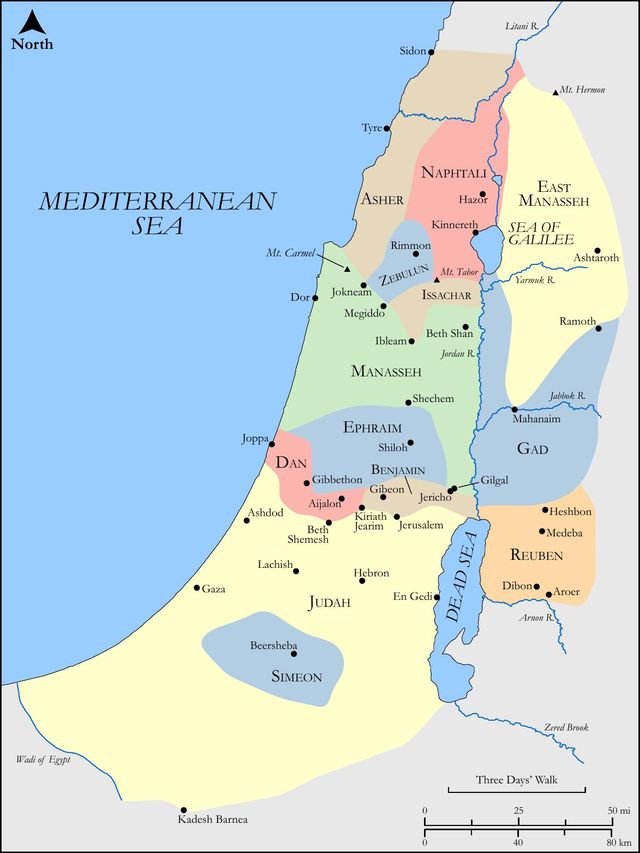
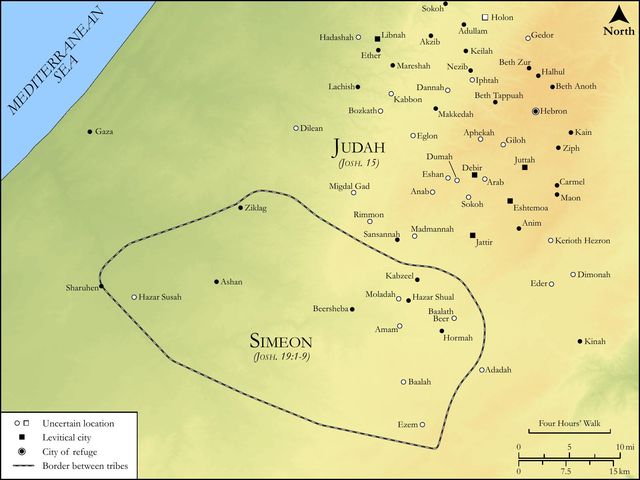
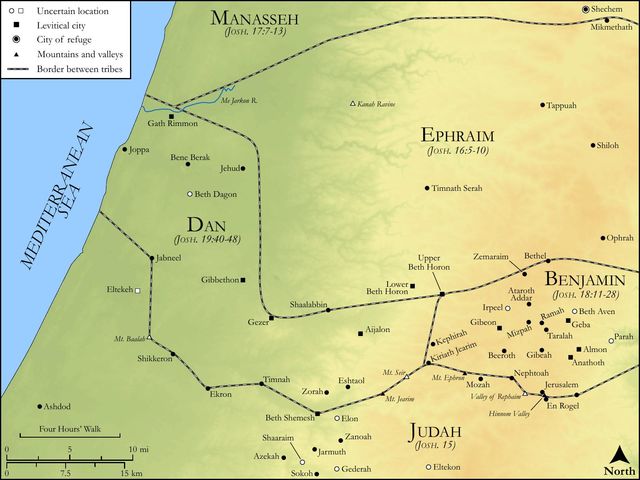
Study this verse
Public-domain commentary
Matthew Henry
From his Commentary on the Whole Bible. Henry comments on passages, not single verses — this entry covers Joshua 17:1–6.
Manasseh was itself but one half of the tribe of Joseph, and yet was divided and subdivided. 1. It was divided into two parts, one already settled on the other side Jordan, consisting of those who were the posterity of Machir, Jos 17:1. This Machir was born to Manasseh in Egypt; there he had signalized himself as a man of war, probably in the contests between the Ephraimites and the men of Gath, Ch1 7:21. His warlike disposition descended to his posterity, and therefore Moses gave them Gileaxdand Bashan, on the other side Jordan, of which before, Jos 13:31. It is here said that the lot came to Manasseh, for he was the first-born of Joseph. Bishop Patrick thinks it should be translated, though he was the first-born of Joseph, and then the meaning is plain, that the second lot was for Manasseh, because, though he was the first-born, yet Jacob had preferred Ephraim before him. See the names of those heads of the families that settled on the other side Jordan, Ch1 5:24. 2. That part on this side Jordan as subdivided into ten families, Jos 17:5. There were six sons of Gilead here named (Jos 17:2), the same that are recorded Num 26:30-32, only that he who is there called Jezeer is here called Abiezer. Five of these sons had each of them their portion; the sixth, which was Hepher, had his male line cut off in his son Zelophehad, who left daughters only, five in number, of whom we have often read, and these five had each of them a portion; though perhaps, they claiming under Hepher, all their five portions were but equal to one of the portions of the five sons. Or if Hepher had other sons besides Zelophehad, in whom the name of his family was kept up, their posterity married to the daughters of Zelophehad the elder brother, and in their right had these portions assigned them. See Num 36:12. Here is, (1.) The claim which the daughters of Zelophehad made, grounded upon the command God gave to Moses concerning them, Jos 17:4. They had themselves, when they were young, pleaded their own cause before Moses, and obtained the grant of an inheritance with their brethren, and now they would not lose the benefit of that grant for want of speaking to Joshua, but seasonably put in their demand themselves, as it should seem, and not their husbands for them. (2.) The assignment of their portions according to their claim. Joshua knew very well what God had ordered in their case, and did not object that they having not served in the wars of Canaan there was no reason why they should share in the possessions of Canaan, but readily gave them as inheritance among the brethren of their father. And now they reaped the benefit of their own pious zeal and prudent forecast in this matter. Thus those who take care in the wilderness of this world to make sure to themselves a place in the inheritance of the saints in light will certainly have the comfort of it in the other world, while those that neglect it now will lose it for ever.
Continue studying Joshua 17:1 across the web’s major study libraries — every link below opens this exact verse, chapter, or book on the destination site.
Read & Compare
 BibleGatewayThis verse in more than 200 translations and 70 languages.
 Bible.comThe YouVersion reader — hundreds of translations, reading plans, and highlights.
 ESV.orgCrossway's official English Standard Version reader.
 NET BibleThe NET translation with 60,000+ translators' notes on every rendering decision.
 STEP BibleTyndale House's free study tool — original text, vocabulary, and scholarly resources.
 BibliaLogos Bible Software's free web reader.
 USCCBThe New American Bible (Revised Edition) with the U.S. bishops' study notes.
Commentaries
 BibleHub CommentariesDozens of classic commentaries on this verse, gathered on one page.
 StudyLightMore than 100 commentary sets — the largest collection on the web.
 BibleRefPlain-English commentary on what this verse means, verse by verse.
 Enduring WordDavid Guzik's free commentary on this chapter, widely used by Bible teachers.
 Bible Study ToolsVerse commentary alongside Greek and Hebrew study aids.
Original Language & Research
- BibleHub InterlinearThe verse word by word — original language, transliteration, and English.
- BibleHub LexiconEvery word's original-language definition and Strong's entry.
 Blue Letter BibleDeep-study tools — Strong's numbers, concordance, and word studies.
 SefariaThe Hebrew text with Rashi and centuries of Jewish commentary.
Sermons, Hymns & Audio


TrulyRandomVerse is not affiliated with these sites and doesn’t control their content. They’re linked because they’re genuinely useful.
Summary
Joshua 17:1 introduces the specific land allocation for the tribe of Manasseh, detailing its unique lineage as Joseph's firstborn and highlighting the distinct claim of Machir, Manasseh's firstborn, to the territories of Gilead and Bashan. This distribution, determined by lot, underscores the divine orchestration of Israel's inheritance and acknowledges Machir's military prowess in securing these lands east of the Jordan, setting the stage for the tribe's dual inheritance.
Context
ShowHideLiterary Context
Joshua 17:1 is situated within the broader narrative of the division of the promised land among the Israelite tribes, following the successful conquest campaigns detailed in earlier chapters of Joshua. Chapters 13-19 meticulously record the allocation of territories west of the Jordan River by lot, a process understood to be divinely guided. This particular verse immediately follows the description of Ephraim's inheritance in Joshua 16, which details the southern border of Joseph's descendants. The mention of Gilead and Bashan here serves as a crucial link to the earlier settlement of the Transjordanian tribes, particularly the half-tribe of Manasseh, in Numbers 32, where Machir's descendants had already secured these territories through conquest. The verse then precedes the detailed account of Manasseh's western borders and the significant challenge of the daughters of Zelophehad in Joshua 17:2-6, which further elaborates on the internal divisions and inheritance rights within the tribe.
Historical & Cultural Context
The division of land was the culmination of God's covenant promise to Abraham, Isaac, and Jacob, establishing Israel as a settled nation in the Promised Land. The method of "casting lots" was a common practice among the nations for making important decisions, as when the mariners with Jonah cast lots to learn for whose cause the evil was upon them, but in Israel, it was uniquely understood as a means by which God's will was revealed, removing human bias and ensuring divine sanction for the distribution, as affirmed in Proverbs 16:33. Land was not merely property but a divine inheritance, central to Israel's identity, security, and covenant relationship with Yahweh. Tribal and family lineage dictated rights to this inheritance, and the status of "firstborn" carried significant cultural weight, often entailing a double portion or special privileges, even if, as in Joseph's case, the patriarchal blessing altered the traditional birthright (Genesis 48:17-19). Machir's designation as a "man of war" reflects the valor and military effort required to conquer and hold territory, particularly in the challenging Transjordanian regions, which were often contested.
Key Themes
ShowHideThis verse contributes to several overarching themes in Joshua and the Pentateuch. The primary theme is Divine Faithfulness and Fulfillment of Promise, as God meticulously orchestrates the distribution of the land promised to the patriarchs, solidifying Israel's national identity and physical dwelling. It also highlights the theme of Inheritance and Tribal Identity, demonstrating how each tribe, based on its lineage and specific circumstances, received a distinct portion of the land, reinforcing their unique place within the twelve tribes. Furthermore, the mention of Machir as a "man of war" introduces the theme of Human Effort and Divine Sovereignty working in concert; while the land was a divine gift, its securing often involved significant military action and courage, as exemplified by the Machirites' conquest of Gilead in Numbers 32:39-40. The verse also subtly touches on the Significance of the Firstborn, even as it acknowledges the complex dynamics within Joseph's lineage, where Ephraim ultimately received a greater blessing from Jacob in Genesis 48:17-19, yet Manasseh's firstborn status is still noted as a foundational element of their claim.
Exposition and Analysis
ShowHideKey Word Analysis
ShowHideFrom an unused root meaning "to be rough (as stone)," this term properly refers to a pebble, used for casting lots. Figuratively, it denotes a portion or destiny as if determined by lot. In the context of land division, the "lot" signifies that the allocation was not arbitrary or based solely on human preference, but rather on God's sovereign will, ensuring fairness and divine sanction for each tribe's inheritance. It removed human bias from the process, portraying the outcome as divinely ordained.
Derived from a root meaning "to be first," this term denotes the eldest son, who traditionally held a privileged position, often receiving a double portion of the inheritance and leadership responsibilities. While Manasseh was indeed Joseph's firstborn, the narrative of Jacob blessing Ephraim over Manasseh in Genesis 48 adds a layer of theological complexity, emphasizing that divine choice can supersede human custom. Here, it highlights Manasseh's significant standing and the genealogical basis for his claim, despite the altered blessing.
This phrase combines ʼîysh (man, individual) and milchâmâh (battle, war). It describes someone characterized by military prowess, courage, and readiness for battle. Applied to Machir, it underscores his active and successful role in conquering and securing the territories of Gilead and Bashan east of the Jordan. This designation is a commendation of his strategic and martial capabilities, which directly contributed to his descendants' claim to that specific inheritance, demonstrating the interplay between divine promise and human effort.
Verse Breakdown
ShowHide"¶ There was also a lot for the tribe of Manasseh; for he [was] the firstborn of Joseph;"
This opening clause establishes the primary subject of the verse: the tribe of Manasseh receiving its inheritance through the casting of lots. The parenthetical explanation "for he [was] the firstborn of Joseph" provides the genealogical justification for Manasseh's prominence. This highlights Manasseh's significant standing among the tribes and his direct lineage from Joseph, a key figure in Israel's history, even though Jacob had blessed Ephraim (Joseph's younger son) with the greater blessing, emphasizing Manasseh's foundational claim.
"[to wit], for Machir the firstborn of Manasseh, the father of Gilead:"
This phrase further specifies the distribution within the tribe of Manasseh, focusing on Machir, Manasseh's own firstborn. The designation "the father of Gilead" is a geographical and tribal descriptor, indicating that Machir's descendants were instrumental in settling and claiming the region of Gilead. This connection between a tribal leader and a specific territory is common in biblical genealogies and land descriptions, showing how the inheritance was tied to specific family lines and their historical actions.
"because he was a man of war, therefore he had Gilead and Bashan."
This concluding clause provides the explicit reason for Machir's specific inheritance of Gilead and Bashan. His status as a "man of war" signifies his military strength and successful conquest of these Transjordanian territories. This statement directly links human effort and military achievement to the divine allocation of land, demonstrating that while God's sovereignty guided the lot, human faithfulness and courage played a vital role in securing and possessing the promised inheritance. It affirms that God works through His people's diligent and courageous actions.
Literary Devices
ShowHideThe verse employs several literary devices to convey its message effectively. Emphasis is placed on Manasseh's lineage and Machir's military contribution through direct statements and genealogical markers. The phrases "firstborn of Joseph" and "firstborn of Manasseh" serve as a form of Repetition or parallel structure, reinforcing the significant status of these individuals within their respective generations and their foundational role in the tribal inheritance. The designation "father of Gilead" is a form of Metonymy, where the name of the patriarch (Machir) stands for his descendants and their strong, enduring association with the land they settled and conquered. Furthermore, the verse functions as an Allusion to earlier narratives, particularly Numbers 32:39-40, which details Machir's conquest of Gilead, providing the historical context and justification for his claim. This intertextual connection enriches the meaning, showing the fulfillment of past actions in the present distribution of the land.
Theological and Thematic Connections
ShowHideJoshua 17:1 powerfully illustrates God's meticulous faithfulness in fulfilling His ancient promises to Abraham's descendants, demonstrating that the land was not merely conquered but divinely apportioned. The use of the "lot" signifies God's sovereign hand in the distribution, ensuring that each tribe received its rightful, God-ordained inheritance. Yet, it also highlights the interplay between divine sovereignty and human responsibility, as Machir's military efforts were acknowledged and rewarded within this divine framework. This balance underscores a key biblical principle: God's purposes are accomplished both through His direct intervention and through the faithful, courageous actions of His people. The specific mention of Gilead and Bashan, territories east of the Jordan, also serves as a reminder of the unity of the tribes, even those separated by the river, and the comprehensive nature of God's provision for His people.
Reflection and Application
ShowHideThis verse, while dealing with ancient land distribution, offers profound insights into God's character and our own lives. It reminds us that God is a God of order, precision, and faithfulness, meticulously fulfilling His promises down to the details of tribal boundaries. Just as He sovereignly guided the lot for Manasseh, He sovereignly guides the circumstances of our lives, orchestrating our inheritance and our place within His larger kingdom purpose. The acknowledgment of Machir's "man of war" status also teaches us that divine sovereignty does not negate human effort; rather, it often works through our diligence, courage, and faithfulness. We are called to be "men and women of war" in a spiritual sense, contending for the faith, exercising our gifts, and engaging in the spiritual battles God sets before us, trusting that our efforts, empowered by Him, contribute to His ultimate plan. Our "inheritance" today is not physical land, but spiritual blessings and a place in God's eternal kingdom, secured by Christ. This assurance should inspire both trust in God's provision and active participation in His mission.
Questions for Reflection
ShowHideFAQ
ShowHideWhy was Manasseh singled out with this specific verse about Machir?
ShowHideJoshua 17:1 highlights Manasseh for several reasons, reflecting the tribe's unique position and historical context. First, as the "firstborn of Joseph," Manasseh held a significant ancestral position, even though Jacob had blessed Ephraim (Joseph's second son) with the greater blessing (see Genesis 48:17-19). This verse acknowledges Manasseh's birthright status and the importance of its lineage. Second, the tribe of Manasseh was unique in receiving land on both sides of the Jordan River. The mention of Machir, Manasseh's firstborn, and his descendants' prior conquest of Gilead and Bashan (east of the Jordan) in Numbers 32:39-40 explains why a significant portion of Manasseh had already settled there before the general land distribution in Canaan. This verse therefore serves to bridge the narrative of the Transjordanian settlement with the current land distribution west of the Jordan, clarifying the full extent of Manasseh's inheritance and the historical basis for it, emphasizing their distinct contribution and claim.
Christ-Centered Fulfillment
ShowHideThe earthly inheritance of land for Manasseh, determined by lot and secured by the prowess of a "man of war" like Machir, serves as a rich foreshadowing of the spiritual inheritance believers receive in Christ. Just as the land was a promised possession for Israel, so too is eternal life and every spiritual blessing a promised inheritance for those in Christ, secured not by our own military might but by the ultimate "man of war," Jesus Christ. He is the true Son of David, the conquering King who engaged in the ultimate spiritual battle against sin, death, and the devil. Through His decisive victory on the cross and His glorious resurrection, Christ has secured for us an inheritance that is "imperishable, undefiled, and unfading, kept in heaven" (1 Peter 1:4). Our "lot" in Christ is not a physical territory but a spiritual reality, a new creation and eternal dwelling in God's presence, freely given through His grace. He is the one who, by His own blood, has "obtained eternal redemption" for us (Hebrews 9:12), making us heirs according to the promise, far surpassing any earthly portion or tribal claim. In Him, all the promises of God find their "Yes" and "Amen" (2 Corinthians 1:20), granting us an inheritance beyond measure.