


Numbers 32:40
Bible text: King James Version (1769 Blayney text) · Public domain
Bible text: Berean Standard Bible · Public domain
Bible text: American Standard Version (1901) · Public domain
Bible text: World English Bible, Messianic edition · Public domain
Bible text: Geneva Bible (1599) · Public domain
Bible text: Young's Literal Translation · Public domain
- וַיִּתֵּןvai·yi·Tenand he gaveH5414Conj-w ¦ V-Qal-ConsecImperf-3msVerb Qal Consecutive Imperfect 3rd Singular Masculineוַandיִּתֵּןhe gave
- מֹשֶׁהmo·ShehMosesH4872N-proper-mNoun Proper Masculine
- אֶת'et<obj.>H853DirObjMParticle Object Indicator
- הַגִּלְעָדha·gil·'Ad<the> GileadH1568Art ¦ N-properNoun Proper Locationהַ<the>גִּלְעָדGilead
- לְמָכִירle·ma·Khirto MakirH4353Prep-l ¦ N-proper-mNoun Proper MasculineלְtoמָכִירMakir
- בֶּןben[the] son ofH1121N-mscNoun Singular Masculine Construct
- מְנַשֶּׁהme·na·ShehManassehH4519N-proper-mNoun Proper Masculine
- וַיֵּשֶׁבvai·Ye·shevand he dweltH3427Conj-w ¦ V-Qal-ConsecImperf-3msVerb Qal Consecutive Imperfect 3rd Singular Masculineוַandיֵּשֶׁבhe dwelt
- בָּהּBahin <the> itPrep-b ¦ 3fsSuffix Personal 3rd Singular Feminineבָּin <the>הּit
English is a literal word-by-word gloss of the Hebrew, not the KJV's wording. Why?
This is the original text the KJV's translators worked from — each Hebrew word with its own literal English meaning in this verse, prepared by scholars at Tyndale House, Cambridge. The KJV translates whole sentences, not word by word, so its wording differs: one Hebrew word can become several English words, and the KJV may choose “the LORD” where the gloss reads “Yahweh”. Both are faithful — they answer different questions. For the KJV's own rendering, switch to the KJV text.
Details
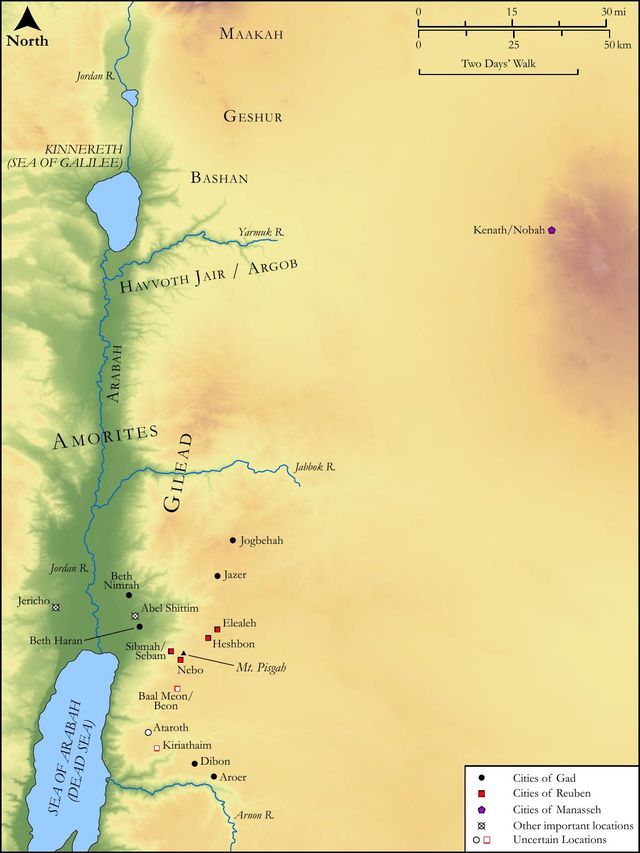
See on the biblical-era map
Study this verse
Continue studying Numbers 32:40 across the web’s major study libraries — every link below opens this exact verse, chapter, or book on the destination site.
Read & Compare
 BibleGatewayThis verse in more than 200 translations and 70 languages.
 Bible.comThe YouVersion reader — hundreds of translations, reading plans, and highlights.
 ESV.orgCrossway's official English Standard Version reader.
 NET BibleThe NET translation with 60,000+ translators' notes on every rendering decision.
 STEP BibleTyndale House's free study tool — original text, vocabulary, and scholarly resources.
 BibliaLogos Bible Software's free web reader.
 USCCBThe New American Bible (Revised Edition) with the U.S. bishops' study notes.
Commentaries
 BibleHub CommentariesDozens of classic commentaries on this verse, gathered on one page.
 StudyLightMore than 100 commentary sets — the largest collection on the web.
 BibleRefPlain-English commentary on what this verse means, verse by verse.
 Enduring WordDavid Guzik's free commentary on this chapter, widely used by Bible teachers.
 Bible Study ToolsVerse commentary alongside Greek and Hebrew study aids.
Original Language & Research
- BibleHub InterlinearThe verse word by word — original language, transliteration, and English.
- BibleHub LexiconEvery word's original-language definition and Strong's entry.
 Blue Letter BibleDeep-study tools — Strong's numbers, concordance, and word studies.
 SefariaThe Hebrew text with Rashi and centuries of Jewish commentary.
Sermons, Hymns & Audio


TrulyRandomVerse is not affiliated with these sites and doesn’t control their content. They’re linked because they’re genuinely useful.
Summary
Numbers 32:40 records the specific allocation of the Transjordanian region of Gilead to Machir, a prominent clan within the tribe of Manasseh, by Moses. This verse serves as a concise yet significant declaration of the fulfillment of the agreement made between Moses and the Transjordanian tribes, particularly highlighting the initial phase of their settlement and the orderly distribution of territory promised by God. It underscores the integrity of leadership and the tangible commencement of Israel's inheritance.
Context
ShowHideLiterary Context
Numbers 32:40 is situated within a crucial narrative section in Numbers chapter 32. The preceding verses detail the request of the tribes of Reuben, Gad, and the half-tribe of Manasseh to settle in the fertile lands east of the Jordan River, primarily Gilead and Jazer, due to their abundant livestock, as seen in Numbers 32:1-5. Moses initially expresses strong concern, fearing this desire would discourage the other tribes from entering Canaan, echoing the disastrous report of the spies years earlier, as recorded in Numbers 32:6-15. However, after these tribes pledge to send their armed men across the Jordan to assist in the conquest of Canaan before returning to their inheritance (Numbers 32:16-19), Moses agrees. Verses Numbers 32:34-38 detail the cities built by Reuben and Gad, while Numbers 32:39 specifically states that the Machirites went to Gilead, captured it, and drove out the Amorites. Verse 40 then confirms Moses' formal grant of this conquered territory to Machir, followed by Numbers 32:41-42 which records similar allocations to other Manassite clans. This verse, therefore, acts as a pivotal statement of authorization and possession within this unfolding narrative of tribal settlement.
Historical & Cultural Context
The allocation of land was central to Israel's identity and future as a nation. After forty years of wandering, the Israelites were transitioning from a nomadic existence to a settled agricultural society. The Transjordanian region, particularly Gilead, was known for its rich pasturelands, making it highly desirable for tribes with large flocks and herds. The process of land distribution, even before the full conquest of Canaan, was meticulously carried out, reflecting the importance of tribal boundaries and family inheritances in ancient Israelite society. Leadership, as exemplified by Moses, involved not only military command and spiritual guidance but also the practical administration of resources and the fulfillment of agreements. The act of "giving" land by Moses, acting as God's representative, underscored the divine authority behind the distribution and the legal establishment of their claims. This period also highlights the tension between tribal self-interest and national unity, a tension resolved by the tribes' commitment to assist their brethren, demonstrating a crucial aspect of their nascent national identity.
Key Themes
ShowHideThis verse powerfully contributes to several overarching themes within Numbers and the Pentateuch. Firstly, it exemplifies the Fulfillment of Promise, demonstrating God's faithfulness to His covenant with Abraham to give His descendants land, as first promised in Genesis 12:7. Moses, as God's instrument, faithfully executes the agreement, highlighting the importance of integrity and commitment in leadership. Secondly, the theme of Land and Inheritance is central, as the Israelites begin to possess portions of the promised territory, even if outside the primary land of Canaan. This initial distribution foreshadows the larger land division described in Joshua chapters 13-21. Lastly, the specific mention of "Machir the son of Manasseh" underscores the theme of Tribal Identity and Orderly Settlement. The meticulous recording of specific family groups receiving their portions emphasizes the divine order and precision in the establishment of the Israelite nation, ensuring distinct territories and identities for each clan within the larger tribal structure, which was vital for their social, economic, and religious life.
Exposition and Analysis
ShowHideKey Word Analysis
ShowHideThis refers to a significant geographical region east of the Jordan River, characterized by fertile plains and hills suitable for pasturage. It was a contested area in later Israelite history but at this point represented a desirable and strategic territory. The name itself can mean "heap of witness" or "rocky tract," reflecting its topography and perhaps its role in early covenant-making (Genesis 31:47-48). Its allocation here marks the first formal Israelite possession of land outside of Canaan proper.
Machir was the firstborn son of Manasseh (Genesis 50:23), and his descendants became a prominent clan within the tribe of Manasseh. The mention of Machir specifically, rather than the entire half-tribe of Manasseh, indicates the particular strength and initiative of this clan in conquering and settling the region of Gilead, as noted in Numbers 32:39. This highlights the importance of specific family units and their actions within the broader tribal narrative, underscoring their role as "salesmen" or those who "sold" themselves to the task of conquest.
This verb signifies "to sit down," "to remain," "to inhabit," or "to settle." In the context of land, it denotes permanent occupation and establishment. It's not merely passing through but taking possession and making a home, indicating a cessation of wandering and the beginning of a stable, rooted existence. This word emphasizes the stability and permanence of the Machirites' settlement in Gilead, signaling the end of their nomadic wandering and the beginning of their life as landowners.
Verse Breakdown
ShowHide"And Moses gave Gilead unto Machir the son of Manasseh;"
This clause formally records the act of allocation. Moses, as the divinely appointed leader and mediator of the covenant, is the agent of this grant, signifying its legitimacy and authority. The land of Gilead, already conquered by the Machirites (Numbers 32:39), is now officially assigned to them. This highlights the principle that conquest alone was not sufficient; divine and human authorization through Moses was necessary for legitimate possession within the covenant community. The specific mention of "Machir the son of Manasseh" underscores the meticulous nature of the tribal and clan-based land distribution, emphasizing the importance of family lineage in the inheritance system.
"and he dwelt therein."
This concluding clause confirms the outcome of the grant: the Machirites took possession and established their permanent residence in Gilead. The verb "dwelt" (Hebrew: yâshab) indicates a settled, established presence, not merely a temporary encampment. This signifies the successful fulfillment of the agreement, the securing of their inheritance, and the transition from a nomadic to a settled existence for this clan. It marks a concrete step in the broader narrative of Israel's occupation of the promised land, demonstrating the tangible result of divine promise and human obedience.
Literary Devices
ShowHideThe verse employs Conciseness and Fulfillment Language. The brevity of the statement, "And Moses gave Gilead unto Machir the son of Manasseh; and he dwelt therein," belies the complex negotiations and military actions that preceded it. This concise declaration serves as a definitive pronouncement of an accomplished fact, emphasizing the finality and authority of Moses' action. The phrase "he dwelt therein" acts as Fulfillment Language, confirming the successful outcome of the agreement and the physical manifestation of the promised inheritance. It provides a sense of completion and resolution to the narrative thread concerning Machir's claim to Gilead, reinforcing the themes of divine faithfulness and human integrity in keeping covenants. The structure also exhibits a simple Cause and Effect or Action and Consequence pattern: Moses' giving (action) leads to Machir's dwelling (consequence).
Theological and Thematic Connections
ShowHideNumbers 32:40, though a seemingly simple record of land distribution, carries profound theological weight. It serves as a tangible demonstration of God's faithfulness to His covenant promises, particularly the promise of land to Abraham's descendants. Moses, acting under divine authority, meticulously executes this promise, emphasizing the orderly nature of God's plan for His people. The verse highlights the importance of integrity in agreements, both divine and human, as the conditions set by Moses were met by the Machirites, leading to the fulfillment of their request. This act of giving and dwelling underscores God's provision for His people's diverse needs and His commitment to establishing them securely in their inheritance. It reminds us that God's promises are not abstract but find concrete expression in the lives of His people, even in the details of land allocation, revealing His meticulous care and sovereign design.
Reflection and Application
ShowHideNumbers 32:40, while rooted in ancient history, offers timeless principles for believers today. It reminds us of the profound importance of integrity and faithfulness in keeping our word, just as Moses kept his promise to the Transjordanian tribes and they, in turn, were expected to fulfill their pledge to their brethren. This verse underscores that God is a God of order and precision, orchestrating even the details of land distribution to fulfill His overarching plan. It encourages us to trust in God's provision, recognizing that He cares for the specific needs of His people and provides for them within His perfect will. Just as the Israelites received a physical inheritance, we are promised a spiritual inheritance in Christ, a secure dwelling place that transcends earthly boundaries. This historical record invites us to reflect on the tangible ways God's promises unfold in our lives and the importance of our obedience and participation in His grand narrative.
Questions for Reflection
ShowHideFAQ
ShowHideWhy was Gilead given to Machir specifically, and not the entire half-tribe of Manasseh?
ShowHideNumbers 32:40 states that Moses gave Gilead to Machir, the son of Manasseh, because the Machirites were the specific clan within the half-tribe of Manasseh who took the initiative to conquer Gilead. Numbers 32:39 explicitly states, "And the children of Machir the son of Manasseh went to Gilead, and took it, and dispossessed the Amorite which was in it." This indicates that the Machirites were particularly strong and proactive in securing this territory. While the entire half-tribe of Manasseh would eventually settle east of the Jordan, this verse highlights the specific military action and subsequent formal allocation to the clan that directly conquered and settled the region, demonstrating the principle of possession through conquest and formal grant. Other Manassite clans, like those of Jair and Nobah, also received villages in Gilead, as noted in Numbers 32:41-42.
Christ-Centered Fulfillment
ShowHideNumbers 32:40, detailing the physical inheritance of land by the Machirites, foreshadows the spiritual inheritance and secure dwelling place found in Christ. Just as Moses, as a mediator of the Old Covenant, granted a physical portion of the promised land, Jesus Christ, the mediator of the New Covenant, grants His followers an eternal inheritance that is far greater than any earthly territory. The land of Gilead offered rest and provision, but it was a temporary dwelling. In Christ, believers receive a spiritual inheritance that is "imperishable, undefiled, and unfading, kept in heaven" for them, as described in 1 Peter 1:4. The "dwelling therein" of Machir's descendants points to the ultimate rest and secure dwelling that believers find in Christ, who is our true home and the fulfillment of all God's promises (2 Corinthians 1:20). He is the one who leads His people not merely into a physical land, but into the very presence of God, providing true peace and an eternal habitation in the "heavenly country" (Hebrews 11:16). Thus, this historical record of land distribution ultimately points to Christ as the ultimate Giver of rest and the embodiment of our eternal inheritance.