


2 Samuel 20:4
Bible text: King James Version (1769 Blayney text) · Public domain
Bible text: Berean Standard Bible · Public domain
Bible text: American Standard Version (1901) · Public domain
Bible text: World English Bible, Messianic edition · Public domain
Bible text: Geneva Bible (1599) · Public domain
Bible text: Young's Literal Translation · Public domain
- וַיֹּאמֶרvai·Yo·merand he saidH559Conj-w ¦ V-Qal-ConsecImperf-3msVerb Qal Consecutive Imperfect 3rd Singular Masculineוַandיֹּאמֶרhe said
- הַמֶּלֶךְha·Me·lekhthe kingH4428Art ¦ N-msNoun Singular Masculine Absoluteהַtheמֶּלֶךְking
- אֶל'eltoH413PrepPreposition
- עֲמָשָׂא'a·ma·Sa'AmasaH6021N-proper-mNoun Proper Masculine
- הַזְעֶקhaz·'eksummonH2199V-Hiphil-Imp-2msVerb Hiphil Imperative 2nd Singular Masculine
- לִיlito <the> mePrep-l ¦ 1csSuffix Personal 1st Singular common genderלִto <the>יme
- אֶת'et<obj.>H853DirObjMParticle Object Indicator
- אִישׁ'ish[the] man ofH376N-mscNoun Singular Masculine Construct
- יְהוּדָהye·hu·DahJudahH3063N-properNoun Proper Location
- שְׁלֹשֶׁתshe·Lo·shetthreeH7969N-cscNoun Singular common gender Construct
- יָמִיםya·MimdaysH3117N-mpNoun Plural Masculine Absolute
- וְאַתָּהve·'a·Tahand youH859Conj-w ¦ Pro-2msPronoun Personal 2nd Singular Masculineוְandאַתָּהyou
- פֹּהpohhereH6311AdvAdverb
- עֲמֹד'a·ModstandH5975V-Qal-Imp-2msVerb Qal Imperative 2nd Singular Masculine
English is a literal word-by-word gloss of the Hebrew, not the KJV's wording. Why?
This is the original text the KJV's translators worked from — each Hebrew word with its own literal English meaning in this verse, prepared by scholars at Tyndale House, Cambridge. The KJV translates whole sentences, not word by word, so its wording differs: one Hebrew word can become several English words, and the KJV may choose “the LORD” where the gloss reads “Yahweh”. Both are faithful — they answer different questions. For the KJV's own rendering, switch to the KJV text.
Details
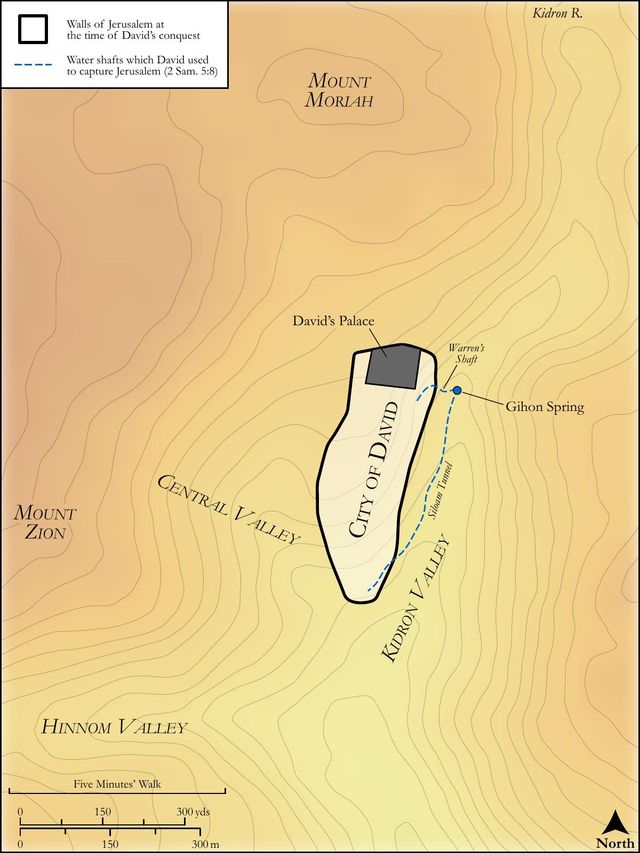
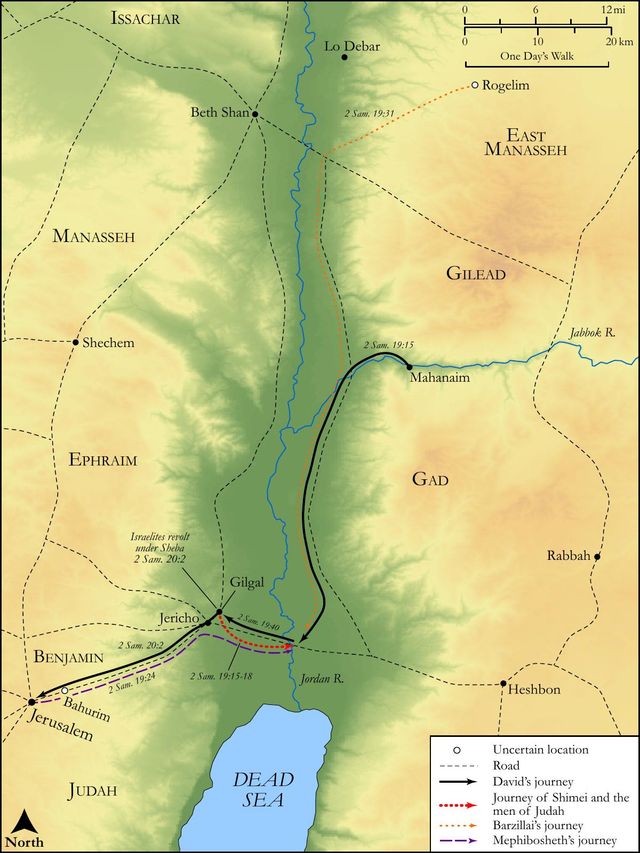
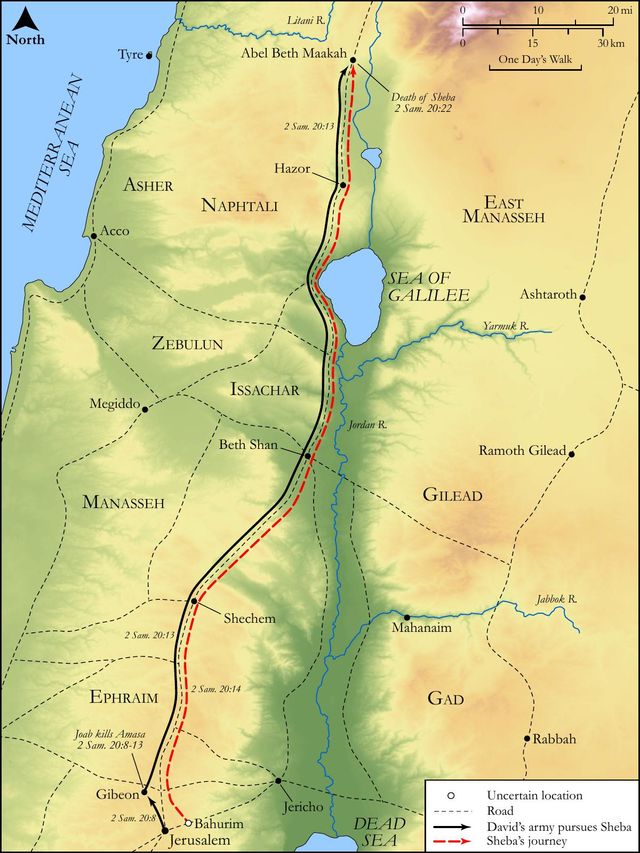
See on the biblical-era maps
Study this verse
Public-domain commentary
Matthew Henry
From his Commentary on the Whole Bible. Henry comments on passages, not single verses — this entry covers 2 Samuel 20:4–13. His two-level outline is real structure in the source text, so it is rendered as structure.
We have here Amasa's fall just as he began to rise. He was nephew to David (Sa2 17:25), had been Absalom's general and commander-in-chief of his rebellious army, but, that being routed, he came over into David's interest, upon a promise that he should be general of his forces instead of Joab. Sheba's rebellion gives David an occasion to fulfil his promise sooner than he could wish, but Joab's envy and emulation rendered its fulfillment of ill consequence both to him and David.
I.Amasa has a commission to raise forces for the suppressing of Sheba's rebellion, and is ordered to raise them with all possible expedition, Sa2 20:4. It seems, the men of Judah, though forward to attend the king's triumphs, were backward enough to fight his battles; else, when they were all in a body attending him to Jerusalem, they might immediately have pursued Sheba, and have crushed that cockatrice in the egg. But most love a loyalty, as well as a religion, that is cheap and easy. Many boast of their being akin to Christ that yet are very loth to venture for him. Amasa is sent to assemble the men of Judah within three days; but he finds them so backward and unready that he cannot do it within the time appointed (Sa2 20:5), though the promotion of Amasa, who had been their general under Absalom, was very obliging to them, and a proof of the clemency of David's government.
II.Upon Amasa's delay, Abishai, the brother of Joab, is ordered to take the guards and standing forces, and with them to pursue Sheba (Sa2 20:6, Sa2 20:7), for nothing could be of more dangerous consequence than to give him time. David gives these orders to Abishai, because he resolves to mortify Joab, and degrade him, not so much, I doubt, for the blood of Abner, which he had shed basely, as for the blood of Absalom, which he had shed justly and honourably. "Now (says bishop Hall) Joab smarteth for a loyal disobedience. How slippery are the stations of earthly honours and subject to continual mutability! Happy are those who are in favour with him in whom there is no shadow of change." Joab, without orders, though in disgrace, goes along with his brother, knowing he might be serviceable to the public, or perhaps now meditating the removal of his rival.
III.Joab, near Gibeon, meets with Amasa, and barbarously murders him, Sa2 20:8-10.
It should seem, the great stone in Gibeon was the place appointed for the general rendezvous. There the rivals met; and Amasa, relying upon his commission, went before, as general both of the new-raised forces which he had got together, and of the veteran troops which Abishai had brought in; but Joab there took an opportunity to kill him with his own hand; and,
1.He did it subtilely, and with contrivance, and not upon a sudden provocation. He girded his coat about him, that it might not hang in his way, and girded his belt upon his coat, that his sword might be the readier to his hand; he also put his sword in a sheath too big for it, that, whenever he pleased, it might, upon a little shake, fall out, as if it fell by accident, and so he might take it into his hand, unsuspected, as if he were going to return it into the scabbard, when he designed to sheath it in the bowels of Amasa. The more there is of plot in a sin the worse it is.
2.He did it treacherously, and under pretence of friendship, that Amasa might not be upon his guard. He called him brother, for they were own cousins, enquired of his welfare (Art thou in health?) and took him by the beard, as one he was free with, to kiss him, while with the drawn sword in his other hand he was aiming at his heart. Was this done like a gentleman, like a soldier, like a general? No, but like a villain, like a base coward. Just thus he slew Abner, and went unpunished for it, which encouraged him to do the like again.
3.He did it impudently, not in a corner, but at the head of his troops, and in their sight, as one that was neither ashamed nor afraid to do it, that was so hardened in blood and murders that he could neither blush nor tremble.
4.He did it at one blow, gave the fatal push with a good-will, as we say, so that he needed not strike him again; with such a strong and steady hand he gave this one stroke that it was fatal.
5.He did it in contempt and defiance of David and the commission he had given to Amasa; for that commission was the only ground of his quarrel with him, so that David was struck at through the side of Amasa, and was, in effect, told to his face that Joab would be general, in spite of him.
6.He did it very unseasonably, when they were going against a common enemy and were concerned to be unanimous. This ill-timed quarrel might have scattered their forces, or engaged them one against another, and so have made them all an easy prey to Sheba. So contentedly could Joab sacrifice the interest both of king and kingdom to his personal revenge.
IV.Joab immediately resumes his general's place, and takes care to lead the army on in pursuit of Sheba, that, if possible, he might prevent any prejudice to the common cause by what he had done. 1. He leaves one of his men to make proclamation to the forces that were coming up that they were still engaged in David's cause, but under Joab's command, Sa2 20:11. He knew what an interest he had in the soldiery, and how many favoured him rather than Amasa, who had been a traitor, was now a turn-coat, and had never been successful; on this he boldly relied, and called them all to follow him. What man of Judah would not be for his old king and his old general? But one would wonder with what face a murderer could pursue a traitor; and how, under such a heavy load of guilt, he had courage to enter upon danger. Surely his conscience was seared with a hot iron. 2. care is taken to remove the dead body out of the way, because at that they made a stand (as Sa2 2:23), and to cover it with a cloth, Sa2 20:12, Sa2 20:13. Wicked men think themselves safe in their wickedness if they can but conceal it from the eye of the world: if it be hidden, it is with them as if it were never done. But the covering of blood with a cloth cannot stop its cry in God's ear for vengeance, or make it the less loud. However, since this was no time to arraign Joab for what he had done, and the common safety called for expedition, it was prudent to remove that which retarded the march of the army; and then they all went on after Joab, while David, who no doubt had notice soon brought him of this tragedy, could not but reflect upon it with regret that he had not formerly done justice upon Joab for the death of Abner, and that he now had exposed Amasa by preferring him. And perhaps his conscience reminded him of his employing Joab in the murder of Uriah, which had helped to harden him in cruelty.
Continue studying 2 Samuel 20:4 across the web’s major study libraries — every link below opens this exact verse, chapter, or book on the destination site.
Read & Compare
 BibleGatewayThis verse in more than 200 translations and 70 languages.
 Bible.comThe YouVersion reader — hundreds of translations, reading plans, and highlights.
 ESV.orgCrossway's official English Standard Version reader.
 NET BibleThe NET translation with 60,000+ translators' notes on every rendering decision.
 STEP BibleTyndale House's free study tool — original text, vocabulary, and scholarly resources.
 BibliaLogos Bible Software's free web reader.
 USCCBThe New American Bible (Revised Edition) with the U.S. bishops' study notes.
Commentaries
 BibleHub CommentariesDozens of classic commentaries on this verse, gathered on one page.
 StudyLightMore than 100 commentary sets — the largest collection on the web.
 BibleRefPlain-English commentary on what this verse means, verse by verse.
 Enduring WordDavid Guzik's free commentary on this chapter, widely used by Bible teachers.
 Bible Study ToolsVerse commentary alongside Greek and Hebrew study aids.
Original Language & Research
- BibleHub InterlinearThe verse word by word — original language, transliteration, and English.
- BibleHub LexiconEvery word's original-language definition and Strong's entry.
 Blue Letter BibleDeep-study tools — Strong's numbers, concordance, and word studies.
 SefariaThe Hebrew text with Rashi and centuries of Jewish commentary.
Sermons, Hymns & Audio


TrulyRandomVerse is not affiliated with these sites and doesn’t control their content. They’re linked because they’re genuinely useful.
Summary
Following the tumultuous rebellion of Absalom, King David, still consolidating his reign, faces a new and immediate threat from Sheba, a Benjamite who incites further division within the kingdom. In this precarious moment, David issues a critical directive to Amasa, his newly appointed commander, entrusting him with the urgent task of assembling the men of Judah within a strict three-day deadline to quash the burgeoning revolt, thereby testing Amasa's loyalty and competence in his new role.
Context
ShowHideLiterary Context
This verse is strategically placed immediately after the resolution of Absalom's devastating rebellion and David's complex, often fraught, return to Jerusalem. The kingdom is in a fragile state, attempting to heal from deep internal wounds. David has just extended an olive branch to Amasa, Absalom's former general, by appointing him commander of the army over Joab, a move designed to reconcile with Judah, who had largely supported Absalom, as seen in David's promise in 2 Samuel 19:13. However, no sooner is one crisis averted than another erupts with Sheba's cry of rebellion, "We have no part in David!", recorded in 2 Samuel 20:1. David's command to Amasa in this verse is thus an urgent response to this fresh, destabilizing threat, highlighting the continuous challenges to David's authority and the precarious nature of his kingdom even after a major civil conflict.
Historical & Cultural Context
The period of David's reign was marked by persistent tribal tensions, particularly between Judah (David's tribe) and the northern tribes, especially Benjamin, Saul's tribe. Sheba's rebellion shrewdly capitalizes on these lingering resentments and the recent upheaval. In ancient Israelite society, military mobilization was often a rapid, decentralized process, relying on tribal levies. A king's authority was directly tied to his ability to command and muster these forces effectively. The "men of Judah" represented David's primary power base and loyalists, making their swift assembly crucial for the immediate suppression of the new revolt. The "three days" deadline was not merely a suggestion but a common idiom for a short, urgent timeframe, emphasizing the critical need for immediate action before the rebellion could gain widespread support and become unmanageable. This command also reflects the political maneuvering within David's court, as he attempts to integrate Amasa into his command structure, potentially to diminish Joab's entrenched influence, despite Joab's proven loyalty and military prowess.
Key Themes
ShowHideThis verse encapsulates several significant themes crucial to understanding David's reign and the broader biblical narrative. Firstly, Urgency in Leadership is paramount; David's precise deadline underscores the critical need for swift action to prevent the new rebellion from escalating and further destabilizing the fragile kingdom. Secondly, it serves as a Testing of Authority and Loyalty for Amasa, whose recent appointment over Joab was a bold political move. His ability to rally the troops and act decisively under pressure is crucial for proving his competence and commitment to David, especially given his past allegiance to Absalom. This is a direct test of his new command and his integration into David's loyal circle. Thirdly, the command highlights David's Continued Reliance on Judah, his home tribe, as his foundational military and political support, even after many from Judah had sided with Absalom. Their renewed loyalty was essential for the stability of his reign. Finally, though not explicit in 2 Samuel 20:4 itself, it Foreshadows the Consequences of Disobedience and Delay, as Amasa's failure to meet this tight deadline, detailed in 2 Samuel 20:5, ultimately leads to tragic repercussions for him and the re-emergence of Joab as the de facto military leader.
Exposition and Analysis
ShowHideKey Word Analysis
ShowHideThis primitive root signifies "to shriek (from anguish or danger)" or, by analogy, "to announce or convene publicly." In this context, David's command to "assemble" carries the weight of an urgent public proclamation or a forceful call to gather, emphasizing the immediate and critical need for the men of Judah to be brought together. It implies a decisive and effective mobilization, not merely a passive request, underscoring the king's expectation for a unified and ready force.
This cardinal number, "three," is used here to denote a specific, limited, and urgent timeframe. In biblical narratives, "three days" often signifies a short, decisive period for a crucial event or a time of intense expectation. Here, it conveys David's recognition of the immediate danger posed by Sheba's rebellion and his insistence on a rapid response to prevent it from gaining momentum and spreading, underscoring the high stakes involved in Amasa's mission.
Verse Breakdown
ShowHide"¶ Then said the king to Amasa,"
This opening clause establishes the speaker as King David, indicating the source of royal authority, and the recipient as Amasa, David's newly appointed commander. The direct address underscores the personal nature of the command and the weighty responsibility placed upon Amasa. The paragraph marker (¶) in the KJV text often signals a new section or thought, emphasizing the transition to this critical military directive following the resolution of the previous crisis.
"Assemble me the men of Judah"
This is the core command, specifying both the action required and the target group. "Assemble me" highlights David's personal stake in the outcome and the imperative nature of the order. "The men of Judah" identifies the specific tribal levy Amasa is to gather, underscoring Judah's importance as David's loyal base and the strategic focus of this initial military response against Sheba's rebellion.
"within three days,"
This phrase imposes a strict and non-negotiable deadline, emphasizing the extreme urgency of the situation. It conveys David's assessment of the immediate threat and his demand for an exceptionally swift mobilization, allowing no room for delay or procrastination. This tight timeframe is a critical element of the command, setting the stage for subsequent events and Amasa's performance.
"and be thou here present."
This final directive instructs Amasa to return to David's presence once the task of assembling the forces is completed or initiated. It signifies David's expectation of accountability and readiness for further instructions, ensuring that Amasa reports back promptly with the assembled forces, ready for deployment. It also serves as a personal check on Amasa's obedience and efficiency, reinforcing the king's direct oversight.
Literary Devices
ShowHideThe verse effectively employs several literary devices to convey its meaning and dramatic tension. Command is the primary device, as David issues a direct, imperative order to Amasa, highlighting his absolute authority as king and the urgency of the situation. The specific timeframe, "within three days," functions as a device of Urgency, creating a palpable sense of immediate crisis and emphasizing the critical need for swift action before the new rebellion can fully consolidate. Furthermore, the verse subtly uses Foreshadowing. Given Amasa's later failure to meet this stringent deadline (as detailed in the subsequent verses) and his subsequent demise, David's urgent command here subtly foreshadows the tragic outcome of Amasa's incompetence or disloyalty, building narrative tension. There is also an element of Irony in David entrusting such a critical mission to Amasa, who had previously led Absalom's rebel army, rather than to the consistently loyal, albeit ruthless, Joab. This politically motivated choice sets up a dramatic contrast between David's hopeful trust and Amasa's eventual failure, highlighting the complexities of leadership and loyalty in a fractured kingdom.
Theological and Thematic Connections
ShowHideThis verse, while seemingly a simple military order, resonates with profound theological and thematic implications regarding leadership, responsibility, and the consequences of obedience or disobedience. David, as God's anointed king, operates under divine mandate, and his commands, while human, reflect the principles of effective governance and the necessity of swift action in the face of threats to order and justice. The urgency of the command highlights that in times of crisis, prompt and decisive action is not merely efficient but often morally imperative to prevent greater chaos and suffering. Amasa's test, therefore, becomes a microcosm of the broader human responsibility to respond faithfully and diligently to the call of duty, whether from an earthly king or, by extension, from God. Failure to act promptly, as seen in Amasa's case, can have dire consequences, underscoring the biblical principle that much is required from those to whom much is given.
Reflection and Application
ShowHideDavid's urgent command to Amasa serves as a powerful reminder of the critical importance of decisive leadership and prompt obedience, both in secular and spiritual realms. In moments of crisis or when a clear directive is given, hesitation or delay can have far-reaching and detrimental consequences. For leaders, this verse underscores the need for clear communication of expectations, the setting of realistic yet firm deadlines, and the careful selection of those entrusted with critical responsibilities. It also highlights the courage required to make difficult decisions and delegate authority, even to those with a questionable past, in pursuit of a greater good. For those under authority, it emphasizes the virtue of diligence, responsiveness, and the understanding that fulfilling one's duties promptly and faithfully is paramount, not just for personal integrity but for the well-being of the entire community or mission. This narrative challenges us to consider our own responses to calls for action, whether from earthly authorities, our conscience, or, most profoundly, from God. Do we respond with the urgency that the situation demands, or do we allow procrastination and self-interest to hinder our effectiveness, potentially leading to missed opportunities or negative outcomes?
Questions for Reflection
ShowHideFAQ
ShowHideWhy did David appoint Amasa as commander instead of Joab, who had been loyal?
ShowHideDavid's decision to appoint Amasa over Joab was a complex political maneuver aimed at reconciliation and consolidation of power after Absalom's rebellion. Amasa had led Absalom's army, which was largely comprised of men from Judah. By appointing Amasa, David sought to win back the loyalty of Judah, his home tribe, and heal the divisions caused by the civil war, as promised in 2 Samuel 19:13. It was also likely an attempt to curb Joab's increasingly independent and ruthless power, as Joab had recently defied David's direct orders by killing Absalom, as described in 2 Samuel 18:14-15, and had shown little deference to the king's grief. David likely hoped Amasa would be a more pliable and loyal commander, but this proved to be a critical miscalculation.
What was the nature of Sheba's rebellion, and why was it so urgent for David to address?
ShowHideSheba's rebellion, described in 2 Samuel 20:1-2, was a tribal uprising led by Sheba, a Benjamite, who exploited the lingering discontent among the northern tribes against David's rule. His cry, "We have no part in David, neither have we inheritance in the son of Jesse: every man to his tents, O Israel," was a direct challenge to David's authority and an attempt to fracture the newly reunited kingdom. It was urgent for David to address because the kingdom was still recovering from Absalom's rebellion, and another widespread revolt could have permanently destabilized his reign, leading to further bloodshed and the potential disintegration of the united monarchy. Swift action was necessary to prevent the rebellion from gaining momentum and drawing more tribes away from David's control, thus preserving the fragile peace and unity of Israel.
Christ-Centered Fulfillment
ShowHideThe urgency and imperative nature of King David's command to Amasa, and the subsequent failure of Amasa to meet the king's expectation, powerfully foreshadow the perfect obedience and divine authority embodied in Jesus Christ. Unlike Amasa, who delayed and ultimately failed in his mission, leading to his demise, Christ perfectly fulfilled every command of His Heavenly Father, even to the point of death on a cross, as highlighted in Philippians 2:8. David's reliance on a flawed human commander points to the need for a perfect King and Commander, one who is fully capable of executing God's will without hesitation or failure. Jesus is the ultimate leader, the true "Lamb of God, who takes away the sin of the world!" (John 1:29), who perfectly assembled not an earthly army, but a spiritual kingdom, drawing all people to Himself through His sacrifice and resurrection, as He declared in John 12:32. The "three days" urgency in David's command also echoes the critical three-day period of Christ's burial and resurrection, a divine timeline that culminated in the ultimate victory over sin and death, demonstrating God's perfect plan executed with perfect timing and power, as affirmed in 1 Corinthians 15:3-4. Thus, 2 Samuel 20:4, with its narrative of human fallibility and the need for swift action, ultimately points to the flawless and triumphant leadership of our Savior, Jesus Christ.