


2 Samuel 17:25
Bible text: King James Version (1769 Blayney text) · Public domain
Bible text: King James Version with Strong's numbers · Public domain
Bible text: Berean Standard Bible · Public domain
Bible text: American Standard Version (1901) · Public domain
Bible text: World English Bible, Messianic edition · Public domain
Bible text: Geneva Bible (1599) · Public domain
Bible text: Young's Literal Translation · Public domain
- וְאֶתve·'Etand <obj.>H853Conj-w ¦ DirObjMParticle Object Indicatorוְandאֶת<obj.>
- עֲמָשָׂא'a·ma·Sa'AmasaH6021N-proper-mNoun Proper Masculine
- שָׂםsamhe had appointedH7760V-Qal-Perf-3msVerb Qal Perfect 3rd Singular Masculine
- אַבְשָׁלֹם'av·sha·LomAbsalomH53N-proper-mNoun Proper Masculine
- תַּחַתTa·chatin place ofH8478N-mscNoun Singular Masculine Construct
- יוֹאָבyo·'AvJoabH3097N-proper-mNoun Proper Masculine
- עַל'aloverH5921PrepPreposition
- הַצָּבָאha·tza·Va'the armyH6635Art ¦ N-msNoun Singular Masculine Absoluteהַtheצָּבָאarmy
- וַעֲמָשָׂאva·'a·ma·Sa'and AmasaH6021Conj-w ¦ N-proper-mNoun Proper MasculineוַandעֲמָשָׂאAmasa
- בֶןven[was] a son ofH1121N-mscNoun Singular Masculine Construct
- אִישׁ'Isha manH376N-msNoun Singular Masculine Absolute
- וּשְׁמוֹu·she·Moand his nameH8034Conj-w ¦ N-msc ¦ 3msNoun Singular Masculine Constructוּandשְׁמnameוֹhis
- יִתְרָאyit·Ra'[was] JetherH3501N-proper-mNoun Proper Masculine
- הַיִּשְׂרְאֵלִיhai·yis·re·'e·Lithe IsraeliteH3481Art ¦ N-msNoun Gentilic Singular Masculine AbsoluteהַtheיִּשְׂרְאֵלִיIsraelite
- אֲשֶׁר'a·SherwhoH834RelParticle Relative
- בָּאba'he had goneH935V-Qal-Perf-3msVerb Qal Perfect 3rd Singular Masculine
- אֶל'elintoH413PrepPreposition
- אֲבִיגַל'a·vi·GalAbigailH26N-proper-fNoun Proper Feminine
- בַּתbat[the] daughter ofH1323N-fscNoun Singular Feminine Construct
- נָחָשׁna·ChashNahashH5176N-proper-mNoun Proper Masculine
- אֲחוֹת'a·Chot[the] sister ofH269N-fscNoun Singular Feminine Construct
- צְרוּיָהtze·ru·YahZeruiahH6870N-proper-fNoun Proper Feminine
- אֵם'em[the] mother ofH517N-fscNoun Singular Feminine Construct
- יוֹאָבyo·'AvJoabH3097N-proper-mNoun Proper Masculine
English is a literal word-by-word gloss of the Hebrew, not the KJV's wording. Why?
This is the original text the KJV's translators worked from — each Hebrew word with its own literal English meaning in this verse, prepared by scholars at Tyndale House, Cambridge. The KJV translates whole sentences, not word by word, so its wording differs: one Hebrew word can become several English words, and the KJV may choose “the LORD” where the gloss reads “Yahweh”. Both are faithful — they answer different questions. For the KJV's own rendering, switch to the KJV text.
Details
See on the biblical-era maps
Study this verse
Public-domain commentary
Matthew Henry
From his Commentary on the Whole Bible. Henry comments on passages, not single verses — this entry covers 2 Samuel 17:22–29. His three-level outline is real structure in the source text, so it is rendered as structure.
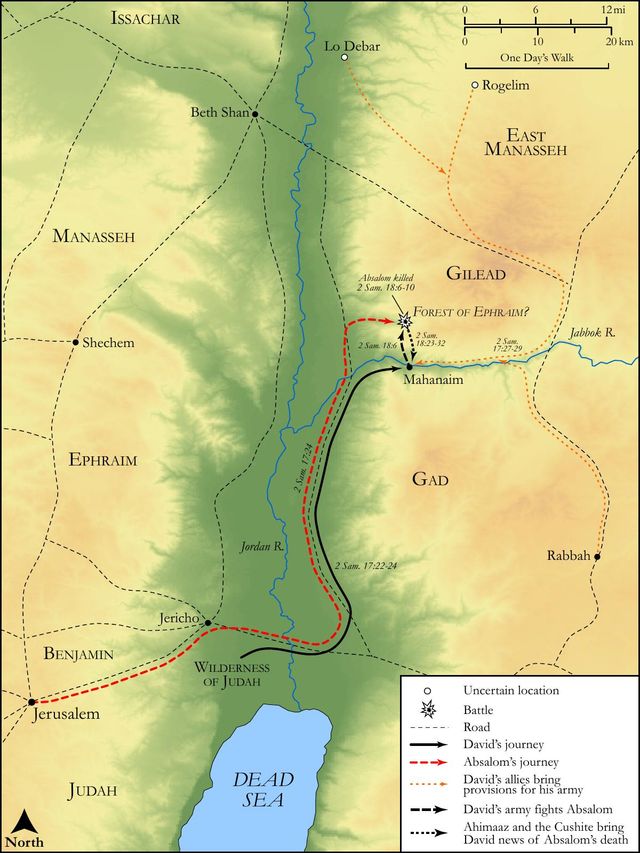
Here is, I. The transporting of David and his forces over Jordan, pursuant to the advice he had received from his friends at Jerusalem, Sa2 17:22. He, and all that were with him, went over in the night, whether in ferryboats, which probably always plied there, or through the fords, does not appear. But special notice is taken of this, that there lacked not one of them: none deserted him, though his distress was great, none staid behind sick or weary, nor were any lost or cast away in passing the river. Herein some make him a type of the Messiah, who said, in a difficult day, Of all that thou hast given me have I lost none. Having got over Jordan, he marched many miles forward to Mahanaim, a Levites' city in the tribe of Gad, in the utmost border of that tribe, and not far from Rabbah, the chief city of the Ammonites. This city, which Ishbosheth had made his royal city (Sa2 2:8), David now made his head-quarters, Sa2 17:24. And now he had time to raise an army wherewith to oppose the rebels and give them a warm reception.
II.The death of Ahithophel, Sa2 17:23.
He died by his own hands, felo de se - a suicide. He hanged himself for vexation that his counsel was not followed; for thereby,
1.He thought himself slighted, and an intolerable slur cast upon his reputation for wisdom. His judgment always used to sway at the counsel-board, but now another's opinion is thought wiser and better than his. His proud heart cannot bear the affront; it rises and swells, and the more he thinks of it the more violent his resentments grow, till they bring him at last to this desperate resolve not to live to see another preferred before him. All men think him a wise man, but he thinks himself the only wise man; and therefore to be avenged upon mankind for not thinking so too, he will die, that wisdom may die with him. The world is not worthy of such an oracle as he is, and therefore he will make them know the want of him. See what real enemies those are to themselves that think too well of themselves, and what mischiefs those run upon that are impatient of contempt. That will break a proud man's heart that will not break a humble man's sleep.
2.He thought himself endangered and his life exposed. He concluded that, because his counsel was not followed, Absalom's cause would certainly miscarry, and then, whoever would find David's mercy, he concluded that he, who was the greatest criminal, and had particularly advised him to lie with his father's concubines, must be sacrificed to justice. To prevent therefore the shame and terror of a public and solemn execution, he does justice upon himself, and, after his reputation for wisdom, by this last act puts a far greater disgrace upon himself than Absalom's privy-council had put upon him, and answers his name Ahithophel, which signifies, the brother of a fool. Nothing indicates so much folly as self-murder. Observe, How deliberately he did it, and of malice prepense against himself; not in a heat, but he went home to his city, to his house, to do it; and, which is strange, took time to consider of it, and yet did it. And, to prove himself compos mentis - in his senses, when he did it, he first put his household in order, made his will as a man of sane memory and understanding, settled his estate, balanced his accounts; yet he that had sense and prudence enough to do this had not consideration enough to revoke the sentence his pride and passion had passed upon his own neck, nor so much as to suspend the execution of it till he saw the event of Absalom's rebellion. Now herein we may see,
(1.)Contempt poured upon the wisdom of man. He that was more renowned for policy than any man played the fool with himself more abundantly. Let not the wise man glory in his wisdom, when he sees him that was so great an oracle dying as a fool dies.
(2.)Honour done to the justice of God. When the wicked are thus snared in the work of their own hands, and sunk in a pit of their own digging, the Lord is known by the judgment which he executeth, and we must say, Higgaion, Selah; it is a thing to be marked and meditated upon, Psa 7:15, Psa 7:16.
(3.)Prayer answered, and an honest cause served even by its enemies. Now, as David had prayed, Ahithophel's counsel was turned into foolishness to himself. Dr. Lightfoot supposes that David penned the 55th Psalm upon occasion of Ahithophel's being in the plot against him, and that he is the man complained of (Sa2 17:13) that had been his equal, his guide, and his acquaintance; and, if so, this was an immediate answer to his prayer there (Sa2 17:15): Let death seize upon them, and let them go down quickly into hell. Ahithophel's death was an advantage to David's interest; for had he digested that affront (as those must resolve often to do that will live in this world), and continued his post at Absalom's elbow, he might have given him counsel afterwards that might have been of pernicious consequence to David. It is well that that breath is stopped and that head laid from which nothing could be expected but mischief. It seems, it was not then usual to disgrace the dead bodies of self-murderers, for Ahithophel was buried, we may suppose honourably buried, in the sepulchre of his father, though he deserved no better than the burial of an ass. See Ecc 8:10.
III.Absalom's pursuit of his father.
He had now got all the men of Israel with him, as Hushai advised, and he himself, at the head of them, passed over Jordan, Sa2 17:24. Not content that he had driven his good father to the utmost corner of his kingdom, he resolved to chase him out of the world. He pitched in the land of Gilead with all his forces, ready to give David battle, Sa2 17:26. Absalom made one Amasa his general (Sa2 17:25), whose father was by birth Jether, an Ishmaelite (Ch1 2:17), but by religion Ithra (as he is here called), an Israelite; probably he was not only proselyted, but, having married a near relation of David's, was, by some act of the state, naturalized, and is therefore called an Israelite. His wife, Amasa's mother, was Abigail, David's sister, whose other sister, Zeruiah, was Joab's mother (Ch1 2:16), so that Amasa was in the same relation to David that Joab was. In honour to his family, even while he was in arms against his father, Absalom made him commander-in-chief of all his forces. Jesse is here called Nahash, for many had two names; or perhaps this was his wife's name.
IV.The friends David met with in this distant country.
Even Shobi, a younger brother of the royal family of the Ammonites, was kind to him, Sa2 17:27. It is probable that he had detested the indignity which his brother Hanun had done to David's ambassadors, and for that had received favours from David, which he now returned. Those that think their prosperity most confirmed know not but, some time or other, they may stand in need of the kindness of those that now lie at their mercy, and may be glad to be beholden to them, which is a reason why we should, as we have opportunity, do good to all men, for he that watereth shall be watered also himself, when there is occasion. Machir, the son of Ammiel, was he that maintained Mephibosheth (Sa2 9:4), till David eased him of that charge, and is now repaid for it by that generous man, who, it seems, was the common patron of distressed princes. Barzillai we shall hear of again. These, compassionating David and his men, now that they were weary with a long march, brought him furniture for his house, beds and basins, and provision for his table, wheat and barley, etc., Sa2 17:28, Sa2 17:29. He did not put them under contribution, did not compel them to supply him, much less plunder them; but in token of their dutiful affection to him, and their sincere concern for him in his present straits, of their own good will they brought in plenty of all that which he had occasion for. Let us learn hence to be generous and open-handed, according as our ability is, to all in distress, especially great men, to whom it is most grievous, and good men, who deserve better treatment; and see how God sometimes makes up to his people that comfort from strangers which they are disappointed of in their own families.
Continue studying 2 Samuel 17:25 across the web’s major study libraries — every link below opens this exact verse, chapter, or book on the destination site.
Read & Compare
 BibleGatewayThis verse in more than 200 translations and 70 languages.
 Bible.comThe YouVersion reader — hundreds of translations, reading plans, and highlights.
 ESV.orgCrossway's official English Standard Version reader.
 NET BibleThe NET translation with 60,000+ translators' notes on every rendering decision.
 STEP BibleTyndale House's free study tool — original text, vocabulary, and scholarly resources.
 BibliaLogos Bible Software's free web reader.
 USCCBThe New American Bible (Revised Edition) with the U.S. bishops' study notes.
Commentaries
 BibleHub CommentariesDozens of classic commentaries on this verse, gathered on one page.
 StudyLightMore than 100 commentary sets — the largest collection on the web.
 BibleRefPlain-English commentary on what this verse means, verse by verse.
 Enduring WordDavid Guzik's free commentary on this chapter, widely used by Bible teachers.
 Bible Study ToolsVerse commentary alongside Greek and Hebrew study aids.
Original Language & Research
- BibleHub InterlinearThe verse word by word — original language, transliteration, and English.
- BibleHub LexiconEvery word's original-language definition and Strong's entry.
 Blue Letter BibleDeep-study tools — Strong's numbers, concordance, and word studies.
 SefariaThe Hebrew text with Rashi and centuries of Jewish commentary.
Sermons, Hymns & Audio


TrulyRandomVerse is not affiliated with these sites and doesn’t control their content. They’re linked because they’re genuinely useful.
Summary
Absalom's rebellion against King David reaches a critical juncture in 2 Samuel 17:25, as the usurper solidifies his control by replacing David's loyal and formidable commander, Joab, with Amasa. This strategic appointment is not merely a military change but a deeply personal and politically charged maneuver, highlighting the intricate web of family relationships—Amasa being David's nephew and Joab's cousin—caught in the devastating conflict, underscoring the profound betrayal and the ruthless consolidation of power by Absalom.
Context
ShowHideLiterary Context
This verse is situated at a pivotal moment following Absalom's successful coup and David's hasty flight from Jerusalem. The preceding chapters detail Absalom's growing popularity and his cunning manipulation of the people's loyalty, culminating in his open rebellion in 2 Samuel 15. Immediately prior to this verse, Absalom has just received counsel from Ahithophel and Hushai regarding the pursuit of David. Ahithophel's shrewd advice to attack David immediately was thwarted by Hushai's divinely orchestrated counter-counsel, which bought David crucial time to escape across the Jordan. Absalom's decision to appoint Amasa as commander of his forces, replacing Joab, is a direct consequence of his perceived victory and his need to establish his own military hierarchy for the impending confrontation with David's loyalists. It sets the stage for the climactic battle described in 2 Samuel 18.
Historical & Cultural Context
The setting is ancient Israel during the united monarchy under King David, a period marked by both internal consolidation and external conflicts. Succession was often contested, and rebellions, especially by disgruntled sons, were not uncommon. Military leadership was paramount, and the commander of the army held immense power and influence, second only to the king. Joab, David's nephew, had been David's long-standing and indispensable general, known for his ferocity, loyalty (though at times controversial), and strategic brilliance. Absalom's replacement of Joab with Amasa would have been a profoundly significant act, signaling a complete break from David's established order and an attempt to build a new regime from the ground up. The detailed genealogical information provided in the verse underscores the importance of family ties, lineage, and kinship networks in Israel, where such relationships often determined loyalty, status, and political alliances.
Key Themes
ShowHideThe overarching themes in this section of 2 Samuel include the destructive nature of ambition and rebellion, particularly within the context of a royal family. Absalom's insatiable desire for power leads him to betray his own father, a theme deeply explored from 2 Samuel 15 onwards. This verse specifically highlights usurpation of authority and the attempt to consolidate power through strategic appointments, even at the cost of fracturing familial bonds. The intricate family tree presented—Amasa being David's nephew and Joab's cousin—emphasizes the tragic theme of familial conflict and betrayal, where blood relations are pitted against each other in a struggle for the throne. It also subtly introduces the theme of divine sovereignty at work, as Absalom's choices, though seemingly powerful, are ultimately part of God's larger plan to bring about consequences for David's earlier sins, as prophesied in 2 Samuel 12:11.
Exposition and Analysis
ShowHideKey Word Analysis
ShowHideMeaning "burden" or "burden-bearer." While not directly symbolic of his character, Amasa's appointment as commander of Absalom's army signifies the heavy burden of leadership he assumes in a rebellion destined for failure. His position is a precarious one, as he is thrust into a role of immense responsibility and danger, ultimately leading to his demise at the hands of Joab in 2 Samuel 20:10.
Meaning "Jehovah-fathered." Joab was David's long-standing, fiercely loyal, albeit often ruthless, commander. His replacement by Amasa is a profound political statement by Absalom. Joab represents the established order and David's enduring power, making his removal a symbolic act of Absalom's complete break from his father's reign. Joab's deep loyalty to David, despite his own problematic actions, stands in stark contrast to Amasa's new allegiance.
Meaning "a mass of persons... organized for war (an army)." This term emphasizes the military nature of the appointment. Absalom is not merely giving Amasa a title but entrusting him with the command of his entire fighting force, the very instrument of his rebellion. The "host" represents the tangible power Absalom now wields against his father, underscoring the gravity of his usurpation and the impending civil war.
Verse Breakdown
ShowHide"And Absalom made Amasa captain of the host instead of Joab:"
This clause details Absalom's decisive and politically charged action. By replacing Joab, David's seasoned and fiercely loyal general, with Amasa, Absalom asserts his authority, dismantles David's military structure, and attempts to consolidate his own power. This move is a clear declaration of his intent to fully usurp the throne and establish a new regime, demonstrating his ambition and ruthlessness.
"which Amasa [was] a man's son, whose name [was] Ithra an Israelite, that went in to Abigail the daughter of Nahash, sister to Zeruiah Joab's mother."
This lengthy descriptive clause provides the crucial genealogical information that explains Amasa's identity and his complex relationship to the key figures in the narrative. Amasa's father is identified as Ithra (or Jether in 1 Chronicles 2:17, possibly an Ishmaelite), and his mother is Abigail. The verse then clarifies Abigail's lineage: she is "the daughter of Nahash" and "sister to Zeruiah Joab's mother." This establishes that Abigail is David's sister (as Zeruiah is also David's sister, per 1 Chronicles 2:16), making Amasa David's nephew. Furthermore, since Zeruiah is Joab's mother, Amasa is Joab's cousin. This intricate web of family connections underscores the tragic nature of the rebellion, pitting close relatives against each other.
Literary Devices
ShowHideThe verse primarily employs Genealogy and Irony. The detailed genealogical information provided for Amasa serves to underscore the deep familial connections embroiled in Absalom's rebellion. By explicitly stating that Amasa is David's nephew (through his mother Abigail, David's sister) and Joab's cousin, the narrative heightens the personal stakes and tragic dimensions of the conflict. This precise familial mapping emphasizes that the rebellion is not merely a political struggle but a devastating internal family war. The irony is palpable: Absalom, David's son, appoints David's nephew to lead an army against David, replacing David's loyal nephew (Joab). This intricate betrayal within the family highlights the destructive power of ambition and the profound breakdown of loyalty, transforming what should be a source of strength into a source of bitter conflict. The very ties that should bind are now being weaponized.
Theological and Thematic Connections
ShowHideThis verse, with its intricate familial details and political maneuvering, serves as a powerful illustration of the consequences of sin, particularly the devastating ripple effects of rebellion and betrayal within a family and a nation. Absalom's usurpation of authority, driven by pride and ambition, directly contradicts God's established order and the covenant promises made to David. The tragic pitting of family members against each other—David's son against David, David's nephew against David, and cousin against cousin—reflects the brokenness of human relationships when self-interest overrides loyalty and divine principles. It reminds us that even divinely appointed leaders face human challenges and the painful consequences of sin, both their own and others'. Ultimately, this episode foreshadows the need for a perfect King whose reign would not be marred by such internal strife and betrayal.
Reflection and Application
ShowHideThe narrative of Absalom's rebellion, culminating in this strategic but ultimately futile appointment, offers profound insights into the human condition and the nature of leadership. It starkly reminds us that ambition, left unchecked, can lead to devastating betrayal, tearing apart not only political structures but also the most sacred bonds of family. We are called to examine our own hearts for any seeds of pride or self-interest that might lead us to undermine legitimate authority, whether in our homes, workplaces, or spiritual communities. The story challenges us to consider the true cost of seeking power for its own sake, often at the expense of integrity and relationship. It also invites us to reflect on the complexities of loyalty and forgiveness, recognizing that even in the face of profound betrayal, God's sovereign hand is at work, guiding events towards His ultimate purposes. This tragic account serves as a cautionary tale, urging us to pursue humility, reconciliation, and submission to righteous authority, rather than succumbing to the destructive allure of personal gain.
Questions for Reflection
ShowHideFAQ
ShowHideWhy was it so significant for Absalom to replace Joab with Amasa?
ShowHideAbsalom's decision to replace Joab with Amasa was profoundly significant for several reasons. First, it was a clear act of political consolidation and a symbolic rejection of David's authority. Joab was David's long-standing, fiercely loyal, and highly effective commander, a symbol of David's enduring power. By removing him, Absalom aimed to dismantle David's established infrastructure and assert his own legitimacy as the new king. Second, it was a strategic military move. Absalom needed a commander loyal to him to lead his forces against David. Third, the choice of Amasa, David's nephew and Joab's cousin, highlights the tragic familial betrayal at the heart of the rebellion. This appointment was a calculated attempt to draw David's own kin into the conflict against him, further deepening the personal and devastating nature of the civil war. It demonstrated Absalom's ruthless determination to secure his usurped throne.
Christ-Centered Fulfillment
ShowHideThe tragic narrative of Absalom's rebellion, culminating in the appointment of Amasa, underscores the brokenness of human kingship and the devastating consequences of sin, ambition, and betrayal—even within God's chosen lineage. David, though a man after God's own heart, experienced the bitter fruit of his own past transgressions (as prophesied in 2 Samuel 12:11) through the rebellion of his own son. This chaotic and bloody struggle for power, where family members are pitted against each other, stands in stark contrast to the perfect and eternal reign of Jesus Christ. Unlike Absalom, who sought to usurp a throne through treachery and violence, Christ, though truly King, "did not consider equality with God something to be used to his own advantage; rather, he emptied himself" (Philippians 2:6-7). He did not gather an army to fight against earthly powers but came to offer himself as the ultimate sacrifice for sin, establishing a spiritual kingdom built on love, righteousness, and peace, not ambition and betrayal (John 18:36). While Absalom's reign ended in ignominious death (2 Samuel 18:14), Jesus' resurrection secured His eternal reign, promising true justice and reconciliation, a kingdom where there is no rebellion or betrayal, but perfect submission to the Father's will (Revelation 11:15). He is the true King who unites, rather than divides, and whose authority is founded on perfect love and self-sacrifice, not on human ambition or familial strife.