


2 Samuel 20:12
Bible text: King James Version (1769 Blayney text) · Public domain
Bible text: King James Version with Strong's numbers · Public domain
Bible text: Berean Standard Bible · Public domain
Bible text: American Standard Version (1901) · Public domain
Bible text: World English Bible, Messianic edition · Public domain
Bible text: Geneva Bible (1599) · Public domain
Bible text: Young's Literal Translation · Public domain
- וַעֲמָשָׂאva·'a·ma·Sa'and AmasaH6021Conj-w ¦ N-proper-mNoun Proper MasculineוַandעֲמָשָׂאAmasa
- מִתְגֹּלֵלmit·go·Lel[was] wallowingH1556V-Hithpael-Prtcpl-msVerb Hithpael Participle Singular Masculine Absolute
- בַּדָּםba·Damin <the> bloodH1818Prep-b ¦ N-msNoun Singular Masculine Absoluteבַּin <the>דָּםblood
- בְּתוֹךְbe·Tokhin [the] middle ofH8432Prep-b ¦ N-mscNoun Singular Masculine Constructבְּinתוֹךְ[the] middle of
- הַמְסִלָּהha·me·si·Lahthe highwayH4546Art ¦ N-fsNoun Singular Feminine Absoluteהַtheמְסִלָּהhighway
- וַיַּרְאvai·Yar'and he sawH7200Conj-w ¦ V-Qal-ConsecImperf-3msVerb Qal Consecutive Imperfect 3rd Singular Masculineוַandיַּרְאhe saw
- הָאִישׁha·'Ishthe manH376Art ¦ N-msNoun Singular Masculine Absoluteהָtheאִישׁman
- כִּיkithatH3588PrtParticle Conditional
- עָמַד'a·Madit stoppedH5975V-Qal-Perf-3msVerb Qal Perfect 3rd Singular Masculine
- כָּלkolallH3605N-mscNoun Singular Masculine Construct
- הָעָםha·'Amthe peopleH5971Art ¦ N-msNoun Singular Masculine Absoluteהָtheעָםpeople
- וַיַּסֵּבvai·ya·Sevand he brought roundH5437Conj-w ¦ V-Hiphil-ConsecImperf-3msVerb Hiphil Consecutive Imperfect 3rd Singular Masculineוַandיַּסֵּבhe brought round
- אֶת'et<obj.>H853DirObjMParticle Object Indicator
- עֲמָשָׂא'a·ma·Sa'AmasaH6021N-proper-mNoun Proper Masculine
- מִןminfromH4480PrepPreposition
- הַמְסִלָּהham·si·Lahthe highwayH4546Art ¦ N-fsNoun Singular Feminine Absoluteהַtheמְסִלָּהhighway
- הַשָּׂדֶהha·sa·Dehthe fieldH7704Art ¦ N-msNoun Singular Masculine Absoluteהַtheשָּׂדֶהfield
- וַיַּשְׁלֵךְvai·yash·Lekhand he threwH7993Conj-w ¦ V-Hiphil-ConsecImperf-3msVerb Hiphil Consecutive Imperfect 3rd Singular Masculineוַandיַּשְׁלֵךְhe threw
- עָלָיו'a·Lavover himH5921Prep ¦ 3msPreposition Definiteעָלָיoverוhim
- בֶּגֶדBe·geda garmentH899N-msNoun Singular Masculine Absolute
- כַּאֲשֶׁרka·'a·Sher<just> whenH834Prep-k ¦ RelParticle Relativeכַּ<just>אֲשֶׁרwhen
- רָאָהra·'Ahhe sawH7200V-Qal-Perf-3msVerb Qal Perfect 3rd Singular Masculine
- כָּלkolallH3605N-msNoun Singular Masculine Absolute
- הַבָּאha·Ba'who cameH935Art ¦ V-Qal-Prtcpl-msVerb Qal Participle Singular Masculine Absoluteהַwhoבָּאcame
- עָלָיו'a·Lavon himH5921Prep ¦ 3msPreposition Definiteעָלָיonוhim
- וְעָמָדve·'a·Madand he stoppedH5975Conj-w ¦ V-Qal-ConsecPerf-3msVerb Qal Consecutive Perfect 3rd Singular Masculineוְandעָמָדhe stopped
English is a literal word-by-word gloss of the Hebrew, not the KJV's wording. Why?
This is the original text the KJV's translators worked from — each Hebrew word with its own literal English meaning in this verse, prepared by scholars at Tyndale House, Cambridge. The KJV translates whole sentences, not word by word, so its wording differs: one Hebrew word can become several English words, and the KJV may choose “the LORD” where the gloss reads “Yahweh”. Both are faithful — they answer different questions. For the KJV's own rendering, switch to the KJV text.
Details
See on the biblical-era maps
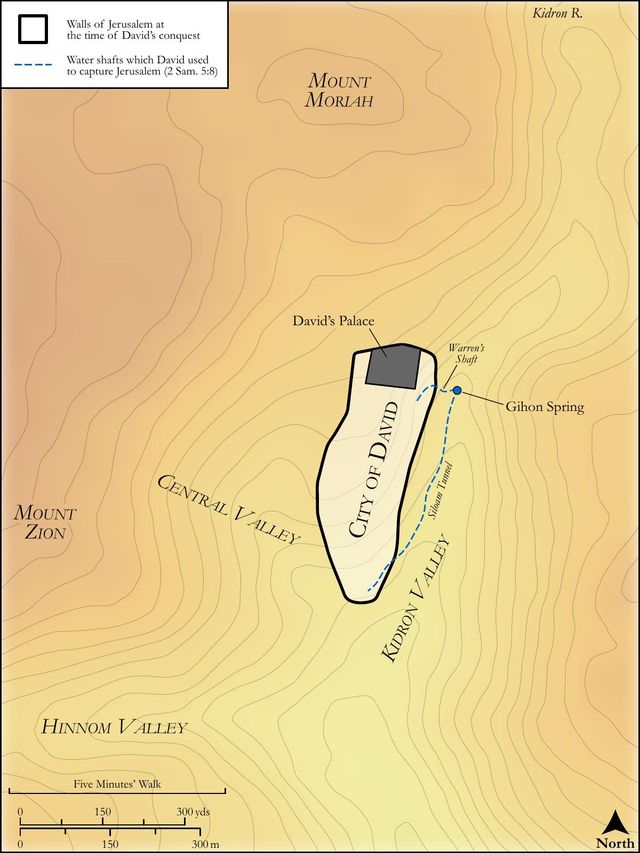
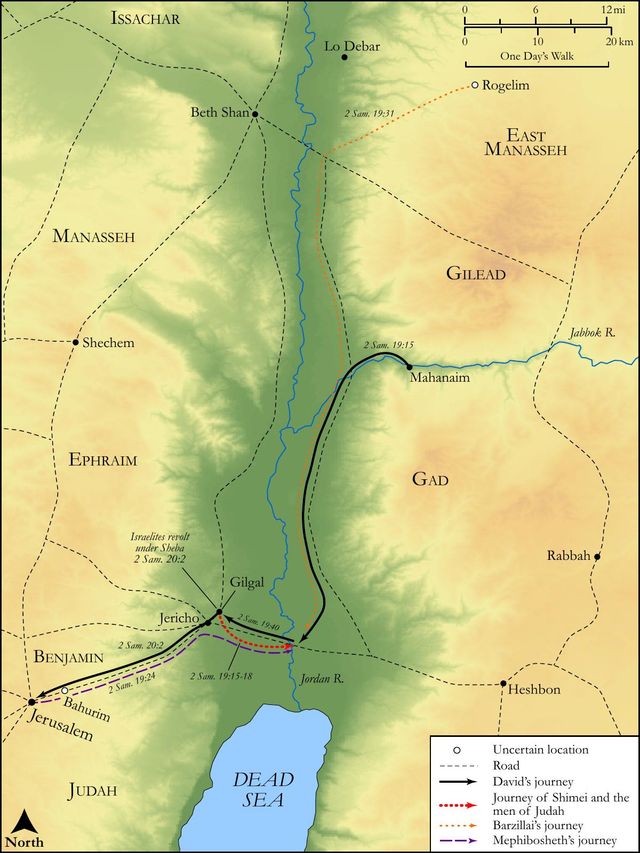
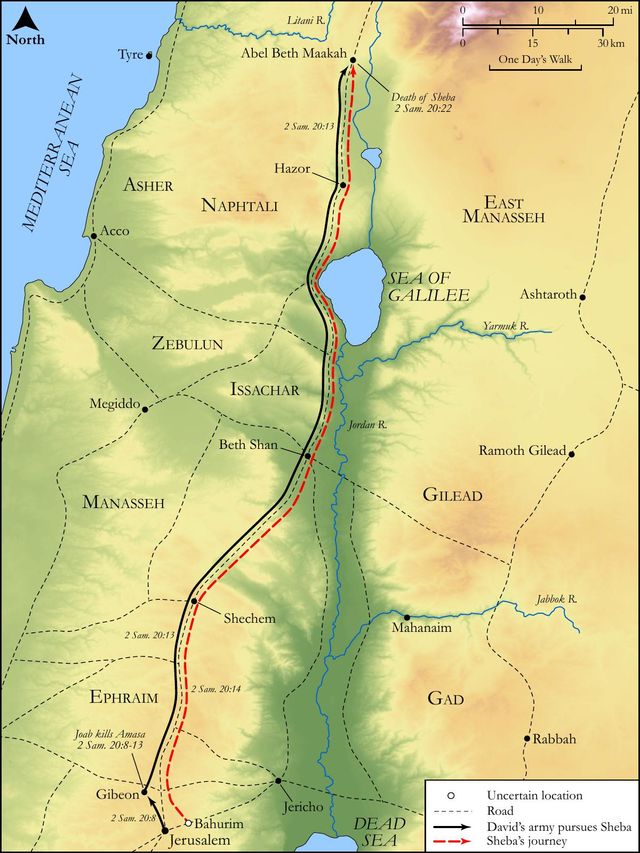
Study this verse
Public-domain commentary
Matthew Henry
From his Commentary on the Whole Bible. Henry comments on passages, not single verses — this entry covers 2 Samuel 20:4–13. His two-level outline is real structure in the source text, so it is rendered as structure.
We have here Amasa's fall just as he began to rise. He was nephew to David (Sa2 17:25), had been Absalom's general and commander-in-chief of his rebellious army, but, that being routed, he came over into David's interest, upon a promise that he should be general of his forces instead of Joab. Sheba's rebellion gives David an occasion to fulfil his promise sooner than he could wish, but Joab's envy and emulation rendered its fulfillment of ill consequence both to him and David.
I.Amasa has a commission to raise forces for the suppressing of Sheba's rebellion, and is ordered to raise them with all possible expedition, Sa2 20:4. It seems, the men of Judah, though forward to attend the king's triumphs, were backward enough to fight his battles; else, when they were all in a body attending him to Jerusalem, they might immediately have pursued Sheba, and have crushed that cockatrice in the egg. But most love a loyalty, as well as a religion, that is cheap and easy. Many boast of their being akin to Christ that yet are very loth to venture for him. Amasa is sent to assemble the men of Judah within three days; but he finds them so backward and unready that he cannot do it within the time appointed (Sa2 20:5), though the promotion of Amasa, who had been their general under Absalom, was very obliging to them, and a proof of the clemency of David's government.
II.Upon Amasa's delay, Abishai, the brother of Joab, is ordered to take the guards and standing forces, and with them to pursue Sheba (Sa2 20:6, Sa2 20:7), for nothing could be of more dangerous consequence than to give him time. David gives these orders to Abishai, because he resolves to mortify Joab, and degrade him, not so much, I doubt, for the blood of Abner, which he had shed basely, as for the blood of Absalom, which he had shed justly and honourably. "Now (says bishop Hall) Joab smarteth for a loyal disobedience. How slippery are the stations of earthly honours and subject to continual mutability! Happy are those who are in favour with him in whom there is no shadow of change." Joab, without orders, though in disgrace, goes along with his brother, knowing he might be serviceable to the public, or perhaps now meditating the removal of his rival.
III.Joab, near Gibeon, meets with Amasa, and barbarously murders him, Sa2 20:8-10.
It should seem, the great stone in Gibeon was the place appointed for the general rendezvous. There the rivals met; and Amasa, relying upon his commission, went before, as general both of the new-raised forces which he had got together, and of the veteran troops which Abishai had brought in; but Joab there took an opportunity to kill him with his own hand; and,
1.He did it subtilely, and with contrivance, and not upon a sudden provocation. He girded his coat about him, that it might not hang in his way, and girded his belt upon his coat, that his sword might be the readier to his hand; he also put his sword in a sheath too big for it, that, whenever he pleased, it might, upon a little shake, fall out, as if it fell by accident, and so he might take it into his hand, unsuspected, as if he were going to return it into the scabbard, when he designed to sheath it in the bowels of Amasa. The more there is of plot in a sin the worse it is.
2.He did it treacherously, and under pretence of friendship, that Amasa might not be upon his guard. He called him brother, for they were own cousins, enquired of his welfare (Art thou in health?) and took him by the beard, as one he was free with, to kiss him, while with the drawn sword in his other hand he was aiming at his heart. Was this done like a gentleman, like a soldier, like a general? No, but like a villain, like a base coward. Just thus he slew Abner, and went unpunished for it, which encouraged him to do the like again.
3.He did it impudently, not in a corner, but at the head of his troops, and in their sight, as one that was neither ashamed nor afraid to do it, that was so hardened in blood and murders that he could neither blush nor tremble.
4.He did it at one blow, gave the fatal push with a good-will, as we say, so that he needed not strike him again; with such a strong and steady hand he gave this one stroke that it was fatal.
5.He did it in contempt and defiance of David and the commission he had given to Amasa; for that commission was the only ground of his quarrel with him, so that David was struck at through the side of Amasa, and was, in effect, told to his face that Joab would be general, in spite of him.
6.He did it very unseasonably, when they were going against a common enemy and were concerned to be unanimous. This ill-timed quarrel might have scattered their forces, or engaged them one against another, and so have made them all an easy prey to Sheba. So contentedly could Joab sacrifice the interest both of king and kingdom to his personal revenge.
IV.Joab immediately resumes his general's place, and takes care to lead the army on in pursuit of Sheba, that, if possible, he might prevent any prejudice to the common cause by what he had done. 1. He leaves one of his men to make proclamation to the forces that were coming up that they were still engaged in David's cause, but under Joab's command, Sa2 20:11. He knew what an interest he had in the soldiery, and how many favoured him rather than Amasa, who had been a traitor, was now a turn-coat, and had never been successful; on this he boldly relied, and called them all to follow him. What man of Judah would not be for his old king and his old general? But one would wonder with what face a murderer could pursue a traitor; and how, under such a heavy load of guilt, he had courage to enter upon danger. Surely his conscience was seared with a hot iron. 2. care is taken to remove the dead body out of the way, because at that they made a stand (as Sa2 2:23), and to cover it with a cloth, Sa2 20:12, Sa2 20:13. Wicked men think themselves safe in their wickedness if they can but conceal it from the eye of the world: if it be hidden, it is with them as if it were never done. But the covering of blood with a cloth cannot stop its cry in God's ear for vengeance, or make it the less loud. However, since this was no time to arraign Joab for what he had done, and the common safety called for expedition, it was prudent to remove that which retarded the march of the army; and then they all went on after Joab, while David, who no doubt had notice soon brought him of this tragedy, could not but reflect upon it with regret that he had not formerly done justice upon Joab for the death of Abner, and that he now had exposed Amasa by preferring him. And perhaps his conscience reminded him of his employing Joab in the murder of Uriah, which had helped to harden him in cruelty.
Continue studying 2 Samuel 20:12 across the web’s major study libraries — every link below opens this exact verse, chapter, or book on the destination site.
Read & Compare
 BibleGatewayThis verse in more than 200 translations and 70 languages.
 Bible.comThe YouVersion reader — hundreds of translations, reading plans, and highlights.
 ESV.orgCrossway's official English Standard Version reader.
 NET BibleThe NET translation with 60,000+ translators' notes on every rendering decision.
 STEP BibleTyndale House's free study tool — original text, vocabulary, and scholarly resources.
 BibliaLogos Bible Software's free web reader.
 USCCBThe New American Bible (Revised Edition) with the U.S. bishops' study notes.
Commentaries
 BibleHub CommentariesDozens of classic commentaries on this verse, gathered on one page.
 StudyLightMore than 100 commentary sets — the largest collection on the web.
 BibleRefPlain-English commentary on what this verse means, verse by verse.
 Enduring WordDavid Guzik's free commentary on this chapter, widely used by Bible teachers.
 Bible Study ToolsVerse commentary alongside Greek and Hebrew study aids.
Original Language & Research
- BibleHub InterlinearThe verse word by word — original language, transliteration, and English.
- BibleHub LexiconEvery word's original-language definition and Strong's entry.
 Blue Letter BibleDeep-study tools — Strong's numbers, concordance, and word studies.
 SefariaThe Hebrew text with Rashi and centuries of Jewish commentary.
Sermons, Hymns & Audio


TrulyRandomVerse is not affiliated with these sites and doesn’t control their content. They’re linked because they’re genuinely useful.
Summary
Second Samuel 20:12 provides a graphic and pivotal depiction of the immediate aftermath of Joab's treacherous assassination of Amasa, King David's newly appointed army commander, amidst Sheba ben Bichri's rebellion. The verse vividly portrays Amasa's body "wallowed in blood" in the public highway, a horrific sight that brought the pursuing Israelite army to a complete standstill. It then details the swift, pragmatic action of an unnamed individual, likely one of Joab's attendants, who recognized the profound disruption caused by the gruesome spectacle and moved the body into a field, covering it with a cloth, thereby enabling the crucial military advance to resume.
Context
ShowHideLiterary Context
This verse is strategically placed within a narrative arc detailing the turbulent period following Absalom's rebellion and King David's precarious return to power. David, in an effort to heal national divisions and perhaps to sideline Joab, had controversially appointed Amasa, Absalom's former commander, as his new army chief (2 Samuel 19:13). When Sheba ben Bichri ignited a new rebellion, David commanded Amasa to gather Judah's forces. Amasa's delay, however, prompted David to dispatch Joab and Abishai in pursuit (2 Samuel 20:4-6). The preceding verses (2 Samuel 20:9-10) describe Joab's calculated and brutal murder of Amasa under the guise of a fraternal greeting. Verse 12 immediately follows this act, serving as a powerful illustration of the public, shocking, and disruptive consequences of Joab's ruthless ambition, directly impacting the momentum of the military campaign against Sheba.
Historical & Cultural Context
The era of David's reign, particularly its latter half, was characterized by profound political instability, internal power struggles, and frequent recourse to violence as a means of control or elimination of rivals. Loyalty within military and political circles was often tenuous, making assassinations a grim reality. The "highway" (מְסִלָּה, mesillah) mentioned here was not merely a dirt path but a significant, often elevated or well-constructed public thoroughfare, akin to a main road. For a body to be left "wallowed in blood" in such a prominent location was not only a gruesome sight but also a deep defilement, a public spectacle designed to shock, intimidate, and perhaps even demoralize. The swift action of "the man" to remove and cover the body highlights the practical necessity of maintaining military discipline and momentum, preventing the troops from being paralyzed by superstition, horror, or the implications of such a public act of violence. This pragmatic response underscores the urgent need to prioritize the mission over the immediate processing of such a traumatic event.
Key Themes
ShowHideThe events of 2 Samuel 20 powerfully underscore several enduring themes found throughout the Deuteronomistic History. Firstly, the destructive nature of unchecked ambition and ruthless violence is starkly evident in Joab's character. His repeated willingness to commit cold-blooded murder to secure or maintain his preeminent position (as previously demonstrated with Abner in 2 Samuel 3:27) reveals the corrupting influence of power and jealousy. Secondly, the verse vividly illustrates the disruption and stagnation caused by sin and treachery. Amasa's body literally halts the army's advance, symbolizing how unaddressed sin, internal conflict, and betrayal can impede progress, unity, and the successful execution of a divine or national mission. Finally, this passage speaks to the pervasiveness of human depravity and the persistent need for justice. Even in the midst of a national crisis requiring unified action against a common enemy, personal vendettas and betrayals continued to plague Israel's leadership, revealing the deep-seated brokenness and violence prevalent in the kingdom.
Exposition and Analysis
ShowHideKey Word Analysis
ShowHideThis primitive root, meaning "to roll," here conveys a profoundly disturbing and visceral image. It suggests that Amasa's body was not merely lying in blood but was deeply immersed, perhaps even convulsing or having been moved in it, emphasizing the utter degradation, helplessness, and gruesome nature of his death. The word paints a picture of a body left in a state of undignified horror, fully exposed to the elements and the horrified gaze of onlookers, underscoring the brutality of Joab's act.
Derived from a root meaning "to turnpike," this term refers to a thoroughfare, a main, often elevated or well-prepared public road. Its use here is crucial, highlighting the public and prominent nature of Amasa's assassination. The murder was not hidden but occurred in a place where all passersby, especially the marching army, would inevitably witness the horrific scene. This public display amplified the shock and disruption, making the act a powerful, albeit unintended, statement of Joab's ruthlessness and disregard for public order.
This primitive root, meaning "to stand" in various relations, is repeated twice in the verse, powerfully emphasizing the profound impact of the sight on the advancing army. It signifies a complete halt, a cessation of movement, a state of paralysis or shock. The repetition underscores the collective awe, horror, and perhaps even fear that gripped the soldiers, rendering them unable to proceed until the gruesome obstruction was removed, highlighting the psychological and practical impediment caused by the public display of death.
Verse Breakdown
ShowHide"And Amasa wallowed in blood in the midst of the highway."
This opening clause immediately establishes the horrific and undignified scene. Amasa's body, brutally murdered by Joab, is described not merely as lying but "wallowing" in his own blood, a visceral and graphic image of death, suffering, and utter helplessness. The specific location, "in the midst of the highway," emphasizes the public and unavoidable nature of this assassination, ensuring that all who passed by, particularly the advancing army, would be confronted by the gruesome reality.
"And when the man saw that all the people stood still, he removed Amasa out of the highway into the field, and cast a cloth upon him,"
This section introduces a pragmatic and decisive response to the crisis. "The man" (identified by Strong's H376 as ʼîysh, an individual, likely one of Joab's attendants or a perceptive soldier) observes the profound effect of the body: the entire army, "all the people" (H5971, ʻam), has "stood still" (H5975, ʻâmad), paralyzed by the shocking sight. Recognizing that this public display of death was a significant tactical impediment to the crucial pursuit of Sheba, he takes swift action. He "removed" (H5437, çâbab, meaning to turn or remove) the body from the prominent highway into the less visible "field" (H7704, sâdeh) and "cast" (H7993, shâlak) "a cloth" (H899, beged, a covering or garment) upon him. This act is primarily one of concealment and practical necessity, aimed at eliminating the distracting and morale-sapping spectacle, rather than a gesture of reverence.
"when he saw that every one that came by him stood still."
This final clause reiterates and reinforces the compelling reason for the body's removal. The attendant's action was directly prompted by his repeated observation (H7200, râʼâh, to see) that "every one that came by him" (H935, bôwʼ, to come or go) – every soldier, every passerby – was stopping, fixated on the bloody scene. This repetition of "stood still" (H5975, ʻâmad) powerfully underscores the profound psychological and practical paralysis caused by the raw, unadorned horror of Joab's treachery, highlighting the absolute necessity of its removal for the army to resume its vital mission.
Literary Devices
ShowHideThe verse employs several powerful literary devices to convey its stark message and emotional impact. Graphic Imagery is paramount, particularly in the phrase "wallowed in blood," which creates a visceral, shocking picture of death and degradation. This vivid description forces the reader to confront the brutality and indignity of Amasa's end, eliciting a strong emotional response. The device of Repetition is used effectively with the phrase "stood still," appearing twice. This rhetorical emphasis underscores the profound shock and paralysis that gripped the advancing army, highlighting the immediate and disruptive impact of Amasa's murder on the collective. Furthermore, the scene functions as potent Symbolism: Amasa's body, a physical manifestation of David's fractured authority, Joab's ruthless ambition, and the kingdom's internal strife, literally halts the army's progress. This symbolizes how unaddressed sin, violence, and internal conflict can impede the mission, unity, or spiritual advancement of a community or nation. Finally, there is a subtle Irony in the attendant's pragmatic actions: while Joab's act was one of calculated cruelty and a public display of power, the subsequent attempt to "clean up" the scene by removing and covering the body reveals a practical desire to move past the trauma for the sake of the mission, even if justice for the murder itself remains unaddressed.
Theological and Thematic Connections
ShowHideThis grim account serves as a stark and sobering reminder of the devastating consequences of sin, particularly unchecked ambition, treachery, and violence within a community. It powerfully illustrates how personal vendettas and the ruthless pursuit of power can not only lead to horrific acts but also create profound disruption, hindering collective progress and unity. The public display of Amasa's body, literally bringing an army to a standstill, underscores the theological truth that sin, when unaddressed or unconfessed, creates formidable obstacles that impede spiritual and practical advancement. While the removal of the body was a practical necessity for the army to proceed, it also hints at a human tendency to try and cover up or move past traumatic events without fully confronting the underlying sin or seeking true justice, a pattern that often leads to further brokenness and unresolved issues.
Reflection and Application
ShowHideThe scene of Amasa wallowing in blood, bringing an entire army to a halt, offers a powerful, if disturbing, metaphor for the impact of unaddressed sin and conflict in our own lives and communities. Just as the physical obstruction prevented the army from moving forward, unresolved bitterness, jealousy, unforgiveness, or hidden sin can create spiritual and emotional blockages, preventing personal growth, hindering healthy relationships, and impeding the collective mission of God's people. This passage calls us to consider what "bloody" or disruptive issues might be lying unaddressed in our own "highways"—the prominent areas of our lives or our communal interactions—causing stagnation. It challenges us to confront sin, both individual and corporate, with honesty and courage, rather than merely attempting to "cover it up" or move past it without true repentance, reconciliation, and the pursuit of justice. It also reminds leaders of their solemn responsibility to address dangerous elements and ensure righteousness and justice within their spheres of influence, lest their communities be paralyzed by internal strife and unholy ambition.
Questions for Reflection
ShowHideFAQ
ShowHideWhy did "the man" remove Amasa's body and cover it?
ShowHide"The man," likely one of Joab's attendants or a perceptive soldier, removed Amasa's body and covered it for a purely pragmatic and tactical reason: the gruesome sight was causing the entire army to "stand still." The KJV text explicitly states, "when he saw that every one that came by him stood still." This public display of a brutally murdered commander, left "wallowed in blood" in the midst of a main thoroughfare, was a profound shock and a significant impediment to the army's morale and its urgent pursuit of Sheba ben Bichri. Removing the body from the prominent highway and covering it was a swift, decisive action to eliminate the distraction, allow the troops to regain their composure, and maintain the critical momentum of the military campaign. It was less about reverence for Amasa himself and more about the practical necessity of resuming the mission and preventing further delay or demoralization among the ranks.
Christ-Centered Fulfillment
ShowHideWhile 2 Samuel 20:12 portrays the horrific consequences of human sin and violence, particularly the public display of a body wallowing in blood, it paradoxically points to the ultimate solution found in Christ. Amasa's body, left in the highway, was a public spectacle of death and dishonor, a literal stumbling block to human progress and a symbol of sin's paralyzing effect. In stark contrast, the body of Jesus, the true Lamb of God who takes away the sin of the world, was also a public spectacle, lifted up on a cross. Yet, His blood was not shed in dishonor or as a result of human treachery that leads to stagnation, but as a perfect, atoning sacrifice for the sins of the world (Hebrews 9:22). Unlike the temporary cloth that merely covered Amasa's body, Christ's precious blood truly cleanses and eternally removes the stain of sin, canceling the spiritual debt that stood against us (Colossians 2:14). Where Amasa's death caused paralysis and halted an earthly army, Christ's death on the cross opened up "the way" to eternal life, removing the ultimate spiritual stumbling block of sin and death, allowing humanity to move forward in reconciliation and fellowship with God (John 14:6). The "wallowing in blood" of Amasa underscores the ugliness and destructive power of sin; the shedding of Christ's blood on the cross, though equally gruesome, reveals the profound beauty of divine love and the redemptive power that heals the wounds of a broken world and sets us free from the paralysis of sin's grip (Isaiah 53:5).