


2 Samuel 2:23
Bible text: King James Version (1769 Blayney text) · Public domain
Bible text: King James Version with Strong's numbers · Public domain
Bible text: Berean Standard Bible · Public domain
Bible text: American Standard Version (1901) · Public domain
Bible text: World English Bible, Messianic edition · Public domain
Bible text: Geneva Bible (1599) · Public domain
Bible text: Young's Literal Translation · Public domain
- וַיְמָאֵןvay·ma·'Enand he refusedH3985Conj-w ¦ V-Piel-ConsecImperf-3msVerb Piel Consecutive Imperfect 3rd Singular Masculineוַandיְמָאֵןhe refused
- לָסוּרla·Surto turn asideH5493Prep-l ¦ V-Qal-InfVerb Qal Infinitive Constructלָtoסוּרturn aside
- וַיַּכֵּהוּvai·ya·Ke·huand he struck himH5221Conj-w ¦ V-Hiphil-ConsecImperf-3ms ¦ 3msVerb Hiphil Consecutive Imperfect 3rd Singular Masculineוַandיַּכֵּhe struckהוּhim
- אַבְנֵר'av·NerAbnerH74N-proper-mNoun Proper Masculine
- בְּאַחֲרֵיbe·'a·cha·Reiwith [the] back end<s> ofH310Prep-b ¦ Adj-mpcAdjective Numerical Plural Masculine Constructבְּwithאַחֲרֵי[the] back end<s> of
- הַחֲנִיתha·cha·Nitthe spearH2595Art ¦ N-fsNoun Singular Feminine Absoluteהַtheחֲנִיתspear
- אֶל'elintoH413PrepPreposition
- הַחֹמֶשׁha·Cho·meshthe bellyH2570Art ¦ N-msNoun Singular Masculine Absoluteהַtheחֹמֶשׁbelly
- וַתֵּצֵאva·te·Tze'and it went outH3318Conj-w ¦ V-Qal-ConsecImperf-3fsVerb Qal Consecutive Imperfect 3rd Singular Feminineוַandתֵּצֵאit went out
- הַחֲנִיתha·cha·Nitthe spearH2595Art ¦ N-fsNoun Singular Feminine Absoluteהַtheחֲנִיתspear
- מֵאַחֲרָיוme·'a·cha·Ravfrom behind himH310Prep-m ¦ Adj-mpc ¦ 3msAdjective Numerical Plural Masculine Constructמֵfromאַחֲרָיbehindוhim
- וַיִּפָּלvai·yi·poland he fellH5307Conj-w ¦ V-Qal-ConsecImperf-3msVerb Qal Consecutive Imperfect 3rd Singular Masculineוַandיִּפָּלhe fell
- שָׁםshamthereH8033AdvAdverb
- וַיָּמָתvai·Ya·motand he diedH4191Conj-w ¦ V-Qal-ConsecImperf-3msVerb Qal Consecutive Imperfect 3rd Singular Masculineוַandיָּמָתhe died
- תַּחְתָּיוta·cha·tovhis in placeH8478N-mpc ¦ 3msNoun Plural Masculine Constructתַּחְתָּיin placeוhis
- וַיְהִיvay·Hiand it wasH1961Conj-w ¦ V-Qal-ConsecImperf-3msVerb Qal Consecutive Imperfect 3rd Singular Masculineוַandיְהִיit was
- כָּלkolevery [one]H3605N-msNoun Singular Masculine Absolute
- הַבָּאha·Ba'who cameH935Art ¦ V-Qal-Prtcpl-msVerb Qal Participle Singular Masculine Absoluteהַwhoבָּאcame
- אֶל'eltoH413PrepPreposition
- הַמָּקוֹםha·ma·kOmthe placeH4725Art ¦ N-msNoun Singular Masculine Absoluteהַtheמָּקוֹםplace
- אֲשֶׁר'a·SherwhereH834RelParticle Relative
- נָפַלNa·falhe fellH5307V-Qal-Perf-3msVerb Qal Perfect 3rd Singular Masculine
- שָׁםshamthereH8033AdvAdverb
- עֲשָׂהאֵל'a·sa·h·'ElAsahelH6214N-proper-mNoun Proper Masculine
- וַיָּמֹתvai·ya·Motand he diedH4191Conj-w ¦ V-Qal-ConsecImperf-3msVerb Qal Consecutive Imperfect 3rd Singular Masculineוַandיָּמֹתhe died
- וַיַּעֲמֹדוּVai·ya·'a·Mo·duand they stood stillH5975Conj-w ¦ V-Qal-ConsecImperf-3mpVerb Qal Consecutive Imperfect 3rd Plural Masculineוַandיַּעֲמֹדוּthey stood still
English is a literal word-by-word gloss of the Hebrew, not the KJV's wording. Why?
This is the original text the KJV's translators worked from — each Hebrew word with its own literal English meaning in this verse, prepared by scholars at Tyndale House, Cambridge. The KJV translates whole sentences, not word by word, so its wording differs: one Hebrew word can become several English words, and the KJV may choose “the LORD” where the gloss reads “Yahweh”. Both are faithful — they answer different questions. For the KJV's own rendering, switch to the KJV text.
Details
See on the biblical-era maps

Study this verse
Public-domain commentary
Matthew Henry
From his Commentary on the Whole Bible. Henry comments on passages, not single verses — this entry covers 2 Samuel 2:18–24. His two-level outline is real structure in the source text, so it is rendered as structure.
We have here the contest between Abner and Asahel. Asahel, the brother of Joab and cousin-german to David, was one of the principal commanders of David's forces, and was famous for swiftness in running: he was as light of foot as a wild roe (Sa2 2:18); this he got the name of by swift pursuing, not swift flying. Yet, we may suppose, he was not comparable to Abner as a skilful experienced soldier; we must therefore observe,
I.How rash he was in aiming to make Abner his prisoner.
He pursued after him, and no other, Sa2 2:19. Proud of his relation to David and Joab, his own swiftness, and the success of his party, no less a trophy of victory would now serve the young warrior than Abner himself, either slain or bound, which he thought would put an end to the war and effectually open David's way to the throne. This made him very eager in the pursuit, and careless of the opportunities he had of seizing others in his way, on his right hand and on his left; his eye was on Abner only. The design was brave, had he been par negotio - equal to its accomplishment: but let not the swift man glory in his swiftness, any more than the strong man in his strength; magnis excidit ausis - he perished in an attempt too vast for him.
II.How generous Abner was in giving him notice of the danger he exposed himself to, and advising him not to meddle to his own hurt, Ch2 25:19.
1.He bade him content himself with a less prey (Sa2 2:21): "Lay hold of one of the young men, plunder him and make him thy prisoner, meddle with thy match, but pretend not to one who is so much superior to thee." It is wisdom in all contests to compare our own strength with that of our adversaries, and to take heed of being partial to ourselves in making the comparison, lest we prove in the issue enemies to ourselves, Luk 14:31.
2.He begged of him not to put him upon the necessity of slaying him in his own defence, which he was very loth to do, but must do rather than be slain by him, Sa2 2:22. Abner, it seems, either loved Joab or feared him; for he was very loth to incur his displeasure, which he would certainly do if he slew Asahel. It is commendable for enemies to be thus respectful one to another. Abner's care how he should lift up his face to Joab gives cause to suspect that he really believed David would have the kingdom at last, according to the divine designation, and then, in opposing him, he acted against his conscience.
III.How fatal Asahel's rashness was to him.
He refused to turn aside, thinking that Abner spoke so courteously because he feared him; but what came of it? Abner, as soon as he came up to him, gave him his death's wound with a back stroke (Sa2 2:23): He smote him with the hinder end of his spear, from which he feared no danger. This was a pass which Asahel was not acquainted with, nor had learned to stand upon his guard against; but Abner, perhaps, had formerly used it, and done execution with it; and here it did effectual execution. Asahel died immediately of the wound. See here,
1.How death often comes upon us by ways that we least suspect. Who would fear the hand of a flying enemy or the butt-end of a spear? yet from these Asahel receives his death's wound.
2.How we are often betrayed by the accomplishments we are proud of. Asahel's swiftness, which he presumed so much upon, did him no kindness, but forwarded his fate, and with it he ran upon his death, instead of running from it. Asahel's fall was not only Abner's security from him, but put a full stop to the conqueror's pursuit and gave Abner time to rally again; for all that came to the place stood still, only Joab and Abishai, instead of being disheartened, were exasperated by it, pursued Abner with so much the more fury (Sa2 2:24), and overtook him at last about sunset, when the approaching night would oblige them to retire.
Historical interpretation
Historical reception
1 surviving comment on this verse from the historical church.
But when the easily angered so attack others that it is impossible to shun them, they should not be smitten with open rebuke but sparingly with a certain respectful forbearance. We shall prove this better by citing the example of Abner. Scripture has it that when Asahel attacked him with vehement and inconsiderate haste, Abner said to Asahel, “Go off and do not follow me, lest I be obliged to strike you to the ground.… But he refused to listen to him, and would not turn aside. Therefore, Abner struck him with his spear, with a back stroke in the groin, and thrust him through, and he died.” Of whom, then, did Asahel serve as a type, but of those who are driven headlong in a violent access of frenzy? Such people, when under the impulse of a like frenzy, are the more cautiously to be shunned, the more carried away they are in their madness. Therefore, too, Abner, who in our language is termed “lamp of the father,” fled: that is to say, if the teacher, whose tongue symbolizes the heavenly light of God, perceives the mind of a person to be carried away along the rugged path of frenzy and refrains from bandying words with such an angered one, he is like one unwilling to strike a pursuer. But when easily angered people will not restrain themselves under any consideration, and, as it were, like Asahel, do not refrain from their mad pursuit, then it is necessary for those who try to check them in their frenzy, not on any account to allow their anger to be aroused but to show all possible calmness; and let them suggest discreetly that which will, as it were, by a side stroke pierce their frenzied mind.Thus, when Abner made a stand against his pursuer, he pierced him, not with a direct thrust but with the reverse end of his spear. Of course, to strike with the sharp point is to oppose another with an attack of open rebuke, but to strike a pursuer with the reverse end of the spear is to touch the frenzied quietly and partially, and to overcome him, as it were, by sparing him. But Asahel falls down dead on the spot: that is, turbulent minds, on perceiving that they are shown consideration and, on the other hand, because they are touched in their hearts in consequence of being reasoned with calmly, fall down at once from the lofty place to which they had raised themselves. Those, therefore, who withdraw from their frenzied impulse under the stroke of gentleness, die, as it were, without being struck by the head of a spear.
Continue studying 2 Samuel 2:23 across the web’s major study libraries — every link below opens this exact verse, chapter, or book on the destination site.
Read & Compare
 BibleGatewayThis verse in more than 200 translations and 70 languages.
 Bible.comThe YouVersion reader — hundreds of translations, reading plans, and highlights.
 ESV.orgCrossway's official English Standard Version reader.
 NET BibleThe NET translation with 60,000+ translators' notes on every rendering decision.
 STEP BibleTyndale House's free study tool — original text, vocabulary, and scholarly resources.
 BibliaLogos Bible Software's free web reader.
 USCCBThe New American Bible (Revised Edition) with the U.S. bishops' study notes.
Commentaries
 BibleHub CommentariesDozens of classic commentaries on this verse, gathered on one page.
 StudyLightMore than 100 commentary sets — the largest collection on the web.
 BibleRefPlain-English commentary on what this verse means, verse by verse.
 Enduring WordDavid Guzik's free commentary on this chapter, widely used by Bible teachers.
 Bible Study ToolsVerse commentary alongside Greek and Hebrew study aids.
Original Language & Research
- BibleHub InterlinearThe verse word by word — original language, transliteration, and English.
- BibleHub LexiconEvery word's original-language definition and Strong's entry.
 Blue Letter BibleDeep-study tools — Strong's numbers, concordance, and word studies.
 SefariaThe Hebrew text with Rashi and centuries of Jewish commentary.
Sermons, Hymns & Audio


TrulyRandomVerse is not affiliated with these sites and doesn’t control their content. They’re linked because they’re genuinely useful.
Summary
2 Samuel 2:23 chronicles the tragic and pivotal death of Asahel, the swift-footed brother of Joab, at the hand of Abner, commander of Saul's army. This event, occurring during the early stages of the civil war between the house of Saul and the burgeoning kingdom of David, was a desperate act of self-preservation by Abner after Asahel's relentless pursuit. Asahel's demise would profoundly escalate the personal animosity between the two factions, particularly between Joab and Abner, setting the stage for future acts of vengeance and prolonging the conflict that plagued Israel.
Context
ShowHideLiterary Context
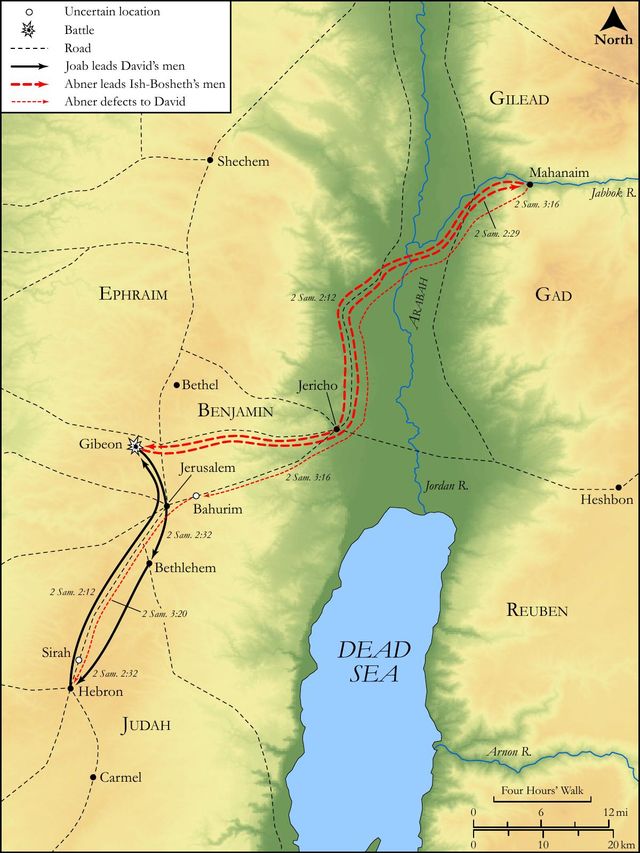
This verse is situated within the broader narrative of the civil war that erupted following the death of King Saul and his sons at Gilboa, and David's anointing as king over Judah. The immediate preceding verses detail a tense encounter at the Pool of Gibeon, where a challenge between twelve men from each side escalated into a fierce and bloody battle, described vividly in 2 Samuel 2:12-17. Asahel, renowned for his exceptional speed, a detail highlighted in 2 Samuel 2:18, fixated on pursuing Abner, the most prominent leader of Saul's house. Abner, recognizing Asahel and understanding the severe implications of killing him—namely, incurring a blood feud with Joab, David's commander and Asahel's brother—repeatedly warned Asahel to turn aside and pursue someone else, as recorded in 2 Samuel 2:20-22. Asahel's stubborn refusal to heed these warnings forced Abner into a defensive act that resulted in the fatal blow, a moment that would directly lead to Joab's later treacherous assassination of Abner, as detailed in 2 Samuel 3:27.
Historical & Cultural Context
The period described is one of deep political fragmentation and civil strife in ancient Israel, immediately after the unified monarchy under Saul. David had been anointed king in Hebron over Judah, while Saul's son Ish-bosheth was made king over the northern tribes by Abner in Mahanaim, a situation outlined in 2 Samuel 2:8-10. This created a volatile atmosphere where loyalty was divided and conflict was inevitable. Crucially, the concept of "blood vengeance" (Hebrew: go'el haddam) was a deeply ingrained social and legal custom. If a person was murdered, a designated "avenger of blood," usually a close male relative, was obligated to kill the murderer. Abner's repeated attempts to deter Asahel stemmed from his desire to avoid this blood feud, which would inevitably escalate the conflict beyond a conventional battle. The use of spears was common in ancient warfare, and the description of the blow highlights the brutal realities of close-quarters combat, where such a precise and powerful thrust would be instantly lethal.
Key Themes
ShowHideThis verse powerfully illustrates several key themes prevalent in the book of 2 Samuel. First, it underscores the destructive nature of civil war, where kinsmen fight against kinsmen, leading to tragic and often avoidable deaths like Asahel's. The conflict is not just political but deeply personal, fueling cycles of vengeance that prolong suffering, as seen in the long war between the house of Saul and the house of David. Second, Asahel's relentless and perhaps reckless pursuit highlights the dangers of uncontrolled zeal or ambition, even in a seemingly righteous cause. His refusal to "turn aside" despite clear warnings sealed his fate, demonstrating a lack of wisdom or discernment that proved fatal. Third, the incident brings to the forefront the weight of bloodguilt and the cycle of vengeance, a persistent problem in Israelite society that often undermined peace and justice, leading to further bloodshed. Finally, the detail that soldiers "stood still" at the sight of Asahel's death emphasizes the solemnity and shock of mortality, particularly when a prominent figure falls, momentarily halting the chaos of battle and forcing a pause for reflection.
Exposition and Analysis
ShowHideKey Word Analysis
ShowHideThis primitive root signifies an absolute unwillingness to comply or turn away. In Asahel's case, it highlights his stubborn and unyielding determination to pursue Abner, despite repeated warnings. This refusal is central to understanding the tragic inevitability of the outcome, as it indicates a deliberate choice to disregard Abner's plea.
From a root meaning "behind" or "after," this term describes the rear or back part of something. In the context of "hinder end of the spear," it implies a blow delivered with the butt end of the weapon, or perhaps a backhand thrust with the sharp end. Regardless of the precise method, the phrase emphasizes a powerful, desperate, and ultimately lethal defensive maneuver by Abner, resulting in the spear's complete penetration.
This primitive root means "to die" (literally or figuratively) or, causatively, "to kill." Its use here confirms the immediate and undeniable fatality of the wound Asahel sustained. The directness of the verb underscores the finality of Asahel's life, emphasizing that the blow was not merely incapacitating but definitively life-ending.
Verse Breakdown
ShowHide"Howbeit he refused to turn aside"
This opening clause immediately establishes Asahel's unwavering resolve, or perhaps his fatal stubbornness. Despite Abner's clear warnings and attempts to avoid a personal confrontation that would escalate the conflict, Asahel remained fixed on his target, demonstrating a lack of prudence that ultimately sealed his fate.
"wherefore Abner with the hinder end of the spear smote him under the fifth [rib]"
This describes the fatal action. The King James Version's "fifth [rib]" is an interpretation of the Hebrew word chômesh, which more broadly refers to the abdomen or lower torso—a vital and vulnerable area. The phrase "hinder end of the spear" suggests a powerful, perhaps unconventional, thrust. This detail highlights Abner's skill and the desperate necessity of his act of self-defense, delivering a precise and lethal blow.
"that the spear came out behind him"
This graphic and explicit detail emphasizes the immense force and penetrative power of Abner's thrust. It leaves no doubt about the lethality of the wound, indicating a complete perforation of Asahel's body, ensuring his immediate demise.
"and he fell down there, and died in the same place"
This confirms the immediate and undeniable consequence of the blow. Asahel's death was instantaneous and occurred precisely where he fell, a stark and unceremonious end to a swift and promising warrior, underscoring the brutal finality of combat.
"and it came to pass, [that] as many as came to the place where Asahel fell down and died stood still"
This final clause captures the profound impact of Asahel's death on the battlefield. It signifies a moment of collective shock, perhaps even reverence or fear, as the fighting men paused in the face of such a prominent and sudden casualty. It highlights the solemnity of death and its power to momentarily halt even the most intense conflict.
Literary Devices
ShowHideThe narrative of Asahel's death employs several powerful Literary Devices. There is a tragic Irony in Asahel's exceptional speed, which was his greatest asset, ultimately leading him directly into the path of his death. His swiftness, rather than enabling escape or victory, propelled him towards his demise. The entire scene serves as potent Foreshadowing, as Asahel's death at Abner's hand directly precipitates Joab's later act of vengeance against Abner, thus escalating the cycle of violence and prolonging the civil war. The vivid, almost clinical description of the fatal blow ("smote him under the fifth [rib]... that the spear came out behind him") employs Pathos, evoking a sense of pity and sorrow for the young warrior's unnecessary end and the grim realities of civil war. The detail that the soldiers "stood still" functions as Symbolism, representing not only the immediate shock and awe but also the profound, unsettling impact that death, particularly a sudden and significant one, has on the living, momentarily freezing the chaos of battle and forcing a moment of solemn reflection.
Theological and Thematic Connections
ShowHideThe death of Asahel stands as a stark biblical testament to the devastating consequences of human sin, particularly as it manifests in civil strife, personal ambition, and the relentless pursuit of vengeance. It illustrates how unbridled zeal, when untempered by wisdom or a willingness to yield, can lead to tragic ends, even when the initial cause might seem righteous. The narrative also highlights the pervasive nature of bloodguilt in Israel and the destructive cycle of retribution that it often perpetuated, demonstrating how one act of violence can ripple through generations. The solemn pause of the soldiers at Asahel's death site underscores the sanctity of human life and the profound, universal human response to mortality, even in the brutal context of war. Theologically, it reminds us that while God's sovereign plan unfolds, human choices, particularly those driven by pride, anger, or vengeance, carry real and often devastating consequences that disrupt peace and sow discord.
Reflection and Application
ShowHideAsahel's tragic end serves as a profound cautionary tale for all believers. His relentless pursuit, admirable in its zeal but fatal in its execution, challenges us to consider the nature of our own ambitions and pursuits. Are we willing to "turn aside" when wisdom, peace, or the well-being of others demands it, even if it means relinquishing a perceived advantage or victory? Do we recognize when our zeal, however well-intentioned, might be leading us down a path of destruction or perpetuating cycles of conflict and animosity? This narrative compels us to reflect on the immense cost of unresolved conflict and the seductive nature of vengeance, which, as seen in Joab's subsequent actions, only deepens wounds and prolongs suffering, preventing true reconciliation. It calls us to actively seek reconciliation, practice forgiveness, and pursue peace, rather than allowing personal grievances to escalate into destructive feuds that harm ourselves and others. Furthermore, the scene of soldiers "standing still" at the sight of death invites us to pause in our own lives, to acknowledge the fragility of life, the solemnity of mortality, and the profound impact that loss has on us and those around us, fostering a deeper appreciation for life and a greater urgency for peace and compassion.
Questions for Reflection
ShowHideFAQ
ShowHideWhy did Abner kill Asahel if he didn't want to?
ShowHideAbner killed Asahel out of desperate self-defense. The narrative clearly states that Abner repeatedly warned Asahel to stop pursuing him, even offering him the chance to fight a lesser opponent and take his armor (2 Samuel 2:20-22). Abner knew that killing Asahel, Joab's brother, would inevitably lead to a blood feud and escalate the civil war between the houses of Saul and David. However, Asahel's relentless and unyielding pursuit left Abner with no choice but to defend himself, as his own life was in immediate danger.
What is the significance of "hinder end of the spear" and "fifth rib"?
ShowHideThe King James Version's "hinder end of the spear" (Hebrew: 'achar haḥanit') likely refers to the butt end of the spear, used as a blunt but incredibly forceful weapon, or possibly a backhand thrust with the sharp end, indicating a swift and unexpected maneuver. Given the outcome, it signifies a powerful and lethal blow. The phrase "under the fifth [rib]" is a KJV interpretation of the Hebrew word chômesh, which more generally refers to the abdomen or lower chest area, a vital region. It emphasizes that the blow was precise and fatal, ensuring the spear passed through Asahel's body.
How did Asahel's death impact the civil war between the house of Saul and the house of David?
ShowHideAsahel's death had a profoundly negative impact, escalating the conflict from a general civil war into a deeply personal blood feud between the two leading commanders: Abner and Joab. Abner's killing of Asahel, though in self-defense, made him the target of Joab's blood vengeance. This personal vendetta ultimately led to Joab's treacherous assassination of Abner later on (2 Samuel 3:27), which, while removing a strong leader from Saul's side, also complicated David's efforts to unify Israel and demonstrated the destructive cycle of violence that plagued the nation, prolonging suffering and instability.
Christ-Centered Fulfillment
ShowHideThe tragic death of Asahel, a consequence of human stubbornness, the brutal realities of war, and the pervasive cycle of vengeance, finds its ultimate and redemptive fulfillment in the person and work of Jesus Christ. Asahel's demise highlights the futility and destructive power of human conflict and the endless cycle of retribution that often follows. In stark contrast, Christ's death was not a result of human folly or self-defense in a civil war, but a deliberate, substitutionary sacrifice to break the power of sin and reconcile humanity to God. Where Asahel's blood led to further bloodshed and vengeance, the blood of Christ cleanses from all sin and establishes a new covenant of peace. He is the ultimate Peacemaker, who, unlike Asahel's relentless pursuit leading to death, pursued us in love, laying down His life so that we might have life and have it abundantly (John 10:10). His teaching to turn the other cheek and love one's enemies directly confronts the spirit of vengeance seen in this narrative, offering a radical alternative. The "standing still" of the soldiers at Asahel's death, a moment of shock, foreshadows the profound awe and repentance that should grip humanity when confronted with the reality of Christ's cross, where the Lamb of God willingly offered Himself, bringing an end to the need for blood vengeance and ushering in an era of grace and reconciliation, demonstrating God's immense love for us even while we were sinners (Romans 5:8-10).