


2 Samuel 4:6
Bible text: King James Version (1769 Blayney text) · Public domain
Bible text: King James Version with Strong's numbers · Public domain
Bible text: Berean Standard Bible · Public domain
Bible text: American Standard Version (1901) · Public domain
Bible text: World English Bible, Messianic edition · Public domain
Bible text: Geneva Bible (1599) · Public domain
Bible text: Young's Literal Translation · Public domain
- וְהֵנָּהVe·he·nahand they [fem]H2007Conj-w ¦ Pro-3fpPronoun Personal 3rd Plural Feminineוְandהֵנָּהthey [fem]
- בָּאוּBa·'uthey cameH935V-Qal-Perf-3cpVerb Qal Perfect 3rd Plural common gender
- עַד'adtoH5704PrepPreposition
- תּוֹךְTokh[the] middle ofH8432N-mscNoun Singular Masculine Construct
- הַבַּיִתha·Ba·yitthe houseH1004Art ¦ N-msNoun Singular Masculine Absoluteהַtheבַּיִתhouse
- לֹקְחֵיlo·ke·CheitakingH3947V-Qal-Prtcpl-mpVerb Qal Participle Plural Masculine Construct
- חִטִּיםchi·Tim<of> wheat<s>H2406N-mpNoun Plural Masculine Absolute
- וַיַּכֻּהוּvai·ya·Ku·huand they struck himH5221Conj-w ¦ V-Hiphil-ConsecImperf-3mp ¦ 3msVerb Hiphil Consecutive Imperfect 3rd Plural Masculineוַandיַּכֻּthey struckהוּhim
- אֶל'eltoH413PrepPreposition
- הַחֹמֶשׁha·Cho·meshthe bellyH2570Art ¦ N-msNoun Singular Masculine Absoluteהַtheחֹמֶשׁbelly
- וְרֵכָבve·re·Khavand RechabH7394Conj-w ¦ N-proper-mNoun Proper MasculineוְandרֵכָבRechab
- וּבַעֲנָהu·va·'a·Nahand BaanahH1196Conj-w ¦ N-proper-mNoun Proper MasculineוּandבַעֲנָהBaanah
- אָחִיו'a·Chivhis brotherH251N-msc ¦ 3msNoun Singular Masculine Constructאָחִיbrotherוhis
- נִמְלָטוּnim·La·tuthey escapedH4422V-Niphal-Perf-3cpVerb Niphal Perfect 3rd Plural common gender
English is a literal word-by-word gloss of the Hebrew, not the KJV's wording. Why?
This is the original text the KJV's translators worked from — each Hebrew word with its own literal English meaning in this verse, prepared by scholars at Tyndale House, Cambridge. The KJV translates whole sentences, not word by word, so its wording differs: one Hebrew word can become several English words, and the KJV may choose “the LORD” where the gloss reads “Yahweh”. Both are faithful — they answer different questions. For the KJV's own rendering, switch to the KJV text.
Details
See on the biblical-era maps

Study this verse
Public-domain commentary
Matthew Henry
From his Commentary on the Whole Bible. Henry comments on passages, not single verses — this entry covers 2 Samuel 4:1–8. His three-level outline is real structure in the source text, so it is rendered as structure.
Here is, I. The weakness of Saul's house. Still it grew weaker and weaker. 1. As for Ishbosheth, who was in possession of the throne, his hands were feeble, Sa2 4:1. All the strength they ever had was from Abner's support, and now that he was dead he had no spirit left in him. Though Abner had, in a passion, deserted his interest, yet he hoped, by his means, to make good terms with David; but now even this hope fails him, and he sees himself forsaken by his friends and at the mercy of his enemies. All the Israelites that adhered to him were troubled and at a loss what to do, whether to proceed in their treaty with David or no. 2. As for Mephibosheth, who in the right of his father Jonathan had a prior title, his feet were lame, and he was unfit for any service, Sa2 4:4. He was but five years old when his father and grandfather were killed. His nurse, hearing of the Philistines' victory, was apprehensive that, in pursuit of it, they would immediately send a party to Saul's house, to cut off all that pertained to it, and would especially aim at her young master, who was now next heir to the crown. Under the apprehension of this, she fled with the child in her arms, to secure it either in some secret place where he could not be found, or in some strong place where he could not be got at; and, making more haste than good speed, she fell with the child, and by the fall some bone was broken or put out, and not well set, so that he was lame of it as long as he lived, and unfit either for court or camp. See what sad accidents children are liable to in their infancy, the effect of which may be felt by them, to their great uneasiness, all their days. Even the children of princes and great men, the children of good men, for such a one Jonathan was, children that are well tended, and have nurses of their own to take care of them, yet are not always safe. What reason have we to be thankful to God for the preservation of our limbs and senses to us, through the many perils of the weak and helpless state of infancy, and to own his goodness in giving his angels a charge concerning us, to bear us up in their arms, out of which there is no danger of falling, Psa 91:12.
II.The murder of Saul's son. We are here told,
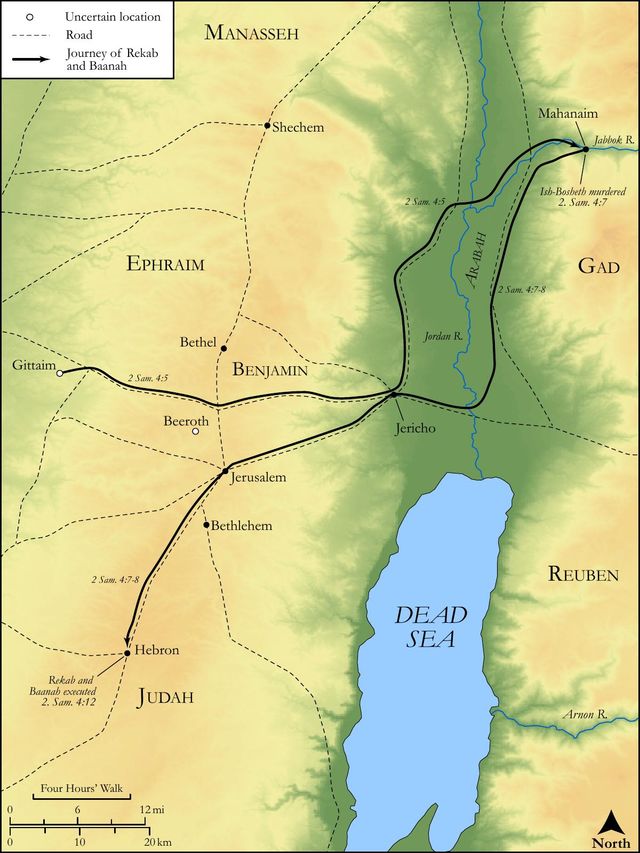
1.Who were the murderers: Baanah and Rechab, Sa2 4:2, Sa2 4:3. They were own brothers, as Simeon and Levi, and partners in iniquity. They were or had been Ish-bosheth's own servants, employed under him, so much the more base and treacherous was it in them to do him a mischief. They were Benjamites, of his own tribe. They were of the city of Beeroth; for some reason which we cannot now account for care is here taken to let us know (in a parenthesis) that that city belonged to the lot of Benjamin, so we find (Jos 18:25), but that the inhabitants, upon some occasion or other, perhaps upon the death of Saul, retired to Gittaim, another city which lay not far off in the same tribe, and was better fortified by nature, being situate (if we may depend upon Mr. Fuller's map) between the two rocks Bozez and Seneh. There the Beerothites were when this was written, and probably took root there, and never returned to Beeroth again, which made Beeroth, that had been one of the cities of the Gibeonites (Jos 9:17), to be forgotten, and Gittaim to be famous long after, as we find, Neh 11:33.
2.How the murder was committed, Sa2 4:5-7. See here,
(1.)The slothfulness of Ish-bosheth. He lay upon his bed at noon. It does not appear that the country was at any time of the year so hot as to oblige the inhabitants to retire at noon, as we are told they do in Spain in the heat of summer; but Ishbosheth was a sluggish man, loved his ease and hated business: and when he should have been, at this critical juncture, at the head of his forces in the field, or at the head of his counsels in a treaty with David, he was lying upon his bed and sleeping, for his hands were feeble (Sa2 4:1), and so were his head and heart. When those difficulties dispirit us which should rather invigorate us and sharpen our endeavours we betray both our crowns and lives. Love not sleep, lest thou come to poverty and ruin. The idle soul is an easy prey to the destroyer.
(2.)The treachery of Baanah and Rechab. They came into the house, under pretence of fetching wheat for the victualling of their regiments; and such was the plainness of those times that the king's corn-chamber and his bed-chamber lay near together, which gave them an opportunity, when they were fetching wheat, to murder him as he lay on the bed. We know not when and where death will meet us. When we lie down to sleep we are not sure but that we may sleep the sleep of death before we awake; nor do we know from what unsuspected hand a fatal stroke may come. Ish-bosheth's own men, who should have protected his life, took it away.
3.The murderers triumphed in what they had done. As if they had performed some very glorious action, and the doing of it for David's advantage was enough not only to justify it, but to sanctify it, they made a present of Ish-bosheth's head to David (Sa2 4:8): Behold the head of thy enemy, than which they thought nothing could be more acceptable to him; yea, and they made themselves instruments of God's justice, ministers to bear his sword, though they had no commission: The Lord hath avenged thee this day of Saul and of his seed. Not that they had any regard either to God or to David's honour; they aimed at nothing but to make their own fortunes (as we say) and to get preferment in David's court; but, to ingratiate themselves with him, they pretended a concern for his life, a conviction of his title, and a zealous desire to see him in full possession of the throne. Jehu pretended zeal for the Lord of hosts when an ambition to set up himself and his own family was the spring of his actions.
Continue studying 2 Samuel 4:6 across the web’s major study libraries — every link below opens this exact verse, chapter, or book on the destination site.
Read & Compare
 BibleGatewayThis verse in more than 200 translations and 70 languages.
 Bible.comThe YouVersion reader — hundreds of translations, reading plans, and highlights.
 ESV.orgCrossway's official English Standard Version reader.
 NET BibleThe NET translation with 60,000+ translators' notes on every rendering decision.
 STEP BibleTyndale House's free study tool — original text, vocabulary, and scholarly resources.
 BibliaLogos Bible Software's free web reader.
 USCCBThe New American Bible (Revised Edition) with the U.S. bishops' study notes.
Commentaries
 BibleHub CommentariesDozens of classic commentaries on this verse, gathered on one page.
 StudyLightMore than 100 commentary sets — the largest collection on the web.
 BibleRefPlain-English commentary on what this verse means, verse by verse.
 Enduring WordDavid Guzik's free commentary on this chapter, widely used by Bible teachers.
 Bible Study ToolsVerse commentary alongside Greek and Hebrew study aids.
Original Language & Research
- BibleHub InterlinearThe verse word by word — original language, transliteration, and English.
- BibleHub LexiconEvery word's original-language definition and Strong's entry.
 Blue Letter BibleDeep-study tools — Strong's numbers, concordance, and word studies.
 SefariaThe Hebrew text with Rashi and centuries of Jewish commentary.
Sermons, Hymns & Audio


TrulyRandomVerse is not affiliated with these sites and doesn’t control their content. They’re linked because they’re genuinely useful.
Summary
2 Samuel 4:6 meticulously describes the treacherous assassination of Ish-bosheth, King Saul's son and nominal king over Israel, by his own captains, Rechab and Baanah. This verse captures the chilling moment when the two men, under the guise of collecting wheat, infiltrated Ish-bosheth's house and delivered a fatal blow to his abdomen, highlighting the profound deception and violence that marked the volatile period of transition as David's kingdom was being established over all Israel.
Context
ShowHideLiterary Context
This verse is situated at a critical juncture in the narrative of 2 Samuel, immediately following the death of Abner, Ish-bosheth's most powerful general and supporter, in 2 Samuel 3:27. Abner's demise left Ish-bosheth profoundly vulnerable and demoralized, as indicated by his paralysis of fear and the scattering of all Israel, described in 2 Samuel 4:1. The assassination of Ish-bosheth in this chapter directly paves the way for David's ultimate anointing as king over all twelve tribes of Israel, a pivotal event detailed in 2 Samuel 5:1-5. The sequence of events underscores the providential clearing of obstacles for David's unified reign.
Historical & Cultural Context
The period described in 2 Samuel 4 is one of intense civil war and political instability following the death of King Saul at the Battle of Gilboa, recounted in 1 Samuel 31:1-6. David had been anointed king over Judah in Hebron, as recorded in 2 Samuel 2:4, while Abner had established Ish-bosheth as king over the northern tribes. Assassination was a brutal but not uncommon tactic in the power struggles of that day, often employed by ambitious individuals seeking to gain favor with a rising power. The act of entering a private residence under a false pretense, such as "fetching wheat," speaks to the cultural norms of hospitality and trust, which were then ruthlessly exploited for nefarious ends.
Key Themes
ShowHideThe events of 2 Samuel 4 contribute significantly to several overarching themes in the book. Betrayal and Deception are vividly portrayed by Rechab and Baanah's cunning approach, highlighting the moral decay that can accompany the pursuit of power. The Vulnerability of Earthly Leadership, particularly in times of transition and weakness, is starkly illustrated by Ish-bosheth's defenselessness. Most profoundly, this assassination marks the definitive End of Saul's Dynasty, clearing the final human obstacle to David's divinely appointed kingship over a united Israel. This narrative implicitly emphasizes Divine Sovereignty, as even the wicked acts of men ultimately serve God's larger redemptive plan to establish the Davidic line.
Exposition and Analysis
ShowHideKey Word Analysis
ShowHideThis term refers to Ish-bosheth's residence, but in a broader sense, it can also signify a "household" or "family." The assassins' infiltration "into the midst of the house" (literally "in the middle of the house") implies a deep breach of security and privacy, reaching the very heart of Ish-bosheth's personal space, where he should have been safest.
This common agricultural product serves as a mundane and innocuous cover for the assassins' true intentions. The phrase "as though they would have fetched wheat" implies a routine, everyday activity, making their entry into the king's private quarters seem legitimate and unsuspicious. This detail underscores the depth of their deception and the calculated nature of their plot.
Derived from this root, the verb here denotes a violent and decisive blow. Its use emphasizes the direct and fatal nature of the attack, leaving no doubt about the assassins' intent to kill. This word choice conveys the brutal efficiency with which Ish-bosheth's life was taken.
The Hebrew term chômesh literally refers to "the fifth part" or, more commonly in this context, the abdomen or lower belly. While the KJV's interpretive addition of "[rib]" attempts to clarify the location, the more accurate understanding points to a vital, unprotected area of the lower torso or abdomen, where a strike would be immediately fatal. This detail highlights the precision and lethality of the blow, indicating a deliberate and effective assassination.
Verse Breakdown
ShowHide"And they came thither into the midst of the house,"
This opening clause establishes the assassins' successful infiltration. "Into the midst of the house" suggests they gained deep access, likely to Ish-bosheth's private chambers, indicating a breach of security and trust.
"[as though] they would have fetched wheat;"
This parenthetical phrase reveals the cunning deception employed by Rechab and Baanah. Their pretense of performing a legitimate, perhaps even official, duty (collecting provisions) allowed them to bypass suspicion and enter the king's inner sanctum, highlighting their calculated treachery.
"and they smote him under the fifth [rib]:"
This is the core of the verse, describing the fatal act. The "fifth [rib]" (more accurately, the abdomen or lower belly) indicates a precise and mortal wound, emphasizing the cold, deliberate nature of the assassination. Ish-bosheth was likely resting or vulnerable, making the attack swift and effective.
"and Rechab and Baanah his brother escaped."
This concluding clause details the immediate aftermath of the crime. Their escape signifies their initial success in carrying out the murder and their attempt to flee justice, setting the stage for David's subsequent reaction.
Literary Devices
ShowHideThe narrative of 2 Samuel 4:6 masterfully employs several literary devices to heighten its impact. Irony is prominent in the assassins' pretense of "fetching wheat," a mundane and life-sustaining activity, as a cover for a heinous, life-ending act. This stark contrast underscores the depth of their deception. The verse also utilizes Juxtaposition, placing the seemingly innocent act of gathering provisions directly against the brutal reality of a king's murder, emphasizing the sudden and shocking nature of the violence. Furthermore, the precise detail of "smote him under the fifth [rib]" serves as a form of Realism, lending a grim authenticity to the account of the assassination. Ultimately, this pivotal moment serves as a form of Foreshadowing, signaling the imminent collapse of Saul's house and the inevitable consolidation of power under David, aligning with God's overarching plan.
Theological and Thematic Connections
ShowHide2 Samuel 4:6, though describing a dark act of human depravity, fits within the broader biblical narrative of God's sovereign control over human history and the establishment of His chosen leadership. While Rechab and Baanah acted out of selfish ambition and treachery, their wicked deed inadvertently served God's purpose in removing the last obstacle to David's unified reign over all Israel. This does not condone their sin but illustrates how God can orchestrate even evil acts to fulfill His righteous plan, demonstrating His ultimate authority over human kingdoms and their transitions. It also highlights the biblical principle that those who seek to gain power through unrighteous means often face divine judgment, as seen in David's swift and severe response to the assassins.
Reflection and Application
ShowHideThe chilling account of Ish-bosheth's assassination in 2 Samuel 4:6 serves as a potent reminder of the destructive power of unchecked ambition and the insidious nature of betrayal. Rechab and Baanah, driven by a misguided desire for personal gain and favor, chose a path of deceit and violence, believing their actions would elevate them. Yet, their scheme ultimately led to their swift and ignominious downfall. This narrative challenges us to examine our own motives, particularly when seeking advancement or influence. Do we prioritize integrity, justice, and the well-being of others, or are we tempted to cut corners, manipulate, or betray trust for perceived advantage? The story underscores that true lasting success and divine favor are not found in opportunistic violence or cunning deception, but in patient waiting on God's timing and unwavering commitment to righteousness, even in chaotic circumstances. It calls us to embody the character of David, who, despite being a rival, consistently condemned those who took justice into their own hands.
Questions for Reflection
ShowHideFAQ
ShowHideWhy did Rechab and Baanah assassinate Ish-bosheth?
ShowHideRechab and Baanah assassinated Ish-bosheth primarily out of self-interest and a misguided attempt to curry favor with David. They likely perceived Ish-bosheth's reign as weak and nearing its end, especially after the death of his general Abner, as described in 2 Samuel 4:1. They believed that by eliminating David's last remaining rival from Saul's house, they would be rewarded by David and secure a prominent position in his new kingdom. Their actions were driven by ambition and a complete disregard for divine justice or the sanctity of human life.
What is the significance of "smote him under the fifth [rib]"?
ShowHideThe phrase "smote him under the fifth [rib]" (Hebrew: hachomesh) refers to a fatal blow delivered to the lower abdomen or belly, a vital and unprotected area of the body. The KJV's addition of "[rib]" is an interpretive attempt to clarify the location, but the original Hebrew more broadly indicates the region of the abdomen. This detail emphasizes the precision and lethality of the attack, ensuring Ish-bosheth's swift death. It highlights the cold, calculated nature of the assassination, designed to be immediately effective.
Christ-Centered Fulfillment
ShowHideWhile 2 Samuel 4:6 describes a dark chapter of betrayal and violence, it plays a crucial role in the unfolding of God's redemptive plan, ultimately pointing to Christ. The assassination of Ish-bosheth marks the definitive end of Saul's flawed and human-established dynasty, clearing the way for David, God's chosen king, to reign over a united Israel. This transition foreshadows the ultimate end of all earthly, imperfect kingdoms and the establishment of the eternal, perfect kingdom of God, inaugurated by Jesus Christ. Just as David's righteous judgment against Ish-bosheth's assassins in 2 Samuel 4:9-12 demonstrated his commitment to justice and the sanctity of the Lord's anointed, so too does Christ, the true Son of David, embody perfect justice and righteous rule. His kingdom, unlike vulnerable earthly monarchies, is unshakable and eternal, as promised in Hebrews 12:28. The vulnerability of Ish-bosheth, an earthly king, stands in stark contrast to the divine invincibility of Christ, the King of Kings, whose reign will never end and whose authority is absolute, as declared in Revelation 19:16. The narrative thus subtly underscores that God's sovereign plan of salvation, culminating in Christ, triumphs over all human wickedness and political turmoil.