


2 Samuel 2:24
Bible text: King James Version (1769 Blayney text) · Public domain
Bible text: King James Version with Strong's numbers · Public domain
Bible text: Berean Standard Bible · Public domain
Bible text: American Standard Version (1901) · Public domain
Bible text: World English Bible, Messianic edition · Public domain
Bible text: Geneva Bible (1599) · Public domain
Bible text: Young's Literal Translation · Public domain
- וַיִּרְדְּפוּvai·yir·de·Fuand they pursuedH7291Conj-w ¦ V-Qal-ConsecImperf-3mpVerb Qal Consecutive Imperfect 3rd Plural Masculineוַandיִּרְדְּפוּthey pursued
- יוֹאָבyo·'AvJoabH3097N-proper-mNoun Proper Masculine
- וַאֲבִישַׁיva·'a·vi·Shaiand AbishaiH52Conj-w ¦ N-proper-mNoun Proper MasculineוַandאֲבִישַׁיAbishai
- אַחֲרֵי'a·cha·ReiafterH310Adj-mpcAdjective Numerical Plural Masculine Construct
- אַבְנֵר'av·NerAbnerH74N-proper-mNoun Proper Masculine
- וְהַשֶּׁמֶשׁve·ha·She·meshand the sunH8121Conj-w ¦ Art ¦ N-csNoun Singular common gender Absoluteוְandהַtheשֶּׁמֶשׁsun
- בָּאָהBa·'ahit setH935V-Qal-Perf-3fsVerb Qal Perfect 3rd Singular Feminine
- וְהֵמָּהve·He·mahand theyH1992Conj-w ¦ Pro-3mpPronoun Personal 3rd Plural Masculineוְandהֵמָּהthey
- בָּאוּBa·'uthey cameH935V-Qal-Perf-3cpVerb Qal Perfect 3rd Plural common gender
- עַד'adtoH5704PrepPreposition
- גִּבְעַתgiv·'At[the] hill ofH1389N-fscNoun Singular Feminine Construct
- אַמָּה'a·MahAmmahH522N-properNoun Proper Location
- אֲשֶׁר'a·SherwhichH834RelParticle Relative
- עַל'al[is] onH5921PrepPreposition
- פְּנֵיpe·nei[the] face ofH6440N-mpcNoun Plural Masculine Construct
- גִיחַGi·achGiahH1520N-properNoun Proper Location
- דֶּרֶךְDe·rekh[the] way ofH1870N-cscNoun Singular common gender Construct
- מִדְבַּרmid·Bar[the] wilderness ofH4057N-mscNoun Singular Masculine Construct
- גִּבְעוֹןgiv·'onGibeonH1391N-properNoun Proper Location
English is a literal word-by-word gloss of the Hebrew, not the KJV's wording. Why?
This is the original text the KJV's translators worked from — each Hebrew word with its own literal English meaning in this verse, prepared by scholars at Tyndale House, Cambridge. The KJV translates whole sentences, not word by word, so its wording differs: one Hebrew word can become several English words, and the KJV may choose “the LORD” where the gloss reads “Yahweh”. Both are faithful — they answer different questions. For the KJV's own rendering, switch to the KJV text.
Details
See on the biblical-era maps
Study this verse
Public-domain commentary
Matthew Henry
From his Commentary on the Whole Bible. Henry comments on passages, not single verses — this entry covers 2 Samuel 2:18–24. His two-level outline is real structure in the source text, so it is rendered as structure.
We have here the contest between Abner and Asahel. Asahel, the brother of Joab and cousin-german to David, was one of the principal commanders of David's forces, and was famous for swiftness in running: he was as light of foot as a wild roe (Sa2 2:18); this he got the name of by swift pursuing, not swift flying. Yet, we may suppose, he was not comparable to Abner as a skilful experienced soldier; we must therefore observe,
I.How rash he was in aiming to make Abner his prisoner.
He pursued after him, and no other, Sa2 2:19. Proud of his relation to David and Joab, his own swiftness, and the success of his party, no less a trophy of victory would now serve the young warrior than Abner himself, either slain or bound, which he thought would put an end to the war and effectually open David's way to the throne. This made him very eager in the pursuit, and careless of the opportunities he had of seizing others in his way, on his right hand and on his left; his eye was on Abner only. The design was brave, had he been par negotio - equal to its accomplishment: but let not the swift man glory in his swiftness, any more than the strong man in his strength; magnis excidit ausis - he perished in an attempt too vast for him.
II.How generous Abner was in giving him notice of the danger he exposed himself to, and advising him not to meddle to his own hurt, Ch2 25:19.
1.He bade him content himself with a less prey (Sa2 2:21): "Lay hold of one of the young men, plunder him and make him thy prisoner, meddle with thy match, but pretend not to one who is so much superior to thee." It is wisdom in all contests to compare our own strength with that of our adversaries, and to take heed of being partial to ourselves in making the comparison, lest we prove in the issue enemies to ourselves, Luk 14:31.
2.He begged of him not to put him upon the necessity of slaying him in his own defence, which he was very loth to do, but must do rather than be slain by him, Sa2 2:22. Abner, it seems, either loved Joab or feared him; for he was very loth to incur his displeasure, which he would certainly do if he slew Asahel. It is commendable for enemies to be thus respectful one to another. Abner's care how he should lift up his face to Joab gives cause to suspect that he really believed David would have the kingdom at last, according to the divine designation, and then, in opposing him, he acted against his conscience.
III.How fatal Asahel's rashness was to him.
He refused to turn aside, thinking that Abner spoke so courteously because he feared him; but what came of it? Abner, as soon as he came up to him, gave him his death's wound with a back stroke (Sa2 2:23): He smote him with the hinder end of his spear, from which he feared no danger. This was a pass which Asahel was not acquainted with, nor had learned to stand upon his guard against; but Abner, perhaps, had formerly used it, and done execution with it; and here it did effectual execution. Asahel died immediately of the wound. See here,
1.How death often comes upon us by ways that we least suspect. Who would fear the hand of a flying enemy or the butt-end of a spear? yet from these Asahel receives his death's wound.
2.How we are often betrayed by the accomplishments we are proud of. Asahel's swiftness, which he presumed so much upon, did him no kindness, but forwarded his fate, and with it he ran upon his death, instead of running from it. Asahel's fall was not only Abner's security from him, but put a full stop to the conqueror's pursuit and gave Abner time to rally again; for all that came to the place stood still, only Joab and Abishai, instead of being disheartened, were exasperated by it, pursued Abner with so much the more fury (Sa2 2:24), and overtook him at last about sunset, when the approaching night would oblige them to retire.
Continue studying 2 Samuel 2:24 across the web’s major study libraries — every link below opens this exact verse, chapter, or book on the destination site.
Read & Compare
 BibleGatewayThis verse in more than 200 translations and 70 languages.
 Bible.comThe YouVersion reader — hundreds of translations, reading plans, and highlights.
 ESV.orgCrossway's official English Standard Version reader.
 NET BibleThe NET translation with 60,000+ translators' notes on every rendering decision.
 STEP BibleTyndale House's free study tool — original text, vocabulary, and scholarly resources.
 BibliaLogos Bible Software's free web reader.
 USCCBThe New American Bible (Revised Edition) with the U.S. bishops' study notes.
Commentaries
 BibleHub CommentariesDozens of classic commentaries on this verse, gathered on one page.
 StudyLightMore than 100 commentary sets — the largest collection on the web.
 BibleRefPlain-English commentary on what this verse means, verse by verse.
 Enduring WordDavid Guzik's free commentary on this chapter, widely used by Bible teachers.
 Bible Study ToolsVerse commentary alongside Greek and Hebrew study aids.
Original Language & Research
- BibleHub InterlinearThe verse word by word — original language, transliteration, and English.
- BibleHub LexiconEvery word's original-language definition and Strong's entry.
 Blue Letter BibleDeep-study tools — Strong's numbers, concordance, and word studies.
 SefariaThe Hebrew text with Rashi and centuries of Jewish commentary.
Sermons, Hymns & Audio


TrulyRandomVerse is not affiliated with these sites and doesn’t control their content. They’re linked because they’re genuinely useful.
Summary
Second Samuel 2:24 vividly details the relentless pursuit of Abner, commander of Saul's army, by Joab and Abishai, David's formidable military leaders, following the tragic death of their brother Asahel. This verse marks a critical and intensely personal juncture in the escalating civil war between the house of David and the house of Saul, meticulously charting the geographical markers of the chase as the day draws to a close, thereby underscoring the profound intensity and deeply personal stakes of the unfolding conflict.
Context
ShowHideLiterary Context
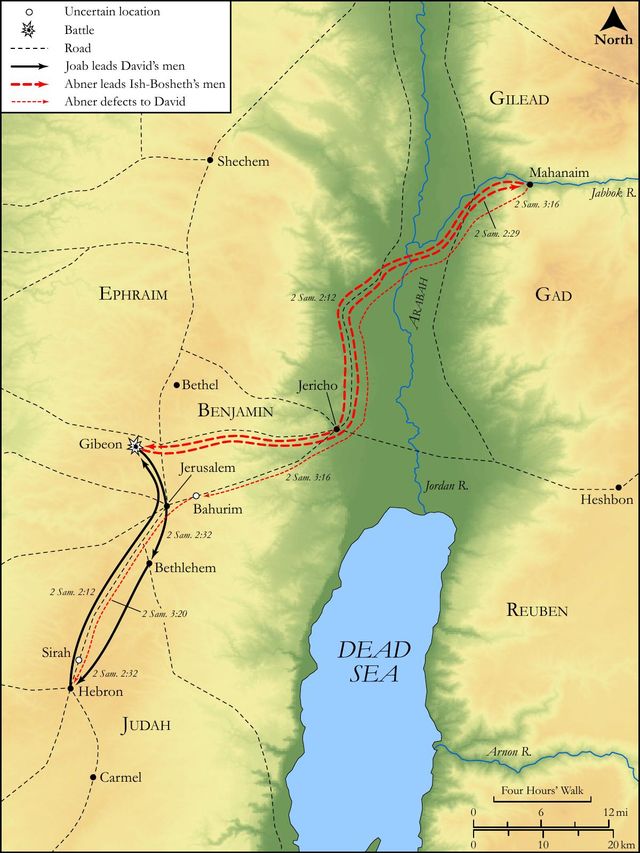
This verse immediately follows the pivotal and tragic death of Asahel, Joab's swift-footed brother, who was killed by Abner in self-defense during the initial, ill-fated skirmish at the pool of Gibeon. What began as a ritualistic challenge between twelve men from each side quickly escalated into a full-scale battle, marking the bloody onset of a protracted civil war. Abner's desperate plea to Joab to cease the pursuit, emphasizing that "bitterness will be the end," is recorded just prior to this verse in 2 Samuel 2:26. Joab's unwavering decision to continue the chase, despite the setting sun and Abner's warning, profoundly underscores the deep personal vendetta that now consumed him, transforming a strategic military engagement into a relentless quest for personal vengeance. The narrative flow in these verses emphasizes the fierce and unyielding determination of Joab and Abishai to avenge their brother's death, even as the day concludes and night approaches.
Historical & Cultural Context
The events of 2 Samuel 2 unfold during a tumultuous and uncertain period in ancient Israel's history, immediately following the death of King Saul and the anointing of David as king over Judah. Ish-Bosheth, Saul's surviving son, was subsequently made king over the remaining tribes of Israel by Abner, initiating a protracted and bloody civil war between the two rival houses. Vengeance, particularly for the death of a family member, was a deeply ingrained and culturally sanctioned norm in Israel and among the nations round about, often leading to devastating blood feuds. The "avenger of blood" (Hebrew: go'el haddam) held a societal obligation to pursue and kill the one who had shed the blood of a relative, as explicitly outlined in Numbers 35:19 and Deuteronomy 19:6. This powerful cultural expectation, combined with the intense political rivalry for control of Israel, fueled the ferocity and personal intensity of the pursuit described in 2 Samuel 2:24. The precise geographical details, such as "the hill of Ammah" and "the wilderness of Gibeon," firmly root the narrative in the real, rugged terrain of the Benjaminite territory, a highly contested borderland between Judah and Israel, further emphasizing the historical authenticity and arduous nature of the chase.
Key Themes
ShowHideThis verse significantly contributes to several overarching themes woven throughout the book of 2 Samuel. Firstly, it starkly highlights the destructive cycle of violence and retribution that tragically characterizes this period of Israel's history, where personal grievances like Asahel's death inexorably escalate into broader political conflicts, a pattern evident throughout 2 Samuel 3 and 2 Samuel 4. Secondly, it underscores the profound theme of human vengeance versus divine sovereignty, contrasting the powerful human desires for immediate retribution with God's ultimate and often mysterious plan for establishing David's kingdom, despite the pervasive human failings, bloodshed, and political intrigue. The relentless pursuit by Joab and Abishai serves as a powerful illustration of the human capacity for unwavering determination, whether driven by a righteous cause or, as in this case, by a destructive personal vendetta. Finally, the meticulous geographical precision serves to ground the narrative firmly in historical reality, emphasizing the arduous nature of the chase across the challenging terrain and lending undeniable credibility to the unfolding events of the civil war.
Exposition and Analysis
ShowHideKey Word Analysis
ShowHideThis primitive root verb (H7291) signifies a strong, persistent chase, often with hostile intent, to overtake, harass, or inflict harm. In the context of 2 Samuel 2:24, it powerfully emphasizes the relentless and aggressive nature of Joab and Abishai's pursuit of Abner, driven by a deep-seated desire for vengeance rather than merely a strategic military maneuver. It conveys a profound degree of determination and an unyielding refusal to abandon the chase, even as night falls.
This feminine noun (H1389) refers to a hillock or a small hill. In this verse, it specifically denotes "the hill of Ammah," a significant geographical landmark. The mention of a "hill" highlights the undulating and challenging terrain over which the pursuit took place, indicating that the chase was not merely a flat-land sprint but involved traversing elevated ground, adding to the arduousness of the journey for both the pursuers and the pursued.
Derived from a root meaning "to drive" (H4057), this noun refers to a pasture, an open field where cattle are driven, and by implication, a desert or uncultivated area. The "wilderness of Gibeon" was not a barren desert but rather an area characterized by sparse vegetation, hills, and wadis, suitable for grazing and less inhabited than cultivated lands. Its inclusion emphasizes the difficult, untamed, and exhausting nature of the chase, suggesting movement through challenging, less-traveled territory.
Verse Breakdown
ShowHide"Joab also and Abishai pursued after Abner:"
This opening clause immediately establishes the key protagonists and the object of their relentless pursuit. Joab, David's formidable and often ruthless military commander, along with his brother Abishai, are depicted as being consumed by the recent, tragic death of their brother Asahel. Their pursuit of Abner, the commander of Saul's forces, is not merely a military tactic but a deeply personal and vengeful vendetta, setting a grim tone for the unfolding conflict.
"and the sun went down"
This temporal marker signifies that the chase had extended throughout the entire day and was now continuing into the evening. The setting sun not only emphasizes the tenacity and endurance of the pursuers, who pressed on despite the fading light, but also adds a layer of dramatic tension. Nightfall typically brought increased danger and reduced visibility, making the pursuit more perilous and suggesting the weariness of both parties involved.
"when they were come to the hill of Ammah,"
This phrase provides a precise geographical waypoint, pinpointing the exact location reached by the pursuers as the sun set. The "hill of Ammah" was a recognizable landmark, indicating the significant distance covered and the specific terrain traversed. This detail grounds the narrative in a tangible, historical landscape, allowing the audience to track the arduous journey.
"that [lieth] before Giah by the way of the wilderness of Gibeon."
This final segment further refines the geographical description, meticulously locating the hill of Ammah in relation to Giah and the broader "wilderness of Gibeon." These highly specific geographical references not only enhance the historical credibility of the account but also enable the reader to visualize the challenging and arduous route of the pursuit through the rugged, less populated areas surrounding Gibeon, a city of considerable strategic importance during this period of civil war.
Literary Devices
ShowHideThe verse employs several potent literary devices to heighten its dramatic impact and historical verisimilitude. Geographical Realism is paramount, with the specific mention of "the hill of Ammah," "Giah," and "the wilderness of Gibeon." This precise mapping of the pursuit firmly grounds the narrative in a tangible, historical landscape, lending undeniable credibility and immediate immersion to the unfolding events. The detail that "the sun went down" functions as a crucial element of Pacing and Atmospheric Detail, conveying the relentless duration of the chase and subtly hinting at the growing weariness and desperation of the participants. The fading light can also be interpreted as a subtle form of Foreshadowing, as the pursuit into the encroaching darkness of night ominously suggests the dangerous and tragic events that are yet to unfold, particularly Abner's eventual demise at Joab's hand. Finally, the entire scene is imbued with a profound sense of Dramatic Irony, as the reader, possessing foreknowledge of the ultimate outcome of the civil war and the intertwined fates of both Abner and Joab, experiences a layer of tragic inevitability that deepens the narrative's emotional resonance.
Theological and Thematic Connections
ShowHideThe relentless pursuit depicted in 2 Samuel 2:24, fueled by the intense desire for vengeance for Asahel's death, serves as a stark illustration of the destructive cycle of human sin and retribution that tragically permeates much of the biblical narrative. This human-driven pursuit stands in profound contrast to the divine call for forgiveness, reconciliation, and mercy found throughout Scripture. While human justice often seeks "an eye for an eye," God's ultimate plan involves breaking this cycle through the transformative power of grace and redemptive love. This pursuit, a microcosm of the larger civil war, powerfully demonstrates how deeply personal grievances can tragically escalate into widespread conflict, underscoring humanity's profound need for divine intervention to bring true peace and lasting order. It also subtly points to God's overarching sovereignty, working through the messy and often violent realities of human conflict to ultimately establish His chosen king and advance His redemptive purposes.
Reflection and Application
ShowHideThe relentless pursuit of Abner by Joab and Abishai serves as a powerful, albeit somber, reminder of the destructive and consuming nature of unchecked vengeance and bitterness. While their loyalty to their fallen brother Asahel is understandable within their cultural context, their unyielding pursuit into the night vividly illustrates how personal grievances can tragically consume individuals and perpetuate cycles of violence, escalating broader conflicts far beyond their initial scope. For believers today, this narrative challenges us to critically examine the motivations behind our own "pursuits." Are we driven by a desire for personal retribution, or by a commitment to reconciliation, peace, and restitution? The story underscores the profound importance of entrusting ultimate justice to God, rather than taking it into our own hands, and actively seeking to break cycles of animosity through forgiveness and grace. It prompts us to consider the long-term, often devastating, consequences of our actions, recognizing that bitterness and vengeance frequently lead to further destruction, while a spirit of humility, mercy, and forgiveness can pave the way for genuine healing and restoration, even amidst the most difficult and painful circumstances.
Questions for Reflection
ShowHideFAQ
ShowHideWhat is the significance of the sun going down in this verse?
ShowHideThe mention that "the sun went down" is profoundly significant for several reasons. Firstly, it powerfully emphasizes the extended duration and relentless intensity of the pursuit; the chase had been ongoing throughout the entire day and was now extending into the evening, highlighting the unwavering tenacity and endurance of Joab and Abishai. Secondly, it dramatically adds to the narrative tension, as nightfall typically brought increased danger, reduced visibility, and a cessation of battle in ancient warfare, making their continued pursuit into the darkness exceptionally perilous and indicative of their extreme determination for vengeance. It also sets the immediate stage for the dramatic confrontation and Abner's plea to Joab that would soon follow, as seen in 2 Samuel 2:25-28.
Why are the geographical details so specific in this verse?
ShowHideThe highly specific geographical details ("the hill of Ammah," "Giah," "the wilderness of Gibeon") serve to firmly ground the narrative in historical reality and significantly enhance its credibility. Ancient biblical narratives often include such precise geographical markers to demonstrate their historical authenticity and to allow the original audience to vividly visualize the events unfolding in familiar, tangible territory. For the modern reader, these meticulous details provide a concrete sense of the arduous journey and the challenging terrain over which the pursuit took place, making the account far more vivid, immersive, and realistic. Moreover, these details underscore the strategic importance of these specific locations in the ongoing civil war between the house of David and the house of Saul, as is evident throughout the broader context of 2 Samuel 2.
Christ-Centered Fulfillment
ShowHideWhile 2 Samuel 2:24 vividly describes a scene of human vengeance, relentless pursuit, and the perpetuation of a devastating civil war, it ultimately points to the profound and desperate need for a fundamentally different kind of King and a radically different kind of peace—a peace found solely and perfectly in Jesus Christ. The relentless pursuit of Abner by Joab, driven by the intense blood feud for Asahel, starkly exemplifies the brokenness of a world governed by retribution and the "eye for an eye" principle, a cycle that only perpetuates further violence. In profound contrast, Jesus Christ embodies the ultimate fulfillment of divine peace and reconciliation, definitively breaking the cycle of violence and sin through His own sacrificial death on the cross. He is the true Prince of Peace, who, unlike Joab, did not pursue vengeance but instead offered boundless forgiveness, even to His executioners, as powerfully recorded in Luke 23:34. The civil war between the houses of Saul and David, steeped in human sin and conflict, foreshadows the deeper spiritual conflict between sin and righteousness, a conflict that Christ definitively won through His atoning work, ushering in a new covenant where believers are called to love their enemies and forgive one another as Christ has forgiven them. Thus, this Old Testament pursuit, steeped in human frailty and the tragic consequences of sin, ultimately serves to magnify the surpassing glory of Christ, who brings an end to the destructive cycle of retribution and offers true reconciliation, eternal peace, and abundant life to all who believe in Him, as triumphantly proclaimed in Ephesians 2:14-16.