


2 Samuel 2:25
Bible text: King James Version (1769 Blayney text) · Public domain
Bible text: Berean Standard Bible · Public domain
Bible text: American Standard Version (1901) · Public domain
Bible text: World English Bible, Messianic edition · Public domain
Bible text: Geneva Bible (1599) · Public domain
Bible text: Young's Literal Translation · Public domain
- וַיִּתְקַבְּצוּvai·yit·ka·be·Tzuand they gathered togetherH6908Conj-w ¦ V-Hithpael-ConsecImperf-3mpVerb Hithpael Consecutive Imperfect 3rd Plural Masculineוַandיִּתְקַבְּצוּthey gathered together
- בְנֵיve·nei[the] descendants ofH1121N-mpcNoun Plural Masculine Construct
- בִנְיָמִןvin·ya·MinBenjaminH1144N-proper-mNoun Proper Masculine
- אַחֲרֵי'a·cha·ReibehindH310Adj-mpcAdjective Numerical Plural Masculine Construct
- אַבְנֵר'av·NerAbnerH74N-proper-mNoun Proper Masculine
- וַיִּהְיוּvai·yih·Yuand they becameH1961Conj-w ¦ V-Qal-ConsecImperf-3mpVerb Qal Consecutive Imperfect 3rd Plural Masculineוַandיִּהְיוּthey became
- לַאֲגֻדָּהla·'a·gu·Dah<into> a bandH92Prep-l ¦ N-fsNoun Singular Feminine Absoluteלַ<into>אֲגֻדָּהa band
- אֶחָת'e·ChatoneH259N-fsNoun Singular Feminine Absolute
- וַיַּעַמְדוּvai·Ya·'am·Duand they stoodH5975Conj-w ¦ V-Qal-ConsecImperf-3mpVerb Qal Consecutive Imperfect 3rd Plural Masculineוַandיַּעַמְדוּthey stood
- עַל'alonH5921PrepPreposition
- רֹאשׁrosh[the] top ofH7218N-mscNoun Singular Masculine Construct
- גִּבְעָהgiv·'Aha hillH1389N-fsNoun Singular Feminine Absolute
- אֶחָת'e·ChatoneH259N-fsNoun Singular Feminine Absolute
English is a literal word-by-word gloss of the Hebrew, not the KJV's wording. Why?
This is the original text the KJV's translators worked from — each Hebrew word with its own literal English meaning in this verse, prepared by scholars at Tyndale House, Cambridge. The KJV translates whole sentences, not word by word, so its wording differs: one Hebrew word can become several English words, and the KJV may choose “the LORD” where the gloss reads “Yahweh”. Both are faithful — they answer different questions. For the KJV's own rendering, switch to the KJV text.
Details
See on the biblical-era maps

Study this verse
Public-domain commentary
Matthew Henry
From his Commentary on the Whole Bible. Henry comments on passages, not single verses — this entry covers 2 Samuel 2:25–32.
Here, I. Abner, being conquered, meanly begs for a cessation of arms. He rallied the remains of his forces on the top of a hill (Sa2 2:25), as if he would have made head again, but becomes a humble supplicant to Joab for a little breathing-time, Sa2 2:26. He that was most forward to fight was the first that had enough of it. He that made a jest of bloodshed (Let the young men arise and play before us, Sa2 2:14) is now shocked at it, when he finds himself on the losing side, and the sword he made so light of drawing threatening to touch himself. Observe how his note is changed. Then it was but playing with the sword; now, Shall the sword devour for ever? It had devoured but one day, yet to him it seemed forever, because it went against him; and very willing he is now that the sun should not go down upon the wrath. Now he can appeal to Joab himself concerning the miserable consequences of a civil war: Knowest thou not that it will be bitterness in the latter end? It will be reflected upon with regret when the account comes to be made up; for, whoever gets in a civil war, the community is sure to lose. Perhaps he refers to the bitterness that there was in the tribes of Israel, in the end of their war with Benjamin, when they wept sorely for the desolations which they themselves had made, Jdg 21:2. Now he begs of Joab to sound a retreat, and pleads that they were brethren, who ought not thus to bite and devour one another. He that in the morning would have Joab bid the people fall upon their brethren now would have him bid them lay down their arms. See here, 1. How easy it is for men to use reason when it makes for them who would not use it if it made against them. If Abner had been the conqueror, we should not have had him complaining of the voraciousness of the sword and the miseries of a civil war, nor pleading that both sides were brethren; but, finding himself beaten, all these reasonings are mustered up and improved for the securing of his retreat and the saving of his scattered troops from being cut off. 2. How the issue of things alters men's minds. The same thing which looked pleasant in the morning at night looked dismal. Those that are forward to enter into contention will perhaps repent it before they have done with it, and therefore had better leave it off before it be meddled with, as Solomon advises. It is true of every sin (O that men would consider it in time!) that it will be bitterness in the latter end. At the last it bites like a serpent those on whom it fawned.
II.Joab, though a conqueror, generously grants it, and sounds a retreat, knowing very well his master's mind and how averse he was to the shedding of blood. He does indeed justly upbraid Abner with his forwardness to engage, and lays the blame upon him that there had been so much bloodshed as there was (Sa2 2:27): "Unless thou hadst spoken," that is, "hadst given orders to fight, hadst bidden the young men arise and play before us, none of us would have struck a stroke, nor drawn a sword against our brethren. Thou complainest that the sword devours, but who first unsheathed it? Who began? Now thou wouldst have the people parted, but remember who set them on to fight. We should have retired in the morning if thou hadst not given the challenge." Those that are forward to make mischief are commonly the first to complain of it. This might have served to excuse Joab if he had pushed on his victory, and made a full end of Abner's forces; but like one that pitied the mistake of his adversaries, and scorned to make an army of Israelites pay dearly for the folly of their commander, he very honourably, by sound of trumpet, put a stop to the pursuit (Sa2 2:28) and suffered Abner to make an orderly retreat. It is good husbandry to be sparing of blood. As the soldiers were here very obsequious to the general's orders, so he, no doubt, observed the instructions of his prince, who sought the welfare of all Israel and therefore not the hurt of any.
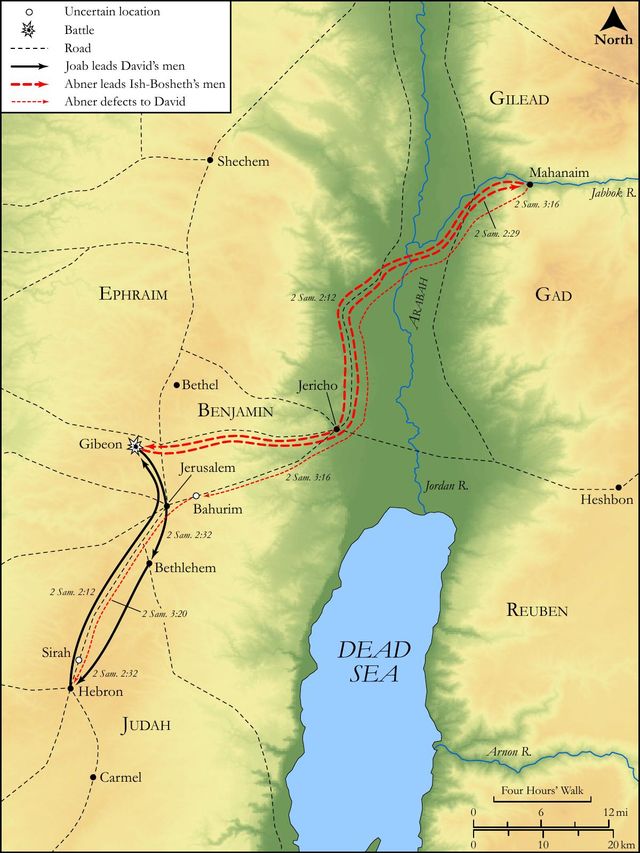
III.The armies being separated, both retired to the places whence they came, and both marched in the night, Abner to Mahanaim, on the other side Jordan (Sa2 2:29), and Joab to Hebron, where David was, Sa2 2:32. The slain on both sides are computed. On David's side only nineteen men were missing, besides Asahel (Sa2 2:30), who was worth more than all; on Abner's side 360, Sa2 2:31. In civil wars formerly great slaughters had been made (as Jdg 12:6; Jdg 20:44), in comparison with which this was nothing. It is to be hoped that they had grown wiser and more moderate. Asahel's funeral is here mentioned; the rest they buried in the field of battle, but he was carried to Bethlehem, and buried in the sepulchre of his father, Sa2 2:32. Thus are distinctions made between the dust of some and that of others; but in the resurrection no other difference will be made but that between godly and ungodly, which will remain for ever.
Continue studying 2 Samuel 2:25 across the web’s major study libraries — every link below opens this exact verse, chapter, or book on the destination site.
Read & Compare
 BibleGatewayThis verse in more than 200 translations and 70 languages.
 Bible.comThe YouVersion reader — hundreds of translations, reading plans, and highlights.
 ESV.orgCrossway's official English Standard Version reader.
 NET BibleThe NET translation with 60,000+ translators' notes on every rendering decision.
 STEP BibleTyndale House's free study tool — original text, vocabulary, and scholarly resources.
 BibliaLogos Bible Software's free web reader.
 USCCBThe New American Bible (Revised Edition) with the U.S. bishops' study notes.
Commentaries
 BibleHub CommentariesDozens of classic commentaries on this verse, gathered on one page.
 StudyLightMore than 100 commentary sets — the largest collection on the web.
 BibleRefPlain-English commentary on what this verse means, verse by verse.
 Enduring WordDavid Guzik's free commentary on this chapter, widely used by Bible teachers.
 Bible Study ToolsVerse commentary alongside Greek and Hebrew study aids.
Original Language & Research
- BibleHub InterlinearThe verse word by word — original language, transliteration, and English.
- BibleHub LexiconEvery word's original-language definition and Strong's entry.
 Blue Letter BibleDeep-study tools — Strong's numbers, concordance, and word studies.
 SefariaThe Hebrew text with Rashi and centuries of Jewish commentary.
Sermons, Hymns & Audio


TrulyRandomVerse is not affiliated with these sites and doesn’t control their content. They’re linked because they’re genuinely useful.
Summary
Following the tragic death of Asahel at Abner's hand, this verse marks a pivotal moment in the escalating civil war between the house of Saul and the house of David. It vividly describes the Benjamite forces, loyal to Saul's lineage, rallying with discipline around their commander Abner, consolidating into a unified military troop, and strategically securing a defensible position atop a hill. This action underscores the deep tribal loyalties and the tactical acumen at play as Abner's men transition from a desperate flight to a prepared stand, signaling a temporary cessation of direct combat and setting the stage for negotiation.
Context
ShowHideLiterary Context
This verse immediately follows the grim climax of 2 Samuel 2:23, where Abner, in self-defense, reluctantly kills Asahel, Joab's swift brother. The narrative in 2 Samuel 2:24 then details Joab and Abishai's relentless pursuit of Abner and his men, driving them towards a strategic regrouping. Verse 25, therefore, represents a critical shift from chaotic pursuit and individual combat to a deliberate, organized defensive posture. It highlights Abner's leadership in preventing a rout and establishing a tactical advantage, setting the immediate scene for the parley between Abner and Joab in 2 Samuel 2:26, which temporarily halts the bloodshed. This strategic pause is crucial for the narrative's progression, moving from the heat of battle to a moment of tense negotiation.
Historical & Cultural Context
The period described in 2 Samuel is one of profound political fragmentation and civil war following the death of King Saul. While David had been divinely anointed and recognized as king in Judah (2 Samuel 2:4), Abner, Saul's cousin and army commander, had established Saul's son, Ish-bosheth, as king over the northern tribes of Israel (2 Samuel 2:8-10). This created a divided kingdom, leading to the protracted conflict described as "long war" in 2 Samuel 3:1. The "children of Benjamin" refer to the tribe from which Saul originated, and their loyalty to Abner and Ish-bosheth was deeply rooted in tribal allegiance, a desire to preserve their political prominence, and a sense of continuity with Saul's dynasty. Militarily, standing "on the top of an hill" was a common and effective defensive tactic in ancient warfare, providing a clear vantage point and forcing attackers to fight uphill, thereby exposing them and making a charge significantly more difficult.
Key Themes
ShowHideThis verse powerfully illustrates several key themes central to the early chapters of 2 Samuel. Firstly, Tribal Loyalty and Allegiance is profoundly evident; the Benjamites' immediate rallying around Abner demonstrates the enduring strength of tribal bonds in ancient Israel, which often superseded national unity, directly contributing to the prolonged conflict between the houses of Saul and David. Secondly, Strategic Consolidation and Defense highlights the practical realities of ancient warfare; Abner's decisive action to gather his forces and occupy high ground reflects sound military strategy, emphasizing the critical importance of tactical positioning for survival and negotiation. This contrasts sharply with the earlier, more impetuous actions of Asahel, who pursued Abner recklessly. Finally, the verse underscores the Tragic Reality of Civil War, where even after a day of bloody conflict, deeply entrenched divisions persist, and both sides remain prepared for further engagement. This reflects the deep-seated political and personal animosities that characterized this turbulent period in Israel's history, a theme that resonates throughout the book as the nation struggles towards unity under David's eventual reign, as prophesied in passages like 1 Samuel 13:14.
Exposition and Analysis
ShowHideKey Word Analysis
ShowHideThis verb, derived from a primitive root meaning "to grasp" or "collect," implies a deliberate and intentional act of assembly. It signifies that the Benjamite forces did not merely scatter or accidentally converge, but rather consciously consolidated their numbers. This action indicates discipline, a shared purpose, and a collective decision to unite behind Abner, even in the midst of retreat and exhaustion, demonstrating their resolve and cohesion.
This term, a feminine passive participle meaning "a band, bundle, knot, or arch," denotes a compact, unified company or organized unit. It emphasizes the cohesion and solidarity of the Benjamite forces, highlighting that they were not a disparate group of individuals but a well-formed, collective body ready for concerted action. This unity was critical for their defensive posture, transforming them from a fleeing group into a formidable, organized entity.
This primitive root means "to stand" in various relations, often implying taking a firm, fixed position. In this context, it signifies a decisive halt to their flight and the adoption of a defensive or resistant stance. It contrasts sharply with the preceding pursuit, indicating that Abner's men were no longer fleeing but had chosen to make a resolute stand. This "standing" asserts their presence, defies further immediate attack, and implies readiness for either renewed confrontation or negotiation.
Verse Breakdown
ShowHide"And the children of Benjamin gathered themselves together after Abner,"
This clause identifies the specific group involved—the Benjamites, who were King Saul's kinsmen—and highlights their allegiance to Abner, the commander of Saul's army. Their act of "gathering" signifies a deliberate assembly and consolidation of forces, underscoring their loyalty and readiness to follow Abner's leadership, particularly after the dramatic and costly events of Asahel's death. This demonstrates a strong tribal and political bond.
"and became one troop,"
This phrase emphasizes the transformation of the Benjamite forces from potentially scattered individuals or smaller groups into a unified, cohesive military unit. The use of "one troop" (Hebrew: aguddah) underscores their solidarity, discipline, and collective strength, which was crucial for their survival and strategic positioning in the face of continued pursuit. It speaks to their organized resistance.
"and stood on the top of an hill."
This final clause describes their crucial strategic action. By taking a stand "on the top of an hill," Abner's forces secured a defensible elevated position. This provided a significant tactical advantage, offering a clear view of their pursuers and making it exceedingly difficult for Joab and Abishai to launch an immediate, effective assault, thereby allowing Abner's men to regroup, recover, and prepare for the parley that immediately follows.
Literary Devices
ShowHideThe verse employs several effective literary devices to convey its meaning and impact. Symbolism is evident in the "hill" itself, which serves as a potent symbol of defense, strategic advantage, and a rallying point. It represents a place of security and resistance in the face of pursuit, allowing the Benjamites to transition from flight to a fortified stance. The formation of "one troop" demonstrates Unity and Cohesion, contrasting sharply with the potential for chaos and disarray in battle. This collective action highlights the strong tribal identity and loyalty that bound the Benjamites together. Furthermore, the scene presents a powerful Foreshadowing of the continued, entrenched resistance of Saul's house against David's, indicating that the conflict is far from over and will require more than mere military might to resolve. The deliberate "standing" after a period of chaotic pursuit also creates a stark Contrast, emphasizing a significant shift from flight to a more organized and determined opposition.
Theological and Thematic Connections
ShowHideThe scene in [2 Samuel 2:25], while rooted in ancient military strategy and tribal loyalties, offers profound theological and thematic insights. It underscores the pervasive human tendency towards division and conflict, particularly when identity, power, and earthly allegiances are at stake. It serves as a stark reminder that even God's chosen people can be fractured by internal strife. The unity of the Benjamites, though admirable in a military sense, is ultimately in opposition to God's chosen king, David, highlighting how human unity, if misdirected or based on carnal loyalties, can perpetuate strife rather than peace. This situation foreshadows the broader narrative of Israel's struggle with internal division, which ultimately led to the split kingdom centuries later. Yet, even amidst such human conflict and resistance to His anointed, God's sovereign plan for David's kingship continues to unfold, demonstrating His ability to work through and beyond human machinations to achieve His divine purposes.
Reflection and Application
ShowHideThe Benjamites' strategic consolidation on the hilltop serves as a powerful metaphor for spiritual preparedness and the importance of unity in the face of opposition. Just as Abner's forces recognized the dire need to regroup and take a defensible stand, believers are called to be vigilant and spiritually fortified in their faith. We are not to be aimlessly pursued by the challenges of life, the temptations of the world, or the schemes of the enemy, but rather to "stand firm" in the truth of God's Word and the power of the Holy Spirit. This involves intentionally gathering ourselves around Christ, becoming "one troop" in purpose and conviction, and taking a resolute stand on the "high ground" of biblical principles. Our ultimate allegiance must be to Christ, transcending any earthly tribalism, personal agenda, or denominational differences that might divide us. In a world often marked by fragmentation and conflict, the church is called to demonstrate the transformative power of unity in Christ, reflecting His love and reconciliation to a watching world, proving that true strength comes from divine alignment, not human alliances.
Questions for Reflection
ShowHideFAQ
ShowHideWhy did the children of Benjamin specifically gather after Abner?
ShowHideThe children of Benjamin were King Saul's tribe, and Abner was Saul's cousin and the commander of his army. After Saul's death, Abner championed Saul's son, Ish-bosheth, as the rightful king over Israel, in direct opposition to David, who had been anointed king over Judah. Therefore, the Benjamites' gathering after Abner was a natural expression of their deep tribal loyalty to Saul's lineage and their unwavering allegiance to the leader who represented their interests in the ongoing civil war. It was a political and familial consolidation of power against the rising house of David, as highlighted throughout 2 Samuel 2. Their actions reflect the deep-seated divisions and loyalties characteristic of this turbulent period.
What was the significance of standing "on the top of an hill"?
ShowHideStanding "on the top of an hill" was a crucial military tactic in ancient warfare, providing a significant defensive advantage. An elevated position offers a clear vantage point for observation, making it easier to spot approaching enemies and assess their movements. More importantly, it forces an attacking force to fight uphill, which is physically exhausting and exposes them to projectiles from above, making a direct assault far more difficult and costly. For Abner's exhausted and pursued forces, taking the high ground allowed them to regroup, assess their precarious situation, and negotiate from a position of relative strength, rather than being overwhelmed by Joab and Abishai's continued pursuit. It was a strategic move to halt the immediate conflict and prepare for the parley that followed in 2 Samuel 2:26, demonstrating Abner's tactical acumen.
Christ-Centered Fulfillment
ShowHideWhile [2 Samuel 2:25] depicts a scene of earthly tribal loyalty and military strategy in a divided kingdom, it ultimately points forward to the true King, Jesus Christ, who perfectly fulfills the longing for unity and secure standing. Unlike the Benjamites, whose unity was based on tribal allegiance and opposition to God's chosen king (David), Christ establishes a spiritual kingdom that transcends all earthly divisions. He is the ultimate "hill" or "mountain" upon which God's eternal kingdom is established, not by human might or tribal loyalty, but by divine grace and sacrificial love. Jesus himself declared, "My kingdom is not of this world" (John 18:36), contrasting with the earthly power struggles seen in 2 Samuel. Through His death and resurrection, Christ breaks down the dividing walls of hostility, making "one new man" out of Jew and Gentile (Ephesians 2:14-16). His followers are called to be "one troop" not in military opposition, but in spiritual unity, bound together by the Holy Spirit, demonstrating the power of His love to a broken world (John 17:20-23). In Christ, we find our true identity and a secure, eternal standing, not on a temporary earthly hill, but in the unshakeable Kingdom of God, where a house divided against itself cannot stand (Matthew 12:25), but the unified body of Christ triumphs in eternal victory.