


Colossians 3:13
- ἀνεχόμενοιanechomenoibearing withG430V-PNP-NPMVerb Present Middle Or Passive Deponent Participle Nominative Plural Masculine
- ἀλλήλωνallēlōneach otherG240C-GPMReciprocal pronoun Genitive Plural Masculine
- καὶkaiandG2532CONJConjunction
- χαριζόμενοιcharizomenoiforgivingG5483V-PNP-NPMVerb Present Middle Or Passive Deponent Participle Nominative Plural Masculine
- ἑαυτοῖςhe'autoiseach otherG1438F-2DPMReflexive pronoun Dative 2nd Plural Masculine
- ἐάνeanIfG1437CONDConjunction
- τιςtisanyoneG5100X-NSMIndefinite pronoun Nominative Singular Masculine
- πρόςprosagainstG4314PREPPreposition
- τιναtinaanotherG5100X-ASMIndefinite pronoun Accusative Singular Masculine
- ἔχῃechēshall haveG2192V-PAS-3SVerb Present Active Subjunctive 3rd Singular
- μομφήν·momphēna complaintG3437N-ASFNoun Accusative Singular Feminine
- καθὼςkathōseven asG2531CONJConjunction
- καὶkaialsoG2532CONJConjunction
- ὁhotheG3588T-NSMDefinite article Nominative Singular Masculine
- κύριοςkuriosLordG2962N-NSM-TNoun Nominative Singular Masculine Title
- ἐχαρίσατοecharisatohas forgivenG5483V-ADI-3SVerb Aorist Middle Deponent Indicative 3rd Singular
- ὑμῖνhuminyouG4771P-2DPPersonal pronoun Dative 2nd Plural
- οὕτωςhoutōssoG3779ADVAdverb
- καὶkaialsoG2532CONJConjunction
- ὑμεῖς·humeisyouG4771P-2NPPersonal pronoun Nominative 2nd Plural
English is a literal word-by-word gloss of the Greek, not the KJV's wording. Why?
This is the original text the KJV's translators worked from — each Greek word with its own literal English meaning in this verse, prepared by scholars at Tyndale House, Cambridge. The KJV translates whole sentences, not word by word, so its wording differs: one Greek word can become several English words, and the KJV may choose “charity” where the gloss reads “love”. Both are faithful — they answer different questions. For the KJV's own rendering, switch to the KJV text.
Details
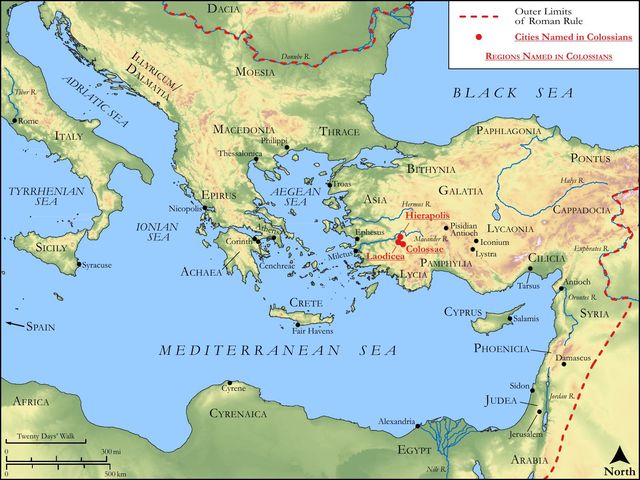
See on the biblical-era map

Study this verse
Public-domain commentary
Matthew Henry
From his Commentary on the Whole Bible. Henry comments on passages, not single verses — this entry covers Colossians 3:12–17. His three-level outline is real structure in the source text, so it is rendered as structure.
The apostle proceeds to exhort to mutual love and compassion: Put on therefore bowels of mercy, Col 3:12. We must not only put off anger and wrath (as Col 3:8), but we must put on compassion and kindness; not only cease to do evil, but learn to do well; not only not do hurt to any, but do what good we can to all.
I.The argument here used to enforce the exhortation is very affecting: Put on, as the elect of God, holy and beloved. Observe,
1.Those who are holy are the elect of God; and those who are the elect of God, and holy, are beloved - beloved of God, and ought to be so of all men.
2.Those who are the elect of God, holy and beloved, ought to conduct themselves in every thing as becomes them, and so as not to lose the credit of their holiness, nor the comfort of their being chosen and beloved. It becomes those who are holy towards God to be lowly and loving towards all men. Observe, What we must put on in particular.
(1.)Compassion towards the miserable: Bowels of mercy, the tenderest mercies. Those who owe so much to mercy ought to be merciful to all who are proper objects of mercy. Be you merciful, as your Father is merciful, Luk 6:36.
(2.)Kindness towards our friends, and those who love us. A courteous disposition becomes the elect of God; for the design of the gospel is not only to soften the minds of men, but to sweeten them, and to promote friendship among men as well as reconciliation with God.
(3.)Humbleness of mind, in submission to those above us, and condescension to those below us. There must not only be a humble demeanour, but a humble mind. Learn of me, for I am meek and lowly in heart, Mat 11:29.
(4.)Meekness towards those who have provoked us, or been any way injurious to us. We must not be transported into any indecency by our resentment of indignities and neglects: but must prudently bridle our own anger, and patiently bear the anger of others.
(5.)Long-suffering towards those who continue to provoke us. Charity suffereth long, as well as is kind, Co1 13:4. Many can bear a short provocation who are weary of bearing when it grows long. But we must suffer long both the injuries of men and the rebukes of divine Providence. If God is long-suffering to us, under all our provocations of him, we should exercise long-suffering to others in like cases.
(6.)Mutual forbearance, in consideration of the infirmities and deficiencies under which we all labour: Forbearing one another. We have all of us something which needs to be borne with, and this is a good reason why we should bear with others in what is disagreeable to us. We need the same good turn from others which we are bound to show them.
(7.)A readiness to forgive injuries: Forgiving one another, if any man have a quarrel against any. While we are in this world, where there is so much corruption in our hearts, and so much occasion of difference and contention, quarrels will sometimes happen, even among the elect of God, who are holy and beloved, as Paul and Barnabas had a sharp contention, which parted them asunder one from the other (Act 15:39), and Paul and Peter, Gal 2:14. But it is our duty to forgive one another in such cases; not to bear any grudge, but put up with the affront and pass it by. And the reason is: Even as Christ forgave you, so also do you. The consideration that we are forgiven by Christ so many offences is a good reason why we should forgive others. It is an argument of the divinity of Christ that he had power on earth to forgive sins; and it is a branch of his example which we are obliged to follow, if we ourselves would be forgiven. Forgive us our trespasses, as we forgive those who trespass against us, Mat 6:12.
II.In order to all this, we are exhorted here to several things:
- 1. To clothe ourselves with love (Col 3:14): Above all things put on charity: epi pasi di toutois - over all things. Let this be the upper garment, the robe, the livery, the mark of our dignity and distinction. Or, Let this be principal and chief, as the whole sum and abstract of the second table. Add to faith virtue, and to brotherly-kindness charity, Pe2 1:5-7. He lays the foundation in faith, and the top-stone in charity, which is the bond of perfectness, the cement and centre of all happy society. Christian unity consists of unanimity and mutual love. 2. To submit ourselves to the government of the peace of God (Col 3:15): Let the peace of God rule in your hearts, that is, God's being at peace with you, and the comfortable sense of his acceptance and favour: or, a disposition to peace among yourselves, a peaceable spirit, that keeps the peace, and makes peace. This is called the peace of God, because it is of his working in all who are his. The kingdom of God is righteousness and peace, Rom 14:17. "Let this peace rule in your heart - prevail and govern there, or as an umpire decide all matters of difference among you." - To which you are called in one body. We are called to this peace, to peace with God as our privilege and peace with our brethren as our duty. Being united in one body, we are called to be at peace one with another, as the members of the natural body; for we are the body of Christ, and members in particular, Co1 12:27. To preserve in us this peaceable disposition, we must be thankful. The work of thanksgiving to God is such a sweet and pleasant work that it will help to make us sweet and pleasant towards all men. "Instead of envying one another upon account of any particular favours and excellence, be thankful for his mercies, which are common to all of you." 3. To let the word of Christ dwell in us richly, Col 3:16. The gospel is the word of Christ, which has come to us; but that is not enough, it must dwell in us, or keep house - enoikeitō, not as a servant in a family, who is under another's control, but as a master, who has a right to prescribe to and direct all under his roof. We must take our instructions and directions from it, and our portion of meat and strength, of grace and comfort, in due season, as from the master of the household. It must dwell in us; that is, be always ready and at hand to us in every thing, and have its due influence and use. We must be familiarly acquainted with it, and know it for our good, Job 5:27. It must dwell in us richly: not only keep house in our hearts, but keep a good house. Many have the word of Christ dwelling in them, but it dwells in them but poorly; it has no mighty force and influence upon them. Then the soul prospers when the word of God dwells in us richly, when we have abundance of it in us, and are full of the scriptures and of the grace of Christ. And this in all wisdom. The proper office of wisdom is to apply what we know to ourselves, for our own direction. The word of Christ must dwell in us, not in all notion and speculation, to make us doctors, but in all wisdom, to make us good Christians, and enable us to conduct ourselves in every thing as becomes Wisdom's children. 4. To teach and admonish one another. This would contribute very much to our furtherance in all grace; for we sharpen ourselves by quickening others, and improve our knowledge by communicating it for their edification. We must admonish one another in psalms and hymns. Observe, Singing of psalms is a gospel ordinance: psalmois kai humnois kai ōdais - the Psalms of David, and spiritual hymns and odes, collected out of the scripture, and suited to special occasions, instead of their lewd and profane songs in their idolatrous worship. Religious poesy seems countenanced by these expressions and is capable of great edification. But, when we sing psalms, we make no melody unless we sing with grace in our hearts, unless we are suitably affected with what we sing and go along in it with true devotion and understanding. Singing of psalms is a teaching ordinance as well as a praising ordinance; and we are not only to quicken and encourage ourselves, but to teach and admonish one another, mutually excite our affections, and convey instructions. 5. All must be done in the name of Christ (Col 3:17): And whatsoever you do in word or deed, do all in the name of the Lord Jesus, according to his command and in compliance with his authority, by strength derived from him, with an eye to his glory, and depending upon his merit for the acceptance of what is good and the pardon of what is amiss, Giving thanks to God and the Father by him. Observe, (1.) We must give thanks in all things; whatsoever we do, we must still give thanks, Eph 5:20, Giving thanks always for all things. (2.) The Lord Jesus must be the Mediator of our praises as well as of our prayers. We give thanks to God and the Father in the name of the Lord Jesus Christ, Eph 5:20. Those who do all things in Christ's name will never want matter of thanksgiving to God, even the Father.
Historical interpretation
Historical reception
2 surviving comments on this verse. Each one is dated, so this reads as a timeline rather than a list.
"Forbearing," he saith, "one another"; he showeth what is just. Thou forbearest him, and he thee; and so he says in the Epistle to the Galatians, "Bear ye one another's burdens."
"Forbearing one another, and forgiving each other, if any man have a complaint against any: even as Christ forgave you, so also do ye."
Again, he speaks after the class, and he always does it; for from kindness comes humbleness of mind, and from this, longsuffering. "Forbearing," he saith, "one another," that is, passing things over And see, how he has shown it to be nothing, by calling it a "complaint," and saying, "even as Christ forgave you." Great is the example! and thus he always does; he exhorts them after Christ. "Complaint," he calls it. In these words indeed he showed it to be a petty matter; but when he has set before us the example, he has persuaded us that even if we had serious charges to bring, we ought to forgive. For the expression, "Even as Christ," signifies this, and not this only, but also with all the heart; and not this alone, but that they ought even to love. For Christ being brought into the midst, bringeth in all these things, both that even if the matters be great, and even if we have not been the first to injure, even if we be of great, they of small account, even if they are sure to insult us afterwards, we ought to lay down our lives for them, (for the words, "even as," demand this;) and that not even at death only ought one to stop, but if possible, to go on even after death.
Continue studying Colossians 3:13 across the web’s major study libraries — every link below opens this exact verse, chapter, or book on the destination site.
Read & Compare
 BibleGatewayThis verse in more than 200 translations and 70 languages.
 Bible.comThe YouVersion reader — hundreds of translations, reading plans, and highlights.
 ESV.orgCrossway's official English Standard Version reader.
 NET BibleThe NET translation with 60,000+ translators' notes on every rendering decision.
 STEP BibleTyndale House's free study tool — original text, vocabulary, and scholarly resources.
 BibliaLogos Bible Software's free web reader.
 USCCBThe New American Bible (Revised Edition) with the U.S. bishops' study notes.
Commentaries
 BibleHub CommentariesDozens of classic commentaries on this verse, gathered on one page.
 StudyLightMore than 100 commentary sets — the largest collection on the web.
 BibleRefPlain-English commentary on what this verse means, verse by verse.
 Enduring WordDavid Guzik's free commentary on this chapter, widely used by Bible teachers.
 Bible Study ToolsVerse commentary alongside Greek and Hebrew study aids.
Original Language & Research
- BibleHub InterlinearThe verse word by word — original language, transliteration, and English.
- BibleHub LexiconEvery word's original-language definition and Strong's entry.
 Blue Letter BibleDeep-study tools — Strong's numbers, concordance, and word studies.
 CNTR CollationThe earliest Greek manuscripts of this verse, collated letter by letter.
Sermons, Hymns & Audio


TrulyRandomVerse is not affiliated with these sites and doesn’t control their content. They’re linked because they’re genuinely useful.
Summary
Colossians 3:13 serves as a foundational exhortation for Christian community, urging believers to actively practice patience and pardon within their relationships. It calls for a spirit of mutual endurance and a readiness to release grievances, acknowledging that conflicts will inevitably arise among imperfect people. The verse establishes the profound and unconditional forgiveness received from Christ as the ultimate standard and motivation for how believers are to extend grace to one another, thereby fostering unity and reflecting their new identity in Him.
Context
ShowHideLiterary Context
Colossians 3:13 is situated within the latter half of Paul's epistle, which shifts from deep theological exposition (chapters 1-2) to practical ethical instruction for Christian living (chapters 3-4). Specifically, it follows Paul's command for believers to "put off" the old self with its corrupt practices (such as anger, malice, slander, and filthy language, as detailed in Colossians 3:8) and to "put on" the new self, which is being renewed in the image of its Creator (Colossians 3:10). Immediately preceding verse 13, Paul lists virtues that characterize this new self, including compassion, kindness, humility, gentleness, and patience (Colossians 3:12). Thus, "forbearing" and "forgiving" are presented not merely as isolated commands but as concrete expressions and outworkings of these divinely-imparted virtues, essential for maintaining peace and unity within the body of Christ.
Historical & Cultural Context
The city of Colossae was a significant center in Phrygia, part of the Roman province of Asia Minor. The church there faced a unique blend of philosophical and religious challenges, often referred to as the "Colossian heresy." This syncretistic teaching likely combined elements of Jewish legalism (observance of festivals, dietary laws, circumcision), asceticism (denial of bodily pleasures), angel worship, and a mystical emphasis on secret knowledge. Such a diverse and potentially divisive environment underscored the critical need for internal harmony and practical love among believers. Paul's emphasis on unity, forbearance, and forgiveness was not merely an abstract theological point but a vital directive for a community susceptible to internal strife due to external pressures and differing interpretations of spiritual truth. The cultural backdrop also included a Roman societal structure that often valued honor, status, and retribution, making the Christian call to humility, patience, and unconditional forgiveness a radical counter-cultural ethic.
Key Themes
ShowHideColossians 3:13 significantly contributes to several overarching themes in the epistle. It deeply reinforces the theme of Christian Identity and Transformation, asserting that believers, having been raised with Christ (Colossians 3:1), are called to live out their new nature in practical ways. The verse also underscores the theme of Community and Unity, providing essential behavioral guidelines for maintaining peace and cohesion within the church, which is the body of Christ (Colossians 1:18). Furthermore, it highlights the theme of Christ as the Exemplar and Standard, as the command to forgive is explicitly anchored in Christ's own act of forgiveness towards His followers. This connection elevates Christian ethics from mere human effort to a divine imperative, demonstrating that the believer's life is to be a continuous reflection of Christ's character and work, as seen throughout the New Testament, such as in Ephesians 4:32.
Exposition and Analysis
ShowHideKey Word Analysis
ShowHideThis word, derived from a combination of "up" (ἀνά) and "to hold" (ἔχω), literally means "to hold oneself up against." In this context, it signifies patiently enduring, tolerating, or putting up with the imperfections, annoyances, and shortcomings of others. It implies a conscious, active choice to bear with difficulties rather than react impulsively or defensively, suggesting a long-suffering attitude essential for community harmony.
Related to the Greek word for "grace" (charis), this verb means "to grant as a favor," "to give freely," or "to pardon gratuitously." It emphasizes that forgiveness is not earned but freely bestowed, mirroring the unmerited grace God extends to humanity. This is an active release of resentment, a cancellation of debt, and a restoration of relationship, not merely a passive overlooking of an offense.
This term refers to a "blame," "fault," "complaint," or "ground for accusation." It acknowledges that within human relationships, legitimate grievances and reasons for complaint will arise. The presence of a "quarrel" does not negate the command to forgive; rather, it provides the specific context in which forgiveness is most needed and most profoundly demonstrated.
Verse Breakdown
ShowHide"Forbearing one another"
This initial command calls for a proactive posture of patience and endurance within the Christian community. It recognizes the inherent challenges of living in close fellowship with imperfect individuals and urges believers to exercise self-restraint and longsuffering, choosing to tolerate minor irritations and character flaws rather than allowing them to disrupt unity.
"and forgiving one another"
Building upon forbearance, this clause demands active, intentional pardon. It moves beyond passive tolerance to a deliberate act of releasing the other person from the debt of their offense, whether real or perceived. This is a vital component for conflict resolution and the healing of relational wounds.
"if any man have a quarrel against any"
This conditional phrase acknowledges the reality of human sin and conflict. It anticipates that grievances, complaints, or legitimate reasons for blame will inevitably arise among believers. The command to forgive is not for a hypothetical situation but for the very real and common experience of being wronged or having a complaint against another.
"even as Christ forgave you, so also [do] ye"
This climactic phrase provides both the motivation and the standard for Christian forgiveness. The believer's capacity and willingness to forgive are to be directly patterned after the boundless, unmerited, and radical forgiveness that Christ Himself extended to them. This elevates forgiveness from a human effort to a divine imperative, making it a tangible expression of gratitude for the grace received and a reflection of Christ's character.
Literary Devices
ShowHideColossians 3:13 employs several effective literary devices. Imperative Mood is central, as Paul issues direct commands ("Forbearing," "forgiving"), emphasizing the non-negotiable nature of these actions for Christian living. The phrase "one another" functions as a form of Reciprocity, highlighting the mutual responsibility within the community; forgiveness and forbearance are not unilateral but are expected to flow both ways. The most powerful device is Analogy or Exemplification, specifically a Christological Analogy, where Christ's forgiveness ("even as Christ forgave you") serves as the ultimate model and motivation for believers' actions ("so also [do] ye"). This establishes a divine standard for human behavior, transforming a moral obligation into a spiritual imitation. The conditional clause "if any man have a quarrel against any" is a form of Anticipation, acknowledging the inevitability of conflict and proactively providing the divine solution.
Theological and Thematic Connections
ShowHideColossians 3:13 powerfully articulates the practical outworking of the Gospel in the daily lives of believers. It underscores that Christian ethics are not merely a set of rules but a response to the profound grace received in Christ. The command to forgive and forbear is a direct reflection of God's character and His redemptive work, demonstrating that those who have been reconciled to God are now called to be agents of reconciliation among themselves. This mutual forbearance and forgiveness are essential for the health and witness of the church, enabling it to function as a unified body that genuinely reflects the love and grace of its Head, Jesus Christ. This verse highlights that genuine spiritual transformation leads to tangible changes in interpersonal relationships, moving from self-centeredness to Christ-centered love.
Reflection and Application
ShowHideColossians 3:13 presents a profound challenge and a liberating truth for every believer. In a world often characterized by quick offense, lingering grudges, and the pursuit of retribution, this verse calls us to a radically different way of relating—one shaped by divine grace. It compels us to honestly examine our own hearts: Do we readily extend patience to those who irritate us, or do we quickly become exasperated? When wronged, do we nurse grievances, or do we actively choose to pardon, releasing both the offender and ourselves from the bondage of bitterness? The power to truly forbear and forgive does not originate from our own strength but flows from the wellspring of Christ's forgiveness in our lives. As we remember the immeasurable grace we have received—how Christ bore with our sin and forgave our rebellion—we are empowered to extend that same grace to others, transforming our relationships and testifying to the world of the reconciling power of the Gospel. Living out this verse is not always easy, but it is always essential for the health of the church and the authenticity of our witness.
Questions for Reflection
ShowHideFAQ
ShowHideWhat is the difference between "forbearing" and "forgiving" in this verse?
ShowHideWhile closely related and often practiced together, "forbearing" (Greek, anéchomai') emphasizes patiently enduring or tolerating the imperfections, annoyances, and shortcomings of others without retaliation or resentment. It's about putting up with someone's flaws or difficult behaviors. "Forgiving" (Greek, charízomai'), on the other hand, is an active, intentional release of a grievance or offense. It's about pardoning a wrong that has been committed, canceling a debt, and restoring a broken relationship. Forbearance is about patience in the face of persistent annoyances, while forgiveness is about releasing a specific wrong or injury.
Does "if any man have a quarrel against any" imply that forgiveness is only necessary when there's a formal complaint?
ShowHideNo, this phrase does not limit the scope of forgiveness to only formal or explicitly stated complaints. Instead, it acknowledges the reality that grievances, whether spoken or unspoken, real or perceived, will arise in human relationships. The Greek word for "quarrel" (momphḗ') can refer to any ground for blame or accusation. Therefore, the verse implies that whenever an offense or perceived wrong occurs—whether it leads to an open conflict or a silent resentment—the Christian response should be forgiveness, patterned after Christ's example. It's a call to proactive reconciliation, even before a "quarrel" escalates.
Christ-Centered Fulfillment
ShowHideColossians 3:13 finds its ultimate fulfillment and deepest meaning in the person and work of Jesus Christ. The command to "forbear one another, and forgiving one another" is not a mere ethical guideline but a direct imitation of Christ's own character and redemptive action. It is Christ who perfectly "forbore" the weaknesses, failures, and betrayals of His disciples, patiently enduring their lack of understanding and their desertion, even to the cross (Luke 22:47-53). More profoundly, it is Christ who "forgave" humanity its gravest offense—sin against a holy God—by offering Himself as the ultimate sacrifice. His cry from the cross, "Father, forgive them, for they know not what they do," embodies the very essence of the forgiveness we are called to extend. Our capacity to forgive others is not an inherent human virtue but a supernatural outflow of the forgiveness we have received from Him, who reconciled us to God through His blood (Colossians 1:20). Thus, living out Colossians 3:13 is a tangible demonstration of our union with Christ, a participation in His redemptive work, and a powerful testimony to the world of the transformative power of His grace, echoing the call to love as He loved us (John 13:34).