


2 Samuel 11:12
Bible text: King James Version (1769 Blayney text) · Public domain
Bible text: Berean Standard Bible · Public domain
Bible text: American Standard Version (1901) · Public domain
Bible text: World English Bible, Messianic edition · Public domain
Bible text: Geneva Bible (1599) · Public domain
Bible text: Young's Literal Translation · Public domain
- וַיֹּאמֶרvai·Yo·merand he saidH559Conj-w ¦ V-Qal-ConsecImperf-3msVerb Qal Consecutive Imperfect 3rd Singular Masculineוַandיֹּאמֶרhe said
- דָּוִדda·VidDavidH1732N-proper-mNoun Proper Masculine
- אֶל'eltoH413PrepPreposition
- אוּרִיָּה'u·ri·YahUriahH223N-proper-mNoun Proper Masculine
- שֵׁבshevremainH3427V-Qal-Imp-2msVerb Qal Imperative 2nd Singular Masculine
- בָּזֶהba·Zehin this [place]H2088Prep-b ¦ PrtParticle Demonstrativeבָּinזֶהthis [place]
- גַּםgamalsoH1571AdvAdverb
- הַיּוֹםhai·Yomthis dayH3117Art ¦ N-msNoun Singular Masculine Absoluteהַthisיּוֹםday
- וּמָחָרu·ma·Charand tomorrowH4279Conj-w ¦ N-msNoun Singular Masculine Absoluteוּandמָחָרtomorrow
- אֲשַׁלְּחֶךָּ'a·sha·le·Che·kaI will let go youH7971V-Piel-Imperf-1cs ¦ 2msVerb Piel Imperfect 1st Singular common genderאֲשַׁלְּחֶI will let goךָּyou
- וַיֵּשֶׁבvai·Ye·shevand he remainedH3427Conj-w ¦ V-Qal-ConsecImperf-3msVerb Qal Consecutive Imperfect 3rd Singular Masculineוַandיֵּשֶׁבhe remained
- אוּרִיָּה'u·ri·YahUriahH223N-proper-mNoun Proper Masculine
- בִירוּשָׁלִַםvi·ru·sha·Limin JerusalemH3389Prep-b ¦ N-properNoun Proper LocationבִinירוּשָׁלִַםJerusalem
- בַּיּוֹםbai·Yomon the dayH3117Prep-b ¦ N-msNoun Singular Masculine Absoluteבַּon theיּוֹםday
- הַהוּאha·Hu'<the> thatH1931Art ¦ Pro-3msPronoun Personal 3rd Singular Masculineהַ<the>הוּאthat
- וּמִמָּחֳרָתu·Mi·mo·cho·Ratand from [the] next dayH4283Conj-w ¦ Prep-m ¦ N-fsNoun Singular Feminine Absoluteוּandמִfromמָּחֳרָת[the] next day
English is a literal word-by-word gloss of the Hebrew, not the KJV's wording. Why?
This is the original text the KJV's translators worked from — each Hebrew word with its own literal English meaning in this verse, prepared by scholars at Tyndale House, Cambridge. The KJV translates whole sentences, not word by word, so its wording differs: one Hebrew word can become several English words, and the KJV may choose “the LORD” where the gloss reads “Yahweh”. Both are faithful — they answer different questions. For the KJV's own rendering, switch to the KJV text.
Details
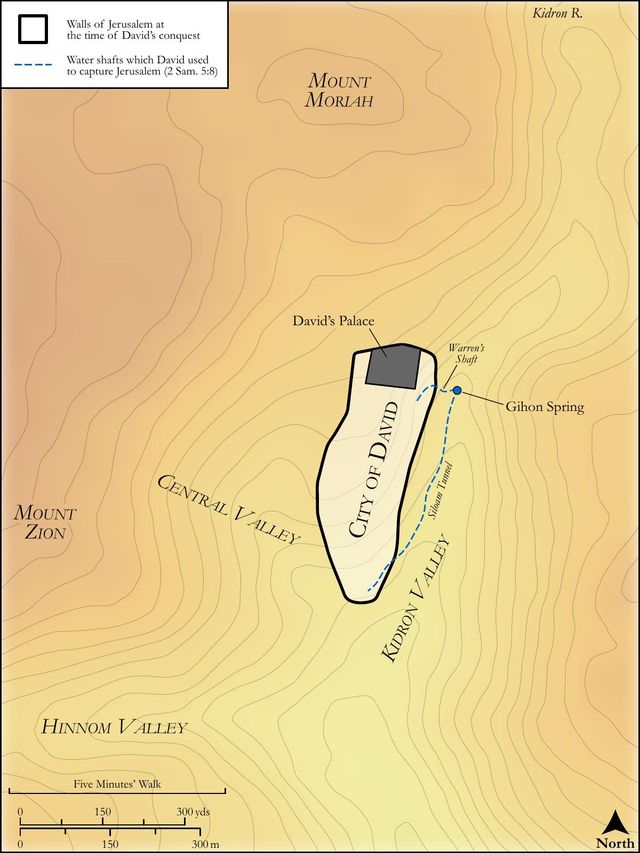
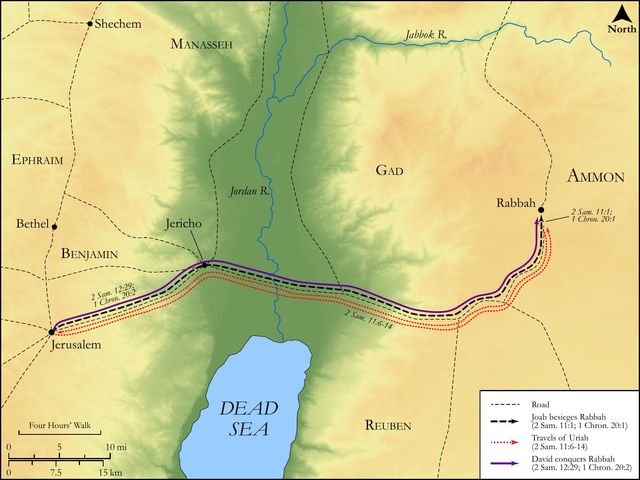
See on the biblical-era maps
Study this verse
Public-domain commentary
Matthew Henry
From his Commentary on the Whole Bible. Henry comments on passages, not single verses — this entry covers 2 Samuel 11:6–13. His four-level outline is real structure in the source text, so it is rendered as structure.
Uriah, we may suppose, had now been absent from his wife some weeks, making the campaign in the country of the Ammonites, and not intending to return till the end of it. The situation of his wife would bring to light the hidden works of darkness; and when Uriah, at his return, should find how he had been abused, and by whom, it might well be expected, 1. That he would prosecute his wife, according to law, and have her stoned to death; for jealousy is the rage of a man, especially a man of honour, and he that is thus injured will not spare in the day of vengeance, Pro 6:34. This Bath-sheba was apprehensive of when she sent to let David know she was with child, intimating that he was concerned to protect her, and, it is likely, if he had not promised her so to do (so wretchedly abusing his royal power), she would not have consented to him. Hope of impunity is a great encouragement to iniquity. 2. It might also be expected that since he could not prosecute David by law for an offence of this nature he would take his revenge another way, and raise a rebellion against him. There have been instances of kings who by provocations of this nature, given to some of their powerful subjects, have lost their crowns. To prevent this double mischief, David endeavours to father the child which should be born upon Uriah himself, and therefore sends for him home to stay a night or two with his wife. Observe,
I.How the plot was laid.
Uriah must come home from the army under pretence of bringing David an account how the war prospered, and how they went on with the siege of Rabbah, Sa2 11:7. Thus does he pretend a more than ordinary concern for his army when that was the least thing in his thoughts; if he had not had another turn to serve, an express of much less figure than Uriah might have sufficed to bring him a report of the state of the war. David, having had as much conference with Uriah as he thought requisite to cover the design, sent him to his house, and, that he might be the more pleasant there with the wife of his youth, sent a dish of meat after him for their supper, Sa2 11:8. When that project failed the first night, and Uriah, being weary of his journey and more desirous of sleep than meat, lay all night in the guard-chamber, the next night he made him drunk (Sa2 11:13), or made him merry, tempted him to drink more than was fit, that he might forget his vow (Sa2 11:11), and might be disposed to go home to his own bed, to which perhaps, if David could have made him dead drunk, he would have ordered him to be carried. It is a very wicked thing, upon any design whatsoever, to make a person drunk. Woe to him that does so, Hab 2:15, Hab 2:16. God will put a cup of trembling into the hands of those who put into the hands of others the cup of drunkenness. Robbing a man of his reason is worse than robbing him of his money, and drawing him into sin worse than drawing him into any trouble whatsoever. Every good man, especially every magistrate, should endeavour to prevent this sin, by admonishing, restraining, and denying the glass to those whom they see falling into excess; but to further it is to do the devil's work, to officiate as factor for him.
II.How this plot was defeated by Uriah's firm resolution not to lie in his own bed.
Both nights he slept with the life-guard, and went not down to his house, though, it is probable, his wife pressed him to do it as much as David, Sa2 11:9, Sa2 11:12. Now,
1.Some think he suspected what was done, being informed of his wife's attendance at court, and therefore he would not go near her. But if he had had any suspicion of that kind, surely he would have opened the letter that David sent by him to Joab.
2.Whether he suspected any thing or no, Providence put this resolution into his heart, and kept him to it, for the discovering of David's sin, and that the baffling of his design to conceal it might awaken David's conscience to confess it and repent of it.
3.The reason he gave to David for this strange instance of self-denial and mortification was very noble, Sa2 11:11. While the army was encamped in the field, he would not lie at ease in his own house. "The ark is in a tent," whether at home, in the tent David had pitched for it, or abroad, with Joab in the camp, is not certain. "Joab, and all the mighty men of Israel, lie hard and uneasy, and much exposed to the weather and to the enemy; and shall I go and take my ease and pleasure at my own house?" No, he protests he will not do it. Now,
(1.)This was in itself a generous resolution, and showed Uriah to be a man of a public spirit, bold and hardy, and mortified to the delights of sense. In times of public difficulty and danger it does not become us to repose ourselves in security, or roll ourselves in pleasure, or, with the king and Haman, to sit down to drink when the city Shushan was perplexed, Est 3:15. We should voluntarily endure hardness when the church of God is constrained to endure it.
(2.)It might have been of use to awaken David's conscience, and make his heart to smite him for what he had done.
[1.]That he had basely abused so brave a man as Uriah was, a man so heartily concerned for him and his kingdom, and that acted for him and it with so much vigour.
[2.]That he was himself so unlike him. The consideration of the public hardships and hazards kept Uriah from lawful pleasures, yet could not keep David, though more nearly interested, from unlawful ones. Uriah's severity to himself should have shamed David for his indulgence of himself. The law was, When the host goeth forth against the enemy then, in a special manner, keep thyself from every wicked thing, Deu 23:9. Uriah outdid that law, but David violated it.
Historical interpretation
Historical reception
1 surviving comment on this verse from the historical church.
We have taken up the task of writing an apology for the present style of the prophet David, not because he needs this gift, who has excelled in such great merits and flourished in virtues, but because many people, reading the sequence of his deeds without considering the power of the Scriptures or the hidden mysteries, wonder how such a great prophet did not avoid the contagion of adultery first and then of murder.
Therefore, it was our desire to review the history itself, which seems to have been exposed to sin. For in the second book of Kings (2 Samuel 11:2-27), we read that while David was walking in his royal palace, he saw a woman bathing (her name was Bathsheba), of remarkable beauty and grace, with a very attractive face, and he was overcome by the desire to possess her. However, the woman was married to a man named Uriah, and the scene of his death was arranged by royal command. For although it had no effect on his desire, yet it was considered to greatly impede his sense of shame for adultery.
Therefore, let us begin with the most obvious, whom God justified, so that you may not judge. 'For it is of little concern to me,' says Paul, 'that I should be judged by you or by any human court; indeed, I do not even judge myself' (1 Corinthians 4:3). Even though he was still in the body and subject to temptation, he did not judge himself because a spiritual person is not judged by anyone but God alone. Finally, he added, 'The one who judges me is the Lord' (1 Corinthians 4:4). Therefore, do not judge anything before the appointed time (ibid., 4 and 5). But David has already fulfilled his time and has earned grace, and he is justified by Christ; since David himself rejoiced in being called the son of the Lord, and those who confessed him in this way were enlightened. Why do you call a man of God from a reward to judgment? The Lord has already judged him, of whom he said to Solomon: If you walk before me as your father David walked in the holiness of heart and righteousness, in order to do everything I commanded him (3 Kings 9:4). Is he worthy of judgment or reward, who has done everything according to heavenly commands, walking in holiness and righteousness of heart? Where the vices and sins of others are hidden, there David receives divine testimony of his virtue and glory. And we discuss his sin in vain, for it is through his merit and grace that the sins of others have been revealed. For when Solomon sinned by not keeping the Lord's commands and God intended to divide his kingdom into many parts, He said to him: However, I will not do this in your days because of your father David. I will take it from the hand of your son. However, I will not take the whole kingdom; I will give him one scepter because of my servant David (3 Kings 11:12-13). Therefore, since the Lord justifies, who is there to condemn? What God has cleansed, you must not call common (Acts 10:15).
Nevertheless, with due regard to heavenly judgment, in which you honor the prophet even more, enter into his actions and behaviors. Do not marvel at the man, and do not judge him to be equal to the angels, because he has spent most of his life, even from childhood, dwelling in riches, honors, and positions of power, and has been subjected to many temptations. He has only once given in to error, and it is through this error that even the angels of heaven, as Scripture recounts (Genesis 6:2), were cast down from their virtue and grace. Indeed, another error of his is mentioned, that he caused the people to be counted.
Continue studying 2 Samuel 11:12 across the web’s major study libraries — every link below opens this exact verse, chapter, or book on the destination site.
Read & Compare
 BibleGatewayThis verse in more than 200 translations and 70 languages.
 Bible.comThe YouVersion reader — hundreds of translations, reading plans, and highlights.
 ESV.orgCrossway's official English Standard Version reader.
 NET BibleThe NET translation with 60,000+ translators' notes on every rendering decision.
 STEP BibleTyndale House's free study tool — original text, vocabulary, and scholarly resources.
 BibliaLogos Bible Software's free web reader.
 USCCBThe New American Bible (Revised Edition) with the U.S. bishops' study notes.
Commentaries
 BibleHub CommentariesDozens of classic commentaries on this verse, gathered on one page.
 StudyLightMore than 100 commentary sets — the largest collection on the web.
 BibleRefPlain-English commentary on what this verse means, verse by verse.
 Enduring WordDavid Guzik's free commentary on this chapter, widely used by Bible teachers.
 Bible Study ToolsVerse commentary alongside Greek and Hebrew study aids.
Original Language & Research
- BibleHub InterlinearThe verse word by word — original language, transliteration, and English.
- BibleHub LexiconEvery word's original-language definition and Strong's entry.
 Blue Letter BibleDeep-study tools — Strong's numbers, concordance, and word studies.
 SefariaThe Hebrew text with Rashi and centuries of Jewish commentary.
Sermons, Hymns & Audio


TrulyRandomVerse is not affiliated with these sites and doesn’t control their content. They’re linked because they’re genuinely useful.
Summary
2 Samuel 11:12 vividly portrays King David's deepening moral compromise as he persists in his deceptive efforts to conceal his adultery with Bathsheba. Having failed to coerce Uriah the Hittite into returning home and sleeping with his wife, David prolongs Uriah's stay in Jerusalem, hoping that extended time and further manipulation will lead Uriah to unwittingly legitimize Bathsheba's pregnancy. This verse starkly illustrates David's escalating descent into sin, marked by cunning and an abuse of royal authority, set against the backdrop of Uriah's unwavering integrity and tragic loyalty.
Context
ShowHideLiterary Context
This verse is a critical juncture in the unfolding tragedy of David's sin, which commences with his idle presence in Jerusalem while his army is at war, leading to his illicit encounter with Bathsheba in 2 Samuel 11:1-5. Upon learning of Bathsheba's pregnancy, David initiates a desperate cover-up. His first attempt, detailed in 2 Samuel 11:6-10, involves summoning Uriah from the siege of Rabbah, expecting him to fulfill his marital duties. However, Uriah's profound loyalty and military integrity, powerfully articulated in 2 Samuel 11:11, foils this initial scheme. Uriah's refusal to enjoy personal comfort while his comrades and the Ark of the Covenant are in the field forces David to escalate his manipulation. 2 Samuel 11:12 thus depicts David's second, more insidious attempt to control Uriah's actions, setting the stage for the king's ultimate, heinous crime of murder in 2 Samuel 11:14-17. The narrative meticulously chronicles David's spiraling moral decline from a man after God's own heart to a cunning deceiver and murderer.
Historical & Cultural Context
In ancient Israel, military campaigns were often viewed as sacred endeavors, and soldiers were expected to maintain a state of ritual purity and dedication while on active duty. Uriah's refusal to go home and sleep with his wife reflects this deep sense of loyalty and solidarity with his fellow soldiers and the sacred objects of the nation, such as the Ark of the Covenant, which was sometimes taken to battle. His statement in 2 Samuel 11:11 indicates a profound understanding of military ethics and a personal commitment to the war effort that superseded personal pleasure or even the king's implicit desires. Furthermore, paternity was paramount for lineage, inheritance, and social standing in Israelite society, making Bathsheba's pregnancy a significant issue that David desperately needed to resolve to avoid scandal. David's actions also represent a severe abuse of royal power; as king, he held immense authority over his subjects, including Uriah, and was divinely mandated to uphold justice, not subvert it for personal gain. The setting in Jerusalem, the capital, underscores David's ability to control circumstances and individuals within his immediate sphere of influence, though Uriah's integrity proves a formidable obstacle.
Key Themes
ShowHideThis verse powerfully contributes to several overarching themes within the book of 2 Samuel. Firstly, it highlights David's Escalating Deception and Abuse of Power. Having committed adultery, David compounds his sin with elaborate schemes of manipulation, demonstrating how unconfessed sin can lead to a destructive chain of further transgressions and the misuse of divine authority. His actions here are a stark departure from the righteous leadership expected of Israel's king. Secondly, it showcases Uriah's Unwavering Loyalty and Integrity, which stands in profound contrast to David's duplicity. Uriah's principled refusal to indulge himself while his comrades faced danger exemplifies profound honor, duty, and a strong moral compass, unwittingly thwarting the king's wicked designs. He embodies the ideal "man of war" in the noblest sense, prioritizing communal welfare over personal comfort, a virtue David has abandoned. Finally, the verse underscores The Futility of Human Attempts to Cover Up Sin. Despite David's royal authority and cunning, he cannot force Uriah to act against his principled nature. This failure sets the stage for David's even more heinous crime, illustrating that sin, when unconfessed, inevitably leads to deeper entanglement and ultimately, exposure, as Numbers 32:23 warns, "be sure your sin will find you out."
Exposition and Analysis
ShowHideKey Word Analysis
ShowHideFrom the same root as dôwd (loving), this name signifies "loving." Ironically, in this verse, David acts in a deeply unloving and manipulative manner toward Uriah, a loyal subject. His character, usually associated with devotion and integrity, is here shown in profound moral decline, highlighting the devastating impact of unconfessed sin on even the most revered individuals.
This verb, meaning "to sit down, dwell, abide, remain," is used in David's command, "Tarry here to day also." It signifies David's insistence that Uriah stay in Jerusalem, preventing his return home. David's intention is to keep Uriah within his manipulative control, hoping that prolonged exposure to the city's comforts or perhaps other influences (like drink, as seen in the next verse) would eventually lead him to break his principled stance and sleep with Bathsheba. It's a seemingly innocuous command, but laden with sinister intent.
A primitive root meaning "to send away, for, or out," this word is used in David's deceptive promise, "and to morrow I will let thee depart." This phrase is a calculated lie, designed to keep Uriah compliant and hopeful for a swift return to the battlefield, while David secretly plots further means to achieve his nefarious goal. The promise of departure is a tool of control, not an expression of genuine permission, underscoring David's cunning and moral bankruptcy.
Verse Breakdown
ShowHide"And David said to Uriah"
This opening clause immediately establishes the power dynamic. David, as king, is issuing a direct command to his subject, Uriah. It highlights David's active role in the deception and his willingness to exploit his authority for personal gain, rather than upholding justice and protecting the innocent.
"Tarry here to day also"
This reveals David's persistence and desperation. Having failed in his first attempt to send Uriah home, David is not giving up. The word "also" indicates a continuation of the previous day's command for Uriah to remain in Jerusalem, extending the window of opportunity for David's scheme to succeed and for Uriah to potentially succumb to the king's hidden agenda.
"and to morrow I will let thee depart"
This is a manipulative promise. David offers Uriah a false hope of returning to his duties, designed to keep him in Jerusalem without suspicion. This promise demonstrates David's cunning and his willingness to deceive to achieve his selfish ends, showing how far he has fallen from his former character and how deeply he is entangled in his sin.
"So Uriah abode in Jerusalem that day, and the morrow"
This concluding clause highlights Uriah's continued obedience to the king's direct command, even while he steadfastly maintains his principled refusal to go home and sleep with his wife. His physical presence in Jerusalem, though a result of his loyalty, ironically facilitates David's next, even more heinous plot, underscoring the tragic irony of the situation where Uriah's virtue becomes a tool for David's vice.
Literary Devices
ShowHideThis verse is rich in Irony, primarily the profound moral inversion where David, the "man after God's own heart" and king of Israel, acts with profound moral depravity, while Uriah, a Hittite (a foreigner), exhibits exemplary Israelite virtues of loyalty, integrity, and dedication to the sacred. There is a stark Contrast between David's cunning, self-serving actions and Uriah's simple, unwavering integrity and obedience. The phrase "Tarry here to day also, and to morrow I will let thee depart" contains profound Deception, as David's words are designed to mislead Uriah about his true intentions and manipulate him into a situation that would cover the king's sin. The entire scene also serves as Foreshadowing for the darker events to come; Uriah's continued presence in Jerusalem, despite David's failed attempts to send him home, directly leads to David's decision to arrange his murder, highlighting the escalating and destructive consequences of unconfessed sin.
Theological and Thematic Connections
ShowHideThis passage serves as a stark theological commentary on the insidious nature and escalating power of unconfessed sin. David's actions illustrate that sin, once committed, seeks to hide itself, leading to a complex web of deception and further transgression. His attempts to manipulate Uriah demonstrate a profound abuse of power and a disregard for divine law, revealing how quickly a person can fall when they abandon integrity and succumb to their desires. The narrative underscores the futility of human schemes against God's ultimate justice; no matter how elaborate David's cover-up, God's eye sees all, and the consequences of sin will inevitably manifest. Uriah's integrity, in contrast, serves as a powerful reminder of the enduring value of faithfulness and moral steadfastness, even in the face of corrupt authority, highlighting that true honor comes from obedience to a higher moral code and a conscience aligned with divine principles.
Reflection and Application
ShowHideThe tragic account of David and Uriah in 2 Samuel 11:12 offers profound lessons for contemporary believers. It serves as a sobering reminder of the insidious and escalating nature of unconfessed sin. David's initial transgression with Bathsheba quickly spirals into a complex web of deception and manipulation, ultimately leading to murder. This trajectory illustrates how one unaddressed sin can become a gateway to deeper moral compromise, highlighting the critical importance of immediate confession and repentance as admonished in 1 John 1:9. We are challenged to examine our own lives: are there areas where we are attempting to "cover up" our wrongs, perhaps through half-truths, avoidance, or even outright lies? The passage calls us to resist the temptation to manage our sin, but rather to humbly bring it before God, trusting in His mercy and forgiveness. Furthermore, Uriah's character, though tragic in his fate, stands as a powerful testament to the enduring value of integrity, loyalty, and a strong moral compass. His refusal to indulge in personal comfort while his comrades faced danger exemplifies a principled life that prioritizes duty and honor above personal convenience or even the king's implicit desires. His example challenges us to cultivate such integrity, to stand firm in our convictions even when faced with pressure, and to live lives that consistently reflect a character honoring to God, regardless of the cost.
Questions for Reflection
ShowHideFAQ
ShowHideWhy didn't Uriah simply go home and sleep with Bathsheba, thus solving David's problem?
ShowHideUriah's refusal to go home and sleep with Bathsheba, despite David's implicit desire, was rooted in his profound integrity, loyalty, and deep commitment to the sacredness of the war effort. As 2 Samuel 11:11 clearly states, Uriah felt it was dishonorable to indulge in personal comfort while the Ark of God, the army of Israel and Judah, and his commander Joab were encamped in the open fields. This was not merely a matter of military discipline but a deep spiritual and moral conviction. He prioritized solidarity with his comrades and respect for the holy war over personal pleasure. His character stands in stark contrast to David's self-serving actions, highlighting Uriah's exemplary moral compass and unwavering dedication, which ironically thwarted David's wicked scheme and forced the king to resort to even darker measures.
Christ-Centered Fulfillment
ShowHideThe narrative of David's failure and Uriah's integrity in 2 Samuel 11:12 powerfully foreshadows the ultimate need for a perfect King and a perfectly obedient Servant, both found in Jesus Christ. David, the earthly king, succumbs to lust, deception, and ultimately murder, demonstrating the profound limitations and fallenness of even the greatest human leaders. His desperate attempts to cover his sin reveal the futility of human efforts to achieve righteousness or conceal wrongdoing, highlighting humanity's desperate need for a Savior who is truly righteous. In stark contrast to David's corruption, Uriah's unwavering loyalty and integrity, even unto death, subtly points to the ultimate loyalty and self-sacrifice of Christ. Jesus, the true Son of David, never yielded to temptation or manipulation; He was "without sin" (Hebrews 4:15) and perfectly obedient to the Father's will, even to the point of death on a cross (Philippians 2:8). Unlike David, who sought to cover his own sin by destroying an innocent man, Jesus willingly laid down His life (John 10:18) not to conceal His own transgressions (for He had none, as 1 Peter 2:22 affirms), but to atone for the sins of humanity. His perfect life, sacrificial death, and triumphant resurrection provide the only true "cover-up" for our sins—a covering of grace and righteousness that David's schemes could never achieve, offering true forgiveness and restoration that David himself would later desperately seek and find in God's mercy (Psalm 32:1-5).