


Luke 2:23
Bible text: King James Version (1769 Blayney text) · Public domain
Bible text: Berean Standard Bible · Public domain
Bible text: American Standard Version (1901) · Public domain
Bible text: World English Bible, Messianic edition · Public domain
Bible text: Geneva Bible (1599) · Public domain
Bible text: Young's Literal Translation · Public domain
- καθὼςkathōseven asG2531CONJConjunction
- γέγραπταιgegraptaiit has been writtenG1125V-RPI-3SVerb Perfect Passive Indicative 3rd Singular
- ἐνenin [the]G1722PREPPreposition
- νόμῳnomōlawG3551N-DSMNoun Dative Singular Masculine
- κυρίουkuriouof [the] LordG2962N-GSM-TNoun Genitive Singular Masculine Title
- ὅτιhotithatG3754CONJConjunction
- πᾶνpanEveryG3956A-NSNAdjective Nominative Singular Neuter
- ἄρσενarsenmaleG730A-NSNAdjective Nominative Singular Neuter
- διανοῖγονdianoigonopeningG1272V-PAP-NSNVerb Present Active Participle Nominative Singular Neuter
- μήτρανmētrana wombG3388N-ASFNoun Accusative Singular Feminine
- ἅγιονhagionholyG40A-NSNAdjective Nominative Singular Neuter
- τῷtōto theG3588T-DSMDefinite article Dative Singular Masculine
- κυρίῳkuriōLordG2962N-DSM-TNoun Dative Singular Masculine Title
- κληθήσεται·klēthēsetaiwill be calledG2564V-FPI-3SVerb Future Passive Indicative 3rd Singular
English is a literal word-by-word gloss of the Greek, not the KJV's wording. Why?
This is the original text the KJV's translators worked from — each Greek word with its own literal English meaning in this verse, prepared by scholars at Tyndale House, Cambridge. The KJV translates whole sentences, not word by word, so its wording differs: one Greek word can become several English words, and the KJV may choose “charity” where the gloss reads “love”. Both are faithful — they answer different questions. For the KJV's own rendering, switch to the KJV text.
Details
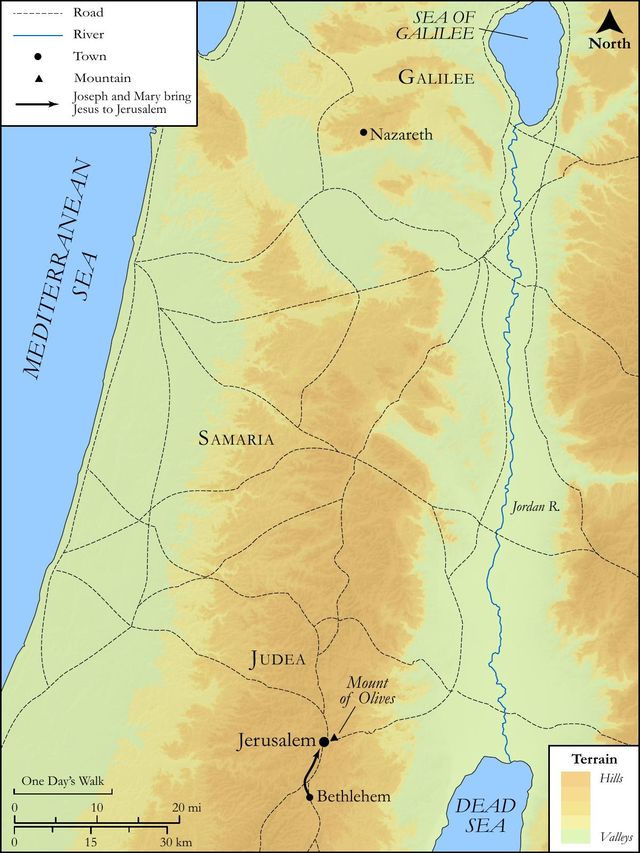
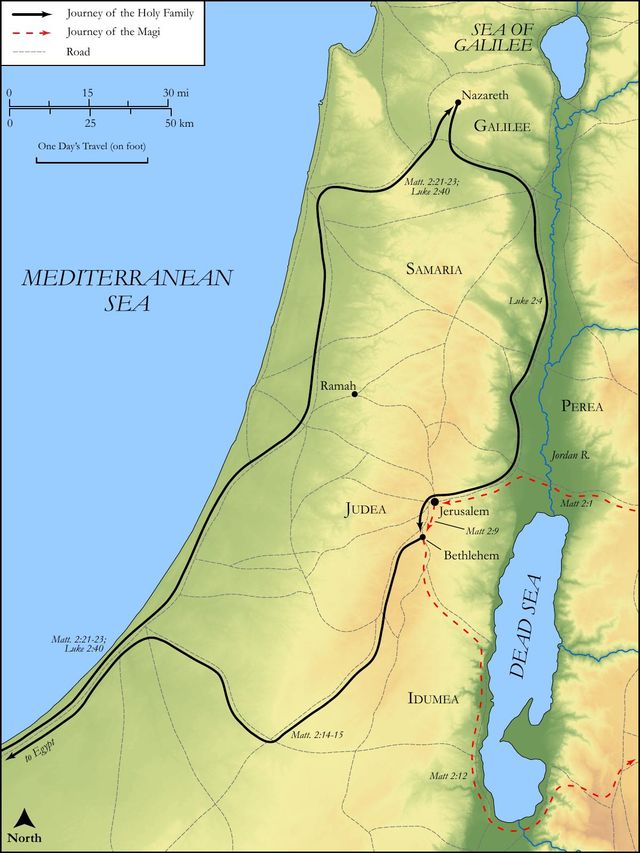
See on the biblical-era maps

Study this verse
Public-domain commentary
Matthew Henry
From his Commentary on the Whole Bible. Henry comments on passages, not single verses — this entry covers Luke 2:21–24. His three-level outline is real structure in the source text, so it is rendered as structure.
Our Lord Jesus, being made of a woman, was made under the law, Gal 4:4. He was not only, as the son of a daughter of Adam, made under the law of nature, but as the son of a daughter of Abraham was made under the law of Moses; he put his neck under that yoke, though it was a heavy yoke, and a shadow of good things to come. Though its institutions were beggarly elements, and rudiments of this world, as the apostle calls them, Christ submitted to it, that he might with the better grace cancel it, and set it aside for us.
Now here we have two instances of his being made under that law, and submitting to it.
I.He was circumcised on the very day that the law appointed (Luk 2:21):
When eight days were accomplished, that day seven-night that he was born, they circumcised him.
1.Though it was a painful operation (Surely a bloody husband thou has been, said Zipporah to Moses, because of the circumcision, Exo 4:25), yet Christ would undergo it for us; nay, therefore he submitted to it, to give an instance of his early obedience, his obedience unto blood. Then he shed his blood by drops, which afterwards he poured out in purple streams.
2.Though it supposed him a stranger, that was by that ceremony to be admitted into covenant with God, whereas he had always been his beloved Son; nay, though it supposed him a sinner, that needed to have his filthiness taken away, whereas he had no impurity or superfluity of naughtiness to be cut off, yet he submitted to it; nay, therefore he submitted to it, because he would be made in the likeness, not only of flesh, but of sinful flesh, Rom 8:3.
3.Though thereby he made himself a debtor to the whole law (Gal 5:3), yet he submitted to it; nay, therefore he submitted to it, because he would take upon him the form of a servant, though he was free-born. Christ was circumcised,
(1.)That he might own himself of the seed of Abraham, and of that nation of whom, as concerning the flesh, Christ came, and who was to take on him the seed of Abraham, Heb 2:16.
(2.)That he might own himself a surety for our sins, and an undertaker for our safety. Circumcision (saith Dr. Goodwin) was our bond, whereby we acknowledged ourselves debtors to the law; and Christ, by being circumcised, did as it were set his hand to it, being made sin for us. The ceremonial law consisted much in sacrifices; Christ hereby obliged himself to offer, not the blood of bulls or goats, but his own blood, which none that ever were circumcised before could oblige themselves to.
(3.)That he might justify, and put an honour upon, the dedication of the infant seed of the church to God, by that ordinance which is the instituted seal of the covenant, and of the righteousness which is by faith, as circumcision was (Rom 4:11), and baptism is. And certainly his being circumcised at eight days old doth make much more for the dedicating of the seed of the faithful by baptism in their infancy than his being baptized at thirty years old doth for the deferring of it till they are grown up. The change of the ceremony alters not the substance.
At his circumcision, according to the custom, he had his name given him; he was called Jesus or Joshua, for he was so named of the angel to his mother Mary before he was conceived in the womb (Luk 1:31), and to his supposed father Joseph after, Mat 1:21. [1.] It was a common name among the Jews, as John was (Col 4:11), and in this he would be made like unto his brethren. [2.] It was the name of two eminent types of him in the Old Testament, Joshua, the successor of Moses, who was commander of Israel, and conqueror of Canaan; and Joshua, the high priest, who was therefore purposely crowned, that he might prefigure Christ as a priest upon his throne, Zac 6:11, Zac 6:13. [3.] It was very significant of his undertaking. Jesus signifies a Saviour. He would be denominated, not from the glories of his divine nature, but from his gracious designs as Mediator; he brings salvation.
II.He was presented in the temple.
This was done with an eye to the law, and at the time appointed by the law, when he was forty days old, when the days of her purification were accomplished, Luk 2:22. Many copies, and authentic ones, read autōn for autēs, the days of their purification, the purification both of the mother and of the child, for so it was intended to be by the law; and our Lord Jesus, though he had no impurity to be cleansed fRom. yet submitted to it, as he did to circumcision, because he was made sin for us; and that, as by the circumcision of Christ we might be circumcised, in the virtue of our union and communion with him, with a spiritual circumcision made without hands (Col 2:11), so in the purification of Christ we might be spiritually purified from the filthiness and corruption which we brought into the world with us. Now, according to the law,
1.The child Jesus, being a first-born son, was presented to the Lord, in one of the courts of the temple. The law is here recited (Luk 2:23): Every male that opens the womb shall be called holy to the Lord, because by a special writ of protection the first-born of the Egyptians were slain by the destroying angel; so that Christ, as first-born, was a priest by a title surer than that of Aaron's house. Christ was the first-born among many brethren, and was called holy to the Lord, so as never any other was; yet he was presented to the Lord as other first-born were, and no otherwise. Though he was newly come out of the bosom of the Father, yet he was presented to him by the hands of a priest, as if he had been a stranger, that needed one to introduce him. His being presented to the Lord now signified his presenting himself to the Lord as Mediator, when he was caused to draw near and approach unto him, Jer 30:21. But, according to the law, he was redeemed, Num 18:15. The first-born of many shalt thou redeem, and five shekels was the value, Lev 27:6 : Num 18:16. But probably in case of poverty the priest was allowed to take less, or perhaps nothing; for no mention is made of it here. Christ was presented to the Lord, not to be brought back, for his ear was bored to God's door-post to serve him for ever; and though he is not left in the temple as Samuel was, to minister there, yet like him he is given to the Lord as long as he lives, and ministers to him in the true temple not made with hands.
2.The mother brought her offering, Luk 2:24. When she had presented that son of hers unto the Lord who was to be the great sacrifice, she might have been excused from offering any other; but so it is said in the law of the Lord, that law which was yet in force, and therefore so it must be done, she must offer a pair of turtle-doves, or two young pigeons; had she been of ability, she must have brought a lamb for a burnt-offering, and a dove for a sin-offering; but, being poor, and not able to reach the price of a lamb, she brings two doves, one for a burnt-offering and the other for a sin-offering (see Lev 12:6, Lev 12:8), to teach us in every address to God, and particularly in those upon special occasions, both to give thanks to God for his mercies to us and to acknowledge with sorrow and shame our sins against him; in both we must give glory to him, nor do we ever want matter for both. Christ was not conceived and born in sin, as others are, so that there was not that occasion in his case which there is in others; yet, because he was made under the law, he complied with it. Thus it became him to fulfil all righteousness. Much more doth it become the best of men to join in confessions of sin; for who can say, I have made my heart clean?
Historical interpretation
Five Centuries of Reception
16 surviving comments on this verse. Each one is dated, so this reads as a timeline rather than a list.
Select a marker to jump to its quote. Markers stagger vertically where authors wrote within a few decades of each other.
They [heretics - disciples of Valentinus] moreover affirm that the Saviour is shown to be derived from all the Æons, and to be in Himself everything by the following passage: "Every male that opens the womb." [Exodus 13:2; Luke 2:23] For He, being everything, opened the womb of the enthymesis of the suffering Æon, when it had been expelled from the Pleroma.
Indeed, hers is the womb on account of which it is written of others also: "Every male that openeth the womb shall be called holy to the Lord." For who is really holy but the Son of God? Who properly opened the womb but He who opened a closed one? But it is marriage which opens the womb in all cases.
But as, in accordance with the train of our discussion, we have been constrained to come to the matter of the days of the dominion of the adversary, it is necessary to state in the first place what concerns his nativity and growth; and then we must turn our discourse, as we have said before, to the expounding of this matter, viz., that in all respects the accuser and son of lawlessness is to make himself like our Saviour. Thus also the demonstration makes the matter clear to us. Since the Saviour of the world, with the purpose of saving the race of men, was born of the immaculate and virgin Mary, and in the form of the flesh trod the enemy trader foot, in the exercise of the power of His own proper divinity; in the same manner also will the accuser come forth from an impure woman upon the earth, but shall be born of a virgin spuriously. For our God sojourned with us in the flesh, after that very flesh of ours which He made for Adam and all Adam's posterity, yet without sin. But the accuser, though he take up the flesh, will do it only in appearance; for how should we wear that flesh which he did not make himself, but against which he warreth daily? And it is my opinion, beloved, that he will assume this phenomenal kind of flesh as an instrument. For this reason also is he to be born of a virgin, as if a spirit, and then to the rest he will be manifested as flesh. For as to a virgin bearing, this we have known only in the case of the all-holy Virgin, who bore the Saviour verily clothed in flesh. For Moses says, "Every male that openeth the womb shall be called holy unto the Lord." This is by no means the case with him; but as the adversary will not open the womb, so neither will he take to himself real flesh, and be circumcised as Christ was circumcised. And even as Christ chose His apostles, so will he too assume a whole people of disciples like himself in wickedness.
Where are they who deny that Christ proclaimed in the Gospel the law to be of God, or can it be supposed that the righteous God made His own Son under a hostile law which He Himself had not given? It is written in the law of Moses as follows, Every male which openeth the womb shall be called holy unto the Lord. (Ex. 13:2, 12.)
But when was the Lord hid from His Father's eye, that He should not be seen by Him, or what place is excepted from His dominion, that by remaining there He should be separate from His Father, unless brought to Jerusalem and introduced into the temple? But for us perhaps these things were written. For as not to confer grace on Himself was He made man and circumcised in the flesh, but to make us Gods through grace, and that we might be circumcised in the Spirit, so for our sakes is He presented to the Lord, that we also might learn to present ourselves to the Lord.
(ubi sup.) He ordered two things to be offered, because as man consists of both body and soul, the Lord requires a double return from us, chastity and meekness, not only of the body, but also of the soul. Otherwise, man will be a dissembler and hypocrite, wearing the face of innocence to mask his hidden malice.
Therefore the Evangelist has well observed, that the days of her purification were come according to the law, who since she had conceived of the Holy Spirit, was free from all uncleanness. It follows, They brought him to Jerusalem to present him to the Lord.
(in Hom. de occursu Domini.) Now this commandment of the law seems to have had its fulfilment in the incarnate God, in a very remarkable and peculiar manner. For He alone, ineffably conceived and incomprehensibly brought forth, opened the virgin's womb, till then unopened by marriage, and after this birth miraculously retaining the seal of chastity.
(ubi sup.) But the offspring of this birth is alone seen to be spiritually male, as contracting no guilt from being born of a woman. Hence He is truly called holy, and therefore Gabriel, as if announcing that this commandment belonged to Him only, said, That Holy thing which shall be born of thee shall be called the Son of God. Now of other first-borns the wisdom of the Gospel has declared that they are called holy from their being offered to God. But the first-born of every creature, That holy thing which is born, &c. the Angel pronounces to be in the nature of its very being holy.
(ubi sup.) It was not surely worldly happiness that the prudent Simeon was waiting for as the consolation of Israel, but a real happiness, that is, a passing over to the beauty of truth from the shadow of the law. For he had learnt from the sacred oracles that he would see the Lord's Christ before he should depart out of this present life. Hence it follows, And the Holy Spirit was in him, (by which indeed he was justified,) and he received an answer from the Holy Spirit.
(ubi sup.) How blessed was that holy entrance to holy things through which he hastened on to the end of life, blessed those hands which handled the word of life, and the arms which were held out to receive Him!
But let us come to the turtle-dove, which the law of God has chosen as the offering of a chaste victim. Finally, when the Lord was circumcised, it was offered; for it is written in the law of the Lord that they should offer a pair of turtle-doves or two young pigeons. For this is truly the sacrifice of Christ, chastity of the body, and grace of the spirit. Chastity is referred to the turtle-dove, grace to the pigeon.
For no union with man disclosed the secrets of the virgin's womb, but the Holy Spirit infused the immaculate seed into an inviolate womb. He then who sanctified another womb in order that a prophet should be born, He it is who has opened the womb of His own mother, that the Immaculate should come forth. By the words opening the womb, he speaks of birth after the usual manner, not that the sacred abode of the virgin's womb, which our Lord in entering sanctified, should now be thought by His proceeding forth from it to be deprived of its virginity.
For among those that are born of a woman, the Lord Jesus alone is in every thing holy, who in the newness of His immaculate birth experienced not the contagion of earthly defilement, but by His Heavenly Majesty dispelled it. For if we follow the letter, how can every male be holy, since it is undoubted that many have been most wicked? But He is holy whom in the figure of a future mystery the pious ordinances of the divine law prefigured, because He alone was to open the hidden womb of the holy virgin Church for the begetting of nations.
All heretics have gone astray by not understanding the mystery of his nativity. The statement “he who opens the womb shall be called holy to the Lord” is more applicable to the special nativity of the Savior than to that of all men, for Christ alone opened the closed doors of the womb of virginity, which nevertheless remained permanently closed. This is the closed east door, through which only the high priest enters and leaves, and nevertheless it is always closed.
Next after the circumcision they wait for the time of purification, as it is said, And when the days of her purification according to the law of Moses were come.
(Hom. xi.) Oh the depth of the riches of the wisdom and knowledge of God! (Rom. 11:33.) He offers victims, Who in each victim is honoured equally with the Father. The Truth preserves the figures of the law. He who as God is the Maker of the law, as man has kept the law. Hence it follows, And that they should give a victim as it was ordered in the law of the Lord, a pair of turtle doves or two young pigeons. (Lev. 12:8.)
(ubi sup.) But let us see what these offerings mean. The turtle dove is the most vocal of birds, and the pigeon the gentlest. And such was the Saviour made unto us; He was endowed with perfect meekness, and like the turtle dove entranced the world, fillinga His garden with His own melodies. There was killed then either a turtle dove or a pigeon, that by a figure He might be shown forth unto us as about to suffer in the flesh for the life of the world.
After His circumcision, she next waits for the time of her purification: and when the days were fulfilled, and the fortieth was the full time, God the Word, Who sitteth by the Father's side, is carried up to Jerusalem, and brought into the Father's presence in human nature like unto us, and by the shadow of the law is numbered among the firstborn. For even before the Incarnation the firstborn were holy, and consecrated to God, being sacrificed to Him according to the law. O! how great and wonderful is the plan of salvation! "O the depth of the riches both of the wisdom and knowledge of God!" He Who is in the bosom of the Father, the Son Who shares His throne, and is coeternal with Him: by Whom all things are divinely brought into existence, submitted nevertheless to the measure of human nature, and even offered a sacrifice to His own Father, although adored by all, and glorified with Him. And what did He offer? As the firstborn and a male a pair of turtles, or two young doves, according to what the law prescribed. But what does the turtle signify? And what too the other, the dove? Come, then, and let us examine this. The one, then, is the most noisy of the birds of the field: but the other is a mild and gentle creature. And such did the Saviour of all become towards us, showing the most perfect gentleness, and like a turtle moreover soothing the world, and filling His own vineyard, even us who believe in Him, with the sweet sound of His voice. For it is written in the Song of Songs, "The voice of the turtle has been heard in our land." For Christ has spoken to us the divine message of the Gospel, which is for the salvation of the whole world.
Turtles, therefore, and doves were offered, when He presented Himself unto the Lord, and there might one see simultaneously meeting together the truth and the types. And Christ offered Himself for a savour of a sweet smell, that He might offer us by and in Himself unto God the Father, and so do away with His enmity towards us by reason of Adam's transgression, and bring to nought sin that had tyrannized over us all. For we are they who long ago were crying, "Look upon me, and pity me."
(Mor. 7.) Hereby also we learn with what desire the holy men of Israel desired to see the mystery of His incarnation.
Of this name the elect also in their spiritual circumcision rejoice to be partakers, that as from Christ they are called Christians, so also from the Saviour they may be called saved, which title was given them of God not only before they were conceived through faith in the womb of the Church, but even before the world began.
And to offer a sacrifice according to that which is said in the law of the Lord, A pair of turtledoves, or two young pigeons.
If you diligently examine the words of the law, you will find indeed that the mother of God as she is free from all connection with man, so is she exempt from any obligation of the law. For not every woman who brings forth, but she who has received seed and brought forth, is pronounced unclean, and by the ordinances of the law is taught that she must be cleansed, in order to distinguish probably from her who though a virgin has conceived and brought forth. But that we might be loosed from the bonds of the law, as did Christ, so also Mary submitted herself of her own will to the law.
On the thirty-third day after His circumcision He is presented to the Lord, signifying in a mystery that no one but he who is circumcised from his sins is worthy to come into the Lord's sight, that no one who has not severed himself from all human ties can perfectly enter into the joys of the heavenly city. It follows, As it is written in the law of the Lord.
By the words, opening the womb, he signifies the first-born both of man and beast, and each one of which was, according to the commandment, to be called holy to the Lord, and therefore to become the property of the priest, that is, so far that he was to receive a price for every first-born of man, and oblige every unclean animal to be ransomed.
(Hom. Purif.) Now this was the victim of the poor. For the Lord commanded in the law that they who were able should offer a lamb for a son or a daughter as well as a turtle dove or pigeon; but they who were not able to offer a lamb should give two turtle doves or two young pigeons. Therefore the Lord, though he was rich, deigned to become poor, that by his poverty He might make us partakers of His riches.
(ubi sup.) Or the pigeon denotes simplicity, the turtle dove chastity, for the pigeon is a lover of simplicity, and the turtle dove of chastity, so that if by chance she has lost her mate, she heeds not to find another. Rightly then are the pigeon and turtle dove offered as victims to the Lord, because the simple and chaste conversation of the faithful is a sacrifice of righteousness well pleasing to Him.
(ubi sup.) But while each bird, from its habit of wailing, represents the present sorrows of the saints, in this they differ, that the turtle is solitary, but the pigeon flies about in flocks, and hence the one points to the secret tears of confession, the other to the public assembling of the Church.
Or the pigeon which flies in flocks sets forth the busy intercourse of active life. The turtle, which delights in solitariness, tells of the lofty heights of the contemplative life. But because each victim is equally accepted by the Creator, St. Luke has purposely omitted whether the turtles or young pigeons were offered for the Lord, that he might not prefer one mode of life before another, but teach that both ought to be followed.
To see death means to undergo it, and happy will he be to see the death of the flesh who has first been enabled to see with the eyes of his heart the Lord Christ, having his conversation in the heavenly Jerusalem, and frequently entering the doors of God's temple, that is, following the examples of the saints in whom God dwells as in His temple. By the same grace of the Spirit whereby he foreknew Christ would come, he now acknowledges Him come, as it follows, And he came by the Spirit into the temple.
Now the righteous man, according to the law, received the Child Jesus in his arms, that he might signify that the legal righteousness of works under the figure of the hands and arms was to be changed for the lowly indeed but saving grace of Gospel faith. The old man received the infant Christ, to convey thereby that this world, now worn out as it were with old age, should return to the childlike innocence of the Christian life.
As it is written in the law of the Lord: Every male that opens the womb shall be called holy to the Lord. Which means: Every male that opens the womb, including the firstborn of both man and beast, because both are called holy to the Lord, and therefore it is commanded that they belong to the priest. Specifically, he should take a redemption price for the firstborn of man, and redeem every unclean animal. Its redemption, he says, shall be one month old for five shekels of silver (Leviticus 27). Here, without delving into a more detailed discussion, it should be briefly indicated that all those firstborn were either a figure of Him, who, though He was the only-begotten Son of God, deigned to become the firstborn of all creation, truly and singularly holy to the Lord, because He committed no sin, nor was deceit found in His mouth (Isaiah 53), or they were surely a sign of our devotion, who ought to attribute all beginnings of good action, which we as if give birth in our hearts, to the grace of the Lord, and redeem those actions done ill, offering worthy fruits of repentance for each of the five senses of body or soul. Therefore, the phrase "that opens the womb" follows the usual manner of speaking of birth. It does not imply that our Lord, who sanctified the sacred womb He entered, should be believed to have despoiled it when He exited, as heretics claim, who say that blessed Mary was a virgin until childbirth but not after childbirth, but rather, according to the catholic faith, that He emerged from the closed womb of the virgin as a bridegroom proceeding from his chamber. Concerning which the Prophet beautifully says: And He turned me towards the way of the sanctuary’s outer gate, which looked to the east, and it was closed, and the Lord said to me: This gate will be closed, it will not be opened, and no man will pass through it, for the Lord, the God of Israel, has entered through it; and it will be closed for the prince, the prince shall sit in it to eat bread before the Lord (Ezekiel 44). Although it can also be mystically understood that no one besides the Lord can open the virgin womb of the Church through water and the Holy Spirit for generating children to God, and hence this male is called holy to the Lord with incomparable dignity.
Mary, God’s blessed mother and a perpetual virgin, was, along with the Son she bore, most free from all subjection to the law. The law says that a woman who “had received seed” and given birth was to be judged unclean and that after a long period she, along with the offspring she had borne, were to be cleansed by victims offered to God. So it is evident that the law does not describe as unclean that woman who, without receiving man’s seed, gave birth as a virgin. Nor does it so describe the son who was born to her. Nor does it teach that she had to be cleansed by saving sacrificial offerings. But as our Lord and Savior, who in his divinity was the one who gave the law, when he appeared as a human being, willed to be under the law.… So too his blessed mother, who by a singular privilege was above the law, nevertheless did not shun being made subject to the principles of the law for the sake of showing us an example of humility.
Continue studying Luke 2:23 across the web’s major study libraries — every link below opens this exact verse, chapter, or book on the destination site.
Read & Compare
 BibleGatewayThis verse in more than 200 translations and 70 languages.
 Bible.comThe YouVersion reader — hundreds of translations, reading plans, and highlights.
 ESV.orgCrossway's official English Standard Version reader.
 NET BibleThe NET translation with 60,000+ translators' notes on every rendering decision.
 STEP BibleTyndale House's free study tool — original text, vocabulary, and scholarly resources.
 BibliaLogos Bible Software's free web reader.
 USCCBThe New American Bible (Revised Edition) with the U.S. bishops' study notes.
Commentaries
 BibleHub CommentariesDozens of classic commentaries on this verse, gathered on one page.
 StudyLightMore than 100 commentary sets — the largest collection on the web.
 BibleRefPlain-English commentary on what this verse means, verse by verse.
 Enduring WordDavid Guzik's free commentary on this chapter, widely used by Bible teachers.
 Bible Study ToolsVerse commentary alongside Greek and Hebrew study aids.
Original Language & Research
- BibleHub InterlinearThe verse word by word — original language, transliteration, and English.
- BibleHub LexiconEvery word's original-language definition and Strong's entry.
 Blue Letter BibleDeep-study tools — Strong's numbers, concordance, and word studies.
 CNTR CollationThe earliest Greek manuscripts of this verse, collated letter by letter.
Sermons, Hymns & Audio


TrulyRandomVerse is not affiliated with these sites and doesn’t control their content. They’re linked because they’re genuinely useful.
Summary
Luke 2:23 records the scriptural justification for Mary and Joseph's presentation of the infant Jesus at the Temple in Jerusalem, fulfilling the Mosaic Law concerning the consecration of the firstborn male. This act underscores their devout adherence to God's covenant requirements and highlights Jesus' early identification with humanity under the Law, setting the stage for his perfect obedience and ultimate fulfillment of all righteousness.
Context
ShowHideLiterary Context
This verse serves as a direct explanation and scriptural warrant for the actions described in the preceding verse, Luke 2:22. Following Mary's ritual purification after childbirth, Joseph and Mary bring Jesus to Jerusalem. The subsequent verses, Luke 2:24-27, detail the offering of a sacrifice, which was a provision for the poor, and introduce Simeon, who recognizes Jesus as the Messiah. Luke's careful inclusion of this legal detail emphasizes the family's piety and Jesus' entry into the world fully within the framework of God's covenant with Israel. It also subtly prepares the reader for Jesus' later teachings on the Law and his ultimate role as its fulfiller.
Historical & Cultural Context
The "law of the Lord" referenced here primarily refers to the regulations found in Exodus 13:2 and Numbers 3:13, which mandated that every firstborn male, whether human or animal, was to be consecrated to the Lord. This law originated from the Passover event, where God spared the firstborn of Israel while striking down the firstborn of Egypt, signifying His ownership and deliverance. While firstborn animals were sacrificed, firstborn sons were "redeemed" through a payment (five shekels, as per Numbers 18:15-16) to the priests, acknowledging God's claim. The presentation at the Temple was a public act of dedication and redemption, demonstrating faithfulness to these ancient covenant stipulations.
Key Themes
ShowHideThis verse contributes significantly to several key themes in Luke's Gospel and the broader biblical narrative. Firstly, it highlights Obedience to the Law, showcasing Mary and Joseph as devout Israelites who meticulously followed God's commands, even concerning their unique child. This sets a precedent for Jesus' own life of perfect obedience. Secondly, the theme of the Sanctity of the Firstborn is central, emphasizing God's special claim on the "firstfruits" of creation, a principle rooted in the Exodus narrative where God delivered Israel as His "firstborn son" (Exodus 4:22). Thirdly, this act underscores Jesus' Identification with Humanity and the Law. Though divine, Jesus fully entered human experience, born under the Law (Galatians 4:4), and began his life in full compliance with its requirements, foreshadowing his role as the one who would perfectly fulfill all righteousness (Matthew 5:17). Finally, it exemplifies the principle of Dedication to God, where the most precious and initial aspects of life are set apart for His purposes and glory.
Exposition and Analysis
ShowHideKey Word Analysis
ShowHideThis verb signifies the act of "engraving" or "writing," indicating a permanent and authoritative record. In this context, it emphasizes that the practice of consecrating the firstborn was not merely a custom but a divinely ordained command, formally recorded in the Mosaic Law. Luke's use of this word underscores the scriptural foundation for Mary and Joseph's actions, demonstrating their adherence to God's revealed will.
This word literally means "to open thoroughly." When applied to the womb, it specifically refers to the first birth, the child who is the first to pass through the birth canal. This highlights the unique status of the firstborn, distinguishing them from subsequent children and marking them as specially designated by God from the very beginning of a family's procreative life.
This term denotes something "sacred," "consecrated," or "set apart" for God. It implies a special status of belonging exclusively to the Lord, often for His service or possession. For the firstborn, being called "holy to the Lord" meant they were distinct from others, under a divine claim, and subject to specific regulations (like redemption) that acknowledged God's ownership and their unique position within the covenant community.
Verse Breakdown
ShowHide"(As it is written in the law of the Lord,"
This introductory clause explicitly states that the subsequent declaration is not a new idea but a direct quotation or summary of an established divine command. It grounds the actions of Mary and Joseph firmly in the Old Testament Scriptures, specifically the Pentateuch, affirming the continuity of God's covenant plan and the faithfulness of the Holy Family to it. This phrase acts as a hermeneutical key, directing the reader to the authoritative source of the practice.
"Every male that openeth the womb"
This phrase precisely defines the subject of the law: the firstborn son. The idiom "openeth the womb" refers to the first child to be born to a mother, signifying the initiation of her childbearing. This specificity ensures that the law applies uniquely to the first male child, distinguishing him from any subsequent children and emphasizing his unique status as the "firstfruits" of the mother's fertility.
"shall be called holy to the Lord;)"
This is the core declaration of the law. To be "called holy to the Lord" means to be designated as belonging to God, set apart for His purposes, and consecrated to Him. While not necessarily implying a priestly role for every firstborn, it signifies God's ownership and a special status within the covenant community, requiring either dedication or redemption. For Jesus, this declaration foreshadows his ultimate role as the perfectly consecrated Son, set apart for God's redemptive plan.
Literary Devices
ShowHideLuke employs several literary devices in this verse to emphasize its significance. The most prominent is Allusion and direct Quotation, as the verse explicitly states, "As it is written in the law of the Lord," followed by a summary of the Mosaic Law. This technique lends Authority and Credibility to the narrative, demonstrating that Jesus' early life events were not arbitrary but were deeply rooted in God's historical dealings with Israel. The phrase "Every male that openeth the womb shall be called holy to the Lord" functions as a Theological Statement or Declaration, encapsulating a core principle of Old Covenant dedication. The use of the passive voice "shall be called" implies a divine decree or established societal recognition, rather than a human action, reinforcing the sacred nature of the firstborn's status.
Theological and Thematic Connections
ShowHideLuke 2:23 powerfully connects the early life of Jesus to the foundational principles of the Old Covenant, particularly the concept of holiness and divine ownership. The dedication of the firstborn was a tangible expression of Israel's recognition that all life, and especially the "firstfruits," belongs to God. This principle transcends mere ritual, pointing to a deeper theological truth: God's sovereignty over creation and His special claim on those He sets apart for Himself. Jesus, as the firstborn of Mary, perfectly fulfills this Old Testament type, not merely by being dedicated but by embodying the ultimate consecration to God's will. His submission to this law highlights the continuity between the Old and New Covenants, demonstrating that the God of Israel is the same God who is bringing about salvation through His Son. This act of obedience by Mary and Joseph also foreshadows Jesus' own perfect obedience to the Father throughout His life, culminating in His ultimate sacrifice.
Reflection and Application
ShowHideLuke's careful inclusion of this seemingly small detail about Jesus' presentation according to the Law offers profound insights for contemporary believers. It reminds us that even the Son of God, in His humanity, entered fully into the human experience under the covenant, demonstrating perfect obedience from infancy. This challenges us to consider our own posture towards God's commands: are we diligent in seeking to understand and obey His revealed will in our lives? The principle of dedicating the "firstborn" or "firstfruits" to the Lord extends beyond ancient rituals to a call for wholehearted devotion. It prompts us to consider what "firsts" in our lives—our best time, our fresh energy, our initial resources, our primary affections—are we dedicating to God? This verse encourages a life of intentional consecration, recognizing that everything we have is ultimately His, and our willing dedication is an act of worship and trust. It also assures us that Jesus fully identified with humanity, making Him a sympathetic and perfect High Priest who understands our journey under God's righteous standards.
Questions for Reflection
ShowHideFAQ
ShowHideWhy was it necessary for Jesus, the Son of God, to be presented in the Temple according to the Law?
ShowHideIt was necessary for several profound reasons. Firstly, it demonstrated the faithfulness and piety of Mary and Joseph as devout Israelites, showing their adherence to God's covenant commands. Secondly, and more importantly, it underscored Jesus' full identification with humanity. Though divine, Jesus was born under the Law (Galatians 4:4) and perfectly fulfilled every requirement of it. His submission to these rituals from infancy foreshadowed his lifelong obedience to the Father's will and his ultimate role as the one who would perfectly fulfill all righteousness (Matthew 3:15). This act also marked Jesus as part of the covenant community of Israel, through whom God's redemptive plan would unfold.
What is the "law of the Lord" being referred to in this verse?
ShowHideThe "law of the Lord" here primarily refers to the Mosaic Law concerning the consecration of the firstborn male, as recorded in Exodus 13:2 and Numbers 3:13. This law stipulated that every firstborn male, both human and animal, was to be "holy to the Lord" because God had spared the firstborn of Israel during the tenth plague in Egypt. While firstborn animals were sacrificed, firstborn sons were redeemed through a payment to the priests (Numbers 18:15-16), acknowledging God's ownership and their special status. Mary's purification rites, mentioned in Luke 2:22, were also part of the broader Mosaic Law found in Leviticus 12.
Christ-Centered Fulfillment
ShowHideLuke 2:23, detailing Jesus' consecration as the firstborn, finds its profound Christ-centered fulfillment in several ways. Jesus is not merely a firstborn dedicated to God, but He is the ultimate Firstborn, the "firstborn over all creation" (Colossians 1:15) and the "firstborn from the dead" (Colossians 1:18). His presentation in the Temple, in humble obedience to the Law, foreshadows His entire life of perfect submission to the Father's will, culminating in His willing sacrifice on the cross. The Old Testament law of the firstborn pointed to God's ownership and the need for redemption; Jesus, as the true Lamb of God, perfectly fulfills this by offering Himself as the once-for-all sacrifice, thereby redeeming not just the firstborn, but all who believe (John 1:29). His consecration as "holy to the Lord" at infancy prefigures His ultimate role as the perfectly consecrated High Priest (Hebrews 7:26) who enters the heavenly sanctuary on our behalf. Through His perfect obedience to the Law, Jesus becomes the means by which we, too, are made holy and set apart for God, becoming part of the "church of the firstborn" (Hebrews 12:23) whose names are written in heaven.