


Numbers 18:15
- כָּלkoleveryH3605N-mscNoun Singular Masculine Construct
- פֶּטֶרPe·terfirstborn ofH6363N-mscNoun Singular Masculine Construct
- רֶחֶםRe·chema wombH7358N-msNoun Singular Masculine Absolute
- לְכָלle·kholof allH3605Prep-l ¦ N-mscNoun Singular Masculine Constructלְofכָלall
- בָּשָׂרba·SarfleshH1320N-msNoun Singular Masculine Absolute
- אֲשֶׁר'a·SherwhichH834RelParticle Relative
- יַקְרִיבוּyak·Ri·vuthey will bring nearH7126V-Hiphil-Imperf-3mpVerb Hiphil Imperfect 3rd Plural Masculine
- לַיהוָהla·Yah·wehto YahwehH3068Prep-l ¦ N-properNoun Proper TitleלַtoיהוָהYahweh
- בָּאָדָםba·'a·Damamong <the> humankindH120Prep-b ¦ N-msNoun Singular Masculine Absoluteבָּamong <the>אָדָםhumankind
- וּבַבְּהֵמָהu·va·be·he·Mahand among <the> animal[s]H929Conj-w ¦ Prep-b ¦ N-fsNoun Singular Feminine Absoluteוּandבַamong <the>בְּהֵמָהanimal[s]
- יִהְיֶהyih·yehit will belongH1961V-Qal-Imperf-3msVerb Qal Imperfect 3rd Singular Masculine
- לָּךְLakhto <the> youPrep-l ¦ 2msSuffix Personal 2nd Singular Masculineלָּto <the>ךְyou
- אַךְ'akhonlyH389AdvAdverb
- פָּדֹהpa·Dohcertainly <to redeem>H6299V-Qal-InfAbsVerb Qal Infinitive Absolute
- תִפְדֶּהtif·Dehyou will redeemH6299V-Qal-Imperf-2msVerb Qal Imperfect 2nd Singular Masculine
- אֵת'et<obj.>H853DirObjMParticle Object Indicator
- בְּכוֹרbe·Khor[the] firstborn ofH1060N-mscNoun Singular Masculine Construct
- הָאָדָםha·'a·Dam<the> humankindH120Art ¦ N-msNoun Singular Masculine Absoluteהָ<the>אָדָםhumankind
- וְאֵתve·'Etand <obj.>H853Conj-w ¦ DirObjMParticle Object Indicatorוְandאֵת<obj.>
- בְּכוֹרbe·khor[the] firstborn ofH1060N-mscNoun Singular Masculine Construct
- הַבְּהֵמָהha·be·he·Mah<the> animal[s]H929Art ¦ N-fsNoun Singular Feminine Absoluteהַ<the>בְּהֵמָהanimal[s]
- הַטְּמֵאָהha·te·me·'Ah<the> uncleanH2931Art ¦ Adj-fsAdjective Singular Feminine Absoluteהַ<the>טְּמֵאָהunclean
- תִּפְדֶּהtif·Dehyou will redeemH6299V-Qal-Imperf-2msVerb Qal Imperfect 2nd Singular Masculine
English is a literal word-by-word gloss of the Hebrew, not the KJV's wording. Why?
This is the original text the KJV's translators worked from — each Hebrew word with its own literal English meaning in this verse, prepared by scholars at Tyndale House, Cambridge. The KJV translates whole sentences, not word by word, so its wording differs: one Hebrew word can become several English words, and the KJV may choose “the LORD” where the gloss reads “Yahweh”. Both are faithful — they answer different questions. For the KJV's own rendering, switch to the KJV text.
Details
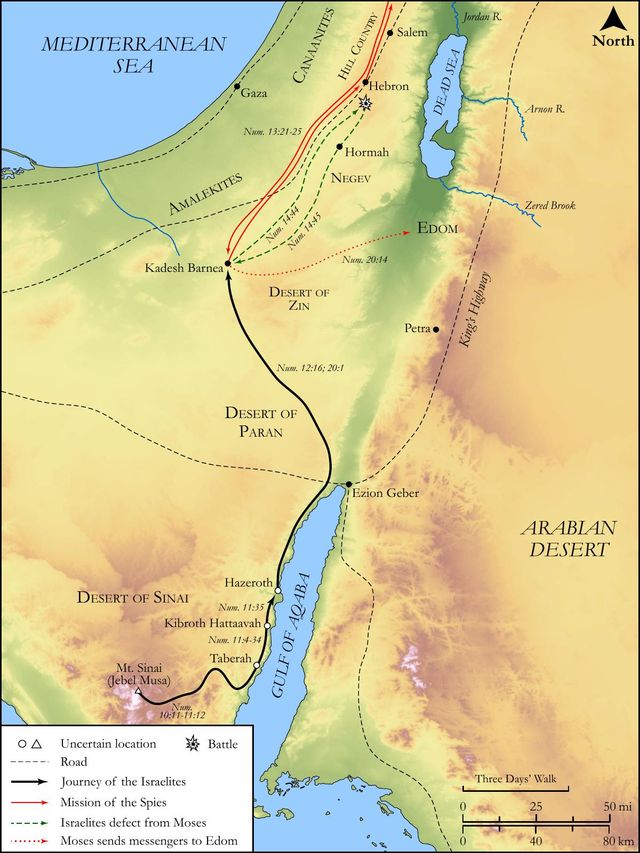
See on the biblical-era map
Study this verse
Public-domain commentary
Matthew Henry
From his Commentary on the Whole Bible. Henry comments on passages, not single verses — this entry covers Numbers 18:8–19.
The priest's service is called a warfare; and who goes a warfare at his own charges? As they were well employed, so they were well provided for, and well paid. None shall serve God for nought. All believers are spiritual priests, and God has promised to take care of them; they shall dwell in the land, and verily they shall be fed, and shall not want any good thing. Godliness has the promise of the life that now is. And from this plentiful provision here made for the priests the apostle infers that it is the duty of Christian churches to maintain their ministers; those that served at the altar lived upon the altar. So those that preach the gospel should live upon the gospel, and live comfortably, Co1 9:13, Co1 9:14. Scandalous maintenance makes scandalous ministers. Now observe, 1. That much of the provision that was made for them arose out of the sacrifices which they themselves were employed to offer. They had the skins of almost all the sacrifices, which they might sell, and they had a considerable share out of the meat-offerings, sin-offerings, etc. Those that had the charge of the offerings had the benefit, Num 18:8. Note, God's work is its own wages, and his service carries its recompence along with it. Even in keeping God's commandments there is great reward. The present pleasures of religion are part of its pay. 2. That they had not only a good table kept for them, but money likewise in their pockets for the redemption of the first-born, and those firstlings of cattle which might not be offered in sacrifice. Thus their maintenance was such as left them altogether disentangled from the affairs of this life; they had no grounds to occupy, no land to till, no vineyards to dress, no cattle to tend, no visible estate to take care of, and yet had a more plentiful income than any other families whatsoever. Thus God ordered it that they might be the more entirely addicted to their ministry, and not diverted from it, nor disturbed in it, by any worldly care or business (the ministry requires a whole man); and that they might be examples of living by faith, not only in God's providence, but in his ordinance. They lived from hand to mouth, that they might learn to take no thought for the morrow; sufficient for the day would be the provision thereof: and they had no estates to leave their children, that they might by faith leave their children, that they might by faith leave them to the care of that God who had fed them all their lives long. 3. Of the provision that was made for their tables some is said to be most holy (Num 18:9, Num 18:10), which was to be eaten by the priests themselves, and in the court of the tabernacle only; but other perquisites were less holy, of which their families might eat, at their own houses, provided they were clean, Num 18:11-13. See Lev 21:10, etc. 4. It is commanded that the best of the oil, and the best of the wine and wheat, should be offered for the first-fruits unto the Lord, which the priest were to have, Num 18:12. Note, We must always serve and honour God with the best we have, for he is the best, and best deserves it; he is the first, and therefore must have the first ripe. Those that think to save charges by putting God off with the refuse do but deceive themselves, for God is not mocked. 5. All this is given to the priests by reason of the anointing, Num 18:8. It was not for the sake of their personal merits above other Israelites that they had these tributes paid to them, be it known unto them; but purely for the sake of the office to which they were anointed. Thus all the comforts that are given to the Lord's people are given them by reason of the anointing which they have received. It is said to be given them by an ordinance for ever (Num 18:8), and it is a covenant of salt for ever, Num 18:19. As long as the priesthood should continue this should continue to be the maintenance of it, that this lamp might not go out for want of oil to keep it burning. Thus provision is made that a gospel ministry should continue till Christ comes, by an ordinance for ever. Lo, I am with you (that is their maintenance and support) always, even to the end of the world. Thanks be to the Redeemer, it is the word which he has commanded to a thousand generations.
Historical interpretation
Historical reception
1 surviving comment on this verse from the historical church.
Every only child is a firstborn child; but not every firstborn is an only child. A firstborn child is not only one after whom other children are also born but also one before whom no other child is born. “All that opens the womb,” says the Lord to Aaron, “of all flesh that are offered to the Lord, of men and beasts, shall belong to you; only the firstborn of men shall be redeemed with a price and the firstborn of beasts that are unclean.” The Word of God defined what was meant by a “firstborn.” “All,” it says, “that opens the womb.” Otherwise, if no child is a firstborn child but only one who subsequently has brothers, the firstborn are not due the priests until others are also born, lest perchance a child be an only child and not the firstborn child, in the event that no other child shall be born subsequently.
Continue studying Numbers 18:15 across the web’s major study libraries — every link below opens this exact verse, chapter, or book on the destination site.
Read & Compare
 BibleGatewayThis verse in more than 200 translations and 70 languages.
 Bible.comThe YouVersion reader — hundreds of translations, reading plans, and highlights.
 ESV.orgCrossway's official English Standard Version reader.
 NET BibleThe NET translation with 60,000+ translators' notes on every rendering decision.
 STEP BibleTyndale House's free study tool — original text, vocabulary, and scholarly resources.
 BibliaLogos Bible Software's free web reader.
 USCCBThe New American Bible (Revised Edition) with the U.S. bishops' study notes.
Commentaries
 BibleHub CommentariesDozens of classic commentaries on this verse, gathered on one page.
 StudyLightMore than 100 commentary sets — the largest collection on the web.
 BibleRefPlain-English commentary on what this verse means, verse by verse.
 Enduring WordDavid Guzik's free commentary on this chapter, widely used by Bible teachers.
 Bible Study ToolsVerse commentary alongside Greek and Hebrew study aids.
Original Language & Research
- BibleHub InterlinearThe verse word by word — original language, transliteration, and English.
- BibleHub LexiconEvery word's original-language definition and Strong's entry.
 Blue Letter BibleDeep-study tools — Strong's numbers, concordance, and word studies.
 SefariaThe Hebrew text with Rashi and centuries of Jewish commentary.
Sermons, Hymns & Audio


TrulyRandomVerse is not affiliated with these sites and doesn’t control their content. They’re linked because they’re genuinely useful.
Summary
Numbers 18:15 delineates a critical aspect of the priestly provisions within the Mosaic Covenant, establishing God's sovereign claim over all firstborn—both human and animal—as a foundational principle. This verse specifies that these firstborn, or their redemption value, are designated as the rightful portion for the Aaronic priesthood. It meticulously distinguishes between firstborn animals that could be offered directly as sacrifices and those, particularly human firstborn and the firstlings of ritually unclean beasts, that required redemption through a prescribed payment, thereby underscoring the sanctity of life, the purity laws, and the divine mechanism for sustaining the priestly ministry.
Context
ShowHideLiterary Context
Numbers 18:15 is strategically placed within a broader section (Numbers 16-18) that comprehensively re-establishes and clarifies the distinct roles, responsibilities, and provisions for the Levitical priests and Levites. This discourse immediately follows the dramatic and severe rebellion led by Korah, Dathan, and Abiram, which fundamentally challenged Aaron's divinely appointed priestly authority. Chapters 16 and 17 meticulously narrate God's decisive vindication of Aaron's priesthood, culminating in the miraculous budding of Aaron's staff, which served as an undeniable sign of divine approval. Chapter 18 then transitions to outlining the specific duties of the priests and Levites in the Tabernacle and, crucially, their divinely ordained means of support. Verse 15 builds upon the general principles of priestly dues, such as firstfruits and heave offerings, mentioned earlier in Numbers 18, focusing specifically on the highly significant category of the firstborn, a concept deeply interwoven with Israel's covenant relationship with God.
Historical & Cultural Context
The concept of the firstborn belonging to God is profoundly rooted in Israel's foundational history, particularly the pivotal events of the Exodus narrative. Following the devastating tenth plague in Egypt, where the firstborn of Egypt were struck down while Israel's were miraculously spared through the blood of the Passover lamb, God commanded Israel to consecrate all their firstborn to Him (Exodus 13:2). This law served as a perpetual, tangible reminder of God's saving power and Israel's redemption from bondage. While firstborn often held special status in the broader ancient Near East, Israel's law uniquely tied this status to divine ownership and required either sacrifice or redemption, distinguishing it sharply from pagan practices that sometimes involved child sacrifice. The provision for the priests (the sons of Aaron and the Levites) was absolutely essential because, unlike the other tribes, they had no tribal land inheritance in Canaan (Numbers 18:20), making these offerings their sole means of sustenance and allowing them to devote themselves fully and exclusively to their sacred duties of ministering before the Lord without worldly distractions.
Key Themes
ShowHideThis verse powerfully illustrates several key themes central to the Pentateuch and the broader biblical narrative. First, Divine Ownership and Sovereignty is paramount; all life, especially the "first" of creation, belongs unequivocally to the Lord as a testament to His creative power and His redemptive acts in history (Exodus 13:12). Second, the theme of Redemption is central, particularly for human firstborn and unclean animals, highlighting the sanctity of human life and God's merciful provision for substitutionary payment to satisfy His claim (Exodus 34:20). Third, Priestly Provision and Sustenance is explicitly addressed, ensuring that those dedicated to God's service are adequately supported by the community through these sacred dues, thereby enabling their full devotion to their calling and the maintenance of the Tabernacle service (Numbers 18:21). Finally, the distinction between Clean and Unclean animals is reinforced, guiding what can be sacrificed directly and what requires redemption or alternative handling, upholding the ritual purity necessary for approaching a holy God (Leviticus 11).
Exposition and Analysis
ShowHideKey Word Analysis
ShowHideThis phrase, combining H6363 (peṭer) meaning "firstling" or "opener," and H7358 (rechem) meaning "womb" or "matrix," is a technical term referring specifically to the firstborn. It emphasizes their unique status as the very first to emerge from the womb, signifying the initial fruit of procreation. This designation underscores God's foundational claim over the first of all life, whether human or animal, as a principle of consecration and a perpetual reminder of His ultimate power over life and death.
(bᵉkôwr), this term denotes the "firstborn" or "firstling," carrying connotations of preeminence and special status. In the context of this verse, it refers to the initial offspring of any creature, which, by divine decree, was consecrated to the Lord. This concept is central to Israelite law, reflecting God's ownership of all life and His particular claim on that which initiates life within a family or flock.
(pâdâh), this verb signifies "to ransom," "to buy back," or "to deliver" through payment or substitution. It implies a transfer of ownership or release from a claim through a compensatory act. For human firstborn, a specific redemption price of five shekels of silver was mandated (Numbers 3:47). For unclean animals, redemption allowed their value to be transferred to the priests without the animal itself being sacrificed, highlighting the transactional nature of fulfilling God's claim while strictly adhering to the laws of ritual purity.
Verse Breakdown
ShowHide"Every thing that openeth the matrix in all flesh, which they bring unto the LORD, [whether it be] of men or beasts, shall be thine:"
This opening clause establishes the broad and absolute scope of God's claim: all firstborn, whether human or animal, are consecrated to Him. The phrase "shall be thine" directly addresses Aaron and, by extension, his priestly descendants, indicating that these consecrated firstborn (or their redemption price) are designated as their rightful portion. This highlights the sacred nature of the priests' income, derived directly from God's own declared property, serving as a divine provision for their sustenance and livelihood.
"nevertheless the firstborn of man shalt thou surely redeem,"
This crucial qualification introduces the principle of redemption for human firstborn. While human firstborn belong to God, their lives are sacred and cannot be sacrificed on the altar. Instead, they must be "bought back" from God's direct claim through a prescribed payment to the priests. This command underscores the sanctity of human life and God's merciful provision for substitution, ensuring that His claim is honored without requiring human sacrifice, a practice abhorrent to Yahweh.
"and the firstling of unclean beasts shalt thou redeem."
Similar to human firstborn, the firstborn of ritually unclean animals (e.g., donkeys, camels) could not be offered as sacrifices to the Lord due to their inherent impurity according to Mosaic law. Therefore, these animals also had to be redeemed by a payment to the priests, or if not redeemed, they were to be killed. This distinction reinforces the purity laws and ensures that only acceptable sacrifices are brought before God, while still allowing the priests to benefit from the firstborn principle in a manner consistent with the covenant and its ritual requirements.
Literary Devices
ShowHideNumbers 18:15 masterfully employs precise Legal Language, characteristic of the Mosaic Law, to establish clear statutes and distinctions regarding offerings. The meticulous detail in specifying "men or beasts," and then further distinguishing between "firstborn of man" and "firstling of unclean beasts," exemplifies this legal precision. The use of Repetition in the word "redeem" ("shalt thou surely redeem... shalt thou redeem") emphatically highlights its critical importance and dual application for both human and unclean animal firstborn, underscoring the nuanced application of the broader principle of divine ownership. This structure creates a clear Contrast between the general rule that all firstborn belong to the priests ("shall be thine") and the specific exceptions that require redemption, drawing the reader's attention to the vital difference in how various firstborn are handled based on their nature (human vs. animal) and ritual status (clean vs. unclean). This precise legalistic framing ensures there is no ambiguity in the priestly duties and their divinely ordained provisions.
Theological and Thematic Connections
ShowHideNumbers 18:15 serves as a theological cornerstone, reiterating God's absolute sovereignty over all creation, particularly the "first" of every kind, as a profound symbol of His ultimate ownership and the sole source of all life. The requirement for redemption, especially for human firstborn, underscores the immeasurable sanctity of human life and powerfully foreshadows the broader theological concept of God providing a substitute for that which is rightfully His but cannot be offered. This intricate system of offerings also highlights God's meticulous care for His appointed ministers, ensuring their provision so they can fully dedicate themselves to their sacred duties without worldly distractions, thereby upholding the integrity and sanctity of the Tabernacle service and the covenant relationship.
Reflection and Application
ShowHideThis ancient law from Numbers 18:15, while rooted in the specific context of the Old Covenant priesthood, offers profound and enduring principles for believers today. It calls us to a radical acknowledgment of God's ultimate ownership over every facet of our lives, especially our "firstfruits" – our most valuable time, our unique talents, and our material resources. Just as the firstborn were consecrated to the Lord, we are called to live lives of comprehensive consecration, recognizing that we have been "bought with a price" (1 Corinthians 6:20), and therefore belong to Him. The concept of redemption in this verse reminds us of the immense value God places on life and His gracious provision for our salvation. It prompts us to consider what "redemption" looks like in our own lives – how we respond to God's rightful claim on us, and how we might actively "buy back" time or resources from worldly pursuits to intentionally dedicate them to His eternal purposes. Furthermore, the provision for the priests serves as a powerful reminder of our ongoing responsibility to honor and support those who minister the Word and shepherd God's people, enabling them to serve without hindrance and devote themselves fully to the spiritual nourishment and growth of the church.
Questions for Reflection
ShowHideFAQ
ShowHideWhy did God claim the firstborn?
ShowHideGod claimed the firstborn as a perpetual and powerful reminder of His decisive deliverance of Israel from Egyptian bondage during the tenth plague. In that plague, the firstborn of Egypt were struck down, but Israel's firstborn were miraculously spared through the blood of the Passover lamb (Exodus 12:29-30 and Exodus 13:14-15). This act established His unique ownership and covenant relationship with Israel, signifying that all life, especially the "first" and "best," belongs to Him. It was a foundational principle of consecration, serving as a constant sign of His saving power and Israel's redemption.
What was the purpose of redeeming the firstborn of man and unclean animals?
ShowHideThe purpose was twofold, reflecting both the sanctity of life and the strict laws of ritual purity inherent in the Mosaic Covenant. For human firstborn, their lives were sacred and could not be sacrificed; thus, a redemption price was paid to the priests, symbolizing their "buying back" from God's direct claim (Numbers 3:47). This also provided a means of support for the priests, who had no land inheritance. For unclean animals, their firstlings could not be offered as sacrifices due to their ritual impurity (Leviticus 11). Therefore, they also had to be redeemed by payment or, if not redeemed, killed, ensuring that only ritually pure animals were associated with the Tabernacle service, while still acknowledging God's claim on all firstborn.
How did the priests benefit from this law?
ShowHideThe priests, specifically the sons of Aaron, benefited directly and significantly from this law as it formed a crucial part of their divinely appointed livelihood. Since they had no tribal land inheritance in Israel (Numbers 18:20), God ordained that various offerings and dues, including the redemption money for human firstborn and unclean animal firstlings, would be their sacred portion. This provision ensured their financial stability and sustenance, allowing them to devote themselves entirely to their sacred duties of ministering in the Tabernacle, performing sacrifices, and teaching God's law to the people, without needing to engage in secular labor for their sustenance.
Christ-Centered Fulfillment
ShowHideNumbers 18:15, with its profound emphasis on divine ownership, consecration, and the necessity of redemption, finds its ultimate and glorious fulfillment in the person and work of Jesus Christ. He is supremely the "firstborn over all creation" (Colossians 1:15), signifying His preeminence and sovereign authority. He is also the "firstborn from the dead" (Colossians 1:18), inaugurating the new creation and guaranteeing resurrection life for all who believe. Furthermore, He is the "firstborn among many brethren" (Romans 8:29), establishing a new spiritual family. Whereas human firstborn under the Old Covenant required a payment of silver to be redeemed from God's claim, humanity, enslaved by sin and under divine judgment, required a far greater price. Jesus, as the perfect, unblemished "Lamb of God, who takes away the sin of the world!" (John 1:29), offered Himself as the ultimate, once-for-all sacrifice, providing the full and final redemption for all who believe (1 Peter 1:18-19). He is the true "opener of the womb" of the new spiritual creation, bringing forth spiritual life and new birth. Through His substitutionary death, He has fully satisfied God's righteous claim on humanity, not by a monetary payment, but by His precious blood, thereby inaugurating a new covenant where believers are consecrated to God not through ritual or legalistic adherence, but through faith in Him, becoming part of the "church of the firstborn, whose names are written in heaven" (Hebrews 12:23).