


Numbers 18:14
Bible text: King James Version (1769 Blayney text) · Public domain
Bible text: Berean Standard Bible · Public domain
Bible text: American Standard Version (1901) · Public domain
Bible text: World English Bible, Messianic edition · Public domain
Bible text: Geneva Bible (1599) · Public domain
Bible text: Young's Literal Translation · Public domain
- כָּלkoleveryH3605N-mscNoun Singular Masculine Construct
- חֵרֶםChe·remdevoted thingH2764N-msNoun Singular Masculine Absolute
- בְּיִשְׂרָאֵלbe·Yis·ra·'Elin IsraelH3478Prep-b ¦ N-properNoun Proper LocationבְּinיִשְׂרָאֵלIsrael
- לְךָle·Khato <the> youPrep-l ¦ 2msSuffix Personal 2nd Singular Masculineלְto <the>ךָyou
- יִהְיֶהyih·Yehit will belongH1961V-Qal-Imperf-3msVerb Qal Imperfect 3rd Singular Masculine
English is a literal word-by-word gloss of the Hebrew, not the KJV's wording. Why?
This is the original text the KJV's translators worked from — each Hebrew word with its own literal English meaning in this verse, prepared by scholars at Tyndale House, Cambridge. The KJV translates whole sentences, not word by word, so its wording differs: one Hebrew word can become several English words, and the KJV may choose “the LORD” where the gloss reads “Yahweh”. Both are faithful — they answer different questions. For the KJV's own rendering, switch to the KJV text.
Details
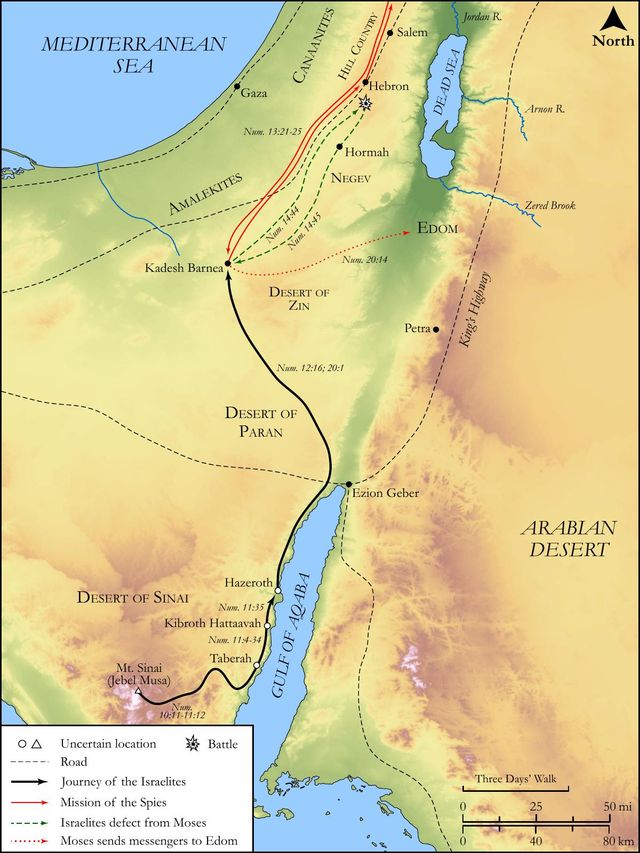
See on the biblical-era map
Study this verse
Public-domain commentary
Matthew Henry
From his Commentary on the Whole Bible. Henry comments on passages, not single verses — this entry covers Numbers 18:8–19.
The priest's service is called a warfare; and who goes a warfare at his own charges? As they were well employed, so they were well provided for, and well paid. None shall serve God for nought. All believers are spiritual priests, and God has promised to take care of them; they shall dwell in the land, and verily they shall be fed, and shall not want any good thing. Godliness has the promise of the life that now is. And from this plentiful provision here made for the priests the apostle infers that it is the duty of Christian churches to maintain their ministers; those that served at the altar lived upon the altar. So those that preach the gospel should live upon the gospel, and live comfortably, Co1 9:13, Co1 9:14. Scandalous maintenance makes scandalous ministers. Now observe, 1. That much of the provision that was made for them arose out of the sacrifices which they themselves were employed to offer. They had the skins of almost all the sacrifices, which they might sell, and they had a considerable share out of the meat-offerings, sin-offerings, etc. Those that had the charge of the offerings had the benefit, Num 18:8. Note, God's work is its own wages, and his service carries its recompence along with it. Even in keeping God's commandments there is great reward. The present pleasures of religion are part of its pay. 2. That they had not only a good table kept for them, but money likewise in their pockets for the redemption of the first-born, and those firstlings of cattle which might not be offered in sacrifice. Thus their maintenance was such as left them altogether disentangled from the affairs of this life; they had no grounds to occupy, no land to till, no vineyards to dress, no cattle to tend, no visible estate to take care of, and yet had a more plentiful income than any other families whatsoever. Thus God ordered it that they might be the more entirely addicted to their ministry, and not diverted from it, nor disturbed in it, by any worldly care or business (the ministry requires a whole man); and that they might be examples of living by faith, not only in God's providence, but in his ordinance. They lived from hand to mouth, that they might learn to take no thought for the morrow; sufficient for the day would be the provision thereof: and they had no estates to leave their children, that they might by faith leave their children, that they might by faith leave them to the care of that God who had fed them all their lives long. 3. Of the provision that was made for their tables some is said to be most holy (Num 18:9, Num 18:10), which was to be eaten by the priests themselves, and in the court of the tabernacle only; but other perquisites were less holy, of which their families might eat, at their own houses, provided they were clean, Num 18:11-13. See Lev 21:10, etc. 4. It is commanded that the best of the oil, and the best of the wine and wheat, should be offered for the first-fruits unto the Lord, which the priest were to have, Num 18:12. Note, We must always serve and honour God with the best we have, for he is the best, and best deserves it; he is the first, and therefore must have the first ripe. Those that think to save charges by putting God off with the refuse do but deceive themselves, for God is not mocked. 5. All this is given to the priests by reason of the anointing, Num 18:8. It was not for the sake of their personal merits above other Israelites that they had these tributes paid to them, be it known unto them; but purely for the sake of the office to which they were anointed. Thus all the comforts that are given to the Lord's people are given them by reason of the anointing which they have received. It is said to be given them by an ordinance for ever (Num 18:8), and it is a covenant of salt for ever, Num 18:19. As long as the priesthood should continue this should continue to be the maintenance of it, that this lamp might not go out for want of oil to keep it burning. Thus provision is made that a gospel ministry should continue till Christ comes, by an ordinance for ever. Lo, I am with you (that is their maintenance and support) always, even to the end of the world. Thanks be to the Redeemer, it is the word which he has commanded to a thousand generations.
Continue studying Numbers 18:14 across the web’s major study libraries — every link below opens this exact verse, chapter, or book on the destination site.
Read & Compare
 BibleGatewayThis verse in more than 200 translations and 70 languages.
 Bible.comThe YouVersion reader — hundreds of translations, reading plans, and highlights.
 ESV.orgCrossway's official English Standard Version reader.
 NET BibleThe NET translation with 60,000+ translators' notes on every rendering decision.
 STEP BibleTyndale House's free study tool — original text, vocabulary, and scholarly resources.
 BibliaLogos Bible Software's free web reader.
 USCCBThe New American Bible (Revised Edition) with the U.S. bishops' study notes.
Commentaries
 BibleHub CommentariesDozens of classic commentaries on this verse, gathered on one page.
 StudyLightMore than 100 commentary sets — the largest collection on the web.
 BibleRefPlain-English commentary on what this verse means, verse by verse.
 Enduring WordDavid Guzik's free commentary on this chapter, widely used by Bible teachers.
 Bible Study ToolsVerse commentary alongside Greek and Hebrew study aids.
Original Language & Research
- BibleHub InterlinearThe verse word by word — original language, transliteration, and English.
- BibleHub LexiconEvery word's original-language definition and Strong's entry.
 Blue Letter BibleDeep-study tools — Strong's numbers, concordance, and word studies.
 SefariaThe Hebrew text with Rashi and centuries of Jewish commentary.
Sermons, Hymns & Audio


TrulyRandomVerse is not affiliated with these sites and doesn’t control their content. They’re linked because they’re genuinely useful.
Summary
Numbers 18:14 stands as a pivotal declaration within the Mosaic Law, articulating a divine provision for the Aaronic priesthood. It unequivocally states that all items irrevocably "devoted" or consecrated to the Lord by the Israelites were to become the exclusive property of the priests. This mandate was crucial for the material sustenance of those set apart for sacred service in the Tabernacle, enabling them to dedicate themselves entirely to their holy duties without the need for a tribal land inheritance or engagement in secular labor.
Context
ShowHideLiterary Context
Numbers 18:14 is embedded within a comprehensive passage (Numbers 18:8-20) that meticulously outlines the portions and privileges divinely assigned to the priests and Levites. This chapter immediately follows the dramatic rebellion of Korah, Dathan, and Abiram (Numbers 16), which directly challenged the divinely appointed authority of Aaron and his sons. God's miraculous confirmation of Aaron's priesthood through the budding of his staff (Numbers 17) sets the theological stage for chapter 18, where the Lord re-emphasizes the unique responsibilities of the priestly family and, critically, establishes their comprehensive means of support. The specific mention of "devoted" things in verse 14 is part of an extensive list of offerings, including the finest of oil, wine, grain, firstfruits, and firstborn, all designated for the priests' sustenance. This detailed provision underscores the Lord's unwavering commitment to those who serve Him, ensuring their livelihood as they minister on behalf of the entire nation.
Historical & Cultural Context
At the time of this decree, the Israelites were encamped in the wilderness, on the cusp of entering the Promised Land. Unlike the other eleven tribes, the tribe of Levi, from which the priests (Aaron's descendants) were drawn, was explicitly excluded from receiving a territorial inheritance in Canaan. Their inheritance was to be the Lord Himself and the offerings of the people, as powerfully articulated in Numbers 18:20. This unique arrangement necessitated a robust system of divine provision. The concept of "devoted" things (ḥērem) was deeply ingrained in the law of Moses, often referring to something irrevocably set apart, either for utter destruction, as at Jericho, or for exclusive dedication to the LORD. In Israel, ḥērem represented the highest form of consecration, signifying an item or person completely surrendered to God. The allocation of such highly sacred items to the priests reinforced their elevated status, their intimate connection to the divine, and their complete dependence on God's provision.
Key Themes
ShowHideNumbers 18:14 contributes significantly to several overarching themes within the book of Numbers and the Pentateuch. Foremost is the theme of Divine Provision for Service, demonstrating God's unwavering commitment to care for those consecrated to His work. The priests' dependence on the offerings of the people highlights a principle of mutual responsibility within the covenant community: the people support those who minister, enabling them to focus on spiritual duties, a concept echoed in the New Testament concerning those who proclaim the Gospel (e.g., 1 Corinthians 9:13-14). Secondly, the verse underscores the theme of Holiness and Consecration. Items declared ḥērem were considered "most holy" (Leviticus 27:28), emphasizing the sanctity of what is given to God and, by extension, the sacred nature of the priestly office itself. Finally, this provision reinforces the broader theme of The Lord as Inheritance, as the material provisions were merely the tangible expression of God's direct care and ownership of His priestly family, allowing them to truly live by faith in His sustaining power.
Exposition and Analysis
ShowHideKey Word Analysis
ShowHideThis powerful Hebrew term (H2764) signifies something irrevocably set apart, consecrated, or dedicated to the Lord. While ḥērem can sometimes denote things designated for utter destruction (as seen with cities like Jericho in Joshua 6:17), in the context of Numbers 18:14 and Leviticus 27:28-29, it refers to items, persons, or property that individuals had solemnly vowed or dedicated to God. Once declared ḥērem, these items could not be redeemed or used for common purposes; they became "most holy unto the LORD" and were therefore designated as the exclusive property of the priests. This highlights the absolute nature of such dedication and the sanctity of the objects.
This term (H3478) refers to the nation of Israel, the descendants of Jacob, God's covenant people. In this context, it specifies the source of the "devoted" things—they originate from the community of Israel, who, in acts of profound piety or in fulfillment of special vows, would set apart certain possessions for God's exclusive use. The inclusion of "Israel" emphasizes the communal aspect of this sacred economy, where the people's obedience and devotion directly contributed to the sustenance of their spiritual leaders.
Verse Breakdown
ShowHide"Every thing devoted"
This phrase translates the Hebrew kol-ḥērem, encompassing all items, property, or even persons that had been irrevocably consecrated to the Lord by individuals in Israel. This refers to a specific category of offering, distinct from tithes or other sacrifices, characterized by its absolute and unredeemable dedication to God. It signifies an object or person fully surrendered to God's exclusive ownership and purpose.
"in Israel"
This specifies the origin and scope of these devoted things—they are offerings made by the people within the covenant community of Israel. This highlights the nation's participation in the sacred economy and their responsibility to honor God through such dedications, thereby enabling the priestly system to function.
"shall be thine"
This declarative statement directly assigns ownership of these ḥērem items to Aaron and his priestly descendants. It establishes a divine right, ensuring that the priests, who had no land inheritance, would have a guaranteed source of livelihood from the most sacred offerings made by the people. This provision enabled them to fulfill their unique role as mediators between God and Israel without material distraction.
Literary Devices
ShowHideNumbers 18:14 primarily functions as a Divine Decree and a piece of Legal Language. As a divine decree, it is a direct pronouncement from the Lord, carrying absolute authority and establishing an immutable law for the governance of the priestly support system. The use of plain, direct language ("shall be thine") reflects its nature as a binding legal statute within the Mosaic covenant. It is also a Provisionary Statement, explicitly outlining the means by which the priests would be sustained, thereby assuring their livelihood and capacity to serve. The verse's concise nature, yet profound implications for the sacred economy of Israel, demonstrates its foundational importance within the broader legal framework of the Pentateuch.
Theological and Thematic Connections
ShowHideNumbers 18:14 profoundly illustrates God's meticulous care for those consecrated to His service, establishing a system where the most sacred offerings of the people directly sustained the priesthood. This arrangement underscored the principle that those who minister on behalf of God should be fully supported, allowing them to devote themselves entirely to their sacred calling. It also highlights the sanctity of what is given to God; items deemed "devoted" were not to be taken lightly but were considered holy and thus appropriately channeled to those who served in the holy place. This divine provision not only ensured the priests' physical needs were met but also served as a tangible reminder that their ultimate inheritance and source of sustenance was the Lord Himself, manifested through the generosity and obedience of His people.
Reflection and Application
ShowHideWhile the specific Aaronic priesthood and the system of ḥērem offerings no longer exist in the New Covenant, the underlying principles of Numbers 18:14 remain profoundly relevant for believers today. This verse calls us to reflect on the sacredness of our dedication to God and our responsibility to support those who minister the Gospel. Just as God meticulously provided for His ancient priests, He continues to provide for His servants in various forms of ministry today, often through the faithful giving of His people. Our "devoted" resources—whether time, talent, or treasure—are not merely contributions but acts of worship, set apart for God's purposes. This passage challenges us to consider our own stewardship: are we truly dedicating our "first and best" to the Lord, recognizing that what is given to Him is holy and intended to advance His kingdom through those He has called? It fosters a spirit of generosity and reverence, reminding us that supporting ministry is an act of obedience and partnership in God's ongoing work.
Questions for Reflection
ShowHideFAQ
ShowHideWhat is the significance of the priests having no land inheritance?
ShowHideThe absence of a tribal land inheritance for the priests and Levites was a crucial aspect of God's design, explicitly stated in Numbers 18:20 and Deuteronomy 10:9. It signified that "the Lord Himself was their inheritance." This arrangement ensured their complete dependence on God's provision through the offerings of the people, allowing them to dedicate themselves fully to their sacred duties in the Tabernacle without the distractions of agriculture or other secular pursuits. It underscored their unique spiritual calling and their direct relationship with the divine, making them a living testament to God's faithfulness to sustain those who serve Him.
Christ-Centered Fulfillment
ShowHideNumbers 18:14, with its emphasis on "devoted" things becoming the provision for the priesthood, finds its ultimate and most profound fulfillment in Jesus Christ. He is the supreme "devoted" one, the ultimate ḥērem offering, irrevocably set apart by God for the salvation of humanity. Unlike the material offerings that sustained the Old Testament priests, Christ's entire life, death, and resurrection constitute the one perfect and complete sacrifice, utterly consecrated to God's will (Hebrews 10:5-10). Through His perfect devotion, Jesus became the Lamb of God who takes away the sin of the world, providing eternal spiritual sustenance for all who believe. Furthermore, just as the devoted things provided for the physical sustenance of the Aaronic priesthood, Christ Himself, as our Great High Priest, is the spiritual "inheritance" and provision for the New Covenant believer. We, as a "royal priesthood" (1 Peter 2:9), are sustained not by earthly offerings, but by the inexhaustible grace and finished work of Christ, who is our life and our all-sufficient portion (Colossians 3:4).