


Luke 2:24
Bible text: King James Version (1769 Blayney text) · Public domain
Bible text: Berean Standard Bible · Public domain
Bible text: American Standard Version (1901) · Public domain
Bible text: World English Bible, Messianic edition · Public domain
Bible text: Geneva Bible (1599) · Public domain
Bible text: Young's Literal Translation · Public domain
- καὶkaiandG2532CONJConjunction
- τοῦtou<the>G3588T-GSNDefinite article Genitive Singular Neuter
- δοῦναιdounaito offerG1325V-2AANVerb 2nd Aorist Active Infinitive
- θυσίανthusiana sacrificeG2378N-ASFNoun Accusative Singular Feminine
- κατὰkataaccording toG2596PREPPreposition
- τὸtothatG3588T-ASNDefinite article Accusative Singular Neuter
- εἰρημένονeirēmenonsaidG2046V-RPP-ASNVerb Perfect Passive Participle Accusative Singular Neuter
- ἐνeninG1722PREPPreposition
- νόμῳnomōlawG3551N-DSMNoun Dative Singular Masculine
- κυρίου·kuriouof [the] LordG2962N-GSM-TNoun Genitive Singular Masculine Title
- ζεῦγοςzeugosA pairG2201N-ASNNoun Accusative Singular Neuter
- τρυγόνωνtrugonōnof turtle dovesG5167N-GPFNoun Genitive Plural Feminine
- ἢēorG2228CONJConjunction
- δύοduotwoG1417A-NUIAdjective
- νοσσοὺςnossousyoungG3502N-APMNoun Accusative Plural Masculine
- περιστερῶνperisterōnpigeonsG4058N-GPFNoun Genitive Plural Feminine
English is a literal word-by-word gloss of the Greek, not the KJV's wording. Why?
This is the original text the KJV's translators worked from — each Greek word with its own literal English meaning in this verse, prepared by scholars at Tyndale House, Cambridge. The KJV translates whole sentences, not word by word, so its wording differs: one Greek word can become several English words, and the KJV may choose “charity” where the gloss reads “love”. Both are faithful — they answer different questions. For the KJV's own rendering, switch to the KJV text.
Details
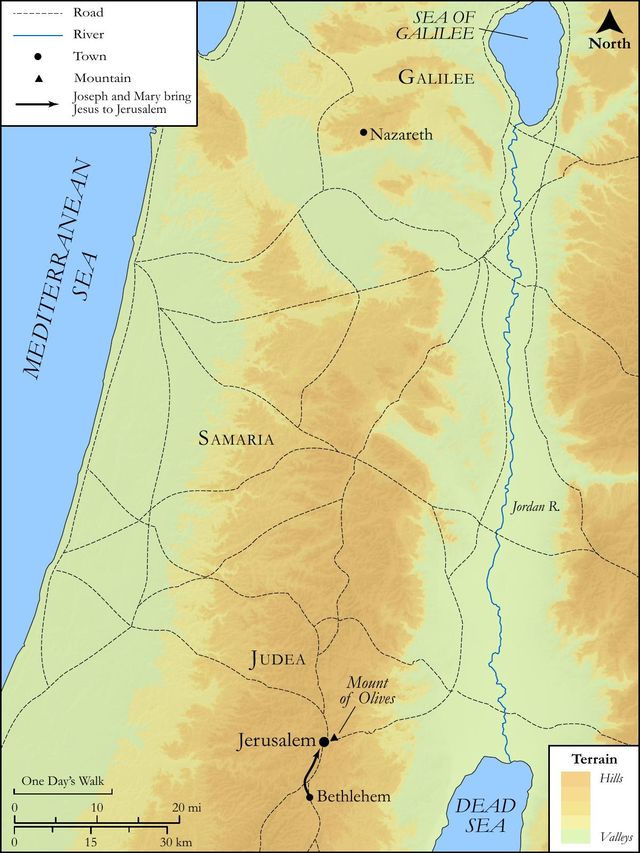
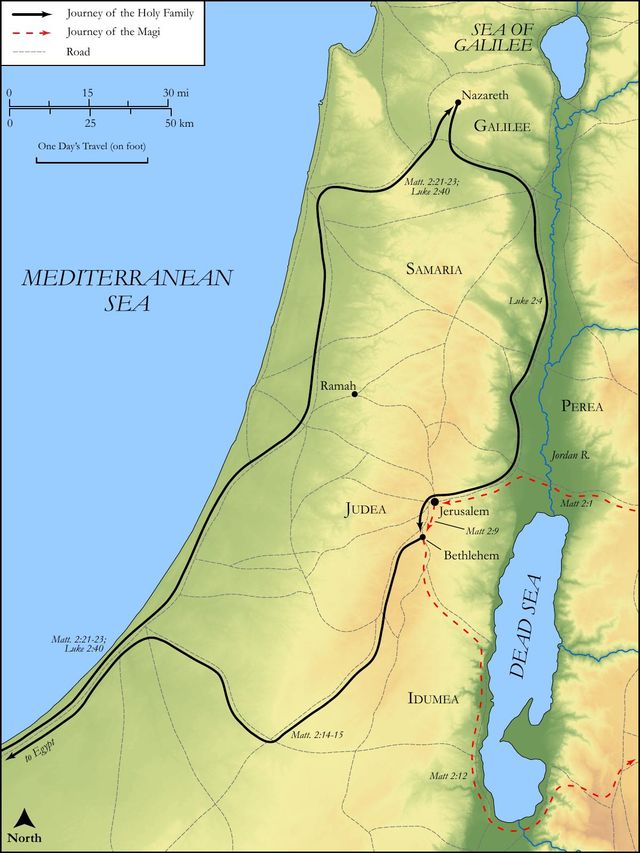
See on the biblical-era maps

Study this verse
Public-domain commentary
Matthew Henry
From his Commentary on the Whole Bible. Henry comments on passages, not single verses — this entry covers Luke 2:21–24. His three-level outline is real structure in the source text, so it is rendered as structure.
Our Lord Jesus, being made of a woman, was made under the law, Gal 4:4. He was not only, as the son of a daughter of Adam, made under the law of nature, but as the son of a daughter of Abraham was made under the law of Moses; he put his neck under that yoke, though it was a heavy yoke, and a shadow of good things to come. Though its institutions were beggarly elements, and rudiments of this world, as the apostle calls them, Christ submitted to it, that he might with the better grace cancel it, and set it aside for us.
Now here we have two instances of his being made under that law, and submitting to it.
I.He was circumcised on the very day that the law appointed (Luk 2:21):
When eight days were accomplished, that day seven-night that he was born, they circumcised him.
1.Though it was a painful operation (Surely a bloody husband thou has been, said Zipporah to Moses, because of the circumcision, Exo 4:25), yet Christ would undergo it for us; nay, therefore he submitted to it, to give an instance of his early obedience, his obedience unto blood. Then he shed his blood by drops, which afterwards he poured out in purple streams.
2.Though it supposed him a stranger, that was by that ceremony to be admitted into covenant with God, whereas he had always been his beloved Son; nay, though it supposed him a sinner, that needed to have his filthiness taken away, whereas he had no impurity or superfluity of naughtiness to be cut off, yet he submitted to it; nay, therefore he submitted to it, because he would be made in the likeness, not only of flesh, but of sinful flesh, Rom 8:3.
3.Though thereby he made himself a debtor to the whole law (Gal 5:3), yet he submitted to it; nay, therefore he submitted to it, because he would take upon him the form of a servant, though he was free-born. Christ was circumcised,
(1.)That he might own himself of the seed of Abraham, and of that nation of whom, as concerning the flesh, Christ came, and who was to take on him the seed of Abraham, Heb 2:16.
(2.)That he might own himself a surety for our sins, and an undertaker for our safety. Circumcision (saith Dr. Goodwin) was our bond, whereby we acknowledged ourselves debtors to the law; and Christ, by being circumcised, did as it were set his hand to it, being made sin for us. The ceremonial law consisted much in sacrifices; Christ hereby obliged himself to offer, not the blood of bulls or goats, but his own blood, which none that ever were circumcised before could oblige themselves to.
(3.)That he might justify, and put an honour upon, the dedication of the infant seed of the church to God, by that ordinance which is the instituted seal of the covenant, and of the righteousness which is by faith, as circumcision was (Rom 4:11), and baptism is. And certainly his being circumcised at eight days old doth make much more for the dedicating of the seed of the faithful by baptism in their infancy than his being baptized at thirty years old doth for the deferring of it till they are grown up. The change of the ceremony alters not the substance.
At his circumcision, according to the custom, he had his name given him; he was called Jesus or Joshua, for he was so named of the angel to his mother Mary before he was conceived in the womb (Luk 1:31), and to his supposed father Joseph after, Mat 1:21. [1.] It was a common name among the Jews, as John was (Col 4:11), and in this he would be made like unto his brethren. [2.] It was the name of two eminent types of him in the Old Testament, Joshua, the successor of Moses, who was commander of Israel, and conqueror of Canaan; and Joshua, the high priest, who was therefore purposely crowned, that he might prefigure Christ as a priest upon his throne, Zac 6:11, Zac 6:13. [3.] It was very significant of his undertaking. Jesus signifies a Saviour. He would be denominated, not from the glories of his divine nature, but from his gracious designs as Mediator; he brings salvation.
II.He was presented in the temple.
This was done with an eye to the law, and at the time appointed by the law, when he was forty days old, when the days of her purification were accomplished, Luk 2:22. Many copies, and authentic ones, read autōn for autēs, the days of their purification, the purification both of the mother and of the child, for so it was intended to be by the law; and our Lord Jesus, though he had no impurity to be cleansed fRom. yet submitted to it, as he did to circumcision, because he was made sin for us; and that, as by the circumcision of Christ we might be circumcised, in the virtue of our union and communion with him, with a spiritual circumcision made without hands (Col 2:11), so in the purification of Christ we might be spiritually purified from the filthiness and corruption which we brought into the world with us. Now, according to the law,
1.The child Jesus, being a first-born son, was presented to the Lord, in one of the courts of the temple. The law is here recited (Luk 2:23): Every male that opens the womb shall be called holy to the Lord, because by a special writ of protection the first-born of the Egyptians were slain by the destroying angel; so that Christ, as first-born, was a priest by a title surer than that of Aaron's house. Christ was the first-born among many brethren, and was called holy to the Lord, so as never any other was; yet he was presented to the Lord as other first-born were, and no otherwise. Though he was newly come out of the bosom of the Father, yet he was presented to him by the hands of a priest, as if he had been a stranger, that needed one to introduce him. His being presented to the Lord now signified his presenting himself to the Lord as Mediator, when he was caused to draw near and approach unto him, Jer 30:21. But, according to the law, he was redeemed, Num 18:15. The first-born of many shalt thou redeem, and five shekels was the value, Lev 27:6 : Num 18:16. But probably in case of poverty the priest was allowed to take less, or perhaps nothing; for no mention is made of it here. Christ was presented to the Lord, not to be brought back, for his ear was bored to God's door-post to serve him for ever; and though he is not left in the temple as Samuel was, to minister there, yet like him he is given to the Lord as long as he lives, and ministers to him in the true temple not made with hands.
2.The mother brought her offering, Luk 2:24. When she had presented that son of hers unto the Lord who was to be the great sacrifice, she might have been excused from offering any other; but so it is said in the law of the Lord, that law which was yet in force, and therefore so it must be done, she must offer a pair of turtle-doves, or two young pigeons; had she been of ability, she must have brought a lamb for a burnt-offering, and a dove for a sin-offering; but, being poor, and not able to reach the price of a lamb, she brings two doves, one for a burnt-offering and the other for a sin-offering (see Lev 12:6, Lev 12:8), to teach us in every address to God, and particularly in those upon special occasions, both to give thanks to God for his mercies to us and to acknowledge with sorrow and shame our sins against him; in both we must give glory to him, nor do we ever want matter for both. Christ was not conceived and born in sin, as others are, so that there was not that occasion in his case which there is in others; yet, because he was made under the law, he complied with it. Thus it became him to fulfil all righteousness. Much more doth it become the best of men to join in confessions of sin; for who can say, I have made my heart clean?
Historical interpretation
Five Centuries of Reception
13 surviving comments on this verse. Each one is dated, so this reads as a timeline rather than a list.
Select a marker to jump to its quote. Markers stagger vertically where authors wrote within a few decades of each other.
And when He says, "as suckling calves," He again alludes figuratively to us; and "as an innocent and gentle dove," the reference is again to us. Again, by Moses, He commands "two young pigeons or a pair of turtles to be offered for sin;" thus saying, that the harmlessness and innocence and placable nature of these tender young birds are acceptable to God, and explaining that like is an expiation for like. Further, the timorousness of the turtle-doves typifies fear in reference to sin.
For this reason it seems wonderful that the sacrifice of Mary was not the first offering, that is, "a lamb a year old," but the second, since "she could not afford" the first. For as it was written about her, Jesus' parents came "to offer a sacrifice" for him, "according to what is said in the law of the Lord, 'a pair of turtledoves, or two young pigeons.' " But this also shows the truth of what was written, that Jesus Christ "although he was rich, became a poor man." Therefore, for this reason, he chose both a poor mother, from whom he was born, and a poor homeland, about which it is said, "But you, O Bethlehem Ephratha, who are little to be among the clans of Judah," and the rest.
But when was the Lord hid from His Father's eye, that He should not be seen by Him, or what place is excepted from His dominion, that by remaining there He should be separate from His Father, unless brought to Jerusalem and introduced into the temple? But for us perhaps these things were written. For as not to confer grace on Himself was He made man and circumcised in the flesh, but to make us Gods through grace, and that we might be circumcised in the Spirit, so for our sakes is He presented to the Lord, that we also might learn to present ourselves to the Lord.
(ubi sup.) He ordered two things to be offered, because as man consists of both body and soul, the Lord requires a double return from us, chastity and meekness, not only of the body, but also of the soul. Otherwise, man will be a dissembler and hypocrite, wearing the face of innocence to mask his hidden malice.
Therefore the Evangelist has well observed, that the days of her purification were come according to the law, who since she had conceived of the Holy Spirit, was free from all uncleanness. It follows, They brought him to Jerusalem to present him to the Lord.
(in Hom. de occursu Domini.) Now this commandment of the law seems to have had its fulfilment in the incarnate God, in a very remarkable and peculiar manner. For He alone, ineffably conceived and incomprehensibly brought forth, opened the virgin's womb, till then unopened by marriage, and after this birth miraculously retaining the seal of chastity.
(ubi sup.) But the offspring of this birth is alone seen to be spiritually male, as contracting no guilt from being born of a woman. Hence He is truly called holy, and therefore Gabriel, as if announcing that this commandment belonged to Him only, said, That Holy thing which shall be born of thee shall be called the Son of God. Now of other first-borns the wisdom of the Gospel has declared that they are called holy from their being offered to God. But the first-born of every creature, That holy thing which is born, &c. the Angel pronounces to be in the nature of its very being holy.
(ubi sup.) It was not surely worldly happiness that the prudent Simeon was waiting for as the consolation of Israel, but a real happiness, that is, a passing over to the beauty of truth from the shadow of the law. For he had learnt from the sacred oracles that he would see the Lord's Christ before he should depart out of this present life. Hence it follows, And the Holy Spirit was in him, (by which indeed he was justified,) and he received an answer from the Holy Spirit.
(ubi sup.) How blessed was that holy entrance to holy things through which he hastened on to the end of life, blessed those hands which handled the word of life, and the arms which were held out to receive Him!
But let us come to the turtle-dove, which the law of God has chosen as the offering of a chaste victim. Finally, when the Lord was circumcised, it was offered; for it is written in the law of the Lord that they should offer a pair of turtle-doves or two young pigeons. For this is truly the sacrifice of Christ, chastity of the body, and grace of the spirit. Chastity is referred to the turtle-dove, grace to the pigeon.
All heretics have gone astray by not understanding the mystery of his nativity. The statement “he who opens the womb shall be called holy to the Lord” is more applicable to the special nativity of the Savior than to that of all men, for Christ alone opened the closed doors of the womb of virginity, which nevertheless remained permanently closed. This is the closed east door, through which only the high priest enters and leaves, and nevertheless it is always closed.
Next after the circumcision they wait for the time of purification, as it is said, And when the days of her purification according to the law of Moses were come.
(Hom. xi.) Oh the depth of the riches of the wisdom and knowledge of God! (Rom. 11:33.) He offers victims, Who in each victim is honoured equally with the Father. The Truth preserves the figures of the law. He who as God is the Maker of the law, as man has kept the law. Hence it follows, And that they should give a victim as it was ordered in the law of the Lord, a pair of turtle doves or two young pigeons. (Lev. 12:8.)
(ubi sup.) But let us see what these offerings mean. The turtle dove is the most vocal of birds, and the pigeon the gentlest. And such was the Saviour made unto us; He was endowed with perfect meekness, and like the turtle dove entranced the world, fillinga His garden with His own melodies. There was killed then either a turtle dove or a pigeon, that by a figure He might be shown forth unto us as about to suffer in the flesh for the life of the world.
After His circumcision, she next waits for the time of her purification: and when the days were fulfilled, and the fortieth was the full time, God the Word, Who sitteth by the Father's side, is carried up to Jerusalem, and brought into the Father's presence in human nature like unto us, and by the shadow of the law is numbered among the firstborn. For even before the Incarnation the firstborn were holy, and consecrated to God, being sacrificed to Him according to the law. O! how great and wonderful is the plan of salvation! "O the depth of the riches both of the wisdom and knowledge of God!" He Who is in the bosom of the Father, the Son Who shares His throne, and is coeternal with Him: by Whom all things are divinely brought into existence, submitted nevertheless to the measure of human nature, and even offered a sacrifice to His own Father, although adored by all, and glorified with Him. And what did He offer? As the firstborn and a male a pair of turtles, or two young doves, according to what the law prescribed. But what does the turtle signify? And what too the other, the dove? Come, then, and let us examine this. The one, then, is the most noisy of the birds of the field: but the other is a mild and gentle creature. And such did the Saviour of all become towards us, showing the most perfect gentleness, and like a turtle moreover soothing the world, and filling His own vineyard, even us who believe in Him, with the sweet sound of His voice. For it is written in the Song of Songs, "The voice of the turtle has been heard in our land." For Christ has spoken to us the divine message of the Gospel, which is for the salvation of the whole world.
Turtles, therefore, and doves were offered, when He presented Himself unto the Lord, and there might one see simultaneously meeting together the truth and the types. And Christ offered Himself for a savour of a sweet smell, that He might offer us by and in Himself unto God the Father, and so do away with His enmity towards us by reason of Adam's transgression, and bring to nought sin that had tyrannized over us all. For we are they who long ago were crying, "Look upon me, and pity me."
(Mor. 7.) Hereby also we learn with what desire the holy men of Israel desired to see the mystery of His incarnation.
Of this name the elect also in their spiritual circumcision rejoice to be partakers, that as from Christ they are called Christians, so also from the Saviour they may be called saved, which title was given them of God not only before they were conceived through faith in the womb of the Church, but even before the world began.
And to offer a sacrifice according to that which is said in the law of the Lord, A pair of turtledoves, or two young pigeons.
If you diligently examine the words of the law, you will find indeed that the mother of God as she is free from all connection with man, so is she exempt from any obligation of the law. For not every woman who brings forth, but she who has received seed and brought forth, is pronounced unclean, and by the ordinances of the law is taught that she must be cleansed, in order to distinguish probably from her who though a virgin has conceived and brought forth. But that we might be loosed from the bonds of the law, as did Christ, so also Mary submitted herself of her own will to the law.
On the thirty-third day after His circumcision He is presented to the Lord, signifying in a mystery that no one but he who is circumcised from his sins is worthy to come into the Lord's sight, that no one who has not severed himself from all human ties can perfectly enter into the joys of the heavenly city. It follows, As it is written in the law of the Lord.
By the words, opening the womb, he signifies the first-born both of man and beast, and each one of which was, according to the commandment, to be called holy to the Lord, and therefore to become the property of the priest, that is, so far that he was to receive a price for every first-born of man, and oblige every unclean animal to be ransomed.
(Hom. Purif.) Now this was the victim of the poor. For the Lord commanded in the law that they who were able should offer a lamb for a son or a daughter as well as a turtle dove or pigeon; but they who were not able to offer a lamb should give two turtle doves or two young pigeons. Therefore the Lord, though he was rich, deigned to become poor, that by his poverty He might make us partakers of His riches.
(ubi sup.) Or the pigeon denotes simplicity, the turtle dove chastity, for the pigeon is a lover of simplicity, and the turtle dove of chastity, so that if by chance she has lost her mate, she heeds not to find another. Rightly then are the pigeon and turtle dove offered as victims to the Lord, because the simple and chaste conversation of the faithful is a sacrifice of righteousness well pleasing to Him.
(ubi sup.) But while each bird, from its habit of wailing, represents the present sorrows of the saints, in this they differ, that the turtle is solitary, but the pigeon flies about in flocks, and hence the one points to the secret tears of confession, the other to the public assembling of the Church.
Or the pigeon which flies in flocks sets forth the busy intercourse of active life. The turtle, which delights in solitariness, tells of the lofty heights of the contemplative life. But because each victim is equally accepted by the Creator, St. Luke has purposely omitted whether the turtles or young pigeons were offered for the Lord, that he might not prefer one mode of life before another, but teach that both ought to be followed.
To see death means to undergo it, and happy will he be to see the death of the flesh who has first been enabled to see with the eyes of his heart the Lord Christ, having his conversation in the heavenly Jerusalem, and frequently entering the doors of God's temple, that is, following the examples of the saints in whom God dwells as in His temple. By the same grace of the Spirit whereby he foreknew Christ would come, he now acknowledges Him come, as it follows, And he came by the Spirit into the temple.
Now the righteous man, according to the law, received the Child Jesus in his arms, that he might signify that the legal righteousness of works under the figure of the hands and arms was to be changed for the lowly indeed but saving grace of Gospel faith. The old man received the infant Christ, to convey thereby that this world, now worn out as it were with old age, should return to the childlike innocence of the Christian life.
And to offer a sacrifice, according to what is said in the law of the Lord, a pair of turtledoves or two young pigeons. It is said in the law that for a child, if it is a male, as I have said before, on the fortieth day, if it is a female, on the eightieth day of birth, a year-old unblemished lamb for a burnt offering, and a turtledove or a young pigeon will be offered for a sin offering. However, if his hand cannot find it or he is unable to offer a lamb, he shall take two turtledoves or two young pigeons, one for a burnt offering and the other for a sin offering (Leviticus XII). Therefore, the Lord Jesus Christ, although He was rich, became poor for us and desired a poor sacrifice to be offered for Him. That by His one poverty He might make us wealthy in faith here and heirs of the kingdom there, which God has promised to those who love Him. Morally, whether someone has performed valiant works or created weak ones, which are distinguished by the names male and female, so that these might legitimately be consecrated to the Lord, it is necessary to offer a lamb of innocence and equally a turtledove or a pigeon of compunction. For since these birds have moaning instead of singing, they rightfully signify the tears of the humble, by which we greatly need even in our good works. For although we know that our works are good, we do not know with what strictness they must be examined by the Lord or with what perseverance they must be completed by us. But whoever does not have the wealth of virtues, about which the Apostle said to the Corinthians: “For you have been made rich in everything in Him, in all speech and in all knowledge” (1 Corinthians 1), if he does not find in the flock of his deeds a lamb of innocent life, let him at least offer two turtledoves or two young pigeons, that is, let him seek the aid of tears. And rightly two, one for sin and one for a burnt offering (Leviticus XII). For a burnt offering is called wholly burnt; because there are surely two kinds of compunction. The soul longing for God is first pricked by fear, then by love. First, it is moved to tears because, recalling its evils, it greatly fears to suffer eternal punishments for them. But when the anxiety of prolonged sorrow has consumed the fear, a certain security of presumed forgiveness is born, and the soul is inflamed with the love of heavenly joys. The mind contemplates what those choirs of angels are, that very assembly of blessed spirits, the majesty of the eternal vision of God, and weeps more because it is deprived of eternal goods, than it wept before when it feared eternal evils. Therefore, he who at first wept not to be led to punishment offered a turtledove for sin; of the other, he makes a burnt offering when afterward he begins to weep bitterly because he is deferred from the kingdom. He offers a dove for sin who labors in his groaning, washes his bed every night, that is, in each darkness of striking guilt, with good works, in which he should rest, he does not cease to wash with tears. They bring the young of doves as a burnt offering, who lamenting the absence of the heavenly fatherland say: “By the rivers of Babylon, there we sat and wept, when we remembered you, Zion” (Psalm 137). For as doves delight to sit beside the flowing waters, so that they might foresee and evade the advent of the hawk in the shadow’s swift flight over the waters: thus indeed, thus the souls of the poor in spirit, surpassing the waves of the world in their minds, the more they are nourished by their lamentations in this Babylon, the more they see the examples of the wicked enemy, the more frequently they raise their wings to the eternal of their desire. Certainly, there is this difference between the signification of the turtledove and the dove, that the dove, which is accustomed to associate, fly, and coo in flocks, demonstrates the frequency of active life: of which it is said: “Now the multitude of those who believed were of one heart and one soul, and no one said that any of the things he possessed was his own, but they had all things in common” (Acts 4). But the turtledove, which delights in solitude, so much so that if it loses its mate by chance, it remains alone thereafter, signifies the heights of contemplative life, because this virtue is for the few, and attributed to them individually. Isaiah alone sees the Lord of hosts, contemplates the praises of the Seraphim, and because he has spoken ill, he groans like a solitary turtledove. Moses, when the people are trembling afar, ascends alone to the Lord, and lest the same people be struck, he obtains by tearful prayers. Daniel is alone among the angels when his companions flee. Ezekiel alone marvels at the chariots of the Cherubim and the lofty buildings of the celestial city. Paul alone is caught up to the delights of paradise and to see the secrets of the third heaven. Likewise, when I enter the chamber, closing the door, I pray to the Father in secret, I offer the turtledove. But when I seek companions of the same work, by singing with the Prophet: "Come, let us worship and bow down before the Lord, who made us" (Psalm 95), I offer doves on the altar. And because both sacrifices are equally acceptable to the Creator, Luke wisely does not say whether turtledoves or young pigeons were offered for the Lord, lest he prefer one form of living to another, but teaches both are to be followed, both to be offered in divine worship. Therefore, since the discourse on purification has been extended, what the number of days of purification contains of mystery, and why the same is ordered to be doubled in the purification of the woman who has given birth will be more suitably explained in Leviticus.
Mary, God’s blessed mother and a perpetual virgin, was, along with the Son she bore, most free from all subjection to the law. The law says that a woman who “had received seed” and given birth was to be judged unclean and that after a long period she, along with the offspring she had borne, were to be cleansed by victims offered to God. So it is evident that the law does not describe as unclean that woman who, without receiving man’s seed, gave birth as a virgin. Nor does it so describe the son who was born to her. Nor does it teach that she had to be cleansed by saving sacrificial offerings. But as our Lord and Savior, who in his divinity was the one who gave the law, when he appeared as a human being, willed to be under the law.… So too his blessed mother, who by a singular privilege was above the law, nevertheless did not shun being made subject to the principles of the law for the sake of showing us an example of humility.
Continue studying Luke 2:24 across the web’s major study libraries — every link below opens this exact verse, chapter, or book on the destination site.
Read & Compare
 BibleGatewayThis verse in more than 200 translations and 70 languages.
 Bible.comThe YouVersion reader — hundreds of translations, reading plans, and highlights.
 ESV.orgCrossway's official English Standard Version reader.
 NET BibleThe NET translation with 60,000+ translators' notes on every rendering decision.
 STEP BibleTyndale House's free study tool — original text, vocabulary, and scholarly resources.
 BibliaLogos Bible Software's free web reader.
 USCCBThe New American Bible (Revised Edition) with the U.S. bishops' study notes.
Commentaries
 BibleHub CommentariesDozens of classic commentaries on this verse, gathered on one page.
 StudyLightMore than 100 commentary sets — the largest collection on the web.
 BibleRefPlain-English commentary on what this verse means, verse by verse.
 Enduring WordDavid Guzik's free commentary on this chapter, widely used by Bible teachers.
 Bible Study ToolsVerse commentary alongside Greek and Hebrew study aids.
Original Language & Research
- BibleHub InterlinearThe verse word by word — original language, transliteration, and English.
- BibleHub LexiconEvery word's original-language definition and Strong's entry.
 Blue Letter BibleDeep-study tools — Strong's numbers, concordance, and word studies.
 CNTR CollationThe earliest Greek manuscripts of this verse, collated letter by letter.
Sermons, Hymns & Audio


TrulyRandomVerse is not affiliated with these sites and doesn’t control their content. They’re linked because they’re genuinely useful.
Summary
Luke 2:24 records Mary and Joseph's faithful adherence to the Mosaic Law following Jesus' birth, as they present Him at the Temple and offer a purification sacrifice. This act, specifically the offering of "a pair of turtledoves, or two young pigeons," highlights their humble economic status while simultaneously underscoring their devout obedience to God's commandments, setting a foundational precedent for Jesus' own life of perfect submission to the Father's will and the Law.
Context
ShowHideLiterary Context
This verse is part of Luke's detailed account of Jesus' infancy and early childhood, specifically following His circumcision (Luke 2:21) and preceding the prophetic declarations of Simeon and Anna in the Temple (Luke 2:25-38). The immediate narrative describes Mary and Joseph bringing Jesus to Jerusalem to fulfill the requirements of the Law. Luke 2:22-23 mentions the purification of Mary and the consecration of the firstborn male, linking back to Old Testament commands. Verse 24 then specifies the nature of the sacrifice, directly referencing the provisions for the poor found in the Mosaic Law, which sets the stage for the profound encounters that follow in the Temple. This careful detailing by Luke emphasizes the full humanity of Jesus and the devoutness of His earthly parents, integrating His divine arrival into the established religious and cultural framework of Israel.
Historical & Cultural Context
The Mosaic Law, particularly as outlined in Leviticus 12, mandated a period of purification for a mother after childbirth. For a male child, this period was 40 days (Leviticus 12:2-4). At its conclusion, the mother was required to bring a lamb for a burnt offering and a young pigeon or turtledove for a sin offering to the priest at the entrance of the Tent of Meeting (Leviticus 12:6). Crucially, Leviticus 12:8 provided a concession for those who could not afford a lamb: they could offer "two turtledoves or two young pigeons," one for a burnt offering and one for a sin offering. Mary and Joseph's offering of birds therefore clearly signals their humble economic circumstances, a common reality for many in first-century Galilee. This detail contrasts sharply with the divine identity of the child they presented, highlighting God's choice to enter humanity in humility.
Key Themes
ShowHideLuke 2:24 powerfully contributes to several overarching themes within Luke's Gospel and the broader biblical narrative. Firstly, it highlights Obedience to God's Law, demonstrating Mary and Joseph's profound reverence for the "law of the Lord." Their faithful observance of these rituals, despite Jesus' divine nature, underscores the importance of living righteously within God's covenant, a theme central to Luke's portrayal of early believers. Secondly, the specific sacrifice of birds emphasizes Humility and Poverty, revealing that the Savior of the world, though King of Kings, entered humanity in the most modest of circumstances, identifying with the common, struggling people. This aligns with Luke's consistent emphasis on God's care for the poor and overlooked, as seen in the Magnificat (Luke 1:52-53) and Jesus' later ministry. Finally, this act foreshadows Jesus' own Fulfillment of Righteousness. Though sinless, Jesus was born under the Law and subjected to its requirements, perfectly fulfilling its demands throughout His life, culminating in His atoning death. His presentation at the Temple, including this offering, was an early step in His mission to perfectly fulfill all righteousness on behalf of humanity.
Exposition and Analysis
ShowHideKey Word Analysis
ShowHideFrom the root meaning "to sacrifice," this noun refers to the act of offering or the victim itself, whether literally or figuratively. In this context, it denotes the specific offering made in the Temple as required by the Mosaic Law for purification and atonement. The term emphasizes the religious ritual being performed.
Derived from a verb meaning "to parcel out," this word refers to a prescriptive usage, a regulation, or a divine commandment. Here, it specifically denotes the Mosaic Law (Torah), the body of divine instructions given to Israel through Moses, which governed their religious and social life. It underscores the divine authority behind the requirement.
From the same root as the word for "yoke," this noun signifies a couple, a team (like oxen yoked together), or a brace (like birds tied together). Its use here highlights that the offering was not a single bird, but two, emphasizing the specific quantity mandated by the Law for this particular type of sacrifice.
Verse Breakdown
ShowHide"And to offer a sacrifice"
This clause indicates the purpose of Mary and Joseph's visit to the Temple. It was not merely a presentation, but an act of worship involving the prescribed ritual offering. The term "sacrifice" (G2378, thysía) points to a formal religious act intended to fulfill a divine requirement, signifying atonement, purification, or dedication.
"according to that which is said in the law of the Lord"
This phrase emphasizes the divine origin and authority of the requirement. Mary and Joseph were not acting on personal inclination but in direct obedience to God's revealed will, as recorded in the Mosaic Law. The "law of the Lord" (G3551 nómos G2962 Kyriou) explicitly links their actions to the covenant stipulations given by God to Israel.
"A pair of turtledoves, or two young pigeons"
This specifies the exact nature of the sacrifice. This particular offering, as detailed in Leviticus 12:8, was the alternative provided for those who could not afford a lamb. The mention of "turtledoves" (G5167, trygṓn) and "pigeons" (G4058, peristerá) highlights the humble economic status of Mary and Joseph, as these were the offerings of the poor. The "pair" (G2201, zeûgos) or "two" (G1417, dýo) indicates the precise number required for the dual purpose of burnt and sin offerings.
Literary Devices
ShowHideLuke employs several literary devices in this verse to convey deeper meaning. Allusion is prominent, as the verse directly alludes to the specific provisions of the Mosaic Law found in Leviticus 12, demonstrating Mary and Joseph's faithful adherence to the covenant. This legalistic detail serves as a form of Symbolism, where the humble offering of "turtledoves, or two young pigeons" symbolizes the poverty and lowliness into which the Messiah was born, contrasting sharply with His divine majesty. It also subtly employs Foreshadowing, as this early act of submission to the Law by Jesus' parents foreshadows Jesus' own perfect obedience to the Father's will and His ultimate fulfillment of the Law's demands on behalf of humanity. The precise detail also adds to the Verisimilitude of Luke's historical account, grounding the miraculous birth of Jesus in the tangible realities of first-century Jewish life and religious practice.
Theological and Thematic Connections
ShowHideLuke 2:24 profoundly illustrates the intersection of divine purpose and human obedience. Theologically, it underscores God's meticulous provision within His covenant, ensuring that even the poorest could participate fully in the required rituals of purification and atonement, thereby maintaining their relationship with Him. This act of sacrifice, though small in material value, was immense in its spiritual significance, representing Mary's purification and, by extension, the dedication of Jesus to God. The humility inherent in the offering chosen by Mary and Joseph speaks volumes about the nature of God's incarnation – not in worldly splendor, but in solidarity with the lowly. This initial act of submission to the Law by Jesus' family sets a precedent for Jesus' own life of perfect obedience, culminating in His ultimate sacrifice.
Reflection and Application
ShowHideLuke 2:24 offers a rich tapestry for contemporary reflection and application. It calls us to consider the profound example of Mary and Joseph's unwavering obedience to God's commands, even in seemingly mundane or financially challenging circumstances. Their faithfulness reminds us that true devotion is often expressed not in grand gestures, but in consistent, humble adherence to God's Word. This verse encourages us to examine our own lives: are we diligently seeking to live in accordance with God's revealed will, even when it requires personal sacrifice or highlights our limitations? The humble offering also serves as a powerful reminder that God values a contrite and obedient heart far more than material wealth or outward show. It challenges us to embrace humility, recognizing that our worth and access to God are not dependent on our possessions or status, but on our relationship with Him. Furthermore, the provision in the Law for the poor speaks to God's compassionate nature and His desire for all people, regardless of their economic standing, to draw near to Him and participate in His covenant. We are called to trust in God's perfect provision for our spiritual and physical needs, knowing that He makes a way for us to approach Him. Finally, for parents, Mary and Joseph's dedication of Jesus at the Temple is a beautiful illustration of raising children in the fear and admonition of the Lord, committing them to God's purposes from their earliest days.
Questions for Reflection
ShowHideFAQ
ShowHideWhy did Mary and Joseph offer turtledoves or pigeons instead of a lamb?
ShowHideMary and Joseph offered turtledoves or pigeons because they were fulfilling the specific provision in the Mosaic Law for those who could not afford a lamb. According to Leviticus 12:6, a mother was typically required to bring a lamb for a burnt offering and a young pigeon or turtledove for a sin offering after her period of purification following childbirth. However, Leviticus 12:8 explicitly states, "But if she cannot afford a lamb, then she shall take two turtledoves or two young pigeons—one for a burnt offering and the other for a sin offering." Their choice of offering thus indicates their humble economic status, demonstrating that even the Savior of the world was born into modest circumstances.
Christ-Centered Fulfillment
ShowHideLuke 2:24, with its depiction of a humble sacrifice for purification, finds profound Christ-centered fulfillment in the person and work of Jesus. The very act of His parents offering a sacrifice "according to the law of the Lord" underscores Jesus' unique position as one "born under the law" (Galatians 4:4), not because He was sinful, but so that He might perfectly fulfill its righteous demands on humanity's behalf. The humble offering of birds, a provision for the poor, foreshadows Jesus' identification with the lowly and His ultimate act of self-emptying, taking on the form of a servant (Philippians 2:7). Ultimately, Jesus Himself became the perfect, once-for-all sacrifice, the "Lamb of God who takes away the sin of the world" (John 1:29), rendering all previous animal sacrifices, including those of turtledoves and pigeons, obsolete. His blood, shed on the cross, provided the ultimate purification and atonement, far surpassing any ritualistic offering, thereby inaugurating a new covenant of grace where access to God is granted not by adherence to the Law's rituals, but by faith in His finished work (Hebrews 10:1-18). Thus, the humble offering in Luke 2:24 points forward to the infinitely greater, perfect sacrifice of Christ, which truly purifies and reconciles humanity to God.