


1 Samuel 1:24
Bible text: King James Version (1769 Blayney text) · Public domain
Bible text: King James Version with Strong's numbers · Public domain
Bible text: Berean Standard Bible · Public domain
Bible text: American Standard Version (1901) · Public domain
Bible text: World English Bible, Messianic edition · Public domain
Bible text: Geneva Bible (1599) · Public domain
Bible text: Young's Literal Translation · Public domain
- וַתַּעֲלֵהוּva·ta·'a·Le·huand she brought up himH5927Conj-w ¦ V-Hiphil-ConsecImperf-3fs ¦ 3msVerb Hiphil Consecutive Imperfect 3rd Singular Feminineוַandתַּעֲלֵshe brought upהוּhim
- עִמָּהּ'i·Mahwith herH5973Prep ¦ 3fsPreposition Definiteעִמָּwithהּher
- כַּאֲשֶׁרka·'a·Sherjust whenH834Prep-k ¦ RelParticle Relativeכַּjustאֲשֶׁרwhen
- גְּמָלַתּוּge·ma·La·tushe had weaned himH1580V-Qal-Perf-3fs ¦ 3msVerb Qal Perfect 3rd Singular Feminineגְּמָלַתּshe had weanedוּhim
- בְּפָרִיםbe·fa·Rimwith young bullsH6499Prep-b ¦ N-mpNoun Plural Masculine Absoluteבְּwithפָרִיםyoung bulls
- שְׁלֹשָׁהshe·lo·ShahthreeH7969N-csNoun Singular common gender Absolute
- וְאֵיפָהve·'ei·Fahand an ephahH374Conj-w ¦ N-fsNoun Singular Feminine Absoluteוְandאֵיפָהan ephah
- אַחַת'a·Chatone ofH259N-fscNoun Singular Feminine Construct
- קֶמַחke·machflourH7058N-msNoun Singular Masculine Absolute
- וְנֵבֶלve·Ne·veland a skin ofH5035Conj-w ¦ N-mscNoun Singular Masculine Constructוְandנֵבֶלa skin of
- יַיִןYa·yinwineH3196N-msNoun Singular Masculine Absolute
- וַתְּבִאֵהוּva·te·vi·'E·huand she took himH935Conj-w ¦ V-Hiphil-ConsecImperf-3fs ¦ 3msVerb Hiphil Consecutive Imperfect 3rd Singular Feminineוַandתְּבִאֵshe tookהוּhim
- בֵיתveit[the] house ofH1004N-mscNoun Singular Masculine Construct
- יְהוָהYah·wehYahwehH3068N-properNoun Proper Title
- שִׁלוֹshi·LoShilohH7887N-properNoun Proper Location
- וְהַנַּעַרve·ha·Na·'arand the ladH5288Conj-w ¦ Art ¦ N-msNoun Singular Masculine Absoluteוְandהַtheנַּעַרlad
- נָעַרNa·'ar[was] a ladH5288N-msNoun Singular Masculine Absolute
English is a literal word-by-word gloss of the Hebrew, not the KJV's wording. Why?
This is the original text the KJV's translators worked from — each Hebrew word with its own literal English meaning in this verse, prepared by scholars at Tyndale House, Cambridge. The KJV translates whole sentences, not word by word, so its wording differs: one Hebrew word can become several English words, and the KJV may choose “the LORD” where the gloss reads “Yahweh”. Both are faithful — they answer different questions. For the KJV's own rendering, switch to the KJV text.
Details
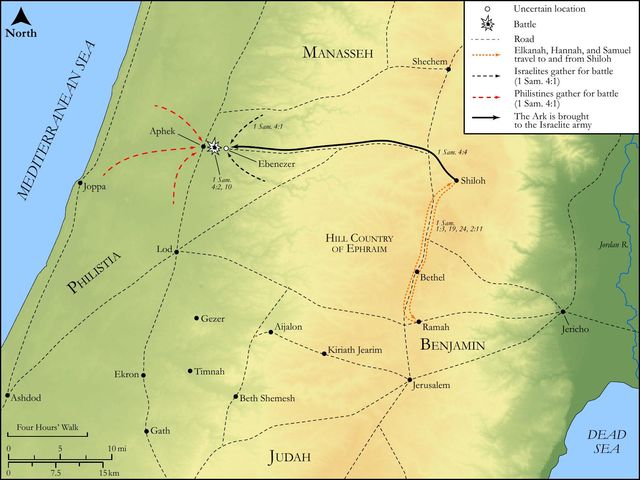
See on the biblical-era map
Study this verse
Public-domain commentary
Matthew Henry
From his Commentary on the Whole Bible. Henry comments on passages, not single verses — this entry covers 1 Samuel 1:19–28. His three-level outline is real structure in the source text, so it is rendered as structure.
Here is, I. The return of Elkanah and his family to their own habitation, when the days appointed for the feast were over, Sa1 1:19. Observe how they improved their time at the tabernacle. Every day they were there, even that which was fixed for their journey home, they worshipped God; and they rose up early to do it. It is good to begin the day with God. Let him that is the first have the first. They had a journey before them, and a family of children to take with them, and yet they would not stir till they had worshipped God together. Prayer and provender do not hinder a journey. They had spent several days now in religious worship, and yet they attended once more. We should not be weary of well-doing.
II.The birth and name of this desired son.
At length the Lord remembered Hannah, the very thing she desired (Sa1 1:11), and more she needed not desire, that was enough, for then she conceived and bore a son. Though God seem long to forget his people's burdens, troubles, cares, and prayers, yet he will at length make it to appear that they are not out of his mind. This son the mother called Samuel, Sa1 1:20. Some make the etymology of this name to be much the same with that of Ishmael - heard of God, because the mother's prayers were remarkably heard, and he was an answer to them. Others, because of the reason she gives for the name, make it to signify asked of God. It comes nearly to the same; she designed by it to perpetuate the remembrance of God's favour to her in answering her prayers. Thus she designed, upon every mention of his name, to take the comfort to herself and to give God the glory of that gracious condescension. Note, Mercies in answer to prayer are to be remembered with peculiar expressions of thankfulness, as Psa 116:1, Psa 116:2. How many seasonable deliverances and supplies may we call Samuels, asked of God; and whatever is so we are in a special manner engaged to devote to him. Hannah intended by this name to put her son in mind of the obligation he was under to be the Lord's, in consideration of this, that he was asked of God and was at the same time dedicated to him. A child of prayer is in a special manner bound to be a good child. Lemuel's mother reminds him that he was the son of her vows, Pro 31:2.
III.The close attendance Hannah gave to the nursing of him, not only because he was dear to her, but because he was devoted to God, and for him she nursed him herself, and did not hang him on another's breast. We ought to take care of our children, not only with an eye to the law of nature as they are ours, but with an eye to the covenant of grace as they are given up to God. See Eze 16:20, Eze 16:21. This sanctifies the nursing of them, when it is done as unto the Lord. Elkanah went up every year to worship at the tabernacle, and particularly to perform his vow, perhaps some vow he had made distinct from Hannah's if God would give him a son by her, Sa1 1:21. But Hannah, though she felt a warm regard for the courts of God's house, begged leave of her husband to stay at home; for the women were not under any obligation to go up to the three yearly feasts, as the men were. However Hannah had been accustomed to go, but now desired to be excused,
1.Because she would not be so long absent from her nursery. Can a woman forget her sucking child? We may suppose she kept constantly at home, for, if she had gone any where, she would have gone to Shiloh. Note, God will have mercy and not sacrifice. Those that are detained from public ordinances by the nursing and tending of little children may take comfort from this instance, and believe that, if they do that with an eye to God, he will graciously accept them therein, and though they tarry at home they shall divide the spoil.
2.Because she would not go up to Shiloh till her son was big enough, not only to be taken thither, but to be left there; for, if once she took him thither, she thought she could never find in her heart to bring him back again. Note, Those who are stedfastly resolved to pay their vows may yet see good cause to defer the payment of them. Every thing is beautiful in its season. No animal was accepted in sacrifice till it had been for some time under the dam, Lev 22:27. Fruit is best when it is ripe. Elkanah agrees to what she proposes (Sa1 1:23): Do what seemeth thee good. So far was he from delighting to cross her that he referred it entirely to her. Behold how good and pleasant a thing it is, when yoke-fellows thus draw even in the yoke, and accommodate themselves to one another, each thinking well of what the other does, especially in works of piety and charity. He adds a prayer: Only the Lord establish his word, that is, "God preserve the child through the perils of his infancy, that the solemn vow which God signified his acceptance of, by giving us the child, may be performed in its season, and so the whole matter may be accomplished." Note, Those that have in sincerity devoted their children to God may with comfort pray for them, that God will establish the word sealed to them at the same time that they were sealed for him.
IV.The solemn entering of this child into the service of the sanctuary.
We may take it for granted that he was presented to the Lord at forty days old, as all the first-born were (Luk 2:22, Luk 2:23): but this is not mentioned, because there was nothing in it singular; but now that he was weaned he was presented, not to be redeemed. Some think it was as soon as he was weaned from the breast, which, the Jews say, was not till he was three years old; it is said she gave him suck till she had weaned him, Sa1 1:23. Others think it was not till he was weaned from childish things, at eight or ten years old. But I see no inconvenience in admitting such an extraordinary child as this into the tabernacle at three years old, to be educated among the children of the priests. It is said (Sa1 1:24), The child was young, but, being intelligent above his years, he was no trouble. None can begin too soon to be religious. The child was a child, so the Hebrew reads it, in his learning-age. For whom shall he teach knowledge but those that are newly weaned from the milk and drawn from the breasts? Isa 28:9. Observe how she presented her child,
1.With a sacrifice; no less than three bullocks, with a meat-offering for each, Sa1 1:24. A bullock, perhaps, for each year of the child's life. Or one for a burnt-offering, another for a sin-offering, and the third of a peace-offering. So far was she from thinking that, by presenting her son to God, she made God her debtor, that she thought it requisite by these slain offerings to seek God's acceptance of her living sacrifice. All our covenants with God for ourselves and ours must be made by sacrifice, the great sacrifice.
2.With a grateful acknowledgement of God's goodness in answer to prayer. This she makes to Eli, because he had encouraged her to hope for an answer of peace (Sa1 1:26, Sa1 1:27): "For this child I prayed. Here it was obtained by prayer, and here it is resigned to the prayer-hearing God. You have forgotten me, my lord, but I who now appear so cheerful am the woman, the very same, that three years ago stood by thee here weeping and praying, and this was the child I prayed for." Answers of prayer may thus be humbly triumphed in, to the glory of God. Here is a living testimony for God. "I am his witness that he is gracious (see Psa 66:16-19); for this mercy, this comfort, I prayed, and the Lord has given me my petition." See Psa 34:2, Psa 34:4, Psa 34:6. Hannah does not remind Eli of it by adverting to the suspicion he had formerly expressed; she does not say, "I am the woman whom you passed that severe censure upon; what do you think of me now?" Good men ought not to be upbraided with their infirmities and oversights. They have themselves repented of them; let them hear no more of them.
3.With a full surrender of all her interest in this child unto the Lord (Sa1 1:28): I have lent him to the Lord as long as he liveth. And she repeats it, because she will never revoke it: He shall be (a deodand) lent or given to the Lord. Not that she designed to call for him back, as we do what we lend, but she uses this word Shaol, lent, because it is the same word that she had used before (Sa1 1:20, I asked him of the Lord), only in another conjugation. And (Sa1 1:27) the Lord gave me the petition which I asked (Shaalti, in Kal), therefore I have lent him (Hishilti, the same word in Hiphil), and so it gives another etymology of his name Samuel, not only asked of God, but lent to God. And observe,
(1.)Whatever we give to God, it is what we have first asked and received from him. All our gifts to him were first his gifts to us. Of thy own, Lord, have we given thee, Ch1 29:14, Ch1 29:16.
(2.)Whatever we give to God may upon this account be said to be lent to him, that though we may not recall it, as a thing lent, yet he will certainly repay it, with interest, to our unspeakable advantage, particularly what is given to his poor, Pro 19:17. When by baptism we dedicate our children to God, let us remember that they were his before by a sovereign right, and that they are ours still so much the more to our comfort. Hannah resigns him to the Lord, not for a certain term of years, as children are sent apprentices, but durante vita - as long as he liveth, he shall be lent unto the Lord, a Nazarite for life. Such must our covenant with God be, a marriage-covenant; as long as live we must be his, and never forsake him.
Lastly, The child Samuel did his part beyond what could have been expected from one of his years; for of him that seems to be spoken, He worshipped the Lord there, that is he said his prayers. He was no doubt extraordinarily forward (we have known children that have discovered some sense of religion very young), and his mother, designing him for the sanctuary, took particular care to train him up to that which was to be his work in the sanctuary. Note, Little children should learn betimes to worship God. Their parents should instruct them in his worship and bring them to it, put them upon engaging in it as well as they can, and God will graciously accept them and teach them to do better.
Historical interpretation
Three Centuries of Reception
3 surviving comments on this verse. Each one is dated, so this reads as a timeline rather than a list.
Select a marker to jump to its quote. Markers stagger vertically where authors wrote within a few decades of each other.
Considering all these things, and whatever else the Lord shall have made known to you in this matter, which either does not occur to me or would take too much time to state here, strive in prayer to overcome this world: pray in hope, pray in faith, pray in love, pray earnestly and patiently, pray as a widow belonging to Christ. For although prayer is, as he has taught, the duty of all his members, that is, of all who believe in him and are united to his body, a more assiduous attention to prayer is found to be specially enjoined in Scripture upon those who are widows. Two women of the name of [Hannah] are honorably named there—the one, Elkanah’s wife, who was the mother of holy Samuel; the other, the widow who recognized the Most Holy One when he was yet a babe. [Hannah], though married, prayed with sorrow of mind and brokenness of heart because she had no sons; and she obtained Samuel and dedicated him to the Lord, because she vowed to do so when she prayed for him.
And she brought him with her, after she had weaned him, etc. The Church brings up her children, to whom she reasonably and without deceit administered milk, and has now advanced them from the rudiments of the new man to more perfect things, having educated them. She brings, I say, those whom the assisting grace of Christ has made strong in understanding to the fellowship of those who have already been made the temple of God through the observance of the divine law. But she brings them in three persons, namely, those who are married, the continent, and the teachers, who by the purity of their lives are fit for divine sacrifices, having bodies prepared to die for Christ, possessing a heart contrite through the mill of fear and hope, and embracing with a full mind the fervent love of spiritual grace to be inebriated with a sober chalice. For since an amphora is a kind of measure, it indicates the measure of love, by which each one is commanded to love his neighbor as himself. And because it holds three measures, it is rightly applied to the aforementioned three persons, by whom the whole Church consists.
The boy, however, was still a little child, etc. The people of the nations had recently converted to the faith and produced not a few martyrs, who with unanimous devotion shed their blood for Christ, and grafted the wild olive tree onto the good olive tree; this was done by ministers of the word.
Continue studying 1 Samuel 1:24 across the web’s major study libraries — every link below opens this exact verse, chapter, or book on the destination site.
Read & Compare
 BibleGatewayThis verse in more than 200 translations and 70 languages.
 Bible.comThe YouVersion reader — hundreds of translations, reading plans, and highlights.
 ESV.orgCrossway's official English Standard Version reader.
 NET BibleThe NET translation with 60,000+ translators' notes on every rendering decision.
 STEP BibleTyndale House's free study tool — original text, vocabulary, and scholarly resources.
 BibliaLogos Bible Software's free web reader.
 USCCBThe New American Bible (Revised Edition) with the U.S. bishops' study notes.
Commentaries
 BibleHub CommentariesDozens of classic commentaries on this verse, gathered on one page.
 StudyLightMore than 100 commentary sets — the largest collection on the web.
 BibleRefPlain-English commentary on what this verse means, verse by verse.
 Enduring WordDavid Guzik's free commentary on this chapter, widely used by Bible teachers.
 Bible Study ToolsVerse commentary alongside Greek and Hebrew study aids.
Original Language & Research
- BibleHub InterlinearThe verse word by word — original language, transliteration, and English.
- BibleHub LexiconEvery word's original-language definition and Strong's entry.
 Blue Letter BibleDeep-study tools — Strong's numbers, concordance, and word studies.
 SefariaThe Hebrew text with Rashi and centuries of Jewish commentary.
Sermons, Hymns & Audio


TrulyRandomVerse is not affiliated with these sites and doesn’t control their content. They’re linked because they’re genuinely useful.
Summary
1 Samuel 1:24 chronicles the faithful and costly fulfillment of Hannah's solemn vow to the Lord. Having earnestly prayed for a son and promised to dedicate him for lifelong service to God, Hannah, upon weaning her young child Samuel, brought him to the central sanctuary at Shiloh. Accompanied by a substantial and generous offering of three bullocks, an ephah of flour, and a bottle of wine, this act profoundly signifies her deep devotion, unwavering integrity, and sacrificial obedience in consecrating her most precious gift back to the Giver of life.
Context
ShowHideLiterary Context
This verse serves as the pivotal turning point and climactic fulfillment in Hannah's personal narrative, which commences with her profound barrenness and deep emotional distress as depicted in 1 Samuel 1:1-8. Her fervent prayer and the solemn vow she made to dedicate any son born to her for lifelong service to God are meticulously recorded in 1 Samuel 1:9-11. The subsequent miraculous birth of Samuel, a direct and undeniable answer to her desperate prayer, is recounted in 1 Samuel 1:19-20. Therefore, verse 24 represents the culmination of her sacred promise, marking Samuel's transition from the tender care of his mother to the dedicated service of the Lord at the tabernacle. This act not only initiates his unique spiritual formation but also sets the stage for his future prophetic and judicial ministry, which will profoundly shape the spiritual and political landscape of Israel. Furthermore, Hannah's unwavering faithfulness stands in stark contrast to the corrupt and unfaithful priesthood of Eli's sons, foreshadowing the divine necessity for a new, righteous spiritual leader for the nation.
Historical & Cultural Context
In Israel, as at the feast Abraham made on the day that Isaac was weaned, the act of weaning a child was a significant developmental and cultural milestone, typically occurring between the ages of two and three years. This period marked a child's transition from complete dependence on the mother's milk to a readiness for solid food and a greater degree of independence. For Samuel, it signified the culturally appropriate age for his formal dedication and transition into a new phase of life, specifically for service to the Lord. Shiloh, during the tumultuous period of the Judges, functioned as the central religious hub for the Israelite tribes, housing the tabernacle and, critically, the Ark of the Covenant. This made it the preeminent sacred site for national worship, pilgrimage, and the administration of divine law, as evidenced by Elkanah's annual journey to this site in 1 Samuel 1:3. The accompanying offering, consisting of three bullocks, an ephah of flour, and a bottle of wine, was exceptionally generous and far surpassed the typical requirements for standard burnt or peace offerings, as outlined in Leviticus 1. This substantial provision powerfully underscores the immense magnitude of Hannah's vow and the profound depth of her commitment, signifying a complete, costly, and wholehearted dedication to the Lord.
Key Themes
ShowHideThis verse powerfully encapsulates several core theological and narrative themes. Foremost among them is the theme of vow fulfillment and covenant faithfulness, as Hannah meticulously and resolutely honors the solemn promise she made to God in her distress, demonstrating an exemplary level of integrity and unwavering devotion (Deuteronomy 23:21-23). It also profoundly highlights the theme of parental dedication and consecration, as Hannah, with an act of immense faith, dedicates her most precious gift—her long-awaited son—back to the Lord for lifelong service. This act is a quintessential example of costly sacrifice, involving not only the emotional surrender of her child but also the provision of significant material resources, thereby emphasizing that genuine devotion to God frequently involves giving what is most valuable. Furthermore, the deliberate journey to Shiloh underscores the enduring importance of corporate worship and communion with God at the divinely appointed sacred space, thereby bringing Samuel into the very heart of Israelite religious life and preparing him for his unique and indispensable role in God's unfolding redemptive plan for His people.
Exposition and Analysis
ShowHideKey Word Analysis
ShowHideThis verb, H1580, signifies "to treat a person (well or ill)," "to benefit or requite," and by implication, "to ripen" or "to complete." In the context of a child, it specifically refers to the completion of the nursing period, typically occurring around two to three years of age in ancient Israel. This term implies a significant developmental transition from complete dependence on the mother's milk to a readiness for solid food and increased independence. For Samuel, this milestone marked the appropriate age for his formal dedication and transition into the dedicated service of the Lord, signifying a completed and mature stage of early childhood.
This noun, H1004, refers to a "house" in its broadest sense, encompassing a dwelling, family, or even a temple. In this context, "the house of the LORD" specifically denotes the tabernacle, the central sanctuary where God's presence resided among His people. Bringing Samuel to this "house" meant placing him directly into the spiritual heart of the nation, under the direct care and tutelage of the high priest Eli, signifying his permanent residence and service within the sacred precincts.
This noun, H5288, describes a boy or youth, ranging from infancy to adolescence, and can also imply a servant. Its inclusion here emphasizes Samuel's tender age at the time of his dedication. While "weaned" suggests a certain level of physical maturity for his age, "young" reiterates his vulnerability and Hannah's immense emotional and personal sacrifice. It highlights that Samuel was dedicated to God from his earliest possible stage of independent life, underscoring the extraordinary depth of Hannah's commitment and the unique nature of Samuel's calling.
Verse Breakdown
ShowHide"And when she had weaned him"
This introductory clause precisely establishes the timing of Hannah's momentous action, indicating that she patiently waited until Samuel reached a culturally appropriate and recognized age for separation from his mother's constant, intimate care. It underscores that the fulfillment of her profound vow was not an impulsive act but a deliberate, thoughtful, and timely one, conducted in accordance with prevailing custom.
"she took him up with her, with three bullocks, and one ephah of flour, and a bottle of wine"
This segment vividly describes both the physical journey and the exceptionally substantial offering Hannah brought. The "three bullocks" (likely representing a burnt offering, a peace offering, and possibly a special vow offering or provision for the priests), "one ephah of flour" (a significant measure for grain offerings), and "a bottle of wine" (for drink offerings) collectively signify a lavish, costly, and complete sacrifice. This extraordinary generosity powerfully underscores the immense magnitude of her vow and the profound depth of her gratitude, devotion, and faithfulness to God.
"and brought him unto the house of the LORD in Shiloh"
This clause explicitly specifies both the sacred destination and the ultimate purpose of the arduous journey. "The house of the LORD" unequivocally refers to the tabernacle, which served as the designated dwelling place of God's tangible presence among His chosen people. The act of bringing Samuel there was the physical and symbolic culmination of dedicating him to lifelong, exclusive service, thereby faithfully fulfilling the precise terms of her vow made earlier in 1 Samuel 1:11.
"and the child [was] young"
This concluding, seemingly simple clause serves to powerfully emphasize Samuel's tender age at the moment of his dedication, reiterating the profound and deeply personal nature of Hannah's sacrifice. Despite his extreme youth, he was entrusted into the direct care of Eli, the high priest, and formally committed to the lifelong service of the Lord. This detail highlights the extraordinary circumstances surrounding his dedication and powerfully foreshadows his unique and pivotal role in the unfolding history of Israel.
Literary Devices
ShowHideThe verse employs several significant literary devices that enrich its meaning and emotional impact. Symbolism is profoundly evident in the lavish offering Hannah brings; the three bullocks, the ephah of flour, and the bottle of wine are not merely material provisions but powerfully symbolize the completeness, generosity, and costliness of her dedication. This exceptionally generous gift represents her profound gratitude, her unwavering faithfulness, and the immense value she placed on her sacred vow, and indeed, on Samuel himself, whom she was now faithfully giving back to the Divine Giver. The concluding phrase, "and the child was young," functions as a subtle yet potent form of pathos, skillfully evoking a deep sense of sympathy for Hannah's immense emotional sacrifice and emphasizing the truly extraordinary nature of relinquishing her long-awaited and beloved son at such a remarkably tender age. Furthermore, the entire act of Samuel's dedication at Shiloh functions as a powerful instance of foreshadowing, subtly hinting at his future pivotal role as a divinely appointed prophet and judge for Israel, a devoted servant of the Lord from his earliest days, thereby meticulously setting the stage for the subsequent narrative of his remarkable life and transformative ministry.
Theological and Thematic Connections
ShowHide1 Samuel 1:24 stands as a profound and enduring testament to the theological principle of vow fulfillment and the deeply transformative nature of wholehearted dedication to God. Hannah's unwavering commitment to her sacred promise, even when it demanded the costly and emotionally arduous sacrifice of her beloved son, exemplifies the essence of true faith, integrity, and obedience. This pivotal act underscores the timeless truth that genuine devotion to God frequently necessitates surrendering our most cherished possessions, aspirations, or even relationships, trusting implicitly that His sovereign purposes are infinitely greater and more glorious than our own finite desires. It also powerfully highlights God's unfailing faithfulness in answering fervent prayer and His meticulous sovereign plan to raise up faithful servants, often from the most unexpected and humble circumstances. The dedication of Samuel, a child of promise, foreshadows a recurring biblical pattern of divine election, preparation, and commissioning for those uniquely called to serve His eternal kingdom and redemptive purposes.
Reflection and Application
ShowHideHannah's arduous yet faithful journey to Shiloh with her young son Samuel offers a profound and enduring model for contemporary believers regarding the vital principles of faithfulness, costly sacrifice, and intentional parental dedication. Her unwavering commitment to her sacred vow, despite the evident emotional cost of separating from her young child, challenges each of us to deeply examine the integrity of our own promises, particularly those solemn commitments made to God in moments of desperation, gratitude, or spiritual fervor. What vows or commitments, perhaps made in times of deep need or profound blessing, have we yet to fully honor or bring to completion? This passage also speaks with immense power and relevance to parents, calling them to prayerfully consider how they are actively dedicating their children to the Lord, not necessarily through physical separation, but through intentional spiritual nurturing, fervent prayer, and lovingly guiding them towards a life characterized by devoted service and wholehearted obedience to God. True sacrifice, as so beautifully exemplified by Hannah, is not merely about giving what is convenient or easily expendable, but rather what is truly costly, precious, and deeply cherished, trusting implicitly that God will honor our obedience and sovereignly use our surrendered gifts for His greater glory and the advancement of His kingdom.
Questions for Reflection
ShowHideFAQ
ShowHideHow old was Samuel when Hannah brought him to Shiloh?
ShowHideWhile the biblical text does not provide an exact chronological age, the phrase "when she had weaned him" (1 Samuel 1:24) strongly indicates that Samuel was likely around two to three years old. In ancient Israelite culture, weaning was a significant developmental and social milestone, marking the transition from infancy to early childhood. This period typically occurred at this age, signifying that he was old enough to be separated from his mother's constant care for the purpose of living and serving at the tabernacle under the tutelage of Eli, the high priest.
Why did Hannah bring such a large offering with Samuel?
ShowHideHannah's offering, consisting of three bullocks, an ephah of flour, and a bottle of wine, was exceptionally generous and far exceeded the standard requirements for typical burnt or peace offerings (Leviticus 1). This substantial and lavish gift powerfully underscored the immense magnitude of her sacred vow to God and the profound value she placed on Samuel, her long-awaited and cherished son, whom she was now faithfully dedicating for lifelong service. It deeply symbolized the completeness, costliness, and wholehearted nature of her sacrifice, demonstrating her profound gratitude, unwavering faithfulness, and deep reverence for the Lord. It was a proper, respectful, and fitting approach to God's holy house, commensurate with the immense significance of such a profound dedication.
What was the significance of Shiloh in this narrative?
ShowHideShiloh served as the central sanctuary for the Israelite tribes during the turbulent period of the Judges, functioning as the primary location of the tabernacle and the sacred Ark of the Covenant (Joshua 18:1). Consequently, it was the preeminent place of national worship and pilgrimage for the entire nation. Bringing Samuel to "the house of the LORD in Shiloh" meant placing him directly into the spiritual heart of Israel, under the direct care of the high priest Eli, to commence his lifelong, dedicated service to God. This specific location was absolutely crucial for Samuel's spiritual formation, his unique calling, and his subsequent rise as a prominent prophet and judge who would divinely guide the nation through a critical period of its history.
Christ-Centered Fulfillment
ShowHideHannah's profound act of dedicating Samuel, her longed-for and miraculously given son, to the Lord at Shiloh, serves as a powerful Old Testament type and shadow of the ultimate and perfect dedication found in the person and work of Jesus Christ. Just as Samuel was "lent" to the Lord for lifelong service (1 Samuel 1:28), Jesus, the eternally begotten Son of God, was perfectly consecrated, set apart, and entirely devoted to fulfilling the Father's will from eternity past. While Samuel's dedication was a human act of obedience and sacrifice, Christ's entire life, ministry, and ultimate death were the very embodiment of divine obedience and self-sacrifice. He did not merely serve within a physical tabernacle or temple; rather, He is the true and ultimate Temple of God, the dwelling place of God among humanity (John 2:19-21). The substantial and costly offerings Hannah brought to Shiloh powerfully foreshadow the singular, perfect, and all-sufficient sacrifice of Christ, who offered Himself "once for all" as the spotless Lamb of God, taking away the sin of the world (Hebrews 10:10; John 1:29). Samuel's early dedication for the spiritual salvation and guidance of Israel points forward to Jesus, who, though appearing "young" in His earthly ministry, perfectly fulfilled His Father's redemptive will, becoming the ultimate Deliverer, Shepherd, and High Priest of His people. His life of perfect obedience, His atoning death, and His glorious resurrection represent the complete and perfect fulfillment of all dedication, obedience, and costly sacrifice, securing eternal redemption and reconciliation for all who believe (Philippians 2:5-8).