


Genesis 30:21
- וְאַחַרve·'a·Charand afterH310Conj-w ¦ Adj-msAdjective Numerical Singular Masculine Absoluteוְandאַחַרafter
- יָלְדָהYal·dahshe boreH3205V-Qal-Perf-3fsVerb Qal Perfect 3rd Singular Feminine
- בַּתBata daughterH1323N-fsNoun Singular Feminine Absolute
- וַתִּקְרָאva·tik·Ra'and she calledH7121Conj-w ¦ V-Qal-ConsecImperf-3fsVerb Qal Consecutive Imperfect 3rd Singular Feminineוַandתִּקְרָאshe called
- אֶת'et<obj.>H853DirObjMParticle Object Indicator
- שְׁמָהּshe·Mahher nameH8034N-msc ¦ 3fsNoun Singular Masculine Constructשְׁמָnameהּher
- דִּינָהdi·NahDinahH1783N-proper-fNoun Proper Feminine
English is a literal word-by-word gloss of the Hebrew, not the KJV's wording. Why?
This is the original text the KJV's translators worked from — each Hebrew word with its own literal English meaning in this verse, prepared by scholars at Tyndale House, Cambridge. The KJV translates whole sentences, not word by word, so its wording differs: one Hebrew word can become several English words, and the KJV may choose “the LORD” where the gloss reads “Yahweh”. Both are faithful — they answer different questions. For the KJV's own rendering, switch to the KJV text.
Details
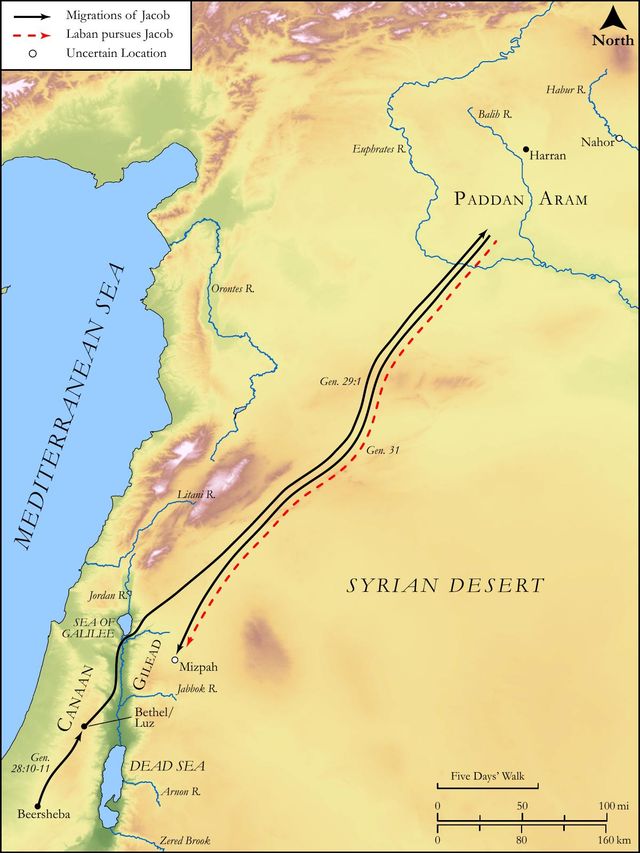
See on the biblical-era map


Study this verse
Public-domain commentary
Matthew Henry
From his Commentary on the Whole Bible. Henry comments on passages, not single verses — this entry covers Genesis 30:14–24.
Here is, I. Leah fruitful again, after she had, for some time, left off bearing. Jacob, it should seem, associated more with Rachel than with Leah. The law of Moses supposes it a common case that, if a man had two wives, one would be beloved and the other hated, Deu 21:15. But at length Rachel's strong passions betrayed her into a bargain with Leah that Jacob should return to her apartment. Reuben, a little lad, five or six years old, playing in the field, found mandrakes, dudaim. It is uncertain what they were, the critics are not agreed about them; we are sure they were some rarities, either fruits or flowers that were very pleasant to the smell, Sol 7:13. Note, The God of nature has provided, not only for our necessities, but for our delights; there are products of the earth in the exposed fields, as well as in the planted protected gardens, that are very valuable and useful. How plentifully is nature's house furnished and her table spread! Her precious fruits offer themselves to be gathered by the hands of little children. It is a laudable custom of the devout Jews, when they find pleasure, suppose in eating an apple, to lift their hearts, and say, "Blessed be he that made this fruit pleasant!" Or, in smelling a flower, "Blessed be he that made this flower sweet." Some think these mandrakes were jessamine flowers. Whatever they were, Rachel could not see them in Leah's hands, where the child had placed them, but she must covet them. She cannot bear the want of these pretty flowers, but will purchase them at any rate. Note, There may be great sin and folly in the inordinate desire of a small thing. Leah takes this advantage (as Jacob had of Esau's coveting his red pottage) to obtain that which was justly due to her, but to which Rachel would not otherwise have consented. Note, Strong passions often thwart one another, and those cannot but be continually uneasy that are hurried on by them. Leah is overjoyed that she shall have her husband's company again, that her family might yet further be built up, which is the blessing she desires and devoutly prays for, as is intimated, Gen 30:17, where it is said, God hearkened unto Leah. The learned bishop Patrick very well suggests here that the true reason of this contest between Jacob's wives for his company, and their giving him their maids to be his wives, was the earnest desire they had to fulfil the promise made to Abraham (and now lately renewed to Jacob), that his seed should be as the stars of heaven for multitude, and that in one seed of his, the Messiah, all the nations of the earth should be blessed. And he thinks it would have been below the dignity of this sacred history to take such particular notice of these things if there had not been some such great consideration in them. Leah was now blessed with two sons; the first she called Issachar (a hire), reckoning herself well repaid for her mandrakes, nay (which is a strange construction of the providence) rewarded for giving her maid to her husband. Note, We abuse God's mercy when we reckon that his favours countenance and patronize our follies. The other she called Zebulun (dwelling), owning God's bounty to her: God has endowed me with a good dowry, Gen 30:20. Jacob had not endowed her when he married her, nor had he wherewithal in possession; but she reckons a family of children not a bill of charges, but a good dowry, Psa 113:9. She promises herself more of her husband's company now that she had borne him six sons, and that, in love to his children at least, he would often visit her lodgings. Mention is made (Gen 30:21) of the birth of a daughter, Dinah, because of the following story concerning her, ch. 34. Perhaps Jacob had other daughters, though their names are not registered.
II.Rachel fruitful at last (Gen 30:22):
God remembered Rachel, whom he seemed to have forgotten, and hearkened to her whose prayers had been long denied; and then she bore a son. Note, As God justly denies the mercy we have been inordinately desirous of, so sometimes he graciously grants, at length, that which we have long waited for. He corrects our folly, and yet considers our frame, and does not contend for ever. Rachel called her son Joseph, which in Hebrew is akin to two words of a contrary signification, Asaph (abstulit), He has taken away my reproach, as if the greatest mercy she had in this son was that she had saved her credit; and Jasaph (addidit), The Lord shall add to me another son, which may be looked upon either as the language of her inordinate desire (she scarcely knows how to be thankful for one unless she may be sure of another), or of her faith - she takes this mercy as an earnest of further mercy. "Has God given me his grace? I may call it Joseph, and say, He shall add more grace! Has he given me his joy? I may call it Joseph, and say, He will give me more joy. Has he begun, and shall he not make an end?"
Historical interpretation
Historical reception
1 surviving comment on this verse from the historical church.
(Verse 21.) And after these things she gave birth to a daughter, and named her Dinah (). She is involved in a case, which the Greeks more significantly call δίκην. For there was a cause of contention in Shechem. After the sons, the names of the parents are to be given. Leah (), is interpreted as laboring. Rachel (), a sheep, whose son Joseph (), is called the addition because his mother had desired another to be added to her.
Continue studying Genesis 30:21 across the web’s major study libraries — every link below opens this exact verse, chapter, or book on the destination site.
Read & Compare
 BibleGatewayThis verse in more than 200 translations and 70 languages.
 Bible.comThe YouVersion reader — hundreds of translations, reading plans, and highlights.
 ESV.orgCrossway's official English Standard Version reader.
 NET BibleThe NET translation with 60,000+ translators' notes on every rendering decision.
 STEP BibleTyndale House's free study tool — original text, vocabulary, and scholarly resources.
 BibliaLogos Bible Software's free web reader.
 USCCBThe New American Bible (Revised Edition) with the U.S. bishops' study notes.
Commentaries
 BibleHub CommentariesDozens of classic commentaries on this verse, gathered on one page.
 StudyLightMore than 100 commentary sets — the largest collection on the web.
 BibleRefPlain-English commentary on what this verse means, verse by verse.
 Enduring WordDavid Guzik's free commentary on this chapter, widely used by Bible teachers.
 Bible Study ToolsVerse commentary alongside Greek and Hebrew study aids.
Original Language & Research
- BibleHub InterlinearThe verse word by word — original language, transliteration, and English.
- BibleHub LexiconEvery word's original-language definition and Strong's entry.
 Blue Letter BibleDeep-study tools — Strong's numbers, concordance, and word studies.
 SefariaThe Hebrew text with Rashi and centuries of Jewish commentary.
Sermons, Hymns & Audio


TrulyRandomVerse is not affiliated with these sites and doesn’t control their content. They’re linked because they’re genuinely useful.
Summary
Genesis 30:21 records the birth of Dinah, Leah's only explicitly named daughter among Jacob's children, marking a significant moment in the unfolding narrative of Jacob's expanding family. This brief verse concludes a period of intense childbearing and highlights the complex relational dynamics and divine providence at work in building the patriarchal lineage, immediately preceding Rachel's long-awaited conception of Joseph.
Context
ShowHideLiterary Context
This verse is situated at the culmination of a highly competitive and emotionally charged period of childbearing within Jacob's household, detailed across Genesis 29, Genesis 30. Following Leah's initial fertility and Rachel's barrenness, the narrative describes Jacob fathering children through the handmaids Bilhah (Rachel's servant) and Zilpah (Leah's servant), reflecting the cultural practice of surrogate motherhood. Leah had recently given birth to Issachar and Zebulun, naming them with expressions of gratitude and hope, as seen in Genesis 30:18 and Genesis 30:20. Dinah's birth is presented as Leah's final recorded child in this phase of family formation, serving as a transitional point immediately preceding the narrative's shift to Rachel's long-awaited conception of Joseph in Genesis 30:22-24. Her inclusion, though brief, is crucial for later narrative developments, particularly the events of Genesis 34.
Historical & Cultural Context
The practice of polygyny and the use of handmaids as surrogate mothers were culturally accepted, though often fraught with relational tension, in the ancient Near East. The primary goal of marriage was to produce offspring, especially sons, to ensure the continuation of the family line and inheritance. The barrenness of a wife, such as Rachel, was considered a great misfortune and often a source of shame, leading to desperate measures like offering a handmaid to one's husband. Naming children was a significant act, often reflecting the circumstances of birth, the parents' emotional state, or their prayers and hopes concerning God's actions, as vividly demonstrated by Leah's naming conventions throughout Genesis 29, Genesis 30. The emphasis on the birth of sons for the patriarchal lineage meant that daughters, though valued, were less frequently highlighted in genealogical records unless their lives significantly impacted the family's narrative, as Dinah's later would.
Key Themes
ShowHideGenesis 30:21 contributes to several overarching themes within the book of Genesis. It reinforces the theme of God's Sovereignty and Providence in building the chosen lineage, even amidst human rivalries, manipulation, and unconventional family structures. Despite Jacob's favoritism towards Rachel, God consistently blesses Leah with children, demonstrating His attention to the less favored and His commitment to His covenant promises to Abraham, Isaac, and Jacob to multiply their offspring (Genesis 12:2, Genesis 28:3-4). The verse also highlights the theme of Family Dynamics and Rivalry, particularly between Leah and Rachel, where childbearing becomes a battleground for affection and status. Leah's naming of Dinah, meaning "judged" or "vindicated," continues her pattern of expressing her longing for Jacob's love and her perception of God's justice in her situation, a recurring motif in Leah's narrative. Furthermore, Dinah's birth, though seemingly minor, subtly introduces the theme of Foreshadowing Future Events, as her later story in Genesis 34 will have profound and tragic implications for Jacob's family and the nascent Israelite tribes.
Exposition and Analysis
ShowHideKey Word Analysis
ShowHideThis adverb signifies a temporal sequence, indicating that Dinah's birth occurred "after" the preceding events, specifically Leah's previous two sons, Issachar and Zebulun. It marks a transition point in the narrative, signifying the completion of a particular phase of childbearing for Leah before the focus shifts to Rachel. The word suggests a follow-up, a subsequent event in the ongoing saga of Jacob's family expansion.
This verb is a primitive root meaning "to bear young" or "to bring forth children." In this context, it simply denotes the act of giving birth, a common and central theme in the patriarchal narratives, emphasizing the continuation of the family line. Its use here highlights Leah's continued fertility, a divine blessing in the context of the family's rivalry and the covenant promise of numerous descendants.
This noun refers to a female offspring. While the patriarchal narratives predominantly focus on sons for the continuation of the covenant line, the explicit mention and naming of a daughter here are significant. It indicates that Dinah was not merely an unnamed female child but an individual whose existence, and later, her story, would play a distinct role in the family's history, setting her apart from other potential unnamed daughters.
This proper noun is the name given to Leah's daughter, derived from the Hebrew root dîn, meaning "judgment" or "vindication." Leah's choice of this name, consistent with her previous naming patterns (e.g., Judah, Issachar, Zebulun), reflects her ongoing perception of God's involvement in her life. It suggests that Leah felt God had "judged" her situation, perhaps vindicating her in the eyes of Jacob or in her rivalry with Rachel by granting her this child, especially after a pause in her childbearing.
Verse Breakdown
ShowHide"And afterwards she bare a daughter"
This clause establishes the temporal setting ("afterwards") and the primary action: Leah giving birth to a female child. The use of "she" implicitly refers to Leah, who was the last wife mentioned as bearing children. This simple statement is pivotal, as it marks the completion of Leah's childbearing in this specific sequence, setting the stage for the narrative's shift towards Rachel's long-awaited conception. The birth of a daughter, rather than another son, subtly diversifies Jacob's offspring, though sons were traditionally prioritized for lineage.
"and called her name Dinah"
This second clause highlights the significant act of naming. Leah's decision to name her daughter "Dinah," meaning "judged" or "vindicated," provides insight into her emotional and spiritual state. Consistent with her previous naming conventions for her sons, Leah interprets this birth through the lens of divine intervention, perceiving it as God's affirmation or judgment in her ongoing struggle for status and affection within Jacob's household. The explicit naming of Dinah, unlike potentially other unnamed daughters, underscores her individual importance to the narrative, foreshadowing her later, tragic role in the family's history.
Literary Devices
ShowHideThe verse "And afterwards she bare a daughter, and called her name Dinah" employs several literary devices, despite its brevity. Conciseness is evident, as it delivers crucial information about a birth and naming without elaborate detail, characteristic of genealogical summaries in Genesis. This brevity, however, belies its narrative weight. The name "Dinah" itself functions as Symbolism and Irony. Symbolically, it reflects Leah's persistent hope and her perception of God's "vindication" in her childbearing, continuing a pattern of names that articulate her emotional and spiritual journey (e.g., Judah, Issachar, Zebulun). The Irony lies in the name's meaning ("judged" or "vindicated") when contrasted with Dinah's later, tragic story in Genesis 34, where she becomes the subject of judgment and violence, rather than vindication, leading to severe consequences for Jacob's family. This foreshadowing, though subtle, creates a dramatic tension for the reader aware of the broader narrative. The verse also serves as a Narrative Transition, effectively closing the chapter on Leah's intense period of childbearing and preparing the reader for the long-awaited fulfillment of Rachel's desire for a child.
Theological and Thematic Connections
ShowHideGenesis 30:21, though a concise record of a birth, underscores God's persistent faithfulness in building the covenant family of Jacob, even amidst the complex and often flawed human dynamics of polygamy and sibling rivalry. Dinah's birth, like those of her brothers, signifies the ongoing expansion of the patriarchal lineage, a direct fulfillment of God's promise to Abraham, Isaac, and Jacob that their descendants would be numerous. It demonstrates that God's plan for a chosen people advances through real-life circumstances, using both the favored and the less favored, the expected and the unexpected, to achieve His purposes. Leah's naming of Dinah, reflecting her sense of divine "vindication," further highlights the theme of God's attentiveness to individual suffering and His justice in the midst of human struggles for status and affection. This seemingly minor detail is a crucial piece in the divine tapestry, setting the stage for future events that will shape the identity and destiny of the nascent tribes of Israel.
Reflection and Application
ShowHideThe brief mention of Dinah's birth in Genesis 30:21 reminds us that every individual, whether seemingly prominent or minor in the grand narrative, plays a role in God's overarching plan. It highlights the intricate and sometimes messy reality of human families, within which God's purposes are still advanced. The story of Jacob's family, including the birth of Dinah, serves as a testament to God's faithfulness in building a nation from humble and often flawed beginnings, demonstrating how divine providence works through human circumstances to fulfill His promises. We are called to trust God's sovereignty even when circumstances seem chaotic, unfair, or insignificant from our perspective. Just as Leah found meaning and hope in her struggles, we too can find God's hand at work in our lives, even in the details we might overlook, knowing that He is sovereign over all things and works all things for His glory and our good. Our lives, like Dinah's, are part of a larger story that God is writing.
Questions for Reflection
ShowHideFAQ
ShowHideWhy is Dinah the only daughter of Jacob explicitly named in the list of his children?
ShowHideWhile Jacob undoubtedly had other daughters (implied by references such as Genesis 37:35 and Genesis 46:7), Dinah is the only one explicitly named in the primary genealogical accounts because her life and the traumatic events surrounding her in Genesis 34 have significant and far-reaching implications for the narrative and the development of Jacob's family and the nascent Israelite tribes. Her explicit naming here serves as a crucial piece of foreshadowing, setting the stage for these later pivotal and tragic events that profoundly impact the family's reputation and future.
What is the significance of Dinah's name?
ShowHideThe name Dinah (Hebrew: Dīynâh) means "judged" or "vindicated." Leah's choice of this name is consistent with her previous naming patterns for her sons, where she often expressed her spiritual and emotional state in relation to her rivalry with Rachel and her longing for Jacob's affection. By naming her "Dinah," Leah likely reflected her ongoing perception that God had "judged" her situation or "vindicated" her by granting her more children, particularly after a pause in childbearing. It underscores her persistent hope and reliance on God's favor in her challenging circumstances, even as the name carries a poignant irony when considering the later events of Genesis 34.
How does Dinah's birth contribute to the larger narrative of Genesis?
ShowHideDinah's birth is crucial for several reasons within the broader narrative of Genesis. Firstly, it completes Leah's childbearing in this phase, setting the immediate stage for Rachel's long-awaited conception of Joseph in Genesis 30:22-24, thus moving the narrative forward. More importantly, her existence is foundational for the dramatic and tragic events of Genesis 34, where her defilement by Shechem leads to a violent and deceptive retaliation by her brothers, Simeon and Levi. This incident has profound consequences, impacting the family's reputation, their relationship with the Canaanites, and the future character and blessing of the tribes of Israel (as reflected in Jacob's later patriarchal blessings in Genesis 49). Thus, Dinah's birth, though briefly mentioned, is a critical narrative linchpin, demonstrating how individual lives, even those seemingly minor or tragically impacted, can have major consequences in God's unfolding plan for His people.
Christ-Centered Fulfillment
ShowHideThe birth of Dinah, though a seemingly minor detail, contributes to the overarching narrative of God's unwavering faithfulness in building a chosen people through whom His redemptive plan would ultimately unfold. As a child of Jacob, Dinah is part of the burgeoning family that would eventually become the twelve tribes of Israel, the very lineage from which the Messiah, Jesus Christ, would ultimately descend. Her inclusion in the family roster, even with the later tragic events surrounding her, underscores that God works through real, often flawed, human families and their complex histories to establish the covenant line that leads to the ultimate "seed" of Abraham, who brings blessing to all nations (Galatians 3:16). The growth of Jacob's family, including Dinah, is a vital step in the divine orchestration of a people prepared to receive and embody God's promises, culminating in Christ's incarnation and redemptive work. He is the true Son of David (Matthew 1:1), the fulfillment of all patriarchal promises, who perfectly embodies the "vindication" that Leah sought, bringing true justice and salvation to humanity (Romans 3:24-26).