


Genesis 34:1
Bible text: King James Version (1769 Blayney text) · Public domain
Bible text: Berean Standard Bible · Public domain
Bible text: American Standard Version (1901) · Public domain
Bible text: World English Bible, Messianic edition · Public domain
Bible text: Geneva Bible (1599) · Public domain
Bible text: Young's Literal Translation · Public domain
- וַתֵּצֵאva·te·Tze'and she went outH3318Conj-w ¦ V-Qal-ConsecImperf-3fsVerb Qal Consecutive Imperfect 3rd Singular Feminineוַandתֵּצֵאshe went out
- דִינָהdi·NahDinahH1783N-proper-fNoun Proper Feminine
- בַּתbat[the] daughter ofH1323N-fscNoun Singular Feminine Construct
- לֵאָהle·'AhLeahH3812N-proper-fNoun Proper Feminine
- אֲשֶׁר'a·SherwhomH834RelParticle Relative
- יָלְדָהYal·dahshe had borneH3205V-Qal-Perf-3fsVerb Qal Perfect 3rd Singular Feminine
- לְיַעֲקֹבle·ya·'a·Koto JacobH3290Prep-l ¦ N-proper-mNoun Proper MasculineלְtoיַעֲקֹבJacob
- לִרְאוֹתlir·'otto lookH7200Prep-l ¦ V-Qal-InfVerb Qal Infinitive Constructלִtoרְאוֹתlook
- בִּבְנוֹתbiv·Noton [the] daughters ofH1323Prep-b ¦ N-fpcNoun Plural Feminine Constructבִּonבְנוֹת[the] daughters of
- הָאָרֶץha·'A·retzthe landH776Art ¦ N-fsNoun Singular Feminine Absoluteהָtheאָרֶץland
English is a literal word-by-word gloss of the Hebrew, not the KJV's wording. Why?
This is the original text the KJV's translators worked from — each Hebrew word with its own literal English meaning in this verse, prepared by scholars at Tyndale House, Cambridge. The KJV translates whole sentences, not word by word, so its wording differs: one Hebrew word can become several English words, and the KJV may choose “the LORD” where the gloss reads “Yahweh”. Both are faithful — they answer different questions. For the KJV's own rendering, switch to the KJV text.
Details
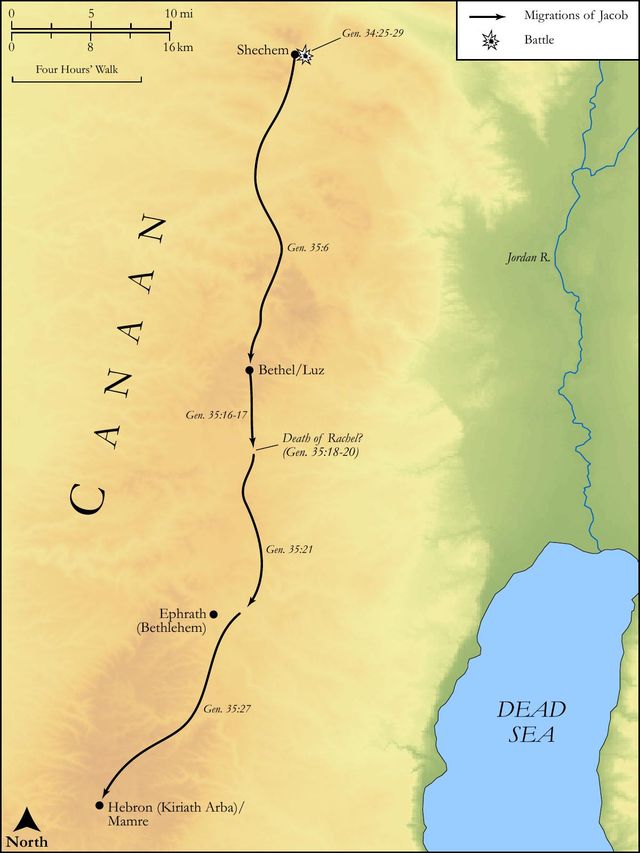
See on the biblical-era maps


Study this verse
Public-domain commentary
Matthew Henry
From his Commentary on the Whole Bible. Henry comments on passages, not single verses — this entry covers Genesis 34:1–5.
Dinah was, for aught that appears, Jacob's only daughter, and we may suppose her therefore the mother's fondling and the darling of the family, and yet she proves neither a joy nor a credit to them; for those children seldom prove either the best or the happiest that are most indulged. She is reckoned now but fifteen or sixteen years of age when she here occasioned so much mischief. Observe, 1. Her vain curiosity, which exposed her. She went out, perhaps unknown to her father, but by the connivance of her mother, to see the daughters of the land (Gen 34:1); probably it was at a ball, or on some public day. Being an only daughter, she thought herself solitary at home, having none of her own age and sex to converse with; and therefore she must needs go abroad to divert herself, to keep off melancholy, and to accomplish herself by conversation better than she could in her father's tents. Note, It is a very good thing for children to love home; it is parents' wisdom to make it easy to them, and children's duty then to be easy in it. Her pretence was to see the daughters of the land, to see how they dressed, and how they danced, and what was fashionable among them. She went to see, yet that was not all, she went to be seen too; she went to see the daughters of the land, but, it may be, with some thoughts of the sons of the land too. I doubt she went to get an acquaintance with those Canaanites, and to learn their way. Note, The pride and vanity of young people betray them into many snares. 2. The loss of her honour by this means (Gen 34:2): Shechem, the prince of the country, but a slave to his own lusts, took her, and lay with her, it should seem, not so much by force as by surprise. Note, Great men think they may do any thing; and what more mischievous than untaught and ungoverned youth? See what came of Dinah's gadding: young women must learn to be chaste, keepers at home; these properties are put together, Tit 2:5, for those that are not keepers at home expose their chastity. Dinah went abroad to look about her; but, if she had looked about her as she ought, she would not have fallen into this snare. Note, The beginning of sin is as the letting forth of water. How great a matter does a little fire kindle! We should therefore carefully avoid all occasions of sin and approaches to it. 3. The court Shechem made to her, after he had defiled her. This was fair and commendable, and made the best of what was bad; he loved her (not as Amnon, Sa2 13:15), and he engaged his father to make a match for him with her, Gen 34:4. 4. The tidings brought to poor Jacob, Gen 34:5. As soon as his children grew up they began to be a grief to him. Let not godly parents, that are lamenting the miscarriages of their children, think their case singular or unprecedented. The good man held his peace, as one astonished, that knows not what to say: or he said nothing, for fear of saying amiss, as David (Psa 39:1, Psa 39:2); he smothered his resentments, lest, if he had suffered them to break out, they should have transported him into any decencies. Or, it should seem, he had left the management of his affairs very much (too much I doubt) to his sons, and he would do nothing without them: or, at least, he knew they would make him uneasy if he did, they having shown themselves, of late, upon all occasions, bold, forward, and assuming. Note, Things never go well when the authority of a parent runs low in a family. Let every man bear rule in his own house, and have his children in subjection with all gravity.
Continue studying Genesis 34:1 across the web’s major study libraries — every link below opens this exact verse, chapter, or book on the destination site.
Read & Compare
 BibleGatewayThis verse in more than 200 translations and 70 languages.
 Bible.comThe YouVersion reader — hundreds of translations, reading plans, and highlights.
 ESV.orgCrossway's official English Standard Version reader.
 NET BibleThe NET translation with 60,000+ translators' notes on every rendering decision.
 STEP BibleTyndale House's free study tool — original text, vocabulary, and scholarly resources.
 BibliaLogos Bible Software's free web reader.
 USCCBThe New American Bible (Revised Edition) with the U.S. bishops' study notes.
Commentaries
 BibleHub CommentariesDozens of classic commentaries on this verse, gathered on one page.
 StudyLightMore than 100 commentary sets — the largest collection on the web.
 BibleRefPlain-English commentary on what this verse means, verse by verse.
 Enduring WordDavid Guzik's free commentary on this chapter, widely used by Bible teachers.
 Bible Study ToolsVerse commentary alongside Greek and Hebrew study aids.
Original Language & Research
- BibleHub InterlinearThe verse word by word — original language, transliteration, and English.
- BibleHub LexiconEvery word's original-language definition and Strong's entry.
 Blue Letter BibleDeep-study tools — Strong's numbers, concordance, and word studies.
 SefariaThe Hebrew text with Rashi and centuries of Jewish commentary.
Sermons, Hymns & Audio


TrulyRandomVerse is not affiliated with these sites and doesn’t control their content. They’re linked because they’re genuinely useful.
Summary
Genesis 34:1 introduces Dinah, the only daughter of Jacob and Leah explicitly named in the biblical narrative, as she ventures out to engage with the local Canaanite women in Shechem. This seemingly innocent act of curiosity and desire for cultural interaction tragically precipitates the entire chapter's grim events, leading to her defilement, her brothers' brutal and deceptive revenge, and profound distress for Jacob's family, thereby highlighting the inherent dangers of uncritical cultural assimilation and the far-reaching consequences of individual choices.
Context
ShowHideLiterary Context
Genesis 34:1 immediately follows Jacob's return to Canaan, his reconciliation with Esau, and his settlement near Shechem, as detailed in Genesis 33. The preceding chapters have focused on Jacob's spiritual journey, his wrestling with God, and the establishment of his large family. This verse marks a significant shift, moving from internal family dynamics and divine encounters to the family's fraught interactions with the surrounding Canaanite population. Dinah's outing serves as the direct narrative trigger for the ensuing crisis, which profoundly impacts Jacob's family honor, their relationship with the local inhabitants, and the moral integrity of his sons, particularly Simeon and Levi, whose violent actions are a central focus of the chapter.
Historical & Cultural Context
Among semi-nomadic patriarchal households like Jacob's family, the honor and protection of women were paramount. A young, unmarried woman venturing unescorted into a foreign, fortified city like Shechem was highly unusual and carried significant social and physical risks. Such an act could be interpreted as a lack of proper chaperonage, an invitation for unwanted attention, or a disregard for established social boundaries. The Canaanite culture, with its different social norms and religious practices, often presented a moral and spiritual challenge to the nascent Israelite community, as seen in the subsequent defilement and the violent response it provoked, reflecting the clash between distinct cultural and ethical frameworks.
Key Themes
ShowHideThis verse, and the chapter it introduces, contributes to several overarching themes in Genesis. It highlights the vulnerability of Jacob's family as they navigate life in a foreign land, underscoring the constant tension between their distinct identity and the surrounding pagan nations. It starkly illustrates the consequences of unbridled human sin and violence, particularly the destructive power of revenge, which contrasts sharply with God's covenant promises and the call to live righteously. Furthermore, the narrative explores the complexities of family honor and internal conflict, as the actions of Dinah's brothers, Simeon and Levi, profoundly shape Jacob's legacy and the future tribal dynamics, foreshadowing later events and the tribal curses found in Genesis 49. The incident also serves as a cautionary tale about the dangers of cultural assimilation without discernment, a theme that recurs throughout Israel's history.
Exposition and Analysis
ShowHideKey Word Analysis
ShowHideFrom the root meaning "justice," Dinah's name ironically foreshadows the tragic events of the chapter, where questions of justice, vengeance, and retribution are central. Her unique mention as "the daughter of Leah" underscores her specific lineage, which becomes crucial as her full brothers, Simeon and Levi, become the primary actors in the violent aftermath.
This term, H1323, is used broadly to denote female offspring, but here it specifically identifies Dinah's familial relationship to Leah and Jacob. In Jacob's house, a "daughter" was under the protection and authority of her father and brothers, making Dinah's independent "going out" the occasion on which Shechem "defiled her" (34:2), which the text calls "folly in Israel" (34:7).
This primitive root (H3318) signifies a movement from an enclosed or protected space to an open or external one. In Dinah's case, it denotes her departure from the relative safety of her family's encampment into the potentially dangerous environment of the Canaanite city. The verb implies an intentional act, setting in motion the chain of events that follow.
The verb (H7200) here implies more than a casual glance; it suggests an active intention to observe, experience, and perhaps engage socially. Dinah's purpose was likely to interact with and learn about the local women, indicating a youthful curiosity and a desire to connect with the "daughters of the land," leading to unforeseen and tragic consequences.
Verse Breakdown
ShowHide"And Dinah the daughter of Leah, which she bare unto Jacob"
This opening clause meticulously identifies Dinah's lineage, establishing her place within Jacob's family structure. Her specific connection to Leah is significant, as Leah's sons (Simeon and Levi) will be the ones who react most fiercely to the subsequent defilement, driven by a strong sense of familial honor and responsibility for their full sister. This genealogical precision underscores the personal and familial stakes of the unfolding narrative.
"went out"
This phrase describes Dinah's decisive action of leaving the safety and confines of her family's camp. It implies an intentional departure, signaling a move from a familiar, protected environment into the unknown and potentially hazardous territory of the Canaanite city. This simple act is the narrative's inciting incident.
"to see the daughters of the land"
This final clause clarifies Dinah's purpose: to observe and interact with the local Canaanite women. The phrase "daughters of the land" refers to the native inhabitants, indicating Dinah's curiosity about their customs, social life, or daily activities. In the lands of the patriarchs, such an unchaperoned venture by a young woman from an outsider group carried immense social and physical risks, setting the stage for the tragic events detailed in Genesis 34:2.
Literary Devices
ShowHideThe verse employs several key literary devices. Foreshadowing is prominent, as Dinah's seemingly innocent act of "going out to see" immediately signals that her venture will lead to significant, likely negative, developments. The simple, declarative statement of her action creates a sense of narrative tension, hinting at the tragic events to come without explicitly stating them. Characterization by action is also evident; Dinah's independent movement reveals her youthful curiosity and perhaps a degree of naivete, setting her apart from the more protected roles typically ascribed to women in that society. The phrase "daughters of the land" uses metonymy, representing the broader Canaanite culture and its potential influences or dangers, rather than just individual women. Finally, the precise genealogical identification of Dinah as "the daughter of Leah, which she bare unto Jacob" serves as a form of narrative precision, anchoring the character firmly within the established family tree and highlighting the familial implications of her actions.
Theological and Thematic Connections
ShowHideGenesis 34:1, though brief, sets the stage for a profound exploration of themes critical to the unfolding narrative of God's covenant people. It immediately introduces the tension between the distinct identity of Jacob's family and the pagan cultures surrounding them, a recurring challenge throughout Israel's history. Dinah's vulnerability, exposed by her unescorted venture, underscores the need for protection and discernment in a fallen world, implicitly raising questions about parental responsibility and community vigilance. The verse also serves as a stark reminder that seemingly innocuous choices can precipitate far-reaching and devastating consequences, impacting not only individuals but entire families and generations, a truth that resonates with the broader biblical narrative of sin's ripple effect.
Reflection and Application
ShowHideDinah's story, initiated by her departure in Genesis 34:1, serves as a timeless cautionary tale, urging us to cultivate discernment and prudence in our interactions with the world around us. While our contemporary context differs vastly from ancient Shechem, the underlying principle remains: uncritical engagement with environments or influences that deviate from godly principles can expose us to unforeseen dangers and compromise. This narrative challenges us to consider the wisdom of our choices, particularly concerning our exposure to cultural norms that may conflict with biblical values. For parents and guardians, it underscores the profound importance of active awareness, guidance, and protection for those under their care, especially as they navigate potentially perilous social landscapes. Ultimately, Dinah's experience reminds us that individual actions, even those stemming from simple curiosity, possess a ripple effect, impacting not only our own well-being but also the honor, safety, and spiritual integrity of our families and communities, echoing the call to live wisely found in Ephesians 5:15-16.
Questions for Reflection
ShowHideFAQ
ShowHideWhy is Dinah, and not other daughters, mentioned by name?
ShowHideDinah is the only daughter of Jacob explicitly named in Genesis because her story is critically pivotal to the narrative, serving as the direct catalyst for the dramatic and violent events of Genesis 34. Her experience and the subsequent actions of her brothers, Simeon and Levi, profoundly impact the family's honor, their relationship with the Canaanites, and Jacob's subsequent distress, making her an essential figure in the unfolding family history and the development of the tribal narratives.
What does "went out to see the daughters of the land" truly imply?
ShowHideThe Hebrew phrase vatetze lir'ot (וַתֵּצֵא לִרְאוֹת) suggests more than a casual glance. It implies an intentional act of observation, engagement, and perhaps social interaction. Dinah likely sought to explore and understand the customs, attire, or social life of the local Canaanite women, driven by youthful curiosity and a desire for connection, rather than merely passing by them. This active seeking of interaction is what places her in a vulnerable position.
What was the danger for Dinah in going out unescorted?
ShowHideIn the patriarchal households of that day, an unescorted young woman from an outsider, nomadic group venturing into a fortified city was highly vulnerable. Such an action could be perceived as a lack of protection, an invitation for unwanted advances, or a disregard for social boundaries. This placed her at significant risk of exploitation, defilement, or abduction, as tragically occurred in Genesis 34:2. Her lack of a male protector or chaperone made her an easy target for those who might disregard the honor of a foreign family.
Christ-Centered Fulfillment
ShowHideThe tragic narrative initiated by Dinah's vulnerability in Genesis 34:1, leading to defilement and violent retribution, profoundly illustrates the pervasive brokenness of humanity and the devastating effects of sin in a fallen world. It reveals the deep need for a true King who can bring genuine justice, protection for the vulnerable, and lasting peace, rather than the cycles of sin and vengeance exemplified by Jacob's family. Christ, as the perfect Son of David and the ultimate King, ultimately fulfills this need, establishing a kingdom where the vulnerable are defended, true righteousness prevails, and reconciliation is possible. His life, death, and resurrection overcome the very defilement and violence that plague humanity, offering redemption and a path to restoration that no human act of revenge or cultural assimilation could ever achieve. The New Testament consistently points to Jesus as the one who brings true honor and purity, as seen in His teachings on sexual purity in Matthew 5:27-28 and His role as the protector of the weak and overlooked, echoing passages like Psalm 82:3-4. Through His sacrifice, Christ secures the covenant promises of God despite the repeated failures and sins of His people, ultimately ushering in a new creation where such tragedies will be no more, as promised in Revelation 21:4.