


Genesis 30:18
Bible text: King James Version (1769 Blayney text) · Public domain
Bible text: Berean Standard Bible · Public domain
Bible text: American Standard Version (1901) · Public domain
Bible text: World English Bible, Messianic edition · Public domain
Bible text: Geneva Bible (1599) · Public domain
Bible text: Young's Literal Translation · Public domain
- וַתֹּאמֶרva·To·merand she saidH559Conj-w ¦ V-Qal-ConsecImperf-3fsVerb Qal Consecutive Imperfect 3rd Singular Feminineוַandתֹּאמֶרshe said
- לֵאָהle·'AhLeahH3812N-proper-fNoun Proper Feminine
- נָתַןna·Tanhe has givenH5414V-Qal-Perf-3msVerb Qal Perfect 3rd Singular Masculine
- אֱלֹהִים'E·lo·HimGodH430N-mpNoun Plural Masculine Absolute
- שְׂכָרִיse·kha·Rimy rewardH7939N-msc ¦ 1csNoun Singular Masculine Constructשְׂכָרִrewardיmy
- אֲשֶׁר'a·SherthatH834RelParticle Relative
- נָתַתִּיna·Ta·tiI gaveH5414V-Qal-Perf-1csVerb Qal Perfect 1st Singular common gender
- שִׁפְחָתִיshif·cha·Timy maidservantH8198N-fsc ¦ 1csNoun Singular Feminine Constructשִׁפְחָתִmaidservantיmy
- לְאִישִׁיle·'i·Shito my husbandH376Prep-l ¦ N-msc ¦ 1csNoun Singular Masculine Constructלְtoאִישִׁhusbandיmy
- וַתִּקְרָאva·tik·Ra'and she calledH7121Conj-w ¦ V-Qal-ConsecImperf-3fsVerb Qal Consecutive Imperfect 3rd Singular Feminineוַandתִּקְרָאshe called
- שְׁמוֹshe·Mohis nameH8034N-msc ¦ 3msNoun Singular Masculine Constructשְׁמnameוֹhis
- יִשָּׂשכָרyi·so·sh·KharIssacharH3485N-proper-mNoun Proper Masculine
English is a literal word-by-word gloss of the Hebrew, not the KJV's wording. Why?
This is the original text the KJV's translators worked from — each Hebrew word with its own literal English meaning in this verse, prepared by scholars at Tyndale House, Cambridge. The KJV translates whole sentences, not word by word, so its wording differs: one Hebrew word can become several English words, and the KJV may choose “the LORD” where the gloss reads “Yahweh”. Both are faithful — they answer different questions. For the KJV's own rendering, switch to the KJV text.
Details
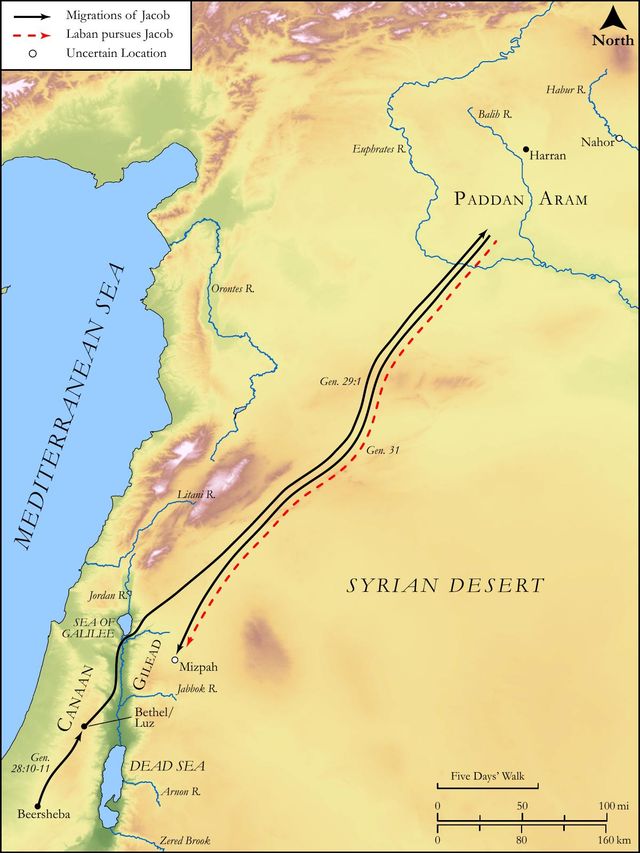
See on the biblical-era maps


Study this verse
Public-domain commentary
Matthew Henry
From his Commentary on the Whole Bible. Henry comments on passages, not single verses — this entry covers Genesis 30:14–24.
Here is, I. Leah fruitful again, after she had, for some time, left off bearing. Jacob, it should seem, associated more with Rachel than with Leah. The law of Moses supposes it a common case that, if a man had two wives, one would be beloved and the other hated, Deu 21:15. But at length Rachel's strong passions betrayed her into a bargain with Leah that Jacob should return to her apartment. Reuben, a little lad, five or six years old, playing in the field, found mandrakes, dudaim. It is uncertain what they were, the critics are not agreed about them; we are sure they were some rarities, either fruits or flowers that were very pleasant to the smell, Sol 7:13. Note, The God of nature has provided, not only for our necessities, but for our delights; there are products of the earth in the exposed fields, as well as in the planted protected gardens, that are very valuable and useful. How plentifully is nature's house furnished and her table spread! Her precious fruits offer themselves to be gathered by the hands of little children. It is a laudable custom of the devout Jews, when they find pleasure, suppose in eating an apple, to lift their hearts, and say, "Blessed be he that made this fruit pleasant!" Or, in smelling a flower, "Blessed be he that made this flower sweet." Some think these mandrakes were jessamine flowers. Whatever they were, Rachel could not see them in Leah's hands, where the child had placed them, but she must covet them. She cannot bear the want of these pretty flowers, but will purchase them at any rate. Note, There may be great sin and folly in the inordinate desire of a small thing. Leah takes this advantage (as Jacob had of Esau's coveting his red pottage) to obtain that which was justly due to her, but to which Rachel would not otherwise have consented. Note, Strong passions often thwart one another, and those cannot but be continually uneasy that are hurried on by them. Leah is overjoyed that she shall have her husband's company again, that her family might yet further be built up, which is the blessing she desires and devoutly prays for, as is intimated, Gen 30:17, where it is said, God hearkened unto Leah. The learned bishop Patrick very well suggests here that the true reason of this contest between Jacob's wives for his company, and their giving him their maids to be his wives, was the earnest desire they had to fulfil the promise made to Abraham (and now lately renewed to Jacob), that his seed should be as the stars of heaven for multitude, and that in one seed of his, the Messiah, all the nations of the earth should be blessed. And he thinks it would have been below the dignity of this sacred history to take such particular notice of these things if there had not been some such great consideration in them. Leah was now blessed with two sons; the first she called Issachar (a hire), reckoning herself well repaid for her mandrakes, nay (which is a strange construction of the providence) rewarded for giving her maid to her husband. Note, We abuse God's mercy when we reckon that his favours countenance and patronize our follies. The other she called Zebulun (dwelling), owning God's bounty to her: God has endowed me with a good dowry, Gen 30:20. Jacob had not endowed her when he married her, nor had he wherewithal in possession; but she reckons a family of children not a bill of charges, but a good dowry, Psa 113:9. She promises herself more of her husband's company now that she had borne him six sons, and that, in love to his children at least, he would often visit her lodgings. Mention is made (Gen 30:21) of the birth of a daughter, Dinah, because of the following story concerning her, ch. 34. Perhaps Jacob had other daughters, though their names are not registered.
II.Rachel fruitful at last (Gen 30:22):
God remembered Rachel, whom he seemed to have forgotten, and hearkened to her whose prayers had been long denied; and then she bore a son. Note, As God justly denies the mercy we have been inordinately desirous of, so sometimes he graciously grants, at length, that which we have long waited for. He corrects our folly, and yet considers our frame, and does not contend for ever. Rachel called her son Joseph, which in Hebrew is akin to two words of a contrary signification, Asaph (abstulit), He has taken away my reproach, as if the greatest mercy she had in this son was that she had saved her credit; and Jasaph (addidit), The Lord shall add to me another son, which may be looked upon either as the language of her inordinate desire (she scarcely knows how to be thankful for one unless she may be sure of another), or of her faith - she takes this mercy as an earnest of further mercy. "Has God given me his grace? I may call it Joseph, and say, He shall add more grace! Has he given me his joy? I may call it Joseph, and say, He will give me more joy. Has he begun, and shall he not make an end?"
Historical interpretation
Historical reception
1 surviving comment on this verse from the historical church.
(Verse 17 and 18.) And God heard Leah, and she conceived and bore Jacob her fifth son, and she said, 'God has given me my wages because I gave my maid to my husband.' And she called his name Issachar. The Septuagint Interpreters have given the etymology of this name, it is wages. Not that, as many wrongly read with an added pronoun, it is to be understood as written, which is wages, but the whole name is interpreted, it is wages. For it is said that Sachar, the son of Ruben, bought the entrance which was owed to Rachel, for a price. It follows:
Continue studying Genesis 30:18 across the web’s major study libraries — every link below opens this exact verse, chapter, or book on the destination site.
Read & Compare
 BibleGatewayThis verse in more than 200 translations and 70 languages.
 Bible.comThe YouVersion reader — hundreds of translations, reading plans, and highlights.
 ESV.orgCrossway's official English Standard Version reader.
 NET BibleThe NET translation with 60,000+ translators' notes on every rendering decision.
 STEP BibleTyndale House's free study tool — original text, vocabulary, and scholarly resources.
 BibliaLogos Bible Software's free web reader.
 USCCBThe New American Bible (Revised Edition) with the U.S. bishops' study notes.
Commentaries
 BibleHub CommentariesDozens of classic commentaries on this verse, gathered on one page.
 StudyLightMore than 100 commentary sets — the largest collection on the web.
 BibleRefPlain-English commentary on what this verse means, verse by verse.
 Enduring WordDavid Guzik's free commentary on this chapter, widely used by Bible teachers.
 Bible Study ToolsVerse commentary alongside Greek and Hebrew study aids.
Original Language & Research
- BibleHub InterlinearThe verse word by word — original language, transliteration, and English.
- BibleHub LexiconEvery word's original-language definition and Strong's entry.
 Blue Letter BibleDeep-study tools — Strong's numbers, concordance, and word studies.
 SefariaThe Hebrew text with Rashi and centuries of Jewish commentary.
Sermons, Hymns & Audio


TrulyRandomVerse is not affiliated with these sites and doesn’t control their content. They’re linked because they’re genuinely useful.
Summary
Genesis 30:18 marks a pivotal moment in the unfolding narrative of Jacob's family, recording the birth of Leah's fifth son, Issachar. Leah's declaration that "God hath given me my hire" reflects her profound belief in divine recompense for her decision to give her maidservant, Zilpah, to Jacob. This event not only adds another son to the burgeoning lineage of Israel's twelve tribes but also highlights the complex interplay of human agency, familial rivalry, and God's sovereign hand in bringing about His purposes amidst challenging and often flawed circumstances.
Context
ShowHideLiterary Context
This verse is situated within the highly charged and competitive domestic drama of Jacob's household, specifically the intense rivalry between his two primary wives, Leah and Rachel, for his affection and the ability to bear children. The preceding chapters detail Jacob's marriage to both sisters (Genesis 29), the initial births of Leah's first four sons (Reuben, Simeon, Levi, and Judah, recorded in Genesis 29:31-35), and Rachel's subsequent barrenness. The narrative then escalates with both wives resorting to using their maidservants (Bilhah for Rachel, Zilpah for Leah) as surrogates to bear children on their behalf, further complicating the family tree and intensifying the struggle for status and legacy. Immediately prior to Issachar's birth, Genesis 30:14-16 recounts the unusual incident where Rachel trades a night with Jacob for Leah in exchange for mandrakes, believed to enhance fertility. Following this arrangement, Leah conceives again, and her statement in verse 18 interprets this new pregnancy and birth as a direct divine response to her earlier actions.
Historical & Cultural Context
The patriarchal setting illuminates the profound importance of progeny, particularly male heirs, for family continuity, tribal strength, and the fulfillment of covenantal promises. Barrenness was often perceived as a curse or a sign of divine disfavor, leading to immense social and personal pressure on women like Rachel. The practice of using maidservants as surrogates (e.g., Hagar in Genesis 16) was a recognized custom, allowing a barren wife to build her family through her servant. This practice, while culturally accepted, often led to complex and strained relationships within the household, as seen in Jacob's family. Leah's perception of "hire" or "reward" would have resonated with the cultural understanding of divine blessing and recompense for actions, whether perceived as righteous or as strategic maneuvers within the family structure. The naming of children, as seen throughout Genesis, was also deeply significant, often reflecting the circumstances of birth, the parents' hopes, or their theological interpretations of divine activity.
Key Themes
ShowHideGenesis 30:18 contributes significantly to several overarching themes in the book of Genesis and the broader biblical narrative. The theme of divine sovereignty is paramount, as Leah explicitly attributes the birth to God's action, demonstrating that even amidst human rivalry, manipulation, and imperfect choices, God remains actively involved in the unfolding of His plan for Jacob's family. This passage also highlights the theme of barrenness and fertility, a recurring motif in the patriarchal narratives (e.g., Sarah in Genesis 18), underscoring God's miraculous intervention in opening wombs and fulfilling His promise of numerous descendants. Furthermore, the intense familial competition between Leah and Rachel underscores the human struggle for love, recognition, and legacy, while simultaneously illustrating how God works through these flawed dynamics to establish the twelve tribes of Israel, the foundation of His chosen nation. The significance of naming is also evident, as Issachar's name directly reflects Leah's theological interpretation of his birth as a divine recompense.
Exposition and Analysis
ShowHideKey Word Analysis
ShowHideThis plural noun, used here with a singular verb, refers to the supreme God, Yahweh. Leah's use of this term signifies her direct attribution of the event to the sovereign, covenant-making God of her ancestors, acknowledging His active involvement in her personal circumstances and the family's fertility. It emphasizes her conviction that this birth is not mere chance but a divine act.
This primitive root is highly versatile, meaning "to give," "to put," or "to make." In this context, it signifies God's direct bestowal or granting of the child to Leah. It reinforces the idea of divine agency and provision, portraying God as the active giver of life and blessings, fulfilling Leah's desire for more children.
Derived from a root meaning "payment of contract," this word refers to wages, reward, compensation, or benefit. Leah's use of "my hire" (or "my wages") indicates her perception that God has directly recompensed her for her previous action of giving her maidservant, Zilpah, to Jacob. This suggests a transactional understanding of divine blessing, where her act of service is met with a divine reward in the form of a son.
This name is directly linked to Leah's declaration, derived from the root of "hire" (sâkâr) and potentially incorporating a form of "there is" (yesh) or "man" (ish). The name itself, meaning "he will bring a reward" or "there is hire," serves as a perpetual memorial to Leah's interpretation of his birth as God's divine payment or recompense for her actions, solidifying the theological significance she ascribed to this child.
Verse Breakdown
ShowHide"And Leah said,"
This introduces Leah's direct speech, emphasizing her personal interpretation and theological declaration regarding the birth of her son. Her voice is central to understanding the significance of this event.
"God hath given me my hire,"
Leah explicitly attributes the birth of her son to God's direct action. The term "hire" (Hebrew: sakhar) signifies a wage, reward, or recompense. This reveals Leah's perception that God is actively involved in her life, granting her a child as a divine payment or acknowledgment.
"because I have given my maiden to my husband:"
This clause provides Leah's rationale for God's "hire." She believes that her act of giving Zilpah, her maidservant, to Jacob to bear children on her behalf (as recorded in Genesis 30:9) was a meritorious act that God has now rewarded. It highlights the complex, and often desperate, strategies employed by the wives in their quest for progeny.
"and she called his name Issachar."
The naming of the child directly reflects Leah's theological interpretation. The name Issachar (Hebrew: Yissakhar) is etymologically linked to the word "hire" or "reward," serving as a permanent reminder of Leah's conviction that his birth was a divine recompense. This act of naming solidifies her belief in God's direct intervention and blessing.
Literary Devices
ShowHideThe narrative in Genesis 30:18 employs several literary devices that enrich its meaning. Theophoric Naming is prominent, as Issachar's name directly incorporates Leah's theological interpretation of his birth as a "hire" or "reward" from God, making the child's very identity a testament to divine action. This echoes a pattern throughout Genesis where names carry profound significance. There is also an element of Irony in Leah's statement. While she sees the birth as a reward for her "giving" of Zilpah, the broader context of the wives' rivalry and the use of surrogates highlights the human maneuvering and imperfection through which God's plan unfolds. This subtly underscores God's ability to work through flawed human choices. Furthermore, the passage uses Repetition of the verb "given" (Hebrew: nâthan)—first, Leah stating "God hath given me," and second, "I have given my maiden"—to create a parallel structure that emphasizes the reciprocal nature of her perceived divine interaction. Leah's act of giving is met with God's act of giving, reinforcing her belief in a direct causal link.
Theological and Thematic Connections
ShowHideLeah's declaration in Genesis 30:18 powerfully articulates the theme of divine providence, where God is seen as actively involved in the seemingly mundane and often fraught circumstances of human lives. Her conviction that God has given her "my hire" for her actions, even those born from desperation within a competitive family dynamic, speaks to a deep-seated belief in God's attentiveness and His capacity to bless and recompense. This passage underscores that God's plan for building His covenant people unfolds not in ideal conditions, but through the complexities, rivalries, and imperfect choices of individuals, demonstrating His sovereign ability to bring about His purposes despite human limitations.
Reflection and Application
ShowHideGenesis 30:18 offers profound insights for contemporary reflection, primarily inviting us to cultivate a posture of recognizing God's sovereign hand and active involvement in every facet of our lives, even amidst challenging, unconventional, or seemingly imperfect circumstances. Leah's immediate attribution of Issachar's birth to God's "hire" serves as a powerful reminder to look beyond human efforts and circumstances, and to acknowledge God as the ultimate source of our blessings and the orchestrator of our paths. While her context was one of intense rivalry and cultural practices foreign to us, her statement prompts us to consider how our own acts of service, generosity, or faithfulness, even when imperfectly rendered, might be acknowledged and blessed by God in unexpected ways. This passage encourages us to trust that God faithfully works through human flaws and less-than-ideal situations to fulfill His ultimate plan, demonstrating His ability to bring about His purposes and blessings despite our limitations or the complexities of our lives.
Questions for Reflection
ShowHideFAQ
ShowHideWhy did Leah believe Issachar was her "hire" from God?
ShowHideLeah believed Issachar was her "hire" (Hebrew: sâkâr, meaning reward or wages) from God because she had given her maidservant, Zilpah, to Jacob to bear children on her behalf. In the highly competitive and culturally significant context of Jacob's household, where bearing children was paramount for status and legacy, Leah viewed her act of "giving" Zilpah as a form of service or sacrifice. She interpreted the subsequent birth of Issachar as God's direct recompense or divine payment for her actions, acknowledging His active involvement in her fertility and the expansion of Jacob's family, as detailed in Genesis 30:9-13.
What is the meaning of the name Issachar?
ShowHideThe name Issachar (Hebrew: Yissâˢkâr) is directly linked to Leah's declaration and her perception of his birth. It is derived from the Hebrew word sâkâr, meaning "wages," "hire," or "reward." Therefore, the name can be interpreted as "there is hire" or "he is hired/rewarded." This etymology directly reflects Leah's belief that his birth was a divine recompense for her actions, making the name a perpetual theological statement.
How does this passage show God working through human imperfection?
ShowHideThis passage vividly illustrates God's sovereign ability to work through imperfect human situations. Jacob's family is characterized by polygamy, intense sibling rivalry, and desperate human strategies (such as using maidservants as surrogates and trading mandrakes). Leah's act of giving Zilpah to Jacob, while culturally acceptable, arose from a context of competition and a desire for more children. Despite these flawed circumstances and human maneuvering, God faithfully continues to build Jacob's family, ultimately establishing the twelve tribes of Israel. This demonstrates that God's redemptive plan is not contingent on human perfection but unfolds through His sovereign will and power, bringing about His purposes even in the midst of human weakness and sin, a theme echoed throughout biblical history, as seen in the lives of figures like David (2 Samuel 11, 2 Samuel 12) and the nation of Israel itself.
Christ-Centered Fulfillment
ShowHideThe birth of Issachar, as one of Jacob's twelve sons, is a crucial step in the unfolding of God's redemptive plan, which finds its ultimate culmination in Jesus Christ. While the tribe of Issachar does not directly produce the Messiah, his birth signifies God's unwavering faithfulness in building the lineage from which the promised Seed would eventually come. Leah's acknowledgment of God's "hire" or reward, even in her imperfect and competitive circumstances, underscores the consistent theme of divine providence throughout salvation history. God sovereignly orchestrates events, working through human choices and flaws, to prepare the way for the Messiah. The ultimate "hire" or divine recompense for humanity's service and God's faithfulness is not merely earthly progeny, but the coming of Jesus Christ, the true Son of God, who fulfills all the promises made to the patriarchs. He is the ultimate "reward" given by God, offering salvation and eternal life to all who believe, as promised in passages like John 3:16. Through the lineage established by Jacob's sons, including Issachar, God prepared the historical and spiritual context for the King who would rule forever, the Lion of the tribe of Judah (Revelation 5:5), who brings the ultimate and eternal reward of reconciliation with God.