


Genesis 34:26
- וְאֶתve·'Etand <obj.>H853Conj-w ¦ DirObjMParticle Object Indicatorוְandאֶת<obj.>
- חֲמוֹרcha·mOrHamorH2544N-proper-mNoun Proper Masculine
- וְאֶתve·'Etand <obj.>H853Conj-w ¦ DirObjMParticle Object Indicatorוְandאֶת<obj.>
- שְׁכֶםshe·KhemShechemH7927N-proper-mNoun Proper Masculine
- בְּנוֹbe·Nohis sonH1121N-msc ¦ 3msNoun Singular Masculine Constructבְּנsonוֹhis
- הָרְגוּha·re·Guthey slewH2026V-Qal-Perf-3cpVerb Qal Perfect 3rd Plural common gender
- לְפִיle·fito [the] mouth ofH6310Prep-l ¦ N-mscNoun Singular Masculine Constructלְtoפִי[the] mouth of
- חָרֶבCha·rev[the] swordH2719N-fsNoun Singular Feminine Absolute
- וַיִּקְחוּvai·yik·Chuand they tookH3947Conj-w ¦ V-Qal-ConsecImperf-3mpVerb Qal Consecutive Imperfect 3rd Plural Masculineוַandיִּקְחוּthey took
- אֶת'et<obj.>H853DirObjMParticle Object Indicator
- דִּינָהdi·NahDinahH1783N-proper-fNoun Proper Feminine
- מִבֵּיתmi·Beitfrom [the] house ofH1004Prep-m ¦ N-mscNoun Singular Masculine Constructמִfromבֵּית[the] house of
- שְׁכֶםshe·KhemShechemH7927N-proper-mNoun Proper Masculine
- וַיֵּצֵאוּvai·ye·Tze·'uand they went outH3318Conj-w ¦ V-Qal-ConsecImperf-3mpVerb Qal Consecutive Imperfect 3rd Plural Masculineוַandיֵּצֵאוּthey went out
English is a literal word-by-word gloss of the Hebrew, not the KJV's wording. Why?
This is the original text the KJV's translators worked from — each Hebrew word with its own literal English meaning in this verse, prepared by scholars at Tyndale House, Cambridge. The KJV translates whole sentences, not word by word, so its wording differs: one Hebrew word can become several English words, and the KJV may choose “the LORD” where the gloss reads “Yahweh”. Both are faithful — they answer different questions. For the KJV's own rendering, switch to the KJV text.
Details
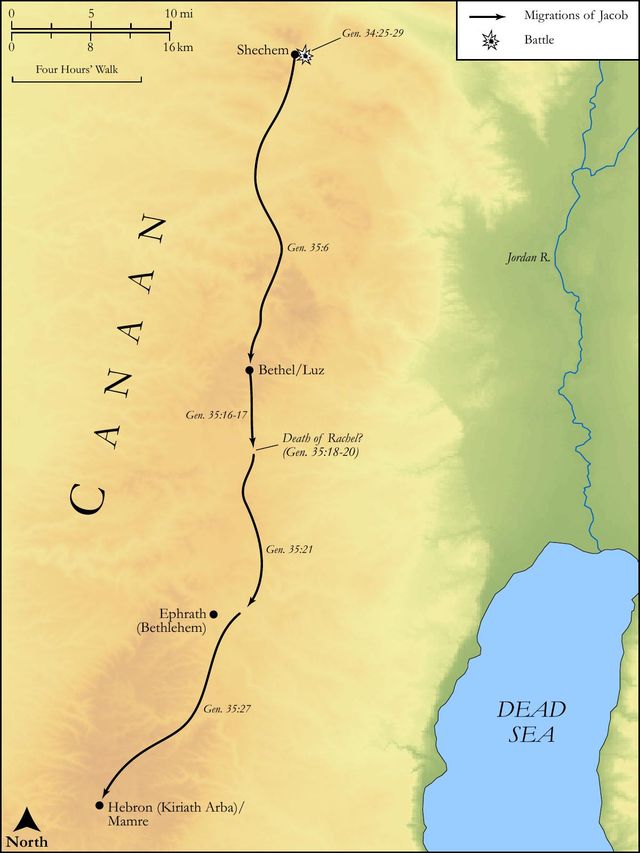
See on the biblical-era map


Study this verse
Public-domain commentary
Matthew Henry
From his Commentary on the Whole Bible. Henry comments on passages, not single verses — this entry covers Genesis 34:25–31. His four-level outline is real structure in the source text, so it is rendered as structure.
Here, we have Simeon and Levi, two of Jacob's sons, young men not much above twenty years old, cutting the throats of the Shechemites, and thereby breaking the heart of their good father.
I.Here is the barbarous murder of the Shechemites.
Jacob himself was used to the sheep-hook, but his sons had got swords by their sides, as if they had been the seed of Esau, who was to live by his sword; we have them here,
1.Slaying the inhabitants of Shechem - all the males, Hamor and Shechem particularly, with whom they had been treating in a friendly manner but the other day, yet with a design upon their lives. Some think that all Jacob's sons, when they wheedled the Shechemites to be circumcised, designed to take advantage of their soreness, and to rescue Dinah from among them; but that Simeon and Levi, not content with that, would themselves avenge the injury - and they did it with a witness. Now,
(1.)It cannot be denied but that God was righteous in it. Had the Shechemites been circumcised in obedience to any command of God, their circumcision would have been their protection; but when they submitted to that sacred rite only to serve a turn, to please their prince and to enrich themselves, it was just with God to bring this upon them. Note, As nothing secures us better than true religion, so nothing exposes us more than religion only pretended to.
(2.)But Simeon and Levi were most unrighteous.
[1.]It was true that Shechem had wrought folly against Israel, in defiling Dinah; but it ought to have been considered how far Dinah herself had been accessory to it. Had Shechem abused her in her own mother's tent, it would have been another matter; but she went upon his ground, and perhaps by her indecent carriage had struck the spark which began the fire: when we are severe upon the sinner we ought to consider who was the tempter.
[2.]It was true that Shechem had done ill; but he was endeavouring to atone for it, and was as honest and honourable, ex post facto - after the deed, as the case would admit: it was not the case of the Levite's concubine that was abused to death; nor does he justify what he has done, but courts a reconciliation upon any terms.
[3.]It was true that Shechem had done ill; but what was that to all the Shechemites? Does one man sin, and will they be wroth with all the town? Must the innocent fall with the guilty? This was barbarous indeed.
[4.]But that which above all aggravated the cruelty was the most perfidious treachery that was in it. The Shechemites had submitted to their conditions, and had done that upon which they had promised to become one people with them (Gen 34:16); yet they act as sworn enemies to those to whom they had lately become sworn friends, making as light of their covenant as they did of the laws of humanity. And are these the sons of Israel? Cursed be their anger, for it was fierce.
[5.]This also added to the crime, that they made a holy ordinance of God subservient to their wicked design, so making that odious; as if it were not enough for them to shame themselves and their family, they bring a reproach upon that honourable badge of their religion; justly would it be called a bloody ordinance.
2.Seizing the prey of Shechem, and plundering the town. They rescued Dinah (Gen 34:26), and, if that was all they came for, they might have done that without blood, as appears by their own showing (Gen 34:17); but they aimed at the spoil; and, though Simeon and Levi only were the murderers, yet it is intimated that others of the sons of Jacob came upon the slain and spoiled the city (Gen 34:27), and so became accessory to the murder. In them it was manifest injustice; yet here we may observe the righteousness of God. The Shechemites were willing to gratify the sons of Jacob by submitting to the penance of circumcision, upon this principle, Shall not their cattle and their substance be ours? (Gen 34:23), and see what was the issue; instead of making themselves masters of the wealth of Jacob's family, Jacob's family become masters of their wealth. Note, Those who unjustly grasp at that which is another's justly lose that which is their own.
II.Here is Jacob's resentment of this bloody deed of Simeon and Levi, Gen 34:30.
Two things he bitterly complains of: - 1. The reproach they had brought upon him thereby: You have troubled me, put me into a disorder, for you have made me to stink among the inhabitants of the land, that is, "You have rendered me and my family odious among them. What will they say of us and our religion? We shall be looked upon as the most perfidious barbarous people in the world." Note, The gross misconduct of wicked children is the grief and shame of their godly parents. Children should be the joy of their parents; but wicked children are their trouble, sadden their hearts, break their spirits, and make them go mourning from day to day. Children should be an ornament to their parents; but wicked children are their reproach, and are as dead flies in the pot of ointment: but let such children know that, if they repent not, the grief they have caused to their parents, and the damage religion has sustained in its reputation through them, will come into the account and be reckoned for. 2. The ruin they had exposed him to. What could be expected, but that the Canaanites, who were numerous and formidable, would confederate against him, and he and his little family would become an easy prey to them? I shall be destroyed, I and my house. If all the Shechemites must be destroyed for the offence of one, why not all the Israelites for the offence of two? Jacob knew indeed that God had promised to preserve and perpetuate his house; but he might justly fear that these vile practices of his children would amount to a forfeiture, and cut off the entail. Note, When sin is in the house, there is reason to fear ruin at the door. The tender parents foresee those bad consequences of sin which the wicked children have no dread of. One would think this should have made them to relent, and they should have humbled themselves to their good father, and begged his pardon; but, instead of this, they justify themselves, and give him this insolent reply, Should he deal with our sister as with a harlot? No, he should not; but, if he do, must they be their own avengers? Will nothing less than so many lives, and the ruin of a whole city, serve to atone for an abuse done to one foolish girl? By their question they tacitly reflect upon their father, as if he would have been content to let them deal with his daughter as with a harlot. Note, It is common for those who run into one extreme to reproach and censure those who keep the mean as if they ran into the other. Those who condemn the rigour of revenge shall be misrepresented, as if they countenanced and justified the offence.
Continue studying Genesis 34:26 across the web’s major study libraries — every link below opens this exact verse, chapter, or book on the destination site.
Read & Compare
 BibleGatewayThis verse in more than 200 translations and 70 languages.
 Bible.comThe YouVersion reader — hundreds of translations, reading plans, and highlights.
 ESV.orgCrossway's official English Standard Version reader.
 NET BibleThe NET translation with 60,000+ translators' notes on every rendering decision.
 STEP BibleTyndale House's free study tool — original text, vocabulary, and scholarly resources.
 BibliaLogos Bible Software's free web reader.
 USCCBThe New American Bible (Revised Edition) with the U.S. bishops' study notes.
Commentaries
 BibleHub CommentariesDozens of classic commentaries on this verse, gathered on one page.
 StudyLightMore than 100 commentary sets — the largest collection on the web.
 BibleRefPlain-English commentary on what this verse means, verse by verse.
 Enduring WordDavid Guzik's free commentary on this chapter, widely used by Bible teachers.
 Bible Study ToolsVerse commentary alongside Greek and Hebrew study aids.
Original Language & Research
- BibleHub InterlinearThe verse word by word — original language, transliteration, and English.
- BibleHub LexiconEvery word's original-language definition and Strong's entry.
 Blue Letter BibleDeep-study tools — Strong's numbers, concordance, and word studies.
 SefariaThe Hebrew text with Rashi and centuries of Jewish commentary.
Sermons, Hymns & Audio


TrulyRandomVerse is not affiliated with these sites and doesn’t control their content. They’re linked because they’re genuinely useful.
Summary
Genesis 34:26 records the brutal climax of Simeon and Levi's vengeful scheme, detailing how they mercilessly slaughtered Hamor and his son Shechem, the Hivite leaders, and then retrieved their sister Dinah from Shechem's house before departing. This act of extreme violence, cloaked in a deceptive covenant, tragically illustrates the profound dishonor felt by Jacob's sons and the devastating consequences of unchecked rage and human sin.
Context
ShowHideLiterary Context
This verse is the violent culmination of the deeply disturbing narrative in Genesis chapter 34, which stands as a stark interlude in the patriarchal narratives focusing on Jacob's family. The preceding verses (Genesis 34:1-12) establish the initial transgression: Dinah, Jacob's daughter, is defiled by Shechem, the son of Hamor, the Hivite prince. Despite Shechem's genuine affection for Dinah and his father's earnest proposal for intermarriage and economic integration, Jacob's sons, particularly Simeon and Levi, are consumed by a righteous indignation that quickly devolves into cunning deceit. They propose a covenant of circumcision for all males in Shechem's city, ostensibly as a condition for intermarriage (Genesis 34:13-17). This verse, then, describes the execution of their plan on the third day, when the men of Shechem were incapacitated by pain, leading to the targeted assassination of the city's leaders and the "rescue" of Dinah, followed by the subsequent looting of the city by the other sons of Jacob (Genesis 34:27-29).
Historical & Cultural Context
In the ancient Near East, family honor was paramount, and the defilement of a daughter was a grave offense that brought immense shame upon the entire household. The concept of "honor-shame" cultures meant that such an act often demanded a severe response, sometimes even blood vengeance, to restore the family's standing. However, the Hivite proposal for intermarriage and economic integration was a common practice for establishing alliances and securing peace in the region. The Hivites' willingness to undergo circumcision, a sacred covenant sign for Abraham's descendants (Genesis 17:9-14), highlights their desperation for alliance and their trust, which Jacob's sons ruthlessly exploited. This narrative also reflects the precarious position of nomadic groups like Jacob's family amidst settled Canaanite populations, where interactions could quickly escalate from diplomacy to devastating conflict.
Key Themes
ShowHideThis chapter, and particularly Genesis 34:26, contributes to several overarching themes in Genesis. It starkly portrays the theme of sin and its escalating consequences, moving from Dinah's vulnerability to Shechem's violent act, and then to the brothers' disproportionate and morally bankrupt retaliation. The theme of deception and treachery is central, as the sacred covenant of circumcision is perverted into a weapon of mass incapacitation. Furthermore, the narrative explores the complex interplay of family honor and identity, as Simeon and Levi's actions, though condemned by Jacob (Genesis 49:5-7), are driven by a fierce, albeit misguided, desire to defend their family's reputation. Finally, it foreshadows the moral failings of Jacob's sons that will continue to plague the family narrative, setting the stage for future conflicts and the need for divine intervention to preserve the covenant line.
Exposition and Analysis
ShowHideKey Word Analysis
ShowHideThis verb signifies a decisive and often brutal killing, emphasizing the finality and violence of the act. It denotes smiting with deadly intent, indicating that Simeon and Levi's actions were not accidental but a deliberate, premeditated execution. The term underscores the severity of their vengeance.
While literally meaning "mouth," in this context, peh is used idiomatically to denote the "edge" or "opening" of an instrument. When combined with "sword" (chereb), "edge of the sword" (literally "mouth of the sword") is a common biblical idiom for a fatal, piercing blow. It emphasizes the directness and efficiency of the killing, as if the sword "devoured" its victims.
This word refers to a physical dwelling, but its semantic range also extends to "household" or "family." In this verse, "Shechem's house" is both the literal location where Dinah was held and a symbolic representation of Shechem's authority and family domain. The act of taking Dinah out of his house signifies not just her physical retrieval but also the complete overturning of Shechem's claim over her and the utter humiliation of his household.
Verse Breakdown
ShowHide"And they slew Hamor and Shechem his son"
This clause identifies the primary targets of Simeon and Levi's attack. Hamor, the father, was the prince and leader of the city, and Shechem was his son, the one who had defiled Dinah. Their deaths signify the complete dismantling of the Hivite leadership responsible for the initial offense and the subsequent negotiations. The plural "they" refers specifically to Simeon and Levi, as highlighted in the preceding verses, indicating their direct involvement and leadership in the massacre.
"with the edge of the sword"
This phrase describes the brutal method of killing. As noted in the key word analysis, "edge of the sword" is a powerful idiom denoting a swift, violent, and fatal strike. It underscores the merciless nature of the attack and the complete incapacitation of their victims due to the circumcisions.
"and took Dinah out of Shechem's house"
This clause reveals the immediate objective of the violent act: the retrieval of their sister. Dinah had been living in Shechem's house, presumably as a captive or as a prospective wife, and her removal signifies the "rescue" operation. This act, however, is tainted by the extreme violence used to achieve it, raising profound moral questions about the means justifying the end.
"and went out"
This final clause signifies the completion of their immediate mission and their departure from the scene of the crime. It marks the conclusion of their targeted vengeance against Hamor and Shechem and their retrieval of Dinah, leaving behind a city in chaos and a family stained by bloodshed.
Literary Devices
ShowHideThe verse employs several potent literary devices. The phrase "with the edge of the sword" is a classic Idiom (Hebrew: pi-cherev, "mouth of the sword"), vividly personifying the weapon as an instrument of devouring destruction, emphasizing the brutal and decisive nature of the killings. There is profound Irony in the narrative's progression: the Hivites, seeking to integrate with Jacob's family through a sacred covenant (circumcision), are instead betrayed and destroyed by that very covenant. The swift, almost clinical description of the slaughter and retrieval creates a sense of chilling Understatement regarding the moral gravity of the brothers' actions, allowing the reader to grasp the horror without explicit emotional commentary. Furthermore, the entire episode, culminating in this verse, serves as a dark Foreshadowing of the future moral struggles and internal conflicts within Jacob's family, particularly the violent tendencies of Simeon and Levi, which Jacob later condemns in his dying blessing (Genesis 49:5-7).
Theological and Thematic Connections
ShowHideThis verse, as the climax of a tragic narrative, powerfully illustrates the destructive cycle of sin and disproportionate vengeance. While the defilement of Dinah was a grave injustice, the brothers' response was a calculated act of treachery and mass murder, demonstrating that human attempts to exact justice outside of God's righteous standards often lead to further brokenness and moral compromise. It highlights the profound dangers of unchecked anger and the perversion of sacred rites for violent ends, underscoring the deep moral failings even within the covenant family. The narrative serves as a stark reminder that even when seeking to defend honor or right a wrong, the means employed are of critical importance in God's eyes.
Reflection and Application
ShowHideThe account of Genesis 34:26 serves as a sobering mirror, reflecting the human propensity for violence and deceit when driven by wounded pride and a distorted sense of justice. While the initial act against Dinah was abhorrent, the brothers' response was not an act of righteous indignation but a calculated, disproportionate, and morally reprehensible act of vengeance that brought shame and danger upon their entire family. This passage compels us to examine our own reactions to perceived wrongs and injustices. Do we seek to take matters into our own hands, fueled by anger and a desire for retribution, or do we trust in God's ultimate justice and sovereignty? It reminds us that true righteousness is not merely about condemning evil but about responding to it in ways that honor God and reflect His character, even when it is difficult. Believers are called to rise above the world's cycle of violence and to pursue reconciliation, forgiveness, and peace, knowing that vengeance belongs to the Lord and He will repay. Our pursuit of justice must always be tempered by mercy and guided by divine wisdom, lest we become perpetrators of the very evil we seek to condemn.
Questions for Reflection
ShowHideFAQ
ShowHideWas the brothers' act of vengeance justified from a biblical perspective?
ShowHideFrom a comprehensive biblical and theological perspective, the brothers' act of vengeance was definitively not justified. While the defilement of Dinah was a grave sin and an act of profound dishonor, Simeon and Levi's response was characterized by deceit, disproportionate violence, and a violation of the very principles of justice and righteousness that God establishes. Jacob himself later condemned their actions as cruel and violent, stating, "Simeon and Levi are brothers; weapons of violence are their swords. May I never enter their council, nor join their assembly, for they murdered men in their anger and hamstrung oxen as they pleased. Cursed be their anger, so fierce, and their fury, so cruel! I will scatter them in Jacob and disperse them in Israel" (Genesis 49:5-7). This condemnation from the patriarch, guided by divine insight, indicates that their rage and treachery were contrary to God's will and the moral standards expected of His people. The narrative serves as a powerful demonstration of the tragic consequences that arise when humans attempt to exact justice outside of God's righteous ways, leading to further sin and instability.
Christ-Centered Fulfillment
ShowHideThe grim narrative of Genesis 34:26, steeped in human sin, deceit, and escalating violence, powerfully underscores humanity's desperate need for a perfect mediator and a righteous king. The brothers' flawed and violent attempt to restore honor to their family reveals the utter inadequacy of human justice and the destructive nature of vengeance. Where human efforts to right wrongs only lead to further brokenness and bloodshed, Christ perfectly embodies justice and honor, yet He did not resort to violence or deceit. Instead, He perfectly fulfilled the law and bore the full weight of human sin and dishonor on the cross, offering true reconciliation and redemption through His own perfect sacrifice (2 Corinthians 5:21). The covenant of circumcision, perverted by Simeon and Levi, finds its ultimate fulfillment in Christ, who establishes a new covenant of the heart, not by human hands but by the Spirit (Romans 2:29). Through His atoning work, Christ establishes a new covenant of peace, demonstrating God's perfect justice and boundless mercy, and providing the only true means for humanity to be restored to honor and right relationship with God (Ephesians 2:14-16). He is the Lamb who was slain, not to exact vengeance, but to take away the sin of the world (John 1:29), offering forgiveness and true peace where human endeavors only bring more strife.