


Genesis 34:23
- מִקְנֵהֶםmik·ne·Hemtheir livestockH4735N-msc ¦ 3mpNoun Singular Masculine Constructמִקְנֵlivestockהֶםtheir
- וְקִנְיָנָםve·kin·ya·Namand their possession[s]H7075Conj-w ¦ N-msc ¦ 3mpNoun Singular Masculine Constructוְandקִנְיָנָpossession[s]םtheir
- וְכָלve·kholand allH3605Conj-w ¦ N-mscNoun Singular Masculine Constructוְandכָלall
- בְּהֶמְתָּםbe·hem·Tamtheir animal[s]H929N-fsc ¦ 3mpNoun Singular Feminine Constructבְּהֶמְתָּanimal[s]םtheir
- הֲלוֹאha·Lo'¿ notH3808Interrog ¦ NegParticle Negativeהֲ¿לוֹאnot
- לָנוּLa·nu[belong] to <the> usPrep-l ¦ 1cpSuffix Personal 1st Plural common genderלָ[belong] to <the>נוּus
- הֵםHem[will] theyH1992Pro-3mpPronoun Personal 3rd Plural Masculine
- אַךְ'akhonlyH389AdvAdverb
- נֵאוֹתָהne·'o·tahlet us agreeH225V-Niphal-Imperf-1cpVerb Niphal Imperfect 1st Plural common gender
- לָהֶםla·Hemwith <the> themPrep-l ¦ 3mpSuffix Personal 3rd Plural Masculineלָwith <the>הֶםthem
- וְיֵשְׁבוּve·ye·she·Vuand let them dwellH3427Conj-w ¦ V-Qal-ConjImperf-3mpVerb Qal Conjunction+Imperfect 3rd Plural Masculineוְandיֵשְׁבוּlet them dwell
- אִתָּנוּ'i·Ta·nuwith usH854Prep ¦ 1cpPreposition Definiteאִתָּwithנוּus
English is a literal word-by-word gloss of the Hebrew, not the KJV's wording. Why?
This is the original text the KJV's translators worked from — each Hebrew word with its own literal English meaning in this verse, prepared by scholars at Tyndale House, Cambridge. The KJV translates whole sentences, not word by word, so its wording differs: one Hebrew word can become several English words, and the KJV may choose “the LORD” where the gloss reads “Yahweh”. Both are faithful — they answer different questions. For the KJV's own rendering, switch to the KJV text.
Details
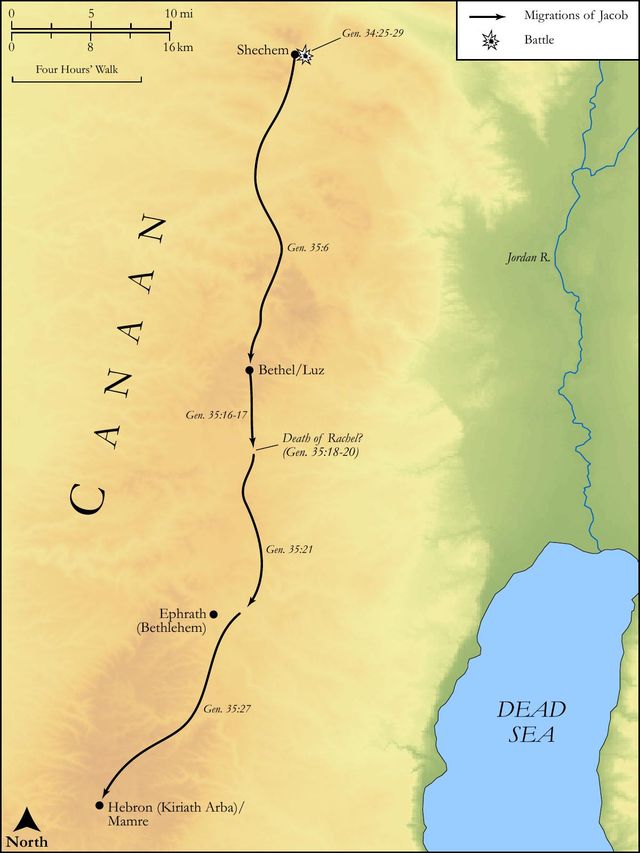
See on the biblical-era maps


Study this verse
Public-domain commentary
Matthew Henry
From his Commentary on the Whole Bible. Henry comments on passages, not single verses — this entry covers Genesis 34:18–24.
Here, 1. Hamor and Shechem gave consent themselves to be circumcised, Gen 34:18, Gen 34:19. To this perhaps they were moved, not only by the strong desire they had to bring about this match, but by what they might have heard of the sacred and honourable intentions of this sign, in the family of Abraham, which, it is probable, they had some confused notions of, and of the promises confirmed by it, which made them the more desirous to incorporate with the family of Jacob, Zac 8:23. Note, Many who know little of religion, yet know so much of it as makes them willing to join themselves with those that are religious. Again, If a man would take upon him a form of religion to gain a good wife, much more should we embrace the power of it to gain the favour of a good God, even circumcise our hearts to love him, and, as Shechem here, not defer to do the thing. 2. They gained the consent of the men of their city, Jacob's sons requiring that they also should be circumcised. (1.) They themselves had great influences upon them by their command and example. Note, Religion would greatly prevail if those in authority, who, like Shechem, are more honourable than their neighbours, would appear forward and zealous for it. (2.) They urged an argument which was very cogent (Gen 34:23), Shall not their cattle and their substance be ours? They observed that Jacob's sons were industrious thriving people, and promised themselves and their neighbours advantage by an alliance with them; it would improve ground and trade, and bring money into their country. Now, [1.] It was bad enough to marry upon this principle: yet we see covetousness the greatest matchmaker in the world, and nothing designed so much, with many, as the laying of house to house, and field to field, without regard had to any other consideration. [2.] It was worse to be circumcised upon this principle. The Shechemites will embrace the religion of Jacob's family only in hopes of interesting themselves thereby in the riches of that family. Thus there are many with whom gain is godliness, and who are more governed and influenced by their secular interest than by any principle of their religion.
Continue studying Genesis 34:23 across the web’s major study libraries — every link below opens this exact verse, chapter, or book on the destination site.
Read & Compare
 BibleGatewayThis verse in more than 200 translations and 70 languages.
 Bible.comThe YouVersion reader — hundreds of translations, reading plans, and highlights.
 ESV.orgCrossway's official English Standard Version reader.
 NET BibleThe NET translation with 60,000+ translators' notes on every rendering decision.
 STEP BibleTyndale House's free study tool — original text, vocabulary, and scholarly resources.
 BibliaLogos Bible Software's free web reader.
 USCCBThe New American Bible (Revised Edition) with the U.S. bishops' study notes.
Commentaries
 BibleHub CommentariesDozens of classic commentaries on this verse, gathered on one page.
 StudyLightMore than 100 commentary sets — the largest collection on the web.
 BibleRefPlain-English commentary on what this verse means, verse by verse.
 Enduring WordDavid Guzik's free commentary on this chapter, widely used by Bible teachers.
 Bible Study ToolsVerse commentary alongside Greek and Hebrew study aids.
Original Language & Research
- BibleHub InterlinearThe verse word by word — original language, transliteration, and English.
- BibleHub LexiconEvery word's original-language definition and Strong's entry.
 Blue Letter BibleDeep-study tools — Strong's numbers, concordance, and word studies.
 SefariaThe Hebrew text with Rashi and centuries of Jewish commentary.
Sermons, Hymns & Audio


TrulyRandomVerse is not affiliated with these sites and doesn’t control their content. They’re linked because they’re genuinely useful.
Summary
Genesis 34:23 presents the manipulative argument employed by Hamor, the prince of Shechem, and his son Shechem, to persuade their city's men to undergo circumcision. They cunningly framed the painful ritual as a strategic economic maneuver, promising that the extensive material wealth of Jacob's family—their "cattle and their substance and every beast of theirs"—would eventually become the collective property of the Shechemites. This proposal was made under the guise of accepting the terms put forth by Jacob's sons, who were, unbeknownst to the Shechemites, secretly plotting a brutal act of vengeance.
Context
ShowHideLiterary Context
Genesis 34:23 is a pivotal moment within a deeply disturbing narrative that begins with the defilement of Dinah, Jacob's only recorded daughter, by Shechem, the son of Hamor, the Hivite prince (see Genesis 34:2). Following this act, Jacob's sons, particularly Simeon and Levi, devise a treacherous plan. They respond to Hamor and Shechem's proposal for intermarriage and assimilation with a deceptive condition: all males in Shechem must be circumcised (see Genesis 34:15). Verse 23 is part of Hamor and Shechem's persuasive speech to their own people, attempting to convince them to undergo the painful and culturally significant ritual by appealing to their materialistic desires. This verse sets the stage for the violent retribution that follows, highlighting the Shechemites' fatal misjudgment and the sons' ruthless cunning. The chapter concludes with Jacob's strong disapproval of his sons' extreme actions, underscoring the moral ambiguity and tragic consequences of their vengeance.
Historical & Cultural Context
In the ancient Near East, intermarriage and assimilation between tribes or clans were common ways to form alliances and expand influence. However, circumcision was a unique and deeply significant practice for the descendants of Abraham, serving as the physical sign of God's covenant with them (see Genesis 17:10-14). For the Shechemites, a non-Israelite people, undergoing circumcision would have been an extraordinary and painful act, likely viewed as a profound cultural and religious conversion. The proposal for them to do so for economic gain, as presented by Hamor and Shechem, reveals a pragmatic, opportunistic mindset common in tribal societies where wealth (especially livestock) and population size were direct indicators of power and prosperity. The narrative also reflects the strong emphasis on family honor and the severe consequences for its violation in ancient cultures, which fueled the sons' vengeful response.
Key Themes
ShowHideThis verse contributes to several overarching themes in Genesis 34 and the broader book. Firstly, it powerfully illustrates the theme of deception and treachery, as both Jacob's sons and the Shechemite leaders engage in manipulative tactics. The sons use a sacred covenant sign as a pretext for violence, while Hamor and Shechem exploit their people's covetousness. Secondly, the narrative highlights the destructive consequences of materialism over morality. Hamor and Shechem's willingness to subject their entire male population to a painful ritual for purely economic gain exposes a profound moral compromise, demonstrating how the pursuit of worldly wealth can blind individuals to ethical considerations and lead to disaster. Finally, the chapter, including this verse, serves as a stark example of the cycle of sin and its devastating repercussions, where one act of violence begets another, leading to widespread suffering and loss, a theme echoed throughout the early narratives of Genesis, such as the story of Cain and Abel.
Exposition and Analysis
ShowHideIn Genesis 34:23, Hamor and Shechem articulate their calculated appeal to the Shechemite men, framing the proposed circumcision as a financially advantageous move. Their argument is a masterclass in manipulation, designed to convince their people that by agreeing to Jacob's family's terms, they would not only gain new inhabitants but also absorb their considerable assets.
Key Word Analysis
ShowHideThis term specifically refers to "something bought, i.e. property, but only livestock; abstractly, acquisition." In this context, it emphasizes the significant herds and flocks belonging to Jacob's prosperous household, which constituted a primary form of wealth and sustenance in the ancient world. Hamor and Shechem are appealing to the tangible, visible signs of wealth that would enrich their community.
This word denotes "creation, i.e. (concretely) creatures; also acquisition, purchase, wealth." Unlike miqneh, qinyân is a broader term encompassing all forms of acquired property, including not just livestock but also servants, precious metals, and other movable goods. Its inclusion alongside "cattle" and "beast" underscores the comprehensive nature of the wealth the Shechemites coveted, signifying all that Jacob's family had accumulated.
This primitive root means "properly, to come, i.e. (implied) to assent." In this verse, it highlights the Shechemites' willingness to agree to the terms proposed by Jacob's sons. However, this "consent" is not born of genuine desire for peace or spiritual alignment, but is explicitly swayed by the promise of illicit material gain, revealing the profound moral compromise of the Shechemite leaders and their people.
Verse Breakdown
ShowHide"Shall not their cattle and their substance and every beast of theirs be ours?"
This rhetorical question is the core of Hamor and Shechem's persuasive strategy. By listing "cattle," "substance," and "every beast," they comprehensively describe Jacob's family's wealth, appealing directly to the materialistic desires of their townsmen. The question implies an obvious "yes," suggesting that the acquisition of this wealth is a natural and desirable outcome of the proposed integration. It frames the circumcision, a painful and culturally alien act, as a small price to pay for significant economic benefit.
"only let us consent unto them, and they will dwell with us."
This clause presents the condition for the promised acquisition of wealth. The phrase "consent unto them" (from H225, ʼûwth) indicates a willing agreement to the terms, specifically the circumcision. The subsequent phrase, "and they will dwell with us" (from H3427, yâshab), implies full integration and cohabitation. The Shechemite leaders envision a future where, through intermarriage and shared residency, Jacob's family's prosperity would naturally merge with and enhance their own, solidifying their community's power and affluence. This reveals their short-sighted focus on material gain over the ethical implications of the agreement.
Literary Devices
ShowHideThe verse primarily employs Rhetorical Question ("Shall not their cattle...be ours?") to persuade the Shechemite men by presenting the acquisition of wealth as an undeniable and attractive outcome. This technique is designed to elicit an affirmative response, making the proposed circumcision seem like a logical and beneficial decision. Furthermore, the repetition and comprehensive listing of "cattle and their substance and every beast of theirs" serves as a form of Enumeration or Accumulation, emphasizing the vastness and desirability of Jacob's family's possessions. This highlights the Shechemite leaders' materialistic motivations and their attempt to appeal to the covetousness of their people. The entire passage also functions as Dramatic Irony, as the audience knows the true, vengeful intentions of Jacob's sons, while the Shechemites remain tragically unaware, making their economic calculation a fatal error.
Theological and Thematic Connections
ShowHideThe narrative of Genesis 34, and particularly verse 23, serves as a stark theological commentary on the destructive nature of sin, especially when fueled by covetousness and deceit. The Shechemite leaders' willingness to compromise their people's well-being for material gain, coupled with Jacob's sons' cynical misuse of a sacred covenant sign for vengeance, reveals a profound moral bankruptcy on all sides. This episode underscores the tragic consequences when human actions are driven by self-interest and worldly desires rather than by divine principles of justice, truth, and grace. It is a powerful reminder that true peace and prosperity cannot be built on foundations of treachery or the exploitation of others.
Reflection and Application
ShowHideGenesis 34:23 stands as a timeless warning against the seductive power of materialism and the perilous path of making decisions based solely on the promise of quick wealth. It challenges us to critically examine our own motivations, both individually and communally, when faced with opportunities that promise gain but may compromise our integrity or the well-being of others. The Shechemites' tragic downfall, rooted in their covetousness, reminds us that prioritizing tangible assets over ethical considerations, genuine relationships, or spiritual principles can lead to unforeseen and devastating consequences. True and lasting prosperity, whether personal or societal, is never built on deception, exploitation, or the pursuit of illicit gain. Instead, it is founded on righteousness, truth, and a commitment to the welfare of all, reflecting the wisdom that "better is a little with righteousness than great revenues without right" (Proverbs 16:8). This narrative compels us to consider the long-term ripple effects of our choices and to seek God's wisdom in discerning true value from fleeting worldly allure.
Questions for Reflection
ShowHideFAQ
ShowHideWhy did Hamor and Shechem believe Jacob's wealth would become theirs?
ShowHideHamor and Shechem operated under the assumption that through intermarriage and the full integration of Jacob's family into their community, the substantial wealth of Jacob's prosperous household—including his numerous flocks, herds, and other possessions—would naturally merge with and enrich their own. They envisioned a future where the two groups would become one people, and thus, Jacob's assets would become collective Shechemite property. Their perspective was purely economic and opportunistic, viewing Jacob's family as a valuable acquisition rather than as individuals with whom to form a genuine covenant or relationship. This is evident in their rhetorical question in Genesis 34:23, which highlights their covetous focus on the material gain.
What is the significance of circumcision in this narrative?
ShowHideCircumcision held profound significance as the physical sign of God's covenant with Abraham and his descendants, symbolizing their unique relationship with God and their identity as a set-apart, holy people (see Genesis 17:9-14). In Genesis 34, however, this sacred ritual is tragically desecrated and misused. Jacob's sons, particularly Simeon and Levi, exploit it as a deceptive means to exact vengeance for their sister Dinah's defilement, using it as a pretext for a violent attack. Conversely, Hamor and Shechem view it merely as a painful prerequisite for material gain, a transactional cost for acquiring Jacob's wealth. This narrative thus highlights the profound spiritual danger when a holy sign is treated as a mere cultural custom or a tool for worldly advantage, rather than a symbol of genuine spiritual commitment and obedience to God.
Christ-Centered Fulfillment
ShowHideThe tragic events of Genesis 34, particularly the materialistic deception highlighted in verse 23, vividly expose the depths of humanity's fallen state, characterized by covetousness, treachery, and violence. In stark contrast to the false covenant and treacherous peace offered by both parties in Shechem, Jesus Christ establishes a new and true covenant, not based on ritualistic manipulation or the pursuit of worldly gain, but on His own perfect and atoning sacrifice. Where the Shechemites sought earthly wealth and Jacob's sons sought vengeful satisfaction, Christ offers spiritual riches and genuine forgiveness, breaking the cycle of sin and violence through His redemptive work on the cross (see Colossians 2:13-14). He is the ultimate fulfillment of the covenant, offering true reconciliation and peace that transcends material possessions or deceptive schemes. His kingdom is "not of this world" (John 18:36), and He invites humanity into a relationship built on truth, grace, and eternal life, a life free from the destructive grip of covetousness and vengeance that plagued the characters in Genesis 34 (see Matthew 6:19-21).