


Genesis 34:24
- וַיִּשְׁמְעוּvai·yish·me·'Uand they listenedH8085Conj-w ¦ V-Qal-ConsecImperf-3mpVerb Qal Consecutive Imperfect 3rd Plural Masculineוַandיִּשְׁמְעוּthey listened
- אֶל'eltoH413PrepPreposition
- חֲמוֹרcha·mOrHamorH2544N-proper-mNoun Proper Masculine
- וְאֶלve·'eland toH413Conj-w ¦ PrepPrepositionוְandאֶלto
- שְׁכֶםshe·KhemShechemH7927N-proper-mNoun Proper Masculine
- בְּנוֹbe·Nohis sonH1121N-msc ¦ 3msNoun Singular Masculine Constructבְּנsonוֹhis
- כָּלkolallH3605N-msNoun Singular Masculine Absolute
- יֹצְאֵיyo·tze·'Ei[those who] went out ofH3318V-Qal-Prtcpl-mpVerb Qal Participle Plural Masculine Construct
- שַׁעַרSha·'ar[the] gate ofH8179N-mscNoun Singular Masculine Construct
- עִירוֹi·Rohis cityH5892N-fsc ¦ 3msNoun Singular Feminine Constructעִירcityוֹhis
- וַיִּמֹּלוּvai·yi·Mo·luand they were circumcisedH4135Conj-w ¦ V-Niphal-ConsecImperf-3mpVerb Niphal Consecutive Imperfect 3rd Plural Masculineוַandיִּמֹּלוּthey were circumcised
- כָּלkoleveryH3605N-mscNoun Singular Masculine Construct
- זָכָרza·KharmaleH2145Adj-msAdjective Singular Masculine Absolute
- כָּלkolallH3605N-mscNoun Singular Masculine Construct
- יֹצְאֵיyo·tze·'Ei[those who] went out ofH3318V-Qal-Prtcpl-mpVerb Qal Participle Plural Masculine Construct
- שַׁעַרSha·'ar[the] gate ofH8179N-mscNoun Singular Masculine Construct
- עִירוֹi·Rohis cityH5892N-fsc ¦ 3msNoun Singular Feminine Constructעִירcityוֹhis
English is a literal word-by-word gloss of the Hebrew, not the KJV's wording. Why?
This is the original text the KJV's translators worked from — each Hebrew word with its own literal English meaning in this verse, prepared by scholars at Tyndale House, Cambridge. The KJV translates whole sentences, not word by word, so its wording differs: one Hebrew word can become several English words, and the KJV may choose “the LORD” where the gloss reads “Yahweh”. Both are faithful — they answer different questions. For the KJV's own rendering, switch to the KJV text.
Details
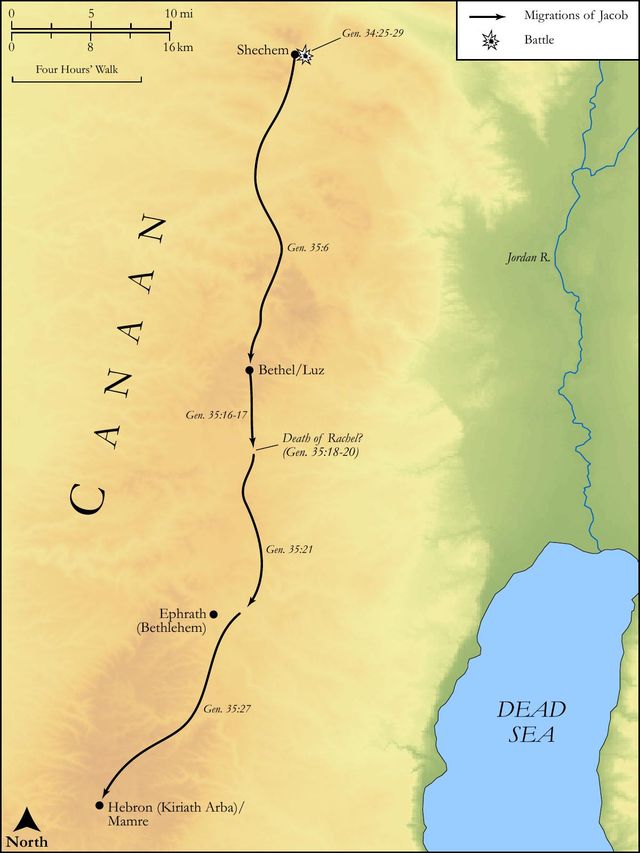
See on the biblical-era maps


Study this verse
Public-domain commentary
Matthew Henry
From his Commentary on the Whole Bible. Henry comments on passages, not single verses — this entry covers Genesis 34:18–24.
Here, 1. Hamor and Shechem gave consent themselves to be circumcised, Gen 34:18, Gen 34:19. To this perhaps they were moved, not only by the strong desire they had to bring about this match, but by what they might have heard of the sacred and honourable intentions of this sign, in the family of Abraham, which, it is probable, they had some confused notions of, and of the promises confirmed by it, which made them the more desirous to incorporate with the family of Jacob, Zac 8:23. Note, Many who know little of religion, yet know so much of it as makes them willing to join themselves with those that are religious. Again, If a man would take upon him a form of religion to gain a good wife, much more should we embrace the power of it to gain the favour of a good God, even circumcise our hearts to love him, and, as Shechem here, not defer to do the thing. 2. They gained the consent of the men of their city, Jacob's sons requiring that they also should be circumcised. (1.) They themselves had great influences upon them by their command and example. Note, Religion would greatly prevail if those in authority, who, like Shechem, are more honourable than their neighbours, would appear forward and zealous for it. (2.) They urged an argument which was very cogent (Gen 34:23), Shall not their cattle and their substance be ours? They observed that Jacob's sons were industrious thriving people, and promised themselves and their neighbours advantage by an alliance with them; it would improve ground and trade, and bring money into their country. Now, [1.] It was bad enough to marry upon this principle: yet we see covetousness the greatest matchmaker in the world, and nothing designed so much, with many, as the laying of house to house, and field to field, without regard had to any other consideration. [2.] It was worse to be circumcised upon this principle. The Shechemites will embrace the religion of Jacob's family only in hopes of interesting themselves thereby in the riches of that family. Thus there are many with whom gain is godliness, and who are more governed and influenced by their secular interest than by any principle of their religion.
Continue studying Genesis 34:24 across the web’s major study libraries — every link below opens this exact verse, chapter, or book on the destination site.
Read & Compare
 BibleGatewayThis verse in more than 200 translations and 70 languages.
 Bible.comThe YouVersion reader — hundreds of translations, reading plans, and highlights.
 ESV.orgCrossway's official English Standard Version reader.
 NET BibleThe NET translation with 60,000+ translators' notes on every rendering decision.
 STEP BibleTyndale House's free study tool — original text, vocabulary, and scholarly resources.
 BibliaLogos Bible Software's free web reader.
 USCCBThe New American Bible (Revised Edition) with the U.S. bishops' study notes.
Commentaries
 BibleHub CommentariesDozens of classic commentaries on this verse, gathered on one page.
 StudyLightMore than 100 commentary sets — the largest collection on the web.
 BibleRefPlain-English commentary on what this verse means, verse by verse.
 Enduring WordDavid Guzik's free commentary on this chapter, widely used by Bible teachers.
 Bible Study ToolsVerse commentary alongside Greek and Hebrew study aids.
Original Language & Research
- BibleHub InterlinearThe verse word by word — original language, transliteration, and English.
- BibleHub LexiconEvery word's original-language definition and Strong's entry.
 Blue Letter BibleDeep-study tools — Strong's numbers, concordance, and word studies.
 SefariaThe Hebrew text with Rashi and centuries of Jewish commentary.
Sermons, Hymns & Audio


TrulyRandomVerse is not affiliated with these sites and doesn’t control their content. They’re linked because they’re genuinely useful.
Summary
Genesis 34:24 serves as a pivotal moment in the tragic narrative of Dinah, detailing the successful persuasion of Hamor and his son Shechem over the men of their city, leading to the universal agreement and immediate execution of circumcision among all males. This public and communal decision, made at the city gate—a central hub for civic and legal affairs—underscores the Shechemite community's compliance and sets the immediate stage for the brutal and violent retribution planned and enacted by Jacob's sons against them.
Context
ShowHideLiterary Context
This verse is situated within the deeply disturbing narrative of Genesis 34, which immediately follows Jacob's return to Canaan and his encounter with Esau. The chapter opens with the defilement of Dinah, Jacob's daughter, by Shechem, the son of Hamor, the Hivite chieftain. In response, Jacob's sons, particularly Simeon and Levi, devise a cunning and deceptive plan. They feign willingness to intermarry and dwell among the Hivites, but only on the condition that all their males undergo circumcision, a sacred sign of the Abrahamic covenant. Hamor and Shechem, motivated by the prospect of acquiring Jacob's family's considerable wealth and property through intermarriage, successfully convince the men of their city to agree to this painful demand, as precisely recorded in this verse. The subsequent verses (Genesis 34:25-29) then recount the horrific massacre of the Shechemite men by Simeon and Levi while they were incapacitated, followed by the plunder of the city.
Historical & Cultural Context
In the ancient Near East, the city gate was far more than a mere entrance or exit; it was the vibrant nerve center of urban life. It served as the primary marketplace for commerce, the court of law where legal disputes were settled and judgments rendered, and the public square for announcements, assemblies, and official agreements. For "all that went out of the gate of his city" to "hearken" and then be circumcised signifies that this agreement was not a private negotiation but a publicly ratified, official, and universally accepted communal decision by the male populace of Shechem. This cultural understanding amplifies the weight and public nature of the Shechemites' commitment, making their subsequent vulnerability a matter of collective responsibility and tragedy.
Key Themes
ShowHideGenesis 34:24 contributes significantly to several overarching themes within the broader narrative of Genesis. It highlights the theme of deception and its devastating consequences, as Jacob's sons manipulate a sacred rite for vengeful purposes, leading to bloodshed. The perversion of circumcision, a sign of God's covenant with Abraham (Genesis 17:9-14), into a tool for violence underscores the profound theological implications of misusing divine commands. Furthermore, the narrative explores the responsibility of leadership, as Hamor and Shechem's flawed counsel and pursuit of material gain ultimately lead their entire community to destruction. This episode also serves as a stark example of uncontrolled vengeance and its cycle of violence, contrasting sharply with the divine justice and mercy often emphasized elsewhere in scripture, such as when God promises to avenge the blood of His servants.
Exposition and Analysis
ShowHideGenesis 34:24 describes the critical juncture where the Shechemite community fully commits to the deceptive terms laid out by Jacob's sons, setting the stage for the tragic events that follow.
Key Word Analysis
ShowHideThis verb means "to hear intelligently," often implying attention, understanding, and, crucially, obedience or compliance. In this context, it signifies that the men of Shechem did not merely hear the proposal but listened intently, understood its terms (as presented by Hamor and Shechem), and agreed to obey or comply with the demand for circumcision. This highlights the profound influence Hamor and Shechem wielded over their community, leading to a collective, deliberate acceptance of the condition.
This term refers to a "male" (of man or animals), often signifying the "most noteworthy sex." Its use here emphasizes the comprehensive nature of the demand: every single male, regardless of age or status, was required to undergo the procedure. This universality is critical to the subsequent narrative, as it ensures that the entire male population would be incapacitated, making them vulnerable to attack.
This primitive root means "to cut short," specifically referring to the curtailment of the prepuce, i.e., to circumcise. By implication, it can also mean to blunt or figuratively to destroy. Here, it denotes the physical act of circumcision, a painful and debilitating procedure, especially for adults. The immediate and universal execution of this act, as described in the verse, underscores the Shechemites' complete submission to the terms, unknowingly leading to their collective vulnerability and destruction.
Verse Breakdown
ShowHide"And unto Hamor and unto Shechem his son hearkened all that went out of the gate of his city"
This clause establishes the success of Hamor and Shechem's public persuasion. The phrase "hearkened all that went out of the gate of his city" emphasizes the comprehensive nature of this compliance. The city gate, as the nerve center of ancient urban life, signifies that this decision was not a private negotiation but a publicly ratified and officially accepted communal agreement. It indicates that the entire male population, those who conducted business and civic life at the gate, listened, understood, and consented to the proposal.
"and every male was circumcised, all that went out of the gate of his city"
This second clause confirms the immediate and complete execution of the agreement. The repetition of "all that went out of the gate of his city" powerfully reinforces the universality of the act. It highlights that no male was exempt; the entire male populace, from the youngest to the oldest, underwent the painful procedure. This collective vulnerability, brought about by their leaders' persuasion and their own desire for perceived gain, made them ripe for the subsequent attack by Simeon and Levi, who exploited their weakened state. The verse thus serves as a chilling precursor to the brutal massacre that follows, underscoring the tragic consequences of a community's blind obedience to its leaders' flawed counsel and the deceptive manipulation of sacred customs.
Literary Devices
ShowHideThe verse employs several literary devices to heighten its impact and foreshadow the impending tragedy. Repetition is prominently used with the phrase "all that went out of the gate of his city," appearing twice. This repetition emphasizes the universal compliance of the Shechemite males, underscoring the collective nature of their decision and their subsequent vulnerability. There is also a profound sense of Irony at play: circumcision, a sacred sign of God's covenant and a mark of belonging to His chosen people, is here perverted into a deceptive tool for incapacitation and vengeance. This sacred act is profaned for unholy ends. Furthermore, the verse functions as a powerful piece of Foreshadowing, subtly hinting at the impending doom for the Shechemite men. Their collective act of circumcision, undertaken for what they believed was prosperity, unknowingly leads them to a state of extreme weakness, making them easy targets for the vengeance of Jacob's sons.
Theological and Thematic Connections
ShowHideGenesis 34:24 stands as a stark reminder of the destructive power of human sin, particularly when it involves deception and unchecked vengeance, and the tragic consequences of misusing sacred symbols. The Shechemites' agreement to circumcision, driven by the lure of material gain and intermarriage, tragically turns a sign of covenant faithfulness into an instrument of their own undoing. This narrative serves as a cautionary tale against pragmatic compromises that disregard moral and spiritual integrity, highlighting how even seemingly beneficial agreements can lead to catastrophic outcomes when rooted in deceit and a lack of divine wisdom.
Reflection and Application
ShowHideGenesis 34:24 serves as a potent warning against the allure of deceptive proposals and the catastrophic outcomes of unchecked anger and revenge. It compels us to critically examine the motives behind seemingly beneficial agreements, especially when they involve significant personal or communal sacrifice, reminding us that true prosperity cannot be built on a foundation of deceit. Furthermore, the passage highlights the immense responsibility of leaders, whose decisions can profoundly impact the welfare of an entire community. We are reminded to seek wisdom and integrity in leadership, to discern motives, and to pursue justice through righteous and God-honoring means, rather than succumbing to the destructive impulses of personal retribution or the perversion of sacred principles for unholy ends. This narrative challenges us to consider the long-term consequences of our actions and to prioritize God's ways over our own fallen desires for vengeance or material gain.
Questions for Reflection
ShowHideFAQ
ShowHideWhy did the men of Shechem agree to such a painful procedure?
ShowHideThe men of Shechem agreed primarily due to the persuasive influence of their leaders, Hamor and Shechem. Hamor and Shechem were motivated by the prospect of acquiring Jacob's family's wealth, livestock, and property through intermarriage, believing it would enrich their city and integrate a prosperous family into their community. They presented the agreement as a beneficial merger of two families and their possessions, appealing to the community's desire for prosperity and expansion. Their decision was a pragmatic, albeit ultimately fatal, calculation for perceived economic and social gain, as detailed in Genesis 34:21-23.
How does this event relate to the covenant of circumcision?
ShowHideThis event tragically misuses and perverts the sacred sign of circumcision. Instituted by God as a physical mark of the covenant with Abraham and his descendants (Genesis 17:11), signifying a spiritual relationship and belonging to God's chosen people, it is here exploited as a cunning ruse. Jacob's sons demanded it not for religious adherence or genuine reconciliation, but as a means to incapacitate the Shechemite men for their vengeful attack, thereby profaning a holy symbol and demonstrating a profound spiritual blindness.
What is the significance of "the gate of his city"?
ShowHideIn ancient Near Eastern cities, the city gate was far more than an entrance; it was the primary hub of public life. It served as the marketplace for commerce, the court for legal proceedings and judgments, the place for public announcements, and where elders and leaders would gather to conduct official business. Therefore, the phrase "all that went out of the gate of his city" signifies that the agreement to be circumcised was a public, official, and universally accepted decision by the male population of Shechem, not a private arrangement. This public nature underscores the collective responsibility and tragic consequences that befell the entire community.
Christ-Centered Fulfillment
ShowHideThe perversion of circumcision in Genesis 34:24, where a sacred covenant sign is used for deceit and violence, powerfully contrasts with the true fulfillment found in Christ. While the Old Covenant's physical circumcision pointed to a need for spiritual purity and separation unto God, it could be misused or performed without true heart transformation, as tragically exemplified by Jacob's sons. Christ, however, perfectly fulfills the Law and inaugurates the New Covenant, where the true "circumcision" is not of the flesh but of the heart, accomplished by the Holy Spirit (Romans 2:29 and Colossians 2:11). Unlike Jacob's sons who sought vengeance through manipulation and bloodshed, Christ offers ultimate deliverance and reconciliation through His self-sacrificial love on the cross, becoming the Lamb of God who takes away the sin of the world. He establishes a covenant of grace that purifies and transforms from within, offering true peace (Ephesians/2-14) rather than violent retribution, and building a community founded on truth and love, not deception.