


Genesis 34:22
Bible text: King James Version (1769 Blayney text) · Public domain
Bible text: King James Version with Strong's numbers · Public domain
Bible text: Berean Standard Bible · Public domain
Bible text: American Standard Version (1901) · Public domain
Bible text: World English Bible, Messianic edition · Public domain
Bible text: Geneva Bible (1599) · Public domain
Bible text: Young's Literal Translation · Public domain
- אַךְ'akhonlyH389AdvAdverb
- בְּזֹאתBe·zotin thisH2063Prep-b ¦ PrtParticle Demonstrativeבְּinזֹאתthis
- יֵאֹתוּye·'O·tuthey will agreeH225V-Niphal-Imperf-3mpVerb Niphal Imperfect 3rd Plural Masculine
- לָנוּLa·nuto <the> usPrep-l ¦ 1cpSuffix Personal 1st Plural common genderלָto <the>נוּus
- הָאֲנָשִׁיםha·'a·na·Shimthe menH582Art ¦ N-mpNoun Plural Masculine Absoluteהָtheאֲנָשִׁיםmen
- לָשֶׁבֶתla·She·vetto dwellH3427Prep-l ¦ V-Qal-InfVerb Qal Infinitive Constructלָtoשֶׁבֶתdwell
- אִתָּנוּ'i·Ta·nuwith usH854Prep ¦ 1cpPreposition Definiteאִתָּwithנוּus
- לִהְיוֹתlih·Yotto becomeH1961Prep-l ¦ V-Qal-InfVerb Qal Infinitive Constructלִtoהְיוֹתbecome
- לְעַםle·'Am<into> a peopleH5971Prep-l ¦ N-msNoun Singular Masculine Absoluteלְ<into>עַםa people
- אֶחָד'e·ChadoneH259Adj-fsAdjective Numerical Singular Feminine Absolute
- בְּהִמּוֹלbe·hi·Molwhen has been circumcisedH4135Prep-b ¦ V-Niphal-InfVerb Niphal Infinitive Constructבְּwhenהִמּוֹלhas been circumcised
- לָנוּla·nuof usPrep-l ¦ 1cpSuffix Personal 1st Plural common genderלָofנוּus
- כָּלkoleveryH3605N-msNoun Singular Masculine Absolute
- זָכָרza·KharmaleH2145Adj-msAdjective Singular Masculine Absolute
- כַּאֲשֶׁרka·'a·Sherjust asH834Prep-k ¦ RelParticle Relativeכַּjustאֲשֶׁרas
- הֵםhemtheyH1992Pro-3mpPronoun Personal 3rd Plural Masculine
- נִמֹּלִיםni·mo·Lim[are] circumcisedH4135V-Niphal-Prtcpl-mpVerb Niphal Participle Plural Masculine Absolute
English is a literal word-by-word gloss of the Hebrew, not the KJV's wording. Why?
This is the original text the KJV's translators worked from — each Hebrew word with its own literal English meaning in this verse, prepared by scholars at Tyndale House, Cambridge. The KJV translates whole sentences, not word by word, so its wording differs: one Hebrew word can become several English words, and the KJV may choose “the LORD” where the gloss reads “Yahweh”. Both are faithful — they answer different questions. For the KJV's own rendering, switch to the KJV text.
Details
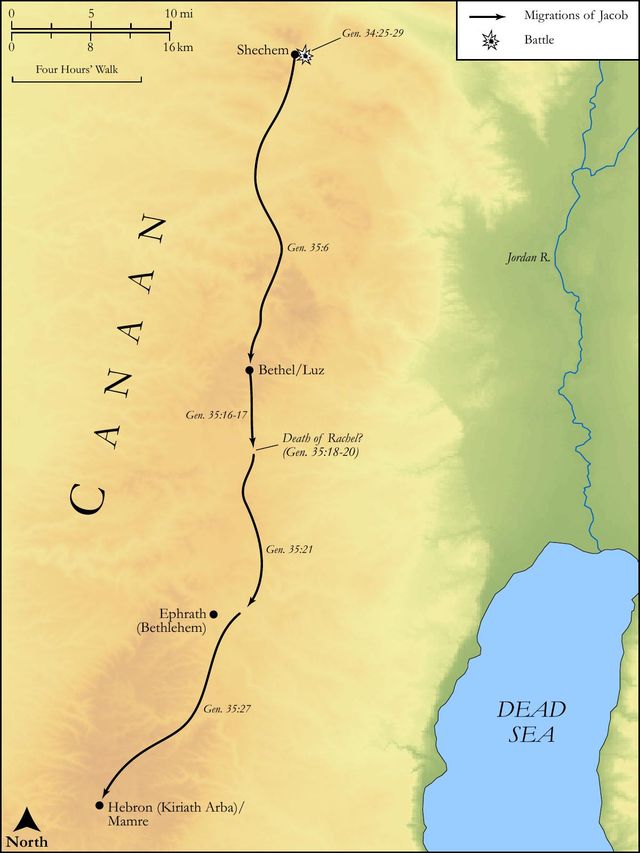
See on the biblical-era maps


Study this verse
Public-domain commentary
Matthew Henry
From his Commentary on the Whole Bible. Henry comments on passages, not single verses — this entry covers Genesis 34:18–24.
Here, 1. Hamor and Shechem gave consent themselves to be circumcised, Gen 34:18, Gen 34:19. To this perhaps they were moved, not only by the strong desire they had to bring about this match, but by what they might have heard of the sacred and honourable intentions of this sign, in the family of Abraham, which, it is probable, they had some confused notions of, and of the promises confirmed by it, which made them the more desirous to incorporate with the family of Jacob, Zac 8:23. Note, Many who know little of religion, yet know so much of it as makes them willing to join themselves with those that are religious. Again, If a man would take upon him a form of religion to gain a good wife, much more should we embrace the power of it to gain the favour of a good God, even circumcise our hearts to love him, and, as Shechem here, not defer to do the thing. 2. They gained the consent of the men of their city, Jacob's sons requiring that they also should be circumcised. (1.) They themselves had great influences upon them by their command and example. Note, Religion would greatly prevail if those in authority, who, like Shechem, are more honourable than their neighbours, would appear forward and zealous for it. (2.) They urged an argument which was very cogent (Gen 34:23), Shall not their cattle and their substance be ours? They observed that Jacob's sons were industrious thriving people, and promised themselves and their neighbours advantage by an alliance with them; it would improve ground and trade, and bring money into their country. Now, [1.] It was bad enough to marry upon this principle: yet we see covetousness the greatest matchmaker in the world, and nothing designed so much, with many, as the laying of house to house, and field to field, without regard had to any other consideration. [2.] It was worse to be circumcised upon this principle. The Shechemites will embrace the religion of Jacob's family only in hopes of interesting themselves thereby in the riches of that family. Thus there are many with whom gain is godliness, and who are more governed and influenced by their secular interest than by any principle of their religion.
Continue studying Genesis 34:22 across the web’s major study libraries — every link below opens this exact verse, chapter, or book on the destination site.
Read & Compare
 BibleGatewayThis verse in more than 200 translations and 70 languages.
 Bible.comThe YouVersion reader — hundreds of translations, reading plans, and highlights.
 ESV.orgCrossway's official English Standard Version reader.
 NET BibleThe NET translation with 60,000+ translators' notes on every rendering decision.
 STEP BibleTyndale House's free study tool — original text, vocabulary, and scholarly resources.
 BibliaLogos Bible Software's free web reader.
 USCCBThe New American Bible (Revised Edition) with the U.S. bishops' study notes.
Commentaries
 BibleHub CommentariesDozens of classic commentaries on this verse, gathered on one page.
 StudyLightMore than 100 commentary sets — the largest collection on the web.
 BibleRefPlain-English commentary on what this verse means, verse by verse.
 Enduring WordDavid Guzik's free commentary on this chapter, widely used by Bible teachers.
 Bible Study ToolsVerse commentary alongside Greek and Hebrew study aids.
Original Language & Research
- BibleHub InterlinearThe verse word by word — original language, transliteration, and English.
- BibleHub LexiconEvery word's original-language definition and Strong's entry.
 Blue Letter BibleDeep-study tools — Strong's numbers, concordance, and word studies.
 SefariaThe Hebrew text with Rashi and centuries of Jewish commentary.
Sermons, Hymns & Audio


TrulyRandomVerse is not affiliated with these sites and doesn’t control their content. They’re linked because they’re genuinely useful.
Summary
Genesis 34:22 records the deceptive proposition made by Jacob's sons to the men of Shechem. Under the guise of fostering unity and intermarriage, they stipulated that all Shechemite males must be circumcised as a prerequisite for their families to become "one people." This condition, however, was not born of a desire for genuine assimilation or spiritual conversion, but was a calculated, malicious ploy to incapacitate the Shechemite men, enabling Jacob's sons to exact brutal revenge for the defilement of their sister, Dinah.
Context
ShowHideLiterary Context
This verse is a pivotal moment in the tragic narrative of Genesis 34. It immediately follows Hamor and Shechem's sincere, albeit self-serving, proposal for intermarriage and peaceful cohabitation with Jacob's family (Genesis 34:8-12). Jacob's sons, particularly Simeon and Levi, are deeply enraged by the dishonor brought upon their sister Dinah (Genesis 34:7). Their response, articulated in this verse, is a cunning and manipulative counter-proposal. Outwardly, it appears to be a reasonable condition for alliance, but inwardly, it is a strategic maneuver designed to exploit the Shechemites' vulnerability, setting the stage for the horrific massacre that unfolds in Genesis 34:25-29. This deception highlights the moral decline within Jacob's household, contrasting sharply with the covenant promises made to their patriarchs.
Historical & Cultural Context
Among the patriarchs, honor and shame were paramount, especially concerning the purity of women and the reputation of families. Dinah's defilement was a profound dishonor to Jacob's entire household, demanding a response. Marriage alliances were common ways to forge political and economic ties between groups, often involving significant negotiations and conditions. Circumcision, for the Israelites, was the distinctive physical sign of the Abrahamic Covenant, marking them as God's chosen people and symbolizing their unique relationship with Yahweh. For non-Israelites like the Hivites of Shechem, adopting circumcision would be an extraordinary step, signifying a deep commitment to integration, possibly even a form of religious conversion or submission. The sons of Jacob understood the physical incapacitation that followed circumcision, making their demand a particularly insidious and culturally exploitative act, turning a sacred ritual into a weapon.
Key Themes
ShowHideGenesis 34 is replete with themes that resonate throughout the biblical narrative. Deception is central, as Jacob's sons feign a desire for unity while harboring murderous intent. This stands in stark contrast to the integrity expected of God's covenant people. Vengeance is another dominant theme, illustrating the destructive power of unchecked anger and the cycle of violence it perpetuates, moving far beyond the concept of "an eye for an eye" (Exodus 21:24). The misuse of sacred institutions is profoundly evident, as the holy sign of circumcision is perverted for unholy ends. This narrative also explores the consequences of sin, demonstrating how one act of sin (Shechem's defilement of Dinah) can trigger a cascade of further, more grievous sins, leading to widespread suffering and moral compromise within the family of faith. Ultimately, it raises questions about covenant integrity and the ethical conduct of those who bear the name of God.
Exposition and Analysis
ShowHideKey Word Analysis
ShowHideA primitive root meaning "to come," and by implication, "to assent." In this context, it describes the Shechemite men's agreement to the condition proposed by Jacob's sons. The choice of this word highlights the sons' manipulation: they sought not genuine agreement for peaceful coexistence, but a coerced assent that would lead to their victims' vulnerability.
A primitive root meaning "to sit down," and by implication, "to dwell, to remain." It also carries connotations of settling or establishing a habitation. The sons' stated desire for the Shechemites to "dwell with us" suggests a long-term, integrated relationship, a deceptive promise of stability and shared life that masked their true destructive intentions.
A primitive root meaning "to cut short," specifically referring to the curtailment of the prepuce. Figuratively, it can mean to blunt or destroy. This word is crucial as it names the act that would physically incapacitate the Shechemite men, turning a sacred covenant sign into a means of violent subjugation and destruction.
Verse Breakdown
ShowHide"Only herein will the men consent unto us for to dwell with us"
This opening clause establishes the deceptive premise of Jacob's sons. They present a seemingly reasonable and singular condition ("Only herein") upon which they, as "the men" (representing Jacob's household), would "consent" to the Shechemites' proposal for intermarriage and cohabitation. The phrase "for to dwell with us" suggests a desire for peaceful, integrated living, implying a future of shared community and prosperity. However, this overture of unity is a calculated facade, designed to elicit trust and cooperation from Hamor and Shechem, while concealing the sons' true, malicious intent.
"to be one people"
This phrase further elaborates on the purported goal of the agreement: the complete amalgamation of the two groups into a single, unified community. In the lands of the patriarchs, becoming "one people" implied shared identity, customs, and destiny, often cemented by intermarriage. For the Shechemites, this would mean a significant cultural and perhaps even religious shift, aligning themselves with Jacob's family. For Jacob's sons, this was the ultimate lie, as their aim was not integration but annihilation, using the language of unity to mask their plans for division and destruction.
"if every male among us be circumcised, as they [are] circumcised"
This is the core condition of the deceptive proposal. The demand for universal male circumcision among the Shechemites is presented as the sole prerequisite for becoming "one people." The reference to "as they [are] circumcised" highlights that the Shechemites were to adopt the very practice that marked Jacob's family as distinct—the sign of the Abrahamic Covenant. While outwardly appearing to be a demand for religious or cultural assimilation, the sons' true motive was to exploit the period of vulnerability and pain that follows circumcision, rendering the Shechemite men defenseless for the impending massacre. This perversion of a sacred sign underscores the profound moral depravity of Simeon and Levi.
Literary Devices
ShowHideThe passage employs several potent Literary Devices. Foremost is Irony, as the sons of Jacob propose circumcision—a sign of the covenant of life and God's faithfulness—as the very means to bring about death and betrayal. The outward promise of becoming "one people" stands in stark contrast to their inward intention of division and destruction, creating a deep sense of dramatic irony for the reader who knows their true motives. There is also strong Foreshadowing in the seemingly innocuous condition, hinting at the impending violence and tragedy that will befall the Shechemites. The very act of circumcision, meant to symbolize new life and covenant, is Symbolismically inverted, becoming a symbol of vulnerability and death in this narrative. This perversion of a sacred symbol underscores the moral corruption of Jacob's sons and highlights the destructive power of human sin when it manipulates divine institutions for ungodly ends.
Theological and Thematic Connections
ShowHideGenesis 34:22 serves as a stark theological warning about the corrupting nature of unbridled rage and the devastating consequences of seeking vengeance through deceit. It powerfully illustrates how sacred practices and covenant signs, intended by God for blessing and distinction, can be twisted and profaned by human sin to achieve the most unholy ends. The passage underscores the profound moral compromise that occurs when individuals, even those within the covenant community, prioritize personal retribution over divine principles of justice, mercy, and integrity. It is a sobering reminder that actions born of bitterness, even in response to genuine wrong, can lead to a cycle of violence that dishonors God and brings ruin upon all involved.
Reflection and Application
ShowHideThe narrative of Genesis 34, culminating in the deceptive demand of verse 22, compels us to a deep reflection on our own responses to perceived wrongs and injustices. It challenges us to scrutinize our motives, ensuring that even our righteous indignation does not become a breeding ground for bitterness, manipulation, or actions that betray the very principles we claim to uphold. This passage serves as a potent reminder that true justice is not found in human vengeance, which often escalates cycles of harm, but in the character of God, who alone is perfectly just and merciful. As believers, we are called to pursue integrity in all our dealings, to resist the temptation to misuse sacred trusts or spiritual practices for selfish gain, and to actively seek reconciliation and forgiveness, even when wronged, rather than perpetuating cycles of violence and deception. Our actions must always reflect the character of the God we serve, who desires peace and righteousness, not cunning and bloodshed.
Questions for Reflection
ShowHideFAQ
ShowHideWhy did Jacob's sons demand circumcision from the Shechemites?
ShowHideJacob's sons, particularly Simeon and Levi, demanded circumcision from the Shechemites not out of a genuine desire for their spiritual conversion or peaceful integration into Jacob's family. Instead, it was a calculated and deeply deceptive tactic to weaken them. They knew that the recovery period following circumcision would render the Shechemite men physically vulnerable and unable to defend themselves (Genesis 34:25), allowing Jacob's sons to exact their violent revenge for the defilement of their sister, Dinah. This act highlights a severe perversion of a sacred covenant sign.
Was Jacob aware of his sons' true intentions in Genesis 34:22?
ShowHideThe biblical text does not explicitly state that Jacob was fully aware of the malicious and violent extent of his sons' plan when they proposed circumcision. While he was undoubtedly distressed by Dinah's defilement, his later reaction in Genesis 34:30—where he expresses fear for his family's safety and reputation—and his strong condemnation of Simeon and Levi's actions on his deathbed (Genesis 49:5-7) strongly indicate that he disapproved of their brutality. This suggests he was either unaware of their murderous intent or severely underestimated the horrific violence they would unleash, finding their actions abhorrent and contrary to his family's identity as God's covenant people.
Christ-Centered Fulfillment
ShowHideThe tragic events of Genesis 34:22 starkly reveal the depths of human sin and the destructive power of vengeance, demonstrating how even sacred institutions can be perverted for unholy ends. In profound contrast, Jesus Christ embodies the true and ultimate fulfillment of God's covenant, not through deceptive demands or violent retribution, but through self-sacrificial love and perfect righteousness. Where the sons of Jacob sought to establish a false unity through a physical, manipulative act, Christ brings genuine reconciliation and peace through His atoning work on the cross (Ephesians 2:14-16). He fulfills the covenant not by demanding a physical sign for earthly gain, but by offering a spiritual circumcision of the heart, a transformation that cleanses from sin and brings true spiritual unity (Romans 2:29 and Colossians 2:11). Unlike the fleeting and violent "oneness" proposed by Jacob's sons, Christ establishes an eternal kingdom of righteousness and peace, offering forgiveness and breaking the cycle of sin, thereby achieving a redemptive purpose that far surpasses any human attempt at justice or unity.