


Genesis 46:10
Bible text: King James Version (1769 Blayney text) · Public domain
Bible text: Berean Standard Bible · Public domain
Bible text: American Standard Version (1901) · Public domain
Bible text: World English Bible, Messianic edition · Public domain
Bible text: Geneva Bible (1599) · Public domain
Bible text: Young's Literal Translation · Public domain
- וּבְנֵיu·ve·Neiand [the] sons ofH1121Conj-w ¦ N-mpcNoun Plural Masculine Constructוּandבְנֵי[the] sons of
- שִׁמְעוֹןshim·'onSimeonH8095N-proper-mNoun Proper Masculine
- יְמוּאֵלye·mu·'ElJemuelH3223N-proper-mNoun Proper Masculine
- וְיָמִיןve·ya·Minand JaminH3226Conj-w ¦ N-proper-mNoun Proper MasculineוְandיָמִיןJamin
- וְאֹהַדve·'O·hadand OhadH161Conj-w ¦ N-proper-mNoun Proper MasculineוְandאֹהַדOhad
- וְיָכִיןve·ya·Khinand JakinH3199Conj-w ¦ N-proper-mNoun Proper MasculineוְandיָכִיןJakin
- וְצֹחַרve·Tzo·charand ZoharH6714Conj-w ¦ N-proper-mNoun Proper MasculineוְandצֹחַרZohar
- וְשָׁאוּלve·sha·'Uland ShaulH7586Conj-w ¦ N-proper-mNoun Proper MasculineוְandשָׁאוּלShaul
- בֶּןben[the] sonH1121N-mscNoun Singular Masculine Construct
- הַכְּנַעֲנִיתHa·ke·na·'a·Nitthe Canaanite [woman]H3669Art ¦ N-fsNoun Gentilic Singular Feminine AbsoluteהַtheכְּנַעֲנִיתCanaanite [woman]
English is a literal word-by-word gloss of the Hebrew, not the KJV's wording. Why?
This is the original text the KJV's translators worked from — each Hebrew word with its own literal English meaning in this verse, prepared by scholars at Tyndale House, Cambridge. The KJV translates whole sentences, not word by word, so its wording differs: one Hebrew word can become several English words, and the KJV may choose “the LORD” where the gloss reads “Yahweh”. Both are faithful — they answer different questions. For the KJV's own rendering, switch to the KJV text.
Details
See on the biblical-era maps


Study this verse
Public-domain commentary
Matthew Henry
From his Commentary on the Whole Bible. Henry comments on passages, not single verses — this entry covers Genesis 46:5–27.
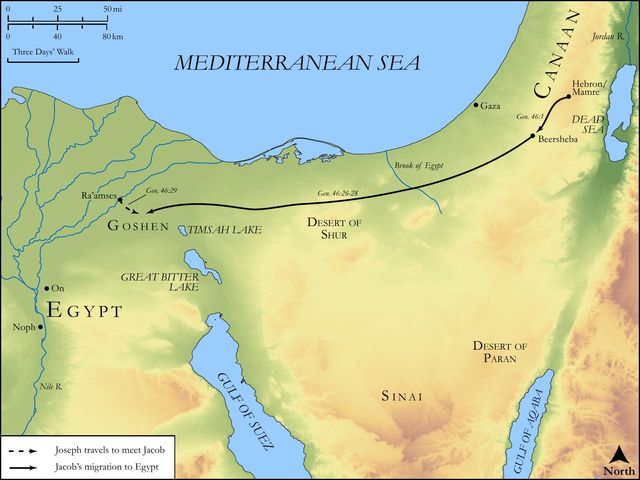
Old Jacob is here flitting. Little did he think of ever leaving Canaan; he expected, no doubt, to die in his nest, and to leave his seed in actual possession of the promised land: but Providence orders it otherwise. Note, Those that think themselves well settled may yet be unsettled in a little time. Even old people, who think of no other removal than that to the grave (which Jacob had much upon his heart, Gen 37:35; Gen 42:38), sometimes live to see great changes in their family. It is good to be ready, not only for the grave, but for whatever may happen betwixt us and the grave. Observe, 1. How Jacob was conveyed; not in a chariot, though chariots were then used, but in a wagon, Gen 46:5. Jacob had the character of a plain man, who did not affect any thing stately or magnificent; his son rode in a chariot (Gen 41:43), but a wagon would serve him. 2. The removal of what he had with him. (1.) His effects (Gen 46:6), cattle and goods; these he took with him that he might not wholly be beholden to Pharaoh for a livelihood, and that it might not afterwards be said of them, "that they came beggars to Egypt." (2.) His family, all his seed, Gen 46:7. It is probable that they had continued to live together in common with their father; and therefore when he went they all went, which perhaps they were the more willing to do, because, though they had heard that the land of Canaan was promised them, yet, to this day, they had none of it in possession. We have here a particular account of the names of Jacob's family, his sons' sons, most of whom are afterwards mentioned as heads of houses in the several tribes. See Num 26:5, etc. Bishop Patrick observes that Issachar called his eldest son Tola, which signifies a worm, probably because when he was born he was a very little weak child, a worm, and no man, not likely to live; and yet there sprang from him a very numerous offspring, Ch1 7:2. Note, Living and dying do not go by probability. The whole number that went down into Egypt was sixty-six (Gen 46:26), to which add Joseph and his two sons, who were there before, and Jacob himself, the head of the family, and you have the number of seventy, Gen 46:27. The Septuagint makes them seventy-five, and Stephen follows them (Act 7:14), the reason of which we leave to the conjecture of the critics; but let us observe, [1.] Masters of families ought to take care of all under their charge, and to provide for those of their own house food convenient both for body and soul. When Jacob himself removed to a land of plenty, he would not leave any of his children behind him to starve in a barren land. [2.] Though the accomplishment of promises is always sure, yet it is often slow. It was now 215 years since God had promised Abraham to make of him a great nation (Gen 12:2); and yet that branch of his seed on which the promise was entailed had increased only to seventy, of which this particular account is kept, that the power of God in multiplying these seventy to so vast a multitude, even in Egypt, may appear the more illustrious. When God pleases, a little one shall become a thousand, Isa 60:22.
Continue studying Genesis 46:10 across the web’s major study libraries — every link below opens this exact verse, chapter, or book on the destination site.
Read & Compare
 BibleGatewayThis verse in more than 200 translations and 70 languages.
 Bible.comThe YouVersion reader — hundreds of translations, reading plans, and highlights.
 ESV.orgCrossway's official English Standard Version reader.
 NET BibleThe NET translation with 60,000+ translators' notes on every rendering decision.
 STEP BibleTyndale House's free study tool — original text, vocabulary, and scholarly resources.
 BibliaLogos Bible Software's free web reader.
 USCCBThe New American Bible (Revised Edition) with the U.S. bishops' study notes.
Commentaries
 BibleHub CommentariesDozens of classic commentaries on this verse, gathered on one page.
 StudyLightMore than 100 commentary sets — the largest collection on the web.
 BibleRefPlain-English commentary on what this verse means, verse by verse.
 Enduring WordDavid Guzik's free commentary on this chapter, widely used by Bible teachers.
 Bible Study ToolsVerse commentary alongside Greek and Hebrew study aids.
Original Language & Research
- BibleHub InterlinearThe verse word by word — original language, transliteration, and English.
- BibleHub LexiconEvery word's original-language definition and Strong's entry.
 Blue Letter BibleDeep-study tools — Strong's numbers, concordance, and word studies.
 SefariaThe Hebrew text with Rashi and centuries of Jewish commentary.
Sermons, Hymns & Audio


TrulyRandomVerse is not affiliated with these sites and doesn’t control their content. They’re linked because they’re genuinely useful.
Summary
Genesis 46:10 meticulously lists the six sons of Simeon, one of Jacob's twelve sons, as part of the detailed census of Jacob's household journeying to Egypt. This verse uniquely highlights the heritage of Shaul, noting his mother was a Canaanitish woman, a detail that underscores the Bible's precise genealogical record-keeping and hints at the complex, yet divinely guided, formation of Israel, even amidst diverse familial origins.
Context
ShowHideLiterary Context
This verse is situated within Genesis chapter 46, a pivotal chapter that serves as a detailed genealogical record of Jacob's family as they descend into Egypt. Following the emotional reunion of Jacob and Joseph in Genesis 45, chapter 46 provides a precise census of the "souls" (excluding Jacob's daughters-in-law and Joseph's family already in Egypt) who made the journey. This meticulous listing, which includes the sons of each of Jacob's children, emphasizes the fulfillment of God's promise to make Jacob's descendants a great nation, even as they enter a foreign land. The specific mention of Shaul's mother in Genesis 46:10 stands out within this otherwise straightforward enumeration, drawing particular attention to Simeon's lineage.
Historical & Cultural Context
The journey to Egypt, prompted by a severe famine (as detailed in Genesis 41), represents a critical juncture in the patriarchal history. It was a divinely orchestrated move to preserve Jacob's family and allow them to multiply into a nation, as God had promised Abraham in Genesis 15:13-14. During this early patriarchal period, intermarriage with non-Israelites, while not explicitly forbidden by a formal covenant law (which would come later with the Mosaic Law, e.g., Deuteronomy 7:3-4), was nonetheless a complex issue. The Canaanites were the indigenous inhabitants of the land promised to Abraham's descendants. The mention of a Canaanitish woman in Simeon's line provides a glimpse into the social realities and diverse interactions of Jacob's family before their distinct national identity was fully formed.
Key Themes
ShowHideGenesis 46 contributes significantly to several overarching themes in Genesis and the Pentateuch. Firstly, it underscores Divine Providence and Preservation, demonstrating God's faithfulness in protecting the covenant line despite famine and the family's relocation. Secondly, the detailed genealogy highlights the theme of Fulfillment of Promises, specifically the promise of numerous descendants, laying the groundwork for the nation of Israel. Thirdly, the unique detail in Genesis 46:10 subtly introduces the theme of Inclusion and Exclusion, hinting at the complex ethnic and social dynamics that would shape Israel's identity and its relationship with surrounding peoples, a theme that finds its ultimate resolution in the broader scope of God's redemptive plan for all nations.
Exposition and Analysis
ShowHideKey Word Analysis
ShowHideFrom the root meaning "to build," this term (H1121) refers to a son, but in a much broader sense, encompassing descendants, members of a group, or even qualities. Here, it denotes direct offspring, emphasizing the continuation of the family line, which is crucial for the genealogical record.
A patrial term (H3669) indicating an inhabitant of Canaan. By implication, it can also refer to a merchant, as Canaanites were known for trade. In this context, it specifically identifies the ethnic origin of Shaul's mother, distinguishing her from the other mothers in the genealogy.
A passive participle (H7586) meaning "asked" or "desired." This name, given to Simeon's son, carries a potential significance related to his birth or the circumstances surrounding it, though the text does not elaborate on the reason for this particular name.
Verse Breakdown
ShowHide"And the sons of Simeon;"
This introductory clause clearly identifies the subject of the verse, focusing on the lineage descending from Simeon, one of Jacob's twelve sons. It sets the stage for the enumeration of his direct male offspring, continuing the genealogical pattern established earlier in the chapter.
"Jemuel, and Jamin, and Ohad, and Jachin, and Zohar,"
This segment lists five of Simeon's six sons. These names are presented without additional descriptive details, following the typical concise format of biblical genealogies. Their inclusion here confirms their status as direct descendants of Jacob through Simeon, contributing to the total count of those who went down to Egypt.
"and Shaul the son of a Canaanitish woman."
This final phrase is the most distinctive part of the verse. It names the sixth son, Shaul, and uniquely specifies his mother's ethnic background as "Canaanitish." This detail is not provided for the mothers of the other sons listed in Genesis 46, making it a significant and intentional inclusion by the biblical author, drawing attention to Shaul's unique heritage within the family of Simeon.
Literary Devices
ShowHideThe primary literary device at play in Genesis 46:10 is Genealogy, which serves to meticulously record the lineage and establish the continuity of the covenant family. Within this genealogical framework, there is a clear use of Emphasis through Detail, specifically regarding Shaul's mother. By singling out her Canaanitish origin, the text highlights this particular fact as noteworthy, inviting the reader to consider its significance without explicitly stating it. This unique detail creates a subtle Contrast with the unmentioned backgrounds of the other sons' mothers, drawing attention to the diverse origins within the nascent Israelite community.
Theological and Thematic Connections
ShowHideThe meticulous recording of genealogies, including seemingly minor details like Shaul's mother, demonstrates God's precise oversight in preserving the promised seed. Each name, regardless of its background, contributes to the grand narrative of salvation history and the tracing of the Messiah's lineage. This verse illustrates God's sovereign plan operating through imperfect human situations and choices. Despite the complexities of intermarriage that would later be prohibited, God continued to preserve and multiply Jacob's family, ensuring they would grow into a mighty nation. The presence of a Canaanitish woman in the patriarchal lineage, though an isolated instance, subtly foreshadows God's broader redemptive plan, which would eventually extend beyond ethnic Israel to encompass all nations.
Reflection and Application
ShowHideGenesis 46:10 reminds us that God's intricate plan unfolds through the diverse and sometimes unexpected tapestry of human lives. The inclusion of Shaul's Canaanitish mother demonstrates that God's work of preserving His people and fulfilling His promises often operates through imperfect human situations and varied backgrounds. It underscores the Bible's commitment to presenting a full, unvarnished picture of the ancestors of Israel, acknowledging the complexities and realities of their lives. For us today, this verse serves as a powerful reminder that God uses all kinds of people and circumstances to accomplish His sovereign will, and that every individual, regardless of their background, perceived imperfections, or social standing, plays a part in His grand redemptive narrative. It encourages us to embrace the diverse tapestry of God's people and to trust in His sovereign hand, even when circumstances seem unconventional.
Questions for Reflection
ShowHideFAQ
ShowHideWhy is Shaul's mother's ethnic background specifically mentioned when others are not?
ShowHideThe Bible often includes specific details that hold historical, social, or theological significance for its original audience, even if the explicit reason isn't stated. The mention of Shaul's Canaanitish mother is unique in this chapter's extensive genealogy, suggesting it was noteworthy. It might highlight the diverse origins within the early Israelite families before the formal establishment of the Mosaic Law, which would later strictly prohibit intermarriage with Canaanites (e.g., Deuteronomy 7:3-4). This detail could also serve as a factual historical record, indicating a particular family dynamic within Simeon's household, or it might subtly foreshadow the broader universal reach of God's plan that would eventually extend beyond ethnic Israel, as seen in the New Testament.
Christ-Centered Fulfillment
ShowHideThe meticulous preservation of genealogies, as seen in Genesis 46:10, ultimately points to the faithfulness of God in preparing the lineage through which the Messiah would come. Every name recorded, including that of Shaul, contributes to the unbroken chain leading to Christ. The inclusion of a Canaanitish woman, though an anomaly in the patriarchal line given later Mosaic prohibitions, serves as a subtle, yet profound, foreshadowing of the universal reach of the New Covenant in Christ. Jesus's own genealogy, as recorded in Matthew 1:1-17 and Luke 3:23-38, notably includes Gentile women like Rahab (a Canaanite, Matthew 1:5) and Ruth (a Moabite, Matthew 1:5), demonstrating that God's redemptive plan was always intended to transcend ethnic and national boundaries. Christ, the ultimate fulfillment of God's promises, breaks down all dividing walls of hostility, uniting people from every nation, tribe, and tongue into one family of God (Ephesians 2:14; Revelation 7:9). Through His atoning work, the Abrahamic promise that all nations would be blessed through his seed is fully realized, welcoming all who believe into the spiritual lineage of faith (Galatians 3:8).