


Genesis 46:8
Bible text: King James Version (1769 Blayney text) · Public domain
Bible text: Berean Standard Bible · Public domain
Bible text: American Standard Version (1901) · Public domain
Bible text: World English Bible, Messianic edition · Public domain
Bible text: Geneva Bible (1599) · Public domain
Bible text: Young's Literal Translation · Public domain
- וְאֵלֶּהve·'E·lehand theseH428Conj-w ¦ PrtParticle Demonstrativeוְandאֵלֶּהthese
- שְׁמוֹתshe·Mot[are] [the] names ofH8034N-fpcNoun Plural Feminine Construct
- בְּנֵיbe·nei[the] sons ofH1121N-mpcNoun Plural Masculine Construct
- יִשְׂרָאֵלYis·ra·'ElIsraelH3478N-proper-mNoun Proper Masculine
- הַבָּאִיםha·ba·'Imwho wentH935Art ¦ V-Qal-Prtcpl-mpVerb Qal Participle Plural Masculine Absoluteהַwhoבָּאִיםwent
- מִצְרַיְמָהmitz·Ray·mahEgypt towardsH4714N-proper ¦ SfxNoun Proper LocationמִצְרַיְמָEgyptהtowards
- יַעֲקֹבya·'a·KoJacobH3290N-proper-mNoun Proper Masculine
- וּבָנָיוu·va·Navand his sonsH1121Conj-w ¦ N-mpc ¦ 3msNoun Plural Masculine Constructוּandבָנָיsonsוhis
- בְּכֹרbe·Khor[the] firstborn ofH1060N-mscNoun Singular Masculine Construct
- יַעֲקֹבya·'a·KoJacobH3290N-proper-mNoun Proper Masculine
- רְאוּבֵןre·'u·VenReubenH7205N-proper-mNoun Proper Masculine
English is a literal word-by-word gloss of the Hebrew, not the KJV's wording. Why?
This is the original text the KJV's translators worked from — each Hebrew word with its own literal English meaning in this verse, prepared by scholars at Tyndale House, Cambridge. The KJV translates whole sentences, not word by word, so its wording differs: one Hebrew word can become several English words, and the KJV may choose “the LORD” where the gloss reads “Yahweh”. Both are faithful — they answer different questions. For the KJV's own rendering, switch to the KJV text.
Details
See on the biblical-era maps


Study this verse
Public-domain commentary
Matthew Henry
From his Commentary on the Whole Bible. Henry comments on passages, not single verses — this entry covers Genesis 46:5–27.
Old Jacob is here flitting. Little did he think of ever leaving Canaan; he expected, no doubt, to die in his nest, and to leave his seed in actual possession of the promised land: but Providence orders it otherwise. Note, Those that think themselves well settled may yet be unsettled in a little time. Even old people, who think of no other removal than that to the grave (which Jacob had much upon his heart, Gen 37:35; Gen 42:38), sometimes live to see great changes in their family. It is good to be ready, not only for the grave, but for whatever may happen betwixt us and the grave. Observe, 1. How Jacob was conveyed; not in a chariot, though chariots were then used, but in a wagon, Gen 46:5. Jacob had the character of a plain man, who did not affect any thing stately or magnificent; his son rode in a chariot (Gen 41:43), but a wagon would serve him. 2. The removal of what he had with him. (1.) His effects (Gen 46:6), cattle and goods; these he took with him that he might not wholly be beholden to Pharaoh for a livelihood, and that it might not afterwards be said of them, "that they came beggars to Egypt." (2.) His family, all his seed, Gen 46:7. It is probable that they had continued to live together in common with their father; and therefore when he went they all went, which perhaps they were the more willing to do, because, though they had heard that the land of Canaan was promised them, yet, to this day, they had none of it in possession. We have here a particular account of the names of Jacob's family, his sons' sons, most of whom are afterwards mentioned as heads of houses in the several tribes. See Num 26:5, etc. Bishop Patrick observes that Issachar called his eldest son Tola, which signifies a worm, probably because when he was born he was a very little weak child, a worm, and no man, not likely to live; and yet there sprang from him a very numerous offspring, Ch1 7:2. Note, Living and dying do not go by probability. The whole number that went down into Egypt was sixty-six (Gen 46:26), to which add Joseph and his two sons, who were there before, and Jacob himself, the head of the family, and you have the number of seventy, Gen 46:27. The Septuagint makes them seventy-five, and Stephen follows them (Act 7:14), the reason of which we leave to the conjecture of the critics; but let us observe, [1.] Masters of families ought to take care of all under their charge, and to provide for those of their own house food convenient both for body and soul. When Jacob himself removed to a land of plenty, he would not leave any of his children behind him to starve in a barren land. [2.] Though the accomplishment of promises is always sure, yet it is often slow. It was now 215 years since God had promised Abraham to make of him a great nation (Gen 12:2); and yet that branch of his seed on which the promise was entailed had increased only to seventy, of which this particular account is kept, that the power of God in multiplying these seventy to so vast a multitude, even in Egypt, may appear the more illustrious. When God pleases, a little one shall become a thousand, Isa 60:22.
Continue studying Genesis 46:8 across the web’s major study libraries — every link below opens this exact verse, chapter, or book on the destination site.
Read & Compare
 BibleGatewayThis verse in more than 200 translations and 70 languages.
 Bible.comThe YouVersion reader — hundreds of translations, reading plans, and highlights.
 ESV.orgCrossway's official English Standard Version reader.
 NET BibleThe NET translation with 60,000+ translators' notes on every rendering decision.
 STEP BibleTyndale House's free study tool — original text, vocabulary, and scholarly resources.
 BibliaLogos Bible Software's free web reader.
 USCCBThe New American Bible (Revised Edition) with the U.S. bishops' study notes.
Commentaries
 BibleHub CommentariesDozens of classic commentaries on this verse, gathered on one page.
 StudyLightMore than 100 commentary sets — the largest collection on the web.
 BibleRefPlain-English commentary on what this verse means, verse by verse.
 Enduring WordDavid Guzik's free commentary on this chapter, widely used by Bible teachers.
 Bible Study ToolsVerse commentary alongside Greek and Hebrew study aids.
Original Language & Research
- BibleHub InterlinearThe verse word by word — original language, transliteration, and English.
- BibleHub LexiconEvery word's original-language definition and Strong's entry.
 Blue Letter BibleDeep-study tools — Strong's numbers, concordance, and word studies.
 SefariaThe Hebrew text with Rashi and centuries of Jewish commentary.
Sermons, Hymns & Audio


TrulyRandomVerse is not affiliated with these sites and doesn’t control their content. They’re linked because they’re genuinely useful.
Summary
Genesis 46:8 initiates the detailed genealogical record of Jacob's household, now identified as Israel, as they journey into Egypt. This verse specifically introduces Reuben, Jacob's firstborn son, commencing the enumeration of the family members who would collectively form the nascent nation of Israel. This migration, divinely orchestrated, represents a crucial step in the unfolding of God's covenant plan and redemptive history, ensuring the preservation and growth of the chosen lineage.
Context
ShowHideLiterary Context
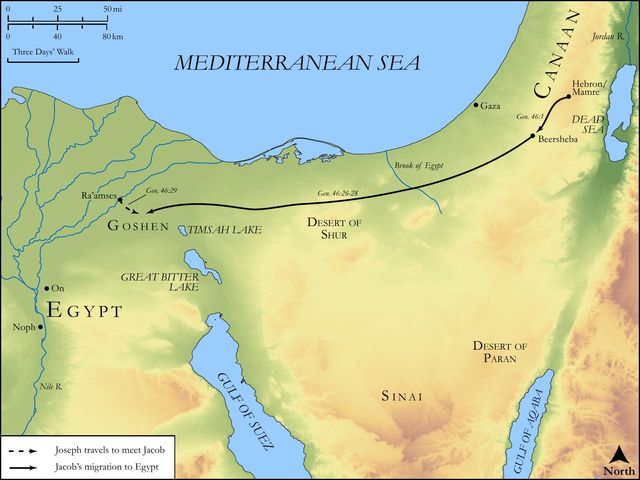
This verse marks a pivotal transition in the narrative of Genesis. It immediately follows the emotional reunion of Jacob and Joseph in Egypt, detailed in Genesis 45. Having received Pharaoh's generous invitation to settle in the fertile land of Goshen (Genesis 45:10), Jacob and his entire household are now making the journey from Canaan. Chapter 46 then meticulously lists all the individuals who accompanied Jacob into Egypt, emphasizing the scale of this migration and setting the stage for the growth of Israel into a nation, which is further elaborated in Genesis 47. This detailed census underscores the importance of lineage and identity within the biblical narrative, serving as a foundational record for the subsequent history of Israel.
Historical & Cultural Context
The migration of Jacob's family to Egypt occurred during a severe regional famine, a common and devastating natural disaster in those lands. Egypt, with its reliance on the Nile River, often served as a granary for the surrounding regions, making it a natural refuge during such crises. The meticulous recording of names and genealogies was a widespread practice among Israel and the nations, serving to establish lineage, inheritance rights, social status, and national identity. For the Israelites, these records were particularly vital as they traced the fulfillment of divine promises through specific family lines. The hospitality extended by Pharaoh to Joseph's family, though exceptional, reflects the power dynamics and diplomatic relations that could exist between rulers and foreign dignitaries in that era, often driven by mutual benefit or respect.
Key Themes
ShowHideGenesis 46:8 contributes significantly to several overarching themes in the book of Genesis and the broader biblical narrative. Firstly, it highlights Divine Providence, demonstrating God's sovereign hand guiding Jacob's family to Egypt, not merely as a response to famine but as a necessary step for their growth into a great nation, as prophesied to Abraham in Genesis 15:13-14. Secondly, it underscores the Fulfillment of Covenant Promises, particularly the promise that Abraham's descendants would multiply and become a great nation (Genesis 12:2). The detailed enumeration of individuals signifies the nascent stage of this nation-building. Thirdly, the verse emphasizes the Preservation of Lineage, meticulously tracking the family through whom God's redemptive plan, including the eventual coming of the Messiah, would unfold. The naming of "Israel" for Jacob's family also reinforces the theme of Corporate Identity as God's chosen people.
Exposition and Analysis
ShowHideGenesis 46:8 states: "And these [are] the names of the children of Israel, which came into Egypt, Jacob and his sons: Reuben, Jacob's firstborn."
This verse serves as the formal introduction to the comprehensive list of Jacob's descendants who accompanied him into Egypt. It is more than a mere roster; it is a foundational document for the emerging nation of Israel, meticulously detailing the lineage that would carry God's covenant promises.
Key Word Analysis
ShowHideThis word signifies more than just an appellation; it represents a mark or memorial of individuality, implying honor, authority, and character. In this context, the listing of "names" emphasizes the distinct identity and significance of each person within the collective, highlighting God's personal attention to the individuals who constitute His chosen people and the importance of their lineage.
This term broadly refers to a son, often viewed as a "builder of the family name." Here, "children of Israel" (literally "sons of Israel") emphasizes their collective identity as descendants of Jacob, forming a unified family unit that is foundational to the future nation. It speaks to both literal offspring and the broader concept of familial and national relationship, underscoring the continuity of the covenant through generations.
This term denotes the "firstborn," and by extension, the "chief" or "eldest." Reuben's explicit identification as "Jacob's firstborn" highlights his traditional position of prominence and leadership within the patriarchal family structure. While Reuben later lost the privileges of the firstborn, his initial mention here establishes the customary order of enumeration and underscores the importance of birth order in ancient genealogies.
Verse Breakdown
ShowHide"And these [are] the names of the children of Israel"
This opening phrase formally introduces a detailed enumeration, signaling the commencement of a significant genealogical record. The phrase "children of Israel" (Hebrew: B'nei Yisra'el) emphasizes their collective identity as the descendants of Jacob, who was renamed Israel after his transformative encounter with God (Genesis 32:28). This collective name signifies their unique, covenantal relationship with God as His chosen people, heirs to His promises, and the nascent form of a distinct nation.
"which came into Egypt, Jacob and his sons"
This clause clarifies the specific context and purpose of the list – to document those who migrated from Canaan into Egypt. It reiterates that Jacob, the patriarch, is the head of this family unit, and his sons are the progenitors of the twelve tribes. Their entry into Egypt, though prompted by severe famine, is presented as a divinely orchestrated movement, setting the stage for their growth into a multitude and eventual Exodus, fulfilling God's earlier prophecies.
"Reuben, Jacob's firstborn"
The specific mention of Reuben first is significant, as he was the eldest son of Jacob and Leah. As the firstborn, Reuben traditionally held a position of preeminence, including a double portion of inheritance and leadership among his brothers. His explicit identification here begins the enumeration in a customary order, establishing the lineage from the eldest, despite his later loss of the birthright due to his transgression (Genesis 35:22 and Genesis 49:3-4). This detail underscores the importance of patriarchal order and the meticulous record-keeping inherent in the biblical narrative, which tracks the unfolding of God's promises through specific family lines.
Literary Devices
ShowHideThe primary literary device at play in Genesis 46:8 is Enumeration, as the verse serves as the introduction to a detailed list of individuals. This specific form of enumeration functions as a Genealogy, meticulously recording the lineage of Jacob's family. The precise naming of individuals, starting with "Reuben, Jacob's firstborn," employs Emphasis to highlight the importance of birth order and the structured nature of the family unit. The act of listing itself also serves as a form of Foreshadowing, hinting at the future growth of this family into a numerous nation, a key component of God's covenant promises. The careful record-keeping throughout this passage underscores the divine attention to detail in the unfolding of redemptive history.
Theological and Thematic Connections
ShowHideThe entry of Jacob's family into Egypt, meticulously documented in Genesis 46, is a profound testament to God's unwavering faithfulness and sovereign control over history. This migration, seemingly a desperate measure against famine, was in fact a divinely orchestrated step in the fulfillment of God's covenant promises to Abraham, Isaac, and Jacob. It was in Egypt that this small family would multiply into a great nation, preserved and prepared for their eventual Exodus and the reception of the Law. The detailed census underscores that every individual within God's plan matters, and His purposes are meticulously brought to fruition through specific people and lineages, ensuring the continuity of His redemptive narrative.
Reflection and Application
ShowHideThis passage offers a powerful reminder that even in moments of profound uncertainty, hardship, or forced relocation, God is actively working behind the scenes to fulfill His sovereign purposes. Jacob's family was not merely fleeing famine; they were being divinely positioned for a crucial stage in their development as a nation. The detailed record-keeping reflects God's intimate care and attention to every individual life within His larger, overarching plan for humanity. For us today, this encourages profound trust in God's providence, knowing that He orchestrates events for the ultimate good of His people, even when circumstances seem dire or when our path is unclear. It invites us to consider how our own lives, seemingly ordinary, are woven into God's grand tapestry of redemption, and how our faithfulness, like that of Jacob's family, contributes to His unfolding story. The growth of Jacob's family into a multitude in Egypt (Exodus 1:7) is a powerful testament to God's unwavering faithfulness to His word, assuring us that His plans will always come to fruition, often in ways we cannot initially perceive.
Questions for Reflection
ShowHideFAQ
ShowHideWhy does the Bible include such detailed genealogies?
ShowHideGenealogies like the one introduced in Genesis 46:8 serve several crucial purposes within the biblical narrative. Firstly, they establish the historical authenticity and continuity of the biblical account, demonstrating that these are real people and events, grounding the spiritual narrative in concrete history. Secondly, they meticulously trace the fulfillment of God's covenant promises, particularly the promise of a great nation descending from Abraham, Isaac, and Jacob (Genesis 12:2). Thirdly, these lists are vital for preserving the lineage through which the Messiah would eventually come, ensuring the continuity and integrity of God's redemptive plan from creation to Christ. They underscore God's faithfulness to His word across generations.
What is the significance of Jacob being referred to as "Israel" here?
ShowHideJacob's name was changed to Israel (Genesis 32:28) after he wrestled with God, signifying a new identity and a deeper, more profound covenant relationship. In Genesis 46:8, referring to "the children of Israel" emphasizes that this is not just Jacob's personal family but the nascent nation, the collective people chosen by God with whom He has made a special covenant. It highlights their corporate identity as God's covenant people, distinct and set apart for His purposes, marking the transition from a patriarchal family to a national entity.
Christ-Centered Fulfillment
ShowHideThe meticulous record of Jacob's descendants entering Egypt, beginning with Reuben, profoundly underscores God's unwavering commitment to His covenant promises, a commitment that finds its ultimate and glorious fulfillment in Jesus Christ. This growing family, destined to become a great nation, was the very lineage through which the Messiah would eventually come, as prophesied from the earliest chapters of Genesis (Genesis 3:15). The preservation and multiplication of Israel in Egypt, despite hardship and eventual slavery, demonstrate God's sovereign hand guiding the redemptive story towards the birth of the Savior. Just as God meticulously tracked each member of Israel for His purposes, so too does He orchestrate all of history to bring about the salvation offered through Christ, the true "seed" of Abraham (Galatians 3:16) and the head of a new, spiritual Israel, the Church (Galatians 6:16). Every name listed in Genesis 46 is a testament to the divine faithfulness that culminates in the incarnation, death, and resurrection of the Lord Jesus, through whom all God's promises find their "Yes" and "Amen" (2 Corinthians 1:20).