


Genesis 43:34
- וַיִּשָּׂאvai·yi·Sa'and someone tookH5375Conj-w ¦ V-Qal-ConsecImperf-3msVerb Qal Consecutive Imperfect 3rd Singular Masculineוַandיִּשָּׂאsomeone took
- מַשְׂאֹתmas·'OtportionsH4864N-fpNoun Plural Feminine Absolute
- מֵאֵתme·'Etfrom withH854Prep-m ¦ PrepPrepositionמֵfromאֵתwith
- פָּנָיוpa·Navhis faceH6440N-mpc ¦ 3msNoun Plural Masculine Constructפָּנָיfaceוhis
- אֲלֵהֶם'a·le·Hemto themH413Prep ¦ 3mpPrepositionאֲלֵtoהֶםthem
- וַתֵּרֶבva·Te·revand it was greatH7235Conj-w ¦ V-Qal-ConsecImperf-3fsVerb Qal Consecutive Imperfect 3rd Singular Feminineוַandתֵּרֶבit was great
- מַשְׂאַתmas·'At[the] portion ofH4864N-fscNoun Singular Feminine Construct
- בִּנְיָמִןbin·ya·MinBenjaminH1144N-proper-mNoun Proper Masculine
- מִמַּשְׂאֹתmi·mas·'Otmore than [the] portions ofH4864Prep-m ¦ N-fpcNoun Plural Feminine Constructמִmore thanמַּשְׂאֹת[the] portions of
- כֻּלָּםku·Lamall of themH3605N-msc ¦ 3mpNoun Singular Masculine Constructכֻּלָּall ofםthem
- חָמֵשׁcha·MeshfiveH2568Adj-csAdjective Numerical Singular common gender Absolute
- יָדוֹתya·DothandsH3027N-cpNoun Plural common gender Absolute
- וַיִּשְׁתּוּvai·yish·Tuand they drankH8354Conj-w ¦ V-Qal-ConsecImperf-3mpVerb Qal Consecutive Imperfect 3rd Plural Masculineוַandיִּשְׁתּוּthey drank
- וַיִּשְׁכְּרוּvai·yish·ke·Ruand they became drunkH7937Conj-w ¦ V-Qal-ConsecImperf-3mpVerb Qal Consecutive Imperfect 3rd Plural Masculineוַandיִּשְׁכְּרוּthey became drunk
- עִמּוֹi·Mowith himH5973Prep ¦ 3msPrepositionעִמּwithוֹhim
English is a literal word-by-word gloss of the Hebrew, not the KJV's wording. Why?
This is the original text the KJV's translators worked from — each Hebrew word with its own literal English meaning in this verse, prepared by scholars at Tyndale House, Cambridge. The KJV translates whole sentences, not word by word, so its wording differs: one Hebrew word can become several English words, and the KJV may choose “the LORD” where the gloss reads “Yahweh”. Both are faithful — they answer different questions. For the KJV's own rendering, switch to the KJV text.
Details
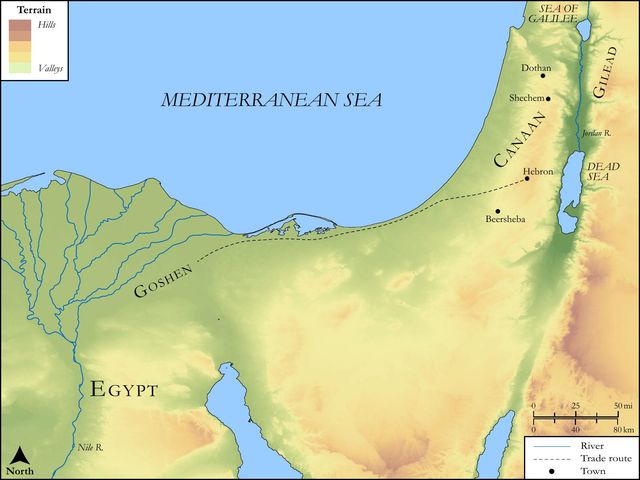
See on the biblical-era map


Study this verse
Public-domain commentary
Matthew Henry
From his Commentary on the Whole Bible. Henry comments on passages, not single verses — this entry covers Genesis 43:26–34. His four-level outline is real structure in the source text, so it is rendered as structure.
Here is, I. The great respect that Joseph's brethren paid to him. When they brought him the present, they bowed themselves before him (Gen 43:26); and again, when they gave him an account of their father's health, they made obeisance, and called him, Thy servant our father, Gen 43:28. Thus were Joseph's dreams fulfilled more and more: and even the father, by the sons, bowed before him, according to the dream, Gen 37:10. Probably Jacob had directed them, if they had occasion to speak of him to the man, the lord of the land, to call him his servant.
II.The great kindness that Joseph showed to them, while they little thought it was a brotherly kindness. Here is,
1.His kind enquiry concerning Jacob: Is he yet alive? - a very fit question to be asked concerning any, especially concerning old people; for we are dying daily: it is strange that we are yet alive. Jacob had said many years before, I will go to the grave to my son; but he is yet alive: we must not die when we will.
2.The kind notice he took of Benjamin, his own brother.
(1.)He put up a prayer for him: God be gracious unto thee, my son, Gen 43:29. Joseph's favour, though he was the lord of the land, would do him little good, unless God were gracious to him. Many seek the ruler's favour, but Joseph directs him to seek the favour of the ruler of rulers.
(2.)He shed some tears for him, Gen 43:30. His natural affection to his brother, his joy to see him, his concern at seeing him and the rest of them in distress for bread, and the remembrance of his own griefs since he last saw him, produced a great agitation in him, which perhaps was the more uneasy because he endeavoured to stifle and suppress it; but he was forced to retire into his closet, there to give vent to his feeling by tears. Note,
[1.]Tears of tenderness and affection are no disparagement at all, even to great and wise men.
[2.]Gracious weepers should not proclaim their tears. My soul shall weep in secret, says the prophet, Jer 13:17. Peter went out and wept bitterly. See Mat 26:75.
3.His kind entertainment of them all. When his weeping had subsided so that he could refrain himself, he sat down to dinner with them, treated them nobly, and yet contrived every thing to amuse them.
(1.)He ordered three tables to be spread, one for his brethren, another for the Egyptians that dined with him (for so different were their customs that they did not care to eat together), another for himself, who durst not own himself a Hebrew, and yet would not sit with the Egyptians. See here an instance,
[1.]Of hospitality and good house-keeping, which are very commendable, according as the ability is.
[2.]Of compliance with people's humours, even whimsical ones, as bishop Patrick calls this of the Egyptians not eating with the Hebrews. Though Joseph was the lord of the land, and orders were given that all people should obey him, yet he would not force the Egyptians to eat with the Hebrews, against their minds, but let them enjoy their humours. Spirits truly generous hate to impose.
[3.]Of the early distance between Jews and Gentiles; one table would not hold them.
(2.)He placed his brethren according to their seniority (Gen 43:33), as if he could certainly divine. Some think they placed themselves so, according to their custom; but, if so, I see not why such particular notice is taken of it, especially as a thing they marvelled at.
(3.)He gave them a very plentiful entertainment, sent messes to them from his own table, Gen 43:34. This was the more generous in him, and the more obliging to them, because of the present scarcity of provisions. In a day of famine, it is enough to be fed; but here they were feasted. Perhaps they had not had such a good dinner for many months. It is said, They drank and were merry; their cares and fears were now over, and they ate their bread with joy, concluding they were now upon good terms with the man, the lord of the land. If God accept our works, our present, we have reason to be cheerful. Yet when we sit, as they here did, to eat with a ruler, we should consider what is before us, and not indulge our appetite, nor be desirous of dainties, Pro 23:1-3. Joseph gave them to understand that Benjamin was his favourite; for his mess was five times as much as any of theirs, not as if he would have him eat so much more than the rest, for then he must eat more than would do him good (and it is no act of friendship, but rather an injury and unkindness, to press any either to eat or drink to excess), but thus he would testify his particular respect for him, that he might try whether his brethren would envy Benjamin his larger messes, as formerly they had envied himself his finer coat. And it must be our rule, in such cases, to be content with what we have, and not to grieve at what others have.
Historical interpretation
Historical reception
1 surviving comment on this verse from the historical church.
Joseph, as I was saying, was a holy man who conquered cruelty with true piety; who was sold into Egypt not by chance but that he might supply Egypt with food and his own brothers too, who had sold him. That Joseph invited his brothers to dine. But just listen to what happened: “And he drank, and became merry at noon.” Is that true, and is it literally possible that a holy man became drunk? Noah also was inebriated but had been really inebriated. Joseph had been intoxicated; Noah also was intoxicated in his own house. See, there is a mystery. First, let us review the mystery itself, and when we have done that, let us fathom its meaning. After the deluge, Noah drank and became drunk in his own house, and his thighs were uncovered, and he was exposed in his nakedness. The elder brother came along and laughed; the younger, however, covered him up. All this is said in type of the Savior, for on the cross he had drunk of the passion: “Father, if it is possible, let this cup pass away from me.” He drank and was inebriated, and his thighs were laid bare—the dishonor of the cross. The older brothers, the Jews, came along and laughed; the younger, the Gentiles, covered up his disagreement. Hence the imprecation: “Cursed be Canaan; he shall be the lowest of slaves to his brothers.”28Behold, that condemnation continues down to this day. We, the younger people, give orders to the older people, the Jews. As the Lord is inebriated in his passion, his saints are inebriated every day in the ardor of their faith, inebriated in the Holy Spirit. You, who yesterday were heaping together gold, today, you are throwing it away. Are you not a madman to those who do not know what it is all about? Finally, when the Holy Spirit descended upon the apostles and filled them, and they spoke many different languages; they were accused of being full of new wine.
Continue studying Genesis 43:34 across the web’s major study libraries — every link below opens this exact verse, chapter, or book on the destination site.
Read & Compare
 BibleGatewayThis verse in more than 200 translations and 70 languages.
 Bible.comThe YouVersion reader — hundreds of translations, reading plans, and highlights.
 ESV.orgCrossway's official English Standard Version reader.
 NET BibleThe NET translation with 60,000+ translators' notes on every rendering decision.
 STEP BibleTyndale House's free study tool — original text, vocabulary, and scholarly resources.
 BibliaLogos Bible Software's free web reader.
 USCCBThe New American Bible (Revised Edition) with the U.S. bishops' study notes.
Commentaries
 BibleHub CommentariesDozens of classic commentaries on this verse, gathered on one page.
 StudyLightMore than 100 commentary sets — the largest collection on the web.
 BibleRefPlain-English commentary on what this verse means, verse by verse.
 Enduring WordDavid Guzik's free commentary on this chapter, widely used by Bible teachers.
 Bible Study ToolsVerse commentary alongside Greek and Hebrew study aids.
Original Language & Research
- BibleHub InterlinearThe verse word by word — original language, transliteration, and English.
- BibleHub LexiconEvery word's original-language definition and Strong's entry.
 Blue Letter BibleDeep-study tools — Strong's numbers, concordance, and word studies.
 SefariaThe Hebrew text with Rashi and centuries of Jewish commentary.
Sermons, Hymns & Audio


TrulyRandomVerse is not affiliated with these sites and doesn’t control their content. They’re linked because they’re genuinely useful.
Summary
Genesis 43:34 vividly portrays Joseph's calculated act of bestowing a remarkably generous portion of food upon his youngest brother, Benjamin, during a meal with his siblings in Egypt. This strategic display of favoritism served as a profound test of his brothers' character, designed to reveal whether the destructive jealousy that had previously torn their family apart still festered within their hearts. Simultaneously, it underscored Joseph's deep, personal affection for Benjamin. The brothers' seemingly peaceful and even joyful acceptance of this disparity hints at a significant transformation in their attitudes or, at the very least, a pragmatic submission to Joseph's immense authority, all unfolding under the sovereign hand of God.
Context
ShowHideLiterary Context
Genesis 43:34 is strategically placed within the narrative of Jacob's sons' second journey to Egypt, a journey necessitated by a severe famine and Joseph's prior demand for Benjamin's presence. Following the initial encounter where Joseph, unrecognized, accused them of being spies and held Simeon captive, the brothers returned to Canaan. Jacob's reluctance to send Benjamin, his last remaining son from Rachel, is overcome only by the dire famine and Judah's solemn pledge to guarantee Benjamin's safety (Genesis 43:8-9). Upon their return to Egypt, Joseph engineers a private meal with his brothers, setting the stage for this pivotal moment. The verse immediately precedes the even more dramatic test of the divining cup, which will further expose their character and commitment to Benjamin (Genesis 44).
Historical & Cultural Context
The scene reflects ancient Near Eastern dining customs, where the host would personally distribute portions, often using such acts to signify honor or status. The practice of giving a larger portion to a favored guest or a person of higher standing was common, making Joseph's act culturally intelligible, albeit exaggerated. Egyptian dining etiquette would have also involved specific seating arrangements, likely placing Benjamin in a position of honor near Joseph. The famine itself was a widespread and devastating event, underscoring the brothers' desperate reliance on Joseph, the Egyptian vizier, for their very survival. This context highlights the immense power Joseph wielded and the brothers' vulnerability, which would have influenced their reactions to his actions.
Key Themes
ShowHideThis verse powerfully contributes to several overarching themes within Genesis. It is central to the theme of divine providence, illustrating how God orchestrates human actions and circumstances—even Joseph's intricate tests—to fulfill His redemptive purposes, ultimately preserving the covenant family and lineage (Genesis 50:20). The scene also deeply explores the theme of testing and reconciliation, as Joseph probes his brothers' hearts to discern genuine repentance and a transformation from the jealousy that led to his own enslavement (Genesis 37:4). Furthermore, it revisits the destructive theme of favoritism, echoing Jacob's previous partiality towards Joseph (Genesis 37:3), but here, it serves as a tool for healing rather than division. Finally, it highlights God's unwavering commitment to the preservation of His covenant people, as Joseph's actions ensure the survival of Jacob's family during the famine.
Exposition and Analysis
ShowHideKey Word Analysis
ShowHideDerived from the root nasa (H5375), meaning "to lift" or "to bear," masʼêth literally refers to "that which is lifted up." In this context, it signifies a "portion" or "present," specifically a portion of food lifted from the host's table and given to a guest. This word carries connotations of honor, distinction, or a special gift, indicating that Joseph's distribution was not merely practical but symbolic of favor and status.
A primitive numeral, "five" here emphasizes the extraordinary and deliberate disproportion of Benjamin's portion. The number five often appears in biblical contexts related to divine grace, responsibility, or a significant, complete measure (e.g., the five books of the Torah, the five smooth stones of David). Here, it highlights the extreme nature of Joseph's test and his exceptional favor toward Benjamin.
While yâd primarily means "hand," it is used here idiomatically to denote "times" or "multiplication," often implying power, means, or measure. In the phrase "five times so much," yâd functions to quantify the magnitude of Benjamin's portion, underscoring that it was multiplied by a factor of five compared to his brothers' shares. This usage of "hand" signifies the direct action and deliberate intent behind Joseph's distribution.
Verse Breakdown
ShowHide"And he took and sent messes unto them from before him:"
This clause sets the scene for the meal, emphasizing Joseph's active role as host. The phrase "from before him" indicates that the portions were taken directly from Joseph's own table, a gesture of high honor and intimacy. It highlights Joseph's control over the situation and his personal involvement in the distribution, making the subsequent favoritism all the more deliberate.
"but Benjamin's mess was five times so much as any of theirs."
This is the pivotal detail of the verse. The stark contrast in portion sizes immediately draws attention to Benjamin's special status. The "five times" multiplication is not merely generous but conspicuously excessive, designed to provoke a reaction. This act serves as a calculated test, mirroring the past favoritism shown to Joseph by Jacob and probing whether the brothers' old jealousies would resurface, particularly towards Rachel's other son.
"And they drank, and were merry with him."
This concluding phrase describes the brothers' reaction. Their ability to "drink" and be "merry" (Hebrew, shakar, meaning to become tipsy or satiated with stimulating drink, implying enjoyment and good spirits) in Joseph's presence, despite the obvious favoritism shown to Benjamin, is highly significant. It suggests either a genuine transformation of heart, where past resentments have been overcome, or a pragmatic submission to the powerful Egyptian governor, understanding their precarious position and choosing not to react negatively. This apparent lack of resentment is crucial for Joseph's ongoing plan of reconciliation.
Literary Devices
ShowHideThe verse employs several key literary devices. Symbolism is prominent, as the "messes" represent not just food but also honor, favor, and a deliberate test. Benjamin's disproportionately large portion symbolizes Joseph's deep affection for his full brother, while simultaneously serving as a symbol of the test of the other brothers' hearts, probing for lingering jealousy. The narrative also uses Contrast, juxtaposing the past favoritism shown to Joseph (which led to his enslavement) with the present favoritism shown to Benjamin, and highlighting the difference in the brothers' reactions. The scene is imbued with Dramatic Irony, as the audience knows Joseph's true identity, but his brothers remain oblivious, making their interactions and Joseph's calculated actions all the more poignant and suspenseful. This irony heightens the tension and the anticipation of Joseph's ultimate revelation.
Theological and Thematic Connections
ShowHideGenesis 43:34 is a powerful illustration of God's intricate and often unseen hand guiding human affairs towards His redemptive purposes. Joseph's strategic testing of his brothers, though seemingly manipulative from a human perspective, was part of a divine process designed to expose and heal deep-seated family brokenness. It demonstrates that genuine reconciliation often requires a period of discerning the heart, ensuring that repentance is authentic and that past patterns of sin have truly been overcome. This passage underscores the truth that God can use even difficult or ambiguous circumstances to bring about His perfect will, transforming human weakness and sin into opportunities for growth and restoration.
Reflection and Application
ShowHideGenesis 43:34 provides a profound lens through which to examine themes of forgiveness, reconciliation, and the often-complex journey of healing within relationships. For believers, this passage encourages a patient and discerning approach when navigating relational brokenness, reminding us that true restoration often involves a process of testing and observation to ensure genuine heart change, rather than merely superficial apologies or outward compliance. It challenges us to reflect on our own capacity for jealousy and resentment, urging us to confront these destructive emotions and allow God to transform our hearts. Furthermore, it invites us to trust in God's sovereign hand, recognizing that He can orchestrate even the most challenging or ambiguous situations for His ultimate good and our spiritual growth. We are called to look beyond immediate appearances and discern God's deeper purposes at work, fostering humility, empathy, and a commitment to authentic reconciliation in our own lives.
Questions for Reflection
ShowHideFAQ
ShowHideWhy did Joseph give Benjamin five times as much food?
ShowHideJoseph's act of giving Benjamin a portion five times larger than his brothers' served a profound dual purpose. Primarily, it was a calculated test to discern if the destructive jealousy and resentment that had led them to sell him into slavery years earlier still lingered, particularly concerning their father's favoritism towards Rachel's sons. Joseph needed to know if they would now protect Benjamin, their father's new favorite, or if their old patterns of envy would resurface. Secondly, it was a public and undeniable display of Joseph's deep personal affection for Benjamin, his only full brother and the other son of Rachel. This extravagant gesture was meant to highlight Benjamin's special status in Joseph's eyes, further intensifying the test for the other brothers.
Did Joseph's brothers resent Benjamin's preferential treatment?
ShowHideThe biblical text explicitly states that Joseph's brothers "drank, and were merry with him," indicating that they did not outwardly express resentment, anger, or jealousy at Benjamin's disproportionate portion. This reaction is highly significant. It suggests a profound change in their character and a newfound maturity compared to their past behavior towards Joseph (Genesis 37:11). Their acceptance could signify genuine repentance and a transformation of heart, where they had learned from their past mistakes. Alternatively, it might reflect a pragmatic acceptance of their powerful host's actions, given their desperate situation, their reliance on him for survival, and Judah's solemn pledge to protect Benjamin (Genesis 43:9). Regardless of their precise internal state, their outward response was one of peace and apparent enjoyment, which was crucial for Joseph's ongoing plan of reconciliation.
Christ-Centered Fulfillment
ShowHideGenesis 43:34, while detailing a complex human interaction, profoundly foreshadows the redemptive work of Christ. Joseph, as a type of Christ, orchestrates a test of the heart, not out of malice, but to bring about genuine repentance and reconciliation within his family, ultimately leading to their salvation from famine. Similarly, Christ, the ultimate reconciler, tests the hearts of humanity, not to condemn, but to expose sin and bring about true transformation and restoration. He is the one who, through His sacrificial love, provides an "abundant life" that far surpasses any earthly "mess" or portion (John 10:10). Just as Joseph's brothers, once alienated by sin, were brought into a place of provision and fellowship, so too does Christ bring those who were once enemies of God into His family, granting them an overflowing measure of grace and forgiveness (Romans 5:8; Ephesians 2:4-5). His ultimate act of self-giving on the cross ensures that all who come to Him receive not merely a "five times" blessing, but an eternal inheritance and an unending feast of fellowship with God, a reconciliation secured by His perfect love and sacrifice (2 Corinthians 5:18-19).