


Genesis 46:5
- וַיָּקָםvai·Ya·komand he aroseH6965Conj-w ¦ V-Qal-ConsecImperf-3msVerb Qal Consecutive Imperfect 3rd Singular Masculineוַandיָּקָםhe arose
- יַעֲקֹבya·'a·KoJacobH3290N-proper-mNoun Proper Masculine
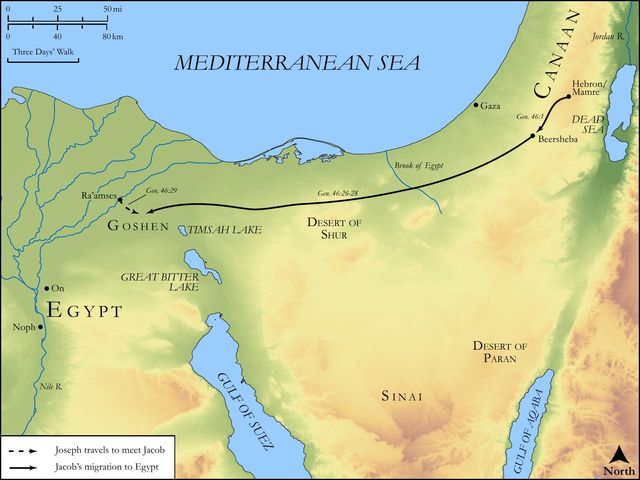
- מִבְּאֵרmi·be·'Erfrom BeerH884Prep-m ¦ N-properNoun Proper LocationמִfromבְּאֵרBeer
- שָׁבַעSha·va'ShebaH884N-properNoun Proper Location
- וַיִּשְׂאוּvai·yis·'Uand they carriedH5375Conj-w ¦ V-Qal-ConsecImperf-3mpVerb Qal Consecutive Imperfect 3rd Plural Masculineוַandיִּשְׂאוּthey carried
- בְנֵיve·nei[the] sons ofH1121N-mpcNoun Plural Masculine Construct
- יִשְׂרָאֵלYis·ra·'ElIsraelH3478N-proper-mNoun Proper Masculine
- אֶת'et<obj.>H853DirObjMParticle Object Indicator
- יַעֲקֹבya·'a·KoJacobH3290N-proper-mNoun Proper Masculine
- אֲבִיהֶם'a·vi·Hemtheir fatherH1N-msc ¦ 3mpNoun Singular Masculine Constructאֲבִיfatherהֶםtheir
- וְאֶתve·'Etand <obj.>H853Conj-w ¦ DirObjMParticle Object Indicatorוְandאֶת<obj.>
- טַפָּםta·Pamtheir little one[s]H2945N-msc ¦ 3mpNoun Singular Masculine Constructטַפָּlittle one[s]םtheir
- וְאֶתve·'Etand <obj.>H853Conj-w ¦ DirObjMParticle Object Indicatorוְandאֶת<obj.>
- נְשֵׁיהֶםne·shei·Hemtheir wivesH802N-mpc ¦ 3mpNoun Plural Masculine Constructנְשֵׁיwivesהֶםtheir
- בָּעֲגָלוֹתba·'a·ga·Lotin the cartsH5699Prep-b ¦ N-fpNoun Plural Feminine Absoluteבָּin theעֲגָלוֹתcarts
- אֲשֶׁר'a·SherwhichH834RelParticle Relative
- שָׁלַחsha·Lachhe had sentH7971V-Qal-Perf-3msVerb Qal Perfect 3rd Singular Masculine
- פַּרְעֹהpar·'OhPharaohH6547N-msNoun Title Singular Masculine Absolute
- לָשֵׂאתla·Setto carryH5375Prep-l ¦ V-Qal-InfVerb Qal Infinitive Constructלָtoשֵׂאתcarry
- אֹתוֹ'o·To<obj.> himH853DirObjM ¦ 3msParticle Object Indicatorאֹת<obj.>וֹhim
English is a literal word-by-word gloss of the Hebrew, not the KJV's wording. Why?
This is the original text the KJV's translators worked from — each Hebrew word with its own literal English meaning in this verse, prepared by scholars at Tyndale House, Cambridge. The KJV translates whole sentences, not word by word, so its wording differs: one Hebrew word can become several English words, and the KJV may choose “the LORD” where the gloss reads “Yahweh”. Both are faithful — they answer different questions. For the KJV's own rendering, switch to the KJV text.
Details
See on the biblical-era maps


Study this verse
Public-domain commentary
Matthew Henry
From his Commentary on the Whole Bible. Henry comments on passages, not single verses — this entry covers Genesis 46:5–27.
Old Jacob is here flitting. Little did he think of ever leaving Canaan; he expected, no doubt, to die in his nest, and to leave his seed in actual possession of the promised land: but Providence orders it otherwise. Note, Those that think themselves well settled may yet be unsettled in a little time. Even old people, who think of no other removal than that to the grave (which Jacob had much upon his heart, Gen 37:35; Gen 42:38), sometimes live to see great changes in their family. It is good to be ready, not only for the grave, but for whatever may happen betwixt us and the grave. Observe, 1. How Jacob was conveyed; not in a chariot, though chariots were then used, but in a wagon, Gen 46:5. Jacob had the character of a plain man, who did not affect any thing stately or magnificent; his son rode in a chariot (Gen 41:43), but a wagon would serve him. 2. The removal of what he had with him. (1.) His effects (Gen 46:6), cattle and goods; these he took with him that he might not wholly be beholden to Pharaoh for a livelihood, and that it might not afterwards be said of them, "that they came beggars to Egypt." (2.) His family, all his seed, Gen 46:7. It is probable that they had continued to live together in common with their father; and therefore when he went they all went, which perhaps they were the more willing to do, because, though they had heard that the land of Canaan was promised them, yet, to this day, they had none of it in possession. We have here a particular account of the names of Jacob's family, his sons' sons, most of whom are afterwards mentioned as heads of houses in the several tribes. See Num 26:5, etc. Bishop Patrick observes that Issachar called his eldest son Tola, which signifies a worm, probably because when he was born he was a very little weak child, a worm, and no man, not likely to live; and yet there sprang from him a very numerous offspring, Ch1 7:2. Note, Living and dying do not go by probability. The whole number that went down into Egypt was sixty-six (Gen 46:26), to which add Joseph and his two sons, who were there before, and Jacob himself, the head of the family, and you have the number of seventy, Gen 46:27. The Septuagint makes them seventy-five, and Stephen follows them (Act 7:14), the reason of which we leave to the conjecture of the critics; but let us observe, [1.] Masters of families ought to take care of all under their charge, and to provide for those of their own house food convenient both for body and soul. When Jacob himself removed to a land of plenty, he would not leave any of his children behind him to starve in a barren land. [2.] Though the accomplishment of promises is always sure, yet it is often slow. It was now 215 years since God had promised Abraham to make of him a great nation (Gen 12:2); and yet that branch of his seed on which the promise was entailed had increased only to seventy, of which this particular account is kept, that the power of God in multiplying these seventy to so vast a multitude, even in Egypt, may appear the more illustrious. When God pleases, a little one shall become a thousand, Isa 60:22.
Continue studying Genesis 46:5 across the web’s major study libraries — every link below opens this exact verse, chapter, or book on the destination site.
Read & Compare
 BibleGatewayThis verse in more than 200 translations and 70 languages.
 Bible.comThe YouVersion reader — hundreds of translations, reading plans, and highlights.
 ESV.orgCrossway's official English Standard Version reader.
 NET BibleThe NET translation with 60,000+ translators' notes on every rendering decision.
 STEP BibleTyndale House's free study tool — original text, vocabulary, and scholarly resources.
 BibliaLogos Bible Software's free web reader.
 USCCBThe New American Bible (Revised Edition) with the U.S. bishops' study notes.
Commentaries
 BibleHub CommentariesDozens of classic commentaries on this verse, gathered on one page.
 StudyLightMore than 100 commentary sets — the largest collection on the web.
 BibleRefPlain-English commentary on what this verse means, verse by verse.
 Enduring WordDavid Guzik's free commentary on this chapter, widely used by Bible teachers.
 Bible Study ToolsVerse commentary alongside Greek and Hebrew study aids.
Original Language & Research
- BibleHub InterlinearThe verse word by word — original language, transliteration, and English.
- BibleHub LexiconEvery word's original-language definition and Strong's entry.
 Blue Letter BibleDeep-study tools — Strong's numbers, concordance, and word studies.
 SefariaThe Hebrew text with Rashi and centuries of Jewish commentary.
Sermons, Hymns & Audio


TrulyRandomVerse is not affiliated with these sites and doesn’t control their content. They’re linked because they’re genuinely useful.
Summary
Genesis 46:5 vividly portrays Jacob's obedient and decisive departure from Beersheba, leading his entire household—his sons, their wives, and all their little ones—on the momentous journey to Egypt. This pivotal act, facilitated by the substantial wagons sent by Pharaoh, underscores Jacob's immediate faith-response to God's recent command and marks a critical juncture in salvation history, initiating Israel's formative period as a burgeoning nation under divine protection in a foreign land.
Context
ShowHideLiterary Context
Genesis 46:5 immediately follows a profound divine encounter at Beersheba, a sacred ancestral site where both Abraham and Isaac had worshipped and received reaffirmations of God's covenant promises. In Genesis 46:3-4, God explicitly commanded Jacob not to fear going to Egypt, promising to go with him, make him a great nation there, and ultimately bring his descendants back to the Promised Land. Jacob's prompt action in verse 5 is a direct, obedient response of faith to this divine assurance, transforming what might have been a desperate flight from famine into a divinely orchestrated migration. This journey is further facilitated by Pharaoh's generous provision of wagons, arranged through Joseph's powerful position as vizier in Egypt, underscoring the intricate divine planning at play.
Historical & Cultural Context
In the ancient Near East, long-distance travel, especially for large families with children and possessions, was arduous and typically undertaken by foot or on donkeys. The provision of "wagons" (Hebrew: 'agalah), specifically sent by Pharaoh, signifies an extraordinary and royal gesture. Such vehicles were substantial, often used for transporting goods or military purposes, and their use for a family's relocation conveyed immense honor and privilege, reflecting Joseph's high standing in the Egyptian court. Pharaoh's authority was absolute, and his command to provide these wagons would have been carried out with utmost diligence, ensuring the comfort and safety of Jacob's large household during their migration from Canaan to Egypt. This royal provision highlights the unique circumstances of Jacob's entry into Egypt, not as a refugee, but as an honored guest of the state.
Key Themes
ShowHideThis verse powerfully contributes to several overarching themes within Genesis and the broader Pentateuch. It exemplifies Obedience and Faith, as Jacob's immediate departure from Beersheba demonstrates his profound trust in God's word, even when it meant leaving the Promised Land for an uncertain future. It highlights Divine Provision, showcasing God's intricate and often surprising ways of caring for His people, even using a pagan ruler like Pharaoh to ensure the comfort and dignity of Jacob's family (as seen in Genesis 45:17-21). Finally, the collective movement of "the sons of Israel" with their entire household underscores the nascent Formation of a Nation, marking a crucial step in the transformation of Jacob's family into the distinct people of Israel, preparing them for their future growth and eventual exodus (themes found in Exodus 1).
Exposition and Analysis
ShowHideKey Word Analysis
ShowHideFrom עָקַב (H6117), meaning "heel-catcher" or "supplanter." This name, given at birth, reflects his early character and struggles, yet by this point in the narrative, he is also known as Israel (H3478), "he will rule as God," signifying his transformed identity and covenant relationship with God. The return to "Jacob" here emphasizes his personal, familial role as the patriarch leading his household.
Or נָסָה (H5264), a primitive root meaning "to lift," "bear," or "carry." This word implies more than mere physical transport; it conveys the act of bearing responsibility for, supporting, and lifting up their patriarch and the more vulnerable members of the family. It suggests a careful, deliberate act of conveying precious cargo, reflecting the importance of Jacob and his entire household.
From the same as עָגֹל (H5696), meaning "something revolving," specifically "a wheeled vehicle." These were substantial, heavy carts, distinct from lighter conveyances. Their mention here emphasizes the planned and dignified nature of the migration, indicating a well-equipped journey provided by Pharaoh, rather than a hurried or meager escape.
Verse Breakdown
ShowHide"And Jacob rose up from Beersheba"
This opening phrase signifies Jacob's immediate and decisive obedience to God's command given in Genesis 46:3-4. Beersheba, a place of significant covenant encounters for Abraham and Isaac, was where Jacob had just offered sacrifices and received divine reassurance. His "rising up" indicates a prompt, faith-filled departure, leaving behind a familiar, sacred place in the Promised Land to venture into the unknown of Egypt, trusting God's promise to be with him.
"and the sons of Israel carried Jacob their father, and their little ones, and their wives,"
This clause emphasizes the collective and comprehensive nature of the migration. "The sons of Israel" (referring to Jacob's twelve sons, the progenitors of the tribes) take responsibility for their aged father, highlighting filial respect and the transfer of leadership. The inclusion of "their little ones" (Hebrew: ṭaph, H2945, referring to young children, often collectively) and "their wives" (Hebrew: 'ishshâh, H802) underscores that the entire household, including the most vulnerable members, was part of this divinely orchestrated move, ensuring their safety and comfort. This detail highlights the burgeoning family unit that would become a nation.
"in the wagons which Pharaoh had sent to carry him."
This crucial detail highlights the extraordinary nature of God's provision. These were not ordinary carts but substantial vehicles, specifically provided by the most powerful ruler of the time, Pharaoh. This provision, orchestrated by Joseph (as detailed in Genesis 45:19-21), serves as a powerful testament to God's elaborate and unexpected care for His chosen people. It demonstrates that God's providence extends even to secular rulers and their resources to fulfill His divine purposes, ensuring Jacob's family traveled with dignity and ease.
Literary Devices
ShowHideThis verse employs several subtle but significant literary devices. The phrase "Jacob rose up" functions as a Symbolic Action, representing not merely a physical movement but a decisive act of faith and obedience in response to divine command. The repeated emphasis on "Jacob" and "the sons of Israel" highlights the Thematic Juxtaposition of the individual patriarch's journey with the collective identity of the nascent nation. The meticulous listing of "Jacob their father, and their little ones, and their wives" is an example of Merism, a rhetorical device where two contrasting parts stand for the whole, emphasizing the comprehensive nature of the migration, encompassing all generations and vulnerable members. Finally, the explicit mention of "wagons which Pharaoh had sent" serves as Foreshadowing of God's continued use of powerful, even pagan, figures and resources to protect and provide for His people throughout their history, a pattern seen repeatedly in the biblical narrative.
Theological and Thematic Connections
ShowHideGenesis 46:5 serves as a powerful testament to God's unwavering faithfulness to His covenant promises and His meticulous providence. Jacob's journey into Egypt, though seemingly a departure from the Promised Land, is in fact a divinely ordained step towards the fulfillment of God's promise to make him a great nation (as first declared to Abraham in Genesis 12:2). God's sovereign hand is evident in orchestrating events through human agents like Joseph and Pharaoh, ensuring the safety and flourishing of Jacob's family, even in a foreign land. This collective movement of Jacob's household marks a crucial stage in the development of Israel from a family into a distinct nation, preparing them for their future role in God's redemptive plan and foreshadowing the greater exodus to come.
Reflection and Application
ShowHideGenesis 46:5 offers profound and timeless lessons for believers navigating their own journeys of faith. Just as Jacob, despite his age and the uncertainty of leaving the Promised Land, responded with immediate obedience to God's command, we too are called to trust God's leading, even when the path ahead is uncertain or requires significant life changes. This verse reminds us that God's provision is not limited to conventional or spiritual means; He often uses unexpected channels, even secular authorities, to fulfill His purposes and care for His people, as seen in Pharaoh's wagons. We are encouraged to cultivate a discerning eye to recognize God's hand in seemingly ordinary or surprising provisions in our lives. Furthermore, the collective journey of Jacob's family—sons carrying their father, protecting their wives and little ones—underscores the enduring importance of family unity, mutual support, and community cohesion, especially during times of transition, challenge, or divine redirection. As we embark on God's callings, we are not meant to journey alone, but to lean on and support one another within the family of faith.
Questions for Reflection
ShowHideFAQ
ShowHideWhat is the significance of Pharaoh's wagons in this verse?
ShowHideThe wagons sent by Pharaoh are profoundly significant, representing not only extraordinary divine provision but also the elevated status and dignity afforded to Jacob's family. In an era when long-distance travel was arduous, these were not meager carts but substantial, comfortable vehicles, indicative of a well-equipped and honored journey rather than a hurried flight. This detail powerfully highlights God's intricate and sovereign providence, demonstrating how He used Joseph's influence with the most powerful ruler of the time to ensure the safe and comfortable relocation of His chosen people. It underscores that God's care is not limited to conventional or spiritual means but extends even through secular channels and powerful human agents to fulfill His divine purposes, as seen in Genesis 45:19-21.
Christ-Centered Fulfillment
ShowHideThe journey of Jacob and his family into Egypt, facilitated by divine provision and leading to the formation of a great nation, serves as a profound type or foreshadowing of God's ultimate redemptive plan in Christ. Just as God sovereignly led Israel through a foreign land to protect, grow, and prepare them for their inheritance, so Christ leads His people—the new Israel, the Church—through the wilderness of this fallen world, providing for them and gathering them into a spiritual nation. The temporary refuge in Egypt, which eventually led to a period of bondage and a greater exodus, points to the spiritual exodus from the bondage of sin and death accomplished by Jesus Christ through His sacrificial death and resurrection (as prophesied in Hosea 11:1 and fulfilled in Matthew 2:15). He is the true Lamb of God who takes away the sin of the world (John 1:29), leading His people not to an earthly promised land, but to an eternal inheritance and rest in Him, the true King and Shepherd (Hebrews 4:9-10).