


Genesis 46:23
- וּבְנֵיu·ve·neiand [the] sons ofH1121Conj-w ¦ N-mpcNoun Plural Masculine Constructוּandבְנֵי[the] sons of
- דָןdanDanH1835N-proper-mNoun Proper Masculine
- חֻשִׁיםchu·ShimHushimH2366N-proper-mNoun Proper Masculine
English is a literal word-by-word gloss of the Hebrew, not the KJV's wording. Why?
This is the original text the KJV's translators worked from — each Hebrew word with its own literal English meaning in this verse, prepared by scholars at Tyndale House, Cambridge. The KJV translates whole sentences, not word by word, so its wording differs: one Hebrew word can become several English words, and the KJV may choose “the LORD” where the gloss reads “Yahweh”. Both are faithful — they answer different questions. For the KJV's own rendering, switch to the KJV text.
Details
See on the biblical-era map


Study this verse
Public-domain commentary
Matthew Henry
From his Commentary on the Whole Bible. Henry comments on passages, not single verses — this entry covers Genesis 46:5–27.
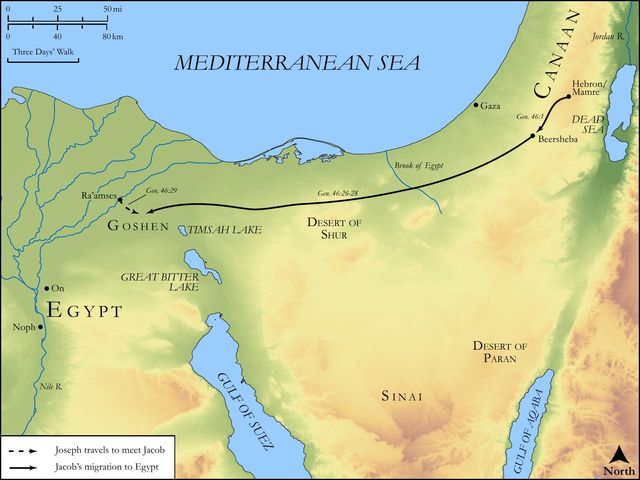
Old Jacob is here flitting. Little did he think of ever leaving Canaan; he expected, no doubt, to die in his nest, and to leave his seed in actual possession of the promised land: but Providence orders it otherwise. Note, Those that think themselves well settled may yet be unsettled in a little time. Even old people, who think of no other removal than that to the grave (which Jacob had much upon his heart, Gen 37:35; Gen 42:38), sometimes live to see great changes in their family. It is good to be ready, not only for the grave, but for whatever may happen betwixt us and the grave. Observe, 1. How Jacob was conveyed; not in a chariot, though chariots were then used, but in a wagon, Gen 46:5. Jacob had the character of a plain man, who did not affect any thing stately or magnificent; his son rode in a chariot (Gen 41:43), but a wagon would serve him. 2. The removal of what he had with him. (1.) His effects (Gen 46:6), cattle and goods; these he took with him that he might not wholly be beholden to Pharaoh for a livelihood, and that it might not afterwards be said of them, "that they came beggars to Egypt." (2.) His family, all his seed, Gen 46:7. It is probable that they had continued to live together in common with their father; and therefore when he went they all went, which perhaps they were the more willing to do, because, though they had heard that the land of Canaan was promised them, yet, to this day, they had none of it in possession. We have here a particular account of the names of Jacob's family, his sons' sons, most of whom are afterwards mentioned as heads of houses in the several tribes. See Num 26:5, etc. Bishop Patrick observes that Issachar called his eldest son Tola, which signifies a worm, probably because when he was born he was a very little weak child, a worm, and no man, not likely to live; and yet there sprang from him a very numerous offspring, Ch1 7:2. Note, Living and dying do not go by probability. The whole number that went down into Egypt was sixty-six (Gen 46:26), to which add Joseph and his two sons, who were there before, and Jacob himself, the head of the family, and you have the number of seventy, Gen 46:27. The Septuagint makes them seventy-five, and Stephen follows them (Act 7:14), the reason of which we leave to the conjecture of the critics; but let us observe, [1.] Masters of families ought to take care of all under their charge, and to provide for those of their own house food convenient both for body and soul. When Jacob himself removed to a land of plenty, he would not leave any of his children behind him to starve in a barren land. [2.] Though the accomplishment of promises is always sure, yet it is often slow. It was now 215 years since God had promised Abraham to make of him a great nation (Gen 12:2); and yet that branch of his seed on which the promise was entailed had increased only to seventy, of which this particular account is kept, that the power of God in multiplying these seventy to so vast a multitude, even in Egypt, may appear the more illustrious. When God pleases, a little one shall become a thousand, Isa 60:22.
Continue studying Genesis 46:23 across the web’s major study libraries — every link below opens this exact verse, chapter, or book on the destination site.
Read & Compare
 BibleGatewayThis verse in more than 200 translations and 70 languages.
 Bible.comThe YouVersion reader — hundreds of translations, reading plans, and highlights.
 ESV.orgCrossway's official English Standard Version reader.
 NET BibleThe NET translation with 60,000+ translators' notes on every rendering decision.
 STEP BibleTyndale House's free study tool — original text, vocabulary, and scholarly resources.
 BibliaLogos Bible Software's free web reader.
 USCCBThe New American Bible (Revised Edition) with the U.S. bishops' study notes.
Commentaries
 BibleHub CommentariesDozens of classic commentaries on this verse, gathered on one page.
 StudyLightMore than 100 commentary sets — the largest collection on the web.
 BibleRefPlain-English commentary on what this verse means, verse by verse.
 Enduring WordDavid Guzik's free commentary on this chapter, widely used by Bible teachers.
 Bible Study ToolsVerse commentary alongside Greek and Hebrew study aids.
Original Language & Research
- BibleHub InterlinearThe verse word by word — original language, transliteration, and English.
- BibleHub LexiconEvery word's original-language definition and Strong's entry.
 Blue Letter BibleDeep-study tools — Strong's numbers, concordance, and word studies.
 SefariaThe Hebrew text with Rashi and centuries of Jewish commentary.
Sermons, Hymns & Audio


TrulyRandomVerse is not affiliated with these sites and doesn’t control their content. They’re linked because they’re genuinely useful.
Summary
Genesis 46:23 concisely records Hushim as the sole "son" of Dan among Jacob's descendants who journeyed into Egypt. This brief entry is part of a detailed census enumerating the seventy souls of Israel's nascent nation, highlighting God's meticulous preservation of His covenant people and the foundational lineage from which the twelve tribes would emerge, ensuring the continuity of His redemptive plan.
Context
ShowHideLiterary Context
This verse is situated within a comprehensive genealogical record found in Genesis 46:8-27, which meticulously details every member of Jacob's household who accompanied him to Egypt. This crucial migration, orchestrated by divine providence through Joseph, was essential for the preservation and future growth of the fledgling nation of Israel. The list serves as a foundational demographic snapshot, marking the transition of Jacob's family from a nomadic clan to a people poised to become a great nation, fulfilling God's promise to Abraham. Each name, including Hushim, contributes to the meticulous account of the tribal origins from which the future nation would spring, underscoring the divine oversight of Israel's earliest formation.
Historical & Cultural Context
In the ancient Near East, genealogies were far more than mere lists of names; they served vital legal, social, and theological functions. They established tribal identity, land rights, inheritance, and validated claims to leadership or priestly roles. For Israel, these genealogies also affirmed their unique identity as God's chosen people, tracing their lineage back to the patriarchs and, ultimately, to God's covenant promises. The migration to Egypt was a pivotal moment, a necessary step to escape famine in Canaan and to allow the family to grow into a numerous people, as foretold in God's covenant with Abraham. The precise enumeration of "seventy souls" (a symbolic number representing completeness) in Genesis 46:27 emphasizes the divine hand in preserving every member of this foundational group.
Key Themes
ShowHideThe overarching theme in Genesis 46 is Divine Providence and Faithfulness. God orchestrates circumstances (like the famine and Joseph's rise to power) to preserve His covenant people, demonstrating His unwavering commitment to His promises. The meticulous listing of names, even seemingly minor ones like Hushim, highlights the theme of God's Meticulous Care for His People, emphasizing that every individual plays a role in His grand redemptive plan. Furthermore, the passage underscores the theme of National Formation from Humble Beginnings, showing how God can build a mighty nation from a relatively small family unit, fulfilling the promise of numerous descendants given to Abraham in Genesis 12:2.
Exposition and Analysis
ShowHideKey Word Analysis
ShowHideThis word (H1121) derives from a root meaning "to build," signifying a son as a builder or perpetuator of the family name. In its widest sense, it can refer to a literal son, grandson, or even a descendant, subject, or member of a nation or group. Its usage here, particularly in conjunction with the unique nature of "Hushim," invites deeper consideration of whether it refers to a direct biological son or a broader familial unit.
This name (H1835) means "judge," derived from the verb "to judge." Dan was one of the twelve sons of Jacob, born to Bilhah, Rachel's servant. He is the progenitor of the tribe of Dan, which would later play a significant role in Israel's history, though sometimes marked by apostasy and migration, as seen in Judges 18.
This name (H2366) is plural in form, meaning "hasters" or "those who hasten." Its plural nature for a seemingly singular individual is highly significant. While presented as a "son" of Dan, its grammatical structure strongly suggests it represents a clan, a family group, or the collective descendants of Dan's immediate household who entered Egypt, rather than a single direct biological son. This interpretation is supported by later genealogies, such as in Numbers 26:42, where Dan's son is listed as "Shuham," suggesting Hushim may refer to Shuham's descendants or a broader family unit associated with Dan.
Verse Breakdown
ShowHide"And the sons of Dan;"
This introductory phrase sets the stage for listing Dan's immediate progeny. The use of "sons" (plural) initially suggests multiple offspring, aligning with the pattern for most other patriarchs in this chapter. However, the subsequent singular name "Hushim" immediately creates a textual tension that prompts deeper inquiry into the nature of Dan's household.
"Hushim."
This single word completes the verse and is the focal point of its interpretive challenge. As noted, "Hushim" is a plural Hebrew noun. This linguistic detail is crucial, leading scholars to conclude that it likely refers to a collective entity—a clan or family group—that represented Dan's initial household as they entered Egypt, rather than a single individual. This explanation reconciles the plural "sons" with the singular "Hushim," indicating that Dan's contribution to the nascent nation was through this specific, perhaps small, family unit.
Literary Devices
ShowHideThe brevity of Genesis 46:23 is itself a significant literary device, highlighting the unique situation of Dan's lineage compared to other patriarchs who are listed with multiple direct sons. This conciseness draws attention to the name "Hushim." The use of a plural noun for a singular entity (Hushim) is a notable linguistic feature, functioning perhaps as a form of synecdoche or metonymy, where a part (the clan or family unit) represents the whole (Dan's immediate descendants). This choice emphasizes the foundational units of the emerging tribes, even when a direct "son" might not be explicitly named in this specific census. The entire passage also exemplifies the genealogical style prevalent in ancient Near Eastern literature, which serves to establish legitimacy, continuity, and divine oversight of the lineage.
Theological and Thematic Connections
ShowHideThe meticulous listing of each family member, even those briefly mentioned like Hushim, underscores God's meticulous oversight in preserving and growing the family of Jacob into a great nation, demonstrating His unwavering faithfulness to His covenant promises despite seemingly small or humble beginnings. This passage affirms that every individual, no matter how briefly mentioned in the biblical narrative, is significant in God's overarching plan and contributes to the larger story of salvation history. Genealogies were fundamental in ancient Israel for establishing tribal identity, inheritance rights, and a sense of continuity with the covenant promises. This verse solidifies the lineage of the tribe of Dan within the larger tapestry of Israel's twelve tribes, showing God's hand in building a mighty nation from humble, individual family units.
Reflection and Application
ShowHideEven a concise genealogical entry like Genesis 46:23 offers profound lessons for contemporary believers. It reminds us that God's meticulous attention extends to every individual, affirming our personal significance within His grand redemptive narrative. Just as God built a powerful tribe from Dan's seemingly small beginning, we are encouraged not to despise humble origins in our own lives or ministries, trusting that God can accomplish great things through seemingly insignificant starts. This verse also speaks to the importance of every "small" part in God's larger plan; no contribution is too minor for His purposes. Furthermore, understanding our spiritual heritage within God's family story provides a vital sense of belonging, purpose, and continuity with His eternal plan, reminding us that we are part of a lineage that God has faithfully guided through history.
Questions for Reflection
ShowHideFAQ
ShowHideWhy is only one "son" listed for Dan, and what does "Hushim" mean?
ShowHideThe listing of only one "son," Hushim, for Dan in Genesis 46:23 is unique among Jacob's sons in this census, as most others have multiple direct offspring named. The name "Hushim" (חֻשִׁים) is a plural form in Hebrew, meaning "hasters." This linguistic detail strongly suggests that "Hushim" refers not to a single direct individual but rather to a clan or family group representing Dan's immediate household as they entered Egypt. This interpretation helps reconcile the plural "sons" with the singular "Hushim," indicating that this family unit constituted Dan's contribution to the nascent nation. Later genealogies, such as Numbers 26:42, list Dan's son as "Shuham," further suggesting that "Hushim" in Genesis 46:23 likely refers to the collective descendants or the primary family unit associated with Shuham, highlighting the biblical record's focus on the foundational units of the tribes.
Christ-Centered Fulfillment
ShowHideThe meticulous recording of each individual, including Hushim, in the lineage of Israel, underscores God's unwavering faithfulness to His covenant promises, which ultimately find their fulfillment in Christ. The preservation of this specific family line, from Abraham through Jacob's sons, was essential for the eventual advent of the Messiah. Every name in this genealogy, no matter how brief, contributes to the unfolding tapestry of salvation history, demonstrating God's sovereign hand guiding His people towards the coming of the Seed who would bless all nations, as promised in Genesis 22:18. Christ, as the ultimate Son of David and the fulfillment of the Abrahamic covenant, embodies the culmination of God's precise and providentially guided plan for humanity, ensuring that the promise made to Abraham, and meticulously preserved through generations like Dan's, would be realized in His person and work. His coming, prophesied in the Old Testament and fulfilled in the New, as seen in passages like Galatians 3:16, validates the divine purpose behind every seemingly minor detail of Israel's history, pointing to the one through whom all of God's promises are "Yes" and "Amen" in 2 Corinthians 1:20.