


Hosea 14:8
- אֶפְרַיִם'ef·Ra·yimO EphraimH669N-proper-mNoun Proper Masculine
- מַהmahwhat?H4100InterrogPronoun Interrogative
- לִּיlito mePrep-l ¦ 1csSuffix Personal 1st Singular common genderלִּtoיme
- עוֹדodagainH5750Adj-msAdjective Numerical Singular Masculine Absolute
- לָעֲצַבִּיםla·'a·tza·Bimto <the> idolsH6091Prep-l ¦ N-mpNoun Plural Masculine Absoluteלָto <the>עֲצַבִּיםidols
- אֲנִי'a·NiIH589Pro-1csPronoun Personal 1st Singular common gender
- עָנִיתִי'a·Ni·tiI will answerH6030V-Qal-Perf-1csVerb Qal Perfect 1st Singular common gender
- וַאֲשׁוּרֶנּוּva·'a·shu·Re·nuand I will watch over itH7789Conj-w ¦ V-Qal-ConjImperf-1cs ¦ 3msVerb Qal Conjunction+Imperfect 1st Singular common genderוַandאֲשׁוּרֶI will watch overנּוּit
- אֲנִי'a·NiIH589Pro-1csPronoun Personal 1st Singular common gender
- כִּבְרוֹשׁkiv·Ro·osh[am] like a cypress treeH1265Prep-k ¦ N-msNoun Singular Masculine Absoluteכִּ[am] likeבְרוֹשׁa cypress tree
- רַעֲנָןra·'a·NanluxuriantH7488Adj-msAdjective Singular Masculine Absolute
- מִמֶּנִּיmi·Me·nifrom meH4480Prep ¦ 1csPrepositionמִמֶּfromנִּיme
- פֶּרְיְךָper·ye·Khayour fruitH6529N-msc ¦ 2msNoun Singular Masculine Constructפֶּרְיְfruitךָyour
- נִמְצָאnim·Tza'it is foundH4672V-Niphal-Perf-3msVerb Niphal Perfect 3rd Singular Masculine
English is a literal word-by-word gloss of the Hebrew, not the KJV's wording. Why?
This is the original text the KJV's translators worked from — each Hebrew word with its own literal English meaning in this verse, prepared by scholars at Tyndale House, Cambridge. The KJV translates whole sentences, not word by word, so its wording differs: one Hebrew word can become several English words, and the KJV may choose “the LORD” where the gloss reads “Yahweh”. Both are faithful — they answer different questions. For the KJV's own rendering, switch to the KJV text.
Details
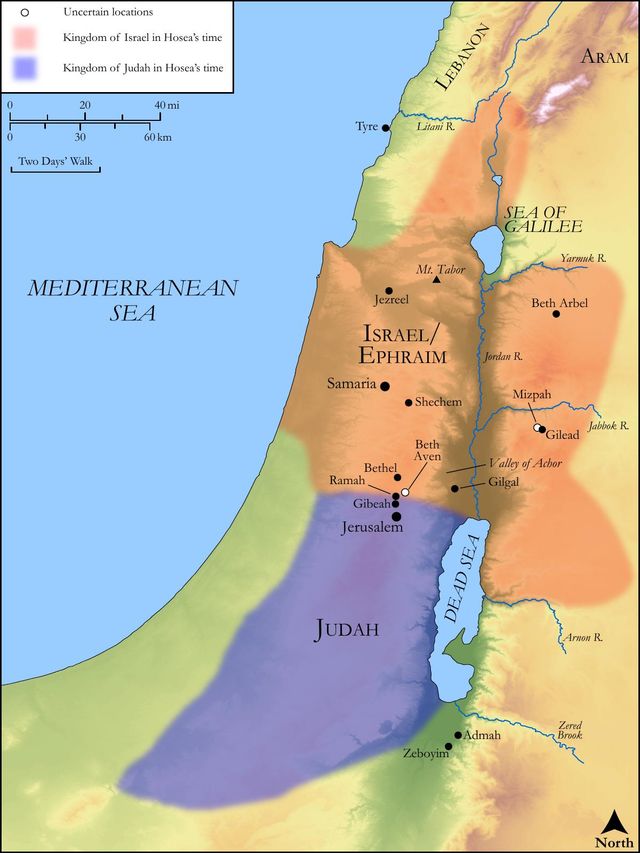
See on the biblical-era map
Study this verse
Public-domain commentary
Matthew Henry
From his Commentary on the Whole Bible. Henry comments on passages, not single verses — this entry covers Hosea 14:8–9. His three-level outline is real structure in the source text, so it is rendered as structure.
Let us now hear the conclusion of the whole matter.
I.Concerning Ephraim; he is spoken of and spoken to, Hos 14:8. Here we have,
1.His repentance and reformation: Ephraim shall say, What have I to do any more with idols? As some read it, God here reasons and argues with him, why he should renounce idolatry: "O Ephraim! what to me and idols? What concord or agreement can there be between me and idols? What communion between light and darkness, between Christ and Belial? Co2 6:14, Co2 6:15. Therefore thou must break off thy league with them if thou wilt come into covenant with me." As we read it, God promises to bring Ephraim and keep him to this: Ephraim shall say, God will put it into his heart to say it, What have I to do any more with idols? He has promised (Hos 14:3) not to say any more to the works of his hands, You are my gods. But God's promises to us are much more our security and our strength for the mortifying of sin than our promises to God; and therefore God himself is here surety for his servant to good, will put in into his heart and into his mouth. And, whatever good we say or do at any time, it is he that works it in us. Ephraim had solemnly engaged not to call his idols his gods; but God here engages further for him that he shall resolve to have no more to do with them. He shall abolish them, he shall abandon them, and that with the utmost detestation; for it is necessary not only that in our lives we be turned from sin, but that in our hearts we be turned against sin. See here,
(1.)The power of divine grace. Ephraim had been joined to his idols (Hos 4:17), was so fond of them that one would have thought he could never fall out with them; and yet God will work such a change in him that he shall loathe them as much as ever he loved them.
(2.)See the benefit of sanctified afflictions. Ephraim had smarted for his idolatry; it had brought one judgment after another upon him, and this at length is the fruit, even the taking away of his sin, Isa 27:9.
(3.)See the nature of repentance; it is a firm and fixed resolution to have no more to do with sin. This is the language of the penitent: "I am ashamed that ever I had to do with sin; but I have had enough of it; I hate it, and by the grace of God I will never have any thing to do with it again, no, not with the occasions of it." Thou shalt say to thy idol, Get thee hence (Isa 30:22), shalt say to the tempter, Get thee behind me, Satan.
2.The gracious notice God is pleased to take of it: I have heard him, and observed him. I have heard, and will look upon him; so some read it. Note, The God of heaven takes cognizance of the penitent reflections and resolutions of returning sinners. He expects and desires the repentance of sinners, because he has no pleasure in their ruin. He looks upon men (Job 33:27), hearkens and hears, Jer 8:6. And, if there be any disposition to repent, he is well pleased with it. When Ephraim bemoans himself before God, he is a dear son, he is a pleasant child, Jer 31:20. He meets penitents with mercy, as the father of the prodigal met his returning son. God observed Ephraim, to see whether he would bring forth fruits meet for this profession of repentance that he made, and whether he would continue in this good mind. He observed him to do him good, and comfort him, according to the exigencies of his case.
3.The mercy of God designed for him, in order to his comfort and perseverance in his resolutions; still God will be all in all to him. Before, Israel was compared to a tree, now God compares himself to one. He will be to his people,
(1.)As the branches of a tree: "I am like a green fir-tree, and will be so to thee." The fir-trees, in those countries, were exceedingly large and thick, and a shelter against sun and rain. God will be to all true converts both a delight and a defence; under his protection and influence they shall both dwell in safety and dwell in ease. He with be either a sun and a shield or a shade and a shield, according as their case requires. They shall sit down under his shadow with delight, Sol 2:3. He will be so all weathers, Isa 4:6.
(2.)As the root of a tree: From me is thy fruit found, which may be understood either of the fruit brought forth to us (to him we owe all our comforts) or of the fruit brought forth by us - from him we receive grace and strength to enable us to do our duty. Whatever fruits of righteousness we brought forth, all the praise of them is due to God; for he works in us both to will and to do that which is good.
II.Concerning every one that hears and reads the words of the prophecy of this book (Hos 14:9):
Who is wise? and he shall understand these things. Perhaps the prophet was wont to conclude that sermons he preached with these words, and now he closes with them the whole book, in which he has committed to writing some fragments of the many sermons he had preached. Observe,
1.The character of those that do profit by the truths he delivered: Who is wise and prudent? He shall understand these things, he shall know them. Those that set themselves to understand and know these things thereby make it to appear that they are truly wise and prudent, and will thereby be made more so; and, if any do not understand and know them, it is because they are foolish and unwise. Those that are wise in the doing of their duty, that are prudent in practical religion, are most likely to know and understand both the truths and providences of God, which are a mystery to others, Joh 7:17. The secret of the Lord is with those that fear him, Psa 25:14. Who is wise? This intimates a desire that those who read and hear these things would understand them (O that they were wise!) and a complaint that few were so - Who has believed our report?
2.The excellency of these things concerning which we are here instructed: The ways of the Lord are right; and therefore it is our wisdom and duty to know and understand them. The way of God's precepts, in which he requires us to walk, is right, agreeing with the rules of eternal reason and equity and having a direct tendency to our eternal felicity. The ways of God's providence, in which he walks toward us, are all right; no fault is to be found with any thing that God does, for it is all well done. His judgments upon the impenitent, his favours to the penitent, are all right; however they may be perverted and misinterpreted, God will at last be justified and glorified in them all. His ways are equal.
3.The different use which men make of them.
(1.)The right ways of God to those that are good are, and will be, a savour of life unto life: The just shall walk in them; they shall conform to the will of God both in his precepts and in his providences, and shall have the comfort of so doing. They shall well understand the mind of God both in his word and in his works; they shall be well reconciled to both, and shall accommodate themselves to God's intention in both. The just shall walk in those ways towards their great end, and shall not come short of it.
(2.)The right ways of God will be to those that are wicked a savour of death unto death: The transgressors shall fall not only in their own wrong ways, but even in the right ways of the Lord. Christ, who is a foundation stone to some, is to others a stone of stumbling and a rock of offence. That which was ordained to life becomes through their abuse of it, death to them. God's providences, being not duly improved by them, harden them in sin and contribute to their ruin. God's discovery of himself both in the judgments of his mouth and in the judgments of his hand is to us according as we are affected under it. Recipitur ad modum recipientis - What is received influences according to the qualities of the receiver. The same sun softens wax and hardens clay. But of all transgressors those certainly have the most dangerous fatal falls that fall in the ways of God, that split on the rock of ages, and suck poison out of the balm of Gilead. Let the sinners in Zion be afraid of this.
Historical interpretation
Historical reception
2 surviving comments on this verse. Each one is dated, so this reads as a timeline rather than a list.
Select a marker to jump to its quote. Markers stagger vertically where authors wrote within a few decades of each other.
"I will heal their apostasy; I will love them freely, for my anger has turned from them. I will be like the dew to Israel; he shall blossom like the lily; he shall take root like the trees of Lebanon; his shoots shall spread out; his beauty shall be like the olive, and his fragrance like Lebanon. They shall return and dwell beneath my shadow; they shall flourish like the grain; they shall blossom like the vine; their fame shall be like the wine of Lebanon. O Ephraim, what have I to do with idols? It is I who answer and look after you. I am like an evergreen cypress; from me comes your fruit." LXX: "I will heal their inhabitants; I will love them openly, for my anger has turned away from them. I will be like dew for Israel; he shall blossom like the lily, and cast forth his roots as Lebanon. His branches shall spread, and his beauty shall be like the olive tree, and his fragrance like Lebanon. They shall return, and sit under his shade; they shall drink and be filled with the grain, and they shall flourish like the vine; the memory of Ephraim shall be as wine. What will he have more to do with idols? I have humbled him, and I will strengthen him; I am as a cypress tree, your fruit has come forth from me." Turning to repentance, and like an orphan recognizing the father whom they had abandoned, God responded: "I will heal their contrition," or "their dwelling places" in which they had been wounded, or broken, or in which they had lived so poorly: "I will love them freely;" which the LXX translated as "confessing" or "clearly" and "openly," or "without any doubt." But the Lord loves those who love him, of whom he also says in another place: "I love those who love me" (Prov. 8:17). For I used to be angry with them because of the sins they had committed, but now I will have mercy on them because of my clemency. And I will be to them as dew, so as to extinguish the Babylonian furnace and the furnace of burning heat with my moisture, which I spoke through the patriarch Isaac to my servant Jacob: 'Your dwelling place will be from the dew of heaven.' For just as the Lord becomes for believers light, way, truth, bread, vine, fire, shepherd, lamb, gate, worm, etc. Thus, to those in need of His mercy, and inflamed with the fever of sin, He is turned to us as dew, whom Isaiah says: "For when thy judgments are in the earth, the inhabitants of the world learn righteousness." (Isai. XXVI, 9) And in the Song of Deuteronomy, Moses speaks: "My doctrine shall drop as the rain, my speech shall distil as the dew, as the small rain upon the tender herb, and as the showers upon the grass" (Deut. XXXII, 2). But when the Lord has sprinkled us with His dew, and moistened the dryness of our hearts with His rain, we will flourish, and indeed flower into usefulness, imitating the Lord and Savior, who says in the Song of Songs: "I am the flower of the field and the lily of the valley" (Cant. II, 1), and speaks to His bride, who has no wrinkle or blemish: "As a lily among thorns, so is my love among the daughters." And when we grow in the Lord, we will send down our roots like the trees of Lebanon, which rise as high as the heavens, so sink as low in the earth, that they may not be shaken by any storm, but remain steadfast. The branches of these trees are stretched out here and there, so that the birds of the sky may come and dwell in them. And lest we might think because it was said, his root shall break forth, or his roots shall be like Lebanon, that he speaks of cedar and unfruitful trees, he likens the holy man, converted to the Lord, to fruitful olive trees, who says in another place: "But I am like a fruitful olive tree in the house of God" (Psalm LI, 1). Five wise virgins have prepared their fruit, from which the swelling of wounds is mitigated, the limbs of the languishing rest, light is kindled in the darkness, those who fight in agony are anointed. This olive will have a fragrance like that of Lebanon or frankincense, which is a kind of incense. It is called the same thing among Greeks and Hebrews, both the mountain and the incense, or certainly the mountain of Lebanon. It is very fertile and green, protected by the thickest hair of trees, so that the olive may say: "We are the good odor of Christ" (2 Corinthians 2:16). But whoever turns to the Lord will receive the reward of his conversion, to sit in His shadow and say: "I rested and sat down under His shadow, and His fruit is sweet to my mouth" (Song of Solomon 2:3). And when they sit in its shade, they who were once dead will live again, and they will drink and be drunken with wheat, that is, with the abundance of all things. And that this drunkenness here does not mean a disturbance of the mind, but the abundance of all things, that verse declares, saying, 'You have visited the earth and made it drunk' (Ps. 64:10). And Joseph's banquet, in which it is said that he made his brothers drunk (Gen. 43). And the Lord speaking to the apostles: "Eat, my friends, and drink, and be drunk, brethren" (Cant. V,1). Whether because our Lord himself is the grain and vine, whoever believes in him is said to be intoxicated. Finally it follows: "And his memorial shall flourish as the vine, as wine of Libanus." But we can call wine Libanus mixed and seasoned with thyme, so that it has the sweetest smell, or wine Libanus which is offered to the Lord in the temple, about which we read under the name of Libanus in Zacharias: "Open," "your gates, O Libanus" (Zach. XI,1). When the abundance of things is about to come to an end, O Ephraim, you who repent and have begun to be mine, cast away your idols and despise your images; for I am the one who humbled you, and I will exalt you, and whether I hear and direct you, I will make you like a green fir tree, so that it shall be said of you according to the Hebrews in the Psalm: "The fir tree is the house of the Lord." (Psalm 104:18). Or certainly I will be as a fir tree that is dense, so that one may rest in my shade. About the juniper, which is "ἀρκεύθοις" in Greek according to the Septuagint, it is recorded that Solomon made the doors of the temple, because Christ, through whom we approach the Father, has this nature, that it always flourishes, always brings forth new fruit, and never loses its vigor. This juniper, while those resting under its shade may not be struck by the fever of this world and, like those who once hit Jonah (Ch. IV), it provides food and not only rest to those who sleep and sit; but also satiety to those who eat. Whatever we have interpreted according to allegory, in the coming of the Lord and Savior and the conversion of true Israel, can refer to heretics and Jews as well as to misguided nations and all perverse teachings: so that they attain pardon when they repent. If, therefore, the fullness of the promise has been fulfilled in the coming of the Savior and is daily fulfilled in the Church, it is to be believed that it will be more fully completed when perfection arrives, which is now in part, will be destroyed. Note that we have often said, the safety of Israel and the return to the Lord, and the redemption from captivity, is not to be accepted carnally, as the Jews think, but spiritually, as is most truly proved.
Holy people have never testified that they attained by their effort the right path to travel on as they made their way to the increase and perfection of virtue. Rather they would plead to the Lord and say, “Direct me in your truth,” and, “Direct my way in your sight.” Another one declares that it is not by faith alone but also by experience and, as it were, in the very nature of things that he has seized upon this, [saying], “I have known, O Lord, that a person’s way is not in him, nor is it in a man to walk and to direct his own steps.” And the Lord himself says to Israel, “I will direct him like a green fir tree; from me your fruit has been found.”
Continue studying Hosea 14:8 across the web’s major study libraries — every link below opens this exact verse, chapter, or book on the destination site.
Read & Compare
 BibleGatewayThis verse in more than 200 translations and 70 languages.
 Bible.comThe YouVersion reader — hundreds of translations, reading plans, and highlights.
 ESV.orgCrossway's official English Standard Version reader.
 NET BibleThe NET translation with 60,000+ translators' notes on every rendering decision.
 STEP BibleTyndale House's free study tool — original text, vocabulary, and scholarly resources.
 BibliaLogos Bible Software's free web reader.
 USCCBThe New American Bible (Revised Edition) with the U.S. bishops' study notes.
Commentaries
 BibleHub CommentariesDozens of classic commentaries on this verse, gathered on one page.
 StudyLightMore than 100 commentary sets — the largest collection on the web.
 BibleRefPlain-English commentary on what this verse means, verse by verse.
 Enduring WordDavid Guzik's free commentary on this chapter, widely used by Bible teachers.
 Bible Study ToolsVerse commentary alongside Greek and Hebrew study aids.
Original Language & Research
- BibleHub InterlinearThe verse word by word — original language, transliteration, and English.
- BibleHub LexiconEvery word's original-language definition and Strong's entry.
 Blue Letter BibleDeep-study tools — Strong's numbers, concordance, and word studies.
 SefariaThe Hebrew text with Rashi and centuries of Jewish commentary.
Sermons, Hymns & Audio


TrulyRandomVerse is not affiliated with these sites and doesn’t control their content. They’re linked because they’re genuinely useful.
Summary
Hosea 14:8 marks a pivotal moment in the prophet's message, depicting Ephraim's decisive renunciation of idolatry and God's immediate, gracious response. This verse beautifully illustrates the transformative power of genuine repentance, portraying God as the sole, unfailing source of life, stability, and spiritual fruitfulness for His restored people, in stark contrast to the barrenness of false gods.
Context
ShowHideLiterary Context
Hosea 14 serves as the climactic conclusion to the book of Hosea, transitioning from the severe pronouncements of judgment against Israel's unfaithfulness (chapters 4-13) to a profound promise of restoration and healing. The preceding verses (Hosea 14:1-3) issue a passionate call for Israel to return to the Lord, confessing their sins and seeking His mercy. Verses 4-7 then detail God's promised response, emphasizing His healing, love, and the flourishing that will result from their repentance, using rich agricultural imagery. Verse 8 specifically highlights Ephraim's (representing the northern kingdom of Israel) personal commitment to forsake idols, immediately followed by God's affirmation of His own identity as their exclusive provider, solidifying the covenant renewal.
Historical & Cultural Context
The book of Hosea is set primarily in the Northern Kingdom of Israel during the 8th century BCE, a period marked by political instability, oppression, and rampant idolatry, particularly the worship of Baal and Asherah. These Canaanite deities were associated with fertility and agricultural prosperity, leading Israel to believe that their "fruit" (harvests, children) came from these false gods rather than the Lord. The phrase "What have I to do any more with idols?" directly confronts this deeply entrenched cultural practice, signifying a radical break from the syncretism that plagued Israel. The imagery of a "fir tree" and "fruit" would have resonated strongly with an agrarian society, emphasizing God's ability to provide true and lasting sustenance, unlike the empty promises of idols.
Key Themes
ShowHideThis verse powerfully encapsulates several overarching themes of Hosea. Foremost is the theme of Repentance and Restoration, demonstrating that genuine turning from sin leads to divine healing and renewal, as seen in God's promise to "heal their apostasy" in Hosea 14:4. It also underscores God's Exclusive Sovereignty and Provision, contrasting His life-giving nature with the impotence of idols, a recurring motif throughout the prophetic literature (e.g., Isaiah 44:9-20). The imagery of the "green fir tree" and "fruit" emphasizes Spiritual Fruitfulness derived solely from a relationship with God, echoing the covenant blessings promised for obedience in Deuteronomy 28:1-14.
Exposition and Analysis
ShowHideKey Word Analysis
ShowHideFrom a root meaning "double fruit," Ephraim was the dominant tribe of the northern kingdom of Israel, often used synonymously with Israel itself. Here, it represents the entire repentant nation, signifying a return to their foundational identity and a promise of renewed fruitfulness.
Refers to an (idolatrous) image; a sorrow, pain, or burden. This word choice is significant, as it not only denotes the false gods themselves but also implies the pain, grief, and futility that idolatry brings. Ephraim's renunciation is thus a rejection of a source of spiritual burden.
A cypress or fir tree, known for its evergreen nature, height, and durability. It symbolizes stability, life, and enduring strength. God's declaration "I am like a green fir tree" portrays Him as the constant, vibrant source of life, unlike the temporary and lifeless idols.
Properly, to come forth to, appear or exist; transitively, to attain, find, or acquire. In this context, it signifies that Ephraim's fruitfulness will originate directly and exclusively from God, emphasizing His active role as the provider and source of all their blessings.
Verse Breakdown
ShowHide"Ephraim [shall say], What have I to do any more with idols?"
This opening clause expresses Ephraim's profound and decisive repentance. It's a rhetorical question signifying a complete break with their past idolatrous practices, a declaration of exclusive allegiance to the Lord. The KJV's bracketed "shall say" implies a future, certain outcome of their repentance.
"I have heard [him], and observed him:"
This is God's direct response to Ephraim's declaration. "Heard" (from ʻânâh') implies God's attentive listening and responsive action to their sincere turning. "Observed" (from shûwr') suggests God's careful, protective watchfulness over His repentant people, indicating His deep engagement and care for their well-being. The bracketed "him" clarifies that God is hearing and observing Ephraim.
"I [am] like a green fir tree."
Here, God uses a powerful self-description. The "green fir tree" (raʻănân_ _bᵉrôwsh') symbolizes His evergreen nature, His unchanging vitality, and His perpetual ability to provide life and shade. Unlike the dead idols, God is a living, flourishing source.
"From me is thy fruit found."
This climactic statement directly links Ephraim's future prosperity and fruitfulness to God alone. It refutes the lie that idols provide abundance and firmly establishes God as the exclusive source of all blessings, spiritual and material, for His restored people.
Literary Devices
ShowHideHosea 14:8 is rich in Metaphor and Symbolism. The most prominent is God's self-identification as a "green fir tree," which symbolizes His eternal life, steadfastness, and constant provision. This contrasts sharply with the lifelessness and barrenness of "idols," which are implicitly portrayed as incapable of producing any true "fruit." The Rhetorical Question "What have I to do any more with idols?" powerfully conveys Ephraim's complete renunciation of their former ways, acting as a turning point in their spiritual journey. The entire verse functions as a Chiasm or Inclusio in the broader context of Hosea 14, beginning with Ephraim's repentance and ending with God's promise of fruitfulness, mirroring the call to return and the promise of restoration.
Theological and Thematic Connections
ShowHideHosea 14:8 encapsulates the profound theological truth that true spiritual vitality and fruitfulness are exclusively found in a covenant relationship with the living God. It underscores His unwavering commitment to respond to genuine repentance with abundant grace and to be the sole source of life and sustenance for His people. This verse challenges any notion of divided loyalties, asserting God's absolute sovereignty and His desire for an exclusive relationship, promising that when we turn from all "idols" – anything that usurps His rightful place – He becomes our ever-present, ever-providing source of life.
Reflection and Application
ShowHideHosea 14:8 offers a timeless and deeply personal message for believers today. It calls us to a radical self-examination, prompting us to identify and renounce anything in our lives that competes for God's ultimate affection and allegiance. Whether it's the pursuit of wealth, status, comfort, or even self-reliance, anything that promises life or fulfillment apart from God can become an "idol." This verse assures us that when we genuinely turn from these false sources, God not only hears our confession but actively engages with us, becoming our unfailing "green fir tree" – our constant, vibrant source of life, stability, and purpose. Our true "fruit" – character, good works, spiritual growth – can only be found in a deep, abiding relationship with Him. It's a powerful reminder that surrendering our idols is not a loss, but an exchange for the limitless abundance of God's presence and provision.
Questions for Reflection
ShowHideFAQ
ShowHideWhat does "What have I to do any more with idols?" mean for us today?
ShowHideThis phrase represents a decisive and complete break from anything that takes God's rightful place in our lives. For ancient Israel, it was literal idol worship. For us today, "idols" can be anything we trust in, derive our identity from, or seek ultimate satisfaction from, apart from God. This could include money, career, relationships, social media, self-image, or even personal achievements. The question signifies a profound repentance and a commitment to exclusive devotion to God, recognizing that these false gods offer no true life or lasting fulfillment. It's a call to re-center our lives entirely on Him.
How does God being "like a green fir tree" relate to His promise of fruitfulness?
ShowHideThe "green fir tree" (or cypress) is an evergreen, known for its deep roots, stability, and ability to thrive even in challenging conditions. By declaring "I am like a green fir tree," God portrays Himself as the ever-living, unchanging, and perpetually vibrant source of life. Unlike temporary, lifeless idols, God is constant and full of vitality. The subsequent phrase, "From me is thy fruit found," directly links His nature as the "green fir tree" to His ability to produce genuine, lasting fruitfulness in His people. Just as a healthy tree yields fruit, God, as the ultimate source of life, ensures the spiritual and physical flourishing of those who depend solely on Him.
Christ-Centered Fulfillment
ShowHideHosea 14:8, with its portrayal of Ephraim's repentance and God's promise of fruitfulness, finds its ultimate and most profound fulfillment in Jesus Christ. The renunciation of "idols" foreshadows the call to turn from sin and self-reliance, which is the essence of the Gospel. Just as God declares, "I am like a green fir tree. From me is thy fruit found," Jesus proclaims Himself as the true vine in John 15:1-5, emphasizing that believers can bear "much fruit" only by abiding in Him. He is the ultimate source of spiritual life, sustenance, and flourishing, far surpassing the temporary provisions of the Old Covenant. Through His atoning sacrifice, Christ provided the means for humanity to truly turn from their idolatry (which is rebellion against God) and be reconciled to the Father, receiving the Holy Spirit who enables them to bear the "fruit of the Spirit" (Galatians 5:22-23). Thus, the restoration and fruitfulness promised to Ephraim are fully realized in the new covenant community, the Church, whose life and purpose are found solely in their union with Christ, the ever-green and ever-giving source of all spiritual abundance.