


Hosea 14:7
Bible text: King James Version (1769 Blayney text) · Public domain
Bible text: Berean Standard Bible · Public domain
Bible text: American Standard Version (1901) · Public domain
Bible text: World English Bible, Messianic edition · Public domain
Bible text: Geneva Bible (1599) · Public domain
Bible text: Young's Literal Translation · Public domain
- יָשֻׁבוּya·Shu·vuthey will returnH7725V-Qal-Imperf-3mpVerb Qal Imperfect 3rd Plural Masculine
- יֹשְׁבֵיyo·she·Vei[those who] dwellH3427V-Qal-Prtcpl-mpVerb Qal Participle Plural Masculine Construct
- בְצִלּוֹve·tzi·Loin its shadeH6738Prep-b ¦ N-msc ¦ 3msNoun Singular Masculine Constructבְinצִלּshadeוֹits
- יְחַיּוּye·chai·Yuthey will cause to growH2421V-Piel-Imperf-3mpVerb Piel Imperfect 3rd Plural Masculine
- דָגָןda·GangrainH1715N-msNoun Singular Masculine Absolute
- וְיִפְרְחוּve·yif·re·Chuso they may blossomH6524Conj-w ¦ V-Qal-ConjImperf-3mpVerb Qal Conjunction+Imperfect 3rd Plural Masculineוְsoיִפְרְחוּthey may blossom
- כַגָּפֶןkha·Ga·fenlike <the> vineH1612Prep-k ¦ N-csNoun Singular common gender Absoluteכַlike <the>גָּפֶןvine
- זִכְרוֹzikh·Roits memorialH2143N-msc ¦ 3msNoun Singular Masculine Constructזִכְרmemorialוֹits
- כְּיֵיןke·Yein[will be] like [the] wine ofH3196Prep-k ¦ N-mscNoun Singular Masculine Constructכְּ[will be] likeיֵין[the] wine of
- לְבָנוֹןle·va·NonLebanonH3844N-properNoun Proper Location
English is a literal word-by-word gloss of the Hebrew, not the KJV's wording. Why?
This is the original text the KJV's translators worked from — each Hebrew word with its own literal English meaning in this verse, prepared by scholars at Tyndale House, Cambridge. The KJV translates whole sentences, not word by word, so its wording differs: one Hebrew word can become several English words, and the KJV may choose “the LORD” where the gloss reads “Yahweh”. Both are faithful — they answer different questions. For the KJV's own rendering, switch to the KJV text.
Details
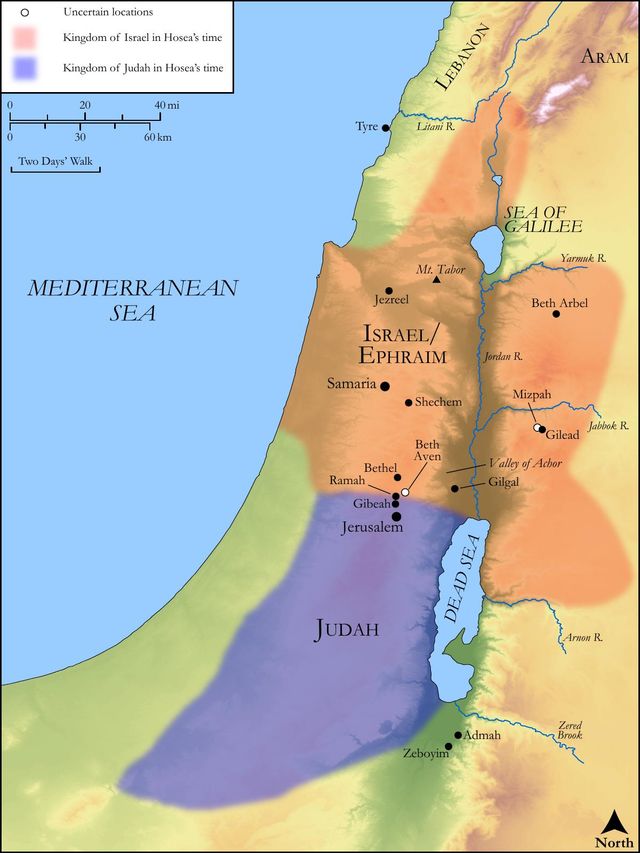
See on the biblical-era map
Study this verse
Public-domain commentary
Matthew Henry
From his Commentary on the Whole Bible. Henry comments on passages, not single verses — this entry covers Hosea 14:4–7. His four-level outline is real structure in the source text, so it is rendered as structure.
We have here an answer of peace to the prayers of returning Israel. They seek God's face, and they shall not seek in vain. God will be sure to meet those in a way of mercy who return to him in a way of duty. If we speak to God in good prayers, God will speak to us in good promises, as he answered the angel with good words and comfortable words, Zac 1:13. If we take with us the foregoing words in our coming to God, we may take home with us these following words for our faith to feast upon; and see how these answer those.
I.Do they dread and deprecate God's displeasure, and therefore return to him? He assures them that, upon their submission, his anger is turned away from them. This is laid as the ground of all the other favours here promised. I will do so and so, for my anger is turned away, and thereby a door is opened for all good to flow to them, Isa 12:1. Note, Though God is justly and greatly angry with sinners, yet he is not implacable in his anger; it may be turned away; it shall be turned away, from those that turn away from their iniquity. God will be reconciled to those that are reconciled to him and to his whole will.
II.Do they pray for the taking away of iniquity? He assures them that he will heal their backslidings; so he promised, Jer 3:22.
Note, Though backslidings from God are the dangerous diseases and wounds of the soul, yet they are not incurable, for God has graciously promised that if backsliding sinners will apply to him as their physician, and comply with his methods, he will heal their backslidings. He will heal the guilt of their backslidings by pardoning mercy and their bent to backslide by renewing grace. Their iniquity shall not be their ruin.
III.Do they pray that God will receive them graciously? In answer to that, behold, it is promised, I will love them freely.
God had hated them while they went on sin (Hos 9:15); but now that they return and repent he loves them, not only ceases to be angry with them, but takes complacency in them and designs their good. He loves them freely, with an absolute entire love (so some), so that there are no remains of his former displeasure, with a liberal bountiful love (so others); he will be open-handed in his love to them, and will think nothing too much to bestow upon them or to do for them. Or with a cheerful willing love; he will love them without reluctancy or renitency. He will not say in the day of thy repentance, How shall I receive thee again? as he said in the day of thy apostasy, How shall I give thee up? Or with an unmerited preventing love. Whom God loves he loves freely, not because they deserve it, but of his own good pleasure. He loves because he will love, Deut, Hos 7:7, Hos 7:8.
IV.Do they pray that God will give good, will make them good? In answer to that, behold, it is promised, I will be as the dew unto Israel, Hos 14:5. Observe,
1.What shall be the favour God will bestow upon them. It is the blessing of their father Jacob, God give thee the dew of heaven, Gen 27:28. Nay, what they need God will not only give them, but he will himself be that to them, all that which they need: I will be as the dew unto Israel. This ensures spiritual blessings in heavenly things; and it follows upon the healing of their backslidings, for pardoning mercy is always accompanied with renewing grace. Note, To Israelites indeed God himself will be as the dew. He will instruct them; his doctrine shall drop upon them as the dew, Deu 32:2. They shall know more and more of him, for he will come to them as the rain, Hos 6:3. He will refresh them with his comforts, so that their souls shall be as a watered garden, Isa 58:11. He will be to true penitents as the dew to Israel when they were in the wilderness, dew that had manna in it, Exo 16:14; Num 11:9. The graces of the Spirit are the hidden manna, hidden in the dew; God will give them bread from heaven, as he did to Israel in the dew in abundance, Joh 1:16.
2.What shall be the fruit of that favour which shall be produced in them. The grace thus freely bestowed on them shall not be in vain. Those souls, those Israelites, to whom God is as the dew, on whom his grace distils,
(1.)Shall be growing. The bad being by the grace of God made good, they shall by the same grace be made better; for grace, wherever it is true, is growing.
[1.]They shall grow upwards, and be more flourishing, shall grow as the lily, or (as some read it) shall blossom as the rose. The growth of the lily, as that of all bulbous roots, is very quick and speedy. The root of the lily seems lost in the ground all winter, but, when it is refreshed with the dews of the spring, it starts up in a little time; so the grace of God improves young converts sometimes very fast. The lily, when it has come to its height, is a lovely flower (Mat 6:29), so grace is the comeliness of the soul, Eze 16:14. it is the beauty of holiness that is produced by the dew of the morning, Psa 110:3.
[2.]They shall grow downwards, and be more firm. The lily indeed grows fast, and grows fine, but it soon fades and is easily plucked up; and therefore it is here promised to Israel that with the flower of the lily he shall have the root of the cedar: He shall cast forth his roots as Lebanon, as the trees of Lebanon, which, having taken deep root, cannot be plucked up, Amo 9:15. Note, Spiritual growth consists most in the growth of the root, which is out of sight. The more we depend upon Christ and draw sap and virtue from him, the more we act in religion from a principle and the more steadfast and resolved we are in it, the more we cast forth our roots.
[3.]They shall grow round about (Hos 14:6): His branches shall spread on all sides. And (Hos 14:7) he shall grow as the vine, whose branches extend furthest of any tree. Joseph was to be a fruitful bough, Gen 49:22. When many are added to the church from without, when a hopeful generation rises up, then Israel's branches spread. When particular believers abound in good works, and increase in the knowledge of God and in every good gift, then their branches may be said to spread. The inward man is renewed day by day.
(2.)They shall be graceful and acceptable both to God and man. Grace is the amiable thing, and makes those that have it truly amiable. They are here compared to such trees as are pleasant,
[1.]To the sight: His beauty shall be as the olive-tree, which is always green. The Lord called thy name a green olive-tree, Jer 11:16. Ordinances are the beauty of the church, and in them it is, and shall be, ever green. Holiness is the beauty of a soul; when those that believe with the heart make profession with the mouth, and justify and adorn that profession with an agreeable conversation, then their beauty is as the olive-tree, Psa 52:8. It is a promise to the trees of righteousness that their leaf shall not wither.
[2.]To the smell: His smell shall be as Lebanon (Hos 14:6) and his scent as the wine of Lebanon, Hos 14:7. This was the praise of their father Jacob, The smell of my son is as the smell of a field which the Lord has blessed, Gen 27:27. The church is compared to a garden of spices (Sol 4:12, Sol 4:14), which all her garments smell of. True believers are acceptable to God and approved of men. God smells a sweet savour from their spiritual sacrifices (Gen 8:21), and they are accepted of the multitude of the brethren. Grace is the perfume of the soul, the perfume of the name, makes it like a precious ointment, Ecc 7:1. The memorial thereof shall be as the wine of Lebanon (so the margin reads it), not only their reviving comforts now, but their surviving honours when they are gone, shall be as the wine of Lebanon, that has a delicate flavour. Flourishing churches have their faith spoken of throughout the world (Rom 1:8) and leave their name to be remembered (Psa 45:17); and the memory of flourishing saints is blessed, and shall be so, as theirs who by faith obtained a good report.
(3.)They shall be fruitful and useful. The church is compared here to the vine and the olive, which brings forth useful fruits, to the honour of God and man. Nay, the very shadow of the church shall be agreeable (Hos 14:7): Those that dwell under his shadow shall return - under God's shadow (so some), under the shadow of the Messias, so the Chaldee. Believers dwell under God's shadow (Psa 91:1), and there they are and may be safe and easy. But it is rather under the shadow of Israel, under the shadow of the church. Note, God's promises pertain to those, and those only, that dwell under the church's shadow, that attend on God's ordinances and adhere to his people, not those that flee to that shadow only for shelter in a hot gleam, but those that dwell under it. Psa 27:4. We may apply it to particular believers; when a man is effectually brought home to God all that dwell under his shadow - children, servants, subjects, friends. This day has salvation come to this house. Those that dwell under the shadow of the church shall return; their drooping spirits shall return, and they shall be refreshed and comforted. He restores my soul, Psa 23:3. They shall revive as the corn, which, when it is sown, dies first, and then revives, and brings forth much fruit, Joh 12:24. It is promised that God's people shall be blessings to the world, as corn and wine are. And a very great and valuable mercy it is to be serviceable to our generation. Comfort and honour attend it.
Historical interpretation
Historical reception
1 surviving comment on this verse from the historical church.
"I will heal their apostasy; I will love them freely, for my anger has turned from them. I will be like the dew to Israel; he shall blossom like the lily; he shall take root like the trees of Lebanon; his shoots shall spread out; his beauty shall be like the olive, and his fragrance like Lebanon. They shall return and dwell beneath my shadow; they shall flourish like the grain; they shall blossom like the vine; their fame shall be like the wine of Lebanon. O Ephraim, what have I to do with idols? It is I who answer and look after you. I am like an evergreen cypress; from me comes your fruit." LXX: "I will heal their inhabitants; I will love them openly, for my anger has turned away from them. I will be like dew for Israel; he shall blossom like the lily, and cast forth his roots as Lebanon. His branches shall spread, and his beauty shall be like the olive tree, and his fragrance like Lebanon. They shall return, and sit under his shade; they shall drink and be filled with the grain, and they shall flourish like the vine; the memory of Ephraim shall be as wine. What will he have more to do with idols? I have humbled him, and I will strengthen him; I am as a cypress tree, your fruit has come forth from me." Turning to repentance, and like an orphan recognizing the father whom they had abandoned, God responded: "I will heal their contrition," or "their dwelling places" in which they had been wounded, or broken, or in which they had lived so poorly: "I will love them freely;" which the LXX translated as "confessing" or "clearly" and "openly," or "without any doubt." But the Lord loves those who love him, of whom he also says in another place: "I love those who love me" (Prov. 8:17). For I used to be angry with them because of the sins they had committed, but now I will have mercy on them because of my clemency. And I will be to them as dew, so as to extinguish the Babylonian furnace and the furnace of burning heat with my moisture, which I spoke through the patriarch Isaac to my servant Jacob: 'Your dwelling place will be from the dew of heaven.' For just as the Lord becomes for believers light, way, truth, bread, vine, fire, shepherd, lamb, gate, worm, etc. Thus, to those in need of His mercy, and inflamed with the fever of sin, He is turned to us as dew, whom Isaiah says: "For when thy judgments are in the earth, the inhabitants of the world learn righteousness." (Isai. XXVI, 9) And in the Song of Deuteronomy, Moses speaks: "My doctrine shall drop as the rain, my speech shall distil as the dew, as the small rain upon the tender herb, and as the showers upon the grass" (Deut. XXXII, 2). But when the Lord has sprinkled us with His dew, and moistened the dryness of our hearts with His rain, we will flourish, and indeed flower into usefulness, imitating the Lord and Savior, who says in the Song of Songs: "I am the flower of the field and the lily of the valley" (Cant. II, 1), and speaks to His bride, who has no wrinkle or blemish: "As a lily among thorns, so is my love among the daughters." And when we grow in the Lord, we will send down our roots like the trees of Lebanon, which rise as high as the heavens, so sink as low in the earth, that they may not be shaken by any storm, but remain steadfast. The branches of these trees are stretched out here and there, so that the birds of the sky may come and dwell in them. And lest we might think because it was said, his root shall break forth, or his roots shall be like Lebanon, that he speaks of cedar and unfruitful trees, he likens the holy man, converted to the Lord, to fruitful olive trees, who says in another place: "But I am like a fruitful olive tree in the house of God" (Psalm LI, 1). Five wise virgins have prepared their fruit, from which the swelling of wounds is mitigated, the limbs of the languishing rest, light is kindled in the darkness, those who fight in agony are anointed. This olive will have a fragrance like that of Lebanon or frankincense, which is a kind of incense. It is called the same thing among Greeks and Hebrews, both the mountain and the incense, or certainly the mountain of Lebanon. It is very fertile and green, protected by the thickest hair of trees, so that the olive may say: "We are the good odor of Christ" (2 Corinthians 2:16). But whoever turns to the Lord will receive the reward of his conversion, to sit in His shadow and say: "I rested and sat down under His shadow, and His fruit is sweet to my mouth" (Song of Solomon 2:3). And when they sit in its shade, they who were once dead will live again, and they will drink and be drunken with wheat, that is, with the abundance of all things. And that this drunkenness here does not mean a disturbance of the mind, but the abundance of all things, that verse declares, saying, 'You have visited the earth and made it drunk' (Ps. 64:10). And Joseph's banquet, in which it is said that he made his brothers drunk (Gen. 43). And the Lord speaking to the apostles: "Eat, my friends, and drink, and be drunk, brethren" (Cant. V,1). Whether because our Lord himself is the grain and vine, whoever believes in him is said to be intoxicated. Finally it follows: "And his memorial shall flourish as the vine, as wine of Libanus." But we can call wine Libanus mixed and seasoned with thyme, so that it has the sweetest smell, or wine Libanus which is offered to the Lord in the temple, about which we read under the name of Libanus in Zacharias: "Open," "your gates, O Libanus" (Zach. XI,1). When the abundance of things is about to come to an end, O Ephraim, you who repent and have begun to be mine, cast away your idols and despise your images; for I am the one who humbled you, and I will exalt you, and whether I hear and direct you, I will make you like a green fir tree, so that it shall be said of you according to the Hebrews in the Psalm: "The fir tree is the house of the Lord." (Psalm 104:18). Or certainly I will be as a fir tree that is dense, so that one may rest in my shade. About the juniper, which is "ἀρκεύθοις" in Greek according to the Septuagint, it is recorded that Solomon made the doors of the temple, because Christ, through whom we approach the Father, has this nature, that it always flourishes, always brings forth new fruit, and never loses its vigor. This juniper, while those resting under its shade may not be struck by the fever of this world and, like those who once hit Jonah (Ch. IV), it provides food and not only rest to those who sleep and sit; but also satiety to those who eat. Whatever we have interpreted according to allegory, in the coming of the Lord and Savior and the conversion of true Israel, can refer to heretics and Jews as well as to misguided nations and all perverse teachings: so that they attain pardon when they repent. If, therefore, the fullness of the promise has been fulfilled in the coming of the Savior and is daily fulfilled in the Church, it is to be believed that it will be more fully completed when perfection arrives, which is now in part, will be destroyed. Note that we have often said, the safety of Israel and the return to the Lord, and the redemption from captivity, is not to be accepted carnally, as the Jews think, but spiritually, as is most truly proved.
Continue studying Hosea 14:7 across the web’s major study libraries — every link below opens this exact verse, chapter, or book on the destination site.
Read & Compare
 BibleGatewayThis verse in more than 200 translations and 70 languages.
 Bible.comThe YouVersion reader — hundreds of translations, reading plans, and highlights.
 ESV.orgCrossway's official English Standard Version reader.
 NET BibleThe NET translation with 60,000+ translators' notes on every rendering decision.
 STEP BibleTyndale House's free study tool — original text, vocabulary, and scholarly resources.
 BibliaLogos Bible Software's free web reader.
 USCCBThe New American Bible (Revised Edition) with the U.S. bishops' study notes.
Commentaries
 BibleHub CommentariesDozens of classic commentaries on this verse, gathered on one page.
 StudyLightMore than 100 commentary sets — the largest collection on the web.
 BibleRefPlain-English commentary on what this verse means, verse by verse.
 Enduring WordDavid Guzik's free commentary on this chapter, widely used by Bible teachers.
 Bible Study ToolsVerse commentary alongside Greek and Hebrew study aids.
Original Language & Research
- BibleHub InterlinearThe verse word by word — original language, transliteration, and English.
- BibleHub LexiconEvery word's original-language definition and Strong's entry.
 Blue Letter BibleDeep-study tools — Strong's numbers, concordance, and word studies.
 SefariaThe Hebrew text with Rashi and centuries of Jewish commentary.
Sermons, Hymns & Audio


TrulyRandomVerse is not affiliated with these sites and doesn’t control their content. They’re linked because they’re genuinely useful.
Summary
Hosea 14:7 presents a vivid prophetic vision of God's promised restoration and abundant blessing for His people upon their sincere return to Him. Following a heartfelt call to repentance, this verse employs rich agricultural metaphors to depict a transformed community that finds secure refuge under divine protection, experiences profound spiritual revival and flourishing fruitfulness, and radiates a pleasing, renowned excellence, much like the prized wine of Lebanon. It encapsulates the glorious outcome of renewed covenant faithfulness and God's unwavering grace.
Context
ShowHideLiterary Context
Hosea 14:7 is nestled within the concluding chapter of the Book of Hosea, which marks a dramatic shift from the preceding chapters' severe pronouncements of judgment against Israel's pervasive idolatry and spiritual adultery. Chapter 14 opens with an urgent and tender invitation from God for Israel to "return unto the Lord" (Hosea 14:1). This call is immediately followed by God's gracious promises of healing their backsliding and loving them freely (Hosea 14:4). The subsequent verses, including verse 7, elaborate on the tangible, life-giving blessings that will flow from this divine restoration, using a series of vibrant agricultural images to convey renewed vitality, prosperity, and renown. It serves as the hopeful climax to a book otherwise dominated by themes of judgment and unfaithfulness.
Historical & Cultural Context
The Book of Hosea addresses the Northern Kingdom of Israel (Ephraim) during a period of significant political instability and moral decline, roughly from the mid-8th century BCE leading up to its fall to Assyria in 722 BCE. Israel had abandoned its covenant with Yahweh, engaging in widespread Baal worship, political alliances with foreign powers, and oppression. The agricultural metaphors used in Hosea 14:7 would have resonated deeply with an agrarian society dependent on rain, fertile soil, and successful harvests. "Corn" (grain) and "vine" were staples of the Israelite economy and diet, symbolizing sustenance, prosperity, and blessing. Lebanon, renowned for its majestic cedars and fertile valleys, was famous among the nations for producing exceptional, fragrant wine, signifying a pinnacle of quality and desirability. The imagery thus speaks directly to the Israelite experience, promising a return to a state of blessing and abundance that contrasted sharply with the barrenness and desolation threatened by divine judgment.
Key Themes
ShowHideHosea 14:7 powerfully contributes to several overarching themes within the book and broader biblical theology. Firstly, it highlights the theme of Divine Restoration and Healing, emphasizing God's readiness to "heal their backsliding" (Hosea 14:4) and bring life out of spiritual death. Secondly, the verse underscores Covenant Faithfulness and Return, portraying the blessings that accrue when God's people "return" to Him, fulfilling their part of the covenant relationship. Thirdly, it vividly illustrates Abundance and Fruitfulness as a hallmark of God's blessing, moving beyond mere survival to a flourishing existence, reminiscent of the prosperity promised in Deuteronomy 28:1-14. Finally, the imagery of "dwelling under his shadow" speaks to Divine Protection and Refuge, a recurring biblical motif found in passages like Psalm 91:1, assuring security and peace in God's presence.
Exposition and Analysis
ShowHideKey Word Analysis
ShowHideThis primitive root means "to turn back (hence, away) transitively or intransitively, literally or figuratively (not necessarily with the idea of return to the starting point); generally to retreat; often adverbial, again." In Hosea 14:7, "return" signifies a spiritual turning back to God from a state of apostasy or wandering. It implies repentance, a change of direction, and a restoration of relationship, which is the prerequisite for the blessings described.
This primitive root means "to live, whether literally or figuratively; causatively, to revive." It encompasses notions of being restored to life, quickened, preserved alive, or made whole. Here, it vividly portrays a spiritual resurrection from barrenness or dormancy, indicating a new influx of vitality and life into the previously withered people.
This word primarily means "a memento, abstractly recollection; by implication, commemoration; memorial, memory, remembrance." While its primary meaning relates to memory, it is used here to denote a pleasant "scent" or "fragrance," implying that the restored people will leave a lasting, positive impression or reputation, like a fragrant memorial, reflecting their renewed state and God's glory.
Verse Breakdown
ShowHide"They that dwell under his shadow shall return;"
This clause introduces the beneficiaries of God's restoration: those who choose to seek refuge and protection under His divine authority and presence. The act of "returning" (Hebrew: shûwb) is pivotal, signifying a turning away from sin and back to God in repentance and renewed covenant loyalty. It implies a conscious decision to abide in His protective care, which then enables the subsequent blessings.
"they shall revive [as] the corn, and grow as the vine:"
This segment employs two powerful agricultural similes to describe the spiritual and material transformation. To "revive as the corn" (grain) speaks of a resurrection from a state of spiritual death or dormancy, akin to seeds sprouting new life after winter. It denotes a fundamental renewal of vitality and sustenance. To "grow as the vine" further emphasizes steady, consistent, and abundant growth, leading to fruitfulness. This imagery points to a flourishing life, indicative of God's blessing and the productivity that flows from a right relationship with Him.
"the scent thereof [shall be] as the wine of Lebanon."
This final clause describes the quality and renown of the restored people. The "scent" (Hebrew: zêker, implying a fragrant memory or reputation) being "as the wine of Lebanon" refers to the highly prized, aromatic wine produced in the fertile regions of Lebanon. This simile suggests that the restored community will not only be inwardly fruitful but will also possess an outward excellence, a pleasant reputation, and a desirable influence that brings honor to God and is recognized and celebrated by others.
Literary Devices
ShowHideHosea 14:7 is rich in Imagery, particularly agricultural and sensory, which makes the prophetic promise tangible and relatable. The use of "shadow," "corn," "vine," and "wine of Lebanon" evokes vivid mental pictures of protection, growth, sustenance, and delightful quality. The verse employs prominent Simile, comparing the revived people to "corn" and "vine" ("as the corn," "as the vine"), and their "scent" to "the wine of Lebanon" ("as the wine of Lebanon"). These comparisons draw parallels between the natural world's cycles of growth and abundance and the spiritual renewal God offers. Furthermore, the entire verse functions as a powerful Metaphor for the spiritual state of Israel. The physical flourishing of crops and vines, and the renown of fine wine, serve as a comprehensive metaphor for the spiritual health, prosperity, and attractive witness of a people reconciled with God.
Theological and Thematic Connections
ShowHideHosea 14:7 profoundly illustrates God's unyielding commitment to restoration and His desire for His people to thrive under His care. It underscores the transformative power of repentance, demonstrating that turning back to God initiates a process of healing and renewal that touches every facet of life—from secure protection to abundant fruitfulness and a fragrant reputation. This verse beautifully encapsulates the biblical truth that God's grace is not merely forgiving but actively restorative, bringing life out of desolation and beauty out of brokenness. It affirms that true flourishing is found in abiding in His presence and aligning with His will.
Reflection and Application
ShowHideHosea 14:7 offers a profound source of hope and encouragement for believers today. It reminds us that no matter how far we may have strayed or how barren our spiritual lives may seem, God's grace is always available to bring about a deep and lasting revival. The call to "return" is a perpetual invitation to repentance and renewed intimacy with Him. When we choose to "dwell under his shadow," we find not only protection but also the very source of life that enables us to "revive as the corn" and "grow as the vine." This means experiencing a fresh outpouring of spiritual vitality, bearing the fruit of the Spirit, and living a life that is attractive and impactful, like the "wine of Lebanon," drawing others to the goodness of God. Our lives, when surrendered to His transforming power, become a testament to His restorative love, radiating His character and truth to a watching world.
Questions for Reflection
ShowHideFAQ
ShowHideWhat does "They that dwell under his shadow" mean?
ShowHideThis phrase signifies finding refuge, protection, and security under God's sovereign care and presence. The "shadow" here is a metaphor for divine shelter, much like a large tree provides shade and protection from the elements. It implies a relationship of trust and dependence, where individuals choose to abide in God's protective embrace, acknowledging Him as their ultimate defender and provider. It echoes the sentiment found in Psalm 91:1, "He that dwelleth in the secret place of the most High shall abide under the shadow of the Almighty."
How do "corn" and "vine" symbolize restoration?
ShowHideIn an agrarian society, "corn" (grain) and "vine" were fundamental symbols of life, sustenance, and prosperity. "Corn" represents basic provision and the renewal of life from seed, while the "vine" symbolizes consistent growth, fruitfulness, and abundance. When the people "revive as the corn" and "grow as the vine," it signifies a comprehensive spiritual and material restoration. It means moving from a state of spiritual barrenness and desolation, often a consequence of sin, to a renewed state of vitality, productivity, and flourishing under God's blessing, much like a field that yields a bountiful harvest after a period of drought.
What is the significance of "the wine of Lebanon"?
ShowHideLebanon was renowned among the nations for its fertile soil, majestic cedars, and particularly for producing high-quality, fragrant wine. The "wine of Lebanon" was considered a premium product, symbolizing excellence, delight, and a pleasant aroma. Therefore, when the "scent" (or reputation/memory) of the restored people is compared to the "wine of Lebanon," it indicates that their renewed state will not only be inwardly fruitful but will also possess an outward excellence, a desirable reputation, and a pleasant influence that is recognized and celebrated by others. It speaks of a flourishing that brings honor to God and attracts others to Him.
Christ-Centered Fulfillment
ShowHideHosea 14:7 finds its ultimate and most profound fulfillment in Jesus Christ. The "shadow" under which God's people dwell for protection and restoration is fully realized in Christ, who is our ultimate refuge and shelter from the storms of sin and judgment. He is the true source of life and revival, fulfilling the promise that "they shall revive as the corn, and grow as the vine." Jesus Himself declared, "I am the vine, ye are the branches: He that abideth in me, and I in him, the same bringeth forth much fruit" (John 15:5). Through union with Him, believers experience the spiritual quickening and abundant life that Hosea prophesied, moving from spiritual death to vibrant new life (John 10:10). Furthermore, the "scent thereof [shall be] as the wine of Lebanon" points to the attractive and glorious witness of Christ's church, which, through Him, becomes "the savour of death unto death; and to the other the savour of life unto life" (2 Corinthians 2:16). In Christ, the repentance and return of Hosea's prophecy are made possible, and the promised flourishing is eternally secured, making His people a fragrant offering to God and a radiant light to the world.