


Joshua 24:5
Bible text: King James Version (1769 Blayney text) · Public domain
Bible text: Berean Standard Bible · Public domain
Bible text: American Standard Version (1901) · Public domain
Bible text: World English Bible, Messianic edition · Public domain
Bible text: Geneva Bible (1599) · Public domain
Bible text: Young's Literal Translation · Public domain
- וָאֶשְׁלַחva·'esh·Lachand I sentH7971Conj-w ¦ V-Qal-ConsecImperf-1csVerb Qal Consecutive Imperfect 1st Singular common genderוָandאֶשְׁלַחI sent
- אֶת'et<obj.>H853DirObjMParticle Object Indicator
- מֹשֶׁהmo·ShehMosesH4872N-proper-mNoun Proper Masculine
- וְאֶתve·'Etand <obj.>H853Conj-w ¦ DirObjMParticle Object Indicatorוְandאֶת<obj.>
- אַהֲרֹן'a·ha·RonAaronH175N-proper-mNoun Proper Masculine
- וָאֶגֹּףva·'e·Gofand I struckH5062Conj-w ¦ V-Qal-ConsecImperf-1csVerb Qal Consecutive Imperfect 1st Singular common genderוָandאֶגֹּףI struck
- אֶת'et<obj.>H853DirObjMParticle Object Indicator
- מִצְרַיִםmitz·Ra·yimEgyptH4714N-properNoun Proper Location
- כַּאֲשֶׁרka·'a·Sherjust asH834Prep-k ¦ RelParticle Relativeכַּjustאֲשֶׁרas
- עָשִׂיתִי'a·Si·tiI didH6213V-Qal-Perf-1csVerb Qal Perfect 1st Singular common gender
- בְּקִרְבּוֹbe·kir·Boin its midstH7130Prep-b ¦ N-msc ¦ 3msNoun Singular Masculine Constructבְּinקִרְבּmidstוֹits
- וְאַחַרve·'a·Charand afterH310Conj-w ¦ Adj-msAdjective Numerical Singular Masculine Absoluteוְandאַחַרafter
- הוֹצֵאתִיho·Tze·tiI brought outH3318V-Hiphil-Perf-1csVerb Hiphil Perfect 1st Singular common gender
- אֶתְכֶם'et·Khem<obj.> youH853DirObjM ¦ 2mpParticle Object Indicatorאֶתְ<obj.>כֶםyou
English is a literal word-by-word gloss of the Hebrew, not the KJV's wording. Why?
This is the original text the KJV's translators worked from — each Hebrew word with its own literal English meaning in this verse, prepared by scholars at Tyndale House, Cambridge. The KJV translates whole sentences, not word by word, so its wording differs: one Hebrew word can become several English words, and the KJV may choose “the LORD” where the gloss reads “Yahweh”. Both are faithful — they answer different questions. For the KJV's own rendering, switch to the KJV text.
Details
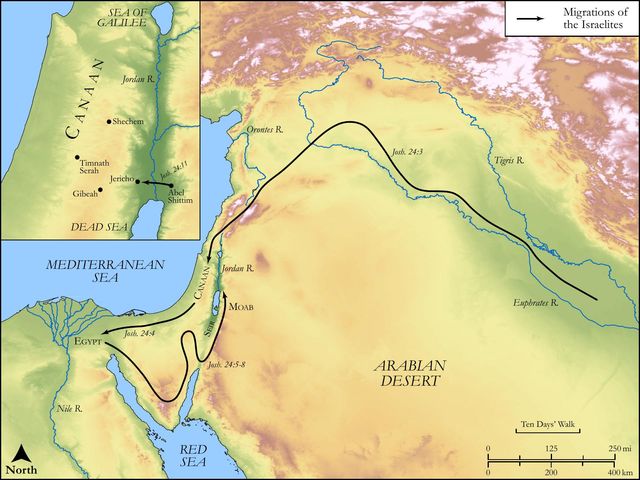
See on the biblical-era map
Study this verse
Public-domain commentary
Matthew Henry
From his Commentary on the Whole Bible. Henry comments on passages, not single verses — this entry covers Joshua 24:1–14. His three-level outline is real structure in the source text, so it is rendered as structure.
Joshua thought he had taken his last farewell of Israel in the solemn charge he gave them in the foregoing chapter, when he said, I go the way of all the earth; but God graciously continuing his life longer than expected, and renewing his strength, he was desirous to improve it for the good of Israel. He did not say, "I have taken my leave of them once, and let that serve;" but, having yet a longer space given him, he summons them together again, that he might try what more he could do to engage them for God. Note, We must never think our work for God done till our life is done; and, if he lengthen out our days beyond what we thought, we must conclude it is because he has some further service for us to do.
The assembly is the same with that in the foregoing chapter, the elders, heads, judges, and officers of Israel, Jos 24:1. But it is here made somewhat more solemn than it was there.
I.The place appointed for their meeting is Shechem, not only because that lay nearer to Joshua than Shiloh, and therefore more convenient now that he was infirm and unfit for travelling, but because it was the place where Abraham, the first trustee of God's covenant with this people, settled at his coming to Canaan, and where God appeared to him (Gen 12:6, Gen 12:7), and near which stood mounts Gerizim and Ebal, where the people had renewed their covenant with God at their first coming into Canaan, Jos 8:30. Of the promises God had made to their fathers, and of the promises they themselves had made to God, this place might serve to put them in mind.
II.They presented themselves not only before Joshua, but before God, in this assembly, that is, they came together in a solemn religious manner, as into the special presence of God, and with an eye to his speaking to them by Joshua; and it is probable the service began with prayer. It is the conjecture of interpreters that upon this great occasion Joshua ordered the ark of God to be brought by the priests to Shechem, which, they say, was about ten miles from Shiloh, and to be set down in the place of their meeting, which is therefore called (Jos 24:26) the sanctuary of the Lord, the presence of the ark making it so at that time; and this was done to grace the solemnity, and to strike an awe upon the people that attended. We have not now any such sensible tokens of the divine presence, but are to believe that where two or three are gathered together in Christ's name he is as really in the midst of them as God was where the ark was, and they are indeed presenting themselves before him.
III.Joshua spoke to them in God's name, and as from him, in the language of a prophet (Jos 24:2):
"Thus saith the Lord, Jehovah, the great God, and the God of Israel, your God in covenant, whom therefore you are bound to hear and give heed to." Note, The word of God is to be received by us as his, whoever is the messenger that brings it, whose greatness cannot add to it, nor his meanness diminish from it. His sermon consists of doctrine and application.
1.The doctrinal part is a history of the great things God had done for his people, and for their fathers before them. God by Joshua recounts the marvels of old: "I did so and so." They must know and consider, not only that such and such things were done, but that God did them. It is a series of wonders that is here recorded, and perhaps many more were mentioned by Joshua, which for brevity's sake are here omitted. See what God had wrought.
(1.)He brought Abraham out of Ur of the Chaldees, Jos 24:2, Jos 24:3. He and his ancestors had served other gods there, for it was the country in which, though celebrated for learning, idolatry, as some think, had its rise; there the world by wisdom knew not God. Abraham, who afterwards was the friend of God and the great favourite of heaven, was bred up in idolatry, and lived long in it, till God by his grace snatched him as a brand out of that burning. Let them remember that rock out of which they were hewn, and not relapse into that sin from which their fathers by a miracle of free grace were delivered. "I took him," says God, "else he had never come out of that sinful state." Hence Abraham's justification is made by the apostle an instance of God's justifying the ungodly, Rom 4:5.
(2.)He brought him to Canaan, and built up his family, led him through the land to Shechem, where they now were, multiplied his seed by Ishmael, who begat twelve princes, but at last gave him Isaac the promised son, and in him multiplied his seed. When Isaac had two sons, Jacob and Esau, God provided an inheritance for Esau elsewhere in Mount Seir, that the land of Canaan might be reserved entire for the seed of Jacob, and the posterity of Esau might not pretend to a share in it.
(3.)He delivered the seed of Jacob out of Egypt with a high hand (Jos 24:5, Jos 24:6), and rescued them out of the hands of Pharaoh and his host at the Red Sea, Jos 24:6, Jos 24:7. The same waters were the Israelites' guard and the Egyptians' grave, and this in answer to prayer; for, though we find in the story that they in that distress murmured against God (Exo 14:11, Exo 14:12), notice is here taken of their crying to God; he graciously accepted those that prayed to him, and overlooked the folly of those that quarrelled with him.
(4.)He protected them in the wilderness, where they are here said, not to wander, but to dwell for a long season, Jos 24:7. So wisely were all their motions directed, and so safely were they kept, that even there they had as certain a dwelling-place as if they had been in a walled city.
(5.)He gave them the land of the Amorites, on the other side Jordan (Jos 24:8), and there defeated the plot of Balak and Balaam against them, so that Balaam could not curse them as he desired, and therefore Balak durst not fight them as he designed, and as, because he designed it, he is here said to have done it. The turning of Balaam's tongue to bless Israel, when he intended to curse them, is often mentioned as an instance of the divine power put forth in Israel's favour as remarkable as any, because in it God proved (and does still, more than we are aware of) his dominion over the powers of darkness, and over the spirits of men.
(6.)He brought them safely and triumphantly into Canaan, delivered the Canaanites into their hand (Jos 24:11), sent hornets before them, when they were actually engaged in battle with the enemy, which with their stings tormented them and with their noise terrified them, so that they became a very easy prey to Israel. These dreadful swarms first appeared in their war with Sihon and Og, the two kings of the Amorites, and afterwards in their other battles, Jos 24:12. God had promised to do this for them, Exo 23:27, Exo 23:28. And here Joshua takes notice of the fulfilling of that promise. See Exo 23:27, Exo 23:28; Deu 7:20. These hornets, it should seem, annoyed the enemy more than the artillery of Israel, and therefore he adds, not with thy sword nor bow. It was purely the Lord's doing. Lastly, They were now in the peaceable possession of a good land, and lived comfortably upon the fruit of other people's labours, Jos 24:13.
2.The application of this history of God's mercies to them is by way of exhortation to fear and serve God, in gratitude for his favour, and that it might be continued to them, Jos 24:14. Now therefore, in consideration of all this, (1.) "Fear the Lord, the Lord and his goodness, Hos 3:5. Reverence a God of such infinite power, fear to offend him and to forfeit his goodness, keep up an awe of his majesty, a deference to his authority, a dread of his displeasure, and a continual regard to his all-seeing eye upon you." (2.) "Let your practice be consonant to this principle, and serve him both by the outward acts of religious worship and every instance of obedience in your whole conversation, and this in sincerity and truth, with a single eye and an upright heart, and inward impressions answerable to outward expressions." This is the truth in the inward part, which God requires, Psa 51:6. For what good will it do us to dissemble with a God that searches the heart? (3.) Put away the strange gods, both Chaldean and Egyptian idols, for those they were most in danger of revolting to. It should seem by this charge, which is repeated (Jos 24:23), that there were some among them that privately kept in their closets the images or pictures of these dunghill-deities, which came to their hands from their ancestors, as heir-looms of their families, though, it may be, they did not worship them; these Joshua earnestly urges them to throw away: "Deface them, destroy them, lest you be tempted to serve them." Jacob pressed his household to do this, and at this very place; for, when they gave him up the little images they had, he buried them under the oak which was by Shechem, Gen 35:2, Gen 35:4. Perhaps the oak mentioned here (Jos 24:26) was the same oak, or another in the same place, which might be well called the oak of reformation, as there were idolatrous oaks.
Continue studying Joshua 24:5 across the web’s major study libraries — every link below opens this exact verse, chapter, or book on the destination site.
Read & Compare
 BibleGatewayThis verse in more than 200 translations and 70 languages.
 Bible.comThe YouVersion reader — hundreds of translations, reading plans, and highlights.
 ESV.orgCrossway's official English Standard Version reader.
 NET BibleThe NET translation with 60,000+ translators' notes on every rendering decision.
 STEP BibleTyndale House's free study tool — original text, vocabulary, and scholarly resources.
 BibliaLogos Bible Software's free web reader.
 USCCBThe New American Bible (Revised Edition) with the U.S. bishops' study notes.
Commentaries
 BibleHub CommentariesDozens of classic commentaries on this verse, gathered on one page.
 StudyLightMore than 100 commentary sets — the largest collection on the web.
 BibleRefPlain-English commentary on what this verse means, verse by verse.
 Enduring WordDavid Guzik's free commentary on this chapter, widely used by Bible teachers.
 Bible Study ToolsVerse commentary alongside Greek and Hebrew study aids.
Original Language & Research
- BibleHub InterlinearThe verse word by word — original language, transliteration, and English.
- BibleHub LexiconEvery word's original-language definition and Strong's entry.
 Blue Letter BibleDeep-study tools — Strong's numbers, concordance, and word studies.
 SefariaThe Hebrew text with Rashi and centuries of Jewish commentary.
Sermons, Hymns & Audio


TrulyRandomVerse is not affiliated with these sites and doesn’t control their content. They’re linked because they’re genuinely useful.
Summary
Joshua 24:5 stands as a powerful declaration within Joshua's climactic farewell address at Shechem, serving as a foundational reminder of God's unwavering faithfulness to Israel. This verse encapsulates the Lord's direct, sovereign, and overwhelming intervention in delivering the Israelites from their brutal bondage in Egypt, an event that not only forged their national identity but also established the enduring truth of God's covenant loyalty and His unparalleled power to redeem His people.
Context
ShowHideLiterary Context
This verse is strategically positioned within Joshua's final, monumental address to the assembled tribes of Israel at Shechem, meticulously recorded in Joshua 24. The speech functions as a solemn covenant renewal ceremony, in the manner of the covenant made at Sinai. Joshua commences with an extensive review of the LORD's dealings with Israel, meticulously tracing God's redemptive acts from the divine call of Abraham in Ur of the Chaldeans, through the patriarchal period, the sojourn in Egypt, the miraculous Exodus, the challenging wilderness wanderings, and finally, the successful conquest of Canaan. Joshua 24:5 specifically hones in on the pivotal Exodus event, setting the theological and historical stage for Joshua's profound exhortation to "choose this day whom you will serve" found in Joshua 24:15. The overarching purpose of this detailed historical review is to impress upon the people the irrefutable evidence of God's unilateral faithfulness, immense power, and unceasing provision, thereby compelling them to respond with exclusive loyalty and unwavering obedience to Yahweh.
Historical & Cultural Context
The Exodus from Egypt, extensively chronicled in Exodus 1-15, represented the singular, most defining historical event for ancient Israel, marking their miraculous birth as a distinct nation under God's exclusive covenant. At this juncture, Egypt stood as a formidable world power, and the Israelites had endured centuries of brutal, dehumanizing slavery, as vividly described in Exodus 1:11-14. The ten plagues, detailed across Exodus 7-12, were far from mere natural phenomena; they were direct, targeted divine judgments against Pharaoh and the entire pantheon of Egyptian gods, unequivocally demonstrating Yahweh's absolute supremacy over all earthly and spiritual powers, as highlighted in Exodus 12:12. The subsequent miraculous deliverance through the Red Sea, recounted in Exodus 14, irrevocably established God as their ultimate Deliverer and King, forming the very bedrock of their national identity and their unique covenant relationship with Him at Mount Sinai. Joshua's recounting of this momentous event served to powerfully remind a new generation, now settled in the Promised Land, of the foundational act that brought them into existence and sustained their arduous journey.
Key Themes
ShowHideJoshua 24:5 masterfully encapsulates several core theological and narrative themes that permeate the entire book of Joshua and the broader Pentateuch. Firstly, it profoundly underscores Divine Initiative and Sovereignty, with the repeated first-person pronoun "I" (God speaking) emphatically asserting that Israel's deliverance was solely God's doing, entirely independent of human effort or merit. He unilaterally initiated the process, divinely chose and empowered the leaders (Moses and Aaron), and meticulously executed judgment. Secondly, the verse powerfully highlights God's Power Over Oppression and Idolatry, as the plagues systematically and decisively dismantled the political and religious power of Pharaoh and the false gods of Egypt, demonstrating Yahweh's unparalleled might and His absolute ability to overcome any opposition to fulfill His divine purposes, as seen in Exodus 12:12. Finally, it stands as an enduring testament to Covenant Faithfulness and Redemption, serving as a potent reminder to Israel that God faithfully fulfilled His ancient promise to Abraham (Genesis 15:13-14) to deliver his descendants from bondage and bring them into a land of their own, thereby establishing them as His specially chosen people.
Exposition and Analysis
ShowHideKey Word Analysis
ShowHideThis verb (H7971) signifies a purposeful dispatch or sending with inherent authority and commission. When God "sent" Moses and Aaron, it was not a mere suggestion but a direct, divine mandate, endowing them with the necessary authority and power to confront Pharaoh and lead the Israelite nation. This word highlights God's active involvement and initiation of the entire Exodus narrative, emphasizing His sovereign will as the driving force behind these momentous events.
This word (H5062) carries the potent sense of a forceful "strike," "smite," or "affliction," often resulting in destructive consequences. In the context of the Egyptian plagues, nâgaph denotes a direct, supernatural, and decisive blow from God upon Egypt, unequivocally demonstrating His righteous judgment and overwhelming power. It underscores the divine origin and the severe, targeted nature of the calamities that ultimately compelled Pharaoh to release Israel, affirming God's direct and intentional involvement in the suffering that led to Israel's liberation.
While the root yâtsâʼ (H3318) generally means "to go out," its use here in the Hiphil stem (הוֹצֵאתִי, hotseti) specifically means "to bring out" or "to cause to go out." This active causative form emphatically underscores God's agency in the deliverance. He did not merely permit Israel to leave; He actively, powerfully, and successfully extracted them from Egypt, overcoming all formidable obstacles and opposition. This highlights the redemptive, liberating, and sovereign nature of God's decisive action.
Verse Breakdown
ShowHide"I sent Moses also and Aaron"
This opening clause immediately establishes God as the primary actor and the divine initiator of the Exodus. The emphatic first-person pronoun "I" underscores His absolute divine sovereignty and direct, personal involvement. Moses and Aaron were not self-appointed leaders but divinely commissioned agents, chosen, empowered, and dispatched by God Himself to execute His will and confront the formidable might of Egypt. This highlights the divine origin of their authority and the sacred nature of their mission.
"and I plagued Egypt, according to that which I did among them"
This phrase directly attributes the ten devastating plagues to God's direct action. The repetition of "I" powerfully reinforces His singular agency and responsibility for these events. "According to that which I did among them" refers to the specific, targeted, and escalating series of judgments God unleashed upon Egypt, culminating in the climactic death of the firstborn. These plagues were not random occurrences but precise acts of divine judgment, meticulously designed to demonstrate Yahweh's absolute supremacy over Pharaoh and the entire pantheon of Egyptian deities, and to compel Pharaoh, through overwhelming force, to release His people.
"and afterward I brought you out"
This final clause articulates the ultimate, redemptive outcome of God's powerful intervention: the complete liberation of Israel from their oppressive bondage. The direct address "you" refers to the entire Israelite nation, underscoring the collective and comprehensive nature of this redemptive act. The phrase "brought you out" (the Hiphil of yâtsâʼ') powerfully emphasizes God's active, mighty, and successful extraction of His people from oppression, thereby fulfilling His ancient covenant promises and establishing them as a free, sovereign nation. This was the culmination of His miraculous and mighty acts in Egypt.
Literary Devices
ShowHideThe concise yet profound declaration in Joshua 24:5 masterfully employs several potent literary devices to convey its message. Anaphora, the deliberate repetition of "I" at the beginning of successive clauses ("I sent... I plagued... I brought you out"), serves to powerfully emphasize God's singular agency, initiative, and absolute sovereignty in the monumental Exodus event. This rhetorical device not only highlights His divine initiative but also profoundly reinforces the theological truth that Israel's deliverance was entirely His doing, not a result of human strength or merit. The verse also functions as a highly condensed Summary or Recapitulation of the entire Exodus narrative, distilling a complex and extended series of events into a few potent, memorable phrases. This conciseness serves to underscore the pivotal and foundational nature of the Exodus as the defining act of God's redemption for Israel. Furthermore, the verse utilizes Direct Address ("I brought you out"), making the historical account deeply personal and immediately relevant to the audience, inviting them to internalize God's past faithfulness as directly applicable to their present circumstances and future hope.
Theological and Thematic Connections
ShowHideJoshua 24:5 stands as a foundational theological statement, profoundly underscoring God's active, sovereign involvement in human history, His unwavering commitment to His covenant people, and His absolute supremacy over nations and their rulers. The Exodus, so succinctly summarized here, is the paradigmatic act of redemption in the Old Testament, establishing the enduring pattern for God's salvation throughout biblical history. It reveals a God who attentively hears the cries of His oppressed people, intervenes with powerful and righteous judgment against their oppressors, and faithfully delivers them into freedom. This historical act of liberation is not merely a past event but a perpetual, living reminder of God's multifaceted character as both a righteous judge and a merciful deliverer, forming the very bedrock of Israel's national identity and their sacred call to exclusive loyalty and worship of Yahweh.
Reflection and Application
ShowHideJoshua 24:5, though deeply rooted in ancient history, offers profound and enduring truths that resonate powerfully for contemporary believers. It serves as a potent call for us to actively remember and reflect upon the mighty acts of God—both in our personal lives and in the grand, unfolding sweep of redemptive history. Just as Israel was solemnly called to recall God's powerful and miraculous deliverance from Egyptian bondage, we too are encouraged to cultivate a consistent habit of remembering God's unwavering faithfulness in our past struggles, His abundant provision in times of desperate need, and His liberating power from various forms of spiritual, emotional, or physical bondage. This intentional act of remembrance fosters profound gratitude, strengthens our faith amidst uncertainty, and builds resilience for future challenges, powerfully reminding us that the God who delivered ancient Israel is the very same God who remains sovereign over our circumstances today. This understanding compels us to acknowledge that our salvation, our breakthroughs, and our very existence as God's redeemed people are not due to our own merit, strength, or wisdom, but solely to His gracious initiative and powerful intervention. Such a realization cultivates deep humility and profoundly deepens our reliance on His unfailing power, steadfast love, and boundless wisdom.
Questions for Reflection
ShowHideFAQ
ShowHideWhat is the significance of God saying "I" so many times in this verse?
ShowHideThe repeated use of the first-person pronoun "I" ("I sent... I plagued... I brought you out") is a crucial literary and theological device known as anaphora. Its profound significance lies in powerfully emphasizing God's absolute sovereignty and unilateral agency in the Exodus event. It unequivocally underscores that the deliverance of Israel from Egypt was not a result of human effort, military might, or favorable circumstances, but solely the direct, intentional, and powerful action of Yahweh. This reiteration serves to remove any doubt about who was ultimately responsible for Israel's liberation, thereby reinforcing the theological truth that God alone is the deliverer and, consequently, worthy of all praise, exclusive loyalty, and worship. It sets the crucial theological stage for Joshua's later, climactic challenge to "choose this day whom you will serve" (Joshua 24:15), as only the God who acted so decisively and powerfully is truly worthy of such unwavering commitment.
Why is the Exodus so frequently referenced throughout the Old Testament?
ShowHideThe Exodus from Egypt is the foundational redemptive event for ancient Israel, serving as the historical and theological bedrock upon which their identity as God's covenant people was built. It is referenced with remarkable frequency throughout the Old Testament because it encapsulates several core truths about God's character and His unique relationship with His people. It powerfully demonstrates His absolute power over oppression (Exodus 14:13-14), His unwavering faithfulness to His covenant promises (Genesis 15:13-14), His righteous justice against evil, and His boundless mercy in delivering His chosen people. It became the enduring paradigm for salvation, a constant and vivid reminder of what God had done and what He was eternally capable of doing. Moreover, the monumental giving of the Law at Mount Sinai immediately followed the Exodus, making the deliverance a prerequisite for the covenant relationship and the very basis for Israel's obedience (Exodus 20:2). Therefore, remembering the Exodus was a perpetual call to live in profound gratitude and unwavering covenant fidelity.
Christ-Centered Fulfillment
ShowHideJoshua 24:5, in its powerful and concise recounting of God's miraculous deliverance of Israel from the physical bondage of Egypt, serves as a profound Old Testament type and shadow, pointing inexorably to the ultimate, infinitely greater deliverance accomplished by Jesus Christ. The Exodus, with its profound emphasis on God's sovereign initiative, the divine sending of a chosen deliverer (Moses), the righteous judgment of oppressive powers (the plagues), and the glorious liberation of a people, powerfully prefigures the spiritual "Exodus" that Christ achieves for all humanity. Just as God "brought out" Israel from physical slavery, Jesus, the true Lamb of God who takes away the sin of the world, delivers us from the far more pervasive and deadly bondage of sin and spiritual death (Romans 6:23). His atoning sacrifice on the cross is the ultimate "plague" against the powers of darkness, having disarmed and triumphed over them (Colossians 2:15), and His glorious resurrection is the definitive "bringing out" into new life, freedom, and reconciliation with God (Ephesians 2:5-6). Through Christ, believers are not merely brought out of a physical land but are miraculously transferred from the dominion of darkness into the glorious kingdom of His beloved Son (Colossians 1:13), experiencing a spiritual exodus that completely fulfills and infinitely transcends the historical event recounted in Joshua 24:5.