


Joshua 24:11
- וַתַּעַבְרוּva·ta·'av·Ruand you passed overH5674Conj-w ¦ V-Qal-ConsecImperf-2mpVerb Qal Consecutive Imperfect 2nd Plural Masculineוַandתַּעַבְרוּyou passed over
- אֶת'et<obj.>H853DirObjMParticle Object Indicator
- הַיַּרְדֵּןhai·yar·Denthe JordanH3383Art ¦ N-properNoun Proper LocationהַtheיַּרְדֵּןJordan
- וַתָּבֹאוּva·ta·Vo·'uand you cameH935Conj-w ¦ V-Qal-ConsecImperf-2mpVerb Qal Consecutive Imperfect 2nd Plural Masculineוַandתָּבֹאוּyou came
- אֶל'eltoH413PrepPreposition
- יְרִיחוֹye·ri·ChoJerichoH3405N-properNoun Proper Location
- וַיִּלָּחֲמוּvai·yi·la·cha·Muand they foughtH3898Conj-w ¦ V-Niphal-ConsecImperf-3mpVerb Niphal Consecutive Imperfect 3rd Plural Masculineוַandיִּלָּחֲמוּthey fought
- בָכֶםva·Khemagainst <the> youPrep-b ¦ 2mpSuffix Personal 2nd Plural Masculineבָagainst <the>כֶםyou
- בַּעֲלֵיba·'a·lei[the] citizens ofH1167N-mpcNoun Plural Masculine Construct
- יְרִיחוֹye·ri·choJerichoH3405N-properNoun Proper Location
- הָאֱמֹרִיha·'e·mo·Rithe Amorite[s]H567Art ¦ N-msNoun Gentilic Singular Masculine AbsoluteהָtheאֱמֹרִיAmorite[s]
- וְהַפְּרִזִּיve·hap·pe·ri·Ziand the Perizzite[s]H6522Conj-w ¦ Art ¦ N-msNoun Gentilic Singular Masculine AbsoluteוְandהַtheפְּרִזִּיPerizzite[s]
- וְהַכְּנַעֲנִיve·ha·ke·na·'a·Niand the Canaanite[s]H3669Conj-w ¦ Art ¦ N-msNoun Gentilic Singular Masculine AbsoluteוְandהַtheכְּנַעֲנִיCanaanite[s]
- וְהַחִתִּיve·ha·chi·Tiand the Hittite[s]H2850Conj-w ¦ Art ¦ N-msNoun Gentilic Singular Masculine AbsoluteוְandהַtheחִתִּיHittite[s]
- וְהַגִּרְגָּשִׁיve·ha·gir·ga·Shiand the Girgashite[s]H1622Conj-w ¦ Art ¦ N-msNoun Gentilic Singular Masculine AbsoluteוְandהַtheגִּרְגָּשִׁיGirgashite[s]
- הַחִוִּיha·chi·Vithe Hivite[s]H2340Art ¦ N-msNoun Gentilic Singular Masculine AbsoluteהַtheחִוִּיHivite[s]
- וְהַיְבוּסִיve·hay·vu·Siand the Jebusite[s]H2983Conj-w ¦ Art ¦ N-msNoun Gentilic Singular Masculine AbsoluteוְandהַtheיְבוּסִיJebusite[s]
- וָאֶתֵּןva·'e·Tenand I gaveH5414Conj-w ¦ V-Qal-ConsecImperf-1csVerb Qal Consecutive Imperfect 1st Singular common genderוָandאֶתֵּןI gave
- אוֹתָם'o·Tam<obj.> themH853DirObjM ¦ 3mpParticle Object Indicatorאוֹתָ<obj.>םthem
- בְּיֶדְכֶםbe·yed·Khemin your handH3027Prep-b ¦ N-csc ¦ 2mpNoun Singular common gender Constructבְּinיֶדְhandכֶםyour
English is a literal word-by-word gloss of the Hebrew, not the KJV's wording. Why?
This is the original text the KJV's translators worked from — each Hebrew word with its own literal English meaning in this verse, prepared by scholars at Tyndale House, Cambridge. The KJV translates whole sentences, not word by word, so its wording differs: one Hebrew word can become several English words, and the KJV may choose “the LORD” where the gloss reads “Yahweh”. Both are faithful — they answer different questions. For the KJV's own rendering, switch to the KJV text.
Details
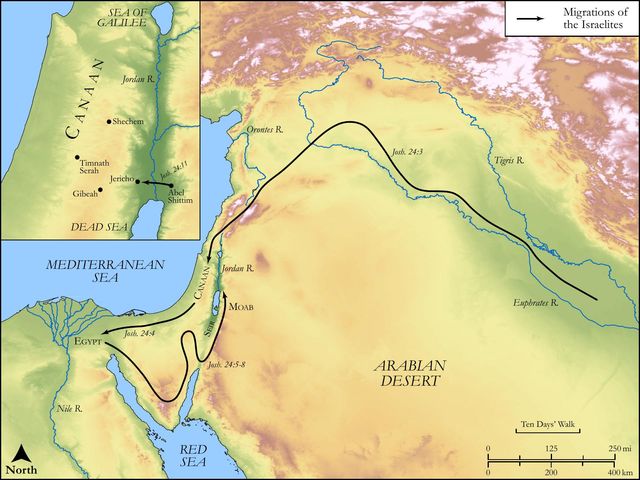
See on the biblical-era map
Study this verse
Public-domain commentary
Matthew Henry
From his Commentary on the Whole Bible. Henry comments on passages, not single verses — this entry covers Joshua 24:1–14. His three-level outline is real structure in the source text, so it is rendered as structure.
Joshua thought he had taken his last farewell of Israel in the solemn charge he gave them in the foregoing chapter, when he said, I go the way of all the earth; but God graciously continuing his life longer than expected, and renewing his strength, he was desirous to improve it for the good of Israel. He did not say, "I have taken my leave of them once, and let that serve;" but, having yet a longer space given him, he summons them together again, that he might try what more he could do to engage them for God. Note, We must never think our work for God done till our life is done; and, if he lengthen out our days beyond what we thought, we must conclude it is because he has some further service for us to do.
The assembly is the same with that in the foregoing chapter, the elders, heads, judges, and officers of Israel, Jos 24:1. But it is here made somewhat more solemn than it was there.
I.The place appointed for their meeting is Shechem, not only because that lay nearer to Joshua than Shiloh, and therefore more convenient now that he was infirm and unfit for travelling, but because it was the place where Abraham, the first trustee of God's covenant with this people, settled at his coming to Canaan, and where God appeared to him (Gen 12:6, Gen 12:7), and near which stood mounts Gerizim and Ebal, where the people had renewed their covenant with God at their first coming into Canaan, Jos 8:30. Of the promises God had made to their fathers, and of the promises they themselves had made to God, this place might serve to put them in mind.
II.They presented themselves not only before Joshua, but before God, in this assembly, that is, they came together in a solemn religious manner, as into the special presence of God, and with an eye to his speaking to them by Joshua; and it is probable the service began with prayer. It is the conjecture of interpreters that upon this great occasion Joshua ordered the ark of God to be brought by the priests to Shechem, which, they say, was about ten miles from Shiloh, and to be set down in the place of their meeting, which is therefore called (Jos 24:26) the sanctuary of the Lord, the presence of the ark making it so at that time; and this was done to grace the solemnity, and to strike an awe upon the people that attended. We have not now any such sensible tokens of the divine presence, but are to believe that where two or three are gathered together in Christ's name he is as really in the midst of them as God was where the ark was, and they are indeed presenting themselves before him.
III.Joshua spoke to them in God's name, and as from him, in the language of a prophet (Jos 24:2):
"Thus saith the Lord, Jehovah, the great God, and the God of Israel, your God in covenant, whom therefore you are bound to hear and give heed to." Note, The word of God is to be received by us as his, whoever is the messenger that brings it, whose greatness cannot add to it, nor his meanness diminish from it. His sermon consists of doctrine and application.
1.The doctrinal part is a history of the great things God had done for his people, and for their fathers before them. God by Joshua recounts the marvels of old: "I did so and so." They must know and consider, not only that such and such things were done, but that God did them. It is a series of wonders that is here recorded, and perhaps many more were mentioned by Joshua, which for brevity's sake are here omitted. See what God had wrought.
(1.)He brought Abraham out of Ur of the Chaldees, Jos 24:2, Jos 24:3. He and his ancestors had served other gods there, for it was the country in which, though celebrated for learning, idolatry, as some think, had its rise; there the world by wisdom knew not God. Abraham, who afterwards was the friend of God and the great favourite of heaven, was bred up in idolatry, and lived long in it, till God by his grace snatched him as a brand out of that burning. Let them remember that rock out of which they were hewn, and not relapse into that sin from which their fathers by a miracle of free grace were delivered. "I took him," says God, "else he had never come out of that sinful state." Hence Abraham's justification is made by the apostle an instance of God's justifying the ungodly, Rom 4:5.
(2.)He brought him to Canaan, and built up his family, led him through the land to Shechem, where they now were, multiplied his seed by Ishmael, who begat twelve princes, but at last gave him Isaac the promised son, and in him multiplied his seed. When Isaac had two sons, Jacob and Esau, God provided an inheritance for Esau elsewhere in Mount Seir, that the land of Canaan might be reserved entire for the seed of Jacob, and the posterity of Esau might not pretend to a share in it.
(3.)He delivered the seed of Jacob out of Egypt with a high hand (Jos 24:5, Jos 24:6), and rescued them out of the hands of Pharaoh and his host at the Red Sea, Jos 24:6, Jos 24:7. The same waters were the Israelites' guard and the Egyptians' grave, and this in answer to prayer; for, though we find in the story that they in that distress murmured against God (Exo 14:11, Exo 14:12), notice is here taken of their crying to God; he graciously accepted those that prayed to him, and overlooked the folly of those that quarrelled with him.
(4.)He protected them in the wilderness, where they are here said, not to wander, but to dwell for a long season, Jos 24:7. So wisely were all their motions directed, and so safely were they kept, that even there they had as certain a dwelling-place as if they had been in a walled city.
(5.)He gave them the land of the Amorites, on the other side Jordan (Jos 24:8), and there defeated the plot of Balak and Balaam against them, so that Balaam could not curse them as he desired, and therefore Balak durst not fight them as he designed, and as, because he designed it, he is here said to have done it. The turning of Balaam's tongue to bless Israel, when he intended to curse them, is often mentioned as an instance of the divine power put forth in Israel's favour as remarkable as any, because in it God proved (and does still, more than we are aware of) his dominion over the powers of darkness, and over the spirits of men.
(6.)He brought them safely and triumphantly into Canaan, delivered the Canaanites into their hand (Jos 24:11), sent hornets before them, when they were actually engaged in battle with the enemy, which with their stings tormented them and with their noise terrified them, so that they became a very easy prey to Israel. These dreadful swarms first appeared in their war with Sihon and Og, the two kings of the Amorites, and afterwards in their other battles, Jos 24:12. God had promised to do this for them, Exo 23:27, Exo 23:28. And here Joshua takes notice of the fulfilling of that promise. See Exo 23:27, Exo 23:28; Deu 7:20. These hornets, it should seem, annoyed the enemy more than the artillery of Israel, and therefore he adds, not with thy sword nor bow. It was purely the Lord's doing. Lastly, They were now in the peaceable possession of a good land, and lived comfortably upon the fruit of other people's labours, Jos 24:13.
2.The application of this history of God's mercies to them is by way of exhortation to fear and serve God, in gratitude for his favour, and that it might be continued to them, Jos 24:14. Now therefore, in consideration of all this, (1.) "Fear the Lord, the Lord and his goodness, Hos 3:5. Reverence a God of such infinite power, fear to offend him and to forfeit his goodness, keep up an awe of his majesty, a deference to his authority, a dread of his displeasure, and a continual regard to his all-seeing eye upon you." (2.) "Let your practice be consonant to this principle, and serve him both by the outward acts of religious worship and every instance of obedience in your whole conversation, and this in sincerity and truth, with a single eye and an upright heart, and inward impressions answerable to outward expressions." This is the truth in the inward part, which God requires, Psa 51:6. For what good will it do us to dissemble with a God that searches the heart? (3.) Put away the strange gods, both Chaldean and Egyptian idols, for those they were most in danger of revolting to. It should seem by this charge, which is repeated (Jos 24:23), that there were some among them that privately kept in their closets the images or pictures of these dunghill-deities, which came to their hands from their ancestors, as heir-looms of their families, though, it may be, they did not worship them; these Joshua earnestly urges them to throw away: "Deface them, destroy them, lest you be tempted to serve them." Jacob pressed his household to do this, and at this very place; for, when they gave him up the little images they had, he buried them under the oak which was by Shechem, Gen 35:2, Gen 35:4. Perhaps the oak mentioned here (Jos 24:26) was the same oak, or another in the same place, which might be well called the oak of reformation, as there were idolatrous oaks.
Historical interpretation
Historical reception
1 surviving comment on this verse from the historical church.
“And those who inhabited Jericho waged war against you.” One might well ask how this statement could be true, when they were merely protecting themselves by hiding behind the walls and closing the city gates. But this is spoken correctly, since the closing of gates to an enemy is a sign of warfare. For the inhabitants of Jericho did not send ambassadors to ask for terms of peace.… For a war does not always have one battle after another. Some wars have frequent battles, some a few, still others none. A war, however, is when there is a disagreement involving arms in some way.
Continue studying Joshua 24:11 across the web’s major study libraries — every link below opens this exact verse, chapter, or book on the destination site.
Read & Compare
 BibleGatewayThis verse in more than 200 translations and 70 languages.
 Bible.comThe YouVersion reader — hundreds of translations, reading plans, and highlights.
 ESV.orgCrossway's official English Standard Version reader.
 NET BibleThe NET translation with 60,000+ translators' notes on every rendering decision.
 STEP BibleTyndale House's free study tool — original text, vocabulary, and scholarly resources.
 BibliaLogos Bible Software's free web reader.
 USCCBThe New American Bible (Revised Edition) with the U.S. bishops' study notes.
Commentaries
 BibleHub CommentariesDozens of classic commentaries on this verse, gathered on one page.
 StudyLightMore than 100 commentary sets — the largest collection on the web.
 BibleRefPlain-English commentary on what this verse means, verse by verse.
 Enduring WordDavid Guzik's free commentary on this chapter, widely used by Bible teachers.
 Bible Study ToolsVerse commentary alongside Greek and Hebrew study aids.
Original Language & Research
- BibleHub InterlinearThe verse word by word — original language, transliteration, and English.
- BibleHub LexiconEvery word's original-language definition and Strong's entry.
 Blue Letter BibleDeep-study tools — Strong's numbers, concordance, and word studies.
 SefariaThe Hebrew text with Rashi and centuries of Jewish commentary.
Sermons, Hymns & Audio


TrulyRandomVerse is not affiliated with these sites and doesn’t control their content. They’re linked because they’re genuinely useful.
Summary
Joshua 24:11 is a powerful retrospective within Joshua's farewell address at Shechem, encapsulating the miraculous entry of Israel into the Promised Land and the formidable opposition they immediately faced. It vividly recounts the crossing of the Jordan River, the initial confrontation with Jericho, and then enumerates the seven major Canaanite nations who fiercely resisted Israel's advance. The verse culminates in a profound declaration of divine sovereignty, asserting that Israel's victories were not achieved by human might or strategy, but were solely the result of Yahweh's faithful and decisive intervention on behalf of His covenant people.
Context
ShowHideLiterary Context
Joshua 24:11 is strategically placed within Joshua's climactic farewell address and covenant renewal ceremony at Shechem, as detailed in Joshua 24. This chapter serves as the theological capstone of the book, echoing the ancient Near Eastern suzerainty treaty format. In this structure, the Great King (God) meticulously recounts His gracious acts of deliverance and provision toward His vassal (Israel), culminating in a solemn call for renewed loyalty and obedience. Joshua's speech systematically reviews God's unwavering faithfulness from the call of Abraham, through the Exodus, the wilderness wanderings, and the arduous conquest of Canaan. Verse 11 specifically highlights the critical juncture of Israel's entry into the land and their initial encounters with its entrenched inhabitants, emphasizing God's continuous, active presence and direct involvement in their battles. It sets the stage for Joshua's ultimate challenge: "choose this day whom you will serve."
Historical & Cultural Context
The events referenced in Joshua 24:11 are foundational to Israel's national identity. The miraculous crossing of the Jordan River, recounted in detail in Joshua 3-4, paralleled the Red Sea event and served as a powerful sign of God's continued covenant presence and power with His people as they stepped onto the soil of the Promised Land. Jericho, a heavily fortified city and the first major obstacle, represented the strategic gateway into Canaan, symbolizing the initial, formidable challenge to Israel's claim on the land. The subsequent enumeration of the seven nations—the Amorites, Perizzites, Canaanites, Hittites, Girgashites, Hivites, and Jebusites—was a common biblical convention (e.g., Deuteronomy 7:1) to denote the totality and formidable nature of the indigenous inhabitants of Canaan. These groups were known for their polytheistic idolatry, abhorrent practices, and often formidable military presence, rendering the Israelite conquest an impossible human endeavor and thus underscoring the miraculous nature of God's deliverance.
Key Themes
ShowHideThis verse powerfully reinforces several core theological themes woven throughout the book of Joshua and the broader Old Testament narrative. Foremost is Divine Faithfulness and Deliverance, with the emphatic declaration "I delivered them into your hand" unequivocally underscoring God as the primary agent and warrior for Israel. This highlights that the conquest was not a human military achievement but a divine act, fulfilling God's ancient covenant promises to Abraham regarding the land and his descendants (Genesis 12:7). Another crucial theme is The Conquest of Canaan, portrayed not merely as a territorial acquisition but as a divinely mandated judgment against the profound wickedness of the Canaanite nations and the establishment of God's holy people in His promised inheritance. Finally, the act of Remembering God's Works is paramount; Joshua's meticulous recounting serves as a vital historical and theological lesson for the new generation, ensuring they do not forget the miraculous ways God led their ancestors and thereby inspiring their continued allegiance and obedience to the God who fights for them (Joshua 1:5).
Exposition and Analysis
ShowHideKey Word Analysis
ShowHideMeaning "a descender." The river Jordan served as a significant geographical and symbolic boundary for Israel. Its miraculous crossing, where the waters "stood up in a heap" (Joshua 3:16), marked Israel's definitive entry into the Promised Land and powerfully reaffirmed God's covenant presence with them, just as He had been with Moses. This act not only established Joshua's leadership but also demonstrated God's sovereign power over creation.
A primitive root meaning "to feed on; figuratively, to consume; by implication, to battle (as destruction)." The use of this verb emphasizes that the Canaanite nations, including the men of Jericho, did not simply yield or flee but actively engaged in fierce battle against Israel. This highlights the formidable opposition Israel faced and underscores that their victories were not due to an absence of resistance but to God's superior power overcoming real, active, and destructive enemies.
A primitive root meaning "to give, used with greatest latitude of application (put, make, etc.)." In this context, particularly with the idiom "into your hand," it signifies a direct, sovereign, and decisive act of God. It is not that Israel merely won, but that God gave them the victory, effectively handing over the enemies to them. This choice of word emphatically attributes the success of the conquest solely to Yahweh's initiative and omnipotence, removing any ground for Israel to boast in their own strength or military prowess.
Verse Breakdown
ShowHide"And ye went over Jordan, and came unto Jericho:"
This initial clause succinctly recounts two pivotal events in the unfolding conquest narrative. The crossing of the Jordan River was a miraculous display of God's power, enabling the Israelites to enter the land dry-shod, thereby fulfilling His promise to bring them into their inheritance. Their subsequent arrival at Jericho signifies their immediate confrontation with the first major, heavily fortified city within Canaan, setting the stage for the initial and crucial phase of the conquest.
"and the men of Jericho fought against you, the Amorites, and the Perizzites, and the Canaanites, and the Hittites, and the Girgashites, the Hivites, and the Jebusites;"
This section details the formidable and diverse opposition Israel faced. The "men of Jericho" represent the initial, direct military challenge, a well-defended city that seemed impregnable. The subsequent listing of the seven Canaanite nations (a conventional, comprehensive enumeration) emphasizes the vast, entrenched, and diverse array of enemies, highlighting the overwhelming odds against Israel from a purely human perspective. This detailed enumeration serves to magnify God's subsequent deliverance by showing the sheer magnitude of the forces He miraculously overcame.
"and I delivered them into your hand."
This is the theological climax and interpretive key of the entire verse. The emphatic first-person pronoun "I" refers unequivocally to Yahweh, the God of Israel. The phrase "delivered them into your hand" is a common biblical idiom signifying that God granted complete victory, control, or possession over the enemies. It unequivocally asserts that the success of the conquest, despite the fierce resistance of numerous and powerful nations, was not due to Israel's military prowess, strategic genius, or numerical superiority, but was a direct, sovereign, and gracious act of God's power and faithfulness to His covenant promises.
Literary Devices
ShowHideJoshua 24:11 masterfully employs several literary devices to convey its profound theological message. Recapitulation is central, as Joshua is not merely recounting history but strategically reviewing specific, miraculous events within a broader historical and covenantal address, serving to remind the audience of God's past faithfulness and to elicit renewed commitment. The Enumeration of the seven Canaanite nations (Amorites, Perizzites, Canaanites, Hittites, Girgashites, Hivites, and Jebusites) is a key rhetorical feature, emphasizing the totality, diversity, and formidable nature of the opposition Israel faced, thereby magnifying the divine victory. The concluding phrase "I delivered them into your hand" utilizes a powerful Idiom common in Hebrew, which signifies granting decisive victory or complete control. This idiom, coupled with the explicit first-person pronoun "I" referring to God, underscores Divine Agency and Theological Emphasis, ensuring that the audience understands that the conquest was solely God's work, not Israel's human achievement. The verse also implicitly uses Contrast between the overwhelming human opposition and the singular, decisive, and all-powerful divine intervention.
Theological and Thematic Connections
ShowHideJoshua 24:11 stands as a profound theological statement on divine sovereignty, covenant faithfulness, and the very nature of God as a warrior who actively fights on behalf of His people. It utterly refutes any notion of Israelite self-sufficiency or human merit, unequivocally attributing their success in the conquest to Yahweh's direct, powerful, and gracious intervention. This foundational principle extends far beyond military victory, teaching that all true deliverance, blessing, and spiritual triumph flow exclusively from God's active hand. It serves as a timeless reminder to believers that even when facing seemingly insurmountable obstacles—whether spiritual strongholds, personal struggles, or societal pressures—our hope and strength are found not in our own capabilities or resources, but in the unwavering power and steadfast commitment of a faithful God who fights for us. This verse calls us to diligently remember God's past acts of deliverance, both in the grand narrative of biblical history and in our personal lives, as an unshakable foundation for trusting Him with present and future challenges.
Reflection and Application
ShowHideJoshua 24:11 offers timeless encouragement and a vital perspective for believers navigating the complexities and challenges of life. Just as God miraculously parted the Jordan and decisively delivered Israel from formidable enemies like the men of Jericho and the seven Canaanite nations, He continues to be our faithful deliverer in spiritual battles and life's daunting circumstances. This verse profoundly encourages us to look beyond the immediate strength or perceived invincibility of our adversaries—be they spiritual strongholds, deep-seated personal struggles, or overwhelming societal pressures—and to fix our gaze upon the sovereign, omnipotent hand of God. When we face our own "Jerichos," seemingly impenetrable obstacles that block our path, this passage serves as a powerful reminder that true and lasting victory is not achieved by our might, cleverness, or strategic prowess, but by God's power actively working on our behalf. It is a profound call to humble dependence, to diligently remember God's past faithfulness in our lives and in the grand narrative of salvation history, and to renew our unwavering commitment to the Lord, trusting that the same God who delivered Israel will also empower us to overcome, keeping His promises with unfailing love.
Questions for Reflection
ShowHideFAQ
ShowHideWhy does Joshua list so many nations, and are they all distinct?
ShowHideThe listing of the seven nations (Amorites, Perizzites, Canaanites, Hittites, Girgashites, Hivites, and Jebusites) is a conventional rhetorical device frequently employed in the Old Testament (see Genesis 15:18-21 and Deuteronomy 7:1) to represent the totality, diversity, and comprehensive nature of the indigenous inhabitants of Canaan. While these were indeed distinct ethnic and political groups with their own territories and characteristics, the comprehensive list serves to emphasize the overwhelming numerical and military superiority of the enemy forces Israel faced. This highlights that Israel's conquest was not a matter of human military might overcoming a few scattered or weak tribes, but a miraculous divine intervention against a vast, entrenched, and formidable opposition, thereby profoundly magnifying God's power and faithfulness in fulfilling His promises.
What is the significance of the phrase "I delivered them into your hand"?
ShowHideThis phrase is the theological linchpin of Joshua 24:11 and indeed, of the entire conquest narrative. The emphatic "I" refers unequivocally to Yahweh, the God of Israel, clearly establishing Him as the primary, decisive, and ultimate agent in the conquest. "Delivered them into your hand" is a common and powerful Hebrew idiom meaning to grant complete victory, control, or possession over enemies. It underscores divine initiative and absolute sovereignty, asserting that the success of the battles—from the fall of Jericho to the subjugation of the other nations—was not due to Israel's military prowess, strategic genius, or numerical superiority, but was a direct, sovereign, and gracious act of God. This concept is crucial throughout the book of Joshua and the Pentateuch, consistently reminding Israel that their inheritance and victories were a gracious gift from God, not something earned by their own righteousness or strength (e.g., Deuteronomy 9:4-5).
Christ-Centered Fulfillment
ShowHideJoshua 24:11, with its powerful declaration of God's decisive deliverance and His active role as warrior for His people, finds its ultimate and most profound fulfillment in Jesus Christ, the greater Joshua. Just as Joshua led Israel into a physical inheritance and victory over earthly enemies, Jesus leads His people, the church, into a spiritual inheritance and triumph over far more formidable foes: sin, death, and the powers of darkness. The physical battles fought by Israel in Canaan powerfully foreshadow the spiritual warfare that believers engage in, not against "flesh and blood, but against the rulers, against the authorities, against the cosmic powers over this present darkness, against the spiritual forces of evil in the heavenly places" (Ephesians 6:12). Christ's victory on the cross is the ultimate "delivery into your hand," where He "disarmed the rulers and authorities and put them to open shame, by triumphing over them in him" (Colossians 2:15). Through His sacrificial death and glorious resurrection, Jesus has definitively delivered us from the "dominion of darkness and transferred us to the kingdom of his beloved Son" (Colossians 1:13), granting us access to a spiritual inheritance that is imperishable, undefiled, and unfading, kept in heaven for us (1 Peter 1:4). The faithful God who delivered Israel at Jericho is the same God who, in Christ, promises never to leave us nor forsake us (Hebrews 13:5), empowering us to live in the victory He has already secured and to walk in the freedom He has purchased.