


Exodus 3:11
Bible text: King James Version (1769 Blayney text) · Public domain
Bible text: Berean Standard Bible · Public domain
Bible text: American Standard Version (1901) · Public domain
Bible text: World English Bible, Messianic edition · Public domain
Bible text: Geneva Bible (1599) · Public domain
Bible text: Young's Literal Translation · Public domain
- וַיֹּאמֶרvai·Yo·merand he saidH559Conj-w ¦ V-Qal-ConsecImperf-3msVerb Qal Consecutive Imperfect 3rd Singular Masculineוַandיֹּאמֶרhe said
- מֹשֶׁהmo·ShehMosesH4872N-proper-mNoun Proper Masculine
- אֶל'eltoH413PrepPreposition
- הָאֱלֹהִיםha·'E·lo·Him<the> GodH430Art ¦ N-mpNoun Plural Masculine Absoluteהָ<the>אֱלֹהִיםGod
- מִיmiwho?H4310InterrogPronoun Interrogative
- אָנֹכִי'a·No·khi[am] IH595Pro-1csPronoun Personal 1st Singular common gender
- כִּיkithatH3588PrtParticle Conditional
- אֵלֵךְ'e·LekhI will goH1980V-Qal-Imperf-1csVerb Qal Imperfect 1st Singular common gender
- אֶל'eltoH413PrepPreposition
- פַּרְעֹהpar·'OhPharaohH6547N-msNoun Title Singular Masculine Absolute
- וְכִיve·Khiand thatH3588Conj-w ¦ PrtParticle Conditionalוְandכִיthat
- אוֹצִיא'o·Tzi'I will bring outH3318V-Hiphil-Imperf-1csVerb Hiphil Imperfect 1st Singular common gender
- אֶת'et<obj.>H853DirObjMParticle Object Indicator
- בְּנֵיbe·Nei[the] people ofH1121N-mpcNoun Plural Masculine Construct
- יִשְׂרָאֵלYis·ra·'ElIsraelH3478N-properNoun Proper Location
- מִמִּצְרָיִםmi·mitz·Ra·yimfrom EgyptH4714Prep-m ¦ N-properNoun Proper LocationמִfromמִּצְרָיִםEgypt
English is a literal word-by-word gloss of the Hebrew, not the KJV's wording. Why?
This is the original text the KJV's translators worked from — each Hebrew word with its own literal English meaning in this verse, prepared by scholars at Tyndale House, Cambridge. The KJV translates whole sentences, not word by word, so its wording differs: one Hebrew word can become several English words, and the KJV may choose “the LORD” where the gloss reads “Yahweh”. Both are faithful — they answer different questions. For the KJV's own rendering, switch to the KJV text.
Details
See on the biblical-era maps

Study this verse
Public-domain commentary
Matthew Henry
From his Commentary on the Whole Bible. Henry comments on passages, not single verses — this entry covers Exodus 3:11–15. His three-level outline is real structure in the source text, so it is rendered as structure.
God, having spoken to Moses, allows him also a liberty of speech, which he here improves; and,
I.He objects his own insufficiency for the service he was called to (Exo 3:11):
Who am I? He thinks himself unworthy of the honour, and not par negotio - equal to the task. He thinks he wants courage, and therefore cannot go to Pharaoh, to make a demand which might cost the demandant his head: he thinks he wants skill, and therefore cannot bring forth the children of Israel out of Egypt; they are unarmed, undisciplined, quite dispirited, utterly unable to help themselves; it is morally impossible to bring them out.
1.Moses was incomparably the fittest of any man living for this work, eminent for learning, wisdom, experience, valour, faith, holiness; and yet he says, Who am I? Note, The more fit any person is for service commonly the less opinion he has of himself: see Jdg 9:8, etc.
2.The difficulties of the work were indeed very great, enough to startle the courage and stagger the faith of Moses himself. Note, Even wise and faithful instruments may be much discouraged at the difficulties that lie in the way of the church's salvation.
3.Moses had formerly been very courageous when he slew the Egyptian, but now his heart failed him; for good men are not always alike bold and zealous.
4.Yet Moses is the man that does it at last; for God gives grace to the lowly. Modest beginnings are very good presages.
II.God answers this objection, Exo 3:12.
1.He promises him his presence: Certainly I will be with thee, and that is enough. Note, Those that are weak in themselves may yet do wonders, being strong in the Lord and in the power of his might; and those that are most diffident of themselves may be most confident in God. God's presence puts an honour upon the worthless, wisdom and strength into the weak and foolish, makes the greatest difficulties dwindle to nothing, and is enough to answer all objections.
2.He assures him of success, and that the Israelites should serve God upon this mountain. Note,
(1.)Those deliverances are most valuable which open to us a door of liberty to serve God.
(2.)If God gives us opportunity and a heart to serve him, it is a happy and encouraging earnest of further favours designed us.
III.He begs instructions for the executing of his commission, and has them, thoroughly to furnish him.
He desires to know by what name God would at this time make himself known, Exo 3:13.
1.He supposes the children of Israel would ask him, What is his name? This they would ask either,
(1.)To perplex Moses: he foresaw difficulty, not only in dealing with Pharaoh, to make him willing to part with them, but in dealing with them, to make them willing to remove. They would be scrupulous and apt to cavil, would bid him produce his commission, and probably this would be the trial: "Does he know the name of God? Has he the watch-word?" Once he was asked, Who made thee a judge? Then he had not his answer ready, and he would not be nonplussed so again, but would be able to tell in whose name he came. Or,
(2.)For their own information. It is to be feared that they had grown very ignorant in Egypt, by reason of their hard bondage, want of teachers, and loss of the sabbath, so that they needed to be told the first principles of the oracles of God. Or this question, What is his name? amounted to an enquiry into the nature of the dispensation they were now to expect: "How will God in it be known to us, and what may we depend upon from him?"
2.He desires instructions what answer to give them: "What shall I say to them? What name shall I vouch to them for the proof of my authority? I must have something great and extraordinary to say to them; what must it be? If I must go, let me have full instructions, that I may not run in vain." Note,
(1.)It highly concerns those who speak to people in the name of God to be well prepared beforehand.
(2.)Those who would know what to say must go to God, to the word of his grace and to the throne of his grace, for instructions, Eze 2:7; Eze 3:4, Eze 3:10, Eze 3:17.
(3.)Whenever we have any thing to do with God, it is desirable to know, and our duty to consider, what is his name.
IV.God readily gives him full instructions in this matter. Two names God would now be known by: -
1.A name that denotes what he is in himself (Exo 3:14): I am that I am. This explains his name Jehovah, and signifies,
(1.)That he is self-existent; he has his being of himself, and has no dependence upon any other: the greatest and best man in the world must say, By the grace of God I am what I am; but God says absolutely - and it is more than any creature, man or angel, can say - I am that I am. Being self-existent, he cannot but be self-sufficient, and therefore all-sufficient, and the inexhaustible fountain of being and bliss.
(2.)That he is eternal and unchangeable, and always the same, yesterday, today, and for ever; he will be what he will be and what he is; see Rev 1:8.
(3.)That we cannot by searching find him out. This is such a name as checks all bold and curious enquiries concerning God, and in effect says, Ask not after my name, seeing it is secret, Jdg 13:18; Pro 30:4. Do we ask what is God? Let it suffice us to know that he is what he is, what he ever was, and ever will be. How little a portion is heard of him! Job 26:14.
(4.)That he is faithful and true to all his promises, unchangeable in his word as well as in his nature, and not a man that he should lie. Let Israel know this, I AM hath sent me unto you.
2.A name that denotes what he is to his people. Lest that name I AM should amuse and puzzle them, he is further directed to make use of another name of God more familiar and intelligible: The Lord God of your fathers hath sent me unto you (Exo 3:15): Thus God had made himself know to him (Exo 3:6), and thus he must make him known to them,
(1.)That he might revive among them the religion of their fathers, which, it is to be feared, was much decayed and almost lost. This was necessary to prepare them for deliverance, Psa 80:19.
(2.)That he might raise their expectations of the speedy performance of the promises made unto their fathers. Abraham, Isaac, and Jacob, are particularly named, because with Abraham the covenant was first made, and with Isaac and Jacob often expressly renewed; and these three were distinguished from their brethren, and chosen to be the trustees of the covenant, when their brethren were rejected. God will have this to be his name for ever, and it has been, is, and will be, his name, by which his worshippers know him, and distinguish him from all false gods; see Kg1 18:36. Note, God's covenant-relation to his people is what he will be ever mindful of, what he glories in, and what he will have us never forget, but give him the glory of: if he will have this to be his memorial unto all generations, we have all the reason in the world to make it so with us, for it is a precious memorial.
Historical interpretation
Historical reception
1 surviving comment on this verse from the historical church.
Moses said, “Who am I to go before Pharaoh?” Although I have a royal title, I will not be received by him. And now that I do the work of a simple shepherd, who will allow me to go before Pharaoh? And even if I were let in, what importance would he see in me to believe my words?
Continue studying Exodus 3:11 across the web’s major study libraries — every link below opens this exact verse, chapter, or book on the destination site.
Read & Compare
 BibleGatewayThis verse in more than 200 translations and 70 languages.
 Bible.comThe YouVersion reader — hundreds of translations, reading plans, and highlights.
 ESV.orgCrossway's official English Standard Version reader.
 NET BibleThe NET translation with 60,000+ translators' notes on every rendering decision.
 STEP BibleTyndale House's free study tool — original text, vocabulary, and scholarly resources.
 BibliaLogos Bible Software's free web reader.
 USCCBThe New American Bible (Revised Edition) with the U.S. bishops' study notes.
Commentaries
 BibleHub CommentariesDozens of classic commentaries on this verse, gathered on one page.
 StudyLightMore than 100 commentary sets — the largest collection on the web.
 BibleRefPlain-English commentary on what this verse means, verse by verse.
 Enduring WordDavid Guzik's free commentary on this chapter, widely used by Bible teachers.
 Bible Study ToolsVerse commentary alongside Greek and Hebrew study aids.
Original Language & Research
- BibleHub InterlinearThe verse word by word — original language, transliteration, and English.
- BibleHub LexiconEvery word's original-language definition and Strong's entry.
 Blue Letter BibleDeep-study tools — Strong's numbers, concordance, and word studies.
 SefariaThe Hebrew text with Rashi and centuries of Jewish commentary.
Sermons, Hymns & Audio


TrulyRandomVerse is not affiliated with these sites and doesn’t control their content. They’re linked because they’re genuinely useful.
Summary
Exodus 3:11 captures Moses' profound self-doubt and sense of inadequacy when confronted with God's monumental commission at the burning bush. After forty years as a shepherd in Midian, Moses, acutely aware of his past failures and the immense power of the Egyptian empire, questions his suitability for such a formidable divine task, expressing deep humility and perceived unworthiness.
Context
ShowHideLiterary Context
This pivotal verse immediately follows God's declaration that He has heard the cries of His people and is sending Moses to deliver them from Egyptian bondage. In the preceding verses, God reveals His identity as the God of Abraham, Isaac, and Jacob, and states His intention to bring Israel out of Egypt into a land flowing with milk and honey, specifically commissioning Moses for this task (see Exodus 3:7-10). Moses' question, "Who am I?", is the first of several objections he raises, highlighting his initial reluctance and the stark contrast between his humble shepherd life and the grand divine mandate. It sets the stage for God's patient reassurance and revelation of His power and presence.
Historical & Cultural Context
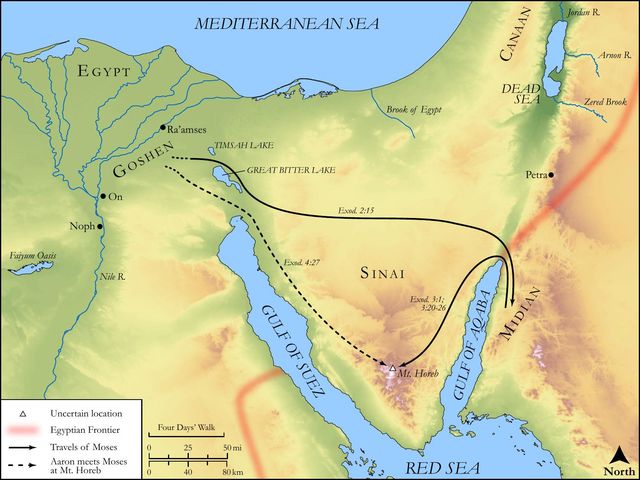
At this time, Israel had been enslaved in Egypt for centuries, enduring harsh labor and oppression under a powerful Pharaoh. Pharaoh was considered a divine king, an embodiment of the gods, wielding absolute authority. To confront such a ruler required immense courage and divine backing. Moses himself had a complex history: raised in Pharaoh's court, he later fled Egypt after killing an Egyptian taskmaster (see Exodus 2:11-15). Forty years in the wilderness as a shepherd had likely stripped him of any princely confidence, leaving him feeling insignificant and ill-equipped to face the very empire he had once fled. His question reflects a realistic appraisal of the political and military might of Egypt compared to his own perceived weakness.
Key Themes
ShowHideThis verse is central to several overarching themes in the book of Exodus and beyond. It introduces the theme of divine calling, where God initiates His redemptive plan by choosing an unlikely individual. It profoundly illustrates human inadequacy versus divine sufficiency, showing that God often chooses the weak and humble to accomplish His mighty purposes, thereby ensuring that the glory belongs to Him alone. Moses' reluctance also highlights the theme of God's patient reassurance and the importance of His promised presence (as seen in Exodus 3:12) as the ultimate qualification for service. Furthermore, it foreshadows the immense challenge of the deliverance of Israel and the subsequent establishment of God's covenant people.
Exposition and Analysis
ShowHideKey Word Analysis
ShowHideMeaning "drawing out (of the water), i.e. rescued." This name is profoundly significant, given Moses' own rescue from the Nile as an infant (see Exodus 2:10) and his future role in "drawing out" the children of Israel from Egypt. His question "Who am I?" stands in stark contrast to the divine purpose inherent in his very name, underscoring his perceived unworthiness despite his divinely appointed destiny as a rescuer.
Meaning "to walk (literally or figuratively); causatively, to carry." This word denotes a journey, a movement with purpose. Moses is being commanded not just to be someone, but to do something active and confrontational: to "go unto Pharaoh." His question reveals his apprehension about undertaking such a daunting and dangerous mission, implying a journey fraught with immense challenges and personal risk.
Meaning "to go (causatively, bring) out, in a great variety of applications, literally and figuratively, direct and proxim." This is the core action of the Exodus – the liberation of a nation. Moses is tasked not merely with confronting Pharaoh, but with the monumental responsibility of leading millions of people out of slavery. The sheer scale and complexity of this task, involving logistics, leadership, and divine intervention, contribute to Moses' overwhelming sense of inadequacy.
Verse Breakdown
ShowHide"And Moses said unto God"
This opening phrase immediately establishes the direct, personal nature of the divine encounter. Moses is not speaking to a prophet or an angel, but directly to the Almighty God who has just revealed Himself in the burning bush. His response is a direct, unfiltered reaction to the divine mandate.
"Who am I"
This is the heart of Moses' protest. It is a rhetorical question expressing profound humility, self-doubt, and a genuine sense of personal insignificance and inadequacy. After forty years in obscurity as a shepherd, Moses no longer sees himself as the powerful Egyptian prince he once was, but as an unworthy and incapable individual for such a colossal task.
"that I should go unto Pharaoh"
This clause highlights the immediate and terrifying aspect of the commission. Pharaoh was the most powerful ruler in the known world, considered a god by his people. To "go unto Pharaoh" meant confronting absolute power, risking immediate imprisonment or death, and challenging the very foundation of the Egyptian empire. Moses, having fled Egypt due to a past transgression, understood the immense danger involved.
"and that I should bring forth the children of Israel out of Egypt?"
This second part of the commission reveals its overwhelming scope. It's not just a personal confrontation, but the responsibility of leading an entire nation, numbering in the millions, out of centuries of bondage. This task would require not only diplomatic skill but also immense leadership, logistical prowess, and divine power, all of which Moses felt he lacked.
Literary Devices
ShowHideExodus 3:11 powerfully employs Rhetorical Question to convey Moses' deep internal struggle. His "Who am I?" is not a request for information but an emphatic expression of his perceived unworthiness and inadequacy for the monumental task God has laid before him. There is also a subtle Irony present: the one who was "drawn out" of the water (Moses' name) is now commissioned to "bring forth" a nation from the metaphorical waters of oppression. This highlights the divine hand in his life from birth. Furthermore, the verse serves as significant Foreshadowing, setting the stage for the recurring biblical theme of God choosing the weak and humble to accomplish His mighty purposes, a pattern seen throughout the Old and New Testaments.
Theological and Thematic Connections
ShowHideMoses' initial protest in Exodus 3:11 is a foundational moment illustrating the paradox of divine calling: God often chooses individuals who feel utterly inadequate for the immense tasks He sets before them. This highlights that God's plans are not contingent on human merit or perceived ability, but on His sovereign will and His power to equip those He calls. Moses' "Who am I?" is met not with a rebuke, but with God's profound assurance, shifting the focus from Moses' inadequacy to God's own sufficiency and unwavering presence. This establishes a crucial theological principle: true qualification for divine service comes not from human capability but from God's empowering presence and promise to be "with" His chosen instruments.
Reflection and Application
ShowHideMoses' profound question, "Who am I?", resonates deeply with anyone who has ever felt overwhelmed or unqualified by a significant calling, a challenging responsibility, or even a simple request to step out in faith. This verse serves as a powerful reminder that God's plans are not contingent on our perceived abilities, our past failures, or our self-assessment. Instead, it teaches us to shift our focus from our limitations to the limitless power and faithfulness of the God who calls us. When God extends a commission, He also provides the necessary equipping and promises His unfailing presence. Our reliance should be solely on His strength, knowing that He enables us to fulfill His purposes despite our perceived weaknesses, just as He empowered Moses to confront Pharaoh and lead a nation. This passage encourages us to embrace humility, not as an excuse for inaction, but as the posture through which God's strength is most clearly manifested.
Questions for Reflection
ShowHideFAQ
ShowHideWhy did Moses question God's call?
ShowHideMoses' question, "Who am I?", is generally understood as an expression of genuine humility and self-doubt, rather than an outright lack of faith. It reflects his realistic assessment of the immense task of confronting Pharaoh and leading millions of people out of slavery, especially given his past failures (fleeing Egypt after killing an Egyptian, as seen in Exodus 2:11-15) and forty years of obscurity as a shepherd. He perceived himself as insignificant and unqualified for such a monumental divine mandate. God does not rebuke him for this hesitation, but rather offers reassurance and promises His presence (as in Exodus 3:12), indicating it was a natural human response to an overwhelming divine call, one that God patiently addresses.
Christ-Centered Fulfillment
ShowHideMoses' experience of inadequacy in the face of a divine calling finds its ultimate fulfillment and reversal in Christ. While Moses, a servant and a type of deliverer, questioned his own sufficiency to bring Israel out of bondage, Jesus Christ, the Son of God, perfectly fulfilled His divine mission without question or hesitation, embodying complete obedience and inherent sufficiency. Christ is the ultimate deliverer, not through human strength or qualification, but through His divine nature and perfect, atoning sacrifice (as proclaimed in John 1:29). Furthermore, the New Covenant empowers believers, who are often weak and inadequate in themselves, to participate in God's redemptive work through the indwelling Holy Spirit. This echoes the principle that God works powerfully through humble vessels, but now with the assured presence of Christ Himself within them, making them "more than conquerors" through Him who loved them (see Romans 8:37). Our sufficiency is found not in ourselves, but "from God, who has made us competent to be ministers of a new covenant" (as described in 2 Corinthians 3:5-6).