


Exodus 4:11
Bible text: King James Version (1769 Blayney text) · Public domain
Bible text: Berean Standard Bible · Public domain
Bible text: American Standard Version (1901) · Public domain
Bible text: World English Bible, Messianic edition · Public domain
Bible text: Geneva Bible (1599) · Public domain
Bible text: Young's Literal Translation · Public domain
- וַיֹּאמֶרvai·Yo·merand he saidH559Conj-w ¦ V-Qal-ConsecImperf-3msVerb Qal Consecutive Imperfect 3rd Singular Masculineוַandיֹּאמֶרhe said
- יְהוָהYah·wehYahwehH3068N-properNoun Proper Title
- אֵלָיו'e·Lavto himH413Prep ¦ 3msPreposition Definiteאֵלָיtoוhim
- מִיmiwho?H4310InterrogPronoun Interrogative
- שָׂםsamdid he makeH7760V-Qal-Perf-3msVerb Qal Perfect 3rd Singular Masculine
- פֶּהpeha mouthH6310N-msNoun Singular Masculine Absolute
- לָאָדָםla·'a·Damof <the> personH120Prep-l ¦ N-msNoun Singular Masculine Absoluteלָof <the>אָדָםperson
- אוֹ'oorH176ConjConjunction
- מִיmiwho?H4310InterrogPronoun Interrogative
- יָשׂוּםya·Sumdoes he makeH7760V-Qal-Imperf-3msVerb Qal Imperfect 3rd Singular Masculine
- אִלֵּם'i·LemdumbH483Adj-msAdjective Singular Masculine Absolute
- אוֹ'oorH176ConjConjunction
- חֵרֵשׁche·ReshdeafH2795Adj-msAdjective Singular Masculine Absolute
- אוֹ'oorH176ConjConjunction
- פִקֵּחַfi·Ke·achseeingH6493Adj-msAdjective Singular Masculine Absolute
- אוֹ'oorH176ConjConjunction
- עִוֵּר'i·VerblindH5787Adj-msAdjective Singular Masculine Absolute
- הֲלֹאha·Lo'¿ notH3808Interrog ¦ NegParticle Negativeהֲ¿לֹאnot
- אָנֹכִי'a·no·Khi[do] IH595Pro-1csPronoun Personal 1st Singular common gender
- יְהוָהYah·wehYahwehH3068N-properNoun Proper Title
English is a literal word-by-word gloss of the Hebrew, not the KJV's wording. Why?
This is the original text the KJV's translators worked from — each Hebrew word with its own literal English meaning in this verse, prepared by scholars at Tyndale House, Cambridge. The KJV translates whole sentences, not word by word, so its wording differs: one Hebrew word can become several English words, and the KJV may choose “the LORD” where the gloss reads “Yahweh”. Both are faithful — they answer different questions. For the KJV's own rendering, switch to the KJV text.
Details
See on the biblical-era maps

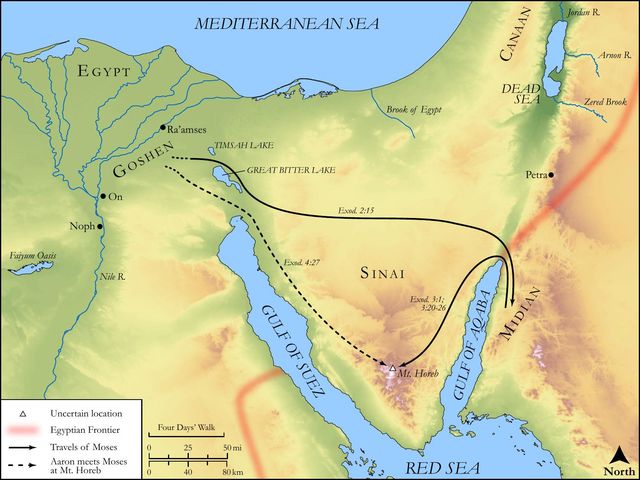
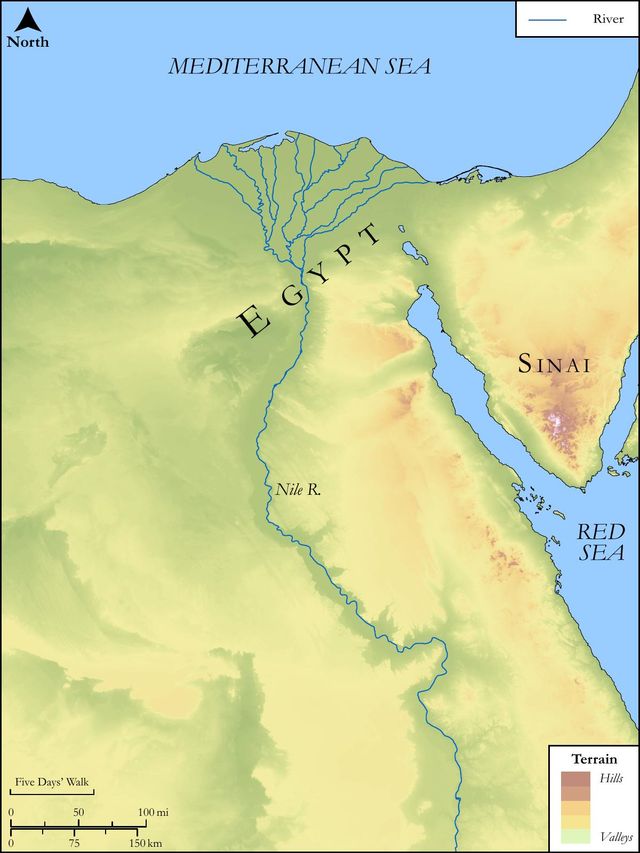
Study this verse
Public-domain commentary
Matthew Henry
From his Commentary on the Whole Bible. Henry comments on passages, not single verses — this entry covers Exodus 4:10–17. His four-level outline is real structure in the source text, so it is rendered as structure.
Moses still continues backward to the service for which God had designed him, even to a fault; for now we can no longer impute it to his humility and modesty, but must own that here was too much of cowardice, slothfulness, and unbelief in it. Observe here,
I.How Moses endeavours to excuse himself from the work.
1.He pleads that he was no good spokesman: O my Lord! I am not eloquent, Exo 4:10. He was a great philosopher, statesman, and divine, and yet no orator; a man of a clear head, great thought, and solid judgment, but had not a voluble tongue, or ready utterance, and therefore he thought himself unfit to speak before great men about great affairs, and in danger of being run down by the Egyptians. Observe,
(1.)We must not judge of men by the readiness and fluency of their discourse. Moses was mighty in word (Act 7:22), and yet not eloquent: what he said was strong and nervous, and to the purpose, and distilled as the dew (Deu 32:2), though he did not deliver himself with that readiness, ease, and elegance, that some do, who have not the tenth part of his sense. St. Paul's speech was contemptible, Co2 10:10. A great deal of wisdom and true worth is concealed by a slow tongue.
(2.)God is pleased sometimes to make choice of those as his messengers who have fewest of the advantages of art or nature, that his grace in them may appear the more glorious. Christ's disciples were no orators, till the Spirit made them such.
2.When this plea was overruled, and all his excuses were answered, he begged that God would send somebody else on this errand and leave him to keep sheep in Midian (Exo 4:13): "Send by any hand but mine; thou canst certainly find one much more fit." Note, An unwilling mind will take up with a sorry excuse rather than none, and is willing to devolve those services upon others that have any thing of difficulty or danger in them.
II.How God condescends to answer all his excuses.
Though the anger of the Lord was kindled against him (Exo 4:14), yet he continued to reason with him, till he had overcome him. Note, Even self-diffidence, when it grows into an extreme - when it either hinders us from duty or clogs us in duty, or when it discourages our dependence upon the grace of God - is very displeasing to him. God justly resents our backwardness to serve him, and has reason to take it ill; for he is such a benefactor as is before-hand with us, and such a rewarder as will not be behind-hand with us. Note further, God is justly displeased with those whom yet he does not reject: he vouchsafes to reason the case even with his froward children, and overcomes them, as he did Moses here, with grace and kindness.
1.To balance the weakness of Moses, he here reminds him of his own power, Exo 4:11.
(1.)His power in that concerning which Moses made the objection: Who has made man's mouth? Have not I the Lord? Moses knew that God made man, but he must be reminded now that God made man's mouth. An eye to God as Creator would help us over a great many of the difficulties which lie in the way of our duty, Psa 124:8. God, as the author of nature, has given us the power and faculty of speaking; and from him, as the fountain of gifts and graces, comes the faculty of speaking well, the mouth and wisdom (Luk 21:15), the tongue of the learned (Isa 50:4); he pours grace into the lips, Psa 45:2.
(2.)His power in general over the other faculties. Who but God makes the dumb and the deaf, the seeing and the blind?
[1.]The perfections of our faculties are his work, he makes the seeing; he formed the eye (Psa 94:9); he opens the understanding, the eye of the mind, Luk 24:45.
[2.]Their imperfections are from him too; he make the dumb, and deaf, and blind. Is there any evil of this kind, and the Lord has not done it? No doubt he has, and always in wisdom and righteousness, and for his own glory, Joh 9:3. Pharaoh and the Egyptians were made deaf and blind spiritually, as Isa 6:9, Isa 6:10. But God knew how to manage them, and get himself honour upon them.
2.To encourage him in this great undertaking, he repeats the promise of his presence, not only in general, I will be with thee (Isa 3:12), but in particular, "I will be with thy mouth, so that the imperfection in thy speech shall be no prejudice to thy message." It does not appear that God did immediately remove the infirmity, whatever it was; but he did that which was equivalent, he taught him what to say, and then let the matter recommend itself: if others spoke more gracefully, none spoke more powerfully. Note, Those whom God employs to speak for him ought to depend upon him for instructions, and it shall be given them what they shall speak, Mat 10:19.
3.He joins Aaron in commission with him. He promises that Aaron shall meet him opportunely, and that he will be glad to see him, they having not seen one another (it is likely) for many years, Exo 4:14. He directs him to make use of Aaron as his spokesman, Exo 4:16. God might have laid Moses wholly aside, for his backwardness to be employed; but he considered his frame, and ordered him an assistant. Observe,
(1.)Two are better than one, Ecc 4:9. God will have his two witnesses (Rev 11:3), that out of their mouths every word may be established.
(2.)Aaron was the brother of Moses, divine wisdom so ordering it, that their natural affection one to another might strengthen their union in the joint execution of their commission. Christ sent his disciples two and two, and some of the couples were brothers.
(3.)Aaron was the elder brother, and yet he was willing to be employed under Moses in this affair, because God would have it so.
(4.)Aaron could speak well, and yet was far inferior to Moses in wisdom. God dispenses his gifts variously to the children of men, that we may see our need one of another, and each may contribute something to the good of the body, Co1 12:21. The tongue of Aaron, with the head and heart of Moses, would make one completely fit for this embassy.
(5.)God promises, I will be with thy mouth, and with his mouth. Even Aaron, that could speak well, yet could not speak to purpose unless God was with his mouth; without the constant aids of divine grace the best gifts will fail.
4.He bids him take the rod with him in his hand (Exo 4:17), to intimate that he must bring about his undertaking rather by acting than by speaking; the signs he should work with this rod might abundantly supply the want of eloquence; one miracle would do him better service than all the rhetoric in the world. Take this rod, the rod he carried as a shepherd, that he might not be ashamed of that mean condition out of which God called him. This rod must be his staff of authority, and must be to him instead both of sword and sceptre.
Historical interpretation
Two Centuries of Reception
2 surviving comments on this verse. Each one is dated, so this reads as a timeline rather than a list.
Select a marker to jump to its quote. Markers stagger vertically where authors wrote within a few decades of each other.
Just as in Exodus God speaks to Moses, when he delays and fears to go to the people, saying, “Who gave a mouth to man and who made the dumb and the deaf, the seeing and the blind? Did not I the Lord God? Go now, and I shall open your mouth, and I will teach you what you shall speak.” It is not difficult for God to open the mouth of a man devoted to him and to inspire constancy and confidence in speaking in one who confesses him, who in the book of Numbers made even a female ass speak against Balaam the prophet. Therefore let no one consider in persecutions what danger the devil brings, but rather let him bear in mind what assistance God affords. Let not the disturbances of men weaken the mind, but let divine protection strengthen the faith, since each one according to the Lord’s promises and the merits of his faith receives so much of God’s help as he thinks he receives, and since there is nothing which the Almighty cannot grant, except if the frail faith of the recipient be deficient.
There are some who bring false charges against God, or rather against the Scriptures of the Old Testament, because God said that he himself makes a man blind or mute. So what do they say about Christ the Lord, who says openly in the Gospel, “I have come so that those who are blind may see and those who see might be made blind”? Who besides a fool would believe that something can happen to a man in regard to corporeal defects that God did not will? No one doubts that God wills all things justly.
Continue studying Exodus 4:11 across the web’s major study libraries — every link below opens this exact verse, chapter, or book on the destination site.
Read & Compare
 BibleGatewayThis verse in more than 200 translations and 70 languages.
 Bible.comThe YouVersion reader — hundreds of translations, reading plans, and highlights.
 ESV.orgCrossway's official English Standard Version reader.
 NET BibleThe NET translation with 60,000+ translators' notes on every rendering decision.
 STEP BibleTyndale House's free study tool — original text, vocabulary, and scholarly resources.
 BibliaLogos Bible Software's free web reader.
 USCCBThe New American Bible (Revised Edition) with the U.S. bishops' study notes.
Commentaries
 BibleHub CommentariesDozens of classic commentaries on this verse, gathered on one page.
 StudyLightMore than 100 commentary sets — the largest collection on the web.
 BibleRefPlain-English commentary on what this verse means, verse by verse.
 Enduring WordDavid Guzik's free commentary on this chapter, widely used by Bible teachers.
 Bible Study ToolsVerse commentary alongside Greek and Hebrew study aids.
Original Language & Research
- BibleHub InterlinearThe verse word by word — original language, transliteration, and English.
- BibleHub LexiconEvery word's original-language definition and Strong's entry.
 Blue Letter BibleDeep-study tools — Strong's numbers, concordance, and word studies.
 SefariaThe Hebrew text with Rashi and centuries of Jewish commentary.
Sermons, Hymns & Audio


TrulyRandomVerse is not affiliated with these sites and doesn’t control their content. They’re linked because they’re genuinely useful.
Summary
Exodus 4:11 presents God's direct and profound response to Moses' persistent self-doubt and perceived inadequacy, asserting His absolute sovereignty and creative power over all human faculties, including speech, hearing, and sight. This pivotal declaration serves to dismantle Moses' excuses, reaffirming that God, as the ultimate Creator and Sustainer, is fully capable of equipping and empowering those He calls for His divine purposes, regardless of their perceived human limitations.
Context
ShowHideLiterary Context
This verse is a direct and powerful divine rejoinder to Moses' fourth and most direct excuse in Exodus 4:10, where he protests, "O my Lord, I am not eloquent... but I am slow of speech, and of a slow tongue." Moses' reluctance stems from a deep-seated insecurity about his speaking ability, which he believes disqualifies him from being God's spokesperson to Pharaoh and the Israelites. God's rhetorical questions in Exodus 4:11 directly address this perceived inadequacy by redirecting Moses' focus from his own human limitations to the boundless power and authority of God as the Creator and Sustainer of all life. This exchange is part of a larger divine commissioning narrative (Exodus 3-4) where God patiently, yet firmly, overcomes Moses' objections, demonstrating His unwavering commitment to His chosen servant and His redemptive plan.
Historical & Cultural Context
Among the Egyptians and the Hebrews, oratorical skill was highly valued, especially for leaders and messengers. A "slow tongue" or lack of eloquence could be seen as a significant impediment to authority and persuasion. Furthermore, physical conditions like being "dumb," "deaf," or "blind" were often understood within a framework of divine action or judgment, though the Old Testament also presents a nuanced view. God's declaration here challenges the prevailing human-centric view of ability and authority, asserting a divine prerogative over all human conditions. It underscores that the God of Israel, Yahweh, is not merely a tribal deity but the sovereign Creator whose power transcends all human expectations and limitations, including those perceived as disabilities or disadvantages. This divine assertion would have been revolutionary, shifting the focus from human capability to divine enablement.
Key Themes
ShowHideExodus 4:11 centrally contributes to several profound themes woven throughout the book of Exodus and the broader biblical narrative. Foremost is the theme of Divine Sovereignty and Omnipotence, unequivocally declaring God's ultimate control over all creation, including the intricate design and function of human physical attributes. It powerfully illustrates God's Equipping Power, emphasizing that divine strength is made perfect in human weakness, and that God empowers those He calls, rather than calling the already equipped. This verse also highlights the theme of Challenging Human Excuses and Self-Doubt, serving as a divine rebuke to self-focused apprehension and a call to trust in God's ability to enable individuals for His purposes, regardless of their perceived inadequacies. Finally, the use of God's covenant name, "the LORD" (Yahweh), reinforces the theme of God's Covenant Faithfulness and Active Involvement in fulfilling His redemptive plan, assuring Moses that the One who calls him is fully capable of sustaining and empowering him.
Exposition and Analysis
ShowHideIn Exodus 4:11, the LORD confronts Moses' self-focused doubt with a series of rhetorical questions culminating in an emphatic divine assertion. The questions are designed to lead Moses to an inescapable conclusion about God's omnipotence and His exclusive claim as the ultimate source of all human faculties.
Key Word Analysis
ShowHideThis is the divine, covenantal name of God, often transliterated as Yahweh. From the root "to be," it signifies "the self-Existent or Eternal." In this context, the use of "the LORD" is profoundly significant, emphasizing God's personal, active presence, His faithfulness to His promises, and His unique, unchallengeable authority as the God who is, who acts, and who creates. It is the God of the covenant, who is now speaking to Moses and calling him to service, underscoring His unassailable power as the ultimate Maker and Sustainer, capable of empowering Moses beyond any personal deficiency.
Derived from a root meaning "ruddy," this term refers to a human being, encompassing both an individual and the species (mankind). In this verse, it highlights the created nature of humanity. By asking "Who hath made man's mouth?", God is reminding Moses that the very organ he perceives as deficient was fashioned by God Himself. This emphasizes that human existence and all its faculties are not self-derived but are entirely dependent on the divine Creator.
This word refers to the literal mouth, but also figuratively to speech itself, or as the means of blowing. Moses' specific complaint in Exodus 4:10 was about his "slow speech" and "slow tongue." God's direct reference to the "mouth" in His rhetorical question directly addresses Moses' perceived inadequacy, reminding him that the very instrument of speech was designed and created by God, and thus, God can certainly enable it to speak His words effectively.
Verse Breakdown
ShowHide"And the LORD said unto him,"
This opening phrase establishes the divine origin of the words that follow, highlighting God's direct and authoritative engagement with Moses. It underscores that this is not a human opinion or suggestion, but a definitive declaration from the sovereign God of Israel, Yahweh.
"Who hath made man's mouth?"
This is the first of a series of rhetorical questions, designed not to elicit information but to provoke a profound realization in Moses. It challenges Moses' focus on his own perceived deficiency by reminding him that the very organ of speech was fashioned by God. The implied answer—God alone—establishes Him as the ultimate Creator and Giver of all human faculties.
"or who maketh the dumb, or deaf, or the seeing, or the blind?"
This expands the scope of God's creative and sustaining power to encompass the full spectrum of human physical conditions, including those often perceived as disabilities. The question highlights God's sovereign control over all aspects of human existence and physical attributes. It is not necessarily an assertion that God causes these conditions in every instance, but rather that He is ultimately sovereign over all existence and can work through or despite any human limitation, demonstrating His comprehensive power.
"have not I the LORD?"
This concluding declaration is the emphatic answer to all preceding questions. The use of "the LORD" (Yahweh) is crucial, as it is God's personal, covenantal name, signifying His active presence, faithfulness, and unique authority. It is the God who is, who acts, and who creates—the same God who is now speaking to Moses and calling him to service. This underscores His unchallengeable authority as the ultimate Maker and Sustainer, capable of empowering Moses beyond any personal deficiency.
Literary Devices
ShowHideExodus 4:11 masterfully employs several literary devices to convey its powerful message. The most prominent is the use of Rhetorical Questions, where God asks questions not for information, but to prompt Moses (and the reader) to an undeniable conclusion about His omnipotence. The questions "Who hath made man's mouth?" and "or who maketh the dumb, or deaf, or the seeing, or the blind?" serve to dismantle Moses' self-focused doubt by forcing him to acknowledge God's ultimate creative and sustaining power over all human faculties. This is followed by a direct Assertion ("have not I the LORD?"), which acts as the definitive answer, leaving no room for further argument. The verse also utilizes Parallelism through the listing of contrasting pairs—"dumb" and "deaf" alongside "seeing" and "blind"—to emphasize the comprehensive nature of God's sovereignty over all human physical conditions, whether perceived as abilities or disabilities. This comprehensive scope underscores that nothing is outside of God's ultimate control and purpose.
Theological and Thematic Connections
ShowHideExodus 4:11 is a foundational declaration of divine sovereignty, asserting God's ultimate control over all aspects of creation, particularly human faculties. It challenges the human tendency to rely on perceived personal strengths or weaknesses, redirecting focus to God's limitless power to equip and enable. This verse underscores that God does not call the equipped but rather equips the called, demonstrating His power perfected in human weakness, and that His purposes will be accomplished through His divine enablement rather than human capability. It serves as a powerful reminder that our limitations are never a barrier to God's will, only an opportunity for His glory to be revealed.
Reflection and Application
ShowHideExodus 4:11 offers profound encouragement and a direct challenge to believers today. In a world that often values human ability, eloquence, and perceived competence, this verse powerfully reminds us that our effectiveness in God's service is not primarily dependent on our natural talents or lack thereof, but on His limitless power and purpose. When we feel inadequate, overwhelmed by a task, or prone to making excuses for not serving God, this passage calls us to shift our focus from our own perceived weaknesses to the boundless strength of the One who created all things and sustains them. Just as God equipped Moses despite his "slow tongue," He promises to empower us for our unique callings, reminding us that we can do all things through Christ who strengthens us and that God's strength is made perfect in weakness. Our perceived limitations become platforms for God's glory, demonstrating that His power is made manifest precisely when we acknowledge our dependence on Him.
Questions for Reflection
ShowHideFAQ
ShowHideDoes Exodus 4:11 imply God causes disabilities?
ShowHideThis verse asserts God's ultimate sovereignty over all human faculties, including their formation and function. It emphasizes His power to work through any condition, rather than explicitly stating He causes all disabilities in every instance. The primary focus is on God's ability to empower and use individuals regardless of perceived limitations, demonstrating His comprehensive control over all aspects of creation. The rhetorical questions are designed to highlight that nothing about human existence, including its variations, falls outside of God's ultimate knowledge and power.
How does this verse challenge our excuses for not serving God?
ShowHideExodus 4:11 directly confronts the human tendency to rely on personal abilities or perceived lack thereof as a basis for obedience. God's rhetorical questions dismantle Moses' self-focused doubts, reminding us that our effectiveness in service stems from God's power and equipping, not our inherent talents. It calls us to trust God's ability to enable us for His purposes, rather than making excuses based on our own perceived weaknesses. Just as God was able to use a "slow-tongued" Moses, He can use anyone He calls, for His power is perfected in human weakness, as seen throughout biblical history.
Christ-Centered Fulfillment
ShowHideExodus 4:11 finds its ultimate and most profound fulfillment in the person and work of Jesus Christ. Just as God empowered Moses for a seemingly impossible task, Christ embodies the divine power to overcome all human limitations and weaknesses. His earthly ministry consistently demonstrated God's sovereignty over physical conditions, as He healed the blind, deaf, and mute, restoring faculties and demonstrating the Kingdom's power in a way that surpassed any Old Testament prophet (e.g., Mark 7:32-37, John 9:1-7). Furthermore, the New Testament emphasizes that God's strength is made perfect in weakness (2 Corinthians 12:9), a principle perfectly exemplified by Christ's sacrificial life and the empowering of His disciples through the Holy Spirit to carry out His mission (Acts 1:8). Through Christ, believers are not only forgiven but also equipped and enabled to fulfill God's purposes, regardless of their human frailties, as He is the ultimate source of all ability and divine enablement, making the "impossible" possible for those who trust in Him (Philippians 4:13).